NCM 107-PEDIA SKILLSLAB
LEARNING OBJECTIVES:
• Demonstrate safe and evidence-based techniques in providing routine
newborn care—including bathing, cord care, diapering, dressing, and
swaddling—while maintaining infant thermoregulation, hygiene, and
comfort.
• Identify and respond appropriately to signs of abnormal findings such
as hypothermia, skin irritation, or cord stump infection during and after
the procedure, in accordance with clinical guidelines and institutional
policies.
• Educate student nurses confidently on proper newborn hygiene and
thermoregulation practices, emphasizing infection prevention, safe
Maintaining Infant Hygiene and Thermal Protection
3.
NCM 107-PEDIA SKILLSLAB
Why is it important?
• Proper infant hygiene and thermoregulation are essential
components of well baby care, minimizing infection risk,
maintaining skin integrity, and ensuring optimal
development.
• Routine care must follow an organized sequence: bathing,
cord stump care, diapering, dressing, and swaddling which
are all guided by physiologic and developmental principles.
Maintaining Infant Hygiene and Thermal Protection
4.
NCM 107-PEDIA SKILLSLAB
Physiologic Principles
1. Thermal Stability
Before any care begins, the infant must be thermally
and cardiorespiratory stable to tolerate handling
(Silbert Flagg,2023).
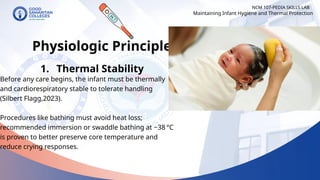
Procedures like bathing must avoid heat loss;
recommended immersion or swaddle bathing at ~38 °C
is proven to better preserve core temperature and
reduce crying responses.
Maintaining Infant Hygiene and Thermal Protection
5.
NCM 107-PEDIA SKILLSLAB
Physiologic Principles
1. Thermal Stability
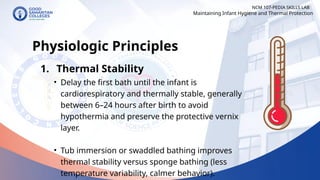
• Delay the first bath until the infant is
cardiorespiratory and thermally stable, generally
between 6–24 hours after birth to avoid
hypothermia and preserve the protective vernix
layer.
• Tub immersion or swaddled bathing improves
thermal stability versus sponge bathing (less
temperature variability, calmer behavior).
Maintaining Infant Hygiene and Thermal Protection
6.
NCM 107-PEDIA SKILLSLAB
Physiologic Principles
1. Thermal Stability
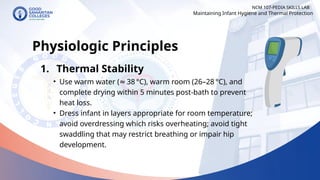
• Use warm water ( 38 °C), warm room (26–28 °C), and
≈
complete drying within 5 minutes post‐bath to prevent
heat loss.
• Dress infant in layers appropriate for room temperature;
avoid overdressing which risks overheating; avoid tight
swaddling that may restrict breathing or impair hip
development.
Maintaining Infant Hygiene and Thermal Protection
7.
NCM 107-PEDIA SKILLSLAB
Physiologic Principles
2. Stress Minimization
• Interventions should reduce physiological stress—
heart rate spikes, cortisol surges, disturbed breathing.
Swaddle bathing reduces these stress signals and
promotes organized behavior afterward .
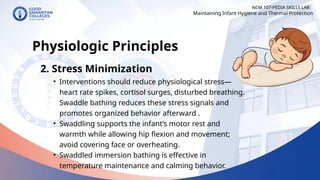
• Swaddling supports the infant’s motor rest and
warmth while allowing hip flexion and movement;
avoid covering face or overheating.
• Swaddled immersion bathing is effective in
temperature maintenance and calming behavior.
Maintaining Infant Hygiene and Thermal Protection
8.
NCM 107-PEDIA SKILLSLAB
Physiologic Principles
3. Skin Integrity and Barrier
Protection
• Bathing should help preserve the vernix and
stratum corneum, avoiding harsh soaps and over-
cleansing.
• Cord stump should be kept dry and exposed;
overuse of antiseptics or moisture increases
infection risk
• Dry cord care is recommended: keep stump clean,
dry, and exposed to air; diaper should be folded
Maintaining Infant Hygiene and Thermal Protection
9.
• Only cleanseif visibly soiled, using clean water;
avoid alcohol or unprescribed antiseptics unless
ordered (preserves skin barrier and reduces
irritation)
• Frequent diaper checks and changes prevent
diaper dermatitis. Use warm water or mild cloth
wipes; pat dry; apply barrier (zinc oxide/petrolatum)
if redness appears
NCM 107-PEDIA SKILLS LAB
Physiologic Principles
3. Skin Integrity and Barrier
Protection
Maintaining Infant Hygiene and Thermal Protection
10.
• Parental participationin routine care to enhance
bonding, confidence, and learning for home care
continuation.
NCM 107-PEDIA SKILLS LAB
Developmental Principles
1. Family Involvement
Maintaining Infant Hygiene and Thermal Protection
2. Support of Natural Behavior and
Comfort
• Swaddling after cleaning provides containment and promotes
rest—reducing startle reflexes and transitional stress.
• Maintaining the vernix supports innate antimicrobial
protection.
11.
• Performing carein a progressive sequence
(bathe cord diaper dress swaddle)
→ → → →
allows stability checks between steps and keeps
the infant calm and physically supported.
NCM 107-PEDIA SKILLS LAB
Developmental Principles
3. Sequential Flow of Care
Maintaining Infant Hygiene and Thermal Protection
12.
• Safety: Checkingstability after each step ensures the
infant’s physiologic status remains optimal.
• Skin Protection: Avoid repeated wet-dry cycles that
compromise skin.
• Optimal Parent Learning Opportunity: Family
participation during bathing carries into other steps,
reinforcing technique.
NCM 107-PEDIA SKILLS LAB
Why Follow the Sequence?
Maintaining Infant Hygiene and Thermal Protection
13.
• Safety: Checkingstability after each step ensures the
infant’s physiologic status remains optimal.
• Skin Protection: Avoid repeated wet-dry cycles that
compromise skin.
• Optimal Parent Learning Opportunity: Family
participation during bathing carries into other steps,
reinforcing technique.
NCM 107-PEDIA SKILLS LAB
Why Follow the Sequence?
Maintaining Infant Hygiene and Thermal Protection
14.
NCM 107-PEDIA SKILLSLAB
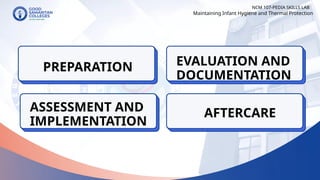
PREPARATION
Maintaining Infant Hygiene and Thermal Protection
ASSESSMENT AND
IMPLEMENTATION
EVALUATION AND
DOCUMENTATION
AFTERCARE
15.
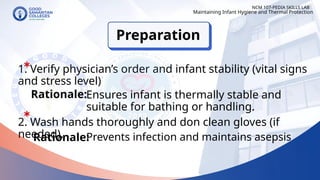
1. Verify physician’sorder and infant stability (vital signs
and stress level)
Preparation
NCM 107-PEDIA SKILLS LAB
Rationale:Ensures infant is thermally stable and
suitable for bathing or handling.
2. Wash hands thoroughly and don clean gloves (if
needed).
Rationale:
Maintaining Infant Hygiene and Thermal Protection
Prevents infection and maintains asepsis
16.
3. Gather andprepare all required materials:
PREPARATION
NCM 107-PEDIA SKILLS LAB
●warm water
○basin
○towels
●mild soap (baby bath soap/baby wash)
○diaper
○cotton balls
○baby clothes (layette/tie-side)
○swaddling blanket
○mittens,booties, and cap/bonnet
(optional)
Rationale:
Maintaining Infant Hygiene and Thermal Protection
Promotes
efficiency and
avoids leaving
infant
unattended
17.
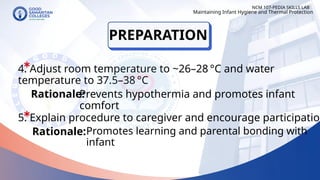
4. Adjust roomtemperature to ~26–28 °C and water
temperature to 37.5–38 °C
PREPARATION
NCM 107-PEDIA SKILLS LAB
Rationale:
Prevents hypothermia and promotes infant
comfort
5. Explain procedure to caregiver and encourage participation
Rationale:
Maintaining Infant Hygiene and Thermal Protection
Promotes learning and parental bonding with
infant
18.
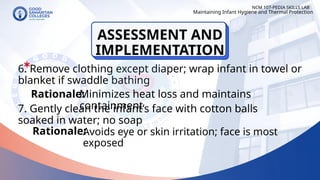
6. Remove clothingexcept diaper; wrap infant in towel or
blanket if swaddle bathing
7. Gently clean the infant’s face with cotton balls
soaked in water; no soap
NCM 107-PEDIA SKILLS LAB
Rationale:
Minimizes heat loss and maintains
containment
Rationale:
Maintaining Infant Hygiene and Thermal Protection
Avoids eye or skin irritation; face is most
exposed
ASSESSMENT AND
IMPLEMENTATION
19.
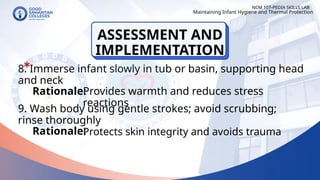
8. Immerse infantslowly in tub or basin, supporting head
and neck
9. Wash body using gentle strokes; avoid scrubbing;
rinse thoroughly
NCM 107-PEDIA SKILLS LAB
Rationale:
Provides warmth and reduces stress
reactions
Rationale:
Maintaining Infant Hygiene and Thermal Protection
Protects skin integrity and avoids trauma
ASSESSMENT AND
IMPLEMENTATION
20.
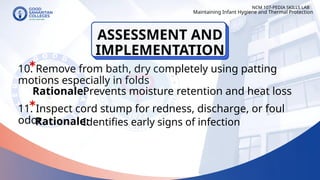
10. Remove frombath, dry completely using patting
motions especially in folds
11. Inspect cord stump for redness, discharge, or foul
odor
NCM 107-PEDIA SKILLS LAB
Rationale:
Prevents moisture retention and heat loss
Rationale:
Maintaining Infant Hygiene and Thermal Protection
Identifies early signs of infection
ASSESSMENT AND
IMPLEMENTATION
21.
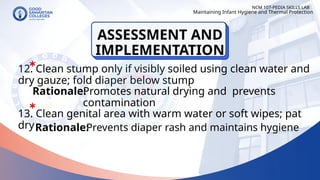
12. Clean stumponly if visibly soiled using clean water and
dry gauze; fold diaper below stump
13. Clean genital area with warm water or soft wipes; pat
dry
NCM 107-PEDIA SKILLS LAB
Rationale:
Promotes natural drying and prevents
contamination
Rationale:
Maintaining Infant Hygiene and Thermal Protection
Prevents diaper rash and maintains hygiene
ASSESSMENT AND
IMPLEMENTATION
22.
14. Apply barriercream if skin is red or irritated.
15. Choose cotton clothing appropriate to room
temperature
NCM 107-PEDIA SKILLS LAB
Rationale:
Protects against moisture and friction-
related injury
Rationale:
Maintaining Infant Hygiene and Thermal Protection
Prevents overheating or chilling
ASSESSMENT AND
IMPLEMENTATION
23.
16. Dress infantin layers; ensure clothes are comfortable
and non-restrictive
17. Place infant on flat surface and swaddle snugly, hips
loose, face uncovered. Do not wrap tightly around chest.
NCM 107-PEDIA SKILLS LAB
Rationale:
Supports free movement and comfort
Rationale:
Maintaining Infant Hygiene and Thermal Protection
Promotes warmth, security, and reduces
startle reflex
ASSESSMENT AND
IMPLEMENTATION
24.
18. Check temperaturepost-procedure (axillary)
19. Reassess cord area after drying for signs of bleeding or
discharge
NCM 107-PEDIA SKILLS LAB
Rationale:
Ensures normothermia and effective thermal
protection
Rationale:
Maintaining Infant Hygiene and Thermal Protection
Identifies complications needing referral
EVALUATION AND
DOCUMENTATION
25.
20. Check skinfor residual moisture or new irritation
21. Observe infant’s comfort level and breathing pattern
NCM 107-PEDIA SKILLS LAB
Rationale:
Detects early onset of dermatitis
Rationale:
Maintaining Infant Hygiene and Thermal Protection
Ensures airway is clear and infant is settled
EVALUATION AND
DOCUMENTATION
26.
22. Document time,methods used, and any abnormalities
observed
NCM 107-PEDIA SKILLS LAB
Rationale:
Ensures accurate records and continuity of
care
Maintaining Infant Hygiene and Thermal Protection
EVALUATION AND
DOCUMENTATION
27.
23. Return infantto bassinet or to the mother for skin-to-
skin holding or feeding
24. Discard used supplies properly; sanitize reusable items
NCM 107-PEDIA SKILLS LAB
Rationale:
Supports bonding, thermoregulation, and
glucose stability
Rationale:
Maintaining Infant Hygiene and Thermal Protection
Maintains a clean and safe environment
AFTERCARE
28.
25. Wash handsafter procedure
26. Provide health teaching to mother an/or guarduan
on cord care, diapering, and signs of concern (e.g., fever,
cord infection)
NCM 107-PEDIA SKILLS LAB
Rationale:Prevents cross-contamination
Rationale:
Maintaining Infant Hygiene and Thermal Protection
Empowers parents and promotes safe care
at home
AFTERCARE
29.
Short Quiz
NCM 107-PEDIASKILLS LAB
Physical Assessment and Anthropometric Measurements of a Newborn