WWhat Happens When Women’shat Happens When Women’s
Preventive Care Is Undervalued?Preventive Care Is Undervalued?
Lessons from RomaniaLessons from Romania
Adriana Baban, PhDAdriana Baban, PhD
Babes-Bolyai UniversityBabes-Bolyai University
Cluj-Napoca, ROMANIACluj-Napoca, ROMANIA
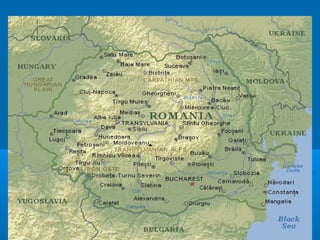
1990 the year of a new start1990 the year of a new start
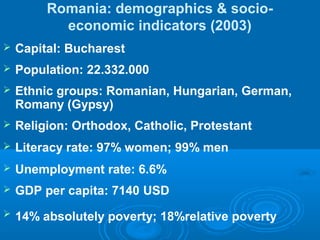
Romania: demographics & socio-
economic indicators (2003)
 Capital: Bucharest
 Population: 22.332.000
 Ethnic groups: Romanian, Hungarian, German,
Romany (Gypsy)
 Religion: Orthodox, Catholic, Protestant
 Literacy rate: 97% women; 99% men
 Unemployment rate: 6.6%
 GDP per capita: 7140 USD
 14% absolutely poverty; 18%relative poverty
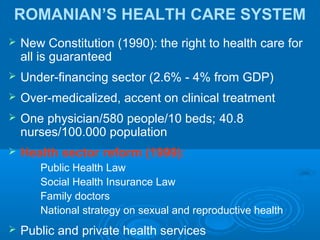
ROMANIAN’S HEALTH CARE SYSTEM
 New Constitution (1990): the right to health care for
all is guaranteed
 Under-financing sector (2.6% - 4% from GDP)
 Over-medicalized, accent on clinical treatment
 One physician/580 people/10 beds; 40.8
nurses/100.000 population
 Health sector reform (1999):
Public Health Law
Social Health Insurance Law
Family doctors
National strategy on sexual and reproductive health
 Public and private health services
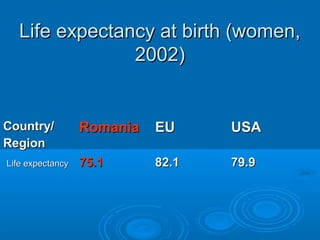
Life expectancy at birth (women,Life expectancy at birth (women,
2002)2002)
Country/Country/
RegionRegion
RomaniaRomania EUEU USAUSA
Life expectancyLife expectancy 75.175.1 82.182.1 79.979.9
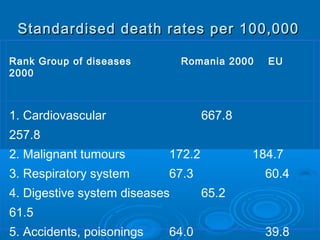
Standardised death rates per 100,000Standardised death rates per 100,000
Rank Group of diseases Romania 2000 EU
2000
1. Cardiovascular 667.8
257.8
2. Malignant tumours 172.2 184.7
3. Respiratory system 67.3 60.4
4. Digestive system diseases 65.2
61.5
5. Accidents, poisonings 64.0 39.8
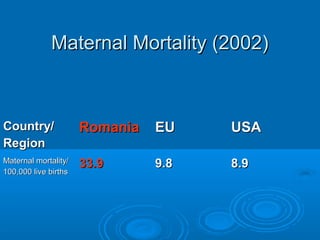
Maternal Mortality (2002)Maternal Mortality (2002)
Country/Country/
RegionRegion
RomaniaRomania EUEU USAUSA
Maternal mortality/Maternal mortality/
100,000 live births100,000 live births
33.933.9 9.89.8 8.98.9
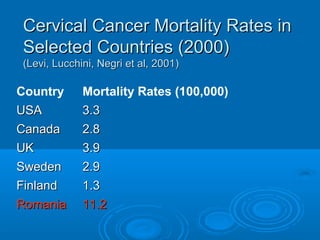
Cervical Cancer Mortality Rates inCervical Cancer Mortality Rates in
Selected Countries (2000)Selected Countries (2000)
((Levi, Lucchini, Negri et al, 2001Levi, Lucchini, Negri et al, 2001))
Country Mortality Rates (100,000)
USAUSA 3.33.3
CanadaCanada 2.82.8
UKUK 3.93.9
SwedenSweden 2.92.9
FinlandFinland 1.31.3
RomaniaRomania 11.211.2
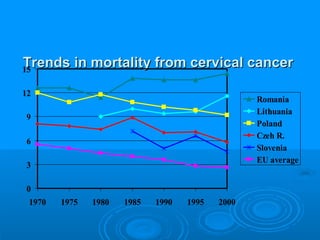
Trends in mortality from cervical cancerTrends in mortality from cervical cancer
0
3
6
9
12
15
1970 1975 1980 1985 1990 1995 2000
Romania
Lithuania
Poland
Czeh R.
Slovenia
EU average
Psychosocial and Health System
Dimensions of Cervical Cancer
Screening In Romania* (2004-2005)
 Babes-Bolyai University, Cluj-Napoca,
Romania
 Romanian Association of Health Psychology
 EngenderHealth, New York
*Project funded by Bill & Melinda Gates Foundation
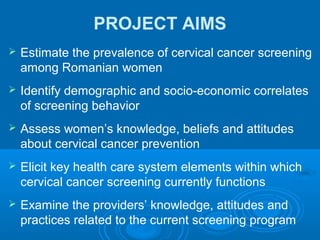
PROJECT AIMS
 Estimate the prevalence of cervical cancer screening
among Romanian women
 Identify demographic and socio-economic correlates
of screening behavior
 Assess women’s knowledge, beliefs and attitudes
about cervical cancer prevention
 Elicit key health care system elements within which
cervical cancer screening currently functions
 Examine the providers’ knowledge, attitudes and
practices related to the current screening program
Study Methods
KAP structured survey
Semi-structured interviews
In-depth interviews
Focus groups
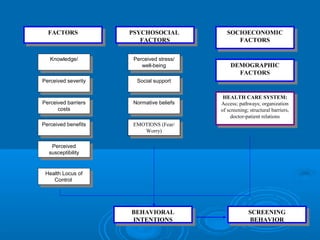
Perceived
susceptibility
Perceived
susceptibility
Perceived severity
Perceived severity
Perceived barriers
costs
Perceived barriers
costs
Perceived benefits
Perceived benefits
PSYCHOSOCIAL
FACTORS
PSYCHOSOCIAL
FACTORS
Social support
Social support
Perceived stress/
well-being
Perceived stress/
well-being
FACTORSFACTORS SOCIOECONOMIC
FACTORS
SOCIOECONOMIC
FACTORS
DEMOGRAPHIC
FACTORS
DEMOGRAPHIC
FACTORS
Health Locus of
Control
Health Locus of
Control
HEALTH CARE SYSTEM:
Access; pathways; organization
of screening; structural barriers,
doctor-patient relations
HEALTH CARE SYSTEM:
Access; pathways; organization
of screening; structural barriers,
doctor-patient relations
BEHAVIORAL
INTENTIONS
BEHAVIORAL
INTENTIONS
SCREENING
BEHAVIOR
SCREENING
BEHAVIOR
EMOTIONS (Fear/
Worry)
EMOTIONS (Fear/
Worry)
Knowledge/
Knowledge/
Normative beliefs
Normative beliefs
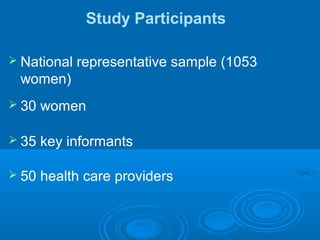
Study Participants
 National representative sample (1053
women)
 30 women
 35 key informants
 50 health care providers
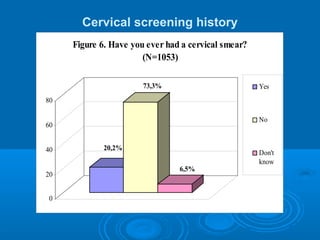
20,2%
73,3%
6,5%
0
20
40
60
80
Figure 6. Have you ever had a cervical smear?
(N=1053)
Yes
No
Don't
know
Cervical screening history
  
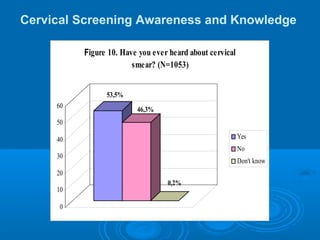
53,5%
46,3%
0,2%
0
10
20
30
40
50
60
Figure 10. Have you ever heard about cervical
smear? (N=1053)
Yes
No
Don't know
Cervical Screening Awareness and Knowledge
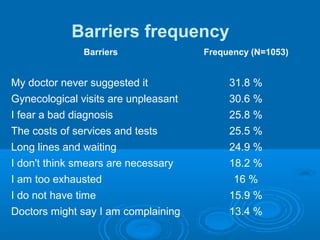
Barriers frequency
Barriers Frequency (N=1053)
My doctor never suggested it 31.8 %
Gynecological visits are unpleasant 30.6 %
I fear a bad diagnosis 25.8 %
The costs of services and tests 25.5 %
Long lines and waiting 24.9 %
I don't think smears are necessary 18.2 %
I am too exhausted 16 %
I do not have time 15.9 %
Doctors might say I am complaining 13.4 %
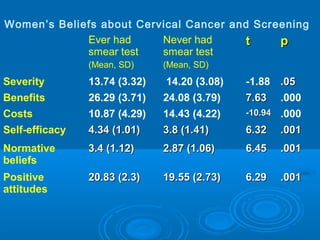
Women’s Beliefs about Cervical Cancer and Screening
Ever had
smear test
(Mean, SD)
Never had
smear test
(Mean, SD)
tt pp
Severity 13.74 (3.32) 14.20 (3.08) -1.88 .05.05
Benefits 26.29 (3.71) 24.08 (3.79) 7.637.63 .000
Costs 10.87 (4.29) 14.43 (4.22) -10.94-10.94 .000
Self-efficacy 4.34 (1.01)4.34 (1.01) 3.8 (1.41)3.8 (1.41) 6.326.32 .001.001
Normative
beliefs
3.4 (1.12)3.4 (1.12) 2.87 (1.06)2.87 (1.06) 6.456.45 .001.001
Positive
attitudes
20.83 (2.3)20.83 (2.3) 19.55 (2.73)19.55 (2.73) 6.296.29 .001.001
Predictors of Screening Behavior
Dimension Model 4
Residence*Residence* 1.90 [1.13-3.20]
KnowledgeKnowledge 1.58 [1.37-1.83]
Normative beliefsNormative beliefs 1.27 [1-1.61]
AgeAge 1.03 [1.00-1.05]
Perceived psychological costsPerceived psychological costs .88 [.83-.94]
Frequency of gynecologicalFrequency of gynecological
examsexams
.71 [.56-.90]
Marital status (married)Marital status (married) .35 [.14-.82]
Nagelkerke RNagelkerke R22
0.43
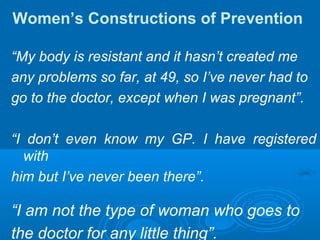
Women’s Constructions of Prevention
“My body is resistant and it hasn’t created me
any problems so far, at 49, so I’ve never had to
go to the doctor, except when I was pregnant”.
“I don’t even know my GP. I have registered
with
him but I’ve never been there”.
“I am not the type of woman who goes to
the doctor for any little thing”.
WWomen’s Constructions of Prevention
(cont)
“I did not go to ask for the Pap smear because I
can’t have cancer. I’m feeling okay. Cancer is
one of those diseases where you can’t feel
Healthy”.
“I feel that nothing is wrong with me, so why
should I have the test?”
Women’s Perceptions of Health Services
“As a young and healthy woman, I would feel
really bad to take up the time of a doctor for a
simple check-up, knowing that there are dozens
of sick and old people waiting in front of his door
in order to be seen and get treatment”.
Women’s Perceptions of Health Services
“When you go to doctors you get the impression
that you bother them, they give you an indifferent
and superficial look. They almost suggest that
unless you are dying why in God’s name you
bother them, that your problem is not something
they should be wasting their time with”.
Locating Responsibility for Cervical
Cancer Prevention
“The Pap test should only be performed by the
gynecologist; no way by the GP! The
gynecologist spends 5 years specializing in that
part of a woman’s body. This is why he’s called a
specialist, while the GP is a “generalist”, he
knows a little of everything.”
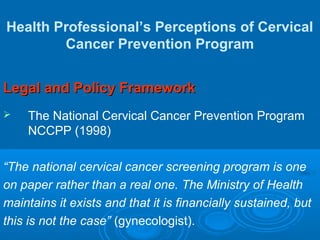
Health Professional’s Perceptions of Cervical
Cancer Prevention Program
Legal and Policy FrameworkLegal and Policy Framework
 The National Cervical Cancer Prevention Program
NCCPP (1998)
“The national cervical cancer screening program is one
on paper rather than a real one. The Ministry of Health
maintains it exists and that it is financially sustained, but
this is not the case” (gynecologist).
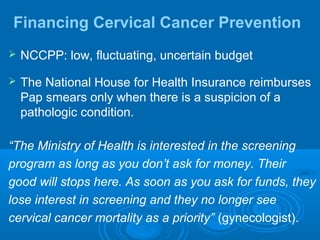
Financing Cervical Cancer Prevention
 NCCPP: low, fluctuating, uncertain budget
 The National House for Health Insurance reimburses
Pap smears only when there is a suspicion of a
pathologic condition.
“The Ministry of Health is interested in the screening
program as long as you don’t ask for money. Their
good will stops here. As soon as you ask for funds, they
lose interest in screening and they no longer see
cervical cancer mortality as a priority” (gynecologist).
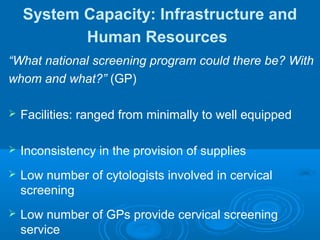
System Capacity: Infrastructure and
Human Resources
“What national screening program could there be? With
whom and what?” (GP)
 Facilities: ranged from minimally to well equipped
 Inconsistency in the provision of supplies
 Low number of cytologists involved in cervical
screening
 Low number of GPs provide cervical screening
service
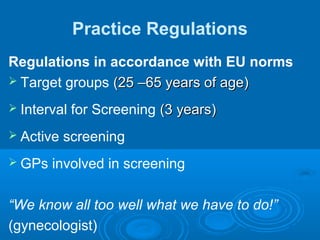
Practice Regulations
Regulations in accordance with EU norms
 Target groups (25 –65 years of age)(25 –65 years of age)
 Interval for Screening (3 years)(3 years)
 Active screening
 GPs involved in screening
“We know all too well what we have to do!”
(gynecologist)
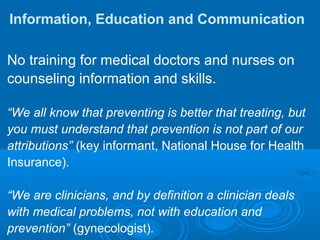
Information, Education and Communication
No training for medical doctors and nurses on
counseling information and skills.
“We all know that preventing is better that treating, but
you must understand that prevention is not part of our
attributions” (key informant, National House for Health
Insurance).
“We are clinicians, and by definition a clinician deals
with medical problems, not with education and
prevention” (gynecologist).
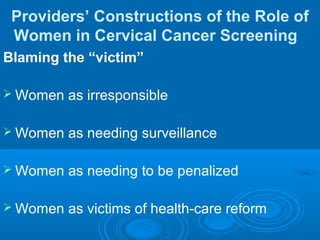
Providers’ Constructions of the Role of
Women in Cervical Cancer Screening
Blaming the “victim”
 Women as irresponsible
 Women as needing surveillance
 Women as needing to be penalized
 Women as victims of health-care reform
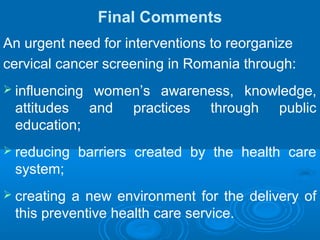
Final Comments
An urgent need for interventions to reorganize
cervical cancer screening in Romania through:
 influencing women’s awareness, knowledge,
attitudes and practices through public
education;
 reducing barriers created by the health care
system;
 creating a new environment for the delivery of
this preventive health care service.

What Happens When Women's Preventive Care is Undervalued? Lessons from Romania

  • 1.
    WWhat Happens WhenWomen’shat Happens When Women’s Preventive Care Is Undervalued?Preventive Care Is Undervalued? Lessons from RomaniaLessons from Romania Adriana Baban, PhDAdriana Baban, PhD Babes-Bolyai UniversityBabes-Bolyai University Cluj-Napoca, ROMANIACluj-Napoca, ROMANIA
  • 3.
    1990 the yearof a new start1990 the year of a new start
  • 4.
    Romania: demographics &socio- economic indicators (2003)  Capital: Bucharest  Population: 22.332.000  Ethnic groups: Romanian, Hungarian, German, Romany (Gypsy)  Religion: Orthodox, Catholic, Protestant  Literacy rate: 97% women; 99% men  Unemployment rate: 6.6%  GDP per capita: 7140 USD  14% absolutely poverty; 18%relative poverty
  • 5.
    ROMANIAN’S HEALTH CARESYSTEM  New Constitution (1990): the right to health care for all is guaranteed  Under-financing sector (2.6% - 4% from GDP)  Over-medicalized, accent on clinical treatment  One physician/580 people/10 beds; 40.8 nurses/100.000 population  Health sector reform (1999): Public Health Law Social Health Insurance Law Family doctors National strategy on sexual and reproductive health  Public and private health services
  • 6.
    Life expectancy atbirth (women,Life expectancy at birth (women, 2002)2002) Country/Country/ RegionRegion RomaniaRomania EUEU USAUSA Life expectancyLife expectancy 75.175.1 82.182.1 79.979.9
  • 7.
    Standardised death ratesper 100,000Standardised death rates per 100,000 Rank Group of diseases Romania 2000 EU 2000 1. Cardiovascular 667.8 257.8 2. Malignant tumours 172.2 184.7 3. Respiratory system 67.3 60.4 4. Digestive system diseases 65.2 61.5 5. Accidents, poisonings 64.0 39.8
  • 8.
    Maternal Mortality (2002)MaternalMortality (2002) Country/Country/ RegionRegion RomaniaRomania EUEU USAUSA Maternal mortality/Maternal mortality/ 100,000 live births100,000 live births 33.933.9 9.89.8 8.98.9
  • 9.
    Cervical Cancer MortalityRates inCervical Cancer Mortality Rates in Selected Countries (2000)Selected Countries (2000) ((Levi, Lucchini, Negri et al, 2001Levi, Lucchini, Negri et al, 2001)) Country Mortality Rates (100,000) USAUSA 3.33.3 CanadaCanada 2.82.8 UKUK 3.93.9 SwedenSweden 2.92.9 FinlandFinland 1.31.3 RomaniaRomania 11.211.2
  • 10.
    Trends in mortalityfrom cervical cancerTrends in mortality from cervical cancer 0 3 6 9 12 15 1970 1975 1980 1985 1990 1995 2000 Romania Lithuania Poland Czeh R. Slovenia EU average
  • 11.
    Psychosocial and HealthSystem Dimensions of Cervical Cancer Screening In Romania* (2004-2005)  Babes-Bolyai University, Cluj-Napoca, Romania  Romanian Association of Health Psychology  EngenderHealth, New York *Project funded by Bill & Melinda Gates Foundation
  • 12.
    PROJECT AIMS  Estimatethe prevalence of cervical cancer screening among Romanian women  Identify demographic and socio-economic correlates of screening behavior  Assess women’s knowledge, beliefs and attitudes about cervical cancer prevention  Elicit key health care system elements within which cervical cancer screening currently functions  Examine the providers’ knowledge, attitudes and practices related to the current screening program
  • 13.
    Study Methods KAP structuredsurvey Semi-structured interviews In-depth interviews Focus groups
  • 14.
    Perceived susceptibility Perceived susceptibility Perceived severity Perceived severity Perceivedbarriers costs Perceived barriers costs Perceived benefits Perceived benefits PSYCHOSOCIAL FACTORS PSYCHOSOCIAL FACTORS Social support Social support Perceived stress/ well-being Perceived stress/ well-being FACTORSFACTORS SOCIOECONOMIC FACTORS SOCIOECONOMIC FACTORS DEMOGRAPHIC FACTORS DEMOGRAPHIC FACTORS Health Locus of Control Health Locus of Control HEALTH CARE SYSTEM: Access; pathways; organization of screening; structural barriers, doctor-patient relations HEALTH CARE SYSTEM: Access; pathways; organization of screening; structural barriers, doctor-patient relations BEHAVIORAL INTENTIONS BEHAVIORAL INTENTIONS SCREENING BEHAVIOR SCREENING BEHAVIOR EMOTIONS (Fear/ Worry) EMOTIONS (Fear/ Worry) Knowledge/ Knowledge/ Normative beliefs Normative beliefs
  • 16.
    Study Participants  Nationalrepresentative sample (1053 women)  30 women  35 key informants  50 health care providers
  • 17.
    20,2% 73,3% 6,5% 0 20 40 60 80 Figure 6. Haveyou ever had a cervical smear? (N=1053) Yes No Don't know Cervical screening history
  • 18.
       53,5% 46,3% 0,2% 0 10 20 30 40 50 60 Figure 10. Haveyou ever heard about cervical smear? (N=1053) Yes No Don't know Cervical Screening Awareness and Knowledge
  • 19.
    Barriers frequency Barriers Frequency(N=1053) My doctor never suggested it 31.8 % Gynecological visits are unpleasant 30.6 % I fear a bad diagnosis 25.8 % The costs of services and tests 25.5 % Long lines and waiting 24.9 % I don't think smears are necessary 18.2 % I am too exhausted 16 % I do not have time 15.9 % Doctors might say I am complaining 13.4 %
  • 20.
    Women’s Beliefs aboutCervical Cancer and Screening Ever had smear test (Mean, SD) Never had smear test (Mean, SD) tt pp Severity 13.74 (3.32) 14.20 (3.08) -1.88 .05.05 Benefits 26.29 (3.71) 24.08 (3.79) 7.637.63 .000 Costs 10.87 (4.29) 14.43 (4.22) -10.94-10.94 .000 Self-efficacy 4.34 (1.01)4.34 (1.01) 3.8 (1.41)3.8 (1.41) 6.326.32 .001.001 Normative beliefs 3.4 (1.12)3.4 (1.12) 2.87 (1.06)2.87 (1.06) 6.456.45 .001.001 Positive attitudes 20.83 (2.3)20.83 (2.3) 19.55 (2.73)19.55 (2.73) 6.296.29 .001.001
  • 21.
    Predictors of ScreeningBehavior Dimension Model 4 Residence*Residence* 1.90 [1.13-3.20] KnowledgeKnowledge 1.58 [1.37-1.83] Normative beliefsNormative beliefs 1.27 [1-1.61] AgeAge 1.03 [1.00-1.05] Perceived psychological costsPerceived psychological costs .88 [.83-.94] Frequency of gynecologicalFrequency of gynecological examsexams .71 [.56-.90] Marital status (married)Marital status (married) .35 [.14-.82] Nagelkerke RNagelkerke R22 0.43
  • 22.
    Women’s Constructions ofPrevention “My body is resistant and it hasn’t created me any problems so far, at 49, so I’ve never had to go to the doctor, except when I was pregnant”. “I don’t even know my GP. I have registered with him but I’ve never been there”. “I am not the type of woman who goes to the doctor for any little thing”.
  • 23.
    WWomen’s Constructions ofPrevention (cont) “I did not go to ask for the Pap smear because I can’t have cancer. I’m feeling okay. Cancer is one of those diseases where you can’t feel Healthy”. “I feel that nothing is wrong with me, so why should I have the test?”
  • 24.
    Women’s Perceptions ofHealth Services “As a young and healthy woman, I would feel really bad to take up the time of a doctor for a simple check-up, knowing that there are dozens of sick and old people waiting in front of his door in order to be seen and get treatment”.
  • 25.
    Women’s Perceptions ofHealth Services “When you go to doctors you get the impression that you bother them, they give you an indifferent and superficial look. They almost suggest that unless you are dying why in God’s name you bother them, that your problem is not something they should be wasting their time with”.
  • 26.
    Locating Responsibility forCervical Cancer Prevention “The Pap test should only be performed by the gynecologist; no way by the GP! The gynecologist spends 5 years specializing in that part of a woman’s body. This is why he’s called a specialist, while the GP is a “generalist”, he knows a little of everything.”
  • 27.
    Health Professional’s Perceptionsof Cervical Cancer Prevention Program Legal and Policy FrameworkLegal and Policy Framework  The National Cervical Cancer Prevention Program NCCPP (1998) “The national cervical cancer screening program is one on paper rather than a real one. The Ministry of Health maintains it exists and that it is financially sustained, but this is not the case” (gynecologist).
  • 28.
    Financing Cervical CancerPrevention  NCCPP: low, fluctuating, uncertain budget  The National House for Health Insurance reimburses Pap smears only when there is a suspicion of a pathologic condition. “The Ministry of Health is interested in the screening program as long as you don’t ask for money. Their good will stops here. As soon as you ask for funds, they lose interest in screening and they no longer see cervical cancer mortality as a priority” (gynecologist).
  • 29.
    System Capacity: Infrastructureand Human Resources “What national screening program could there be? With whom and what?” (GP)  Facilities: ranged from minimally to well equipped  Inconsistency in the provision of supplies  Low number of cytologists involved in cervical screening  Low number of GPs provide cervical screening service
  • 30.
    Practice Regulations Regulations inaccordance with EU norms  Target groups (25 –65 years of age)(25 –65 years of age)  Interval for Screening (3 years)(3 years)  Active screening  GPs involved in screening “We know all too well what we have to do!” (gynecologist)
  • 31.
    Information, Education andCommunication No training for medical doctors and nurses on counseling information and skills. “We all know that preventing is better that treating, but you must understand that prevention is not part of our attributions” (key informant, National House for Health Insurance). “We are clinicians, and by definition a clinician deals with medical problems, not with education and prevention” (gynecologist).
  • 32.
    Providers’ Constructions ofthe Role of Women in Cervical Cancer Screening Blaming the “victim”  Women as irresponsible  Women as needing surveillance  Women as needing to be penalized  Women as victims of health-care reform
  • 33.
    Final Comments An urgentneed for interventions to reorganize cervical cancer screening in Romania through:  influencing women’s awareness, knowledge, attitudes and practices through public education;  reducing barriers created by the health care system;  creating a new environment for the delivery of this preventive health care service.