Deepak Kumar et al Int. Journal of Engineering Research and Applications www.ijera.com
ISSN : 2248-9622, Vol. 4, Issue 4( Version 9), April 2014, pp.05-12
www.ijera.com 5 | P a g e
Implementation of Lean in Continuous Industry: A Case Study
(Steel Industry)
Deepak Kumar1
, Sumit Kumar Singh1
, Khemchand Sharma2
1
Assistant Professor- Deptt. Of Mechanical Engineering, NGFCET, Palwal
2
Assistant Professor- Deptt. Of Mechanical Engineering, DITMR, Faridabad
Abstract
The goal of this research is to investigate how lean manufacturing tools can be adapted from the discrete to the
continuous manufacturing environment, and to evaluate their benefits on a specific application instance.
Although the process and discrete industry share several common characteristics, there are areas where they are
very different. This research attempts to identify commonalities between discrete and continuous manufacturing
where lean techniques from the discrete side are directly applicable.
Key words: Lean, lean tool, Discrete manufacturing, Competitiveness, Sources of Competitiveness.
I. Introduction
This research addresses the application of
lean manufacturing concepts to the continuous
production/ process sector with a focus on the steel
industry. Toyota Motor Company in Japan pioneered
the concept of the Toyota Production System, or what
is known today in the US as “Lean Manufacturing.”
The basic idea behind the system is eliminating waste.
Waste is defined as anything that does not add value
to the end product from the customer’s perspective. .
Lean is to manufacture only what is needed by the
customer, when it is needed and in the quantities
ordered. Tools including just in time, cellular
manufacturing, total productive maintenance, single-
minute exchange of dies, and production smoothing
have been widely used in discrete parts
manufacturing sectors such as automotive,
electronics and appliance manufacturing.
II. Problem Statement
Lean tools and techniques of lean
manufacturing have been widely used in the discrete
industry but applications of lean manufacturing to the
continuous process industry have been far fewer. this
is because such industries are inherently more
efficient and present relatively less need for such
improvement activities. Managers have also been
hesitant to adopt lean manufacturing tools and
techniques to the continuous process industry
because of reasons such as high volume and low
variety products, large inflexible machines, and the
long setup times that characterize the process
industry. As an example, it is difficult to use the
cellular manufacturing concept in a process facility
due to the fact that equipment is large and not easy to
move. While it seems that some lean manufacturing
tools are difficult to adapt in the process industry. For
example, Cook and Rogowski (1996) and Billesbach
(1994) used just-in-time concepts at a process
facility; nobody has systematically investigated how
to apply lean tools and techniques to a continuous
process facility due to the differences exhibited
between the two manufacturing environments.
III. Research Approach
The initial step in this research is to
systematically study and define the history of the lean
manufacturing concept and its different tools and
techniques. This will be followed by a literature
review of the process industry and a study of the
findings regarding applications of lean concepts to
continuous manufacturing, and the steel industry in
particular. . The next step is to develop taxonomy of
the continuous process industry with respect to its
product/process characteristics and the relative
balance of discrete and continuous operations. This
taxonomy is used to contrast the process industry and
to characterize the process industry into
distinguishable groups. Next, this taxonomy is used
to examine and identify specific lean manufacturing
tools and techniques that could be applicable. To
study the effect of lean tools in the process sector the
steel industry is used to illustrate the procedures of
implementing lean tools at a process facility. The
future state map is developed for a system with lean
tools applied to it.
Discrete vs. Continuous Manufacturing Systems
Manufacturing systems are classified into
two major classes; discrete manufacturing and
continuous manufacturing (also referred to as the
process industry). Discrete manufacturing refers to
making discrete products such as an engine, an
automobile, a drive shaft, a coffee maker, or a
RESEARCH ARTICLE OPEN ACCESS
Deepak Kumar et al Int. Journal of Engineering Research and Applications www.ijera.com
ISSN : 2248-9622, Vol. 4, Issue 4( Version 9), April 2014, pp.05-12
www.ijera.com 6 | P a g e
washing machine. On the other hand, continuous
manufacturing includes making products that are
measured or metered rather than being counted.
Examples include paint, steel, textile, flat glass, resin,
oil, and flour (Needy and Bidanda, 2001).
Case Study:
4.3.1 Study Area (X Steel Ltd.)
X Steel Ltd produces several products that are used
primarily in appliance manufacturing. The annealed
product type. X Steel Ltd produces three types of the
annealed product: open coil annealed, hydrogen batch
annealed and continuous annealed.
The objectives of the industry are:
1. To train technical and non-technical personnel.
2. To Reduces Production cycle time.
3. To reduces Product delivery lead-time.
4. To conduct research in the respective fields.
IV. Method of Data Collection
A total of 100 questionnaires each were
prepared and randomly administered among
management, employees and vendors.
One of the procedures used for data
collection in this research work was through the use
of questionnaires since it is an effective and
systematic way of asking questions under scientific
control. Interviews were conducted with both top
management staff to elicit information about the
efforts in achieving TQM through HRM. In other
words, almost all individual characteristics as well as
the respective subgroups were covered by the sample.
The interviews were performed to gain a deeper
knowledge of the results received by the
questionnaire respondents. The interviews were
structured in order to ensure the objectivity of the
research, and open-ended questions were used.
Quantitative and qualitative aspects may also be
combined in the same study.
Various Factors of Lean Manufacturing Which
Effect the Organization
Business Services: A service that is clearly
identifiable by business representatives and has a
clear line to the business value chain, interfacing
closely with explicit business processes. In this lean
manufacturing process used in X steel ltd. there are
three types of Business Service are explain one is
Professional service second is Research and
Development Service and third is Other Business
service. Business Service means Service related to all
area of the manufacturing known as Service
Incidental to Manufacturing, Technical testing and
analysis service, market research and public service
etc. In this questionnaire there are four sub parts of
the Professional Service as follows (1) Engineering
Service (2) Integrated Engineering Service (3)
Accounting and Auditing Service (4) Taxation
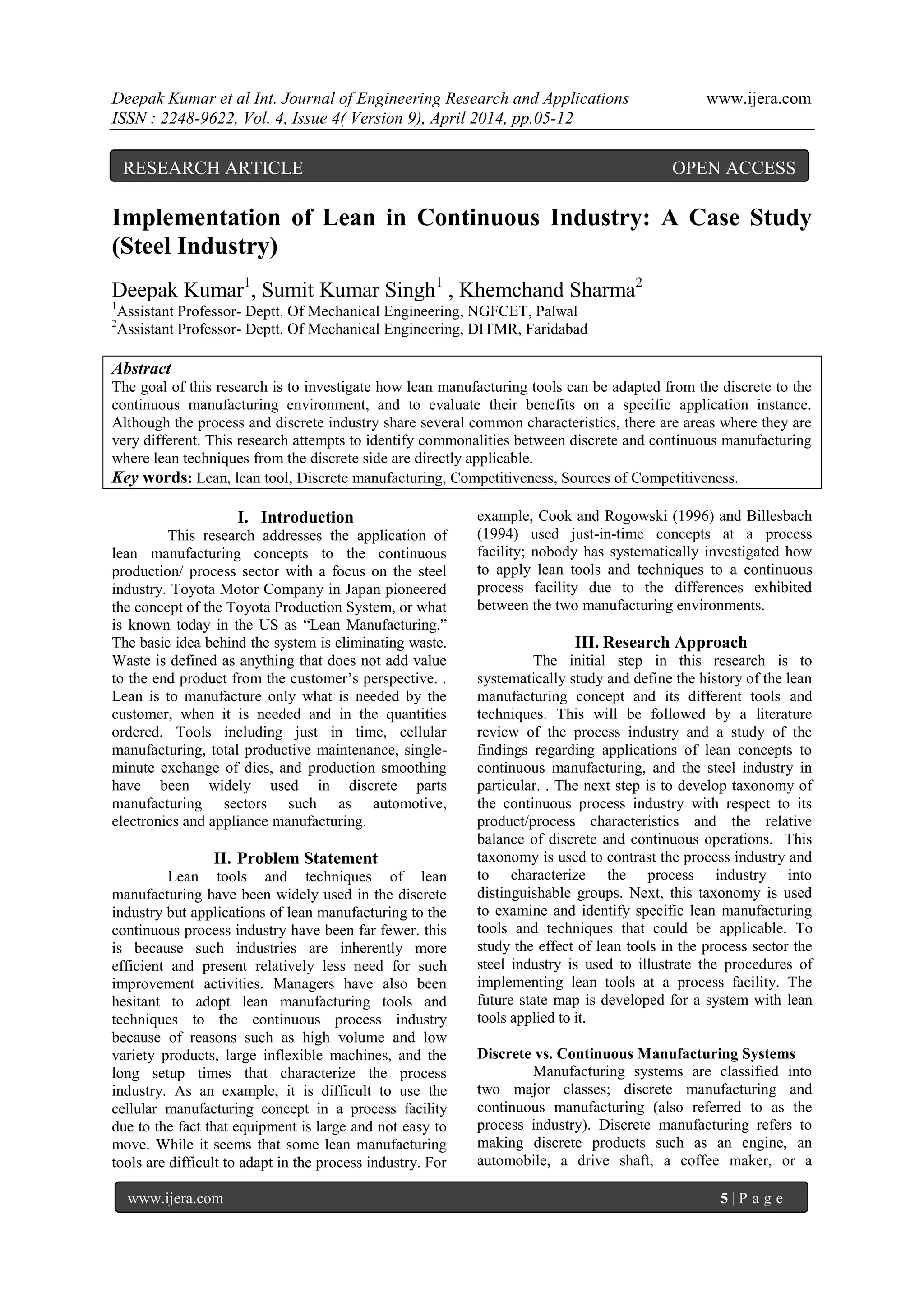
Service. See table 1
( TABLE 1 ) Business Services
Years 2006-07 2007-08 2008-09 2009-10 2010-11
1.1.Professional Services
1. I. Engineering Services 4 6 5 7 8
1. II. Integrated Engineering Services 7 9 9 8 9
1. III. Accounting & Auditing Services 6 8 5 9 9
1. IV. Taxation Services 8 8 7 8 8
Total 25 31 26 32 34
1.2. Research and Development Services
2. I. R & D Services 2 3 2 3 3
2. II. Interdisciplinary R&D Services 3 4 3 4 5
Total 5 7 5 7 8
1.3. Other Business Services
3. I. Service incidental to Manufacturing 6 7 5 8 9
3. II. Technical testing and analysis service 7 8 6 9 10
3. III. Market research and public opinion
polling Services
5 6 4 7 8
Deepak Kumar et al Int. Journal of Engineering Research and Applications www.ijera.com
ISSN : 2248-9622, Vol. 4, Issue 4( Version 9), April 2014, pp.05-12
www.ijera.com 7 | P a g e
3. IV. Advertising Services 2 3 2 3 3
3. V. Services related to Manufacturing
Consulting
4 6 3 5 7
3. VI. Management Consulting Services 3 4 3 6 8
3. VII. Building-Clearing Services 6 7 7 8 9
3. VIII. Maintenance and repair of equipment 3 5 4 6 8
3. IX. Supply Services of Personnel 4 5 4 6 7
3.X. Packaging Services 7 8 7 8 9
Total 47 58 45 66 78
Total 77 96 76 105 120
Communication Services: Management directly
and honestly communicates priorities, strategies and
status to all levels of the work force. . Cell design
puts material, tools, and equipment for the comfort
and ease of use by the cell’s operators. Each cell has
good physical facilities for communications, e.g.,
meeting areas and communications boards. in this
project we taken as a six sub group of
Telecommunication services name as Voice
Telephone service, Electronic Mail, Voice Mail, On-
line information and data base retrieval, Enhanced/
value- added facsimile services, incl. store and
forward. Store and receives. And on-line information/
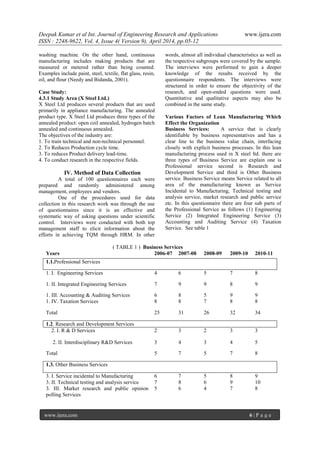
data processing. See table 2
(TABLE 2 ) Communication Services
Years 2006-07 2007-08 2008-09 2009-10 2010-11
2.1. Telecommunication Services
1.I. Voice Telephone Services 6 7 6 8 9
1. II. Electronic Mail 5 7 7 9 10
1. III. Voice Mail 0 0 0 0 0
1. IV. On-line information and data base
retrieval
7 8 6 8 9
1.V.enhanced/Value-added facsimile
services,incl.store and forward, store and
retrieve
4 5 4 6 7
1. VI. On-line information / Data
processing(incl.transaction processing)
5 4 4 5 6
Total 27 31 27 36 41
Distribution Services: Distribution service is defined as in terms of manufacturing company the supply of any
product is of consumer by help of these channels. These channels are known as Commission agent’s service,
Wholesale trade Service and Retailing service. See table 3
(TABLE3) Distribution Services
Years 2006-
07
2007-
08
2008-
09
2009-
10
2010-11
I. Commission agent’s Services 2 3 3 2 3
Deepak Kumar et al Int. Journal of Engineering Research and Applications www.ijera.com
ISSN : 2248-9622, Vol. 4, Issue 4( Version 9), April 2014, pp.05-12
www.ijera.com 8 | P a g e
II. Wholesale trade Services 1 1 1 3 4
III. Retailing Services 0 0 0 0 0
Total 3 4 4 5 7
Educational Services:
In this lean manufacturing system the education is play a very important role. In this education article
the three types of schooling is very important name as (1) primary Education Service (2) Secondary Education
Service and (3) Higher Education Service. In primary education service the first step of schooling system. In
this service the education nursery to fifth class. In Secondary Education Service is the second step of the
education system in this type of system the education must be 6th class to 10th class. And last step is Higher
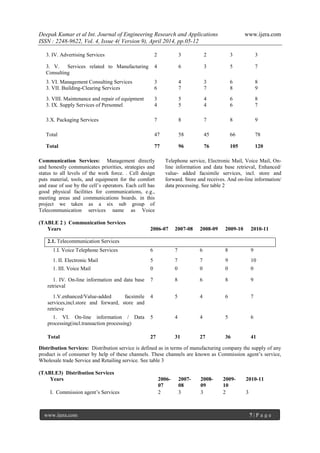
education service in this type of system above of 10th class education system. See table 4
(TABLE 4) Educational Services
Years 2006-07 2007-08 2008-09 2009-10 2010-11
I. Primary Education Service 4 5 5 8 9
II. Secondary Education Services 6 7 7 9 9
III. Higher Education Services 7 8 7 8 9
Total 17 20 19 25 27
Environmental services : The various combinations of scientific, technical, and advisory activities (including
modification processes, i.e., the influence of manmade and natural factors) required to acquire, produce, and
supply information on the past, present, and future states of space, atmospheric, and disposal service and
sanitation and similar service of the manufacturing process. In this lean manufacturing concept the
environmental service is a very important part of steel plant. Because in steel plant the blast furnace is used so
emission of smoke is very high. In this project we taken a there sub parts of analysis name as
(1) coolant Services
(2) Disposal Service
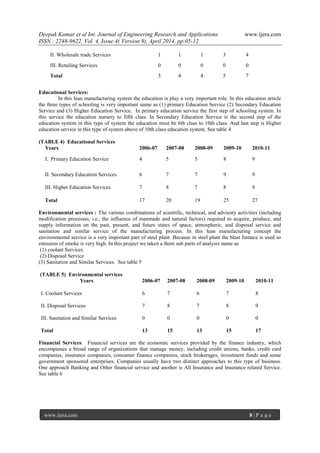
(3) Sanitation and Similar Services. See table 5
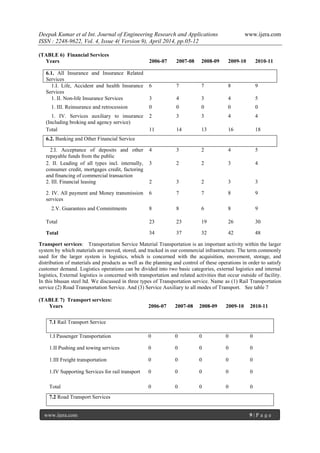
(TABLE 5) Environmental services
Years 2006-07 2007-08 2008-09 2009-10 2010-11
I. Coolant Services 6 7 6 7 8
II. Disposal Services 7 8 7 8 9
III. Sanitation and Similar Services 0 0 0 0 0
Total 13 15 13 15 17
Financial Services: Financial services are the economic services provided by the finance industry, which
encompasses a broad range of organizations that manage money, including credit unions, banks, credit card
companies, insurance companies, consumer finance companies, stock brokerages, investment funds and some
government sponsored enterprises. Companies usually have two distinct approaches to this type of business.
One approach Banking and Other financial service and another is All Insurance and Insurance related Service.
See table 6
Deepak Kumar et al Int. Journal of Engineering Research and Applications www.ijera.com
ISSN : 2248-9622, Vol. 4, Issue 4( Version 9), April 2014, pp.05-12
www.ijera.com 9 | P a g e
(TABLE 6) Financial Services
Years 2006-07 2007-08 2008-09 2009-10 2010-11
6.1. All Insurance and Insurance Related
Services
1.I. Life, Accident and health Insurance
Services
6 7 7 8 9
1. II. Non-life Insurance Services 3 4 3 4 5
1. III. Reinsurance and retrocession 0 0 0 0 0
1. IV. Services auxiliary to insurance
(Including broking and agency service)
2 3 3 4 4
Total 11 14 13 16 18
6.2. Banking and Other Financial Service
2.I. Acceptance of deposits and other
repayable funds from the public
4 3 2 4 5
2. II. Leading of all types incl. internally,
consumer credit, mortgages credit, factoring
and financing of commercial transaction
3 2 2 3 4
2. III. Financial leasing 2 3 2 3 3
2. IV. All payment and Money transmission
services
6 7 7 8 9
2.V. Guarantees and Commitments 8 8 6 8 9
Total 23 23 19 26 30
Total 34 37 32 42 48
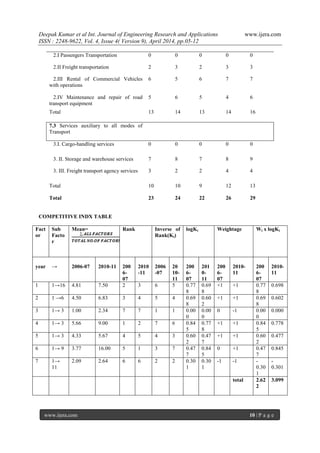
Transport services: Transportation Service Material Transportation is an important activity within the larger
system by which materials are moved, stored, and tracked in our commercial infrastructure. The term commonly
used for the larger system is logistics, which is concerned with the acquisition, movement, storage, and
distribution of materials and products as well as the planning and control of these operations in order to satisfy
customer demand. Logistics operations can be divided into two basic categories, external logistics and internal
logistics, External logistics is concerned with transportation and related activities that occur outside of facility.
In this bhusan steel ltd. We discussed in three types of Transportation service. Name as (1) Rail Transportation
service (2) Road Transportation Service. And (3) Service Auxiliary to all modes of Transport. See table 7
(TABLE 7) Transport services:
Years 2006-07 2007-08 2008-09 2009-10 2010-11
7.1 Rail Transport Service
1.I Passenger Transportation 0 0 0 0 0
1.II Pushing and towing services 0 0 0 0 0
1.III Freight transportation 0 0 0 0 0
1.IV Supporting Services for rail transport 0 0 0 0 0
Total 0 0 0 0 0
7.2 Road Transport Services
Deepak Kumar et al Int. Journal of Engineering Research and Applications www.ijera.com
ISSN : 2248-9622, Vol. 4, Issue 4( Version 9), April 2014, pp.05-12
www.ijera.com 10 | P a g e
2.I Passengers Transportation 0 0 0 0 0
2.II Freight transportation 2 3 2 3 3
2.III Rental of Commercial Vehicles
with operations
6 5 6 7 7
2.IV Maintenance and repair of road
transport equipment
5 6 5 4 6
Total 13 14 13 14 16
7.3 Services auxiliary to all modes of
Transport
3.I. Cargo-handling services 0 0 0 0 0
3. II. Storage and warehouse services 7 8 7 8 9
3. III. Freight transport agency services 3 2 2 4 4
Total 10 10 9 12 13
Total 23 24 22 26 29
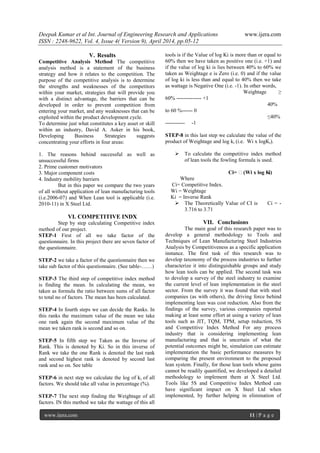
COMPETITIVE INDX TABLE
Fact
or
Sub
Facto
r
Mean= Rank Inverse of
Rank(Ki)
logKi Weightage Wi x logKi
year → 2006-07 2010-11 200
6-
07
2010
-11
2006
-07
20
10-
11
200
6-
07
201
0-
11
200
6-
07
2010-
11
200
6-
07
2010-
11
1 1→16 4.81 7.50 2 3 6 5 0.77
8
0.69
8
+1 +1 0.77
8
0.698
2 1 →6 4.50 6.83 3 4 5 4 0.69
8
0.60
2
+1 +1 0.69
8
0.602
3 1→ 3 1.00 2.34 7 7 1 1 0.00
0
0.00
0
0 -1 0.00
0
0.000
4 1→ 3 5.66 9.00 1 2 7 6 0.84
5
0.77
8
+1 +1 0.84
5
0.778
5 1→ 3 4.33 5.67 4 5 4 3 0.60
2
0.47
7
+1 +1 0.60
2
0.477
6 1→ 9 3.77 16.00 5 1 3 7 0.47
7
0.84
5
0 +1 0.47
7
0.845
7 1→
11
2.09 2.64 6 6 2 2 0.30
1
0.30
1
-1 -1 -
0.30
1
-
0.301
total 2.62
2
3.099
Deepak Kumar et al Int. Journal of Engineering Research and Applications www.ijera.com
ISSN : 2248-9622, Vol. 4, Issue 4( Version 9), April 2014, pp.05-12
www.ijera.com 11 | P a g e
V. Results
Competitive Analysis Method The competitive
analysis method is a statement of the business
strategy and how it relates to the competition. The
purpose of the competitive analysis is to determine
the strengths and weaknesses of the competitors
within your market, strategies that will provide you
with a distinct advantage, the barriers that can be
developed in order to prevent competition from
entering your market, and any weaknesses that can be
exploited within the product development cycle.
To determine just what constitutes a key asset or skill
within an industry, David A. Asker in his book,
Developing Business Strategies suggests
concentrating your efforts in four areas:
1. The reasons behind successful as well as
unsuccessful firms
2. Prime customer motivators
3. Major component costs
4. Industry mobility barriers
But in this paper we compare the two years
of all without application of lean manufacturing tools
(i.e.2006-07) and When Lean tool is applicable (i.e.
2010-11) in X Steel Ltd.
VI. COMPETITIVE INDX
Step by step calculating Competitive index
method of our project.
STEP-1 First of all we take factor of the
questionnaire. In this project there are seven factor of
the questionnaire.
STEP-2 we take a factor of the questionnaire then we
take sub factor of this questionnaire. (See table-……)
STEP-3 The third step of competitive index method
is finding the mean. In calculating the mean, we
taken as formula the ratio between sums of all factor
to total no of factors. The mean has been calculated.
STEP-4 In fourth steps we can decide the Ranks. In
this ranks the maximum value of the mean we take
one rank again the second maximum value of the
mean we taken rank is second and so on.
STEP-5 In fifth step we Taken as the Inverse of
Rank. This is denoted by Ki. So in this inverse of
Rank we take the one Rank is denoted the last rank
and second highest rank is denoted by second last
rank and so on. See table
STEP-6 in next step we calculate the log of ki of all
factors. We should take all value in percentage (%).
STEP-7 The next step finding the Weightage of all
factors. IN this method we take the wattage of this all
tools is if the Value of log Ki is more than or equal to
60% then we have taken as positive one (i.e. +1) and
if the value of log ki is lies between 40% to 60% we
taken as Weightage e is Zero (i.e. 0) and if the value
of log ki is less than and equal to 40% then we take
as wattage is Negative One (i.e. -1). In other words,
Weightage ≥
60% -------------- +1
40%
to 60 %------ 0
≤40%
----------- -1
STEP-8 in this last step we calculate the value of the
product of Weightage and log ki (i.e. Wi x logKi).
 To calculate the competitive index method
of lean tools the fowling formula is used.
Ci= ∑(Wi x log Ki)
Where
Ci= Competitive Index.
Wi = Weightage
Ki = Inverse Rank
 The Theoretically Value of CI is Ci = -
3.716 to 3.71
VII. Conclusions
The main goal of this research paper was to
develop a general methodology to Tools and
Techniques of Lean Manufacturing Steel Industries
Analysis by Competitiveness as a specific application
instance. The first task of this research was to
develop taxonomy of the process industries to further
characterize it into distinguishable groups and study
how lean tools can be applied. The second task was
to develop a survey of the steel industry to examine
the current level of lean implementation in the steel
sector. From the survey it was found that with steel
companies (as with others), the driving force behind
implementing lean was cost reduction. Also from the
findings of the survey, various companies reported
making at least some effort at using a variety of lean
tools such as JIT, TQM, TPM, setup reduction, 5S
and Competitive Index Method For any process
industry that is considering implementing lean
manufacturing and that is uncertain of what the
potential outcomes might be, simulation can estimate
implementation the basic performance measures by
comparing the present environment to the proposed
lean system. Finally, for those lean tools whose gains
cannot be readily quantified, we developed a detailed
methodology to implement them at X Steel Ltd.
Tools like 5S and Competitive Index Method can
have significant impact on X Steel Ltd when
implemented, by further helping in elimination of
Deepak Kumar et al Int. Journal of Engineering Research and Applications www.ijera.com
ISSN : 2248-9622, Vol. 4, Issue 4( Version 9), April 2014, pp.05-12
www.ijera.com 12 | P a g e
wastes such as excess inventory, long set up times,
and missed shipments.
References
[1] Abbett, D., and V. Payne, “Gulfstream V
Value Stream Tour,” (Presentation at 1999
Lean Summit), 1999.
[2] Attri Rajesh ,Kumar Deepak (2012)
Analysis of barriers of Total Productive
Maintenance , “International Journal of
System Assurance Engineering and
Management”
[3] Billesbach, J.T., “Applying Lean Production
Principles To A Process Facility,”
Production and Inventory Management
Journal, Third Quarter, 1994, PP. 40-44.
[4] Brunt, D., “From Current State to Future
State: Mapping the Steel to Component
Supply chain,” International Journal of
Logistics: Research and Applications, Vol.
3, No. 3, 2000, PP. 259-271.
[5] Cleland, D.I., and B. Bidanda, The
Automated Factory Handbook: Technology
and Management, (Blue Ridge Summit,
PA,1990).
[6] Dennis, Roger Daina, “Defining Production
and Inventory Management Systems for
Process Industries” (Ph.D. Dissertation,
University of Cincinnati, 1993).
[7] Detty, R.B., and J.C. Yingling, “Quantifying
Benefits of Conversion to Lean
Manufacturing with Discrete Event
Simulation: a case study,” International
Journal of Production Research, Vol. 38,
No. 2, 2000, PP. 429-445.
[8] Feld, M.W., Lean Manufacturing: Tools,
Techniques, and how to use them (Boca
Raton, London: The St. Lucie Press, 2000).
[9] Hays, R.H., and K.B. Clark, “Why some
factories are more productive than others,”
Harvard Business Review, September-
October 1986, PP. 66-73.
[10] Imai, G., Gemba Kaizen (McGraw-Hill,
New York, NY, 1997).
[11] Karlsson, C., and A. Par, “Assessing
changes towards lean production,”
International Journal of Operation &
Production Management, Vol. 16, No.2,
1996, PP. 24-41.
[12] Moore, R., “Combining TPM and
Reliability-Focused Maintenance,” Plant
Engineering, June 1997.
[13] Nicholls, M.G., “Optimizing the Operation
of an Ingot Mill in an Aluminium Smelter,”
Journal of Operational Research Society,
Vol. 45, No. 9, 1994, PP. 987-999.
[14] Ohno, T., Toyota Production System:
Beyond large-scale production 1997.
[15] Raia, E., “Just-in-Time Transplant Style,”
Purchasing, 1992, PP. 60-65.
[16] Roy, R.N. and K.K. Guin, “A Proposed
Model of JIT Purchasing in An Integrated
Steel Plant,” International Journal of
Production Economics, 1999, PP. 179-187.
[17] Taylor, R.W., “A linear Programming model
to Manage the Maintenance Backlog,”
Omega, Vol. 24, No. 2, 1996, PP. 2 17-227.
[18] Taylor, S.G., S.M. Seward, and S.F.
Bolander, “ Why The Process Industries are
Different,” Production and Inventory
Management Journal, Vol. 22, Fourth Quarter
1981, PP. 9-24.
[19] Welgama, P.S., and R.G.J. Mills, “ Use of
Simulation in the design of a JIT system,”
International Journal of Operations &
Production Management, Vol. 15, No. 9,
1995, PP. 245-260.
[20] White, R.E., “An Empirical Assessment of
JIT In U.S. Manufacturers,” Production and
Inventory Management Journal, Second
Quarter 1993, PP. 3 8-42.
[21] Womack, J.P., and D.T. Jones, “From Lean
Production to the Lean Enterprise,” Harvard
Business Review, March-April 1994, PP.
93-103.

B44090512

  • 1.
    Deepak Kumar etal Int. Journal of Engineering Research and Applications www.ijera.com ISSN : 2248-9622, Vol. 4, Issue 4( Version 9), April 2014, pp.05-12 www.ijera.com 5 | P a g e Implementation of Lean in Continuous Industry: A Case Study (Steel Industry) Deepak Kumar1 , Sumit Kumar Singh1 , Khemchand Sharma2 1 Assistant Professor- Deptt. Of Mechanical Engineering, NGFCET, Palwal 2 Assistant Professor- Deptt. Of Mechanical Engineering, DITMR, Faridabad Abstract The goal of this research is to investigate how lean manufacturing tools can be adapted from the discrete to the continuous manufacturing environment, and to evaluate their benefits on a specific application instance. Although the process and discrete industry share several common characteristics, there are areas where they are very different. This research attempts to identify commonalities between discrete and continuous manufacturing where lean techniques from the discrete side are directly applicable. Key words: Lean, lean tool, Discrete manufacturing, Competitiveness, Sources of Competitiveness. I. Introduction This research addresses the application of lean manufacturing concepts to the continuous production/ process sector with a focus on the steel industry. Toyota Motor Company in Japan pioneered the concept of the Toyota Production System, or what is known today in the US as “Lean Manufacturing.” The basic idea behind the system is eliminating waste. Waste is defined as anything that does not add value to the end product from the customer’s perspective. . Lean is to manufacture only what is needed by the customer, when it is needed and in the quantities ordered. Tools including just in time, cellular manufacturing, total productive maintenance, single- minute exchange of dies, and production smoothing have been widely used in discrete parts manufacturing sectors such as automotive, electronics and appliance manufacturing. II. Problem Statement Lean tools and techniques of lean manufacturing have been widely used in the discrete industry but applications of lean manufacturing to the continuous process industry have been far fewer. this is because such industries are inherently more efficient and present relatively less need for such improvement activities. Managers have also been hesitant to adopt lean manufacturing tools and techniques to the continuous process industry because of reasons such as high volume and low variety products, large inflexible machines, and the long setup times that characterize the process industry. As an example, it is difficult to use the cellular manufacturing concept in a process facility due to the fact that equipment is large and not easy to move. While it seems that some lean manufacturing tools are difficult to adapt in the process industry. For example, Cook and Rogowski (1996) and Billesbach (1994) used just-in-time concepts at a process facility; nobody has systematically investigated how to apply lean tools and techniques to a continuous process facility due to the differences exhibited between the two manufacturing environments. III. Research Approach The initial step in this research is to systematically study and define the history of the lean manufacturing concept and its different tools and techniques. This will be followed by a literature review of the process industry and a study of the findings regarding applications of lean concepts to continuous manufacturing, and the steel industry in particular. . The next step is to develop taxonomy of the continuous process industry with respect to its product/process characteristics and the relative balance of discrete and continuous operations. This taxonomy is used to contrast the process industry and to characterize the process industry into distinguishable groups. Next, this taxonomy is used to examine and identify specific lean manufacturing tools and techniques that could be applicable. To study the effect of lean tools in the process sector the steel industry is used to illustrate the procedures of implementing lean tools at a process facility. The future state map is developed for a system with lean tools applied to it. Discrete vs. Continuous Manufacturing Systems Manufacturing systems are classified into two major classes; discrete manufacturing and continuous manufacturing (also referred to as the process industry). Discrete manufacturing refers to making discrete products such as an engine, an automobile, a drive shaft, a coffee maker, or a RESEARCH ARTICLE OPEN ACCESS
  • 2.
    Deepak Kumar etal Int. Journal of Engineering Research and Applications www.ijera.com ISSN : 2248-9622, Vol. 4, Issue 4( Version 9), April 2014, pp.05-12 www.ijera.com 6 | P a g e washing machine. On the other hand, continuous manufacturing includes making products that are measured or metered rather than being counted. Examples include paint, steel, textile, flat glass, resin, oil, and flour (Needy and Bidanda, 2001). Case Study: 4.3.1 Study Area (X Steel Ltd.) X Steel Ltd produces several products that are used primarily in appliance manufacturing. The annealed product type. X Steel Ltd produces three types of the annealed product: open coil annealed, hydrogen batch annealed and continuous annealed. The objectives of the industry are: 1. To train technical and non-technical personnel. 2. To Reduces Production cycle time. 3. To reduces Product delivery lead-time. 4. To conduct research in the respective fields. IV. Method of Data Collection A total of 100 questionnaires each were prepared and randomly administered among management, employees and vendors. One of the procedures used for data collection in this research work was through the use of questionnaires since it is an effective and systematic way of asking questions under scientific control. Interviews were conducted with both top management staff to elicit information about the efforts in achieving TQM through HRM. In other words, almost all individual characteristics as well as the respective subgroups were covered by the sample. The interviews were performed to gain a deeper knowledge of the results received by the questionnaire respondents. The interviews were structured in order to ensure the objectivity of the research, and open-ended questions were used. Quantitative and qualitative aspects may also be combined in the same study. Various Factors of Lean Manufacturing Which Effect the Organization Business Services: A service that is clearly identifiable by business representatives and has a clear line to the business value chain, interfacing closely with explicit business processes. In this lean manufacturing process used in X steel ltd. there are three types of Business Service are explain one is Professional service second is Research and Development Service and third is Other Business service. Business Service means Service related to all area of the manufacturing known as Service Incidental to Manufacturing, Technical testing and analysis service, market research and public service etc. In this questionnaire there are four sub parts of the Professional Service as follows (1) Engineering Service (2) Integrated Engineering Service (3) Accounting and Auditing Service (4) Taxation Service. See table 1 ( TABLE 1 ) Business Services Years 2006-07 2007-08 2008-09 2009-10 2010-11 1.1.Professional Services 1. I. Engineering Services 4 6 5 7 8 1. II. Integrated Engineering Services 7 9 9 8 9 1. III. Accounting & Auditing Services 6 8 5 9 9 1. IV. Taxation Services 8 8 7 8 8 Total 25 31 26 32 34 1.2. Research and Development Services 2. I. R & D Services 2 3 2 3 3 2. II. Interdisciplinary R&D Services 3 4 3 4 5 Total 5 7 5 7 8 1.3. Other Business Services 3. I. Service incidental to Manufacturing 6 7 5 8 9 3. II. Technical testing and analysis service 7 8 6 9 10 3. III. Market research and public opinion polling Services 5 6 4 7 8
  • 3.
    Deepak Kumar etal Int. Journal of Engineering Research and Applications www.ijera.com ISSN : 2248-9622, Vol. 4, Issue 4( Version 9), April 2014, pp.05-12 www.ijera.com 7 | P a g e 3. IV. Advertising Services 2 3 2 3 3 3. V. Services related to Manufacturing Consulting 4 6 3 5 7 3. VI. Management Consulting Services 3 4 3 6 8 3. VII. Building-Clearing Services 6 7 7 8 9 3. VIII. Maintenance and repair of equipment 3 5 4 6 8 3. IX. Supply Services of Personnel 4 5 4 6 7 3.X. Packaging Services 7 8 7 8 9 Total 47 58 45 66 78 Total 77 96 76 105 120 Communication Services: Management directly and honestly communicates priorities, strategies and status to all levels of the work force. . Cell design puts material, tools, and equipment for the comfort and ease of use by the cell’s operators. Each cell has good physical facilities for communications, e.g., meeting areas and communications boards. in this project we taken as a six sub group of Telecommunication services name as Voice Telephone service, Electronic Mail, Voice Mail, On- line information and data base retrieval, Enhanced/ value- added facsimile services, incl. store and forward. Store and receives. And on-line information/ data processing. See table 2 (TABLE 2 ) Communication Services Years 2006-07 2007-08 2008-09 2009-10 2010-11 2.1. Telecommunication Services 1.I. Voice Telephone Services 6 7 6 8 9 1. II. Electronic Mail 5 7 7 9 10 1. III. Voice Mail 0 0 0 0 0 1. IV. On-line information and data base retrieval 7 8 6 8 9 1.V.enhanced/Value-added facsimile services,incl.store and forward, store and retrieve 4 5 4 6 7 1. VI. On-line information / Data processing(incl.transaction processing) 5 4 4 5 6 Total 27 31 27 36 41 Distribution Services: Distribution service is defined as in terms of manufacturing company the supply of any product is of consumer by help of these channels. These channels are known as Commission agent’s service, Wholesale trade Service and Retailing service. See table 3 (TABLE3) Distribution Services Years 2006- 07 2007- 08 2008- 09 2009- 10 2010-11 I. Commission agent’s Services 2 3 3 2 3
  • 4.
    Deepak Kumar etal Int. Journal of Engineering Research and Applications www.ijera.com ISSN : 2248-9622, Vol. 4, Issue 4( Version 9), April 2014, pp.05-12 www.ijera.com 8 | P a g e II. Wholesale trade Services 1 1 1 3 4 III. Retailing Services 0 0 0 0 0 Total 3 4 4 5 7 Educational Services: In this lean manufacturing system the education is play a very important role. In this education article the three types of schooling is very important name as (1) primary Education Service (2) Secondary Education Service and (3) Higher Education Service. In primary education service the first step of schooling system. In this service the education nursery to fifth class. In Secondary Education Service is the second step of the education system in this type of system the education must be 6th class to 10th class. And last step is Higher education service in this type of system above of 10th class education system. See table 4 (TABLE 4) Educational Services Years 2006-07 2007-08 2008-09 2009-10 2010-11 I. Primary Education Service 4 5 5 8 9 II. Secondary Education Services 6 7 7 9 9 III. Higher Education Services 7 8 7 8 9 Total 17 20 19 25 27 Environmental services : The various combinations of scientific, technical, and advisory activities (including modification processes, i.e., the influence of manmade and natural factors) required to acquire, produce, and supply information on the past, present, and future states of space, atmospheric, and disposal service and sanitation and similar service of the manufacturing process. In this lean manufacturing concept the environmental service is a very important part of steel plant. Because in steel plant the blast furnace is used so emission of smoke is very high. In this project we taken a there sub parts of analysis name as (1) coolant Services (2) Disposal Service (3) Sanitation and Similar Services. See table 5 (TABLE 5) Environmental services Years 2006-07 2007-08 2008-09 2009-10 2010-11 I. Coolant Services 6 7 6 7 8 II. Disposal Services 7 8 7 8 9 III. Sanitation and Similar Services 0 0 0 0 0 Total 13 15 13 15 17 Financial Services: Financial services are the economic services provided by the finance industry, which encompasses a broad range of organizations that manage money, including credit unions, banks, credit card companies, insurance companies, consumer finance companies, stock brokerages, investment funds and some government sponsored enterprises. Companies usually have two distinct approaches to this type of business. One approach Banking and Other financial service and another is All Insurance and Insurance related Service. See table 6
  • 5.
    Deepak Kumar etal Int. Journal of Engineering Research and Applications www.ijera.com ISSN : 2248-9622, Vol. 4, Issue 4( Version 9), April 2014, pp.05-12 www.ijera.com 9 | P a g e (TABLE 6) Financial Services Years 2006-07 2007-08 2008-09 2009-10 2010-11 6.1. All Insurance and Insurance Related Services 1.I. Life, Accident and health Insurance Services 6 7 7 8 9 1. II. Non-life Insurance Services 3 4 3 4 5 1. III. Reinsurance and retrocession 0 0 0 0 0 1. IV. Services auxiliary to insurance (Including broking and agency service) 2 3 3 4 4 Total 11 14 13 16 18 6.2. Banking and Other Financial Service 2.I. Acceptance of deposits and other repayable funds from the public 4 3 2 4 5 2. II. Leading of all types incl. internally, consumer credit, mortgages credit, factoring and financing of commercial transaction 3 2 2 3 4 2. III. Financial leasing 2 3 2 3 3 2. IV. All payment and Money transmission services 6 7 7 8 9 2.V. Guarantees and Commitments 8 8 6 8 9 Total 23 23 19 26 30 Total 34 37 32 42 48 Transport services: Transportation Service Material Transportation is an important activity within the larger system by which materials are moved, stored, and tracked in our commercial infrastructure. The term commonly used for the larger system is logistics, which is concerned with the acquisition, movement, storage, and distribution of materials and products as well as the planning and control of these operations in order to satisfy customer demand. Logistics operations can be divided into two basic categories, external logistics and internal logistics, External logistics is concerned with transportation and related activities that occur outside of facility. In this bhusan steel ltd. We discussed in three types of Transportation service. Name as (1) Rail Transportation service (2) Road Transportation Service. And (3) Service Auxiliary to all modes of Transport. See table 7 (TABLE 7) Transport services: Years 2006-07 2007-08 2008-09 2009-10 2010-11 7.1 Rail Transport Service 1.I Passenger Transportation 0 0 0 0 0 1.II Pushing and towing services 0 0 0 0 0 1.III Freight transportation 0 0 0 0 0 1.IV Supporting Services for rail transport 0 0 0 0 0 Total 0 0 0 0 0 7.2 Road Transport Services
  • 6.
    Deepak Kumar etal Int. Journal of Engineering Research and Applications www.ijera.com ISSN : 2248-9622, Vol. 4, Issue 4( Version 9), April 2014, pp.05-12 www.ijera.com 10 | P a g e 2.I Passengers Transportation 0 0 0 0 0 2.II Freight transportation 2 3 2 3 3 2.III Rental of Commercial Vehicles with operations 6 5 6 7 7 2.IV Maintenance and repair of road transport equipment 5 6 5 4 6 Total 13 14 13 14 16 7.3 Services auxiliary to all modes of Transport 3.I. Cargo-handling services 0 0 0 0 0 3. II. Storage and warehouse services 7 8 7 8 9 3. III. Freight transport agency services 3 2 2 4 4 Total 10 10 9 12 13 Total 23 24 22 26 29 COMPETITIVE INDX TABLE Fact or Sub Facto r Mean= Rank Inverse of Rank(Ki) logKi Weightage Wi x logKi year → 2006-07 2010-11 200 6- 07 2010 -11 2006 -07 20 10- 11 200 6- 07 201 0- 11 200 6- 07 2010- 11 200 6- 07 2010- 11 1 1→16 4.81 7.50 2 3 6 5 0.77 8 0.69 8 +1 +1 0.77 8 0.698 2 1 →6 4.50 6.83 3 4 5 4 0.69 8 0.60 2 +1 +1 0.69 8 0.602 3 1→ 3 1.00 2.34 7 7 1 1 0.00 0 0.00 0 0 -1 0.00 0 0.000 4 1→ 3 5.66 9.00 1 2 7 6 0.84 5 0.77 8 +1 +1 0.84 5 0.778 5 1→ 3 4.33 5.67 4 5 4 3 0.60 2 0.47 7 +1 +1 0.60 2 0.477 6 1→ 9 3.77 16.00 5 1 3 7 0.47 7 0.84 5 0 +1 0.47 7 0.845 7 1→ 11 2.09 2.64 6 6 2 2 0.30 1 0.30 1 -1 -1 - 0.30 1 - 0.301 total 2.62 2 3.099
  • 7.
    Deepak Kumar etal Int. Journal of Engineering Research and Applications www.ijera.com ISSN : 2248-9622, Vol. 4, Issue 4( Version 9), April 2014, pp.05-12 www.ijera.com 11 | P a g e V. Results Competitive Analysis Method The competitive analysis method is a statement of the business strategy and how it relates to the competition. The purpose of the competitive analysis is to determine the strengths and weaknesses of the competitors within your market, strategies that will provide you with a distinct advantage, the barriers that can be developed in order to prevent competition from entering your market, and any weaknesses that can be exploited within the product development cycle. To determine just what constitutes a key asset or skill within an industry, David A. Asker in his book, Developing Business Strategies suggests concentrating your efforts in four areas: 1. The reasons behind successful as well as unsuccessful firms 2. Prime customer motivators 3. Major component costs 4. Industry mobility barriers But in this paper we compare the two years of all without application of lean manufacturing tools (i.e.2006-07) and When Lean tool is applicable (i.e. 2010-11) in X Steel Ltd. VI. COMPETITIVE INDX Step by step calculating Competitive index method of our project. STEP-1 First of all we take factor of the questionnaire. In this project there are seven factor of the questionnaire. STEP-2 we take a factor of the questionnaire then we take sub factor of this questionnaire. (See table-……) STEP-3 The third step of competitive index method is finding the mean. In calculating the mean, we taken as formula the ratio between sums of all factor to total no of factors. The mean has been calculated. STEP-4 In fourth steps we can decide the Ranks. In this ranks the maximum value of the mean we take one rank again the second maximum value of the mean we taken rank is second and so on. STEP-5 In fifth step we Taken as the Inverse of Rank. This is denoted by Ki. So in this inverse of Rank we take the one Rank is denoted the last rank and second highest rank is denoted by second last rank and so on. See table STEP-6 in next step we calculate the log of ki of all factors. We should take all value in percentage (%). STEP-7 The next step finding the Weightage of all factors. IN this method we take the wattage of this all tools is if the Value of log Ki is more than or equal to 60% then we have taken as positive one (i.e. +1) and if the value of log ki is lies between 40% to 60% we taken as Weightage e is Zero (i.e. 0) and if the value of log ki is less than and equal to 40% then we take as wattage is Negative One (i.e. -1). In other words, Weightage ≥ 60% -------------- +1 40% to 60 %------ 0 ≤40% ----------- -1 STEP-8 in this last step we calculate the value of the product of Weightage and log ki (i.e. Wi x logKi).  To calculate the competitive index method of lean tools the fowling formula is used. Ci= ∑(Wi x log Ki) Where Ci= Competitive Index. Wi = Weightage Ki = Inverse Rank  The Theoretically Value of CI is Ci = - 3.716 to 3.71 VII. Conclusions The main goal of this research paper was to develop a general methodology to Tools and Techniques of Lean Manufacturing Steel Industries Analysis by Competitiveness as a specific application instance. The first task of this research was to develop taxonomy of the process industries to further characterize it into distinguishable groups and study how lean tools can be applied. The second task was to develop a survey of the steel industry to examine the current level of lean implementation in the steel sector. From the survey it was found that with steel companies (as with others), the driving force behind implementing lean was cost reduction. Also from the findings of the survey, various companies reported making at least some effort at using a variety of lean tools such as JIT, TQM, TPM, setup reduction, 5S and Competitive Index Method For any process industry that is considering implementing lean manufacturing and that is uncertain of what the potential outcomes might be, simulation can estimate implementation the basic performance measures by comparing the present environment to the proposed lean system. Finally, for those lean tools whose gains cannot be readily quantified, we developed a detailed methodology to implement them at X Steel Ltd. Tools like 5S and Competitive Index Method can have significant impact on X Steel Ltd when implemented, by further helping in elimination of
  • 8.
    Deepak Kumar etal Int. Journal of Engineering Research and Applications www.ijera.com ISSN : 2248-9622, Vol. 4, Issue 4( Version 9), April 2014, pp.05-12 www.ijera.com 12 | P a g e wastes such as excess inventory, long set up times, and missed shipments. References [1] Abbett, D., and V. Payne, “Gulfstream V Value Stream Tour,” (Presentation at 1999 Lean Summit), 1999. [2] Attri Rajesh ,Kumar Deepak (2012) Analysis of barriers of Total Productive Maintenance , “International Journal of System Assurance Engineering and Management” [3] Billesbach, J.T., “Applying Lean Production Principles To A Process Facility,” Production and Inventory Management Journal, Third Quarter, 1994, PP. 40-44. [4] Brunt, D., “From Current State to Future State: Mapping the Steel to Component Supply chain,” International Journal of Logistics: Research and Applications, Vol. 3, No. 3, 2000, PP. 259-271. [5] Cleland, D.I., and B. Bidanda, The Automated Factory Handbook: Technology and Management, (Blue Ridge Summit, PA,1990). [6] Dennis, Roger Daina, “Defining Production and Inventory Management Systems for Process Industries” (Ph.D. Dissertation, University of Cincinnati, 1993). [7] Detty, R.B., and J.C. Yingling, “Quantifying Benefits of Conversion to Lean Manufacturing with Discrete Event Simulation: a case study,” International Journal of Production Research, Vol. 38, No. 2, 2000, PP. 429-445. [8] Feld, M.W., Lean Manufacturing: Tools, Techniques, and how to use them (Boca Raton, London: The St. Lucie Press, 2000). [9] Hays, R.H., and K.B. Clark, “Why some factories are more productive than others,” Harvard Business Review, September- October 1986, PP. 66-73. [10] Imai, G., Gemba Kaizen (McGraw-Hill, New York, NY, 1997). [11] Karlsson, C., and A. Par, “Assessing changes towards lean production,” International Journal of Operation & Production Management, Vol. 16, No.2, 1996, PP. 24-41. [12] Moore, R., “Combining TPM and Reliability-Focused Maintenance,” Plant Engineering, June 1997. [13] Nicholls, M.G., “Optimizing the Operation of an Ingot Mill in an Aluminium Smelter,” Journal of Operational Research Society, Vol. 45, No. 9, 1994, PP. 987-999. [14] Ohno, T., Toyota Production System: Beyond large-scale production 1997. [15] Raia, E., “Just-in-Time Transplant Style,” Purchasing, 1992, PP. 60-65. [16] Roy, R.N. and K.K. Guin, “A Proposed Model of JIT Purchasing in An Integrated Steel Plant,” International Journal of Production Economics, 1999, PP. 179-187. [17] Taylor, R.W., “A linear Programming model to Manage the Maintenance Backlog,” Omega, Vol. 24, No. 2, 1996, PP. 2 17-227. [18] Taylor, S.G., S.M. Seward, and S.F. Bolander, “ Why The Process Industries are Different,” Production and Inventory Management Journal, Vol. 22, Fourth Quarter 1981, PP. 9-24. [19] Welgama, P.S., and R.G.J. Mills, “ Use of Simulation in the design of a JIT system,” International Journal of Operations & Production Management, Vol. 15, No. 9, 1995, PP. 245-260. [20] White, R.E., “An Empirical Assessment of JIT In U.S. Manufacturers,” Production and Inventory Management Journal, Second Quarter 1993, PP. 3 8-42. [21] Womack, J.P., and D.T. Jones, “From Lean Production to the Lean Enterprise,” Harvard Business Review, March-April 1994, PP. 93-103.