International Journal of Business and Management Invention 
ISSN (Online): 2319 – 8028, ISSN (Print): 2319 – 801X 
www.ijbmi.org Volume 3 Issue 9 ǁ September. 2014 ǁ PP.13-19 
www.ijbmi.org 13 | Page 
Organizational Role Stress among Managers in the Indian Hospitality Industry 1,Vidya Patwardhan , 2,Dr Suresh Mayya , 3,Dr H.G. Joshi 1,Asst.Professor, Selection Grade, Welcomgroup Graduate School of Hotel Administration (WGSHA), Manipal University, Manipal-576104, Karnataka, India 2,Associate Professor, Dept. of Commerce, Mahatma Gandhi Memorial College, Udupi – 576101, Karnataka, India. 3, Associate Professor, Manipal Centre for Information Systems (MCIS), Manipal-576104, Karnataka, India. ABSTRACT : Although men and women experience stress as a result of their managerial positions, there are some stressors that are unique to women in management positions (Suraj, 2005). Exploration of women’s perceived role related stress factors would therefore seem to be valuable. Through this study an attempt was made to investigate the intensity of organizational role stress among women managers of Indian hospitality industry. Organizational role stress scale is used on a sample of 45 women managers of 5 star luxury and 5 star hotels to explore the level of role stress. The same scale was administered to 32 male managers in order to compare their stress levels. The other variables like experience, length of service and managerial level were also taken into consideration in order to determine potentially related matters. The suitable statistical techniques like mean, SD, t-test and ANOVA were used to find the differences between stress levels of men and women managers. The findings show that role stress was experienced at moderate to high levels among women managers and the major stressors were inter role distance, role Erosion, role stagnation and role overload. The study findings may be useful for HR professionals to evaluate the organizational causes of stress at different levels and develop strategies to reduce stress. KEY WORDS: Male Managers, Women Managers, Role Stress, Hotel Industry, India 
I. INTRODUCTION 
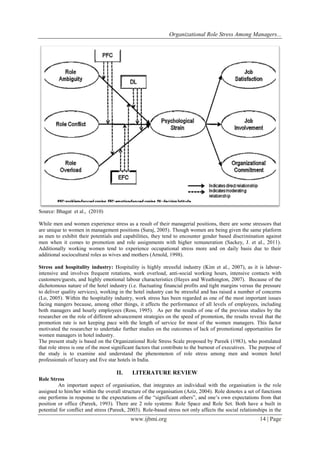
According to Hans Selye (1974), stress is a physiological reaction to certain threatening environment and is caused by events in the work environment. Stress can play a positive role at the workplace by increasing the attentiveness of the staff and activating their capacities. A moderate level of stress at workplace has the potential to add towards the organization’s efficiency. But it becomes precarious once excessive level of stress begins to affect one’s health and productivity. It is often assumed that managers and executives are more vulnerable than non-mangers to the ravages of stress. Executive burnout is often the end result of stress experienced, but not properly coped with, by an executive (Pareek, 1983). The research model proposed by Bhagat S.R (2010) depicts the three facets of organizational stress (i.e. role ambiguity, role conflict, and role overload) that are antecedents of psychological strain which, in turn, is negatively related to job satisfaction, job involvement, and organizational commitment.
Organizational Role Stress Among Managers... 
www.ijbmi.org 14 | Page 
Source: Bhagat et al., (2010) While men and women experience stress as a result of their managerial positions, there are some stressors that are unique to women in management positions (Suraj, 2005). Though women are being given the same platform as men to exhibit their potentials and capabilities, they tend to encounter gender based discrimination against men when it comes to promotion and role assignments with higher remuneration (Sackey, J. et al., 2011). Additionally working women tend to experience occupational stress more and on daily basis due to their additional sociocultural roles as wives and mothers (Arnold, 1998). Stress and hospitality industry: Hospitality is highly stressful industry (Kim et al., 2007), as it is labour- intensive and involves frequent rotations, work overload, anti-social working hours, intensive contacts with customers/guests, and highly emotional labour characteristics (Hayes and Weathington, 2007). Because of the dichotomous nature of the hotel industry (i.e. fluctuating financial profits and tight margins versus the pressure to deliver quality services), working in the hotel industry can be stressful and has raised a number of concerns (Lo, 2005). Within the hospitality industry, work stress has been regarded as one of the most important issues facing mangers because, among other things, it affects the performance of all levels of employees, including both managers and hourly employees (Ross, 1995). As per the results of one of the previous studies by the researcher on the role of different advancement strategies on the speed of promotion, the results reveal that the promotion rate is not keeping pace with the length of service for most of the women managers. This factor motivated the researcher to undertake further studies on the outcomes of lack of promotional opportunities for women managers in hotel industry. The present study is based on the Organizational Role Stress Scale proposed by Pareek (1983), who postulated that role stress is one of the most significant factors that contribute to the burnout of executives. The purpose of the study is to examine and understand the phenomenon of role stress among men and women hotel professionals of luxury and five star hotels in India. 
II. LITERATURE REVIEW 
Role Stress 
An important aspect of organisation, that integrates an individual with the organisation is the role assigned to him/her within the overall structure of the organisation (Aziz, 2004). Role denotes a set of functions one performs in response to the expectations of the “significant others”, and one’s own expectations from that position or office (Pareek, 1993). There are 2 role systems: Role Space and Role Set. Both have a built in potential for conflict and stress (Pareek, 2003). Role-based stress not only affects the social relationships in the
Organizational Role Stress Among Managers... 
www.ijbmi.org 15 | Page 
work environment but also psychological and physical wellbeing of an individual and his/her role performance. Uncertain expectations along with lack of support and conflicting interests have the potential to generate role stress. By integrating the self with the role, the role stress can be reduced and a person’s effectiveness in the organisation can be enhanced. 
III. ROLE STRESS AMONG WOMEN 
In India, research and surveys reveal that men out-number women in terms of attaining top managerial positions (Centre for Social Research, 2009) and women appear to be underrepresented at managerial levels in Indian Hotel Companies (HVS 2011-12). Of the eight obstacles identified by Brownell (1998) to women’s career advancement, gender differences were found on the perceived importance of old boy networks, family and work conflict, pay and promotions, job characteristics, lack of mentors, lack of credibility, sexual harassment and stress. According to the study undertaken by Khetarpal (2006), the key stressors which affect maximum number of women in organizations are poor peer relations, intrinsic impoverishment and under- participation. Matteson (1980) identified four categories of work stressors: physical environment, individual level (a mixer of role and career development variables), group level (primarily relationship-based) and organizational level (a mixture of climate, structure, job design and task characteristic) affecting women. Aziz (2003) investigated the prevalence of organisational role stress among Indian information technology employees. Resource inadequacy has emerged as the most potent stressor. The study reported more stress among men as compared to women. Although these studies are in the context of IT and other service sectors, they very well match with the findings related to the field of hospitality in general. RESEARCH QUESTION AND HYPOTHESIS Based on the review of literature, results of the researcher’s previous paper on career advancement of women managers and general information collected through conversations with some of the experienced men and women managers, the following hypothesis has been formulated; Question: What are the levels of ORS experienced by male and female managers of Indian hotel industry? The hypothesis that guided this question was; H0: The stress levels between male and females managers in Indian five star hotels are the same. H1: Female managers in Indian five star hotels experience substantial job stress compared to male managers 
IV. METHODOLOGY AND INSTRUMENT 
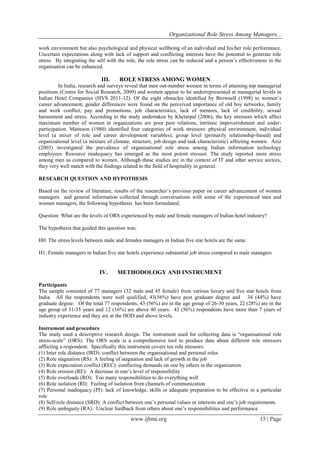
Participants The sample consisted of 77 managers (32 male and 45 female) from various luxury and five star hotels from India. All the respondents were well qualified, 43(56%) have post graduate degree and 34 (44%) have graduate degree. Of the total 77 respondents, 43 (56%) are in the age group of 26-30 years, 22 (28%) are in the age group of 31-35 years and 12 (16%) are above 40 years. 43 (56%) respondents have more than 7 years of industry experience and they are at the HOD and above levels. Instrument and procedure The study used a descriptive research design. The instrument used for collecting data is “organisational role stress-scale” (ORS). The ORS scale is a comprehensive tool to produce data about different role stressors afflicting a respondent. Specifically this instrument covers ten role stressors: (1) Inter role distance (IRD): conflict between the organisational and personal roles (2) Role stagnation (RS): A feeling of stagnation and lack of growth in the job (3) Role expectation conflict (REC): conflicting demands on one by others in the organization (4) Role erosion (RE): A decrease in one’s level of responsibility (5) Role overloads (RO): Too many responsibilities to do everything well (6) Role isolation (RI): Feeling of isolation from channels of communication (7) Personal inadequacy (PI): lack of knowledge, skills or adequate preparation to be effective in a particular role (8) Self-role distance (SRD): A conflict between one’s personal values or interests and one’s job requirements (9) Role ambiguity (RA): Unclear feedback from others about one’s responsibilities and performance
Organizational Role Stress Among Managers... 
www.ijbmi.org 16 | Page 
(10) Resource inadequacy (RIn): non-availability of resources needed for effective role performance The ORS is a widely used instrument to measure these role stressors. The scale holds five items for each role stress i.e. a total of 50 statements, and it uses a five-point scale, from 1 to 5. The total score on each role stress ranges from 5 to 25 and the total ORS score from 50 to 250. The ratings of five items are totalled to get the total score for each role stressor. Score up to 5 is categorized as low stress, 6-10 is moderate, 11-15 is high and 16-20 is very high. The ORS scale was used to generate data about varied stresses experienced by respondents. The data was analysed through Microsoft excel to get the rankings and also by using SPSS 16.0 to obtain the t-values and ANOVA. The mean and SD for both men and women managers were calculated separately and the rank orders were given according to the mean ratings. 
V. RESULTS AND DISCUSSION 
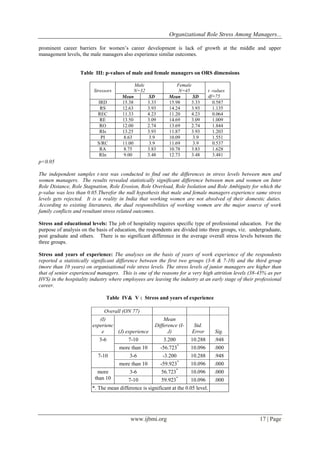
As the authors were concerned with ascertaining the differences and similarities between female and male managers, these two groups were treated as two separate sub-populations of the main sample throughout the analysis. The findings of the study reveal that hospitality managers experience organizational role stress at moderate to high levels. The stress levels of male managers are comparatively lesser than the female managers as against the study results of Aziz (2003). The mean organizational role stress score of 115.25 for male and 126.96 for female managers with the standard deviation of 26.39 and 55.09 suggests that the stress levels are high but they are not evenly spread throughout the population. Among the constituent role stressors as shown in the tables below, Inter Role Distance (IRD) has emerged as the most potent stressor for both men and women with a mean score of 15.38 and 15.98. It is followed by Role Erosion (mean score of 13.50 and 14.69) and Role Isolation (mean score 13.25) for men and Role Stagnation (mean score 14.24) for women. It is a well-known fact that the hotel industry works 24x7 and the managers are expected to be present even during unsociable hours. Table I: ORS scores for male managers Table II: ORS scores for female managers 
Equated to women managers, male managers feel more isolated in their roles. The ranking of men for this category was 3 (mean score 13.25) and for women, it was 6 (mean score 11.87). Hospitality is majorly a male dominated industry and there are competing interests between many male members as compared to women. The growth may be limited to the best performing members of the community in particular. Though one of the
Organizational Role Stress Among Managers... 
www.ijbmi.org 17 | Page 
prominent career barriers for women’s career development is lack of growth at the middle and upper management levels, the male managers also experience similar outcomes. Table III: p-values of male and female managers on ORS dimensions 
Stressors 
Male N=32 
Female N=45 
t -values df=75 
Mean 
SD 
Mean 
SD 
IRD 
15.38 
3.33 
15.98 
3.33 
0.587 
RS 
12.63 
3.93 
14.24 
3.93 
1.135 
REC 
11.33 
4.23 
11.20 
4.23 
0.064 
RE 
13.50 
3.09 
14.69 
3.09 
1.009 
RO 
12.00 
2.74 
13.69 
2.74 
1.844 
RIs 
13.25 
3.93 
11.87 
3.93 
1.203 
PI 
8.63 
3.9 
10.09 
3.9 
1.551 
S/RC 
11.00 
3.9 
11.69 
3.9 
0.537 
RA 
8.75 
3.83 
10.78 
3.83 
1.628 
RIn 
9.00 
3.48 
12.73 
3.48 
3.481 
p<0.05 The independent samples t-test was conducted to find out the differences in stress levels between men and women managers. The results revealed statistically significant difference between men and women on Inter Role Distance, Role Stagnation, Role Erosion, Role Overload, Role Isolation and Role Ambiguity for which the p-value was less than 0.05.Therefor the null hypothesis that male and female managers experience same stress levels gets rejected. It is a reality in India that working women are not absolved of their domestic duties. According to existing literatures, the dual responsibilities of working women are the major source of work family conflicts and resultant stress related outcomes. Stress and educational levels: The job of hospitality requires specific type of professional education. For the purpose of analysis on the basis of education, the respondents are divided into three groups, viz. undergraduate, post graduate and others. There is no significant difference in the average overall stress levels between the three groups. Stress and years of experience: The analyses on the basis of years of work experience of the respondents reported a statistically significant difference between the first two groups (3-6 & 7-10) and the third group (more than 10 years) on organisational role stress levels. The stress levels of junior managers are higher than that of senior experienced managers. This is one of the reasons for a very high attrition levels (38-45% as per HVS) in the hospitality industry where employees are leaving the industry at an early stage of their professional career. Table IV& V : Stress and years of experience Overall (ON 77) (I) experience (J) experience Mean Difference (I- J) Std. Error Sig. 3-6 7-10 3.200 10.288 .948 more than 10 -56.723* 10.096 .000 7-10 3-6 -3.200 10.288 .948 more than 10 -59.923* 10.096 .000 more than 10 3-6 56.723* 10.096 .000 7-10 59.923* 10.096 .000 *. The mean difference is significant at the 0.05 level.
Organizational Role Stress Among Managers... 
www.ijbmi.org 18 | Page 
Due to the current economic downturn, the average occupancy rates in star hotels in India are only about 58.4% (HVS, 2013). As a result hotels are trying to minimize costs through applying a range of cost cutting strategies but at the same time they are trying improve the customer service quality. They have adopted strategies to reduce personnel, freeze wages and conditions, eliminate or combine job categories and increase hours of work which have enormous implications for those working in the industry. Typically, these concerns are associated with shift work and fatigue as a result of working long hours, unpredictable shifts, few breaks, heavy physical, mental and emotional demands (Wallace, 2003). This correlates with the results of the study where managers in general have a feeling of role isolation, role stagnation and role erosion and their growth is temporarily stunted. The above factors can be categorized as environmental sources of stress and they are beyond the control of any individual. But they have the potential to create stress because they affect the manager’s professional growth. The overall results of this study based on ratings given reveal that the perceived stress levels are higher among women as compared to men. Not surprisingly, the stress will be greater for women due to family responsibilities resulting in work life conflicts and vice versa. 
VI. CONCLUSION 
It can be concluded that, cumulatively, women managers are experiencing significantly higher pressure stemming from home, work and social factors than are men managers; Women managers are also facing greater number of stress outcomes (behavioural and health) than are men managers. In order to reduce job stress among managers, organizations should clearly outline and communicate its expectations, provide opportunity to develop their career and move to higher positions in the organization. Attention can also be paid to gender differences as organizations attempt to provide support and design programs to reduce stress levels of women managers. While some of the stressors may be common to all types of organizations, there are some pressures and demands that are unique to hospitality industry. Therefore there is a definite need for hotel companies to devise and invest in strategies that can keep the level of stress within the manageable limits among managers. REFERENCES 
[1] Arnold, J. et al. (1998). Work Psychology: Understanding Human Behaviour in the Workplace. Pearson Higher Education: London. 
[2] Aziz, M. (2004). Role Stress among Women in the Indian Information Technology Sector. Women in Management Review, 19 (7),pp 353-363. 
[3] Bhagat, R.S. et al. (2010). Organizational stress, psychological strain and work outcomes in six national contexts: A closer look at the moderating influences of coping styles and decision latitude, Cross cultural management, 17, pp10-29. 
[4] Centre for Social Research (2013). Women Managers in India: Challenges and Opportunities. Retrieved from http://www.csrindia.org/index.php/women-managers-in-india. 
[5] Hayes, C.T. and Weathington, B.L. (2007). Optimism, stress, life satisfaction, and job burnout in restaurant managers. The Journal of Psychology, 141(6), pp565-579. 
[6] HVS (2012). Indian Hotel Industry survey 2011-12.Retrieved from www.fhrai.com on 15/9/2013. 
[7] HVS (2013). Hotels in India: Trends and Opportunities. Retrieved from http://www.hvs.com/article/6499/2013-hotels-in-india- trends-opportunities/ on 3 July 2014. 
[8] Ivancevich, J.M. and Matteson, M.T. (1980). Stress at Work : A Managerial Perspective. Scott, Foresman and Co.: Glenview. 
[9] Khetarpal, A. & ,Kochar, G. K.,(2006). Role Stress And Preventive Management. Internet Journal of World Health & Societal Politics, 3 (1), pp. 2-2. 
[10] Kim, H.J. et al. (2007). Hotel job burnout: the role of personality characteristics. International Journal of Hospitality Management, 26(2), pp. 421-434. 
[11] Lo, K. and Lamm, F. Occupational Stress in the Hospitality Industry - An Employment Relations Perspective. 
[12] Nelson, D. & Burke, R. (2000). Women Executives: Health, Stress and Success. Academy of Management Executive, 14(2), pp. 107-121. Overall (ON 77) Tukey HSD experience N Subset for alpha = 0.05 1 2 7-10 25 100.04 3-6 25 103.24 more than 10 27 159.96 Sig. .947 1.000
Organizational Role Stress Among Managers... 
www.ijbmi.org 19 | Page 
[13] Pareek, U. (1983). The 1983 Annual for facilitators, trainers and consultants. Pfeiffer & company: London. 
[14] Pareek, U. (1993). Making Organisational Roles Effective. Tata McGraw Hill: New Delhi. 
[15] Ross, G.F., (1995). Work stress and personality measures among hospitality industry employees. International Journal of Contemporary Hospitality Management, 7(6), pp. 9–14. 
[16] Sackey, J. et al. (2011). Relational impact of job stress on gender based managerial effectiveness in Ghanaian organizations. World Academy of Science, Engineering and Technology 60. 
[17] Selye, H. (1974). Birth of Stress. Retrieved from http://www.stress.org/about/hans-selye-birth-of-stress/ on 15 October, 2013. 
[18] Suraj, G. (2005). Agenda: Empowering women for gender equity. Women in Management and Occupational Stress, 19(65), pp.83-94. 
[19] The impact of Stress on the Employees involved in Hospitality Business. Retrieved from http://buy- dissertation.com/images/pdf/Dissertation_Subject-Healthcare.pdf on 30 June, 2014. 
[20] Wallace, M. (2003). OSH implications of shift work and irregular hours of work: guidelines for managing shift work. National Occupational Health and Safety Commission Development, Sydney. 
[21] Wentling, R.M. (2003). The career development and aspirations of women in middle management revisited. Women in Management Review, 18 (3)pp. 311-24.

B0391013019

  • 1.
    International Journal ofBusiness and Management Invention ISSN (Online): 2319 – 8028, ISSN (Print): 2319 – 801X www.ijbmi.org Volume 3 Issue 9 ǁ September. 2014 ǁ PP.13-19 www.ijbmi.org 13 | Page Organizational Role Stress among Managers in the Indian Hospitality Industry 1,Vidya Patwardhan , 2,Dr Suresh Mayya , 3,Dr H.G. Joshi 1,Asst.Professor, Selection Grade, Welcomgroup Graduate School of Hotel Administration (WGSHA), Manipal University, Manipal-576104, Karnataka, India 2,Associate Professor, Dept. of Commerce, Mahatma Gandhi Memorial College, Udupi – 576101, Karnataka, India. 3, Associate Professor, Manipal Centre for Information Systems (MCIS), Manipal-576104, Karnataka, India. ABSTRACT : Although men and women experience stress as a result of their managerial positions, there are some stressors that are unique to women in management positions (Suraj, 2005). Exploration of women’s perceived role related stress factors would therefore seem to be valuable. Through this study an attempt was made to investigate the intensity of organizational role stress among women managers of Indian hospitality industry. Organizational role stress scale is used on a sample of 45 women managers of 5 star luxury and 5 star hotels to explore the level of role stress. The same scale was administered to 32 male managers in order to compare their stress levels. The other variables like experience, length of service and managerial level were also taken into consideration in order to determine potentially related matters. The suitable statistical techniques like mean, SD, t-test and ANOVA were used to find the differences between stress levels of men and women managers. The findings show that role stress was experienced at moderate to high levels among women managers and the major stressors were inter role distance, role Erosion, role stagnation and role overload. The study findings may be useful for HR professionals to evaluate the organizational causes of stress at different levels and develop strategies to reduce stress. KEY WORDS: Male Managers, Women Managers, Role Stress, Hotel Industry, India I. INTRODUCTION According to Hans Selye (1974), stress is a physiological reaction to certain threatening environment and is caused by events in the work environment. Stress can play a positive role at the workplace by increasing the attentiveness of the staff and activating their capacities. A moderate level of stress at workplace has the potential to add towards the organization’s efficiency. But it becomes precarious once excessive level of stress begins to affect one’s health and productivity. It is often assumed that managers and executives are more vulnerable than non-mangers to the ravages of stress. Executive burnout is often the end result of stress experienced, but not properly coped with, by an executive (Pareek, 1983). The research model proposed by Bhagat S.R (2010) depicts the three facets of organizational stress (i.e. role ambiguity, role conflict, and role overload) that are antecedents of psychological strain which, in turn, is negatively related to job satisfaction, job involvement, and organizational commitment.
  • 2.
    Organizational Role StressAmong Managers... www.ijbmi.org 14 | Page Source: Bhagat et al., (2010) While men and women experience stress as a result of their managerial positions, there are some stressors that are unique to women in management positions (Suraj, 2005). Though women are being given the same platform as men to exhibit their potentials and capabilities, they tend to encounter gender based discrimination against men when it comes to promotion and role assignments with higher remuneration (Sackey, J. et al., 2011). Additionally working women tend to experience occupational stress more and on daily basis due to their additional sociocultural roles as wives and mothers (Arnold, 1998). Stress and hospitality industry: Hospitality is highly stressful industry (Kim et al., 2007), as it is labour- intensive and involves frequent rotations, work overload, anti-social working hours, intensive contacts with customers/guests, and highly emotional labour characteristics (Hayes and Weathington, 2007). Because of the dichotomous nature of the hotel industry (i.e. fluctuating financial profits and tight margins versus the pressure to deliver quality services), working in the hotel industry can be stressful and has raised a number of concerns (Lo, 2005). Within the hospitality industry, work stress has been regarded as one of the most important issues facing mangers because, among other things, it affects the performance of all levels of employees, including both managers and hourly employees (Ross, 1995). As per the results of one of the previous studies by the researcher on the role of different advancement strategies on the speed of promotion, the results reveal that the promotion rate is not keeping pace with the length of service for most of the women managers. This factor motivated the researcher to undertake further studies on the outcomes of lack of promotional opportunities for women managers in hotel industry. The present study is based on the Organizational Role Stress Scale proposed by Pareek (1983), who postulated that role stress is one of the most significant factors that contribute to the burnout of executives. The purpose of the study is to examine and understand the phenomenon of role stress among men and women hotel professionals of luxury and five star hotels in India. II. LITERATURE REVIEW Role Stress An important aspect of organisation, that integrates an individual with the organisation is the role assigned to him/her within the overall structure of the organisation (Aziz, 2004). Role denotes a set of functions one performs in response to the expectations of the “significant others”, and one’s own expectations from that position or office (Pareek, 1993). There are 2 role systems: Role Space and Role Set. Both have a built in potential for conflict and stress (Pareek, 2003). Role-based stress not only affects the social relationships in the
  • 3.
    Organizational Role StressAmong Managers... www.ijbmi.org 15 | Page work environment but also psychological and physical wellbeing of an individual and his/her role performance. Uncertain expectations along with lack of support and conflicting interests have the potential to generate role stress. By integrating the self with the role, the role stress can be reduced and a person’s effectiveness in the organisation can be enhanced. III. ROLE STRESS AMONG WOMEN In India, research and surveys reveal that men out-number women in terms of attaining top managerial positions (Centre for Social Research, 2009) and women appear to be underrepresented at managerial levels in Indian Hotel Companies (HVS 2011-12). Of the eight obstacles identified by Brownell (1998) to women’s career advancement, gender differences were found on the perceived importance of old boy networks, family and work conflict, pay and promotions, job characteristics, lack of mentors, lack of credibility, sexual harassment and stress. According to the study undertaken by Khetarpal (2006), the key stressors which affect maximum number of women in organizations are poor peer relations, intrinsic impoverishment and under- participation. Matteson (1980) identified four categories of work stressors: physical environment, individual level (a mixer of role and career development variables), group level (primarily relationship-based) and organizational level (a mixture of climate, structure, job design and task characteristic) affecting women. Aziz (2003) investigated the prevalence of organisational role stress among Indian information technology employees. Resource inadequacy has emerged as the most potent stressor. The study reported more stress among men as compared to women. Although these studies are in the context of IT and other service sectors, they very well match with the findings related to the field of hospitality in general. RESEARCH QUESTION AND HYPOTHESIS Based on the review of literature, results of the researcher’s previous paper on career advancement of women managers and general information collected through conversations with some of the experienced men and women managers, the following hypothesis has been formulated; Question: What are the levels of ORS experienced by male and female managers of Indian hotel industry? The hypothesis that guided this question was; H0: The stress levels between male and females managers in Indian five star hotels are the same. H1: Female managers in Indian five star hotels experience substantial job stress compared to male managers IV. METHODOLOGY AND INSTRUMENT Participants The sample consisted of 77 managers (32 male and 45 female) from various luxury and five star hotels from India. All the respondents were well qualified, 43(56%) have post graduate degree and 34 (44%) have graduate degree. Of the total 77 respondents, 43 (56%) are in the age group of 26-30 years, 22 (28%) are in the age group of 31-35 years and 12 (16%) are above 40 years. 43 (56%) respondents have more than 7 years of industry experience and they are at the HOD and above levels. Instrument and procedure The study used a descriptive research design. The instrument used for collecting data is “organisational role stress-scale” (ORS). The ORS scale is a comprehensive tool to produce data about different role stressors afflicting a respondent. Specifically this instrument covers ten role stressors: (1) Inter role distance (IRD): conflict between the organisational and personal roles (2) Role stagnation (RS): A feeling of stagnation and lack of growth in the job (3) Role expectation conflict (REC): conflicting demands on one by others in the organization (4) Role erosion (RE): A decrease in one’s level of responsibility (5) Role overloads (RO): Too many responsibilities to do everything well (6) Role isolation (RI): Feeling of isolation from channels of communication (7) Personal inadequacy (PI): lack of knowledge, skills or adequate preparation to be effective in a particular role (8) Self-role distance (SRD): A conflict between one’s personal values or interests and one’s job requirements (9) Role ambiguity (RA): Unclear feedback from others about one’s responsibilities and performance
  • 4.
    Organizational Role StressAmong Managers... www.ijbmi.org 16 | Page (10) Resource inadequacy (RIn): non-availability of resources needed for effective role performance The ORS is a widely used instrument to measure these role stressors. The scale holds five items for each role stress i.e. a total of 50 statements, and it uses a five-point scale, from 1 to 5. The total score on each role stress ranges from 5 to 25 and the total ORS score from 50 to 250. The ratings of five items are totalled to get the total score for each role stressor. Score up to 5 is categorized as low stress, 6-10 is moderate, 11-15 is high and 16-20 is very high. The ORS scale was used to generate data about varied stresses experienced by respondents. The data was analysed through Microsoft excel to get the rankings and also by using SPSS 16.0 to obtain the t-values and ANOVA. The mean and SD for both men and women managers were calculated separately and the rank orders were given according to the mean ratings. V. RESULTS AND DISCUSSION As the authors were concerned with ascertaining the differences and similarities between female and male managers, these two groups were treated as two separate sub-populations of the main sample throughout the analysis. The findings of the study reveal that hospitality managers experience organizational role stress at moderate to high levels. The stress levels of male managers are comparatively lesser than the female managers as against the study results of Aziz (2003). The mean organizational role stress score of 115.25 for male and 126.96 for female managers with the standard deviation of 26.39 and 55.09 suggests that the stress levels are high but they are not evenly spread throughout the population. Among the constituent role stressors as shown in the tables below, Inter Role Distance (IRD) has emerged as the most potent stressor for both men and women with a mean score of 15.38 and 15.98. It is followed by Role Erosion (mean score of 13.50 and 14.69) and Role Isolation (mean score 13.25) for men and Role Stagnation (mean score 14.24) for women. It is a well-known fact that the hotel industry works 24x7 and the managers are expected to be present even during unsociable hours. Table I: ORS scores for male managers Table II: ORS scores for female managers Equated to women managers, male managers feel more isolated in their roles. The ranking of men for this category was 3 (mean score 13.25) and for women, it was 6 (mean score 11.87). Hospitality is majorly a male dominated industry and there are competing interests between many male members as compared to women. The growth may be limited to the best performing members of the community in particular. Though one of the
  • 5.
    Organizational Role StressAmong Managers... www.ijbmi.org 17 | Page prominent career barriers for women’s career development is lack of growth at the middle and upper management levels, the male managers also experience similar outcomes. Table III: p-values of male and female managers on ORS dimensions Stressors Male N=32 Female N=45 t -values df=75 Mean SD Mean SD IRD 15.38 3.33 15.98 3.33 0.587 RS 12.63 3.93 14.24 3.93 1.135 REC 11.33 4.23 11.20 4.23 0.064 RE 13.50 3.09 14.69 3.09 1.009 RO 12.00 2.74 13.69 2.74 1.844 RIs 13.25 3.93 11.87 3.93 1.203 PI 8.63 3.9 10.09 3.9 1.551 S/RC 11.00 3.9 11.69 3.9 0.537 RA 8.75 3.83 10.78 3.83 1.628 RIn 9.00 3.48 12.73 3.48 3.481 p<0.05 The independent samples t-test was conducted to find out the differences in stress levels between men and women managers. The results revealed statistically significant difference between men and women on Inter Role Distance, Role Stagnation, Role Erosion, Role Overload, Role Isolation and Role Ambiguity for which the p-value was less than 0.05.Therefor the null hypothesis that male and female managers experience same stress levels gets rejected. It is a reality in India that working women are not absolved of their domestic duties. According to existing literatures, the dual responsibilities of working women are the major source of work family conflicts and resultant stress related outcomes. Stress and educational levels: The job of hospitality requires specific type of professional education. For the purpose of analysis on the basis of education, the respondents are divided into three groups, viz. undergraduate, post graduate and others. There is no significant difference in the average overall stress levels between the three groups. Stress and years of experience: The analyses on the basis of years of work experience of the respondents reported a statistically significant difference between the first two groups (3-6 & 7-10) and the third group (more than 10 years) on organisational role stress levels. The stress levels of junior managers are higher than that of senior experienced managers. This is one of the reasons for a very high attrition levels (38-45% as per HVS) in the hospitality industry where employees are leaving the industry at an early stage of their professional career. Table IV& V : Stress and years of experience Overall (ON 77) (I) experience (J) experience Mean Difference (I- J) Std. Error Sig. 3-6 7-10 3.200 10.288 .948 more than 10 -56.723* 10.096 .000 7-10 3-6 -3.200 10.288 .948 more than 10 -59.923* 10.096 .000 more than 10 3-6 56.723* 10.096 .000 7-10 59.923* 10.096 .000 *. The mean difference is significant at the 0.05 level.
  • 6.
    Organizational Role StressAmong Managers... www.ijbmi.org 18 | Page Due to the current economic downturn, the average occupancy rates in star hotels in India are only about 58.4% (HVS, 2013). As a result hotels are trying to minimize costs through applying a range of cost cutting strategies but at the same time they are trying improve the customer service quality. They have adopted strategies to reduce personnel, freeze wages and conditions, eliminate or combine job categories and increase hours of work which have enormous implications for those working in the industry. Typically, these concerns are associated with shift work and fatigue as a result of working long hours, unpredictable shifts, few breaks, heavy physical, mental and emotional demands (Wallace, 2003). This correlates with the results of the study where managers in general have a feeling of role isolation, role stagnation and role erosion and their growth is temporarily stunted. The above factors can be categorized as environmental sources of stress and they are beyond the control of any individual. But they have the potential to create stress because they affect the manager’s professional growth. The overall results of this study based on ratings given reveal that the perceived stress levels are higher among women as compared to men. Not surprisingly, the stress will be greater for women due to family responsibilities resulting in work life conflicts and vice versa. VI. CONCLUSION It can be concluded that, cumulatively, women managers are experiencing significantly higher pressure stemming from home, work and social factors than are men managers; Women managers are also facing greater number of stress outcomes (behavioural and health) than are men managers. In order to reduce job stress among managers, organizations should clearly outline and communicate its expectations, provide opportunity to develop their career and move to higher positions in the organization. Attention can also be paid to gender differences as organizations attempt to provide support and design programs to reduce stress levels of women managers. While some of the stressors may be common to all types of organizations, there are some pressures and demands that are unique to hospitality industry. Therefore there is a definite need for hotel companies to devise and invest in strategies that can keep the level of stress within the manageable limits among managers. REFERENCES [1] Arnold, J. et al. (1998). Work Psychology: Understanding Human Behaviour in the Workplace. Pearson Higher Education: London. [2] Aziz, M. (2004). Role Stress among Women in the Indian Information Technology Sector. Women in Management Review, 19 (7),pp 353-363. [3] Bhagat, R.S. et al. (2010). Organizational stress, psychological strain and work outcomes in six national contexts: A closer look at the moderating influences of coping styles and decision latitude, Cross cultural management, 17, pp10-29. [4] Centre for Social Research (2013). Women Managers in India: Challenges and Opportunities. Retrieved from http://www.csrindia.org/index.php/women-managers-in-india. [5] Hayes, C.T. and Weathington, B.L. (2007). Optimism, stress, life satisfaction, and job burnout in restaurant managers. The Journal of Psychology, 141(6), pp565-579. [6] HVS (2012). Indian Hotel Industry survey 2011-12.Retrieved from www.fhrai.com on 15/9/2013. [7] HVS (2013). Hotels in India: Trends and Opportunities. Retrieved from http://www.hvs.com/article/6499/2013-hotels-in-india- trends-opportunities/ on 3 July 2014. [8] Ivancevich, J.M. and Matteson, M.T. (1980). Stress at Work : A Managerial Perspective. Scott, Foresman and Co.: Glenview. [9] Khetarpal, A. & ,Kochar, G. K.,(2006). Role Stress And Preventive Management. Internet Journal of World Health & Societal Politics, 3 (1), pp. 2-2. [10] Kim, H.J. et al. (2007). Hotel job burnout: the role of personality characteristics. International Journal of Hospitality Management, 26(2), pp. 421-434. [11] Lo, K. and Lamm, F. Occupational Stress in the Hospitality Industry - An Employment Relations Perspective. [12] Nelson, D. & Burke, R. (2000). Women Executives: Health, Stress and Success. Academy of Management Executive, 14(2), pp. 107-121. Overall (ON 77) Tukey HSD experience N Subset for alpha = 0.05 1 2 7-10 25 100.04 3-6 25 103.24 more than 10 27 159.96 Sig. .947 1.000
  • 7.
    Organizational Role StressAmong Managers... www.ijbmi.org 19 | Page [13] Pareek, U. (1983). The 1983 Annual for facilitators, trainers and consultants. Pfeiffer & company: London. [14] Pareek, U. (1993). Making Organisational Roles Effective. Tata McGraw Hill: New Delhi. [15] Ross, G.F., (1995). Work stress and personality measures among hospitality industry employees. International Journal of Contemporary Hospitality Management, 7(6), pp. 9–14. [16] Sackey, J. et al. (2011). Relational impact of job stress on gender based managerial effectiveness in Ghanaian organizations. World Academy of Science, Engineering and Technology 60. [17] Selye, H. (1974). Birth of Stress. Retrieved from http://www.stress.org/about/hans-selye-birth-of-stress/ on 15 October, 2013. [18] Suraj, G. (2005). Agenda: Empowering women for gender equity. Women in Management and Occupational Stress, 19(65), pp.83-94. [19] The impact of Stress on the Employees involved in Hospitality Business. Retrieved from http://buy- dissertation.com/images/pdf/Dissertation_Subject-Healthcare.pdf on 30 June, 2014. [20] Wallace, M. (2003). OSH implications of shift work and irregular hours of work: guidelines for managing shift work. National Occupational Health and Safety Commission Development, Sydney. [21] Wentling, R.M. (2003). The career development and aspirations of women in middle management revisited. Women in Management Review, 18 (3)pp. 311-24.