ARCHAEOLOGICAL ZONES
MEXICO
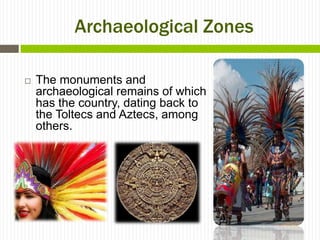
Archaeological Zones

   The monuments and
    archaeological remains of which
    has the country, dating back to
    the Toltecs and Aztecs, among
    others.
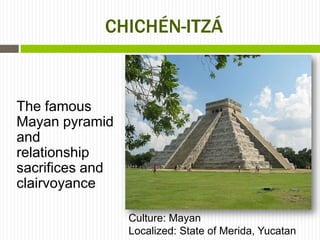
CHICHÉN-ITZÁ


The famous
Mayan pyramid
and
relationship
sacrifices and
clairvoyance

                 Culture: Mayan
                 Localized: State of Merida, Yucatan
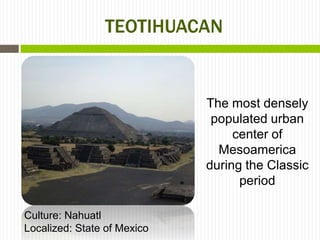
TEOTIHUACAN


                             The most densely
                              populated urban
                                  center of
                               Mesoamerica
                             during the Classic
                                   period

Culture: Nahuatl
Localized: State of Mexico
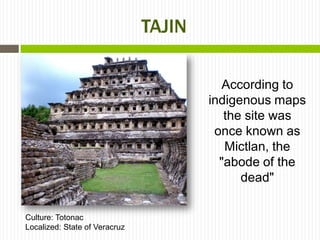
TAJIN

                                          According to
                                       indigenous maps
                                          the site was
                                        once known as
                                          Mictlan, the
                                         "abode of the
                                             dead"

Culture: Totonac
Localized: State of Veracruz
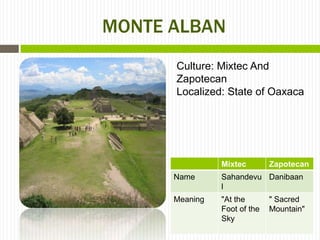
MONTE ALBAN
      Culture: Mixtec And
      Zapotecan
      Localized: State of Oaxaca


                Mixtec        Zapotecan
      Name      Sahandevu Danibaan
                l
      Meaning   "At the       " Sacred
                Foot of the   Mountain"
                Sky
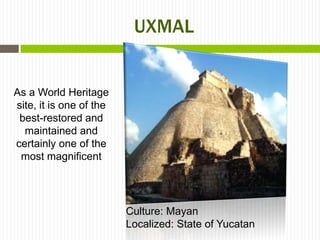
UXMAL


As a World Heritage
site, it is one of the
 best-restored and
  maintained and
certainly one of the
 most magnificent


                         Culture: Mayan
                         Localized: State of Yucatan
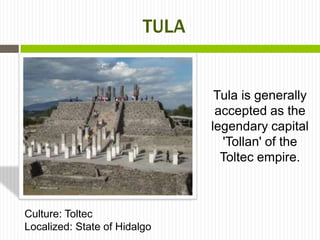
TULA


                                 Tula is generally
                                 accepted as the
                                legendary capital
                                  'Tollan' of the
                                  Toltec empire.


Culture: Toltec
Localized: State of Hidalgo
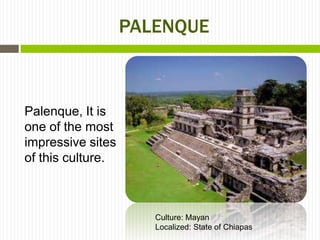
PALENQUE


Palenque, It is
one of the most
impressive sites
of this culture.


                      Culture: Mayan
                      Localized: State of Chiapas
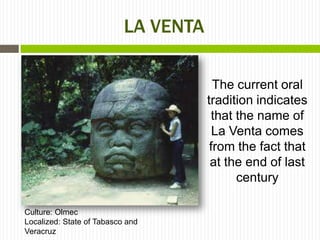
LA VENTA

                                        The current oral
                                      tradition indicates
                                       that the name of
                                        La Venta comes
                                       from the fact that
                                       at the end of last
                                            century

Culture: Olmec
Localized: State of Tabasco and
Veracruz
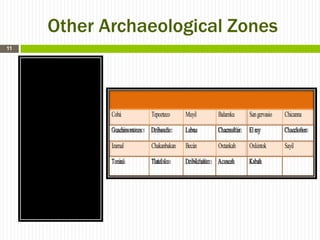
Other Archaeological Zones
11


            Cobá             Tepozteco     Muyil           Balamku      San gervasio   Chicanna

            Guachimontones   Dzibanche     Labna           Chacmultún   El rey         Chacchoben

            Izamal           Chakanbakan   Becán           Oxtankah     Oxkintok       Sayil

            Toniná           Tlatelolco    Dzibilchaltun   Acanceh      Kabah
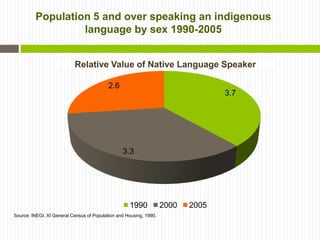
Population 5 and over speaking an indigenous
                  language by sex 1990-2005


                           Relative Value of Native Language Speaker

                                           2.6
                                                                                  3.7


                                                 3.3


                                                    1990            2000   2005
Source: INEGI. XI General Census of Population and Housing, 1990.
Bibliography
   http://yucatantoday.com/en/topics/chichen-itza
   http://wikitravel.org/en/Tulum
   http://www.delange.org/ElTajin/ElTajin.htm
   http://yucatantoday.com/en/topics/uxmal
   http://www.elclima.com.mx/zona_arqueologica_la_venta.htm
   http://www.ancient-wisdom.co.uk/mexicotula.htm
   http://www.mexconnect.com/articles/960-paquime-casas-grandes-
    chihuahua
   http://listas.20minutos.es/lista/zonas-arqueologicas-de-mexico-
    34047/
   http://www.scielo.org.ar/scielo.php?pid=S1850-
    00132011000100003&script=sci_arttext
   http://www.inegi.org.mx/prod_serv/contenidos/espanol/bvinegi/prod
    uctos/integracion/sociodemografico/mujeresyhombres/hym_09/myh
    _edo_mex.pdf

Archaeological

  • 1.
  • 2.
    Archaeological Zones  The monuments and archaeological remains of which has the country, dating back to the Toltecs and Aztecs, among others.
  • 3.
    CHICHÉN-ITZÁ The famous Mayan pyramid and relationship sacrificesand clairvoyance Culture: Mayan Localized: State of Merida, Yucatan
  • 4.
    TEOTIHUACAN The most densely populated urban center of Mesoamerica during the Classic period Culture: Nahuatl Localized: State of Mexico
  • 5.
    TAJIN According to indigenous maps the site was once known as Mictlan, the "abode of the dead" Culture: Totonac Localized: State of Veracruz
  • 6.
    MONTE ALBAN Culture: Mixtec And Zapotecan Localized: State of Oaxaca Mixtec Zapotecan Name Sahandevu Danibaan l Meaning "At the " Sacred Foot of the Mountain" Sky
  • 7.
    UXMAL As a WorldHeritage site, it is one of the best-restored and maintained and certainly one of the most magnificent Culture: Mayan Localized: State of Yucatan
  • 8.
    TULA Tula is generally accepted as the legendary capital 'Tollan' of the Toltec empire. Culture: Toltec Localized: State of Hidalgo
  • 9.
    PALENQUE Palenque, It is oneof the most impressive sites of this culture. Culture: Mayan Localized: State of Chiapas
  • 10.
    LA VENTA The current oral tradition indicates that the name of La Venta comes from the fact that at the end of last century Culture: Olmec Localized: State of Tabasco and Veracruz
  • 11.
    Other Archaeological Zones 11 Cobá Tepozteco Muyil Balamku San gervasio Chicanna Guachimontones Dzibanche Labna Chacmultún El rey Chacchoben Izamal Chakanbakan Becán Oxtankah Oxkintok Sayil Toniná Tlatelolco Dzibilchaltun Acanceh Kabah
  • 12.
    Population 5 andover speaking an indigenous language by sex 1990-2005 Relative Value of Native Language Speaker 2.6 3.7 3.3 1990 2000 2005 Source: INEGI. XI General Census of Population and Housing, 1990.
  • 13.
    Bibliography  http://yucatantoday.com/en/topics/chichen-itza  http://wikitravel.org/en/Tulum  http://www.delange.org/ElTajin/ElTajin.htm  http://yucatantoday.com/en/topics/uxmal  http://www.elclima.com.mx/zona_arqueologica_la_venta.htm  http://www.ancient-wisdom.co.uk/mexicotula.htm  http://www.mexconnect.com/articles/960-paquime-casas-grandes- chihuahua  http://listas.20minutos.es/lista/zonas-arqueologicas-de-mexico- 34047/  http://www.scielo.org.ar/scielo.php?pid=S1850- 00132011000100003&script=sci_arttext  http://www.inegi.org.mx/prod_serv/contenidos/espanol/bvinegi/prod uctos/integracion/sociodemografico/mujeresyhombres/hym_09/myh _edo_mex.pdf

Editor's Notes

  • #3 As for the historical monuments of Mexican law considers those monuments built between the sixteenth and nineteenth centuries, since the arrival of the Spanish until the last century. Below I will present some archaeological sites:
  • #4 The famous Mayan pyramids of Chichén-Itzá are over 1500 years old. Some believe people were occasionally thrown into the nearby cenote as sacrifices, and those who survived were believed to be seers.
  • #5 Teotihuacan is the highest peak during the Classic period.
  • #6 El Tajin the site derives its name from a modern Totonac belief that 12 old lords of the thunderstorm, known collectively as "Tajín," live among its ruins.
  • #7 The prehispanic name of Monte Alban has not been identified with precision but the most common names given by the Mixtec and Zapotecan are:
  • #8 Means "'built three times" in the Mayan language, and though its name is a mystery, its beauty is not.
  • #9 Tula is founded around 750 AD, at the same time as the Teotihuacan empire was in decline.
  • #10 Compared to other Maya cities, it is considered of medium size: less than Tikal or Copán, noted for its architectural and sculptural heritage.
  • #11 The current oral tradition indicates that the name of La Venta comes from the fact that at the end of last centuryto the place they called "La Venta".
  • #12 Mexico has many archaeological sites, some places more ancient and more recent, here are some examples: …among many others
  • #13 Another important aspect is to highlight the Relative Value of Native Language Speaker that includes men and women in different years.