Sensory Over-Responsivity and OCD:
How can Research Inform Practice?
Tamar Podoly, OT, Clinical Psychologist
Ayelet Ben-Sasson, OT, ScD
IOCDF 2016
Outline
• Concept: Sensory over-responsivity
• Research: How SOR and OC interplay?
• Theory: Why SOR and OC interplay?
• Practice: Sensory-based intervention
Sensory Over-Responsivity
• Type of sensory modulation disorder manifested by negative,
intense, rapid, prolonged responses towards daily sensations:
– Auditory, tactile, vision, taste, smell, vestibular
– Particularly in unstructured, unpredictable situations
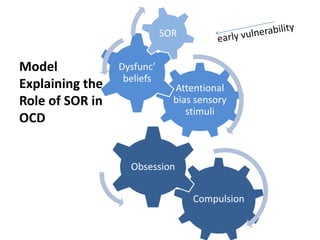
– Temporal and cumulative effects
– Indicators: avoidance, resistance, aggression vs. distress,
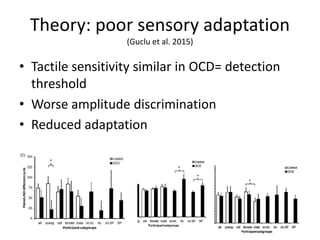
distractibility, irritability
• Affects 5% of pediatric population (Ahn et al., 2004)
• Prevalent in many developmental disorders such as in ASD and
ADHD (Ben-Sasson et al., 2009)
• SOR is an imbalance between sensitivity and habituation: high
sensitization and low habituation to stimuli
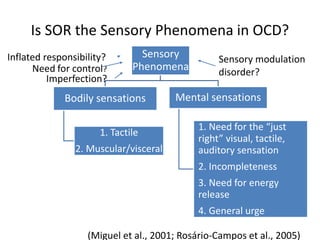
Is SOR the Sensory Phenomena in OCD?
Bodily sensations
1. Tactile
2. Muscular/visceral
Mental sensations
1. Need for the “just
right” visual, tactile,
auditory sensation
2. Incompleteness
3. Need for energy
release
4. General urge
Sensory
Phenomena
(Miguel et al., 2001; Rosário-Campos et al., 2005)
Inflated responsibility?
Need for control?
Imperfection?
Sensory modulation
disorder?
Outline
• Concept: Sensory over-responsivity
• Research: How SOR and OC interplay?
• Theory: Why SOR and OC interplay?
• Practice: Sensory-based intervention
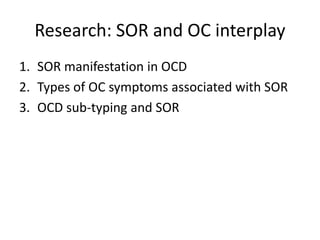
Research: SOR and OC interplay
1. SOR manifestation in OCD
2. Types of OC symptoms associated with SOR
3. OCD sub-typing and SOR
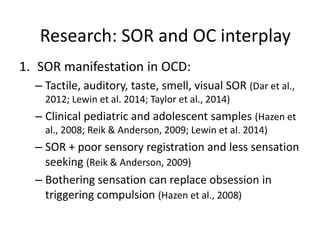
1. SOR manifestation in OCD:
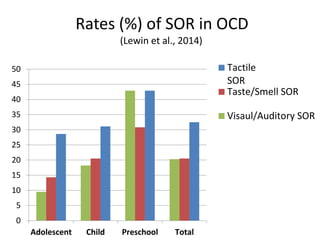
– Tactile, auditory, taste, smell, visual SOR (Dar et al.,
2012; Lewin et al. 2014; Taylor et al., 2014)
– Clinical pediatric and adolescent samples (Hazen et
al., 2008; Reik & Anderson, 2009; Lewin et al. 2014)
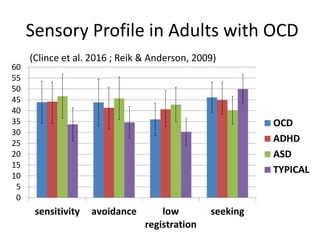
– SOR + poor sensory registration and less sensation
seeking (Reik & Anderson, 2009)
– Bothering sensation can replace obsession in
triggering compulsion (Hazen et al., 2008)
Research: SOR and OC interplay
Sensory Profile in Adults with OCD
0
5
10
15
20
25
30
35
40
45
50
55
60
sensitivity avoidance low
registration
seeking
OCD
ADHD
ASD
TYPICAL
(Clince et al. 2016 ; Reik & Anderson, 2009)
Rates (%) of SOR in OCD
(Lewin et al., 2014)
0
5
10
15
20
25
30
35
40
45
50
TotalPreschoolChildAdolescent
Tactile
SOR
Taste/Smell SOR
Visaul/Auditory SOR
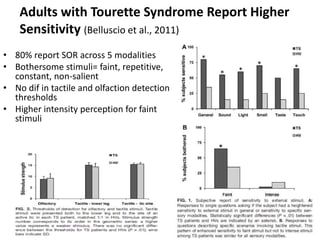
Adults with Tourette Syndrome Report Higher
Sensitivity (Belluscio et al., 2011)
• 80% report SOR across 5 modalities
• Bothersome stimuli= faint, repetitive,
constant, non-salient
• No dif in tactile and olfaction detection
thresholds
• Higher intensity perception for faint
stimuli
Research: SOR and OC interplay
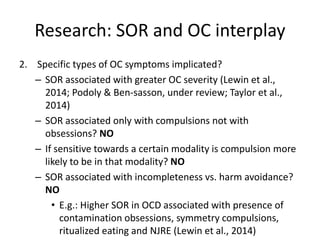
2. Specific types of OC symptoms implicated?
– SOR associated with greater OC severity (Lewin et al.,
2014; Podoly & Ben-sasson, under review; Taylor et al.,
2014)
– SOR associated only with compulsions not with
obsessions? NO
– If sensitive towards a certain modality is compulsion more
likely to be in that modality? NO
– SOR associated with incompleteness vs. harm avoidance?
NO
• E.g.: Higher SOR in OCD associated with presence of
contamination obsessions, symmetry compulsions,
ritualized eating and NJRE (Lewin et al., 2014)
OCD subtyping and SOR
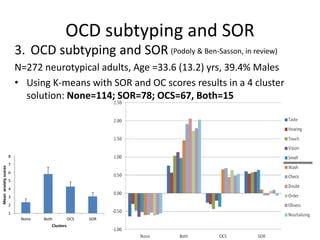
3. OCD subtyping and SOR
N=272 neurotypical adults, Age =33.6 (13.2) yrs, 39.4% Males
• Using K-means with SOR and OC scores results in a 4 cluster
solution: None=114; SOR=78; OCS=67, Both=15
1
2
3
4
5
6
7
8
None Both OCS SOR
Meananxietyscores
Clusters
(Podoly & Ben-Sasson, in review)
OCD subtyping and SOR
OCD + sensory symptoms are more likely to have:
• Early onset
• Elevated OC severity
• Have tics and co-morbid TS
• Anxiety and depression
• Response to pharmacological intervention
• Poor response to traditional interventions
(Ferrao et al., 2012; Shavitt et al., 2006; Summerfeldt, 2004; Wang
et al., 2012)
Outline
• Concept: Sensory over-responsivity
• Research: How SOR and OC interplay?
• Theory: Why SOR and OC interplay?
• Practice: Sensory-based intervention
Theory: Why SOR and OC interplay?
• SOR creates attention bias towards stimuli
which in turn leads to obsessive thoughts and
compulsions.
• SOR as a vulnerability factor for
psychopathology (Levit-Binnun et al., 2013)
• Anxiety mediates the relation between SOR
and OCD
Model
Explaining the
Role of SOR in
OCD
Compulsion
Obsession
Attentional
bias sensory
stimuli
Dysfunc’
beliefs
SOR
Theory: poor sensory adaptation
(Guclu et al. 2015)
• Tactile sensitivity similar in OCD= detection
threshold
• Worse amplitude discrimination
• Reduced adaptation
Outline
• Concept: Sensory over-responsivity
• Research: How SOR and OC interplay?
• Theory: Why SOR and OC interplay?
• Practice: Sensory-based intervention
Sensory based OCD-Identification
• Childhood and infancy history.
• Parents reports.
• Obsessions that involve specific body
sensations.
• Compulsions that involve avoidance of specific
body sensations.
Sensory based OCD- Assessment
SMD assessments available:
• Sensory Profile
• Sensory Over Responsivity Scale (SensorR)
• Sensory Processing Measure (SPM)
• Adult Sensory Questionnaire (ASQ)
• Adult Sensory Interview (ADULT-SI)
• Sensory Perception Quotient (SPQ)
• Sensory Habituation Questionnaire (S-HAB-Q)
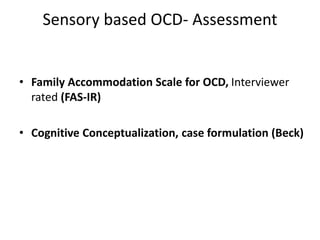
Sensory based OCD- Assessment
• Family Accommodation Scale for OCD, Interviewer
rated (FAS-IR)
• Cognitive Conceptualization, case formulation (Beck)
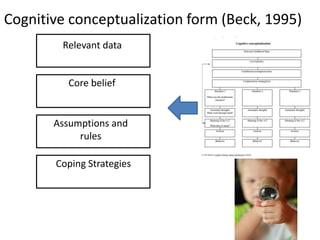
Cognitive conceptualization form (Beck, 1995)
Relevant data
Core belief
Assumptions and
rules
Coping Strategies
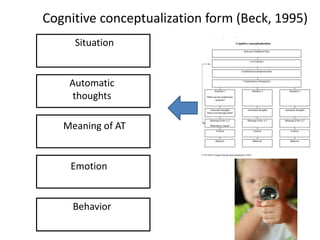
Cognitive conceptualization form (Beck, 1995)
Situation
Automatic
thoughts
Meaning of AT
Emotion
Behavior
Sensory based OCD-
Differential diagnosis
• ADHD
• ASD
• Schizophrenia
• Panic disorder
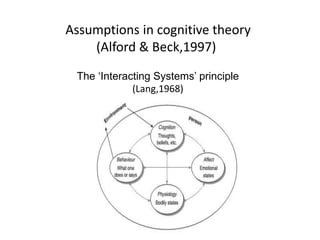
The ‘Interacting Systems’ principle
(Lang,1968)
Assumptions in cognitive theory
(Alford & Beck,1997)
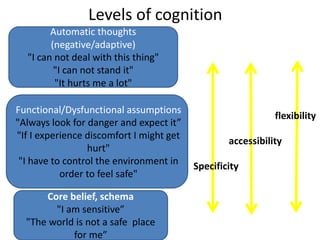
Levels of cognition
Automatic thoughts
(negative/adaptive)
"I can not deal with this thing"
"I can not stand it"
"It hurts me a lot"
Functional/Dysfunctional assumptions
"Always look for danger and expect it”
"If I experience discomfort I might get
hurt"
"I have to control the environment in
order to feel safe"
Core belief, schema
"I am sensitive”
"The world is not a safe place
for me”
Specificity
accessibility
flexibility
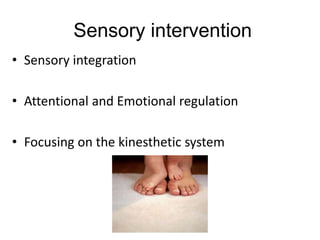
Sensory intervention
• Sensory integration
• Attentional and Emotional regulation
• Focusing on the kinesthetic system
Sensory intervention
self regulation
First order regulation – automatic, not controlled.
Second order regulation – controlled, Not always
conscious.
Third order regulation – controlled, conscious, and
requires high-functioning.
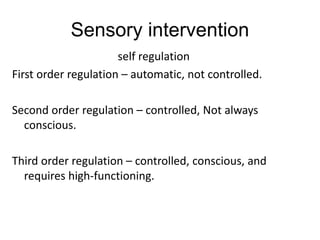
Sensory intervention
Arousal levels
Sensory system
Bottom
upTop-
down
Sensory based OCD
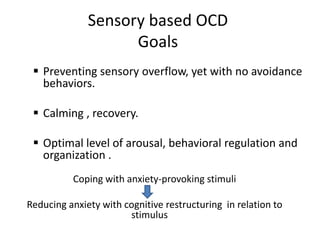
Goals
 Preventing sensory overflow, yet with no avoidance
behaviors.
 Calming , recovery.
 Optimal level of arousal, behavioral regulation and
organization .
Coping with anxiety-provoking stimuli
Reducing anxiety with cognitive restructuring in relation to
stimulus
Sensory based OCD
Techniques
• Psycho-education
• Use of sensory stimulation for regulation.
• Use of cognition for regulation.
• Gradual exposure (sensory based)
• Classic ERP
Adjustments for OCD
• Therapeutic contract with family/parents and client.
• High family/parental involvement.
• Interesting, funny and challenging exposures.
• Flexible sensory diet to avoid ritualization.
• Do not attack all fronts at once.
• Client control and lead the exposure.
The course of treatment
Phase I – Psycho-education
Phase II - Analysis of automatic thoughts
Phase III - Planning exposure.
Phase IV – Adjusting exposure to different settings.
Phase V – Exposure level, practices at home and at
school
Phase VI - When do you know that the treatment
has ended?
Psycho-education
• Sensory system
• Course of treatment
• Exposure
• Parents/children
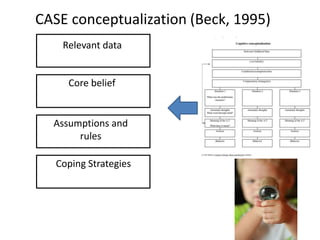
CASE conceptualization (Beck, 1995)
Relevant data
Core belief
Assumptions and
rules
Coping Strategies
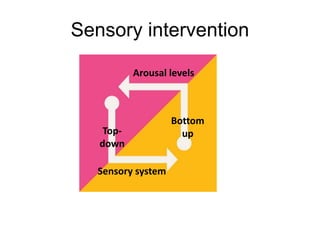
CASE conceptualization (Beck, 1995)
Situation
Automatic
thoughts
Meaning of AT
Emotion
Behavior
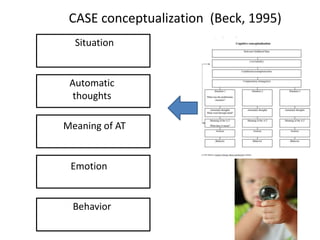
Exposure
Calming techniques
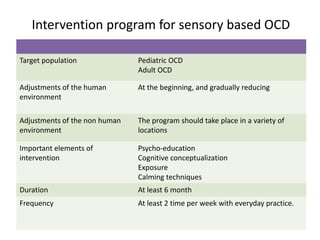
Intervention program for sensory based OCD
Target population Pediatric OCD
Adult OCD
Adjustments of the human
environment
At the beginning, and gradually reducing
Adjustments of the non human
environment
The program should take place in a variety of
locations
Important elements of
intervention
Psycho-education
Cognitive conceptualization
Exposure
Calming techniques
Duration At least 6 month
Frequency At least 2 time per week with everyday practice.
Selected References
Belluscio, B. A., Jin, L., Watters, V., Lee, T. H., & Hallett, M. (2011). Sensory sensitivity to external stimuli
in Tourette syndrome patients. Movement Disorders, 26(14), 2538-2543.
Conelea, C. A., Carter, A. C., & Freeman, J. B. (2014). Sensory Over-Responsivity in a Sample of Children
Seeking Treatment for Anxiety. Journal of Developmental & Behavioral Pediatrics, 35(8), 510-521.
Dar, R., Kahn, D.T., & Carmeli, R. (2012). The relationship between sensory processing, childhood rituals
and obsessive-compulsive symptoms. Journal of Behavior Therapy and Experimental Psychiatry,
43(1), 679-684.
Güçlü, B., Tanıdır, C., Çanayaz, E., Güner, B., İpek Toz, H., Üneri, Ö. Ş., & Tommerdahl, M. (2015). Tactile
processing in children and adolescents with obsessive–compulsive disorder. Somatosensory & motor
research, 32(3), 163-171.
Hazen, E.P., Reichert, E.L., Piacentini, J.C., Migule, E.C., Do Rosario, M.D., Pauls, D., & Geller, D.A. (2008).
Case Series: Sensory Intolerance as a Primary Symptom of Pediatric OCD. Annual Clinical Psychiatry,
20(4), 199–203.
Lewin, A.B., Wu, S.M., Murphy, T.K., & Storch. E.A. (2014). Sensory over-responsivity in pediatric
obsessive compulsive disorder. Journal of Psychopathology and Behavioral Assessment, 36, 201-211.
Podoly, T. & Ben-Sasson, A. (under review). Cluster analysis of sensory over-responsivity and obsessive
compulsive symptosm.
Rieke, E.F., & Anderson, D. (2009). Adolescent/adult sensory profile and obsessive– compulsive disorder.
American Journal of Occupational Therapy, 63, 138–145.
Summerfeldt, L. J. (2004). Understanding and Treating Incompleteness in Obsessive Compulsive
Disorder. Journal of Clinical Psychology, 60(11), 1155-1168.
Taylor, S., Conelea, C.A., McKay, D., Crowe, K.B., & Abramowitz, J.S. (2014). Sensory intolerance: latent
structure and psychopathologic correlates. Comprehensive Psychiatry, 55(5), 1279-1284.

Ayelet Ben Sasson - Sensory Over-Responsivity and OCD

  • 1.
    Sensory Over-Responsivity andOCD: How can Research Inform Practice? Tamar Podoly, OT, Clinical Psychologist Ayelet Ben-Sasson, OT, ScD IOCDF 2016
  • 2.
    Outline • Concept: Sensoryover-responsivity • Research: How SOR and OC interplay? • Theory: Why SOR and OC interplay? • Practice: Sensory-based intervention
  • 3.
    Sensory Over-Responsivity • Typeof sensory modulation disorder manifested by negative, intense, rapid, prolonged responses towards daily sensations: – Auditory, tactile, vision, taste, smell, vestibular – Particularly in unstructured, unpredictable situations – Temporal and cumulative effects – Indicators: avoidance, resistance, aggression vs. distress, distractibility, irritability • Affects 5% of pediatric population (Ahn et al., 2004) • Prevalent in many developmental disorders such as in ASD and ADHD (Ben-Sasson et al., 2009) • SOR is an imbalance between sensitivity and habituation: high sensitization and low habituation to stimuli
  • 4.
    Is SOR theSensory Phenomena in OCD? Bodily sensations 1. Tactile 2. Muscular/visceral Mental sensations 1. Need for the “just right” visual, tactile, auditory sensation 2. Incompleteness 3. Need for energy release 4. General urge Sensory Phenomena (Miguel et al., 2001; Rosário-Campos et al., 2005) Inflated responsibility? Need for control? Imperfection? Sensory modulation disorder?
  • 5.
    Outline • Concept: Sensoryover-responsivity • Research: How SOR and OC interplay? • Theory: Why SOR and OC interplay? • Practice: Sensory-based intervention
  • 6.
    Research: SOR andOC interplay 1. SOR manifestation in OCD 2. Types of OC symptoms associated with SOR 3. OCD sub-typing and SOR
  • 7.
    1. SOR manifestationin OCD: – Tactile, auditory, taste, smell, visual SOR (Dar et al., 2012; Lewin et al. 2014; Taylor et al., 2014) – Clinical pediatric and adolescent samples (Hazen et al., 2008; Reik & Anderson, 2009; Lewin et al. 2014) – SOR + poor sensory registration and less sensation seeking (Reik & Anderson, 2009) – Bothering sensation can replace obsession in triggering compulsion (Hazen et al., 2008) Research: SOR and OC interplay
  • 8.
    Sensory Profile inAdults with OCD 0 5 10 15 20 25 30 35 40 45 50 55 60 sensitivity avoidance low registration seeking OCD ADHD ASD TYPICAL (Clince et al. 2016 ; Reik & Anderson, 2009)
  • 9.
    Rates (%) ofSOR in OCD (Lewin et al., 2014) 0 5 10 15 20 25 30 35 40 45 50 TotalPreschoolChildAdolescent Tactile SOR Taste/Smell SOR Visaul/Auditory SOR
  • 10.
    Adults with TouretteSyndrome Report Higher Sensitivity (Belluscio et al., 2011) • 80% report SOR across 5 modalities • Bothersome stimuli= faint, repetitive, constant, non-salient • No dif in tactile and olfaction detection thresholds • Higher intensity perception for faint stimuli
  • 11.
    Research: SOR andOC interplay 2. Specific types of OC symptoms implicated? – SOR associated with greater OC severity (Lewin et al., 2014; Podoly & Ben-sasson, under review; Taylor et al., 2014) – SOR associated only with compulsions not with obsessions? NO – If sensitive towards a certain modality is compulsion more likely to be in that modality? NO – SOR associated with incompleteness vs. harm avoidance? NO • E.g.: Higher SOR in OCD associated with presence of contamination obsessions, symmetry compulsions, ritualized eating and NJRE (Lewin et al., 2014)
  • 12.
    OCD subtyping andSOR 3. OCD subtyping and SOR N=272 neurotypical adults, Age =33.6 (13.2) yrs, 39.4% Males • Using K-means with SOR and OC scores results in a 4 cluster solution: None=114; SOR=78; OCS=67, Both=15 1 2 3 4 5 6 7 8 None Both OCS SOR Meananxietyscores Clusters (Podoly & Ben-Sasson, in review)
  • 13.
    OCD subtyping andSOR OCD + sensory symptoms are more likely to have: • Early onset • Elevated OC severity • Have tics and co-morbid TS • Anxiety and depression • Response to pharmacological intervention • Poor response to traditional interventions (Ferrao et al., 2012; Shavitt et al., 2006; Summerfeldt, 2004; Wang et al., 2012)
  • 14.
    Outline • Concept: Sensoryover-responsivity • Research: How SOR and OC interplay? • Theory: Why SOR and OC interplay? • Practice: Sensory-based intervention
  • 15.
    Theory: Why SORand OC interplay? • SOR creates attention bias towards stimuli which in turn leads to obsessive thoughts and compulsions. • SOR as a vulnerability factor for psychopathology (Levit-Binnun et al., 2013) • Anxiety mediates the relation between SOR and OCD
  • 16.
    Model Explaining the Role ofSOR in OCD Compulsion Obsession Attentional bias sensory stimuli Dysfunc’ beliefs SOR
  • 17.
    Theory: poor sensoryadaptation (Guclu et al. 2015) • Tactile sensitivity similar in OCD= detection threshold • Worse amplitude discrimination • Reduced adaptation
  • 18.
    Outline • Concept: Sensoryover-responsivity • Research: How SOR and OC interplay? • Theory: Why SOR and OC interplay? • Practice: Sensory-based intervention
  • 19.
    Sensory based OCD-Identification •Childhood and infancy history. • Parents reports. • Obsessions that involve specific body sensations. • Compulsions that involve avoidance of specific body sensations.
  • 20.
    Sensory based OCD-Assessment SMD assessments available: • Sensory Profile • Sensory Over Responsivity Scale (SensorR) • Sensory Processing Measure (SPM) • Adult Sensory Questionnaire (ASQ) • Adult Sensory Interview (ADULT-SI) • Sensory Perception Quotient (SPQ) • Sensory Habituation Questionnaire (S-HAB-Q)
  • 21.
    Sensory based OCD-Assessment • Family Accommodation Scale for OCD, Interviewer rated (FAS-IR) • Cognitive Conceptualization, case formulation (Beck)
  • 22.
    Cognitive conceptualization form(Beck, 1995) Relevant data Core belief Assumptions and rules Coping Strategies
  • 23.
    Cognitive conceptualization form(Beck, 1995) Situation Automatic thoughts Meaning of AT Emotion Behavior
  • 24.
    Sensory based OCD- Differentialdiagnosis • ADHD • ASD • Schizophrenia • Panic disorder
  • 25.
    The ‘Interacting Systems’principle (Lang,1968) Assumptions in cognitive theory (Alford & Beck,1997)
  • 26.
    Levels of cognition Automaticthoughts (negative/adaptive) "I can not deal with this thing" "I can not stand it" "It hurts me a lot" Functional/Dysfunctional assumptions "Always look for danger and expect it” "If I experience discomfort I might get hurt" "I have to control the environment in order to feel safe" Core belief, schema "I am sensitive” "The world is not a safe place for me” Specificity accessibility flexibility
  • 27.
    Sensory intervention • Sensoryintegration • Attentional and Emotional regulation • Focusing on the kinesthetic system
  • 28.
    Sensory intervention self regulation Firstorder regulation – automatic, not controlled. Second order regulation – controlled, Not always conscious. Third order regulation – controlled, conscious, and requires high-functioning.
  • 29.
  • 30.
    Sensory based OCD Goals Preventing sensory overflow, yet with no avoidance behaviors.  Calming , recovery.  Optimal level of arousal, behavioral regulation and organization . Coping with anxiety-provoking stimuli Reducing anxiety with cognitive restructuring in relation to stimulus
  • 31.
    Sensory based OCD Techniques •Psycho-education • Use of sensory stimulation for regulation. • Use of cognition for regulation. • Gradual exposure (sensory based) • Classic ERP
  • 32.
    Adjustments for OCD •Therapeutic contract with family/parents and client. • High family/parental involvement. • Interesting, funny and challenging exposures. • Flexible sensory diet to avoid ritualization. • Do not attack all fronts at once. • Client control and lead the exposure.
  • 33.
    The course oftreatment Phase I – Psycho-education Phase II - Analysis of automatic thoughts Phase III - Planning exposure. Phase IV – Adjusting exposure to different settings. Phase V – Exposure level, practices at home and at school Phase VI - When do you know that the treatment has ended?
  • 34.
    Psycho-education • Sensory system •Course of treatment • Exposure • Parents/children
  • 35.
    CASE conceptualization (Beck,1995) Relevant data Core belief Assumptions and rules Coping Strategies
  • 36.
    CASE conceptualization (Beck,1995) Situation Automatic thoughts Meaning of AT Emotion Behavior
  • 37.
  • 38.
  • 39.
    Intervention program forsensory based OCD Target population Pediatric OCD Adult OCD Adjustments of the human environment At the beginning, and gradually reducing Adjustments of the non human environment The program should take place in a variety of locations Important elements of intervention Psycho-education Cognitive conceptualization Exposure Calming techniques Duration At least 6 month Frequency At least 2 time per week with everyday practice.
  • 40.
    Selected References Belluscio, B.A., Jin, L., Watters, V., Lee, T. H., & Hallett, M. (2011). Sensory sensitivity to external stimuli in Tourette syndrome patients. Movement Disorders, 26(14), 2538-2543. Conelea, C. A., Carter, A. C., & Freeman, J. B. (2014). Sensory Over-Responsivity in a Sample of Children Seeking Treatment for Anxiety. Journal of Developmental & Behavioral Pediatrics, 35(8), 510-521. Dar, R., Kahn, D.T., & Carmeli, R. (2012). The relationship between sensory processing, childhood rituals and obsessive-compulsive symptoms. Journal of Behavior Therapy and Experimental Psychiatry, 43(1), 679-684. Güçlü, B., Tanıdır, C., Çanayaz, E., Güner, B., İpek Toz, H., Üneri, Ö. Ş., & Tommerdahl, M. (2015). Tactile processing in children and adolescents with obsessive–compulsive disorder. Somatosensory & motor research, 32(3), 163-171. Hazen, E.P., Reichert, E.L., Piacentini, J.C., Migule, E.C., Do Rosario, M.D., Pauls, D., & Geller, D.A. (2008). Case Series: Sensory Intolerance as a Primary Symptom of Pediatric OCD. Annual Clinical Psychiatry, 20(4), 199–203. Lewin, A.B., Wu, S.M., Murphy, T.K., & Storch. E.A. (2014). Sensory over-responsivity in pediatric obsessive compulsive disorder. Journal of Psychopathology and Behavioral Assessment, 36, 201-211. Podoly, T. & Ben-Sasson, A. (under review). Cluster analysis of sensory over-responsivity and obsessive compulsive symptosm. Rieke, E.F., & Anderson, D. (2009). Adolescent/adult sensory profile and obsessive– compulsive disorder. American Journal of Occupational Therapy, 63, 138–145. Summerfeldt, L. J. (2004). Understanding and Treating Incompleteness in Obsessive Compulsive Disorder. Journal of Clinical Psychology, 60(11), 1155-1168. Taylor, S., Conelea, C.A., McKay, D., Crowe, K.B., & Abramowitz, J.S. (2014). Sensory intolerance: latent structure and psychopathologic correlates. Comprehensive Psychiatry, 55(5), 1279-1284.

Editor's Notes

  • #3 OC = Obsessive Compulsive Symptoms As opposed to disorders
  • #4 Consider including a neurological slide in which the modulation is presented Consider talking about this not being a clinical dx of itself according to DMS V? Show the NY Ti mes slide about SOR I have? תמר תחליף תרשים
  • #5 ISOR is rarely a target in practice: 1. Cognitive and affective interpretation of symptoms 2. Less OT services in OCD Interpreted as a cognitive phenomena: imperfection? inflated responsibility? need for control? Rate in OCD? Considering the sensory phenomena subtypes, 371 (57.0%) patients had musculoskeletal sensations, 519 (79.7%) had externally triggered “just-right” perceptions FERRO 2011
  • #6 OC = Obsessive Compulsive Symptoms As opposed to disorders
  • #7 Show Riek and Anderson Graph Show Cluster Analysis Graph from our study Gluco, Belocio, Hazen, Taylor, Lewin, Dar, Dar
  • #8 תמר האם יש תרשימים מרשימים באחד המאמרים האחרים ששווה להציג פה כגון אצל הניסויים בתחום החושי?
  • #9 Talk about the three types of SMD presented here Compare OCD ADHD ASD TYP GUCLU ? CLINCE only adults in ADHD TYP AND ASD REIK OCD AND TYP ADULTS (7 WITH ADHD
  • #10 Do we have these rates for adults? If not c ompare to the previous slide מעל 2 סת
  • #11 Guclo?
  • #12 Show Riek and Anderson Graph Show Cluster Analysis Graph from our study Gluco, Belocio, Hazen, Taylor, Lewin, Dar, Dar
  • #13 ADD Wilk’s F? להחליף תרשים של צבירים עם תרשים של ממוצעים ולא ציוני תקן כי המודל המתואר התייחס לציונים הרגילים ולא התקן? Both: higher tactile, taste, smell, vision Both=SOR in auditory Both>OCS in all OCI SOR>OCS obsess, neutralize Add: oth unique in elevated tactile vision taste SOR while NONE cluster was significantly lower than all other clusters. BOTH and OCS did not differ. SOR cluster was significantly lower than BOTH, but it did not differ from OCS cluster (p > .05). See figure 3 for mean anxiety by cluster.
  • #14 
  • #15 OC = Obsessive Compulsive Symptoms As opposed to disorders
  • #16 Causal relation? OCD elevates arousal which leads to SOR
  • #17 “Repeated sensations of discomfort can become obsessions, and can promote ritualistic and compulsive behavior, designed to avoid these feelings “
  • #18 “A stronger explanation for these three main findings (similar detection threshold, worse discrimination, reduced adaptation) is a scaling factor which modifies the incoming sensory signal in OCD. In order to achieve normal Weber fractions internally (Gu¨c¸lu¨ 2007), this factor should change nonlinearly, with a decreasing slope at higher input levels.”
  • #19 OC = Obsessive Compulsive Symptoms As opposed to disorders
  • #21 https://books.google.co.il/books?id=duoMBwAAQBAJ&pg=PA227&lpg=PA227&dq=sensory+over+responsivity+scale&source=bl&ots=7ZzurBgge9&sig=KaEGEuMuLYkLZQjGvCFG_SO7mic&hl=en&sa=X&sqi=2&ved=0ahUKEwil7-vMs4fNAhVpI8AKHZGGAhkQ6AEIZTAJ#v=onepage&q=sensory%20over%20responsivity%20scale&f=false
  • #22 https://books.google.co.il/books?id=duoMBwAAQBAJ&pg=PA227&lpg=PA227&dq=sensory+over+responsivity+scale&source=bl&ots=7ZzurBgge9&sig=KaEGEuMuLYkLZQjGvCFG_SO7mic&hl=en&sa=X&sqi=2&ved=0ahUKEwil7-vMs4fNAhVpI8AKHZGGAhkQ6AEIZTAJ#v=onepage&q=sensory%20over%20responsivity%20scale&f=false
  • #29 ויסות מסדר ראשון – אוטומטי, לא נשלט:נשימה, חום גוף, מעגלי שינה וערות, לחץ דם. ויסות מסדר שני – לא תמיד מודע, אך נשלט: מיקוד מבט, סינכרון בין נשימה ובליעה, שימוש בתנועה ועוד. ויסות מסדר שלישי – דורש יכולת קוגניטיבית גבוהה, תפקודים אקזקוטיבים, מודע ונשלט. פתרון בעיות, ניתור עצמי, בחירת מטרות וכו.
  • #38 מה מנחה אותי בבחירת החשיפות
  • #40 להוסיף את חשיבות החשיפות וההרגעה כחלק מהטיפול.