vint research report: 1 of 4 
VINT research report: 2 of 4 
VINT research report: 3 of 4 
VINT research report: 4 of 4 
Creating clarity with Big Data 
Jaap Bloem 
Menno van Doorn 
Sander Duivestein 
Thomas van Manen 
Erik van Ommeren 
VINT | Vision • Inspiration • Navigation • Trends 
vint.sogeti.com 
vint@sogeti.nl
Table of contents 
The vint Big Data research reports 3 
1 Digital data as the new industrial revolution 4 
2 Total data management in each organization 7 
3 Participate in our Big Data discussion at 
www.sogeti.com/vint/bigdata/questions 9 
4 Why the word “Big”? 11 
5 The importance of Big Data 13 
6 Big Data is Extreme Information Management 16 
7 Big Data in organizations in the year 2012 18 
8 With Big Data from Big Science to Big Business 22 
9 Big Data as new Data Science era 24 
10 Closing the knowledge gap is essential 25 
11 Big Data in hard cash 27 
Summary and Social Business Analytics 29 
Literature and illustrations 30 
2nd edition, August 2012 
2012 The Sogeti Trend Lab vint 
LINE UP boek en media bv, Groningen, the Netherlands VINT | Vision • Inspiration • Navigation • Trends
The vint Big Data research reports 3 
Since 2005, when the term “Big Data” was launched – by O’Reilly Media 
remarkably enough, which had coined Web 2.0 a year previously – Big Data 
has become an increasingly topical theme. In terms of technological devel-opment 
and business adoption, the domain of Big Data has made powerful 
advances; and that is putting it mildly. 
In this initial report on Big Data, the first of four, we give answers to ques-tions 
concerning what exactly Big Data is, where it differs from existing data 
classification, how the transformative potential of Big Data can be esti-mated, 
and what the current situation (2012) is with regard to adoption and 
planning. 
vint attempts to create clarity in these developments by presenting experi-ences 
and visions in perspective: objectively and laced with examples. But 
not all answers, not by a long way, are readily available. Indeed, more ques-tions 
will arise – about the roadmap, for example, that you wish to use for 
Big Data. Or about governance. Or about the way you may have to revamp 
your organization. About the privacy issues that Big Data raises, such as 
those involving social analytics. And about the structures that new algorithms 
and systems will probably bring us. 
The new data focus is a quest involving many issues, at the start of and cer-tainly 
during the entire journey. That is why we will be pleased to exchange 
thoughts with you: online, at www.sogeti.com/vint/bigdata/questions, and in 
personal conversations, of course. By actively participating in the discussion, 
you can sharpen your (and our) ideas with respect to Big Data and come 
to progressive insights for taking lucid and responsible decisions. In this 
way, we jointly determine the concrete substantiation of the coming three 
research reports after this kick-off on the topic of Big Data. 
For inspiration, we have included seven questions to which we would very 
much like to receive a response or, rather, your opinion. You can click on 
the relevant buttons in the pdf version of this document. You will then be 
directly transported to the discussion in question. 
Join the 
conversation
4 1 Digital data as the new industrial 
revolution 
In 2012, approximately forty years after the beginning of the information era, all eyes 
are now on its basis: digital data. This may not seem very exciting, but the influx of 
various data types, plus the speed with which the trend will continue, probably into 
infinity, is certainly striking. Data, data and more data: we are at the center of an 
expanding data universe, full of undiscovered connections. This is not abstract and 
general, but rather specific and concrete, as each new insight may be the entrance to 
a gold mine. This data explosion is so simple and fundamental that Joe Hellerstein of 
Berkeley University speaks of ‘a new industrial revolution’: a revolution on the basis of 
digital data that form the engine of completely new business-operational and societal 
opportunities. 
At the beginning of May 2012, at the Cloud Computing Conference arranged by 
Goldman Sachs, Shaun Connolly from Hortonworks presented data as “The New 
Competitive Advantage.” Connolly articulated seven reasons for this statement, two 
of which were business-oriented, three were technological, and two were financial: 
Business reasons 
1. New innovative business models become possible 
2. New insights arise that give competitive advantages 
Technological reasons 
3. The generation and storage of data continue to grow exponentially 
4. We find data in various forms everywhere 
5. Traditional solutions do not meet new demands regarding complexity 
Financial reasons 
6. The costs of data systems continue to rise as a percentage of the it budget 
7. New standard hardware and open-source software offer cost benefits 
Connolly believes that, as a consequence of this combination, the traditional data 
world of business transactions is now beginning to merge with that of interactions 
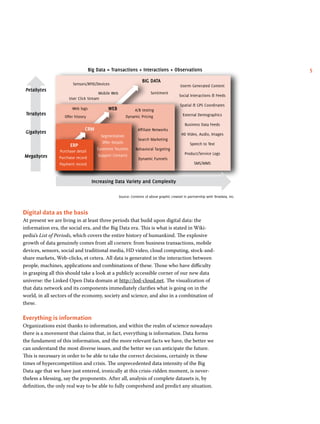
and observations. Applying the formula Big Data = Transactions + Interactions + 
Observations, the goal is now: more business, higher productivity and new commer-cial 
opportunities.
Big Data = Transactions + Interactions + Observations 5 
BIG DATA 
Increasing Data Variety and Complexity 
Source: Contents of above graphic created in partnership with Teradata, Inc. 
WEB 
CRM 
Petabytes 
Sensors/RFID/Devices Userm Generated Content 
Social Interactions & Feeds 
Spatial & GPS Coordinates 
External Demographics 
Business Data Feeds 
HD Video, Audio, Images 
Speech to Text 
Product/Service Logs 
SMS/MMS 
A/B testing 
Dynamic Pricing 
Affiliate Networks 
Search Marketing 
Behavioral Targeting 
Dynamic Funnels 
Segmentation 
Offer Details 
Customer Touches 
Support Contacts 
Purchase detail 
Purchase record 
Payment record 
Sentiment 
User Click Stream 
Web logs 
Offer history 
Mobile Web 
Terabytes 
Gigabytes 
Megabytes 
ERP 
Digital data as the basis 
At present we are living in at least three periods that build upon digital data: the 
information era, the social era, and the Big Data era. This is what is stated in Wiki-pedia’s 
List of Periods, which covers the entire history of humankind. The explosive 
growth of data genuinely comes from all corners: from business transactions, mobile 
devices, sensors, social and traditional media, HD video, cloud computing, stock-and-share 
markets, Web-clicks, et cetera. All data is generated in the interaction between 
people, machines, applications and combinations of these. Those who have difficulty 
in grasping all this should take a look at a publicly accessible corner of our new data 
universe: the Linked Open Data domain at http://lod-cloud.net. The visualization of 
that data network and its components immediately clarifies what is going on in the 
world, in all sectors of the economy, society and science, and also in a combination of 
these. 
Everything is information 
Organizations exist thanks to information, and within the realm of science nowadays 
there is a movement that claims that, in fact, everything is information. Data forms 
the fundament of this information, and the more relevant facts we have, the better we 
can understand the most diverse issues, and the better we can anticipate the future. 
This is necessary in order to be able to take the correct decisions, certainly in these 
times of hypercompetition and crisis. The unprecedented data intensity of the Big 
Data age that we have just entered, ironically at this crisis-ridden moment, is never-theless 
a blessing, say the proponents. After all, analysis of complete datasets is, by 
definition, the only real way to be able to fully comprehend and predict any situation.
6 
Data 
Information 
Knowledge 
Wisdom 
Context 
Past Future 
Understanding 
This argument has no leaks, and thanks to modern and affordable it – hardware, 
software, networks, algorithms and applications – analysis of complete datasets can 
now genuinely take off. 
Big Data case: loss of clients 
Until recently we were compelled to take random samples and analyze them. But 
how do you sample a network or a collection of subnetworks? If a telecom provider 
wishes to have insight into the circumstances under which a subnetwork of friends 
and acquaintances suddenly switches to a rival company (it “churns”), we are prob-ably 
dealing with a total of more than 10 million existing and recent subscribers, with 
information on their habits, their expenditures on services, and who their friends are: 
the number of times the phone is used for calls or sms messages, for example. We 
are dealing with tipping points: a part of the subnetwork churns and the rest follow 
after a (short) time. In itself, this is rather predictable: if colleagues or friends have 
switched and are better off or cheaper out under a rival, then there is a social and 
economic stimulus to switch as well. A provider will, of course, attempt to prevent 
this situation arising and must take a hard look at all the data. For example, if a 
random sample is taken from a million clients, the circles of friends that formed the 
basis of the switch can no longer be seen as a unit, and therefore in this case the basis 
for accurate prediction crumbles. Therefore, sampling is not the appropriate method 
here. In order to obtain a good view of the tipping points we must examine all the 
data in their proper context and coherence. Then, on the basis of developing pat-terns, 
we can anticipate their churn at an early stage and apply retention actions and 
programs. 
Detection of fraud 
Another area for which we require a complete dataset is fraud detection. The signal is 
so small that it is impossible to work with random samples until the signal has been 
identified. Accordingly, all data must be analyzed in this field as well. It can justifi- 
Join the 
conversation 
Question 1 
Will facts now definiti-vely 
defeat intuition? 
www.sogeti.com/vint/r1q1
ably be referred to as an evident case of Big Data when the possibility of ‘collusion’ is 7 
being examined: illegal collaboration that is directed toward impeding others as much 
as possible and of sabotaging them, as occurs in the casino world. Churn and fraud 
detection are examples of the application possibilities of Big Data Analytics (see also 
Section 7). 
Big Data Success Stories 
In October 2011, under the title Big Data Success Stories, ibm published an illustrative 
reader with twelve different case studies, to demonstrate what Big Data actually signi-fies. 
We shall also respond to that issue here, in the following section and in Section 7, 
“Big Data in organizations in the year 2012.” For the moment we shall proceed from 
the fact that Big Data Analysis goes further than what traditional relational databases 
can offer, and that current trends are moving toward the use of an increasing number 
of new data types. With all the empirical data that are there for the taking, it seems as 
if, in the future, we will only need to examine the facts in a smart way so that theory 
and model-forming, as intermediate steps, can ultimately be skipped. This Big Data 
promise was articulated as far back as 2008, in an article entitled “The End of Theory: 
The Data Deluge Makes the Scientific Method Obsolete”. 
2 Total data management in each 
organization 
Big Data, the enormous data expansion that is spreading rapidly in all respects, 
demands total data management in every organization. This fact has been underlined 
by many experts, including The 451 Group. 
An increasing quantity of data is arriving from all kinds of sources: from traditional 
transactional data to sensors and rfid tags, not forgetting social media, Internet, 
clouds and mobile devices. It no longer matters whether data is structured, semi-structured 
or unstructured, as current it solutions for data acquisition and process-ing, 
and their affordability are thriving at the same time. 
Data growth surpasses Moore’s Law 
Although the flood of data now exceeds Moore’s Law – every 18 months a doubling 
of the number of transistors per square inch on integrated circuits takes place against 
increasingly lower cost – we are still able to deal with the data deluge in a meaningful 
way. This is possible due to advanced hardware, software, networks and data technol-ogies. 
In short, we are capable, along with a well-trained workforce, of exploiting the 
entire data field. Anyone who can do this well, stated Gartner in their presentation
8 entitled “Information Management Goes ‘Extreme’: The Biggest Challenges for 21st 
Century cios”, can achieve 20% better than competitors who do not do so: 
Through 2015, organizations integrating high-value, diverse new information types 
and sources into a coherent information management infrastructure will outper-form 
their industry peers financially by more than 20%. 
The rules of the game remain the same, but the tactics have changed. Just as always, 
we wish to process information from raw data and extract intelligent new insights 
that enable better and faster business decisions. Big Data is actually an appeal to 
organizations to elevate their Business Intelligence efforts to a radically higher level: 
on the basis of the appropriate technology, the proper processes, the right roles and 
the relevant knowledge and expertise, called ‘Data Science’. This must be practised 
throughout the entire organization and constantly. 
Big Data is a new phase 
Big or Total Data constitutes a new phase in the trend that was quantified by mit 
Sloan Management Review and the ibm Institute for Business Value in 2010, in their 
study entitled Analytics: The New Path to Value. Almost half of the best-achieving 
organizations, it turned out, used digital data for their long-term strategies, in con-trast 
to only a fifth of the underperformers. With regard to daily operations, this was 
even more than half of the top-performers against slightly more than a quarter of the 
poorly achieving organizations. The conclusion must be drawn that priority must be 
given to an analysis of the full array of digital data. 
Use insights to 
guide future 
strategies 
Use insights to 
guide day-to-day 
operations 
45% 
20% 
53% 
27% 
Top performers Lower performers 
Of course, organizations do not wish to discard this type of advice, all the more 
because it builds logically upon existing Business Intelligence and the target of 
economic profit. But various demands and requirements must be dealt with and put 
in place. In addition to the potential and promise of Big Data, we shall also cover 
this aspect in our research report. The ambition of all our four Big Data reports is 
to exchange thoughts with you on the topic of this important subject matter, and to 
jointly explore the possibilities. 
Join the 
conversation 
Question 2 
How do you link real-time 
Big Data to the 
operational supervision 
of your company? 
www.sogeti.com/vint/r1q2
3 Participate in our Big Data 9 
discussion at www.sogeti.com/ 
vint/bigdata/questions 
The Big Data issues about which we would like to exchange ideas and experiences, on 
the basis of the research report before you, are threefold: 
A. Your Big Data profile: what does that look like? 
B. Ten Big Data management challenges: what are your issues? 
C. Five requirements for your Big Data project: are you ready? 
Note: 
Interaction on this and related matters occurs on our website, and also face-to- 
face as far as we are concerned. We shall share new research insights with 
you on a weekly basis, via blog posts, e-mail and Twitter alerts. The accom-panying 
video material, presenting leading experts, is intended as inspira-tion 
to think through and discuss the entire theme of Big Data from various 
angles. 
A. Your Big Data profile: what does that look like? 
Big Data is concerned with exceptionally large, often widespread bundles of semi-structured 
or unstructured data. In addition, they are often incomplete and not 
readily accessible. “Exceptionally large” means the following, measured against the 
extreme boundaries of current standard it and relational databases: petabytes of 
data or more, millions of people or more, billions of records or more, and a complex 
combination of all these. With fewer data and greater complexity, you will encoun-ter 
a serious Big Data challenge, certainly if your tools, knowledge and expertise are 
not fully up to date. Moreover, if this is the case, you are not prepared for future data 
developments. Semi-structured or unstructured means that the connections between 
data elements are not clear, and probabilities will have to be determined. 
B. Ten Big Data management challenges: what are your issues? 
1. How are you coping with the growing quantities of semi-structured and unstruc-tured 
data? It has been estimated that 80 per cent of the data most valuable to 
organizations are located outside the traditional relational data-warehousing and 
data-mining to which Business Intelligence has been primarily oriented until now. 
2. Those new valuable data come from a range of different data types and data 
sources. Do you know which of these are important for your business and do you 
have a plan to apply them strategically?
10 3. Do you have an overall view of the complexity of your data, either independently or 
in combination? And do you know what exactly you want to know in which order 
of sequence. Now and in the future? 
4. New insights obtained from the combination of structured and unstructured data 
may have an imminent expiry date. Are you aware of the desired speed of process-ing 
and analyzing various data and data combinations? Which issues that you 
might wish to solve require a real-time approach? Please keep in mind that real-time 
processes are needed to enable real-time decisions. 
5. Have you thought about the costs of your new data management? How are they 
structured: according to data domains, technology and expertise, for instance? 
6. The storage of all data that you wish to analyze and stockpile will probably make 
new demands upon your it infrastructure. Do you have any kind of plan to deal 
with this, and are you also watching performance? 
7. What is the state of your data security system? 
8. The storage and security of Big Data is of major importance with regard to your 
data governance, risk management and compliance. Are you involving the appro-priate 
departments and people in your Big Data activities? 
9. Generating new business insights from large quantities of data requires an orga-nization- 
wide approach. New knowledge and expertise are needed for this. Are 
they available in your organization and how can these be guaranteed and further 
developed? 
10. Do you know what your Big or Total Data efforts mean for your energy use? 
C. Five requirements for your Big Data project: are you ready? 
On the basis of the above-listed management challenges, we now summarize five 
fundamental conditions that are collectively needed in order for you to embark confi-dently 
on a concrete Big Data project: 
1. Your organization has at its disposal the right mindset and culture. There is no 
doubt, throughout the whole organization, about the usefulness of a Big or Total 
Data approach, you know where you want to begin, and what the targets for the 
future are. 
2. There is sufficient management support and it is evident who the executive spon-sors 
are. 
3. The required expertise and experience with regard to Data Science and Big Data 
frameworks and tools are available and guaranteed. 
4. Sufficient budget has been allocated for the necessary training, in order to ensure 
that the required expertise and experience, mindset and culture will bond. 
5. There are adequate resources and budget for the development of Big Data applica-tions, 
and you have selected the right partners and suppliers in this context. 
Join the 
conversation 
Question 3 
What is the best approach 
to capture positive attention 
among the management? 
www.sogeti.com/vint/r1q3
4 Why the word “Big”? 11 
We refer to something as “big” – Big Mac for example – to draw attention to its vol-ume. 
But if we supply no relevant image, the word “big” immediately evokes funda-mental 
questions. That is also exactly the case with Big Data, and also with the related 
Big Science. How large is Big Data actually, and in relation to what? 
“Big” is not a particularly handy term 
Accordingly, the analysts at Forrester and at Gartner agree completely with this state-ment: 
in retrospect, “big” is perhaps not a convenient name for the flood of data that 
is increasing at an enormous pace. Both research companies, and others with them, 
prefer to use “extreme” rather than “big.” That term also has a longer history in the 
field of statistics. 
In everyday life, “big” refers to very concrete oversize phenomena. But inconceivably 
high quantities of digital data are not perceived by the eye. In addition, more is hap-pening 
than “quantity” alone. 
Big Data and Web 2.0 
It is no coincidence that O’Reilly Media introduced the term “Big Data” a year after 
Web 2.0 appeared, as many valuable Big Data situations are indeed related to con-sumer 
conduct. Web 2.0 provided the impulse to rethink the interaction that was 
taking place on Internet, and to push it somewhat further. In much the same way, the 
qualification “Big Data” calls attention to the business possibilities of the flood of data 
on the one hand, and the new technologies, techniques and methods that are directed 
toward these, on the other. 
A simple answer 
As mentioned, the increase in data has now exceeded Moore’s Law. Various types 
of data in combination with the necessary speed of analysis now form the greatest 
challenge, although we must not forget the limited number of people who can deal 
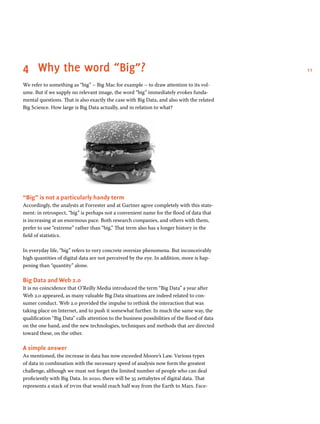
proficiently with Big Data. In 2020, there will be 35 zettabytes of digital data. That 
represents a stack of dvds that would reach half way from the Earth to Mars. Face-
12 book has 70 petabytes and 2700 multiprocessor nodes. The Bing search engine has 
150 petabytes and 40,000 nodes. But what does Big Data exactly signify for organiza-tions? 
We can approach Big Data from the standpoint of the issues, but also from the 
standpoint of the solutions. The simplest response comes from Forrester Research 
and is as follows: 
Big Data: Techniques and Technologies that Make Handling Data at Extreme Scale 
Economical. 
Just like The 451 Group and Gartner, Forrester also makes no distinction between Big 
and Little Data. Compared to bygone times, many new and different data have arrived 
on the scene, and this is an ongoing process; but data remain data. They go hand in 
hand, and we can only truly advance further if there is well-thought-out integration of 
the whole spectrum of various orders of magnitude. We are dealing with a single data 
spectrum, a single continuum, and that is what organizations ought to be strategically 
exploring step by step. 
One large data continuum 
Around thirty years ago, this also applied to the growth of scientific activity: large and 
small. In his book entitled Reflections on Big Science (1967), the atomic scientist Alvin 
Weinberg wrote: 
The scientific enterprise, both Little Science and Big Science, has grown explosively 
and has become very much more complicated. 
This observation referred to science at that time, and it now refers precisely to what 
is happening in the realm of data. Check what Chirag Metha has to say. As a Technol-ogy, 
Design & Innovation Strategist, Metha was associated with the Office of the ceo 
at sap: 
Today, technology — commodity hardware and sophisticated software to leverage 
this hardware — changes the way people think about small and large data. It’s a 
data continuum. [...] Big Data is an amalgamation of a few trends – data growth 
of a magnitude or two, external data more valuable than internal data, and shift in 
computing business models. [...] Big Data is about redefining what data actually 
means to you. [... ] This is not about technology. This is about a completely new way 
of doing business where data finally gets the driver’s seat. 
Big Data does not at all mean to say that we ought to forget Little or Small Data, 
or Medium, Large et cetera. On the contrary, it is important that we can and must 
review all the data in all their forms. It is possible technologically, and desirable, if not 
essential, businesswise.
Complex, Unstructured 13 
• Text 
• Images 
• Audio 
• Video 
• ... 
Relational 
Stored Digital Information 
(exabytes) 
Web 
Application 
Data 
Business 
Transaction 
Data 
1970 1980 1990 2000 2010 
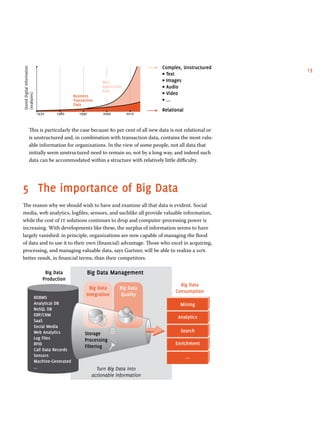
This is particularly the case because 80 per cent of all new data is not relational or 
is unstructured and, in combination with transaction data, contains the most valu-able 
information for organizations. In the view of some people, not all data that 
initially seem unstructured need to remain so, not by a long way, and indeed such 
data can be accommodated within a structure with relatively little difficulty. 
5 The importance of Big Data 
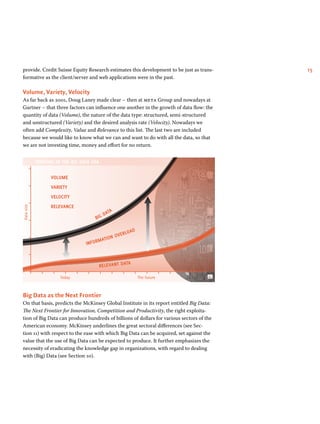
The reason why we should wish to have and examine all that data is evident. Social 
media, web analytics, logfiles, sensors, and suchlike all provide valuable information, 
while the cost of it solutions continues to drop and computer-processing power is 
increasing. With developments like these, the surplus of information seems to have 
largely vanished: in principle, organizations are now capable of managing the flood 
of data and to use it to their own (financial) advantage. Those who excel in acquiring, 
processing, and managing valuable data, says Gartner, will be able to realize a 20% 
better result, in financial terms, than their competitors. 
... 
RDBMS 
Analytical DB 
NoSQL DB 
ERP/CRM 
SaaS 
Social Media 
Web Analytics 
Log Files 
RFID 
Call Data Records 
Sensors 
Machine-Generated 
... 
Storage 
Processing 
Filtering 
Big Data 
Production 
Big Data Management 
Big Data 
Consumption 
Big Data 
Integration 
Big Data 
Quality 
Turn Big Data into 
actionable information 
Mining 
Analytics 
Search 
Enrichment
14 Within organizations, the share of unstructured data, such as documents, e-mail and 
images, is around 60 to 80 per cent. Of all data analyses that currently take place in 
organizations, 5 to 15 per cent contain a social component that enriches the struc-tured 
data. This number must increase, not least because of all the external data that 
can be included in the analyses. 
The Internet of Things is also becoming an increasingly rich source of data. At this 
moment, says Cisco cto Padmasree Warrior, there are 13 billion devices connected 
to the Internet and that will be 50 billion in 2020. idc expects more than 1 billion 
sensors to be connected to the Internet by that time. All the accompanying data flows 
can supply interesting insights that can aid better business decisions. 
We are at Big Data’s point of departure 
Banks belong to the top of the organizations that are engaged with Big Data but, in 
the report with the eloquent title Big Data: Harnessing a Game-changing Asset by 
the Economist Intelligence Unit, Paul Scholten, coo Retail & Private Banking at abn 
amro, candidly admits that the bank is in an exploratory phase when it comes to 
making good use of unstructured social data in particular: 
We are used to structured, financial data. [...] We are not so good at the unstruc-tured 
stuff. [...] The company is just beginning to understand the uses of social 
media, and what might be possible in terms of improving customer service. 
Mark Thiele states that it is interesting to compare Big Data in the year 2012 with the 
start of the World Wide Web. Thiele is the Executive vp Data Center Technology at 
Switch, the operator of the Supernap data center in Las Vegas, the largest and most 
powerful of its type in the world: 
Big Data today is what the web was in 1993. We knew the web was something and 
that it might get Big, but few of us really understood what “Big” meant. Today, we 
aren’t even scratching the surface of the Big Bata opportunity. 
No isolated phenomenon 
If there is one thing that has become clear, that is the fact that Big Data is not an iso-lated 
phenomenon. The word “big” emphasizes the quantitative aspect which fortu-nately 
immediately raises the necessary questions, so that we are compelled to think 
more profoundly about Big Data. 
In March 2012, Credit Suisse Equity Research published the report entitled The Apps 
Revolution Manifesto, Volume 1: The Technologies. The authors regard, in particular, 
the convergence of Service-Oriented Architecture, Cloud, Fast Data, Big Data, Social 
and Mobile as being determinative of the value that new enterprise applications can 
Join the 
conversation 
Question 4 
For organizations, what is 
the most important new 
rule of play with regard 
to Big Data? 
www.sogeti.com/vint/r1q4
provide. Credit Suisse Equity Research estimates this development to be just as trans- 15 
formative as the client/server and web applications were in the past. 
Volume, Variety, Velocity 
As far back as 2001, Doug Laney made clear – then at meta Group and nowadays at 
Gartner – that three factors can influence one another in the growth of data flow: the 
quantity of data (Volume), the nature of the data type: structured, semi-structured 
and unstructured (Variety) and the desired analysis rate (Velocity). Nowadays we 
often add Complexity, Value and Relevance to this list. The last two are included 
because we would like to know what we can and want to do with all the data, so that 
we are not investing time, money and effort for no return. 
THRIVING IN THE BIG DATA ERA 
VOLUME 
Data size 
VARIETY 
VELOCITY 
RELEVANCE 
BIG DATA 
INFORMATION OVERLOAD 
RELEVANT DATA 
Today The future 
Big Data as the Next Frontier 
On that basis, predicts the McKinsey Global Institute in its report entitled Big Data: 
The Next Frontier for Innovation, Competition and Productivity, the right exploita-tion 
of Big Data can produce hundreds of billions of dollars for various sectors of the 
American economy. McKinsey underlines the great sectoral differences (see Sec-tion 
11) with respect to the ease with which Big Data can be acquired, set against the 
value that the use of Big Data can be expected to produce. It further emphasizes the 
necessity of eradicating the knowledge gap in organizations, with regard to dealing 
with (Big) Data (see Section 10).
16 6 Big Data is Extreme Information 
Management 
Gartner has now elaborated the basic model of Volume, Variety and Velocity into three 
layers, each with four dimensions (as shown in the illustration below). The resulting 
twelve factors dovetail together and must all be purposefully addressed in the informa-tion 
management of the 21 st century: separately and as a whole. 
Perishability Fidelity 
Validation Linking 
Classification Contracts 
Technology Pervasive Use 
Velocity Volume 
Variety Complexity 
In short, here we have, moving from the bottom to the top, the following: departing 
from the variety and complexity, in particular, of an increasing amount of data – often 
also in real-time – it is very possible to express validated statements and to establish 
connections on the basis of correct technological applications in combination with 
intensive input of all data, in order to elevate business decision making to a qualita-tively 
higher level. 
If we take Big Data as the point of departure, we find ourselves on the volume side, as 
the name indicates. Variety and speed are the other dimensions at that level. An extra 
addition is the complexity of not only the data but also of the ‘use cases’: the way in 
which all data is brought into association by means of relevant and constructive ques-
tioning. We have already presented a concrete typology on the basis of the formula 17 
Big Data = Transactions + Interactions + Observations in Section 1. 
The intermediate level is concerned with access and control. To start with, there 
are always agreements (Contracts) about which information precisely (Classifica-tion) 
should be recorded and how it can be used. Social media and cloud computing 
provide splendid opportunities, but new technology (Technology) is needed to ensure 
that the data can be used everywhere and at any time (Pervasive use). 
The top layer covers the reliability of information (Validation, Fidelity). It must be not 
only relevant and accurate when acquired (Perishability), but also in the use case. It is 
also important whether or not enrichment occurs in combination with other informa-tion 
(Linking). 
Altogether, in a Big Data context, organizations must respond to the six well-known 
standard questions: what, when, why, where, who and how? The first four cover the 
structure of your Enterprise Information Architecture and the last two that of your 
Enterprise Information Management. 
What? What are the correct data and information? 
When? What are their ideal lifecycle stages? 
Why? What are the right characteristics? 
Where? What are the proper interfaces for interaction? 
Who? What are the right roles in the organization? 
How? What are the right information activities? 
This is the concretization that belongs to the standard questions, in a nutshell. These 
questions serve as a guideline for the further structuring of Big Data, Total Data or 
Extreme Information Management processes. 
eim and Big Data Governance 
ibm’s Big Data Governance Maturity Framework provides reliable handholds for 
Extreme Information Management. The accompanying checklist contains more than 
90 points of interest in 11 subareas. This elucidating material can be accessed via: 
ibmdatamag.com/2012/04/big-data-governance-a-framework-to-assess-maturity 
Join the 
conversation 
Question 5 
To what extent is Big 
Data a solution looking 
for a problem? 
www.sogeti.com/vint/r1q5
18 7 Big Data in organizations in the 
year 2012 
Along the axes of speed (Velocity) and data types (Variety) – thus deliberately 
abstracting from data quantities (Volume) – sas and idc formulated the following 
self-evident potential of Big Data Analytics for organizations in the year 2012. 
Potential Use Cases for Big Data Analytics 
Real Time 
Batch 
Credit & Market Risk in Banks 
Fraud Detection (Credit Card) & Financial Crimes (AML) in Banks 
(including Social Network Analysis) 
Event-based Marketing in Financial Services and Telecoms 
Markdown Optimization in Retail 
Claims and Tax Fraud in Public Sector 
Structured Semi-structured Unstructured 
Data 
Velocity 
Data Variety 
Predictive 
Maintenance in 
Aerospace 
Social Media 
Sentiment Analysis 
Demand Forecasting 
in Manufacturing 
Disease Analysis 
on Electronic Health 
Records 
Traditional Data 
Warehousing Text Mining Video Surveillance/ 
Analysis 
Data Science as a sport 
The desired intensive interplay between staff members in the field of Big Data and the 
current shortage of expertise and experience within organizations allow scope for the 
Web 2.0 approach called ‘crowdsourcing’. The Australian Kaggle.com is one example 
of this kind of online initiative in Big Data service-provision. It makes a sport of Big 
Data challenges: “We’re making data science a sport.” In their online arena, as Kaggle 
calls it, data cracks can participate in diverse competitions. Organizations offer their 
data and questions, which are subsequently and skillfully analyzed right down to the 
finest details by experts affiliated with Kaggle. The best solution is the winner and is 
awarded the stated prize. Fame, prize money and game enjoyment are what the gladi-ators 
are seeking:
Kaggle is an arena where you can match your data science skills against a global 19 
cadre of experts in statistics, mathematics, and machine learning. Whether you’re a 
world-class algorithm wizard competing for prize money or a novice looking to learn 
from the best, here’s your chance to jump in and geek out, for fame, fortune, or fun. 
Developments such as Kaggle are very interesting because the potential of innova-tions 
and/or innovative entrepreneurship on the basis of Big Data are highly valued. 
State-of-the-art computer systems such as Watson by ibm and Wolfram|Alpha play 
a major role here. These and other intelligent computers are applied in an increasing 
number of Big Data challenges: from banks to the Smart Grid and healthcare. 
IBM Watson Wolfram Alpha 
Question 
Question/computation 
? ? 
Linguistic understanding 
Curated 
structured data 
Computational 
algorithms 
Realtime data 
Linguistic 
matching 
Text documents 
Candidate 
answers 
Combine 
scores & 
answers 
Definite answer 
Extended report 
95% 
5% 
... 
Ranked answers 
Scoring methods 
Symbolic representation 
Answer 
classification 
The Social Business Analytics example of churning, the erosion of a client 
stock, which occurs all too frequently in for instance the telecoms industry, 
was dealt with at the beginning of this report, in Section 1. 
The Smart Grid 
All over the world, a great number of pilot projects are currently taking place at 
the interface of Big Data and the so-called ‘Smart Grid’. Grid monitoring is one of 
the major areas of interest, as is now happening in the Tennessee Valley Authority 
project, in which 9 million households and more than 4 billion measurements a day
20 collectively supply 500 terabytes of data. Typical applications include the tracing of 
interruptions and the monitoring of energy use. There are smart meters for electric-ity, 
gas and water. It is expected that 270 million will be operational in 2013. If we take 
this a step further, to intelligent houses, these will each generate 4 to 20 petabytes of 
data a year on the basis of 100 sensors per household. The need for Big Data applica-tions 
in the utilities sector is thus increasing, and evolving deregulation is fueling this 
trend. 
Healthcare 
Healthcare is a broad domain that affects us all directly. With regard to clinical use of 
Big Data, thus for healthcare treatment, it is beneficial to be able to follow informa-tion 
that has been compiled in all sorts of ways over the course of time. In addition, 
a beginning can be made on pattern recognition, particularly the detection of events 
that do not occur frequently or are not perceptible when research is oriented to small 
populations. A good example is the way in which Google is capable, by means of Big 
Data analysis and in real-time, of following the way a flu epidemic is spreading. Even 
more impressive is the way in which the scientific Global Viral Forecasting project 
uses Big Data to prevent worldwide pandemics such as hiv and H1N1 infection. In 
such matters we must be aggressively proactive, as the absence of results has taught 
us that we simply cannot just sit and wait while potential catastrophes are developing 
all around us. 
Ahead of our gene chart 
A fundamental Big Data development in the field of healthcare is the ambition of 
the Broad Institute, an initiative of mit and Harvard, to expand the Human Genome 
Project, which was eventually rounded off in 2003. Over a period of 13 years, scien-tists 
ultimately managed to chart all the 20,000 to 25,000 genes plus the 3 million 
basic pairs of human dna. What the mega-project primarily proved was that genes 
only make up a minor part of our genome and that there are many more fundamental 
elements that must be identified and investigated. 
The Broad Institute has been engaged with this assignment since 2003, and particu-larly 
with the issue of how cells actually process information, which not only leads to 
a better understanding of the genome but also has great therapeutic value. In com-bination 
with other institutes, the Broad Institute is currently researching the cell 
mutations that cause cancer, the molecular structure of the viruses, bacteria et cetera 
that are responsible for infectious illnesses, and the possibilities of their use in the 
development of medicines. 
Genome biology and the study of cell circuits belong to the most important Big Data 
challenges of our time. At the end of 2011, the Broad Institute had amassed 8 peta­bytes 
of data. The institute is continually working on dozens of specialist software
tools in order to be able to analyze the data in the required way. All software and data 21 
can be downloaded by everyone. 
Social analytics 
Warehouses use social analytics to rapidly adapt their online assortment to the cus-tomers’ 
wishes on the basis of terabytes of search assignments, blog posts and tweets. 
They now do so within a few days, instead of the six weeks that it normally used to 
take. Modern social-analytics tools have been optimized for use by business profes-sionals, 
and can cope with all kinds of data sources: publicly accessible sources, own 
data and that of partners. 
The data flow revolution 
Software for the analysis of data flows is used to uncover real-time deviations and 
new patterns in the data. In this way, organizations can immediately gain new insights 
and take quick decisions that are necessary on the basis of the latest developments. In 
this context, you can think of tweets that are monitored, or blog posts, video images, 
electrocardiograms, gps data, various types of sensors and financial markets. Modern 
data-flow software makes it possible to monitor real-time complex associations in 
situations that are much more complicated than relational databases and traditional 
analytical methods could possibly cope with. Ranging from patient care to better 
customer service, data-flow software offers surprising new possibilities. 
Preventing medical complications 
In hospitals, the respiration, blood pressure and the temperature of patients are con-tinually 
monitored. In order to be able to detect the often subtle signals warning of 
complications, data-flow systems have to be applied. They are capable of identifying 
the first indicators of malfunction, well before the symptoms actually appear. In the 
past, 1000 measurements per second were aggregated to form patient reports every 
half hour or hour, but that is now considered as too crude. In this case, data-flow 
systems are of vital importance in order to be able to intervene proactively. 
An optimum service 
Another example is the service to customers. Internet and social media have empow-ered 
the customers and made them fastidious. On average, we trust one another’s 
opinions three times more than we trust those expressed by corporate adverts. 
Therefore it is essential to listen attentively to what customers and others online have 
to say and to the information that they are exchanging. The improvement of service 
currently demands close attention to comments on websites, in e-mails, in text mes-sages 
and on social media. If members of staff have to do that manually, the process 
is much too slow and there are too many inconsistencies in the reporting and the 
follow-up. With advanced data-flow software for content analysis, organizations are 
now capable of automatically analyzing that kind of unstructured data and of catego-rizing 
it according to certain terms and clauses that occur within all comments made.
22 With such a policy, the car-hire company Hertz has doubled the productivity of its 
customer service. 
Visionary phase 
The examples given with regard to Big Data are as yet rather rudimentary. This is 
probably an indication of the phase we are in regarding Big Data. Organizations are 
not yet basing their distinctive value on their capacity to deal with Big Data. This far, 
we have not been able to identify the real “heroes” of this era, so that the disruptive 
potential only glimmers through the examples. We are currently in a visionary phase, 
in which much experimentation is going on. During our Big Data research and in the 
publication of various research reports, vint will pay particular attention to cases in 
different areas, from various angles and sectors. 
8 With Big Data from Big Science to 
Big Business 
Big Data is developing most rapidly in the world of Big Science. In 10 years, 
2800 radio telescopes in the Square Kilometer Area project (ska), the largest Big 
Science project ever, will generate 1 billion gigabytes of data daily. That is equal to the 
entire Internet on a weekday in 2012. As far back as 2008, Chris Anderson proclaimed 
the Petabyte Age in the magazine Wired, and Joseph Hellerstein, from uc Berkeley, 
announced the Industrial Revolution of Data. In comparison: in 2012, Google pro-cesses 
a total of 5 petabytes or 5000 terabytes per hour. 
Big Data, Big Science and Big Bang 
The terms Big Data, Big Science and Big Bang are all related to a completely differ-ent 
situation than the one to which we have traditionally been accustomed. For Big 
Bang, we can thank Fred Hoyle, the British astrophysicist, who coined the term in a 
radio broadcast in 1949. Atomic scientist Alvin Weinberg popularized Big Science in 
the Science magazine in 1961. And it was only relatively recently, in 2005, that Roger 
Magoulas of O’Reilly Media came up with the term Big Data. Its use was oriented to 
organizations: ranging from Next Best Offer Analytics directed toward the individual, 
to production environments and sensor data. 
Big Business and Big Bucks 
So, it is a good habit to call something “big” if we wish to draw attention to it. In this 
context we can think of Big Brother (1949) by George Orwell, not forgetting more 
profane matters such as Big Business – large (American) enterprises from the mid-nineteenth 
century – and Big Bucks, both of which have a direct association with 
Big Science and Big Data. With respect to Big Data, we are currently shifting from 
Join the 
conversation 
Question 6 
How much privacy are 
you prepared to sacri-fice 
to receive optimum 
service? 
www.sogeti.com/vint/r1q6
megabytes, gigabytes and terabytes to the vertiginous age of petabytes, exabytes and 23 
zettabytes. It’s all happening extremely rapidly. 
The notion that opportunities to capitalize on Big Data are simply lying there, ready 
to be seized, is echoing everywhere. In 2011, the McKinsey Global Institute called Big 
Data “the next frontier for innovation, competition, and productivity” and the Econo-mist 
Intelligence Unit spoke unequivocally of “a game-changing asset.” These are 
quotes taken from titles of two directive reports on Big Data, a topical theme that is 
developing vigorously, and about which the last word has certainly not been uttered. 
McKinsey states it very explicitly: 
This research by no means represents the final word on big data; instead, we see it 
as a beginning. We fully anticipate that this is a story that will continue to evolve as 
technologies and techniques using big data develop and data, their uses, and their 
economic benefits grow (alongside associated challenges and risks). 
The Global Pulse project 
As if he wished to underline the qualifying words of McKinsey, Ban Ki Moon, the 
Secretary-General of the United Nations, presented the so-called “Global Pulse proj-ect” 
at the end of 2011, geared to keeping up to date with a number of developments 
all over the world via large online datasets – New Data in Global Pulse terminology. 
The project is being run as a cooperative endeavor with various commercial and aca-demic 
partners, with the ultimate aim of being able to intervene earlier and better in 
crisis situations if that should be necessary. There are five main projects: 
1. A Global Snapshot of Well-being through Mobile Phones 
2. Real-Time E-Pricing of Bread 
3. Tracking the Food Crisis via Online News 
4. Unemployment through the Lens of Social Media 
5. Twitter and Perceptions of Crisis-Related Stress 
Data Science rules! 
Despite such indicative initiatives, the Big Data concept is most closely related to 
what we call Big Science. There, the Volume, Variety and Velocity aspects, in com-bination 
with state-of-the-art hardware and software, are most obviously present, 
although some people may contest scientific Relevance and Value, certainly in times 
of crisis. Moreover, the cern particle accelerator and hypermodern telescopes are 
somewhat larger than what we have to deal with businesswise, and they are of a 
completely different order in terms of data techniques. So, how does Big Data bring
24 us from Big Science to Big Business? The heart of the answer is Data Science, the art of 
transforming existing data to new insights by means of which an organization can or 
will take action. 
Without mentioning the currently much-discussed concept of Data Science, Chirag 
Metha, the former Technology, Design & Innovation Strategist for the sap Office of 
the ceo, emphasized above all the importance of the tools and the corresponding col-laboration, 
as Big Data is certainly not only for experts. On the contrary, it is impera-tive 
to involve as many people as possible in the data chain: 
Without self-service tools, most people will likely be cut off from the data chain even 
if they have access to data they want to analyze. I cannot overemphasize how 
important the tools are in the Big Data value chain. They make it an inclusive 
system where more people can participate in data discovery, exploration, and 
analysis. Unusual insights rarely come from experts; they invariably come from 
people who were always fascinated by data but analyzing data was never part 
of their day-to-day job. Big Data is about enabling these people to participate – all 
information accessible to all people. 
9 Big Data as new Data Science era 
Right from the outset, a key characteristic of Big Science was the fact that the isolated 
scientist, working in his ivory tower, had become a thing of the past. But it did not 
remain a distinctive feature of Big Science, as co-operation soon became the norm 
across the whole of society. Modern science without well-coordinated collaboration 
has become inconceivable. The report entitled Big Science > Big Data > Big Collabo-ration: 
Cancer Research in a Virtual Frontier, dating from October 2011, emphasizes 
that from a Big Data perspective. In this report, Big Science is put into the same 
category as Big Data and Big Collaboration. In the report itself, the three “Bigs” men-tioned 
in the title are supplemented by Big Technology or Big Compute: 
Big Science generates dimensions of data points and high-resolution images to be 
deciphered and decoded. In cancer research, Big Data often require on-demand Big 
Compute across settings using a private cloud, a public cloud or mix of the two. 
It is exactly this that changes for organizations when they decide to work with Big 
Data. If existing technologies and working methods in an organization are not able to 
cope with Big Data, a new approach will be needed. This means: investing in hard-ware, 
in people, in skills, in processes, in management and in governance. According 
to Gartner, Big Data is primarily literally the Volume component at the basis of what 
is referred to as Extreme Information Management. An integral part of that is Data
Science, the “science” that inevitably enters the organization along with Big Data, Fast 25 
Data, Total Data and Dynamic Data. Chirag Metha gives the following profile sketch 
of a data scientist: 
The role of a data scientist is not to replace any existing bi people but to 
complement them. You could expect the data scientists to have the following skills: 
• Deep understanding of data and data sources to explore and discover the pat-terns 
at which data is being generated. 
• Theoretical as well practical (tool) level understanding of advanced statistical 
algorithms and machine learning. 
• Strategically connected with the business at all the levels to understand broader 
as well deeper business challenges and being able to translate them into designing 
experiments with data. 
• Design and instrument the environment and applications to generate and gather 
new data and establish an enterprise-wide data strategy since one of the promises 
of Big Data is to leave no data behind and not to have any silos. 
Big Data: a new microscope 
With his Principles of Scientific Management, dating from more than a century ago, 
Frederick Taylor put the “scientization” of organizations on the agenda; in his particu-lar 
case this was scientific management. This was important but it was essentially an 
issue of continuous improvement. With Big Data, the enthusiasts see a fundamental 
change, somewhat similar to the advent of the microscope. This is currently a favored 
analogy: we are on the brink of a new era, comparable with the beginning of modern 
science around 400 years ago. Owing to the digital “microscope”, which is currently 
being invented for Big Data, as it were, we will soon be able to analyze and predict 
events much more scientifically and accurately in all fields, according to mit profes-sor 
Erik Brynjolfsson. Eventually we will be able to zoom in and out rapidly thanks to 
advanced hardware and software, with the ultimate aim of discovering structures and 
connections that enable us to obtain spectacularly better insight and solutions, and 
make better decisions: Data Driven Decisions and Predictive Analysis. 
10 Closing the knowledge gap is 
essential 
As a topical business theme, with sky-high economic and societal promise, Big 
Data is currently the subject of much interest and is gathering momentum. This will 
remain the case, at least in the near future, and accordingly there is a need for a clear 
picture. In that context, as the McKinsey Global Institute has calculated, 140,000 to 
190,000 data experts (data scientists) will have to join organizations in the usa alone, 
and the number of business people who can deal with such data will have to increase 
by 1.5 million. First of all, a certain knowledge level is required in order be able to 
Join the 
conversation 
Question 7 
Can Big Data help 
you predict the future 
better? 
www.sogeti.com/vint/r1q7
26 handle Big Data responsibly. Unfortunately there is a structural lack of knowledge 
in organizations across the entire spectrum. According to an ibm study dating from 
2011, organizations are most willing to introduce structural improvements, as indi-cated 
by the percentages shown below. A few years ago, the excuse could still be 
applied that the development of Big Data was only possible for scientific people and a 
select number of organizations. For all other parties it was simply too difficult and too 
expensive. That is no longer the case. Pioneers such as Walmart, Tesco and Google 
have demonstrated that data can be the source of steady competitive advantage. 
According to ibm, no fewer than 83% of the cios currently nurture visionary plans to 
significantly improve the competitive position of their organization by means of new 
Business Intelligence & Analytics on the basis of Big Data. 
Business leaders 
make decisions based 
on information they 
don’t trust, or don’t 
have 
Say they feel 
overwhelmed by the 
amount of data their 
company manages 
Say they need to 
do a better job 
capturing and 
understanding 
information rapidly 
Cited “BI & Analytics” 
as part of their 
visionary plans to 
enhance 
competitiveness 
1 in 3 
56% 
60% 
83% 
The Economist Intelligence Unit underlines this, but also subdivides Big Data conduct 
in large organizations into the following maturity quartet: 
••Data wasters 
Of the data wasters, 30 per cent give no priority to the gathering of data. The 
70 per cent from this category who do give priority to data-gathering use the data 
much too sparingly. Such organizations are below-average achievers. We find them 
in every economic sector. 
••Data collectors 
These organizations recognize the importance of data, but do not have the 
resources to capitalize on them. They can only store them. They have immersed
themselves completely in data. We find this category primarily in healthcare and 27 
professional services. 
••Aspiring data managers 
This is the largest group. People are fully aware of the importance of Big Data for 
the future of the organization. They use data for strategic decision-making and 
make solid investments in that area. But they have never reached the upmost level 
in terms of achievement. We find them mainly in the communications branch and 
in retail services. 
••Strategic data managers 
This is the most advanced group of Big Data users. These organizations first of 
all identify specific metrics and data that are related to their strategic targets. We 
find them primarily in the manufacturing industry, in financial services and in the 
technology sector. 
Thus, organizations should not merely collect all kinds of data, but should also 
develop the wish and competence to work with as much data as possible. In conjunc-tion 
with business professionals, data scientists must help interpret all the data and 
generate insights that are genuinely beneficial to the organization. This may concern 
specific issues or exploratory data research. The intention is to transform an organi-zation 
from an intuitive decision-making instance into a data-intensive one, shifting 
from the heroic manager who takes decisions simply hoping for the best and know-ing 
that there is too little data available, toward the more scientific manager who first 
seeks data and insight. 
11 Big Data in hard cash 
Precisely why Data Science skills are needed so badly has been quantified by 
Mc­Kinsey 
as follows. According to the office, trillions of dollars and Euros can be 
generated in value worldwide on the basis of Big Data. For example, 300 billion dol-lars 
in American healthcare, 250 billion Euros in European government, more than 
100 billion dollar in the American telecom business and up to 700 billion for their 
customers, can be earned on an annual basis. By capitalizing on Big Data, the Ameri-can 
retail trade could increase net yield from turnover by more than 60 per cent, and 
the manufacturing industry would eventually only need to spend half on production 
development and assembly, while working capital could decline by 7 per cent. 
These are examples from the overview picture of American economic sectors on the 
next page. The great sectoral differences between the ease with which Big Data can be 
obtained, set against the value that can be expected from using Big Data, are obvious. 
The McKinsey Center for Business Technology published this chart early 2012 in the
28 reader Perspectives on Digital Business, on the basis of information from the report 
entitled Big Data: The Next Frontier for Innovation, Competition, and Productivity by 
the McKinsey Global Institute, May 2011. 
Utilities 
Information 
Finance and 
insurance 
Transportation and warehousing 
Real estate 
Management of companies 
Wholesale trade 
Government 
Retail trade 
Educational 
services 
Arts and 
entertainment 
Manufacturing 
Professional services 
Accommodation and food 
Construction 
Administrative 
services 
Other services 
Big Data: ease-of-capture index 
Big Data: value potential index High 
High 
Low 
Natural resources 
Health care 
providers 
Computers and other electronic products 
To determine the ease of obtaining data (“ease of capture”) on the vertical axis, the 
researchers have investigated four factors: the analytic talent available, the it inten-sity, 
the data-driven mindset, and the availability of data in a sector. The potential 
value (horizontal axis) is a function of the following five factors: the amount of data 
present, the variation in business-economic performance, contact with clients and 
suppliers, transaction intensity, and the competitive turbulence in a sector. The size 
of the circles in the figure indicates the relative contribution of a sector to the Gross 
Domestic Product. 
Big Data has great potential particularly in areas that involve many people, such as 
utilities and healthcare. This is mostly so due to the relative ease with which Big Data 
can be obtained, as the figure above shows. In that context, utilities take the title. In 
terms of the combination of Big Data ease-of-capture, client relevance, financial profit 
and contribution to the economy, the information-processing industries, including 
financial service-providers, occupy top position.
Summary and Social Business 29 
Analytics 
Big Data in the year 2012 is comparable to what the worldwide web was in the early 
nineties. An enormous acceleration has taken place, everything is being connected 
to everything else, and the corresponding visions are being formulated. Many people 
expect that the current data focus will turn the world upside down: in terms of eco-nomics, 
society, innovation and social interaction. 
Organizations are currently faced with the major challenge of having to imagine the 
concrete possibilities of Big Data. How could Big Data generate a revolution in your 
professional field? Or what would change if you truly succeeded in knowing every-thing 
you wanted to know? Could you cope with that? Would you like that and, if so, 
in which way? And can you allow yourself to wait for further developments in the 
realm of Big Data, or perhaps avoid participating altogether? 
The core of Big Data is that we are dealing with one data spectrum, one continuum. 
Organizations will explore this continuum step by step, because we do not wish to 
ignore new possibilities to make better decisions. To help define the urgency of trans-formation 
within your organization, we presented and explained the following issues 
in Section 3: 
A. Your Big Data profile: what does that look like? 
B. Ten Big Data management challenges: what are your issues? 
C. Five requirements for your Big Data project: are you ready? 
The interaction covering this and related matters takes place on our website, but 
may certainly also occur face-to-face as far as we are concerned. We shall share new 
research insights with you on a weekly basis, via Blog posts, e-mail and Twitter alerts. 
The accompanying video material featuring leading experts is intended as inspiration 
to think through and discuss the entire Big Data theme from various angles. 
Not all answers can be given immediately, not by a long shot Indeed: even more ques-tions 
will arise. The Big Data theme is a mission with many questions at the beginning 
of, and certainly during, the journey. For this reason we will be only too pleased to 
exchange thoughts with you: online at www.sogeti.com/vint/bigdata/questions and, of 
course, in personal conversations. 
By actively participating in the discussion you will help yourself and us to sharpen 
ideas relating to Big Data, in order to arrive at lucid and responsible decisions based 
on progressive insight. In this way, we can jointly determine the concrete substantia-tion 
of the coming three research reports after this kick-off on the topic of Big Data.
30 In many organizations, the focus currently lies on the challenge to chart relevant 
customer behavior and its consequences as richly as possible, and to steer them in 
desired directions. This is the core of Social Business Analytics, the main theme of the 
second Big Data research report of a total of four published by vint, the Sogeti Trend 
Lab. 
Literature and illustrations 
Anderson, C. (2008): “The End of Theory: The Data Deluge Makes the Scientific Method 
Obsolete” 
Appro Supercomputer Solutions (2012): “From Sensors to Supercomputers (Part 1)” 
Appro Supercomputer Solutions (2012): “From Sensors to Supercomputers (Part 2)” 
Credit Suisse Equity Research (2012): The Apps Revolution Manifesto. Volume 1: The 
Technologies 
Economist Intelligence Unit/sas (2011): Big Data: Harnessing a Game-changing Asset 
Frost & Sullivan (2011): Big Science > Big Data > Big Collaboration – Cancer Research in a 
Virtual Frontier 
Gartner (2012): “Information Management Goes ‘Extreme’: The Biggest Challenges for 21st 
Century cios” 
Harbor Research (2012): “Smart Systems Drive New Innovation Modes” 
Hortonworks (2012): “7 Key Drivers for the Big Data Market” 
ibm (2011): Big Data Success Stories 
ibm Data Management (2012): “Big Data Governance: A Framework to Assess Maturity” 
idc/sas (2011): Big Data analytics: Future architectures, Skills and roadmaps for the cio 
Leadership Council for Information Advantage/emc (2011): Big Data: Big Opportunities to 
Create Business Value 
McKinsey Global Institute (2011): Big Data: The Next Frontier for Innovation, Competition, 
and Productivity 
Mehta, C. (2012): “4 Big Data Myths – Part ii” 
mit Sloan Management Review/ibm Institute for Business Value (2010): Analytics: The New 
Path to Value 
Sumser, J. (2012): “Big Data: The Questions Matter Most” 
The 451 Group (2010): “Total data: ‘bigger’ than big data” 
un Secretary-General (2011): Global Pulse 
Wolfram, S. (2011): “Jeopardy, ibm, and Wolfram|Alpha” 
World Economic Forum (2012): Big Data, Big Impact: New Possibilities for International 
Development 
Yared, P. (2012): “Big Data may be hot, but ‘little data’ is what makes it useful”
31
Creating clarity with Big Data 
Question 1 
Will facts now definitively defeat intuition? 
Question 2 
How do you link real-time Big Data to the 
operational supervision of your company? 
Question 3 
What is the best approach to capture positive 
attention among the management? 
Question 4 
For organizations, what is the most important 
new rule of play with regard to Big Data? 
Question 5 
To what extent is Big Data a solution looking for 
a problem? 
Question 6 
How much privacy are you prepared to sacrifice 
to receive optimum service? 
Question 7 
www.sogeti.com/vint/r1q1 
www.sogeti.com/vint/r1q2 
www.sogeti.com/vint/r1q3 
www.sogeti.com/vint/r1q4 
www.sogeti.com/vint/r1q5 
www.sogeti.com/vint/r1q6 
www.sogeti.com/vint/r1q7 Can Big Data help you predict the future better? 
Participate in our Big Data discussion at 
www.sogeti.com/vint/bigdata/questions 
VINT | Vision • Inspiration • Navigation • Trends

Sogeti on big data creating clarity - Report 1-4 on Big Data - Sogeti ViNT

  • 1.
    vint research report:1 of 4 VINT research report: 2 of 4 VINT research report: 3 of 4 VINT research report: 4 of 4 Creating clarity with Big Data Jaap Bloem Menno van Doorn Sander Duivestein Thomas van Manen Erik van Ommeren VINT | Vision • Inspiration • Navigation • Trends vint.sogeti.com vint@sogeti.nl
  • 2.
    Table of contents The vint Big Data research reports 3 1 Digital data as the new industrial revolution 4 2 Total data management in each organization 7 3 Participate in our Big Data discussion at www.sogeti.com/vint/bigdata/questions 9 4 Why the word “Big”? 11 5 The importance of Big Data 13 6 Big Data is Extreme Information Management 16 7 Big Data in organizations in the year 2012 18 8 With Big Data from Big Science to Big Business 22 9 Big Data as new Data Science era 24 10 Closing the knowledge gap is essential 25 11 Big Data in hard cash 27 Summary and Social Business Analytics 29 Literature and illustrations 30 2nd edition, August 2012 2012 The Sogeti Trend Lab vint LINE UP boek en media bv, Groningen, the Netherlands VINT | Vision • Inspiration • Navigation • Trends
  • 3.
    The vint BigData research reports 3 Since 2005, when the term “Big Data” was launched – by O’Reilly Media remarkably enough, which had coined Web 2.0 a year previously – Big Data has become an increasingly topical theme. In terms of technological devel-opment and business adoption, the domain of Big Data has made powerful advances; and that is putting it mildly. In this initial report on Big Data, the first of four, we give answers to ques-tions concerning what exactly Big Data is, where it differs from existing data classification, how the transformative potential of Big Data can be esti-mated, and what the current situation (2012) is with regard to adoption and planning. vint attempts to create clarity in these developments by presenting experi-ences and visions in perspective: objectively and laced with examples. But not all answers, not by a long way, are readily available. Indeed, more ques-tions will arise – about the roadmap, for example, that you wish to use for Big Data. Or about governance. Or about the way you may have to revamp your organization. About the privacy issues that Big Data raises, such as those involving social analytics. And about the structures that new algorithms and systems will probably bring us. The new data focus is a quest involving many issues, at the start of and cer-tainly during the entire journey. That is why we will be pleased to exchange thoughts with you: online, at www.sogeti.com/vint/bigdata/questions, and in personal conversations, of course. By actively participating in the discussion, you can sharpen your (and our) ideas with respect to Big Data and come to progressive insights for taking lucid and responsible decisions. In this way, we jointly determine the concrete substantiation of the coming three research reports after this kick-off on the topic of Big Data. For inspiration, we have included seven questions to which we would very much like to receive a response or, rather, your opinion. You can click on the relevant buttons in the pdf version of this document. You will then be directly transported to the discussion in question. Join the conversation
  • 4.
    4 1 Digitaldata as the new industrial revolution In 2012, approximately forty years after the beginning of the information era, all eyes are now on its basis: digital data. This may not seem very exciting, but the influx of various data types, plus the speed with which the trend will continue, probably into infinity, is certainly striking. Data, data and more data: we are at the center of an expanding data universe, full of undiscovered connections. This is not abstract and general, but rather specific and concrete, as each new insight may be the entrance to a gold mine. This data explosion is so simple and fundamental that Joe Hellerstein of Berkeley University speaks of ‘a new industrial revolution’: a revolution on the basis of digital data that form the engine of completely new business-operational and societal opportunities. At the beginning of May 2012, at the Cloud Computing Conference arranged by Goldman Sachs, Shaun Connolly from Hortonworks presented data as “The New Competitive Advantage.” Connolly articulated seven reasons for this statement, two of which were business-oriented, three were technological, and two were financial: Business reasons 1. New innovative business models become possible 2. New insights arise that give competitive advantages Technological reasons 3. The generation and storage of data continue to grow exponentially 4. We find data in various forms everywhere 5. Traditional solutions do not meet new demands regarding complexity Financial reasons 6. The costs of data systems continue to rise as a percentage of the it budget 7. New standard hardware and open-source software offer cost benefits Connolly believes that, as a consequence of this combination, the traditional data world of business transactions is now beginning to merge with that of interactions and observations. Applying the formula Big Data = Transactions + Interactions + Observations, the goal is now: more business, higher productivity and new commer-cial opportunities.
  • 5.
    Big Data =Transactions + Interactions + Observations 5 BIG DATA Increasing Data Variety and Complexity Source: Contents of above graphic created in partnership with Teradata, Inc. WEB CRM Petabytes Sensors/RFID/Devices Userm Generated Content Social Interactions & Feeds Spatial & GPS Coordinates External Demographics Business Data Feeds HD Video, Audio, Images Speech to Text Product/Service Logs SMS/MMS A/B testing Dynamic Pricing Affiliate Networks Search Marketing Behavioral Targeting Dynamic Funnels Segmentation Offer Details Customer Touches Support Contacts Purchase detail Purchase record Payment record Sentiment User Click Stream Web logs Offer history Mobile Web Terabytes Gigabytes Megabytes ERP Digital data as the basis At present we are living in at least three periods that build upon digital data: the information era, the social era, and the Big Data era. This is what is stated in Wiki-pedia’s List of Periods, which covers the entire history of humankind. The explosive growth of data genuinely comes from all corners: from business transactions, mobile devices, sensors, social and traditional media, HD video, cloud computing, stock-and-share markets, Web-clicks, et cetera. All data is generated in the interaction between people, machines, applications and combinations of these. Those who have difficulty in grasping all this should take a look at a publicly accessible corner of our new data universe: the Linked Open Data domain at http://lod-cloud.net. The visualization of that data network and its components immediately clarifies what is going on in the world, in all sectors of the economy, society and science, and also in a combination of these. Everything is information Organizations exist thanks to information, and within the realm of science nowadays there is a movement that claims that, in fact, everything is information. Data forms the fundament of this information, and the more relevant facts we have, the better we can understand the most diverse issues, and the better we can anticipate the future. This is necessary in order to be able to take the correct decisions, certainly in these times of hypercompetition and crisis. The unprecedented data intensity of the Big Data age that we have just entered, ironically at this crisis-ridden moment, is never-theless a blessing, say the proponents. After all, analysis of complete datasets is, by definition, the only real way to be able to fully comprehend and predict any situation.
  • 6.
    6 Data Information Knowledge Wisdom Context Past Future Understanding This argument has no leaks, and thanks to modern and affordable it – hardware, software, networks, algorithms and applications – analysis of complete datasets can now genuinely take off. Big Data case: loss of clients Until recently we were compelled to take random samples and analyze them. But how do you sample a network or a collection of subnetworks? If a telecom provider wishes to have insight into the circumstances under which a subnetwork of friends and acquaintances suddenly switches to a rival company (it “churns”), we are prob-ably dealing with a total of more than 10 million existing and recent subscribers, with information on their habits, their expenditures on services, and who their friends are: the number of times the phone is used for calls or sms messages, for example. We are dealing with tipping points: a part of the subnetwork churns and the rest follow after a (short) time. In itself, this is rather predictable: if colleagues or friends have switched and are better off or cheaper out under a rival, then there is a social and economic stimulus to switch as well. A provider will, of course, attempt to prevent this situation arising and must take a hard look at all the data. For example, if a random sample is taken from a million clients, the circles of friends that formed the basis of the switch can no longer be seen as a unit, and therefore in this case the basis for accurate prediction crumbles. Therefore, sampling is not the appropriate method here. In order to obtain a good view of the tipping points we must examine all the data in their proper context and coherence. Then, on the basis of developing pat-terns, we can anticipate their churn at an early stage and apply retention actions and programs. Detection of fraud Another area for which we require a complete dataset is fraud detection. The signal is so small that it is impossible to work with random samples until the signal has been identified. Accordingly, all data must be analyzed in this field as well. It can justifi- Join the conversation Question 1 Will facts now definiti-vely defeat intuition? www.sogeti.com/vint/r1q1
  • 7.
    ably be referredto as an evident case of Big Data when the possibility of ‘collusion’ is 7 being examined: illegal collaboration that is directed toward impeding others as much as possible and of sabotaging them, as occurs in the casino world. Churn and fraud detection are examples of the application possibilities of Big Data Analytics (see also Section 7). Big Data Success Stories In October 2011, under the title Big Data Success Stories, ibm published an illustrative reader with twelve different case studies, to demonstrate what Big Data actually signi-fies. We shall also respond to that issue here, in the following section and in Section 7, “Big Data in organizations in the year 2012.” For the moment we shall proceed from the fact that Big Data Analysis goes further than what traditional relational databases can offer, and that current trends are moving toward the use of an increasing number of new data types. With all the empirical data that are there for the taking, it seems as if, in the future, we will only need to examine the facts in a smart way so that theory and model-forming, as intermediate steps, can ultimately be skipped. This Big Data promise was articulated as far back as 2008, in an article entitled “The End of Theory: The Data Deluge Makes the Scientific Method Obsolete”. 2 Total data management in each organization Big Data, the enormous data expansion that is spreading rapidly in all respects, demands total data management in every organization. This fact has been underlined by many experts, including The 451 Group. An increasing quantity of data is arriving from all kinds of sources: from traditional transactional data to sensors and rfid tags, not forgetting social media, Internet, clouds and mobile devices. It no longer matters whether data is structured, semi-structured or unstructured, as current it solutions for data acquisition and process-ing, and their affordability are thriving at the same time. Data growth surpasses Moore’s Law Although the flood of data now exceeds Moore’s Law – every 18 months a doubling of the number of transistors per square inch on integrated circuits takes place against increasingly lower cost – we are still able to deal with the data deluge in a meaningful way. This is possible due to advanced hardware, software, networks and data technol-ogies. In short, we are capable, along with a well-trained workforce, of exploiting the entire data field. Anyone who can do this well, stated Gartner in their presentation
  • 8.
    8 entitled “InformationManagement Goes ‘Extreme’: The Biggest Challenges for 21st Century cios”, can achieve 20% better than competitors who do not do so: Through 2015, organizations integrating high-value, diverse new information types and sources into a coherent information management infrastructure will outper-form their industry peers financially by more than 20%. The rules of the game remain the same, but the tactics have changed. Just as always, we wish to process information from raw data and extract intelligent new insights that enable better and faster business decisions. Big Data is actually an appeal to organizations to elevate their Business Intelligence efforts to a radically higher level: on the basis of the appropriate technology, the proper processes, the right roles and the relevant knowledge and expertise, called ‘Data Science’. This must be practised throughout the entire organization and constantly. Big Data is a new phase Big or Total Data constitutes a new phase in the trend that was quantified by mit Sloan Management Review and the ibm Institute for Business Value in 2010, in their study entitled Analytics: The New Path to Value. Almost half of the best-achieving organizations, it turned out, used digital data for their long-term strategies, in con-trast to only a fifth of the underperformers. With regard to daily operations, this was even more than half of the top-performers against slightly more than a quarter of the poorly achieving organizations. The conclusion must be drawn that priority must be given to an analysis of the full array of digital data. Use insights to guide future strategies Use insights to guide day-to-day operations 45% 20% 53% 27% Top performers Lower performers Of course, organizations do not wish to discard this type of advice, all the more because it builds logically upon existing Business Intelligence and the target of economic profit. But various demands and requirements must be dealt with and put in place. In addition to the potential and promise of Big Data, we shall also cover this aspect in our research report. The ambition of all our four Big Data reports is to exchange thoughts with you on the topic of this important subject matter, and to jointly explore the possibilities. Join the conversation Question 2 How do you link real-time Big Data to the operational supervision of your company? www.sogeti.com/vint/r1q2
  • 9.
    3 Participate inour Big Data 9 discussion at www.sogeti.com/ vint/bigdata/questions The Big Data issues about which we would like to exchange ideas and experiences, on the basis of the research report before you, are threefold: A. Your Big Data profile: what does that look like? B. Ten Big Data management challenges: what are your issues? C. Five requirements for your Big Data project: are you ready? Note: Interaction on this and related matters occurs on our website, and also face-to- face as far as we are concerned. We shall share new research insights with you on a weekly basis, via blog posts, e-mail and Twitter alerts. The accom-panying video material, presenting leading experts, is intended as inspira-tion to think through and discuss the entire theme of Big Data from various angles. A. Your Big Data profile: what does that look like? Big Data is concerned with exceptionally large, often widespread bundles of semi-structured or unstructured data. In addition, they are often incomplete and not readily accessible. “Exceptionally large” means the following, measured against the extreme boundaries of current standard it and relational databases: petabytes of data or more, millions of people or more, billions of records or more, and a complex combination of all these. With fewer data and greater complexity, you will encoun-ter a serious Big Data challenge, certainly if your tools, knowledge and expertise are not fully up to date. Moreover, if this is the case, you are not prepared for future data developments. Semi-structured or unstructured means that the connections between data elements are not clear, and probabilities will have to be determined. B. Ten Big Data management challenges: what are your issues? 1. How are you coping with the growing quantities of semi-structured and unstruc-tured data? It has been estimated that 80 per cent of the data most valuable to organizations are located outside the traditional relational data-warehousing and data-mining to which Business Intelligence has been primarily oriented until now. 2. Those new valuable data come from a range of different data types and data sources. Do you know which of these are important for your business and do you have a plan to apply them strategically?
  • 10.
    10 3. Doyou have an overall view of the complexity of your data, either independently or in combination? And do you know what exactly you want to know in which order of sequence. Now and in the future? 4. New insights obtained from the combination of structured and unstructured data may have an imminent expiry date. Are you aware of the desired speed of process-ing and analyzing various data and data combinations? Which issues that you might wish to solve require a real-time approach? Please keep in mind that real-time processes are needed to enable real-time decisions. 5. Have you thought about the costs of your new data management? How are they structured: according to data domains, technology and expertise, for instance? 6. The storage of all data that you wish to analyze and stockpile will probably make new demands upon your it infrastructure. Do you have any kind of plan to deal with this, and are you also watching performance? 7. What is the state of your data security system? 8. The storage and security of Big Data is of major importance with regard to your data governance, risk management and compliance. Are you involving the appro-priate departments and people in your Big Data activities? 9. Generating new business insights from large quantities of data requires an orga-nization- wide approach. New knowledge and expertise are needed for this. Are they available in your organization and how can these be guaranteed and further developed? 10. Do you know what your Big or Total Data efforts mean for your energy use? C. Five requirements for your Big Data project: are you ready? On the basis of the above-listed management challenges, we now summarize five fundamental conditions that are collectively needed in order for you to embark confi-dently on a concrete Big Data project: 1. Your organization has at its disposal the right mindset and culture. There is no doubt, throughout the whole organization, about the usefulness of a Big or Total Data approach, you know where you want to begin, and what the targets for the future are. 2. There is sufficient management support and it is evident who the executive spon-sors are. 3. The required expertise and experience with regard to Data Science and Big Data frameworks and tools are available and guaranteed. 4. Sufficient budget has been allocated for the necessary training, in order to ensure that the required expertise and experience, mindset and culture will bond. 5. There are adequate resources and budget for the development of Big Data applica-tions, and you have selected the right partners and suppliers in this context. Join the conversation Question 3 What is the best approach to capture positive attention among the management? www.sogeti.com/vint/r1q3
  • 11.
    4 Why theword “Big”? 11 We refer to something as “big” – Big Mac for example – to draw attention to its vol-ume. But if we supply no relevant image, the word “big” immediately evokes funda-mental questions. That is also exactly the case with Big Data, and also with the related Big Science. How large is Big Data actually, and in relation to what? “Big” is not a particularly handy term Accordingly, the analysts at Forrester and at Gartner agree completely with this state-ment: in retrospect, “big” is perhaps not a convenient name for the flood of data that is increasing at an enormous pace. Both research companies, and others with them, prefer to use “extreme” rather than “big.” That term also has a longer history in the field of statistics. In everyday life, “big” refers to very concrete oversize phenomena. But inconceivably high quantities of digital data are not perceived by the eye. In addition, more is hap-pening than “quantity” alone. Big Data and Web 2.0 It is no coincidence that O’Reilly Media introduced the term “Big Data” a year after Web 2.0 appeared, as many valuable Big Data situations are indeed related to con-sumer conduct. Web 2.0 provided the impulse to rethink the interaction that was taking place on Internet, and to push it somewhat further. In much the same way, the qualification “Big Data” calls attention to the business possibilities of the flood of data on the one hand, and the new technologies, techniques and methods that are directed toward these, on the other. A simple answer As mentioned, the increase in data has now exceeded Moore’s Law. Various types of data in combination with the necessary speed of analysis now form the greatest challenge, although we must not forget the limited number of people who can deal proficiently with Big Data. In 2020, there will be 35 zettabytes of digital data. That represents a stack of dvds that would reach half way from the Earth to Mars. Face-
  • 12.
    12 book has70 petabytes and 2700 multiprocessor nodes. The Bing search engine has 150 petabytes and 40,000 nodes. But what does Big Data exactly signify for organiza-tions? We can approach Big Data from the standpoint of the issues, but also from the standpoint of the solutions. The simplest response comes from Forrester Research and is as follows: Big Data: Techniques and Technologies that Make Handling Data at Extreme Scale Economical. Just like The 451 Group and Gartner, Forrester also makes no distinction between Big and Little Data. Compared to bygone times, many new and different data have arrived on the scene, and this is an ongoing process; but data remain data. They go hand in hand, and we can only truly advance further if there is well-thought-out integration of the whole spectrum of various orders of magnitude. We are dealing with a single data spectrum, a single continuum, and that is what organizations ought to be strategically exploring step by step. One large data continuum Around thirty years ago, this also applied to the growth of scientific activity: large and small. In his book entitled Reflections on Big Science (1967), the atomic scientist Alvin Weinberg wrote: The scientific enterprise, both Little Science and Big Science, has grown explosively and has become very much more complicated. This observation referred to science at that time, and it now refers precisely to what is happening in the realm of data. Check what Chirag Metha has to say. As a Technol-ogy, Design & Innovation Strategist, Metha was associated with the Office of the ceo at sap: Today, technology — commodity hardware and sophisticated software to leverage this hardware — changes the way people think about small and large data. It’s a data continuum. [...] Big Data is an amalgamation of a few trends – data growth of a magnitude or two, external data more valuable than internal data, and shift in computing business models. [...] Big Data is about redefining what data actually means to you. [... ] This is not about technology. This is about a completely new way of doing business where data finally gets the driver’s seat. Big Data does not at all mean to say that we ought to forget Little or Small Data, or Medium, Large et cetera. On the contrary, it is important that we can and must review all the data in all their forms. It is possible technologically, and desirable, if not essential, businesswise.
  • 13.
    Complex, Unstructured 13 • Text • Images • Audio • Video • ... Relational Stored Digital Information (exabytes) Web Application Data Business Transaction Data 1970 1980 1990 2000 2010 This is particularly the case because 80 per cent of all new data is not relational or is unstructured and, in combination with transaction data, contains the most valu-able information for organizations. In the view of some people, not all data that initially seem unstructured need to remain so, not by a long way, and indeed such data can be accommodated within a structure with relatively little difficulty. 5 The importance of Big Data The reason why we should wish to have and examine all that data is evident. Social media, web analytics, logfiles, sensors, and suchlike all provide valuable information, while the cost of it solutions continues to drop and computer-processing power is increasing. With developments like these, the surplus of information seems to have largely vanished: in principle, organizations are now capable of managing the flood of data and to use it to their own (financial) advantage. Those who excel in acquiring, processing, and managing valuable data, says Gartner, will be able to realize a 20% better result, in financial terms, than their competitors. ... RDBMS Analytical DB NoSQL DB ERP/CRM SaaS Social Media Web Analytics Log Files RFID Call Data Records Sensors Machine-Generated ... Storage Processing Filtering Big Data Production Big Data Management Big Data Consumption Big Data Integration Big Data Quality Turn Big Data into actionable information Mining Analytics Search Enrichment
  • 14.
    14 Within organizations,the share of unstructured data, such as documents, e-mail and images, is around 60 to 80 per cent. Of all data analyses that currently take place in organizations, 5 to 15 per cent contain a social component that enriches the struc-tured data. This number must increase, not least because of all the external data that can be included in the analyses. The Internet of Things is also becoming an increasingly rich source of data. At this moment, says Cisco cto Padmasree Warrior, there are 13 billion devices connected to the Internet and that will be 50 billion in 2020. idc expects more than 1 billion sensors to be connected to the Internet by that time. All the accompanying data flows can supply interesting insights that can aid better business decisions. We are at Big Data’s point of departure Banks belong to the top of the organizations that are engaged with Big Data but, in the report with the eloquent title Big Data: Harnessing a Game-changing Asset by the Economist Intelligence Unit, Paul Scholten, coo Retail & Private Banking at abn amro, candidly admits that the bank is in an exploratory phase when it comes to making good use of unstructured social data in particular: We are used to structured, financial data. [...] We are not so good at the unstruc-tured stuff. [...] The company is just beginning to understand the uses of social media, and what might be possible in terms of improving customer service. Mark Thiele states that it is interesting to compare Big Data in the year 2012 with the start of the World Wide Web. Thiele is the Executive vp Data Center Technology at Switch, the operator of the Supernap data center in Las Vegas, the largest and most powerful of its type in the world: Big Data today is what the web was in 1993. We knew the web was something and that it might get Big, but few of us really understood what “Big” meant. Today, we aren’t even scratching the surface of the Big Bata opportunity. No isolated phenomenon If there is one thing that has become clear, that is the fact that Big Data is not an iso-lated phenomenon. The word “big” emphasizes the quantitative aspect which fortu-nately immediately raises the necessary questions, so that we are compelled to think more profoundly about Big Data. In March 2012, Credit Suisse Equity Research published the report entitled The Apps Revolution Manifesto, Volume 1: The Technologies. The authors regard, in particular, the convergence of Service-Oriented Architecture, Cloud, Fast Data, Big Data, Social and Mobile as being determinative of the value that new enterprise applications can Join the conversation Question 4 For organizations, what is the most important new rule of play with regard to Big Data? www.sogeti.com/vint/r1q4
  • 15.
    provide. Credit SuisseEquity Research estimates this development to be just as trans- 15 formative as the client/server and web applications were in the past. Volume, Variety, Velocity As far back as 2001, Doug Laney made clear – then at meta Group and nowadays at Gartner – that three factors can influence one another in the growth of data flow: the quantity of data (Volume), the nature of the data type: structured, semi-structured and unstructured (Variety) and the desired analysis rate (Velocity). Nowadays we often add Complexity, Value and Relevance to this list. The last two are included because we would like to know what we can and want to do with all the data, so that we are not investing time, money and effort for no return. THRIVING IN THE BIG DATA ERA VOLUME Data size VARIETY VELOCITY RELEVANCE BIG DATA INFORMATION OVERLOAD RELEVANT DATA Today The future Big Data as the Next Frontier On that basis, predicts the McKinsey Global Institute in its report entitled Big Data: The Next Frontier for Innovation, Competition and Productivity, the right exploita-tion of Big Data can produce hundreds of billions of dollars for various sectors of the American economy. McKinsey underlines the great sectoral differences (see Sec-tion 11) with respect to the ease with which Big Data can be acquired, set against the value that the use of Big Data can be expected to produce. It further emphasizes the necessity of eradicating the knowledge gap in organizations, with regard to dealing with (Big) Data (see Section 10).
  • 16.
    16 6 BigData is Extreme Information Management Gartner has now elaborated the basic model of Volume, Variety and Velocity into three layers, each with four dimensions (as shown in the illustration below). The resulting twelve factors dovetail together and must all be purposefully addressed in the informa-tion management of the 21 st century: separately and as a whole. Perishability Fidelity Validation Linking Classification Contracts Technology Pervasive Use Velocity Volume Variety Complexity In short, here we have, moving from the bottom to the top, the following: departing from the variety and complexity, in particular, of an increasing amount of data – often also in real-time – it is very possible to express validated statements and to establish connections on the basis of correct technological applications in combination with intensive input of all data, in order to elevate business decision making to a qualita-tively higher level. If we take Big Data as the point of departure, we find ourselves on the volume side, as the name indicates. Variety and speed are the other dimensions at that level. An extra addition is the complexity of not only the data but also of the ‘use cases’: the way in which all data is brought into association by means of relevant and constructive ques-
  • 17.
    tioning. We havealready presented a concrete typology on the basis of the formula 17 Big Data = Transactions + Interactions + Observations in Section 1. The intermediate level is concerned with access and control. To start with, there are always agreements (Contracts) about which information precisely (Classifica-tion) should be recorded and how it can be used. Social media and cloud computing provide splendid opportunities, but new technology (Technology) is needed to ensure that the data can be used everywhere and at any time (Pervasive use). The top layer covers the reliability of information (Validation, Fidelity). It must be not only relevant and accurate when acquired (Perishability), but also in the use case. It is also important whether or not enrichment occurs in combination with other informa-tion (Linking). Altogether, in a Big Data context, organizations must respond to the six well-known standard questions: what, when, why, where, who and how? The first four cover the structure of your Enterprise Information Architecture and the last two that of your Enterprise Information Management. What? What are the correct data and information? When? What are their ideal lifecycle stages? Why? What are the right characteristics? Where? What are the proper interfaces for interaction? Who? What are the right roles in the organization? How? What are the right information activities? This is the concretization that belongs to the standard questions, in a nutshell. These questions serve as a guideline for the further structuring of Big Data, Total Data or Extreme Information Management processes. eim and Big Data Governance ibm’s Big Data Governance Maturity Framework provides reliable handholds for Extreme Information Management. The accompanying checklist contains more than 90 points of interest in 11 subareas. This elucidating material can be accessed via: ibmdatamag.com/2012/04/big-data-governance-a-framework-to-assess-maturity Join the conversation Question 5 To what extent is Big Data a solution looking for a problem? www.sogeti.com/vint/r1q5
  • 18.
    18 7 BigData in organizations in the year 2012 Along the axes of speed (Velocity) and data types (Variety) – thus deliberately abstracting from data quantities (Volume) – sas and idc formulated the following self-evident potential of Big Data Analytics for organizations in the year 2012. Potential Use Cases for Big Data Analytics Real Time Batch Credit & Market Risk in Banks Fraud Detection (Credit Card) & Financial Crimes (AML) in Banks (including Social Network Analysis) Event-based Marketing in Financial Services and Telecoms Markdown Optimization in Retail Claims and Tax Fraud in Public Sector Structured Semi-structured Unstructured Data Velocity Data Variety Predictive Maintenance in Aerospace Social Media Sentiment Analysis Demand Forecasting in Manufacturing Disease Analysis on Electronic Health Records Traditional Data Warehousing Text Mining Video Surveillance/ Analysis Data Science as a sport The desired intensive interplay between staff members in the field of Big Data and the current shortage of expertise and experience within organizations allow scope for the Web 2.0 approach called ‘crowdsourcing’. The Australian Kaggle.com is one example of this kind of online initiative in Big Data service-provision. It makes a sport of Big Data challenges: “We’re making data science a sport.” In their online arena, as Kaggle calls it, data cracks can participate in diverse competitions. Organizations offer their data and questions, which are subsequently and skillfully analyzed right down to the finest details by experts affiliated with Kaggle. The best solution is the winner and is awarded the stated prize. Fame, prize money and game enjoyment are what the gladi-ators are seeking:
  • 19.
    Kaggle is anarena where you can match your data science skills against a global 19 cadre of experts in statistics, mathematics, and machine learning. Whether you’re a world-class algorithm wizard competing for prize money or a novice looking to learn from the best, here’s your chance to jump in and geek out, for fame, fortune, or fun. Developments such as Kaggle are very interesting because the potential of innova-tions and/or innovative entrepreneurship on the basis of Big Data are highly valued. State-of-the-art computer systems such as Watson by ibm and Wolfram|Alpha play a major role here. These and other intelligent computers are applied in an increasing number of Big Data challenges: from banks to the Smart Grid and healthcare. IBM Watson Wolfram Alpha Question Question/computation ? ? Linguistic understanding Curated structured data Computational algorithms Realtime data Linguistic matching Text documents Candidate answers Combine scores & answers Definite answer Extended report 95% 5% ... Ranked answers Scoring methods Symbolic representation Answer classification The Social Business Analytics example of churning, the erosion of a client stock, which occurs all too frequently in for instance the telecoms industry, was dealt with at the beginning of this report, in Section 1. The Smart Grid All over the world, a great number of pilot projects are currently taking place at the interface of Big Data and the so-called ‘Smart Grid’. Grid monitoring is one of the major areas of interest, as is now happening in the Tennessee Valley Authority project, in which 9 million households and more than 4 billion measurements a day
  • 20.
    20 collectively supply500 terabytes of data. Typical applications include the tracing of interruptions and the monitoring of energy use. There are smart meters for electric-ity, gas and water. It is expected that 270 million will be operational in 2013. If we take this a step further, to intelligent houses, these will each generate 4 to 20 petabytes of data a year on the basis of 100 sensors per household. The need for Big Data applica-tions in the utilities sector is thus increasing, and evolving deregulation is fueling this trend. Healthcare Healthcare is a broad domain that affects us all directly. With regard to clinical use of Big Data, thus for healthcare treatment, it is beneficial to be able to follow informa-tion that has been compiled in all sorts of ways over the course of time. In addition, a beginning can be made on pattern recognition, particularly the detection of events that do not occur frequently or are not perceptible when research is oriented to small populations. A good example is the way in which Google is capable, by means of Big Data analysis and in real-time, of following the way a flu epidemic is spreading. Even more impressive is the way in which the scientific Global Viral Forecasting project uses Big Data to prevent worldwide pandemics such as hiv and H1N1 infection. In such matters we must be aggressively proactive, as the absence of results has taught us that we simply cannot just sit and wait while potential catastrophes are developing all around us. Ahead of our gene chart A fundamental Big Data development in the field of healthcare is the ambition of the Broad Institute, an initiative of mit and Harvard, to expand the Human Genome Project, which was eventually rounded off in 2003. Over a period of 13 years, scien-tists ultimately managed to chart all the 20,000 to 25,000 genes plus the 3 million basic pairs of human dna. What the mega-project primarily proved was that genes only make up a minor part of our genome and that there are many more fundamental elements that must be identified and investigated. The Broad Institute has been engaged with this assignment since 2003, and particu-larly with the issue of how cells actually process information, which not only leads to a better understanding of the genome but also has great therapeutic value. In com-bination with other institutes, the Broad Institute is currently researching the cell mutations that cause cancer, the molecular structure of the viruses, bacteria et cetera that are responsible for infectious illnesses, and the possibilities of their use in the development of medicines. Genome biology and the study of cell circuits belong to the most important Big Data challenges of our time. At the end of 2011, the Broad Institute had amassed 8 peta­bytes of data. The institute is continually working on dozens of specialist software
  • 21.
    tools in orderto be able to analyze the data in the required way. All software and data 21 can be downloaded by everyone. Social analytics Warehouses use social analytics to rapidly adapt their online assortment to the cus-tomers’ wishes on the basis of terabytes of search assignments, blog posts and tweets. They now do so within a few days, instead of the six weeks that it normally used to take. Modern social-analytics tools have been optimized for use by business profes-sionals, and can cope with all kinds of data sources: publicly accessible sources, own data and that of partners. The data flow revolution Software for the analysis of data flows is used to uncover real-time deviations and new patterns in the data. In this way, organizations can immediately gain new insights and take quick decisions that are necessary on the basis of the latest developments. In this context, you can think of tweets that are monitored, or blog posts, video images, electrocardiograms, gps data, various types of sensors and financial markets. Modern data-flow software makes it possible to monitor real-time complex associations in situations that are much more complicated than relational databases and traditional analytical methods could possibly cope with. Ranging from patient care to better customer service, data-flow software offers surprising new possibilities. Preventing medical complications In hospitals, the respiration, blood pressure and the temperature of patients are con-tinually monitored. In order to be able to detect the often subtle signals warning of complications, data-flow systems have to be applied. They are capable of identifying the first indicators of malfunction, well before the symptoms actually appear. In the past, 1000 measurements per second were aggregated to form patient reports every half hour or hour, but that is now considered as too crude. In this case, data-flow systems are of vital importance in order to be able to intervene proactively. An optimum service Another example is the service to customers. Internet and social media have empow-ered the customers and made them fastidious. On average, we trust one another’s opinions three times more than we trust those expressed by corporate adverts. Therefore it is essential to listen attentively to what customers and others online have to say and to the information that they are exchanging. The improvement of service currently demands close attention to comments on websites, in e-mails, in text mes-sages and on social media. If members of staff have to do that manually, the process is much too slow and there are too many inconsistencies in the reporting and the follow-up. With advanced data-flow software for content analysis, organizations are now capable of automatically analyzing that kind of unstructured data and of catego-rizing it according to certain terms and clauses that occur within all comments made.
  • 22.
    22 With sucha policy, the car-hire company Hertz has doubled the productivity of its customer service. Visionary phase The examples given with regard to Big Data are as yet rather rudimentary. This is probably an indication of the phase we are in regarding Big Data. Organizations are not yet basing their distinctive value on their capacity to deal with Big Data. This far, we have not been able to identify the real “heroes” of this era, so that the disruptive potential only glimmers through the examples. We are currently in a visionary phase, in which much experimentation is going on. During our Big Data research and in the publication of various research reports, vint will pay particular attention to cases in different areas, from various angles and sectors. 8 With Big Data from Big Science to Big Business Big Data is developing most rapidly in the world of Big Science. In 10 years, 2800 radio telescopes in the Square Kilometer Area project (ska), the largest Big Science project ever, will generate 1 billion gigabytes of data daily. That is equal to the entire Internet on a weekday in 2012. As far back as 2008, Chris Anderson proclaimed the Petabyte Age in the magazine Wired, and Joseph Hellerstein, from uc Berkeley, announced the Industrial Revolution of Data. In comparison: in 2012, Google pro-cesses a total of 5 petabytes or 5000 terabytes per hour. Big Data, Big Science and Big Bang The terms Big Data, Big Science and Big Bang are all related to a completely differ-ent situation than the one to which we have traditionally been accustomed. For Big Bang, we can thank Fred Hoyle, the British astrophysicist, who coined the term in a radio broadcast in 1949. Atomic scientist Alvin Weinberg popularized Big Science in the Science magazine in 1961. And it was only relatively recently, in 2005, that Roger Magoulas of O’Reilly Media came up with the term Big Data. Its use was oriented to organizations: ranging from Next Best Offer Analytics directed toward the individual, to production environments and sensor data. Big Business and Big Bucks So, it is a good habit to call something “big” if we wish to draw attention to it. In this context we can think of Big Brother (1949) by George Orwell, not forgetting more profane matters such as Big Business – large (American) enterprises from the mid-nineteenth century – and Big Bucks, both of which have a direct association with Big Science and Big Data. With respect to Big Data, we are currently shifting from Join the conversation Question 6 How much privacy are you prepared to sacri-fice to receive optimum service? www.sogeti.com/vint/r1q6
  • 23.
    megabytes, gigabytes andterabytes to the vertiginous age of petabytes, exabytes and 23 zettabytes. It’s all happening extremely rapidly. The notion that opportunities to capitalize on Big Data are simply lying there, ready to be seized, is echoing everywhere. In 2011, the McKinsey Global Institute called Big Data “the next frontier for innovation, competition, and productivity” and the Econo-mist Intelligence Unit spoke unequivocally of “a game-changing asset.” These are quotes taken from titles of two directive reports on Big Data, a topical theme that is developing vigorously, and about which the last word has certainly not been uttered. McKinsey states it very explicitly: This research by no means represents the final word on big data; instead, we see it as a beginning. We fully anticipate that this is a story that will continue to evolve as technologies and techniques using big data develop and data, their uses, and their economic benefits grow (alongside associated challenges and risks). The Global Pulse project As if he wished to underline the qualifying words of McKinsey, Ban Ki Moon, the Secretary-General of the United Nations, presented the so-called “Global Pulse proj-ect” at the end of 2011, geared to keeping up to date with a number of developments all over the world via large online datasets – New Data in Global Pulse terminology. The project is being run as a cooperative endeavor with various commercial and aca-demic partners, with the ultimate aim of being able to intervene earlier and better in crisis situations if that should be necessary. There are five main projects: 1. A Global Snapshot of Well-being through Mobile Phones 2. Real-Time E-Pricing of Bread 3. Tracking the Food Crisis via Online News 4. Unemployment through the Lens of Social Media 5. Twitter and Perceptions of Crisis-Related Stress Data Science rules! Despite such indicative initiatives, the Big Data concept is most closely related to what we call Big Science. There, the Volume, Variety and Velocity aspects, in com-bination with state-of-the-art hardware and software, are most obviously present, although some people may contest scientific Relevance and Value, certainly in times of crisis. Moreover, the cern particle accelerator and hypermodern telescopes are somewhat larger than what we have to deal with businesswise, and they are of a completely different order in terms of data techniques. So, how does Big Data bring
  • 24.
    24 us fromBig Science to Big Business? The heart of the answer is Data Science, the art of transforming existing data to new insights by means of which an organization can or will take action. Without mentioning the currently much-discussed concept of Data Science, Chirag Metha, the former Technology, Design & Innovation Strategist for the sap Office of the ceo, emphasized above all the importance of the tools and the corresponding col-laboration, as Big Data is certainly not only for experts. On the contrary, it is impera-tive to involve as many people as possible in the data chain: Without self-service tools, most people will likely be cut off from the data chain even if they have access to data they want to analyze. I cannot overemphasize how important the tools are in the Big Data value chain. They make it an inclusive system where more people can participate in data discovery, exploration, and analysis. Unusual insights rarely come from experts; they invariably come from people who were always fascinated by data but analyzing data was never part of their day-to-day job. Big Data is about enabling these people to participate – all information accessible to all people. 9 Big Data as new Data Science era Right from the outset, a key characteristic of Big Science was the fact that the isolated scientist, working in his ivory tower, had become a thing of the past. But it did not remain a distinctive feature of Big Science, as co-operation soon became the norm across the whole of society. Modern science without well-coordinated collaboration has become inconceivable. The report entitled Big Science > Big Data > Big Collabo-ration: Cancer Research in a Virtual Frontier, dating from October 2011, emphasizes that from a Big Data perspective. In this report, Big Science is put into the same category as Big Data and Big Collaboration. In the report itself, the three “Bigs” men-tioned in the title are supplemented by Big Technology or Big Compute: Big Science generates dimensions of data points and high-resolution images to be deciphered and decoded. In cancer research, Big Data often require on-demand Big Compute across settings using a private cloud, a public cloud or mix of the two. It is exactly this that changes for organizations when they decide to work with Big Data. If existing technologies and working methods in an organization are not able to cope with Big Data, a new approach will be needed. This means: investing in hard-ware, in people, in skills, in processes, in management and in governance. According to Gartner, Big Data is primarily literally the Volume component at the basis of what is referred to as Extreme Information Management. An integral part of that is Data
  • 25.
    Science, the “science”that inevitably enters the organization along with Big Data, Fast 25 Data, Total Data and Dynamic Data. Chirag Metha gives the following profile sketch of a data scientist: The role of a data scientist is not to replace any existing bi people but to complement them. You could expect the data scientists to have the following skills: • Deep understanding of data and data sources to explore and discover the pat-terns at which data is being generated. • Theoretical as well practical (tool) level understanding of advanced statistical algorithms and machine learning. • Strategically connected with the business at all the levels to understand broader as well deeper business challenges and being able to translate them into designing experiments with data. • Design and instrument the environment and applications to generate and gather new data and establish an enterprise-wide data strategy since one of the promises of Big Data is to leave no data behind and not to have any silos. Big Data: a new microscope With his Principles of Scientific Management, dating from more than a century ago, Frederick Taylor put the “scientization” of organizations on the agenda; in his particu-lar case this was scientific management. This was important but it was essentially an issue of continuous improvement. With Big Data, the enthusiasts see a fundamental change, somewhat similar to the advent of the microscope. This is currently a favored analogy: we are on the brink of a new era, comparable with the beginning of modern science around 400 years ago. Owing to the digital “microscope”, which is currently being invented for Big Data, as it were, we will soon be able to analyze and predict events much more scientifically and accurately in all fields, according to mit profes-sor Erik Brynjolfsson. Eventually we will be able to zoom in and out rapidly thanks to advanced hardware and software, with the ultimate aim of discovering structures and connections that enable us to obtain spectacularly better insight and solutions, and make better decisions: Data Driven Decisions and Predictive Analysis. 10 Closing the knowledge gap is essential As a topical business theme, with sky-high economic and societal promise, Big Data is currently the subject of much interest and is gathering momentum. This will remain the case, at least in the near future, and accordingly there is a need for a clear picture. In that context, as the McKinsey Global Institute has calculated, 140,000 to 190,000 data experts (data scientists) will have to join organizations in the usa alone, and the number of business people who can deal with such data will have to increase by 1.5 million. First of all, a certain knowledge level is required in order be able to Join the conversation Question 7 Can Big Data help you predict the future better? www.sogeti.com/vint/r1q7
  • 26.
    26 handle BigData responsibly. Unfortunately there is a structural lack of knowledge in organizations across the entire spectrum. According to an ibm study dating from 2011, organizations are most willing to introduce structural improvements, as indi-cated by the percentages shown below. A few years ago, the excuse could still be applied that the development of Big Data was only possible for scientific people and a select number of organizations. For all other parties it was simply too difficult and too expensive. That is no longer the case. Pioneers such as Walmart, Tesco and Google have demonstrated that data can be the source of steady competitive advantage. According to ibm, no fewer than 83% of the cios currently nurture visionary plans to significantly improve the competitive position of their organization by means of new Business Intelligence & Analytics on the basis of Big Data. Business leaders make decisions based on information they don’t trust, or don’t have Say they feel overwhelmed by the amount of data their company manages Say they need to do a better job capturing and understanding information rapidly Cited “BI & Analytics” as part of their visionary plans to enhance competitiveness 1 in 3 56% 60% 83% The Economist Intelligence Unit underlines this, but also subdivides Big Data conduct in large organizations into the following maturity quartet: ••Data wasters Of the data wasters, 30 per cent give no priority to the gathering of data. The 70 per cent from this category who do give priority to data-gathering use the data much too sparingly. Such organizations are below-average achievers. We find them in every economic sector. ••Data collectors These organizations recognize the importance of data, but do not have the resources to capitalize on them. They can only store them. They have immersed
  • 27.
    themselves completely indata. We find this category primarily in healthcare and 27 professional services. ••Aspiring data managers This is the largest group. People are fully aware of the importance of Big Data for the future of the organization. They use data for strategic decision-making and make solid investments in that area. But they have never reached the upmost level in terms of achievement. We find them mainly in the communications branch and in retail services. ••Strategic data managers This is the most advanced group of Big Data users. These organizations first of all identify specific metrics and data that are related to their strategic targets. We find them primarily in the manufacturing industry, in financial services and in the technology sector. Thus, organizations should not merely collect all kinds of data, but should also develop the wish and competence to work with as much data as possible. In conjunc-tion with business professionals, data scientists must help interpret all the data and generate insights that are genuinely beneficial to the organization. This may concern specific issues or exploratory data research. The intention is to transform an organi-zation from an intuitive decision-making instance into a data-intensive one, shifting from the heroic manager who takes decisions simply hoping for the best and know-ing that there is too little data available, toward the more scientific manager who first seeks data and insight. 11 Big Data in hard cash Precisely why Data Science skills are needed so badly has been quantified by Mc­Kinsey as follows. According to the office, trillions of dollars and Euros can be generated in value worldwide on the basis of Big Data. For example, 300 billion dol-lars in American healthcare, 250 billion Euros in European government, more than 100 billion dollar in the American telecom business and up to 700 billion for their customers, can be earned on an annual basis. By capitalizing on Big Data, the Ameri-can retail trade could increase net yield from turnover by more than 60 per cent, and the manufacturing industry would eventually only need to spend half on production development and assembly, while working capital could decline by 7 per cent. These are examples from the overview picture of American economic sectors on the next page. The great sectoral differences between the ease with which Big Data can be obtained, set against the value that can be expected from using Big Data, are obvious. The McKinsey Center for Business Technology published this chart early 2012 in the
  • 28.
    28 reader Perspectiveson Digital Business, on the basis of information from the report entitled Big Data: The Next Frontier for Innovation, Competition, and Productivity by the McKinsey Global Institute, May 2011. Utilities Information Finance and insurance Transportation and warehousing Real estate Management of companies Wholesale trade Government Retail trade Educational services Arts and entertainment Manufacturing Professional services Accommodation and food Construction Administrative services Other services Big Data: ease-of-capture index Big Data: value potential index High High Low Natural resources Health care providers Computers and other electronic products To determine the ease of obtaining data (“ease of capture”) on the vertical axis, the researchers have investigated four factors: the analytic talent available, the it inten-sity, the data-driven mindset, and the availability of data in a sector. The potential value (horizontal axis) is a function of the following five factors: the amount of data present, the variation in business-economic performance, contact with clients and suppliers, transaction intensity, and the competitive turbulence in a sector. The size of the circles in the figure indicates the relative contribution of a sector to the Gross Domestic Product. Big Data has great potential particularly in areas that involve many people, such as utilities and healthcare. This is mostly so due to the relative ease with which Big Data can be obtained, as the figure above shows. In that context, utilities take the title. In terms of the combination of Big Data ease-of-capture, client relevance, financial profit and contribution to the economy, the information-processing industries, including financial service-providers, occupy top position.
  • 29.
    Summary and SocialBusiness 29 Analytics Big Data in the year 2012 is comparable to what the worldwide web was in the early nineties. An enormous acceleration has taken place, everything is being connected to everything else, and the corresponding visions are being formulated. Many people expect that the current data focus will turn the world upside down: in terms of eco-nomics, society, innovation and social interaction. Organizations are currently faced with the major challenge of having to imagine the concrete possibilities of Big Data. How could Big Data generate a revolution in your professional field? Or what would change if you truly succeeded in knowing every-thing you wanted to know? Could you cope with that? Would you like that and, if so, in which way? And can you allow yourself to wait for further developments in the realm of Big Data, or perhaps avoid participating altogether? The core of Big Data is that we are dealing with one data spectrum, one continuum. Organizations will explore this continuum step by step, because we do not wish to ignore new possibilities to make better decisions. To help define the urgency of trans-formation within your organization, we presented and explained the following issues in Section 3: A. Your Big Data profile: what does that look like? B. Ten Big Data management challenges: what are your issues? C. Five requirements for your Big Data project: are you ready? The interaction covering this and related matters takes place on our website, but may certainly also occur face-to-face as far as we are concerned. We shall share new research insights with you on a weekly basis, via Blog posts, e-mail and Twitter alerts. The accompanying video material featuring leading experts is intended as inspiration to think through and discuss the entire Big Data theme from various angles. Not all answers can be given immediately, not by a long shot Indeed: even more ques-tions will arise. The Big Data theme is a mission with many questions at the beginning of, and certainly during, the journey. For this reason we will be only too pleased to exchange thoughts with you: online at www.sogeti.com/vint/bigdata/questions and, of course, in personal conversations. By actively participating in the discussion you will help yourself and us to sharpen ideas relating to Big Data, in order to arrive at lucid and responsible decisions based on progressive insight. In this way, we can jointly determine the concrete substantia-tion of the coming three research reports after this kick-off on the topic of Big Data.
  • 30.
    30 In manyorganizations, the focus currently lies on the challenge to chart relevant customer behavior and its consequences as richly as possible, and to steer them in desired directions. This is the core of Social Business Analytics, the main theme of the second Big Data research report of a total of four published by vint, the Sogeti Trend Lab. Literature and illustrations Anderson, C. (2008): “The End of Theory: The Data Deluge Makes the Scientific Method Obsolete” Appro Supercomputer Solutions (2012): “From Sensors to Supercomputers (Part 1)” Appro Supercomputer Solutions (2012): “From Sensors to Supercomputers (Part 2)” Credit Suisse Equity Research (2012): The Apps Revolution Manifesto. Volume 1: The Technologies Economist Intelligence Unit/sas (2011): Big Data: Harnessing a Game-changing Asset Frost & Sullivan (2011): Big Science > Big Data > Big Collaboration – Cancer Research in a Virtual Frontier Gartner (2012): “Information Management Goes ‘Extreme’: The Biggest Challenges for 21st Century cios” Harbor Research (2012): “Smart Systems Drive New Innovation Modes” Hortonworks (2012): “7 Key Drivers for the Big Data Market” ibm (2011): Big Data Success Stories ibm Data Management (2012): “Big Data Governance: A Framework to Assess Maturity” idc/sas (2011): Big Data analytics: Future architectures, Skills and roadmaps for the cio Leadership Council for Information Advantage/emc (2011): Big Data: Big Opportunities to Create Business Value McKinsey Global Institute (2011): Big Data: The Next Frontier for Innovation, Competition, and Productivity Mehta, C. (2012): “4 Big Data Myths – Part ii” mit Sloan Management Review/ibm Institute for Business Value (2010): Analytics: The New Path to Value Sumser, J. (2012): “Big Data: The Questions Matter Most” The 451 Group (2010): “Total data: ‘bigger’ than big data” un Secretary-General (2011): Global Pulse Wolfram, S. (2011): “Jeopardy, ibm, and Wolfram|Alpha” World Economic Forum (2012): Big Data, Big Impact: New Possibilities for International Development Yared, P. (2012): “Big Data may be hot, but ‘little data’ is what makes it useful”
  • 31.
  • 32.
    Creating clarity withBig Data Question 1 Will facts now definitively defeat intuition? Question 2 How do you link real-time Big Data to the operational supervision of your company? Question 3 What is the best approach to capture positive attention among the management? Question 4 For organizations, what is the most important new rule of play with regard to Big Data? Question 5 To what extent is Big Data a solution looking for a problem? Question 6 How much privacy are you prepared to sacrifice to receive optimum service? Question 7 www.sogeti.com/vint/r1q1 www.sogeti.com/vint/r1q2 www.sogeti.com/vint/r1q3 www.sogeti.com/vint/r1q4 www.sogeti.com/vint/r1q5 www.sogeti.com/vint/r1q6 www.sogeti.com/vint/r1q7 Can Big Data help you predict the future better? Participate in our Big Data discussion at www.sogeti.com/vint/bigdata/questions VINT | Vision • Inspiration • Navigation • Trends