AWS Machine Learning
Workshop by Mike Ghen
Workshop Objectives
Identify data sets and problems where machine learning technologies can be applied
Identify features and target variables in data sets
Refine a training data set to use when build machine learning models
Train machine learning models using AWS Machine Learning
Evaluate machine learning models using AWS Machine Learning
Compute batch predictions using AWS Machine Learning
Solving Business Problems with Amazon
Machine Learning
● Supervised learning: learning from data that has been
labeled with the actual answer
● You have existing examples of actual answers
● Acute inflammations in patients
○ You can not code the rules
○ You can not scale
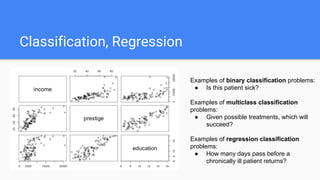
Classification, Regression
Examples of binary classification problems:
● Is this patient sick?
Examples of multiclass classification
problems:
● Given possible treatments, which will
succeed?
Examples of regression classification
problems:
● How many days pass before a
chronically ill patient returns?
Creating a Data Source
● The target – The answer that you want to predict
● Variables/features – These are attributes of the example
that can be used to identify patterns to predict the target
https://s3.amazonaws.com/mikeghen/acute-inflammations.csv
J.Czerniak, H.Zarzycki, Application of rough sets in the presumptive diagnosis of urinary system diseases, Artifical Inteligence and Security in
Computing Systems, ACS'2002 9th International Conference Proceedings, Kluwer Academic Publishers,2003, pp. 41-51
Training and Validation of a ML model
● Splits the training datasource into two sections
● Trains the ML model on the section that contains
70% of the input data
● Evaluates the model using the remaining 30% of the
input data
Presumptive Diagnosis:
Acute Inflammations
https://s3.amazonaws.com/mikeghen/acute-
inflammations-holdout.csv
J.Czerniak, H.Zarzycki, Application of rough sets in the presumptive diagnosis of urinary system diseases, Artifical
Inteligence and Security in Computing Systems, ACS 2002 9th International Conference Proceedings, Kluwer
Academic Publishers,2003, pp. 41-51
Advanced Topics
● Bootstrapping and Boosting
● Deploying models
○ Building ML Models using custom code
○ Creating an endpoint for real-time predictions
● The importance of evaluation
○ FOREX experiences

AWS Machine Learning Workshp

  • 1.
  • 2.
    Workshop Objectives Identify datasets and problems where machine learning technologies can be applied Identify features and target variables in data sets Refine a training data set to use when build machine learning models Train machine learning models using AWS Machine Learning Evaluate machine learning models using AWS Machine Learning Compute batch predictions using AWS Machine Learning
  • 3.
    Solving Business Problemswith Amazon Machine Learning ● Supervised learning: learning from data that has been labeled with the actual answer ● You have existing examples of actual answers ● Acute inflammations in patients ○ You can not code the rules ○ You can not scale
  • 4.
    Classification, Regression Examples ofbinary classification problems: ● Is this patient sick? Examples of multiclass classification problems: ● Given possible treatments, which will succeed? Examples of regression classification problems: ● How many days pass before a chronically ill patient returns?
  • 5.
    Creating a DataSource ● The target – The answer that you want to predict ● Variables/features – These are attributes of the example that can be used to identify patterns to predict the target https://s3.amazonaws.com/mikeghen/acute-inflammations.csv J.Czerniak, H.Zarzycki, Application of rough sets in the presumptive diagnosis of urinary system diseases, Artifical Inteligence and Security in Computing Systems, ACS'2002 9th International Conference Proceedings, Kluwer Academic Publishers,2003, pp. 41-51
  • 6.
    Training and Validationof a ML model ● Splits the training datasource into two sections ● Trains the ML model on the section that contains 70% of the input data ● Evaluates the model using the remaining 30% of the input data
  • 7.
    Presumptive Diagnosis: Acute Inflammations https://s3.amazonaws.com/mikeghen/acute- inflammations-holdout.csv J.Czerniak,H.Zarzycki, Application of rough sets in the presumptive diagnosis of urinary system diseases, Artifical Inteligence and Security in Computing Systems, ACS 2002 9th International Conference Proceedings, Kluwer Academic Publishers,2003, pp. 41-51
  • 8.
    Advanced Topics ● Bootstrappingand Boosting ● Deploying models ○ Building ML Models using custom code ○ Creating an endpoint for real-time predictions ● The importance of evaluation ○ FOREX experiences