 Program management: Program management involves
managing a group of related projects that, in total, have
the goal of providing value and supporting the
organization's mission. It is the role of the program
manager to ensure that component projects fit together
properly to create the intended strategic result. .
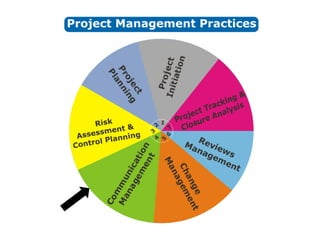
 Project management: Include techniques for managing
a project’s scope, quality, time, cost, risk, human
resources, procurement, and communications. Project
Managers also use techniques to integrate all of these
elements of project management in each phase of the
project lifecycle.
 This is the systematic planning, implementing,
monitoring, and revision of all the channels of
communication within an organization and
between organizations; it also includes the
organization and dissemination of new
communication directives connected with an
organization, network or communications
technology.
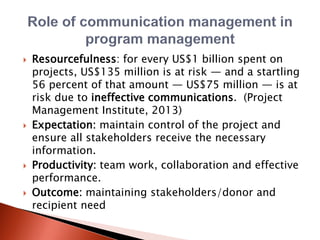
 Resourcefulness: for every US$1 billion spent on
projects, US$135 million is at risk — and a startling
56 percent of that amount — US$75 million — is at
risk due to ineffective communications. (Project
Management Institute, 2013)
 Expectation: maintain control of the project and
ensure all stakeholders receive the necessary
information.
 Productivity: team work, collaboration and effective
performance.
 Outcome: maintaining stakeholders/donor and
recipient need
 Developing communication strategies
(communicating a concept or a process or a
data that satisfy long term strategic goal of
an organization through advance planning)
 Designing internal (program newsletters,
sharepoints, org websites) and external
communications directives (webcast, podcast,
Journals, documentary)
 Managing the flow of information including
online communication
 What information needs to flow in and out of
the program?
 Who needs what information?
 When is the information needed? frequecy
 What is the format of the information? Print,
Electronic, Social media and Mass media
 Who will be responsible for transmitting and
providing the information? Communication
officers/ Website Administrator/Project
/Program manager
 Creating awareness of a concept or information is akin to
a promotional or advertising task. In the area of
complex communications, topics are generally quite in-
depth, niche or technical.
 Niche topics are generally of low interest to the ‘general
public’ but of great interest to smaller well defined
groups. Almost always these groups either ARE the people
we want to communicate with or at least they can reach
them.
 This ‘community effect’ is amplified by the web, via
emails, social networking, blogs & forums etc – this aids
creating awareness.
 Technical or niche topics are far less competitive online –
which means that Search Engines are considerably easier.
 Target audience: Segmentation or general.
Identifying target groups to communicate with is
generally easier
 Timeframe: Its impact on the overall program
objective- when do we start, when will it more
impactful, will it affect the program negatively at
any point
 Donor specific or generic: Paradigm shift to a
more development oriented reports- reach and
impact, direct and indirect etc.
 What do we want to achieve: Primary and
secondary, key to our design and method
 Workshop
 Policy Dialogue
 Partner’s Forum
 Several Communication Medium: Print,
Electronic, Social and Mass media.
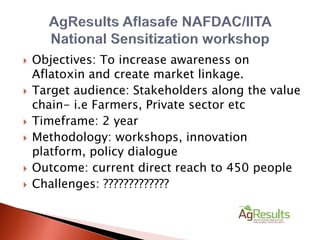
 Objectives: To increase awareness on
Aflatoxin and create market linkage.
 Target audience: Stakeholders along the value
chain- i.e Farmers, Private sector etc
 Timeframe: 2 year
 Methodology: workshops, innovation
platform, policy dialogue
 Outcome: current direct reach to 450 people
 Challenges: ?????????????
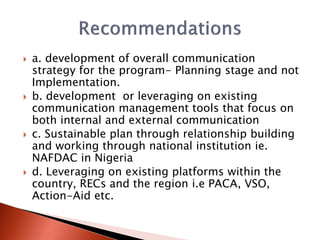
 a. development of overall communication
strategy for the program- Planning stage and not
Implementation.
 b. development or leveraging on existing
communication management tools that focus on
both internal and external communication
 c. Sustainable plan through relationship building
and working through national institution ie.
NAFDAC in Nigeria
 d. Leveraging on existing platforms within the
country, RECs and the region i.e PACA, VSO,
Action-Aid etc.
If we knew what it was we were doing, it would
not be called research, would it?
Albert Eistein

Awareness and Communication Strategy on Mycotoxin program

  • 2.
     Program management:Program management involves managing a group of related projects that, in total, have the goal of providing value and supporting the organization's mission. It is the role of the program manager to ensure that component projects fit together properly to create the intended strategic result. .
  • 3.
     Project management:Include techniques for managing a project’s scope, quality, time, cost, risk, human resources, procurement, and communications. Project Managers also use techniques to integrate all of these elements of project management in each phase of the project lifecycle.
  • 5.
     This isthe systematic planning, implementing, monitoring, and revision of all the channels of communication within an organization and between organizations; it also includes the organization and dissemination of new communication directives connected with an organization, network or communications technology.
  • 6.
     Resourcefulness: forevery US$1 billion spent on projects, US$135 million is at risk — and a startling 56 percent of that amount — US$75 million — is at risk due to ineffective communications. (Project Management Institute, 2013)  Expectation: maintain control of the project and ensure all stakeholders receive the necessary information.  Productivity: team work, collaboration and effective performance.  Outcome: maintaining stakeholders/donor and recipient need
  • 7.
     Developing communicationstrategies (communicating a concept or a process or a data that satisfy long term strategic goal of an organization through advance planning)  Designing internal (program newsletters, sharepoints, org websites) and external communications directives (webcast, podcast, Journals, documentary)  Managing the flow of information including online communication
  • 8.
     What informationneeds to flow in and out of the program?  Who needs what information?  When is the information needed? frequecy  What is the format of the information? Print, Electronic, Social media and Mass media  Who will be responsible for transmitting and providing the information? Communication officers/ Website Administrator/Project /Program manager
  • 9.
     Creating awarenessof a concept or information is akin to a promotional or advertising task. In the area of complex communications, topics are generally quite in- depth, niche or technical.  Niche topics are generally of low interest to the ‘general public’ but of great interest to smaller well defined groups. Almost always these groups either ARE the people we want to communicate with or at least they can reach them.  This ‘community effect’ is amplified by the web, via emails, social networking, blogs & forums etc – this aids creating awareness.  Technical or niche topics are far less competitive online – which means that Search Engines are considerably easier.
  • 10.
     Target audience:Segmentation or general. Identifying target groups to communicate with is generally easier  Timeframe: Its impact on the overall program objective- when do we start, when will it more impactful, will it affect the program negatively at any point  Donor specific or generic: Paradigm shift to a more development oriented reports- reach and impact, direct and indirect etc.  What do we want to achieve: Primary and secondary, key to our design and method
  • 11.
     Workshop  PolicyDialogue  Partner’s Forum  Several Communication Medium: Print, Electronic, Social and Mass media.
  • 12.
     Objectives: Toincrease awareness on Aflatoxin and create market linkage.  Target audience: Stakeholders along the value chain- i.e Farmers, Private sector etc  Timeframe: 2 year  Methodology: workshops, innovation platform, policy dialogue  Outcome: current direct reach to 450 people  Challenges: ?????????????
  • 13.
     a. developmentof overall communication strategy for the program- Planning stage and not Implementation.  b. development or leveraging on existing communication management tools that focus on both internal and external communication  c. Sustainable plan through relationship building and working through national institution ie. NAFDAC in Nigeria  d. Leveraging on existing platforms within the country, RECs and the region i.e PACA, VSO, Action-Aid etc.
  • 14.
    If we knewwhat it was we were doing, it would not be called research, would it? Albert Eistein