AWKENEING LEADERS: Leadership Workshop Guide
Submitted to
Project Manager
Jamal Mohamed Mohamed Niswi
Sarvodaya Headquarters, “Damsak Mandira”
No 98, Rawatawatta Road,
Moratuwa, Sri Lanka
Submitted by
Meron Kebede & Krystal Le
Virginia Polytechnic Institute and State University
Blacksburg, VA 24061, United States
16 July 2014
WORKSHOP OVERVIEW
Intended Audience & Background Information:
This workshop intends to identify and explore the leadership qualities that will contribute to the
success of the staff members affiliated with Sarvodaya. Building on the philosophy of Sarvodaya
Sharmadana Movement, Sri Lanka's largest non-governmental organization, this workshop aims
to nurture the sharing of one’s knowledge, time and energy in the workplace.
Workshop Goal:
The purpose of this workshop is to:
Ø define and show different aspects of leadership
Ø reinforce critical communication and time management skills in the workplace
Ø promote problem solving, critical thinking and verbal reasoning skills when handling a
presented task
Ø encourage teamwork and collaboration
Ø cultivate the different leadership qualities of all participants
Ø demonstrate the process and guidelines that must be taken when faced with immediate or
critical decisions in the workplace
Ø discuss the importance of motivation and enthusiasm within the workplace
Ø identify strategies for prioritizing, setting and communicating goals in the workplace
Ø provide a non-conventional, fun and engaging learning opportunity
Trainer roles and Responsibilities:
The facilitator of the workshop is required to articulately present information and debrief
the many activities that this workshop entails. Some probing questions will be provided for the
trainer, however, the trainer must always remain alert so that he/she can add relevant thought-
provoking questions and provide additional insights during the debrief discussions and
reflections. Discussion and reflections are essential components of the learning process and are
highly encouraged in this workshop. In cases where intriguing and beneficial discussion take
place, the facilitator should not cut it short in favor of time. However, he/she needs to be aware
that he/she needs to make up time in another section of the workshop.
Further, the trainer/facilitator is an integral and critical factor in the success of this
workshop. Therefore, his/her enthusiasm and effort to involve participants in the learning events
are what makes the difference between average session and an outstanding one that will impact
and improve the performance of the participants.
The facilitator must remember these important points and suggestions and try to incorporate
them throughout his/her delivery:
Ø There is more to training than telling. People don’t automatically learn by pouring out
everything you know at them. The learner needs to become mentally and physically
involved in the learning event.
Ø Keep the training lively and engaging.
Ø People learning by doing. This includes discussing, figuring out, rehearsing, answering
questions, thinking aloud and coming up with examples.
Ø Relax and have fun. Training does not have to be serious 100% of the time in order to get
results. In fact, a little well-placed levity can promote a positive training atmosphere
Workshop Preparation:
Organization and preparation which are vital components of leadership are needed to lead
a successful workshop. Listed below are few suggestions that will help in preparing for this
session.
Ø The trainer must carefully read the facilitator notes of each activity before
conducting the workshop
Ø Gather all materials needed to conduct the workshop
Ø Gather information about the potential workshop site:
Ø Size of room to make sure there is adequate space for number of
participants to work in small groups
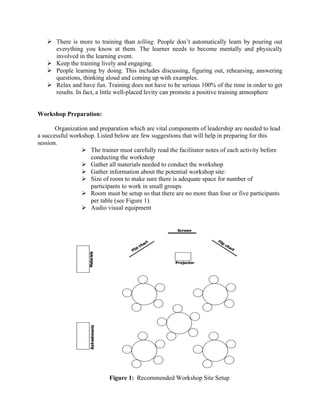
Ø Room must be setup so that there are no more than four or five participants
per table (see Figure 1).
Ø Audio visual equipment
Figure 1: Recommended Workshop Site Setup
Module Materials
Ø Participant’s Guide/Agenda
Ø Copies of course evaluation
Ø Flipchart paper and stand
Ø Markers
Ø Pens
Ø Projection system for slides
Ø A Stick
Ø Newspapers
Ø 1 long rope
Ø Blindfolds
Ø Notebooks
Ø One color print out of each image in section 5 (total print out: 3)
Other materials needed:
Ø Sign-in sheet for participants
Ø Name tags
Agenda and Delivery Time Estimates
This workshop is approximately four to five hours of instructional time. The times below are
estimated instructional time for each section of activities and do not include breaks or lunches.
Generally, throughout the workshop, one ten-minute breaks should be given. If the workshop
falls within lunch, 60-minute lunch break should be given.
Activity & Time Topics and Skills covered
Welcome & Introduction Ø Facilitator introduction(s)
Ø What does it mean to be a Leader?
Ø Icebreaker Activity: Your Most
Admired Leader
Ø Characteristics of Leaders
Workshop Activity No.1 Ø Problem Solving
Ø Planning
Ø Communication
Ø Focus
Workshop Activity No.2 Ø Creative thinking
Ø Communication
Ø Teamwork
Ø Creativity
Break Ø Break/ Refreshments
Workshop Activity No.3 Ø Creative thinking
Ø Communication
Ø Teamwork
Ø creativity
Workshop Activity No.4
Ø Communication
Ø Active listening
Ø Interpretation
Ø Clarity
Workshop Activity No.5
Ø Critical thinking
Ø Reasoning
Ø Communication
Ø Presentation skills
WELCOME & INTRODUCTION
Trainer Introduction and Notes:
As participants enter the workshop room, they will pick up the agenda of the program in the
materials section as shown in Figure 1. Before proceeding to any activity, the facilitator will
introduce him/herself and briefly describe his/her background. In this section, the facilitator lays
the groundwork for the leadership workshop. This includes the purpose of the workshop and its
intended objectives. Further, this section includes discussions of fundamental questions such as:
Ø What is leadership?
Ø What are the characteristics of leaders?
These are brief discussions and should be facilitated as a whole group. Encourage participants to
express their viewpoints and opinions and transition to the next activity.
Facilitator’s Transition: looking at the list we have created, let’s move on to an icebreaker
activity.
Icebreaker: Icebreaker Activity: Your Most Admired Leader
Ø Introduce yourself: name, district and position
Ø “Introduce” the admired leader you identify with
Ø Name ONE specific leadership quality that makes
him/her stand out.
Instructions: identify an individual that you consider to be a great leader (living or deceased,
famous or not). Consider the traits that make this person such an admirable leader. Each
participant will introduce themselves and also “introduce” to the whole group the leader they
deem excellent. Then the participants state one specific leadership quality that makes him/her
stand out.
Debrief activity/Facilitator notes:
Ø Draw two columns on a flip chart. As participants make their introductions, record the
name of the leader identified in one column and the one leadership quality identified in
the other.
Facilitator transition: Based on the list created on the flipchart, ask this question: are leaders
born, or are they made?
WORKSHOP ACTIVITIES
Activity No. 1: Helium Stick
Objective: Lower the aluminum tent pole to the ground.
Skills Developed: Problem Solving, Planning, Communication, Focus
Group Size: 8-20 (depending on the length of the stick)
Time length: 20-50 minutes
Materials: A Stick
Ideas for sticks (rough guidelines):
Ø rolled sheets of newspaper
Ø straightened out wired coat hangers
Ø taped drinking straws
Ø broom stick
Set Up / Preparation:
1. Divide your group in half and then have them create two parallel lines where the lines are
facing each other. The lines are close to each other (approximately 12 – 18 inches apart).
The members of each line stand shoulder to shoulder.
2. Once the two lines are formed, everyone holds out their index fingers at waist level.
3. You (the facilitator) then announce to the group that you will be placing a long stick on
top of their fingers. THIS PART IS IMPORTANT - - when you place the stick on their
fingers, do so from behind and in the middle of one of the lines ALWAYS KEEPING
YOUR HAND ON TOP OF THE STICK to prevent the group from raising the pole in
the air. Apply enough pressure on top of the pole to prevent the group from lifting it up. It
seems every group I’ve worked with wants to raise the tent pole with their fingers even
before they understand or know the directions.
4. Finally, with your hand on top of the stick, you will give them the following directions:
“Your directions are as follows…as a group, you must lower this stick to the ground
without even a single person on the team losing contact with the stick. Should someone
lose contact with the stick, you must start again.” Then, release your hand from the stick.
Rules:
Ø No one may lose contact with the stick; if anyone loses contact with the stick the entire
group must start again.
Ø The starting position is with the stick at waist level.
Ø Both index fingers must be used and only the index fingers may be used. The index
fingers must be placed below the stick.
Ø Nothing else is allowed to touch the stick (other than the ground at the end of the
activity).
Safety Warning:
The ends of the tent pole can be dangerous if the pole starts moving quickly and
hits someone in the face. Take precautions to prevent injury.
Facilitator Notes:
1. This is a VERY CHALLENGING activity. Do not do this with groups in serious conflict.
2. Here’s what typically happens in this activity: When you (the facilitator) give the
directions and then release the pole, the group will often times RAISE the pole (not lower
it)! The group will usually laugh and find this somewhat strange. It’s likely to take
several attempts to just keep the tent pole steady (not lowering or raising).
3. This is a communication intensive activity where each person must be absolutely
committed to doing his or her part. People will likely get frustrated and it’s common for
some blaming to occur.
4. The group will likely throw out many ideas on how to solve this challenge. What it
usually comes down to is the entire group focusing, doing their job with the direction of
one leader. Groups that have the most difficulty are usually all talking at once.
5. You may have to stop this activity several times mid-stream to help the group process
how they are approaching this activity.
Debriefing & Reflection Questions:
Ø Why did the stick rise when you wanted it to go down?
Ø Did you anticipate this problem?
Ø How did you fix this problem?
Ø How might you coach others to do this task?
Ø What are some parallels you can draw between this activity and your workplace
Activity No. 2: The Tower
Objective: To build the highest free standing tower that will hold a notebook off the ground.
Skills Developed: Creative thinking, communication, teamwork, listening
Group Size: 3-5 people within a group
Time length: 20-40 minutes.
Materials: A stack newspaper per group, a notebook per group
Set Up / Preparation:
1. Distribute the same materials (the same stack of newspaper and notebook) to participants.
2. Then, you will give each group the following directions: “Your directions are as
follows…as a group, you must use the newspaper provided and no other materials, to
construct the tallest free standing tower that holds the notebook that they are given.
3. The activity is given only 15 minutes. The team with the tallest structure and supports the
notebook will be the winner of the challenge.
Rules:
Ø Only newspapers are allowed to construct the structure. The notebook may not be used
when building the structure.
Facilitator Notes:
1. Incidentally the best technical approach to this task almost certainly requires the
construction and use of connectable tubular rolled or triangular telescopic sections,
made from lengthways strips of newspaper.
Debriefing & Reflection Questions:
1. Who took the initiative to plan before starting to build?
2. What innovative approaches did each group use to complete the activity?
3. What observations could be made about high-risk and low-risk approaches?
4. What effects did time pressure have on each group’s performance?
5. Would each team be able to improve their results at a second attempt? How and why?
6. What transferable skills from this activity can be implemented into the workplace?
Activity No. 3: Blind Square
Objective: To have the blindfolded group form a square and/or a triangle, using a rope
Skills Developed: Creative thinking, communication, teamwork, creativity
Group Size: 8-10 people within a group
Time length: 20-40 minutes
Materials: A long rope tied into a circle, a blindfold for each participant
Set Up / Preparation:
1. The group begins by forming a circle facing the center and putting on blindfolds.
2. Each person picks up the rope, which has been tied into a circle around each participant.
(everyone should be standing on the outside of the rope)
3. Using the rope, they form either a square or a triangle.
Rules:
Ø The rope must always be in the participant’s hands.
Facilitator Notes:
1. Observe the different methods, especially ways of communication, that will take
place during this activity.
Debriefing & Reflection Questions
1. How did each group approach this activity i.e who took control?
2. What leadership skills were conveyed?
3. Discuss the role of teamwork
Activity No. 4: Paper Doilies
Objective: To produce similar paper doilies
Skills Developed: Communication, active listening, interpretation, clarifying questions
techniques
Group Size: 2 people within a group
Time length: 20-40 minutes
Materials: Newspaper
Set Up / Preparation:
1. This exercise can be carried out in pairs with several pairs playing the game at the same
time, or one pair playing and the remainder of the group observing.
2. Two participants sit back to back. Each participant has a piece of newspaper.
3. The facilitator reads out loud pre-prepared instructions to the participants as to how the
student is to fold and tear/cut their sheet of newspaper. The instructions must be read out
exactly as they appear on the instructions sheet with no additional comments.
4. After the instructions have been completed, the team members turn and face each other,
unfold their sheets and compare their paper doilies, which will look quite different, even
though each has been made from the same instructions.
Instruction Sheet:
The points in the parenthesis are notes for the facilitator to help with the debriefing and
reflection.
1. Fold the paper in half horizontally (this depends on what way the sheet is held and could
be interpreted to be folded along the landscape or portrait axis)
2. Fold in half again diagonally (again, this is open to interpretation - normally an
asymmetrical fold corner-to-corner).
3. Fold in half again vertically (again, this is open to interpretation).
4. Tear off 2cm of the sharpest corner with a straight tear.
5. Tear off 1cm of the opposite with a curved tear (curved what way? - again this is open to
interpretation).
6. Unfold the paper and compare your doily with your partner's doily.
Rules:
Ø The participants cannot discuss or ask for further explanation.
Ø Participants must not see what the other is doing while the exercise is under way.
Facilitator Notes:
1. Do this activity beforehand to ensure smooth execution
2. Observe how each group chose to communicate.
Debriefing & Reflection Questions:
1. Which pairs produced identical paper doilies?
2. Why were some groups unable to end up with the exact same doilies?
3. What instructions were the least helpful and why?
4. How could these instructions have been made clearer?
5. What leadership skills were conveyed?
Extension:
As an extension of the exercise ask everyone in their pairs, to re-write their own instructions to
guarantee production of two identical doilies.
Activity No. 5: Critical Analysis
Objective: To engage participants in critical thinking and reasoning.
Skills Developed: Critical thinking, reasoning, communication, and presentation skills
Group Size: Groups of three
Time length: 20-40 minutes
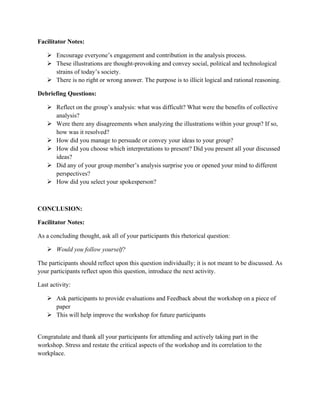
Materials: Picture (provided below)
Set Up / Preparation:
1. Distribute one of these
pictures among the three
groups.
2. Allow each group around 10
minutes to collaboratively
analyze and interpret the
message their picture is trying
to convey.
3. Have each group select one
spokesperson that will present
their interpretation. This
should take about 3 minutes
each.
Facilitator Notes:
Ø Encourage everyone’s engagement and contribution in the analysis process.
Ø These illustrations are thought-provoking and convey social, political and technological
strains of today’s society.
Ø There is no right or wrong answer. The purpose is to illicit logical and rational reasoning.
Debriefing Questions:
Ø Reflect on the group’s analysis: what was difficult? What were the benefits of collective
analysis?
Ø Were there any disagreements when analyzing the illustrations within your group? If so,
how was it resolved?
Ø How did you manage to persuade or convey your ideas to your group?
Ø How did you choose which interpretations to present? Did you present all your discussed
ideas?
Ø Did any of your group member’s analysis surprise you or opened your mind to different
perspectives?
Ø How did you select your spokesperson?
CONCLUSION:
Facilitator Notes:
As a concluding thought, ask all of your participants this rhetorical question:
Ø Would you follow yourself?
The participants should reflect upon this question individually; it is not meant to be discussed. As
your participants reflect upon this question, introduce the next activity.
Last activity:
Ø Ask participants to provide evaluations and Feedback about the workshop on a piece of
paper
Ø This will help improve the workshop for future participants
Congratulate and thank all your participants for attending and actively taking part in the
workshop. Stress and restate the critical aspects of the workshop and its correlation to the
workplace.
REFERENCES
Ø http://www.ventureteambuilding.co.uk
Ø http://www.buzzle.com/articles/leadership-activities-for-groups.html
Ø http//www.outsideyourelement.org/mrteo/adventure_files/top-4-high-impact-team-and-
leadership-activites.pdf
Ø http://www.businessballs.com/teambuildinggames.htm
Ø http://www.griffth.edu.au/_data/assests/pdf_file/0006/338550/Program-leader-facilitator-
guide.pdf
Ø http://ncwwi.org/files/Leadership_and_Management/Leadership_Trainers_Guide_-
_GA.pdf
Ø http://inspireamaze.com/these-29-clever-drawings-will-make-you-question-everything-
wrong-with-the-world/

Awakening Leaders

  • 1.
    AWKENEING LEADERS: LeadershipWorkshop Guide Submitted to Project Manager Jamal Mohamed Mohamed Niswi Sarvodaya Headquarters, “Damsak Mandira” No 98, Rawatawatta Road, Moratuwa, Sri Lanka Submitted by Meron Kebede & Krystal Le Virginia Polytechnic Institute and State University Blacksburg, VA 24061, United States 16 July 2014
  • 2.
    WORKSHOP OVERVIEW Intended Audience& Background Information: This workshop intends to identify and explore the leadership qualities that will contribute to the success of the staff members affiliated with Sarvodaya. Building on the philosophy of Sarvodaya Sharmadana Movement, Sri Lanka's largest non-governmental organization, this workshop aims to nurture the sharing of one’s knowledge, time and energy in the workplace. Workshop Goal: The purpose of this workshop is to: Ø define and show different aspects of leadership Ø reinforce critical communication and time management skills in the workplace Ø promote problem solving, critical thinking and verbal reasoning skills when handling a presented task Ø encourage teamwork and collaboration Ø cultivate the different leadership qualities of all participants Ø demonstrate the process and guidelines that must be taken when faced with immediate or critical decisions in the workplace Ø discuss the importance of motivation and enthusiasm within the workplace Ø identify strategies for prioritizing, setting and communicating goals in the workplace Ø provide a non-conventional, fun and engaging learning opportunity Trainer roles and Responsibilities: The facilitator of the workshop is required to articulately present information and debrief the many activities that this workshop entails. Some probing questions will be provided for the trainer, however, the trainer must always remain alert so that he/she can add relevant thought- provoking questions and provide additional insights during the debrief discussions and reflections. Discussion and reflections are essential components of the learning process and are highly encouraged in this workshop. In cases where intriguing and beneficial discussion take place, the facilitator should not cut it short in favor of time. However, he/she needs to be aware that he/she needs to make up time in another section of the workshop. Further, the trainer/facilitator is an integral and critical factor in the success of this workshop. Therefore, his/her enthusiasm and effort to involve participants in the learning events are what makes the difference between average session and an outstanding one that will impact and improve the performance of the participants. The facilitator must remember these important points and suggestions and try to incorporate them throughout his/her delivery:
  • 3.
    Ø There ismore to training than telling. People don’t automatically learn by pouring out everything you know at them. The learner needs to become mentally and physically involved in the learning event. Ø Keep the training lively and engaging. Ø People learning by doing. This includes discussing, figuring out, rehearsing, answering questions, thinking aloud and coming up with examples. Ø Relax and have fun. Training does not have to be serious 100% of the time in order to get results. In fact, a little well-placed levity can promote a positive training atmosphere Workshop Preparation: Organization and preparation which are vital components of leadership are needed to lead a successful workshop. Listed below are few suggestions that will help in preparing for this session. Ø The trainer must carefully read the facilitator notes of each activity before conducting the workshop Ø Gather all materials needed to conduct the workshop Ø Gather information about the potential workshop site: Ø Size of room to make sure there is adequate space for number of participants to work in small groups Ø Room must be setup so that there are no more than four or five participants per table (see Figure 1). Ø Audio visual equipment Figure 1: Recommended Workshop Site Setup
  • 4.
    Module Materials Ø Participant’sGuide/Agenda Ø Copies of course evaluation Ø Flipchart paper and stand Ø Markers Ø Pens Ø Projection system for slides Ø A Stick Ø Newspapers Ø 1 long rope Ø Blindfolds Ø Notebooks Ø One color print out of each image in section 5 (total print out: 3) Other materials needed: Ø Sign-in sheet for participants Ø Name tags Agenda and Delivery Time Estimates This workshop is approximately four to five hours of instructional time. The times below are estimated instructional time for each section of activities and do not include breaks or lunches. Generally, throughout the workshop, one ten-minute breaks should be given. If the workshop falls within lunch, 60-minute lunch break should be given. Activity & Time Topics and Skills covered Welcome & Introduction Ø Facilitator introduction(s) Ø What does it mean to be a Leader? Ø Icebreaker Activity: Your Most Admired Leader Ø Characteristics of Leaders Workshop Activity No.1 Ø Problem Solving Ø Planning Ø Communication Ø Focus Workshop Activity No.2 Ø Creative thinking Ø Communication Ø Teamwork Ø Creativity
  • 5.
    Break Ø Break/Refreshments Workshop Activity No.3 Ø Creative thinking Ø Communication Ø Teamwork Ø creativity Workshop Activity No.4 Ø Communication Ø Active listening Ø Interpretation Ø Clarity Workshop Activity No.5 Ø Critical thinking Ø Reasoning Ø Communication Ø Presentation skills WELCOME & INTRODUCTION Trainer Introduction and Notes: As participants enter the workshop room, they will pick up the agenda of the program in the materials section as shown in Figure 1. Before proceeding to any activity, the facilitator will introduce him/herself and briefly describe his/her background. In this section, the facilitator lays the groundwork for the leadership workshop. This includes the purpose of the workshop and its intended objectives. Further, this section includes discussions of fundamental questions such as: Ø What is leadership? Ø What are the characteristics of leaders? These are brief discussions and should be facilitated as a whole group. Encourage participants to express their viewpoints and opinions and transition to the next activity. Facilitator’s Transition: looking at the list we have created, let’s move on to an icebreaker activity. Icebreaker: Icebreaker Activity: Your Most Admired Leader Ø Introduce yourself: name, district and position Ø “Introduce” the admired leader you identify with Ø Name ONE specific leadership quality that makes him/her stand out.
  • 6.
    Instructions: identify anindividual that you consider to be a great leader (living or deceased, famous or not). Consider the traits that make this person such an admirable leader. Each participant will introduce themselves and also “introduce” to the whole group the leader they deem excellent. Then the participants state one specific leadership quality that makes him/her stand out. Debrief activity/Facilitator notes: Ø Draw two columns on a flip chart. As participants make their introductions, record the name of the leader identified in one column and the one leadership quality identified in the other. Facilitator transition: Based on the list created on the flipchart, ask this question: are leaders born, or are they made? WORKSHOP ACTIVITIES Activity No. 1: Helium Stick Objective: Lower the aluminum tent pole to the ground. Skills Developed: Problem Solving, Planning, Communication, Focus Group Size: 8-20 (depending on the length of the stick) Time length: 20-50 minutes Materials: A Stick Ideas for sticks (rough guidelines): Ø rolled sheets of newspaper Ø straightened out wired coat hangers Ø taped drinking straws Ø broom stick Set Up / Preparation: 1. Divide your group in half and then have them create two parallel lines where the lines are facing each other. The lines are close to each other (approximately 12 – 18 inches apart). The members of each line stand shoulder to shoulder. 2. Once the two lines are formed, everyone holds out their index fingers at waist level.
  • 7.
    3. You (thefacilitator) then announce to the group that you will be placing a long stick on top of their fingers. THIS PART IS IMPORTANT - - when you place the stick on their fingers, do so from behind and in the middle of one of the lines ALWAYS KEEPING YOUR HAND ON TOP OF THE STICK to prevent the group from raising the pole in the air. Apply enough pressure on top of the pole to prevent the group from lifting it up. It seems every group I’ve worked with wants to raise the tent pole with their fingers even before they understand or know the directions. 4. Finally, with your hand on top of the stick, you will give them the following directions: “Your directions are as follows…as a group, you must lower this stick to the ground without even a single person on the team losing contact with the stick. Should someone lose contact with the stick, you must start again.” Then, release your hand from the stick. Rules: Ø No one may lose contact with the stick; if anyone loses contact with the stick the entire group must start again. Ø The starting position is with the stick at waist level. Ø Both index fingers must be used and only the index fingers may be used. The index fingers must be placed below the stick. Ø Nothing else is allowed to touch the stick (other than the ground at the end of the activity). Safety Warning: The ends of the tent pole can be dangerous if the pole starts moving quickly and hits someone in the face. Take precautions to prevent injury. Facilitator Notes: 1. This is a VERY CHALLENGING activity. Do not do this with groups in serious conflict. 2. Here’s what typically happens in this activity: When you (the facilitator) give the directions and then release the pole, the group will often times RAISE the pole (not lower it)! The group will usually laugh and find this somewhat strange. It’s likely to take several attempts to just keep the tent pole steady (not lowering or raising). 3. This is a communication intensive activity where each person must be absolutely committed to doing his or her part. People will likely get frustrated and it’s common for some blaming to occur. 4. The group will likely throw out many ideas on how to solve this challenge. What it usually comes down to is the entire group focusing, doing their job with the direction of one leader. Groups that have the most difficulty are usually all talking at once.
  • 8.
    5. You mayhave to stop this activity several times mid-stream to help the group process how they are approaching this activity. Debriefing & Reflection Questions: Ø Why did the stick rise when you wanted it to go down? Ø Did you anticipate this problem? Ø How did you fix this problem? Ø How might you coach others to do this task? Ø What are some parallels you can draw between this activity and your workplace Activity No. 2: The Tower Objective: To build the highest free standing tower that will hold a notebook off the ground. Skills Developed: Creative thinking, communication, teamwork, listening Group Size: 3-5 people within a group Time length: 20-40 minutes. Materials: A stack newspaper per group, a notebook per group Set Up / Preparation: 1. Distribute the same materials (the same stack of newspaper and notebook) to participants. 2. Then, you will give each group the following directions: “Your directions are as follows…as a group, you must use the newspaper provided and no other materials, to construct the tallest free standing tower that holds the notebook that they are given. 3. The activity is given only 15 minutes. The team with the tallest structure and supports the notebook will be the winner of the challenge. Rules: Ø Only newspapers are allowed to construct the structure. The notebook may not be used when building the structure. Facilitator Notes: 1. Incidentally the best technical approach to this task almost certainly requires the construction and use of connectable tubular rolled or triangular telescopic sections, made from lengthways strips of newspaper. Debriefing & Reflection Questions:
  • 9.
    1. Who tookthe initiative to plan before starting to build? 2. What innovative approaches did each group use to complete the activity? 3. What observations could be made about high-risk and low-risk approaches? 4. What effects did time pressure have on each group’s performance? 5. Would each team be able to improve their results at a second attempt? How and why? 6. What transferable skills from this activity can be implemented into the workplace? Activity No. 3: Blind Square Objective: To have the blindfolded group form a square and/or a triangle, using a rope Skills Developed: Creative thinking, communication, teamwork, creativity Group Size: 8-10 people within a group Time length: 20-40 minutes Materials: A long rope tied into a circle, a blindfold for each participant Set Up / Preparation: 1. The group begins by forming a circle facing the center and putting on blindfolds. 2. Each person picks up the rope, which has been tied into a circle around each participant. (everyone should be standing on the outside of the rope) 3. Using the rope, they form either a square or a triangle. Rules: Ø The rope must always be in the participant’s hands. Facilitator Notes: 1. Observe the different methods, especially ways of communication, that will take place during this activity. Debriefing & Reflection Questions 1. How did each group approach this activity i.e who took control? 2. What leadership skills were conveyed? 3. Discuss the role of teamwork Activity No. 4: Paper Doilies
  • 10.
    Objective: To producesimilar paper doilies Skills Developed: Communication, active listening, interpretation, clarifying questions techniques Group Size: 2 people within a group Time length: 20-40 minutes Materials: Newspaper Set Up / Preparation: 1. This exercise can be carried out in pairs with several pairs playing the game at the same time, or one pair playing and the remainder of the group observing. 2. Two participants sit back to back. Each participant has a piece of newspaper. 3. The facilitator reads out loud pre-prepared instructions to the participants as to how the student is to fold and tear/cut their sheet of newspaper. The instructions must be read out exactly as they appear on the instructions sheet with no additional comments. 4. After the instructions have been completed, the team members turn and face each other, unfold their sheets and compare their paper doilies, which will look quite different, even though each has been made from the same instructions. Instruction Sheet: The points in the parenthesis are notes for the facilitator to help with the debriefing and reflection. 1. Fold the paper in half horizontally (this depends on what way the sheet is held and could be interpreted to be folded along the landscape or portrait axis) 2. Fold in half again diagonally (again, this is open to interpretation - normally an asymmetrical fold corner-to-corner). 3. Fold in half again vertically (again, this is open to interpretation). 4. Tear off 2cm of the sharpest corner with a straight tear. 5. Tear off 1cm of the opposite with a curved tear (curved what way? - again this is open to interpretation). 6. Unfold the paper and compare your doily with your partner's doily. Rules: Ø The participants cannot discuss or ask for further explanation. Ø Participants must not see what the other is doing while the exercise is under way. Facilitator Notes: 1. Do this activity beforehand to ensure smooth execution
  • 11.
    2. Observe howeach group chose to communicate. Debriefing & Reflection Questions: 1. Which pairs produced identical paper doilies? 2. Why were some groups unable to end up with the exact same doilies? 3. What instructions were the least helpful and why? 4. How could these instructions have been made clearer? 5. What leadership skills were conveyed? Extension: As an extension of the exercise ask everyone in their pairs, to re-write their own instructions to guarantee production of two identical doilies. Activity No. 5: Critical Analysis Objective: To engage participants in critical thinking and reasoning. Skills Developed: Critical thinking, reasoning, communication, and presentation skills Group Size: Groups of three Time length: 20-40 minutes Materials: Picture (provided below) Set Up / Preparation: 1. Distribute one of these pictures among the three groups. 2. Allow each group around 10 minutes to collaboratively analyze and interpret the message their picture is trying to convey. 3. Have each group select one spokesperson that will present their interpretation. This should take about 3 minutes each.
  • 13.
    Facilitator Notes: Ø Encourageeveryone’s engagement and contribution in the analysis process. Ø These illustrations are thought-provoking and convey social, political and technological strains of today’s society. Ø There is no right or wrong answer. The purpose is to illicit logical and rational reasoning. Debriefing Questions: Ø Reflect on the group’s analysis: what was difficult? What were the benefits of collective analysis? Ø Were there any disagreements when analyzing the illustrations within your group? If so, how was it resolved? Ø How did you manage to persuade or convey your ideas to your group? Ø How did you choose which interpretations to present? Did you present all your discussed ideas? Ø Did any of your group member’s analysis surprise you or opened your mind to different perspectives? Ø How did you select your spokesperson? CONCLUSION: Facilitator Notes: As a concluding thought, ask all of your participants this rhetorical question: Ø Would you follow yourself? The participants should reflect upon this question individually; it is not meant to be discussed. As your participants reflect upon this question, introduce the next activity. Last activity: Ø Ask participants to provide evaluations and Feedback about the workshop on a piece of paper Ø This will help improve the workshop for future participants Congratulate and thank all your participants for attending and actively taking part in the workshop. Stress and restate the critical aspects of the workshop and its correlation to the workplace.
  • 14.
    REFERENCES Ø http://www.ventureteambuilding.co.uk Ø http://www.buzzle.com/articles/leadership-activities-for-groups.html Øhttp//www.outsideyourelement.org/mrteo/adventure_files/top-4-high-impact-team-and- leadership-activites.pdf Ø http://www.businessballs.com/teambuildinggames.htm Ø http://www.griffth.edu.au/_data/assests/pdf_file/0006/338550/Program-leader-facilitator- guide.pdf Ø http://ncwwi.org/files/Leadership_and_Management/Leadership_Trainers_Guide_- _GA.pdf Ø http://inspireamaze.com/these-29-clever-drawings-will-make-you-question-everything- wrong-with-the-world/