Submitted By – Mohammad Rahil
Submitted To - Ms. Snehal Jade
Batch - C3
Centre - Nagpur
Year - 2018
INTRODUCTION
 Aviation began in the 18th century with the
development of the hot air balloon, an apparatus
capable of atmospheric displacement through
buoyancy.
 Some of the most significant advancements in
aviation technology came with the controlled gliding
flying of Otto Lilienthal in 1896
 Then a large step in significance came with the
construction of the first powered airplane by the
Wright brothers in the early 1900s.
 Since that time, aviation has been technologically
revolutionized by the introduction of the Jet which
permitted a major form of transport throughout the
world.
ACKNOWLEDGEMENT
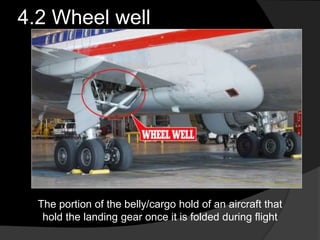
I would like to extend my gratitude towards
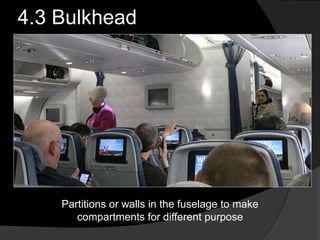
Frankfinn Institute for providing me such a
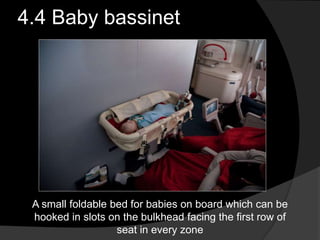
great opportunity. I would also like to
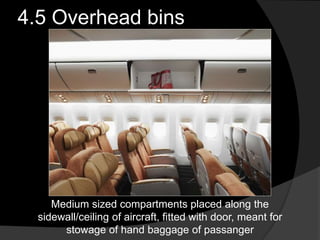
thanks my faculty Ms Snehal Jade for her
guidance and help in completion of this
assignment successfully.
INDEX
Content Page no.
1. Task 1 5 – 28
2. Task 2 29 – 41
3. Task 3 42 – 54
4. Task 4 55 – 62
5. Task 5 63 – 66
TASK-1
Current Scenario of Aviation industry
 The civil aviation industry in India has emerged as
one of the fastest growing industries in the country
during the last three years.
 India is currently considered the third largest
domestic civil aviation market in the world. India is
expected to become the world’s largest domestic
civil aviation market in the next 10 to 15 years, as
per Mr Jayant Sinha, Union Minister of State for
Civil Aviation, Government of India.
 According to International Air Transport
Association IATA, India will displace the UK for the
third place in 2025.
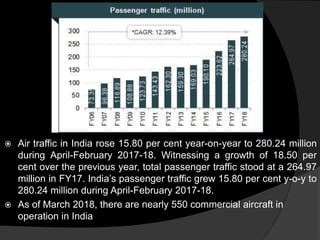
 Air traffic in India rose 15.80 per cent year-on-year to 280.24 million
during April-February 2017-18. Witnessing a growth of 18.50 per
cent over the previous year, total passenger traffic stood at a 264.97
million in FY17. India’s passenger traffic grew 15.80 per cent y-o-y to
280.24 million during April-February 2017-18.
 As of March 2018, there are nearly 550 commercial aircraft in
operation in India
Key investments and developments in
India’s aviation industry include:
 AAI is going to invest Rs 15,000 crore (US$ 2.32 billion) in
2018-19 for expanding existing terminals and constructing
15 new ones.
 The Airports Authority of India (AAI) will undertake new
development works at Lucknow, Deoghar, Rajkot and
Allahabad airports.
 The objective is to improve and develop airport
infrastructure to meet growing traffic demands. AAI plans to
construct new integrated passenger terminal building at
Chaudhary Charan Singh International Airport, Lucknow at
an estimated cost of Rs. 1,230 crore (US$ 190.65 million).
The new terminal will be able to handle 4000 passengers
during peak hour and 6.35 million passengers per annum.
Government Initiatives
 Allocation to Civil Aviation Ministry has been tripled to Rs 6,602.86
crore (US$ 1,019.9 million) under Union Budget 2018-19.
 In February 2018, the Prime Minister of India launched the
construction of Navi Mumbai airport which is expected to be built at
a cost of US$ 2.58 billion. The first phase of the airport will be
completed by end of 2019.
 Under the second round of Regional Connectivity Scheme (RCS 2)
the government has awarded 325 routes to airlines as well as
helicopter operators with the objective of enhancing flight services
to hilly and remote areas.
 Constructing 17 highways-cum-airstrips are the government's
priorities and it will start work on them this year
 Airport building and modernization projects worth over Rs 19,300
crore (US$ 2.99 billion) have been recommended green clearance
TASK – 1
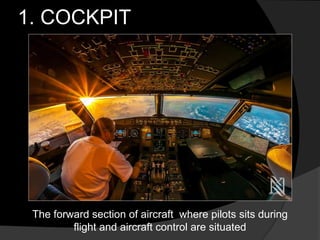
1. COCKPIT
The forward section of aircraft where pilots sits during
flight and aircraft control are situated
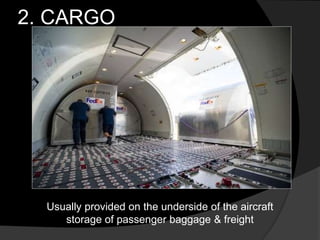
2. CARGO
Usually provided on the underside of the aircraft
storage of passenger baggage & freight
3. EXTERIOR PART
1. NOSE GEAR
2. MAIN GEAR
3. WINGLET
4. RUDDER
5. ELEVATOR
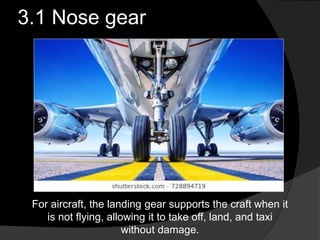
3.1 Nose gear
For aircraft, the landing gear supports the craft when it
is not flying, allowing it to take off, land, and taxi
without damage.
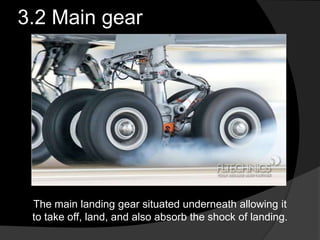
3.2 Main gear
The main landing gear situated underneath allowing it
to take off, land, and also absorb the shock of landing.
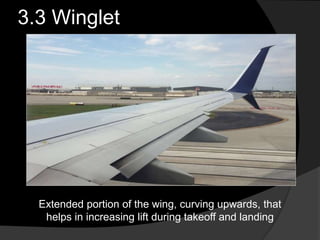
3.3 Winglet
Extended portion of the wing, curving upwards, that
helps in increasing lift during takeoff and landing
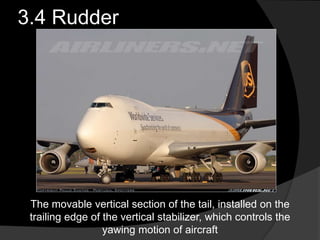
3.4 Rudder
The movable vertical section of the tail, installed on the
trailing edge of the vertical stabilizer, which controls the
yawing motion of aircraft
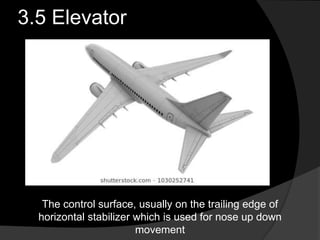
3.5 Elevator
The control surface, usually on the trailing edge of
horizontal stabilizer which is used for nose up down
movement
4. INTERIOR PART
1. CABIN
2. WHEEL WELL
3. BULKHEAD
4. BABY BASSINET
5. OVERHEAD BINS
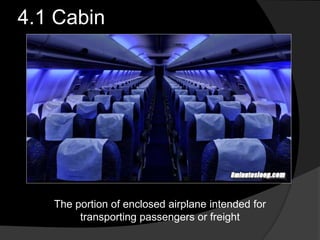
4.1 Cabin
The portion of enclosed airplane intended for
transporting passengers or freight
4.2 Wheel well
The portion of the belly/cargo hold of an aircraft that
hold the landing gear once it is folded during flight
4.3 Bulkhead
Partitions or walls in the fuselage to make
compartments for different purpose
4.4 Baby bassinet
A small foldable bed for babies on board which can be
hooked in slots on the bulkhead facing the first row of
seat in every zone
4.5 Overhead bins
Medium sized compartments placed along the
sidewall/ceiling of aircraft, fitted with door, meant for
stowage of hand baggage of passanger
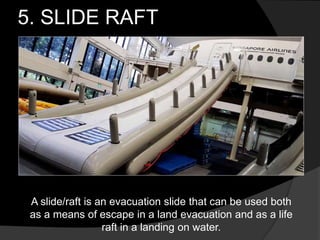
5. SLIDE RAFT
A slide/raft is an evacuation slide that can be used both
as a means of escape in a land evacuation and as a life
raft in a landing on water.
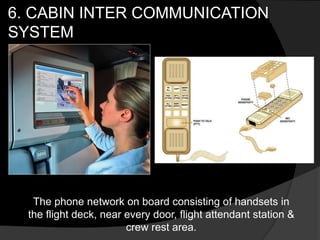
6. CABIN INTER COMMUNICATION
SYSTEM
The phone network on board consisting of handsets in
the flight deck, near every door, flight attendant station &
crew rest area.
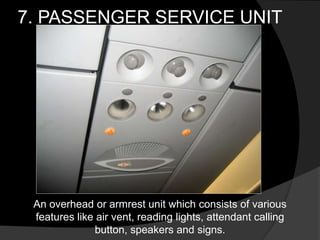
7. PASSENGER SERVICE UNIT
An overhead or armrest unit which consists of various
features like air vent, reading lights, attendant calling
button, speakers and signs.
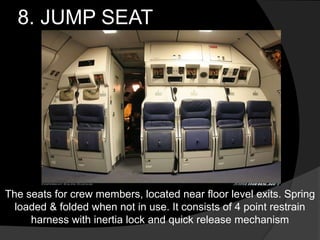
8. JUMP SEAT
The seats for crew members, located near floor level exits. Spring
loaded & folded when not in use. It consists of 4 point restrain
harness with inertia lock and quick release mechanism
TASK – 2
EMBARKATION PROCESS
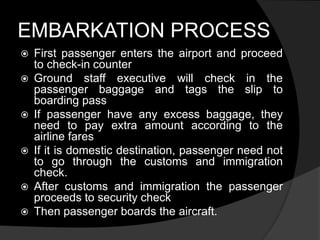
 First passenger enters the airport and proceed
to check-in counter
 Ground staff executive will check in the
passenger baggage and tags the slip to
boarding pass
 If passenger have any excess baggage, they
need to pay extra amount according to the
airline fares
 If it is domestic destination, passenger need not
to go through the customs and immigration
check.
 After customs and immigration the passenger
proceeds to security check
 Then passenger boards the aircraft.
DISEMBARKATION
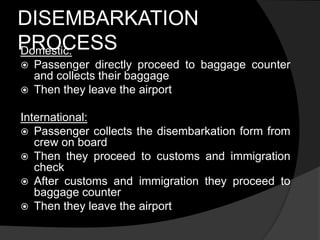
PROCESSDomestic:
 Passenger directly proceed to baggage counter
and collects their baggage
 Then they leave the airport
International:
 Passenger collects the disembarkation form from
crew on board
 Then they proceed to customs and immigration
check
 After customs and immigration they proceed to
baggage counter
 Then they leave the airport
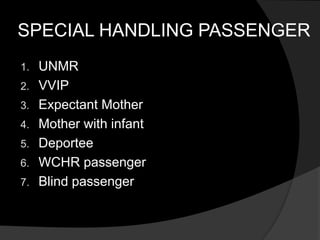
SPECIAL HANDLING PASSENGER
1. UNMR
2. VVIP
3. Expectant Mother
4. Mother with infant
5. Deportee
6. WCHR passenger
7. Blind passenger
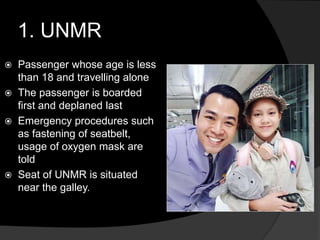
1. UNMR
 Passenger whose age is less
than 18 and travelling alone
 The passenger is boarded
first and deplaned last
 Emergency procedures such
as fastening of seatbelt,
usage of oxygen mask are
told
 Seat of UNMR is situated
near the galley.
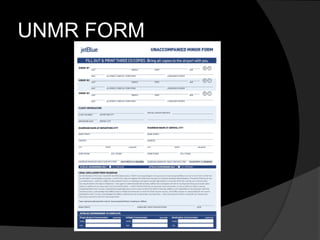
UNMR FORM
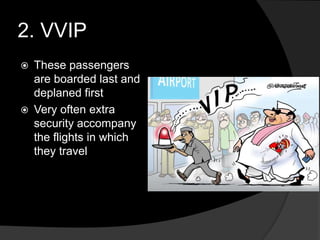
2. VVIP
 These passengers
are boarded last and
deplaned first
 Very often extra
security accompany
the flights in which
they travel
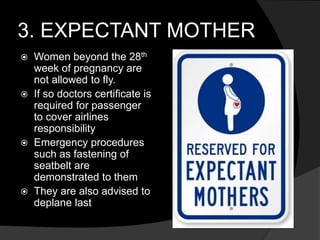
3. EXPECTANT MOTHER
 Women beyond the 28th
week of pregnancy are
not allowed to fly.
 If so doctors certificate is
required for passenger
to cover airlines
responsibility
 Emergency procedures
such as fastening of
seatbelt are
demonstrated to them
 They are also advised to
deplane last
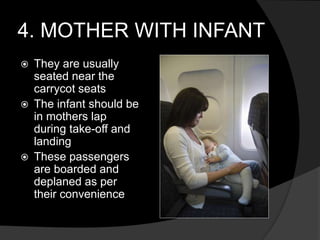
4. MOTHER WITH INFANT
 They are usually
seated near the
carrycot seats
 The infant should be
in mothers lap
during take-off and
landing
 These passengers
are boarded and
deplaned as per
their convenience
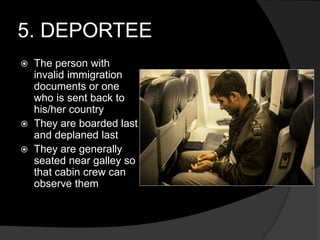
5. DEPORTEE
 The person with
invalid immigration
documents or one
who is sent back to
his/her country
 They are boarded last
and deplaned last
 They are generally
seated near galley so
that cabin crew can
observe them
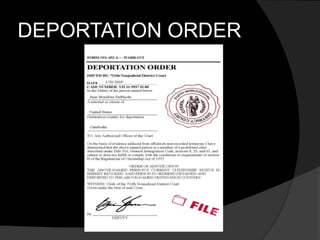
DEPORTATION ORDER
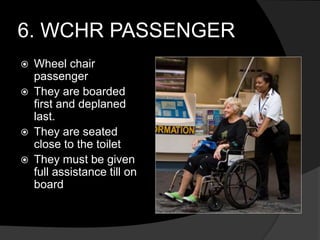
6. WCHR PASSENGER
 Wheel chair
passenger
 They are boarded
first and deplaned
last.
 They are seated
close to the toilet
 They must be given
full assistance till on
board
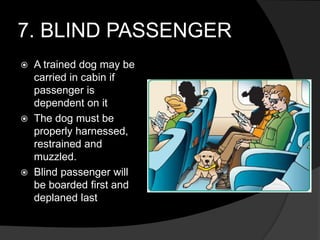
7. BLIND PASSENGER
 A trained dog may be
carried in cabin if
passenger is
dependent on it
 The dog must be
properly harnessed,
restrained and
muzzled.
 Blind passenger will
be boarded first and
deplaned last
TASK – 3
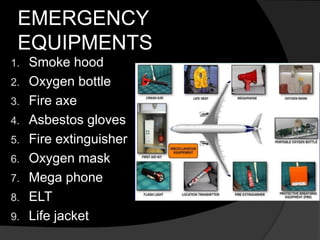
EMERGENCY
EQUIPMENTS
1. Smoke hood
2. Oxygen bottle
3. Fire axe
4. Asbestos gloves
5. Fire extinguisher
6. Oxygen mask
7. Mega phone
8. ELT
9. Life jacket
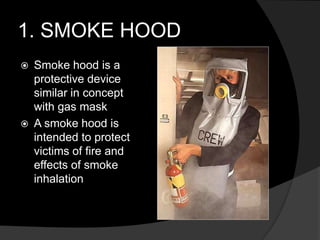
1. SMOKE HOOD
 Smoke hood is a
protective device
similar in concept
with gas mask
 A smoke hood is
intended to protect
victims of fire and
effects of smoke
inhalation
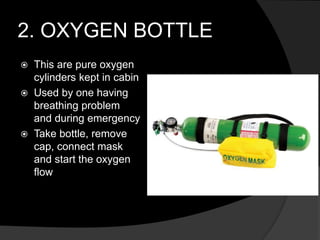
2. OXYGEN BOTTLE
 This are pure oxygen
cylinders kept in cabin
 Used by one having
breathing problem
and during emergency
 Take bottle, remove
cap, connect mask
and start the oxygen
flow
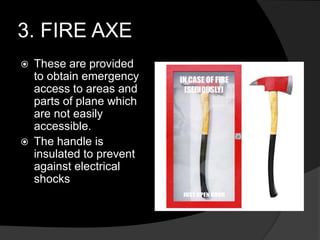
3. FIRE AXE
 These are provided
to obtain emergency
access to areas and
parts of plane which
are not easily
accessible.
 The handle is
insulated to prevent
against electrical
shocks
4. ASBESTOS GLOVES
 It is an insulated
glove usually used
to protect the
wearer’s hand from
hot things like oven,
cookware, fire etc.
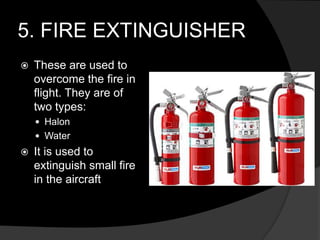
5. FIRE EXTINGUISHER
 These are used to
overcome the fire in
flight. They are of
two types:
ď‚— Halon
ď‚— Water
 It is used to
extinguish small fire
in the aircraft
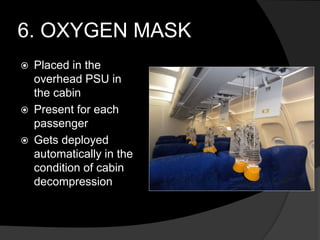
6. OXYGEN MASK
 Placed in the
overhead PSU in
the cabin
 Present for each
passenger
 Gets deployed
automatically in the
condition of cabin
decompression
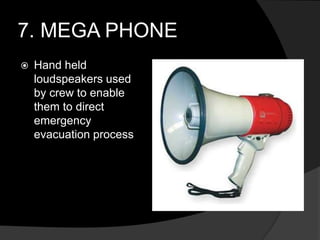
7. MEGA PHONE
 Hand held
loudspeakers used
by crew to enable
them to direct
emergency
evacuation process
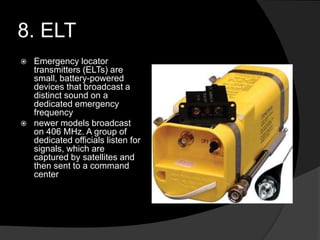
8. ELT
 Emergency locator
transmitters (ELTs) are
small, battery-powered
devices that broadcast a
distinct sound on a
dedicated emergency
frequency
 newer models broadcast
on 406 MHz. A group of
dedicated officials listen for
signals, which are
captured by satellites and
then sent to a command
center
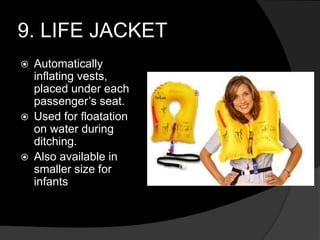
9. LIFE JACKET
 Automatically
inflating vests,
placed under each
passenger’s seat.
 Used for floatation
on water during
ditching.
 Also available in
smaller size for
infants
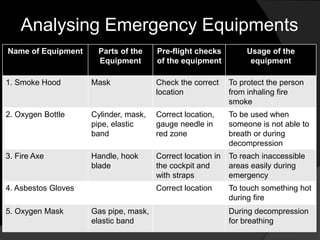
Analysing Emergency Equipments
Name of Equipment Parts of the
Equipment
Pre-flight checks
of the equipment
Usage of the
equipment
1. Smoke Hood Mask Check the correct
location
To protect the person
from inhaling fire
smoke
2. Oxygen Bottle Cylinder, mask,
pipe, elastic
band
Correct location,
gauge needle in
red zone
To be used when
someone is not able to
breath or during
decompression
3. Fire Axe Handle, hook
blade
Correct location in
the cockpit and
with straps
To reach inaccessible
areas easily during
emergency
4. Asbestos Gloves Correct location To touch something hot
during fire
5. Oxygen Mask Gas pipe, mask,
elastic band
During decompression
for breathing
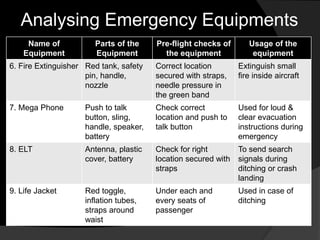
Analysing Emergency Equipments
Name of
Equipment
Parts of the
Equipment
Pre-flight checks of
the equipment
Usage of the
equipment
6. Fire Extinguisher Red tank, safety
pin, handle,
nozzle
Correct location
secured with straps,
needle pressure in
the green band
Extinguish small
fire inside aircraft
7. Mega Phone Push to talk
button, sling,
handle, speaker,
battery
Check correct
location and push to
talk button
Used for loud &
clear evacuation
instructions during
emergency
8. ELT Antenna, plastic
cover, battery
Check for right
location secured with
straps
To send search
signals during
ditching or crash
landing
9. Life Jacket Red toggle,
inflation tubes,
straps around
waist
Under each and
every seats of
passenger
Used in case of
ditching
TASK – 4
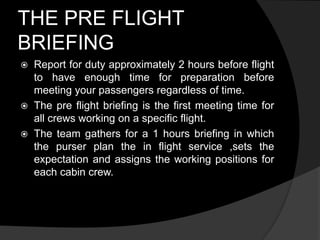
THE PRE FLIGHT
BRIEFING
 Report for duty approximately 2 hours before flight
to have enough time for preparation before
meeting your passengers regardless of time.
 The pre flight briefing is the first meeting time for
all crews working on a specific flight.
 The team gathers for a 1 hours briefing in which
the purser plan the in flight service ,sets the
expectation and assigns the working positions for
each cabin crew.
THE PRE TAKE – OFF
SERVICE
 Service between boarding and take off is called
pre take off service .
 You will be standing in the cabin welcoming
passengers on board and helping them to locate
their senate and store their cabin baggage quickly
to maintain a smooth flow for all passengers
boarding .
 Don’t lift the passenger bag you barely touch the
bag with two fingers .
 Boarding completed.
CLOSING THE DOOR
 Hold the door assist handle on the door frame.
Press the gust lock on the door support arm to
unlock the door .
 Check the door area is clear.
 Slide the door rearwards until it is front of the
doorframe then pull the door inwards and lower
the door control handle for airbus in anti clock wise
for Boeing and make sure that the door is locked
properly.
 Arm the door in to evacuate slide raft emergency
mishap.
TAKE OFF
 It is vital that flight attendants remain aware as the
majority of emergencies occur during takeoff.
 Informing the passengers of the aircraft safety
procedures and ensuring that all hand luggage is
security stored.
 The cockpit crew assigns a seat belt in passengers
service unit to wear seat belts during take off.
 Cabin crew should inform all passengers to wear seat
belt and make sure that they have done it.
 Remind the passengers not to get up or not to remove
seat belts during take off.
AT CRUISING
 Serving meals and refreshments to passengers regular
cockpit checks must be done to ensure the pilots health and
safety
 They must also respond to call lights dealing with special
request.
 During turbulence flight attendants must ensure the cabin is
secure.
 Prior to landing all loose items trays and rubbish must be
collected and secured along with service and gallery
equipment .
 All hot liquids must be disposed of .
BEFORE LANDING
 An disembarkation form is handed over to all the
passengers for filling the details for immigration check.
 Cabin crew should also fill the disembarkation form before
landing and a final cabin check must then be completed
prior to landing.
 They also assist any special while following needs
passengers and small children off the aircraft to escort
children , while following the proper paperwork picking
then up.
 Giving first aid to passengers disembarkation safety at the
end of a flight and checking that there is no luggage left in
the overhead lockers .
AFTER LANDING
 Upon landing flight attendants must remain stationed at
exits and monitor the aircraft and cabin as passengers
disembark the plane .
 Completing paperwork including writing a flight report
and sign out.
TASK – 5
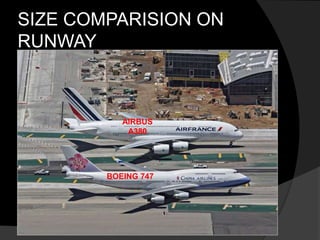
SIZE COMPARISION ON
RUNWAY
AIRBUS
A380
BOEING 747
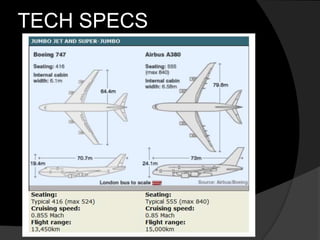
TECH SPECS
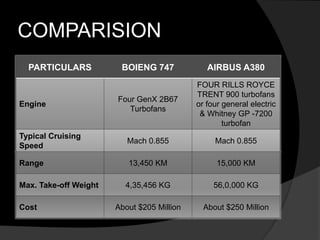
COMPARISION
PARTICULARS BOIENG 747 AIRBUS A380
Engine
Four GenX 2B67
Turbofans
FOUR RILLS ROYCE
TRENT 900 turbofans
or four general electric
& Whitney GP -7200
turbofan
Typical Cruising
Speed
Mach 0.855 Mach 0.855
Range 13,450 KM 15,000 KM
Max. Take-off Weight 4,35,456 KG 56,0,000 KG
Cost About $205 Million About $250 Million
CONCLUSION
From this assignment I got to know a lot
of things about an aircraft. Like various
parts of aircraft, internal as well as
external parts and also about the
emergency equipments, how they are
used and checked before aircraft takes-
off.
All these are very useful information
which can be used in practical life.
BIBLIOGRAPHY
 Frankfinn Aviation module
 www.google.com
 www.wikipidea.com
 www.slideshare.net
Aviation assignment Frankfinn

Aviation assignment Frankfinn

  • 1.
    Submitted By –Mohammad Rahil Submitted To - Ms. Snehal Jade Batch - C3 Centre - Nagpur Year - 2018
  • 2.
    INTRODUCTION  Aviation beganin the 18th century with the development of the hot air balloon, an apparatus capable of atmospheric displacement through buoyancy.  Some of the most significant advancements in aviation technology came with the controlled gliding flying of Otto Lilienthal in 1896  Then a large step in significance came with the construction of the first powered airplane by the Wright brothers in the early 1900s.  Since that time, aviation has been technologically revolutionized by the introduction of the Jet which permitted a major form of transport throughout the world.
  • 3.
    ACKNOWLEDGEMENT I would liketo extend my gratitude towards Frankfinn Institute for providing me such a great opportunity. I would also like to thanks my faculty Ms Snehal Jade for her guidance and help in completion of this assignment successfully.
  • 4.
    INDEX Content Page no. 1.Task 1 5 – 28 2. Task 2 29 – 41 3. Task 3 42 – 54 4. Task 4 55 – 62 5. Task 5 63 – 66
  • 5.
  • 6.
    Current Scenario ofAviation industry  The civil aviation industry in India has emerged as one of the fastest growing industries in the country during the last three years.  India is currently considered the third largest domestic civil aviation market in the world. India is expected to become the world’s largest domestic civil aviation market in the next 10 to 15 years, as per Mr Jayant Sinha, Union Minister of State for Civil Aviation, Government of India.  According to International Air Transport Association IATA, India will displace the UK for the third place in 2025.
  • 7.
     Air trafficin India rose 15.80 per cent year-on-year to 280.24 million during April-February 2017-18. Witnessing a growth of 18.50 per cent over the previous year, total passenger traffic stood at a 264.97 million in FY17. India’s passenger traffic grew 15.80 per cent y-o-y to 280.24 million during April-February 2017-18.  As of March 2018, there are nearly 550 commercial aircraft in operation in India
  • 8.
    Key investments anddevelopments in India’s aviation industry include:  AAI is going to invest Rs 15,000 crore (US$ 2.32 billion) in 2018-19 for expanding existing terminals and constructing 15 new ones.  The Airports Authority of India (AAI) will undertake new development works at Lucknow, Deoghar, Rajkot and Allahabad airports.  The objective is to improve and develop airport infrastructure to meet growing traffic demands. AAI plans to construct new integrated passenger terminal building at Chaudhary Charan Singh International Airport, Lucknow at an estimated cost of Rs. 1,230 crore (US$ 190.65 million). The new terminal will be able to handle 4000 passengers during peak hour and 6.35 million passengers per annum.
  • 9.
    Government Initiatives  Allocationto Civil Aviation Ministry has been tripled to Rs 6,602.86 crore (US$ 1,019.9 million) under Union Budget 2018-19.  In February 2018, the Prime Minister of India launched the construction of Navi Mumbai airport which is expected to be built at a cost of US$ 2.58 billion. The first phase of the airport will be completed by end of 2019.  Under the second round of Regional Connectivity Scheme (RCS 2) the government has awarded 325 routes to airlines as well as helicopter operators with the objective of enhancing flight services to hilly and remote areas.  Constructing 17 highways-cum-airstrips are the government's priorities and it will start work on them this year  Airport building and modernization projects worth over Rs 19,300 crore (US$ 2.99 billion) have been recommended green clearance
  • 10.
  • 11.
    1. COCKPIT The forwardsection of aircraft where pilots sits during flight and aircraft control are situated
  • 12.
    2. CARGO Usually providedon the underside of the aircraft storage of passenger baggage & freight
  • 13.
    3. EXTERIOR PART 1.NOSE GEAR 2. MAIN GEAR 3. WINGLET 4. RUDDER 5. ELEVATOR
  • 14.
    3.1 Nose gear Foraircraft, the landing gear supports the craft when it is not flying, allowing it to take off, land, and taxi without damage.
  • 15.
    3.2 Main gear Themain landing gear situated underneath allowing it to take off, land, and also absorb the shock of landing.
  • 16.
    3.3 Winglet Extended portionof the wing, curving upwards, that helps in increasing lift during takeoff and landing
  • 17.
    3.4 Rudder The movablevertical section of the tail, installed on the trailing edge of the vertical stabilizer, which controls the yawing motion of aircraft
  • 18.
    3.5 Elevator The controlsurface, usually on the trailing edge of horizontal stabilizer which is used for nose up down movement
  • 19.
    4. INTERIOR PART 1.CABIN 2. WHEEL WELL 3. BULKHEAD 4. BABY BASSINET 5. OVERHEAD BINS
  • 20.
    4.1 Cabin The portionof enclosed airplane intended for transporting passengers or freight
  • 21.
    4.2 Wheel well Theportion of the belly/cargo hold of an aircraft that hold the landing gear once it is folded during flight
  • 22.
    4.3 Bulkhead Partitions orwalls in the fuselage to make compartments for different purpose
  • 23.
    4.4 Baby bassinet Asmall foldable bed for babies on board which can be hooked in slots on the bulkhead facing the first row of seat in every zone
  • 24.
    4.5 Overhead bins Mediumsized compartments placed along the sidewall/ceiling of aircraft, fitted with door, meant for stowage of hand baggage of passanger
  • 25.
    5. SLIDE RAFT Aslide/raft is an evacuation slide that can be used both as a means of escape in a land evacuation and as a life raft in a landing on water.
  • 26.
    6. CABIN INTERCOMMUNICATION SYSTEM The phone network on board consisting of handsets in the flight deck, near every door, flight attendant station & crew rest area.
  • 27.
    7. PASSENGER SERVICEUNIT An overhead or armrest unit which consists of various features like air vent, reading lights, attendant calling button, speakers and signs.
  • 28.
    8. JUMP SEAT Theseats for crew members, located near floor level exits. Spring loaded & folded when not in use. It consists of 4 point restrain harness with inertia lock and quick release mechanism
  • 29.
  • 30.
    EMBARKATION PROCESS  Firstpassenger enters the airport and proceed to check-in counter  Ground staff executive will check in the passenger baggage and tags the slip to boarding pass  If passenger have any excess baggage, they need to pay extra amount according to the airline fares  If it is domestic destination, passenger need not to go through the customs and immigration check.  After customs and immigration the passenger proceeds to security check  Then passenger boards the aircraft.
  • 31.
    DISEMBARKATION PROCESSDomestic:  Passenger directlyproceed to baggage counter and collects their baggage  Then they leave the airport International:  Passenger collects the disembarkation form from crew on board  Then they proceed to customs and immigration check  After customs and immigration they proceed to baggage counter  Then they leave the airport
  • 32.
    SPECIAL HANDLING PASSENGER 1.UNMR 2. VVIP 3. Expectant Mother 4. Mother with infant 5. Deportee 6. WCHR passenger 7. Blind passenger
  • 33.
    1. UNMR  Passengerwhose age is less than 18 and travelling alone  The passenger is boarded first and deplaned last  Emergency procedures such as fastening of seatbelt, usage of oxygen mask are told  Seat of UNMR is situated near the galley.
  • 34.
  • 35.
    2. VVIP  Thesepassengers are boarded last and deplaned first  Very often extra security accompany the flights in which they travel
  • 36.
    3. EXPECTANT MOTHER Women beyond the 28th week of pregnancy are not allowed to fly.  If so doctors certificate is required for passenger to cover airlines responsibility  Emergency procedures such as fastening of seatbelt are demonstrated to them  They are also advised to deplane last
  • 37.
    4. MOTHER WITHINFANT  They are usually seated near the carrycot seats  The infant should be in mothers lap during take-off and landing  These passengers are boarded and deplaned as per their convenience
  • 38.
    5. DEPORTEE  Theperson with invalid immigration documents or one who is sent back to his/her country  They are boarded last and deplaned last  They are generally seated near galley so that cabin crew can observe them
  • 39.
  • 40.
    6. WCHR PASSENGER Wheel chair passenger  They are boarded first and deplaned last.  They are seated close to the toilet  They must be given full assistance till on board
  • 41.
    7. BLIND PASSENGER A trained dog may be carried in cabin if passenger is dependent on it  The dog must be properly harnessed, restrained and muzzled.  Blind passenger will be boarded first and deplaned last
  • 42.
  • 43.
    EMERGENCY EQUIPMENTS 1. Smoke hood 2.Oxygen bottle 3. Fire axe 4. Asbestos gloves 5. Fire extinguisher 6. Oxygen mask 7. Mega phone 8. ELT 9. Life jacket
  • 44.
    1. SMOKE HOOD Smoke hood is a protective device similar in concept with gas mask  A smoke hood is intended to protect victims of fire and effects of smoke inhalation
  • 45.
    2. OXYGEN BOTTLE This are pure oxygen cylinders kept in cabin  Used by one having breathing problem and during emergency  Take bottle, remove cap, connect mask and start the oxygen flow
  • 46.
    3. FIRE AXE These are provided to obtain emergency access to areas and parts of plane which are not easily accessible.  The handle is insulated to prevent against electrical shocks
  • 47.
    4. ASBESTOS GLOVES It is an insulated glove usually used to protect the wearer’s hand from hot things like oven, cookware, fire etc.
  • 48.
    5. FIRE EXTINGUISHER These are used to overcome the fire in flight. They are of two types:  Halon  Water  It is used to extinguish small fire in the aircraft
  • 49.
    6. OXYGEN MASK Placed in the overhead PSU in the cabin  Present for each passenger  Gets deployed automatically in the condition of cabin decompression
  • 50.
    7. MEGA PHONE Hand held loudspeakers used by crew to enable them to direct emergency evacuation process
  • 51.
    8. ELT  Emergencylocator transmitters (ELTs) are small, battery-powered devices that broadcast a distinct sound on a dedicated emergency frequency  newer models broadcast on 406 MHz. A group of dedicated officials listen for signals, which are captured by satellites and then sent to a command center
  • 52.
    9. LIFE JACKET Automatically inflating vests, placed under each passenger’s seat.  Used for floatation on water during ditching.  Also available in smaller size for infants
  • 53.
    Analysing Emergency Equipments Nameof Equipment Parts of the Equipment Pre-flight checks of the equipment Usage of the equipment 1. Smoke Hood Mask Check the correct location To protect the person from inhaling fire smoke 2. Oxygen Bottle Cylinder, mask, pipe, elastic band Correct location, gauge needle in red zone To be used when someone is not able to breath or during decompression 3. Fire Axe Handle, hook blade Correct location in the cockpit and with straps To reach inaccessible areas easily during emergency 4. Asbestos Gloves Correct location To touch something hot during fire 5. Oxygen Mask Gas pipe, mask, elastic band During decompression for breathing
  • 54.
    Analysing Emergency Equipments Nameof Equipment Parts of the Equipment Pre-flight checks of the equipment Usage of the equipment 6. Fire Extinguisher Red tank, safety pin, handle, nozzle Correct location secured with straps, needle pressure in the green band Extinguish small fire inside aircraft 7. Mega Phone Push to talk button, sling, handle, speaker, battery Check correct location and push to talk button Used for loud & clear evacuation instructions during emergency 8. ELT Antenna, plastic cover, battery Check for right location secured with straps To send search signals during ditching or crash landing 9. Life Jacket Red toggle, inflation tubes, straps around waist Under each and every seats of passenger Used in case of ditching
  • 55.
  • 56.
    THE PRE FLIGHT BRIEFING Report for duty approximately 2 hours before flight to have enough time for preparation before meeting your passengers regardless of time.  The pre flight briefing is the first meeting time for all crews working on a specific flight.  The team gathers for a 1 hours briefing in which the purser plan the in flight service ,sets the expectation and assigns the working positions for each cabin crew.
  • 57.
    THE PRE TAKE– OFF SERVICE  Service between boarding and take off is called pre take off service .  You will be standing in the cabin welcoming passengers on board and helping them to locate their senate and store their cabin baggage quickly to maintain a smooth flow for all passengers boarding .  Don’t lift the passenger bag you barely touch the bag with two fingers .  Boarding completed.
  • 58.
    CLOSING THE DOOR Hold the door assist handle on the door frame. Press the gust lock on the door support arm to unlock the door .  Check the door area is clear.  Slide the door rearwards until it is front of the doorframe then pull the door inwards and lower the door control handle for airbus in anti clock wise for Boeing and make sure that the door is locked properly.  Arm the door in to evacuate slide raft emergency mishap.
  • 59.
    TAKE OFF  Itis vital that flight attendants remain aware as the majority of emergencies occur during takeoff.  Informing the passengers of the aircraft safety procedures and ensuring that all hand luggage is security stored.  The cockpit crew assigns a seat belt in passengers service unit to wear seat belts during take off.  Cabin crew should inform all passengers to wear seat belt and make sure that they have done it.  Remind the passengers not to get up or not to remove seat belts during take off.
  • 60.
    AT CRUISING  Servingmeals and refreshments to passengers regular cockpit checks must be done to ensure the pilots health and safety  They must also respond to call lights dealing with special request.  During turbulence flight attendants must ensure the cabin is secure.  Prior to landing all loose items trays and rubbish must be collected and secured along with service and gallery equipment .  All hot liquids must be disposed of .
  • 61.
    BEFORE LANDING  Andisembarkation form is handed over to all the passengers for filling the details for immigration check.  Cabin crew should also fill the disembarkation form before landing and a final cabin check must then be completed prior to landing.  They also assist any special while following needs passengers and small children off the aircraft to escort children , while following the proper paperwork picking then up.  Giving first aid to passengers disembarkation safety at the end of a flight and checking that there is no luggage left in the overhead lockers .
  • 62.
    AFTER LANDING  Uponlanding flight attendants must remain stationed at exits and monitor the aircraft and cabin as passengers disembark the plane .  Completing paperwork including writing a flight report and sign out.
  • 63.
  • 64.
  • 65.
  • 66.
    COMPARISION PARTICULARS BOIENG 747AIRBUS A380 Engine Four GenX 2B67 Turbofans FOUR RILLS ROYCE TRENT 900 turbofans or four general electric & Whitney GP -7200 turbofan Typical Cruising Speed Mach 0.855 Mach 0.855 Range 13,450 KM 15,000 KM Max. Take-off Weight 4,35,456 KG 56,0,000 KG Cost About $205 Million About $250 Million
  • 67.
    CONCLUSION From this assignmentI got to know a lot of things about an aircraft. Like various parts of aircraft, internal as well as external parts and also about the emergency equipments, how they are used and checked before aircraft takes- off. All these are very useful information which can be used in practical life.
  • 68.
    BIBLIOGRAPHY  Frankfinn Aviationmodule  www.google.com  www.wikipidea.com  www.slideshare.net