Paramasivam Mohankumar
Group 6 41
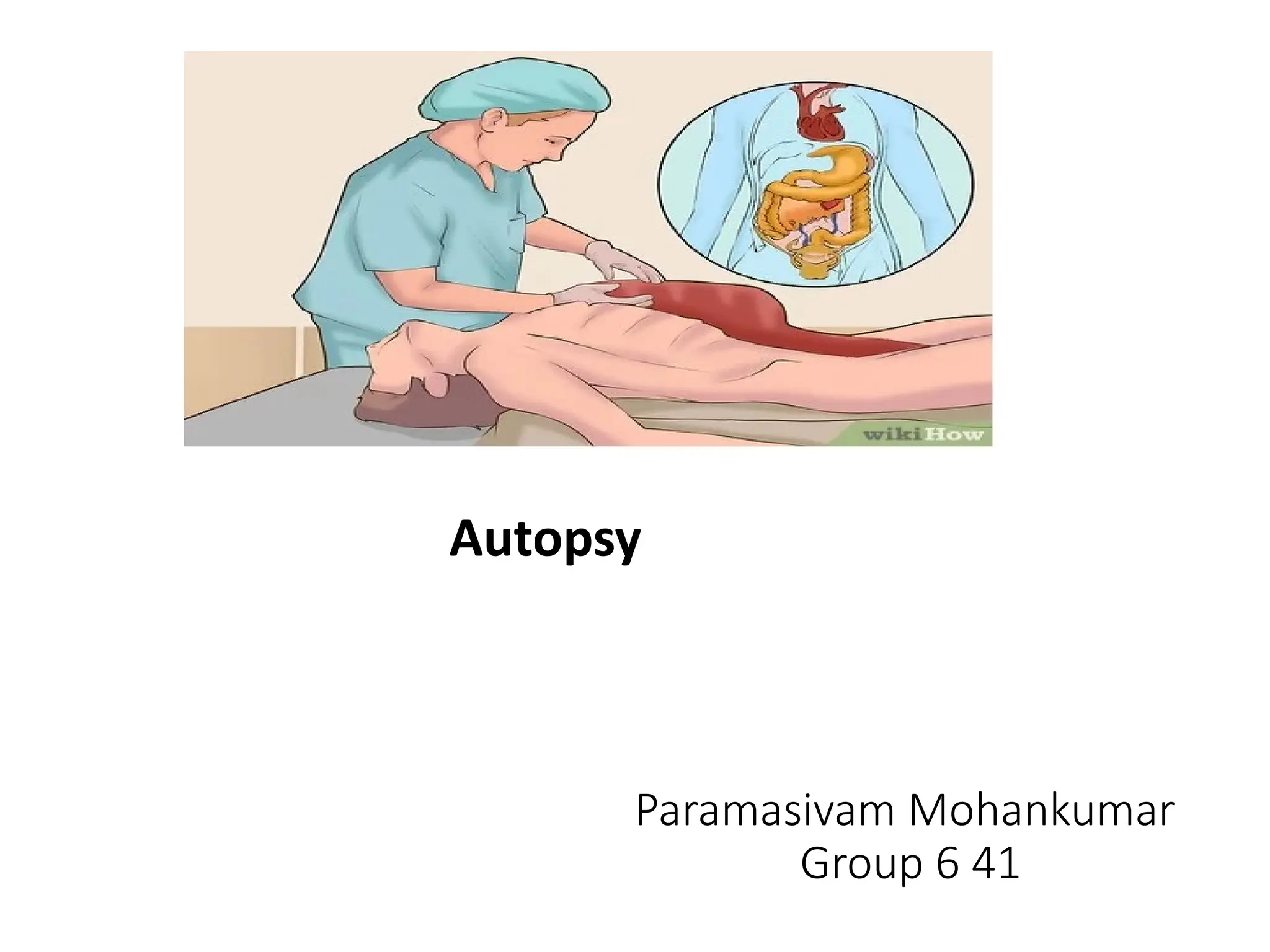
Autopsy
• Autopsy
• Objectives of autopsy
• General technical consideration
• Components of post mortem room
• Autopsy record
• Kinds of autopsy
• Autopsy techniques
• Steps of autopsy
Overview
Autopsy :
Autopsy refers to systemic examination of a dead person medical legal and or
scientific purposes.
In each and every case the autopsy must be complete, all the body cavities should
be opened, and every organ must be examined, because evidence contributory to
the cause of death may be found in more than one organ.
Partial autopsies have no place in forensic pathologic practice.
A complete autopsy is necessary to substantiate the truth of the evidence of
eyewitnesses.
• To identify the cause of death.
• To identify any hereditary disease
• To recognise any congenital anomalies
• To rule out an infectious disease.
• Education of medical students
• Information for audit.
• Material for research.
• Accurate data on death for National statistics.
Objectives of autopsy :
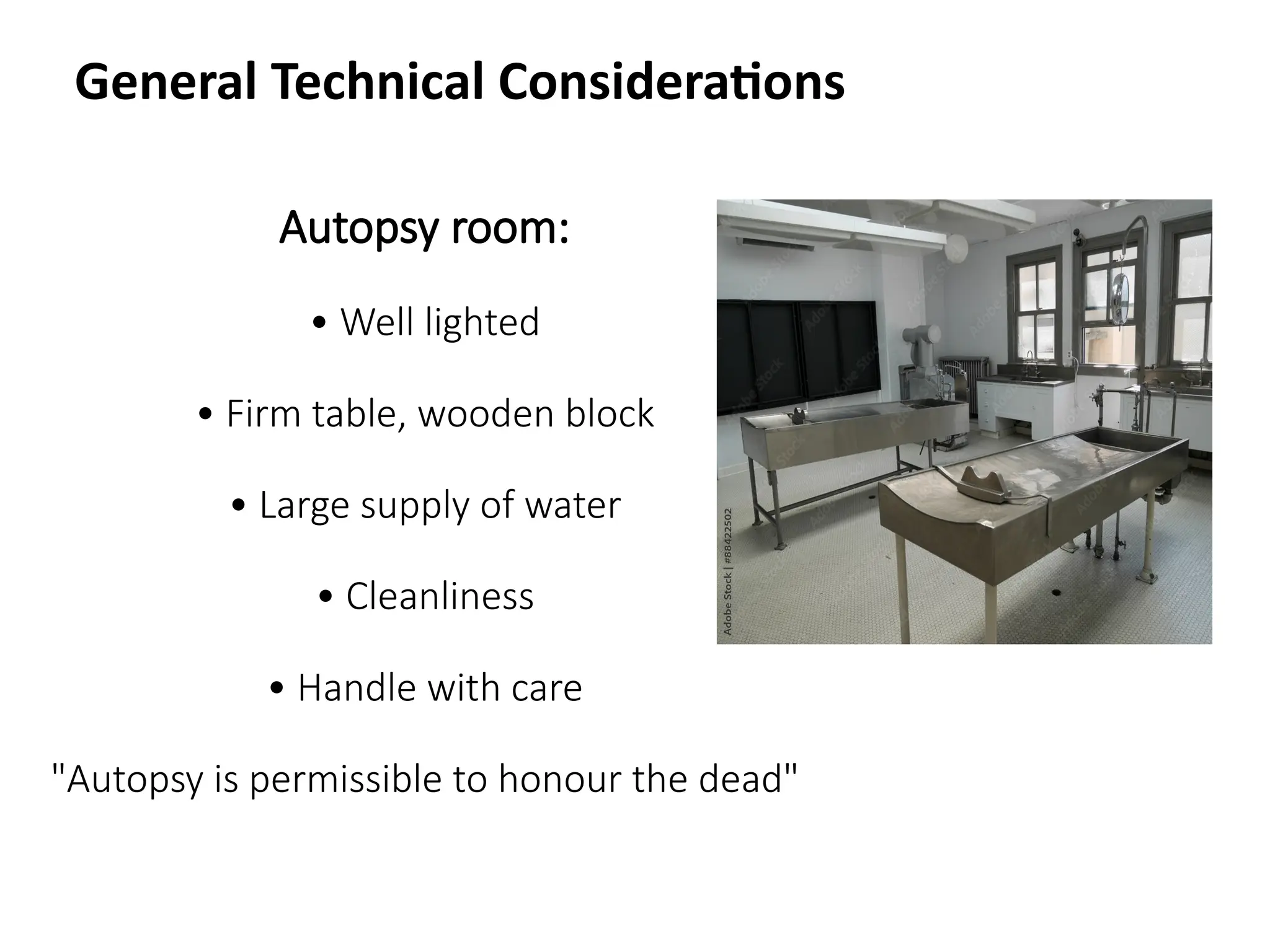
Autopsy room:
• Well lighted
• Firm table, wooden block
• Large supply of water
• Cleanliness
• Handle with care
"Autopsy is permissible to honour the dead"
General Technical Considerations
• Mortuary: For every 100 bed Hospital-4 body storage space.
: Temp-Main cold storage 4º C-Deep freeze unit- 20° C
• Table-Stainless steel with raised edge all around
- Large deep sink at the foot with both hot & cold water.
-Suction apparatus
Components of a post-mortem room
• Name, age, sex, colour, weight, length.
• IP No & Autopsy No.
• Date & time of death.
• Date, time & place of examination
• Name of resident & staff pathologist
• Temp & weather of room
• Name of person who identified the body
• Summary of clinical history
Autopsy record
• External examination
• Internal examination
Condition and appearance of organs, tissues &
cavities.
Chemical & microscopic examination
Diagnosis
There are two kinds of autopsies:
Forensic/Medico-legal
Clinical/Pathological Autopsy
Forensic: to find the cause of death for a police
investigation.
Clinical: Performed in a hospital Done to find the
cause of death for research.
Kinds of Autopsies :
Autopsy techniques :
General
1. En Masse (Le Tulle)
2. En Bloc
3. Virchow's
4. Rokitansky
1. Post operative
2. Needle
3. Endoscopic
4. Restriction of skin incisions
5. Autopsy through surgical wounds
Special :
1st External Examination
• height/weight
• Photography
UV exam (fluids)
2nd-Toxicology
• Nail scrapings
• Fluid samples
3rd Internal Examination
• Head (circular saw)
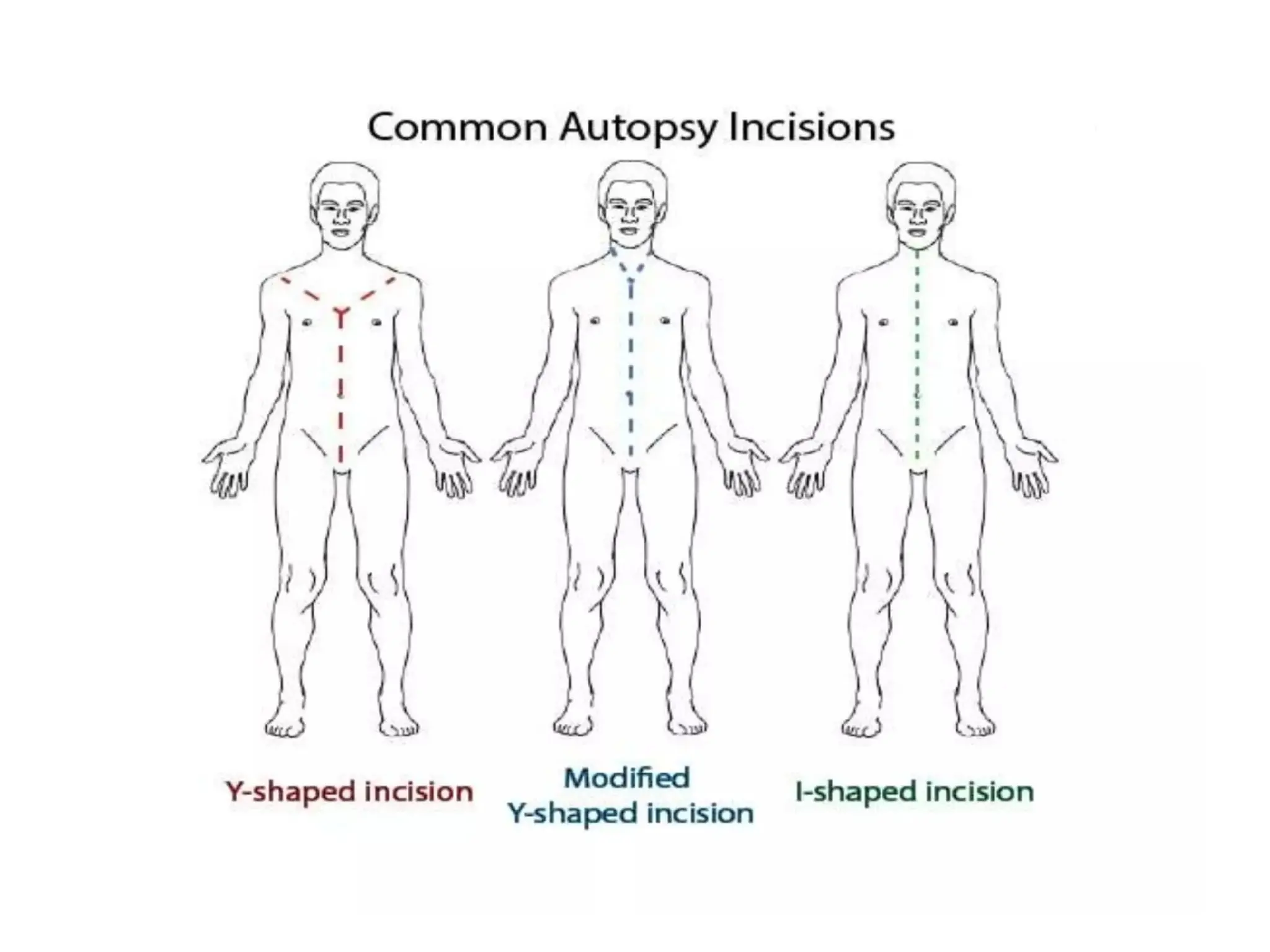
• Chest (incision)
• Abdomen
Steps of autopsy:
Autopsy , methods of the autopsy summary

Autopsy , methods of the autopsy summary

  • 1.
  • 2.
    • Autopsy • Objectivesof autopsy • General technical consideration • Components of post mortem room • Autopsy record • Kinds of autopsy • Autopsy techniques • Steps of autopsy Overview
  • 3.
    Autopsy : Autopsy refersto systemic examination of a dead person medical legal and or scientific purposes. In each and every case the autopsy must be complete, all the body cavities should be opened, and every organ must be examined, because evidence contributory to the cause of death may be found in more than one organ. Partial autopsies have no place in forensic pathologic practice. A complete autopsy is necessary to substantiate the truth of the evidence of eyewitnesses.
  • 4.
    • To identifythe cause of death. • To identify any hereditary disease • To recognise any congenital anomalies • To rule out an infectious disease. • Education of medical students • Information for audit. • Material for research. • Accurate data on death for National statistics. Objectives of autopsy :
  • 5.
    Autopsy room: • Welllighted • Firm table, wooden block • Large supply of water • Cleanliness • Handle with care "Autopsy is permissible to honour the dead" General Technical Considerations
  • 6.
    • Mortuary: Forevery 100 bed Hospital-4 body storage space. : Temp-Main cold storage 4º C-Deep freeze unit- 20° C • Table-Stainless steel with raised edge all around - Large deep sink at the foot with both hot & cold water. -Suction apparatus Components of a post-mortem room
  • 7.
    • Name, age,sex, colour, weight, length. • IP No & Autopsy No. • Date & time of death. • Date, time & place of examination • Name of resident & staff pathologist • Temp & weather of room • Name of person who identified the body • Summary of clinical history Autopsy record
  • 8.
    • External examination •Internal examination Condition and appearance of organs, tissues & cavities. Chemical & microscopic examination Diagnosis
  • 9.
    There are twokinds of autopsies: Forensic/Medico-legal Clinical/Pathological Autopsy Forensic: to find the cause of death for a police investigation. Clinical: Performed in a hospital Done to find the cause of death for research. Kinds of Autopsies :
  • 10.
    Autopsy techniques : General 1.En Masse (Le Tulle) 2. En Bloc 3. Virchow's 4. Rokitansky
  • 11.
    1. Post operative 2.Needle 3. Endoscopic 4. Restriction of skin incisions 5. Autopsy through surgical wounds Special :
  • 12.
    1st External Examination •height/weight • Photography UV exam (fluids) 2nd-Toxicology • Nail scrapings • Fluid samples 3rd Internal Examination • Head (circular saw) • Chest (incision) • Abdomen Steps of autopsy: