Moderater to- Mrs. Bindu k
Lect. DMCH
Presented By –
Deepika
 It is a basic ethical principle. An
autonomous person is capable of making
rational decisions & acting on those
decisions . It is a positive force that allows
nurses to attain goal. Autonomy is also used
to refer to the self-government of the people
in decision making & practice .
 The meaning of Autonomy derived from
Ancient Greek word “Autonomous” in which
“Auto” means “Self” & “Nomos” means
“Law”, hence when combined understood to
mean "one who gives oneself their own law".
Autonomy essentially means independence &
ability to be self directed . In health care , it has
come to mean a self directing freedom & moral
independence in which an individual is free to
choose & implement his or her own decision.
 Autonomy is defined as “the state
of being self-governing.”
or
 “Autonomy also means self-
directing freedom, which could
mean moral independence.”
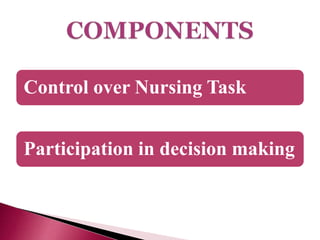
Control over Nursing Task
Participation in decision making
Having the opportunity for independent
thought & action .
Having the authority & responsibility for
implementing goals related to the quality of
care.
Being able to initiate changes & innovation in
practice.
 Determining & implementing quality
standards .
 Making decision affecting each nurse’s job
context including salary, staffing, professional
growth.
 Setting institutional policies , procedures &
goals.
The ability to
decide
A respect for
the individual
autonomy of
others
The power to
act upon
decisions
FACTORS
Fear
Lack of
intellig
ence
Pain
Drugs
that affect
reasoning
ability
Disease
1.
• Principle of paternalism
2.
• Principle of extreme paternalism
3.
• Principle of social welfare / social welfare principle
 It includes “Preventing Self Harm.”
E.g- when a client must be involuntarily
hospitalized , such as in the case of
mentally ill person who is disoriented & is
danger to himself or herself.
 This principle includes “Providing benefits
for the person being constrained .”
In this a nurse must take those
decisions which provides benefits to the
client or which are beneficial for the
patients & promote their health by giving
quality of care.
 This principle of autonomy emphasis on
“Providing benefits to others or the society .”
 In this principle a nurse can take decision
independently for the welfare of society or the
welfare for the individuals of a particular
society by giving preventive , promotive,
curative & rehabilitative health care services .
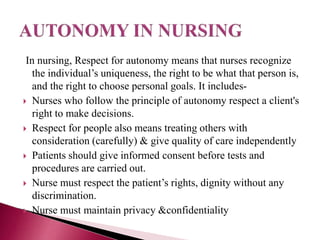
In nursing, Respect for autonomy means that nurses recognize
the individual’s uniqueness, the right to be what that person is,
and the right to choose personal goals. It includes-
 Nurses who follow the principle of autonomy respect a client's
right to make decisions.
 Respect for people also means treating others with
consideration (carefully) & give quality of care independently
 Patients should give informed consent before tests and
procedures are carried out.
 Nurse must respect the patient’s rights, dignity without any
discrimination.
 Nurse must maintain privacy &confidentiality
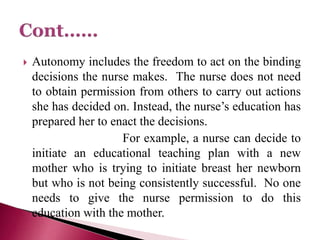
 Autonomy includes the freedom to act on the binding
decisions the nurse makes. The nurse does not need
to obtain permission from others to carry out actions
she has decided on. Instead, the nurse’s education has
prepared her to enact the decisions.
For example, a nurse can decide to
initiate an educational teaching plan with a new
mother who is trying to initiate breast her newborn
but who is not being consistently successful. No one
needs to give the nurse permission to do this
education with the mother.
 “A study was conducted to measure the
importance & satisfaction associated
with twenty –one job characteristics .
Special attention was given to aspects
of the faculty role as related to
professional autonomy.”
 The study confirmed that faculty members
regards professional autonomy & the freedom to
be self directed as more important than the
extrinsic or material rewards of their position .
 Increased faculty moral, productivity & retention
of qualified faculty members occur only when
faculty function autonomously.
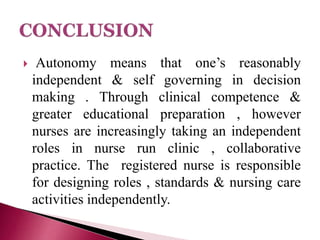
 Autonomy means that one’s reasonably
independent & self governing in decision
making . Through clinical competence &
greater educational preparation , however
nurses are increasingly taking an independent
roles in nurse run clinic , collaborative
practice. The registered nurse is responsible
for designing roles , standards & nursing care
activities independently.
Today we have discussed about –
 Introduction
 Meaning
 Definition
 Components
 Features
 Factors
 Principles
 Autonomy in nursing
 Research Study
 1. Autonomy means……………..
 2. ………..&…………… are the components of
Autonomy
 3. principle of Paternalism includes………………
 4……………&…………. Factors that diminished
Autonomy.
 BT Basvanthapa; “ Nursing Administration”; 2nd edition; published
by jaypee bros. Pvt. Ltd. ; page no. 505-506
 Kumari Neelam; “A Text Book of Management of Nursing Services
and Education”; published by Pee Vee publishers; 1st edition; page
no -365
 Clement. I , “Management of Nursing services & Education”,
Elsevier publisher; Page no-499-501
 TNAI, “Fundamental of nursing a procedure Mannual,” 1st
edition2005;Published by TNAI; Page no-13
 Kozier Barbara “Fundamental of Nursing” Published by Pearson
Education Pvt.Ltd ; 7th edition ;Page no-11
 www.google.com
 www.jil.gv.jp pdf
 www.revisionguru.co.

autonomy.pptx

  • 1.
    Moderater to- Mrs.Bindu k Lect. DMCH Presented By – Deepika
  • 2.
     It isa basic ethical principle. An autonomous person is capable of making rational decisions & acting on those decisions . It is a positive force that allows nurses to attain goal. Autonomy is also used to refer to the self-government of the people in decision making & practice .
  • 3.
     The meaningof Autonomy derived from Ancient Greek word “Autonomous” in which “Auto” means “Self” & “Nomos” means “Law”, hence when combined understood to mean "one who gives oneself their own law". Autonomy essentially means independence & ability to be self directed . In health care , it has come to mean a self directing freedom & moral independence in which an individual is free to choose & implement his or her own decision.
  • 4.
     Autonomy isdefined as “the state of being self-governing.” or  “Autonomy also means self- directing freedom, which could mean moral independence.”
  • 5.
    Control over NursingTask Participation in decision making
  • 6.
    Having the opportunityfor independent thought & action . Having the authority & responsibility for implementing goals related to the quality of care. Being able to initiate changes & innovation in practice.
  • 7.
     Determining &implementing quality standards .  Making decision affecting each nurse’s job context including salary, staffing, professional growth.  Setting institutional policies , procedures & goals.
  • 8.
    The ability to decide Arespect for the individual autonomy of others The power to act upon decisions
  • 9.
  • 10.
    1. • Principle ofpaternalism 2. • Principle of extreme paternalism 3. • Principle of social welfare / social welfare principle
  • 11.
     It includes“Preventing Self Harm.” E.g- when a client must be involuntarily hospitalized , such as in the case of mentally ill person who is disoriented & is danger to himself or herself.
  • 12.
     This principleincludes “Providing benefits for the person being constrained .” In this a nurse must take those decisions which provides benefits to the client or which are beneficial for the patients & promote their health by giving quality of care.
  • 13.
     This principleof autonomy emphasis on “Providing benefits to others or the society .”  In this principle a nurse can take decision independently for the welfare of society or the welfare for the individuals of a particular society by giving preventive , promotive, curative & rehabilitative health care services .
  • 14.
    In nursing, Respectfor autonomy means that nurses recognize the individual’s uniqueness, the right to be what that person is, and the right to choose personal goals. It includes-  Nurses who follow the principle of autonomy respect a client's right to make decisions.  Respect for people also means treating others with consideration (carefully) & give quality of care independently  Patients should give informed consent before tests and procedures are carried out.  Nurse must respect the patient’s rights, dignity without any discrimination.  Nurse must maintain privacy &confidentiality
  • 15.
     Autonomy includesthe freedom to act on the binding decisions the nurse makes. The nurse does not need to obtain permission from others to carry out actions she has decided on. Instead, the nurse’s education has prepared her to enact the decisions. For example, a nurse can decide to initiate an educational teaching plan with a new mother who is trying to initiate breast her newborn but who is not being consistently successful. No one needs to give the nurse permission to do this education with the mother.
  • 16.
     “A studywas conducted to measure the importance & satisfaction associated with twenty –one job characteristics . Special attention was given to aspects of the faculty role as related to professional autonomy.”
  • 17.
     The studyconfirmed that faculty members regards professional autonomy & the freedom to be self directed as more important than the extrinsic or material rewards of their position .  Increased faculty moral, productivity & retention of qualified faculty members occur only when faculty function autonomously.
  • 18.
     Autonomy meansthat one’s reasonably independent & self governing in decision making . Through clinical competence & greater educational preparation , however nurses are increasingly taking an independent roles in nurse run clinic , collaborative practice. The registered nurse is responsible for designing roles , standards & nursing care activities independently.
  • 19.
    Today we havediscussed about –  Introduction  Meaning  Definition  Components  Features  Factors  Principles  Autonomy in nursing  Research Study
  • 20.
     1. Autonomymeans……………..  2. ………..&…………… are the components of Autonomy  3. principle of Paternalism includes………………  4……………&…………. Factors that diminished Autonomy.
  • 21.
     BT Basvanthapa;“ Nursing Administration”; 2nd edition; published by jaypee bros. Pvt. Ltd. ; page no. 505-506  Kumari Neelam; “A Text Book of Management of Nursing Services and Education”; published by Pee Vee publishers; 1st edition; page no -365  Clement. I , “Management of Nursing services & Education”, Elsevier publisher; Page no-499-501  TNAI, “Fundamental of nursing a procedure Mannual,” 1st edition2005;Published by TNAI; Page no-13  Kozier Barbara “Fundamental of Nursing” Published by Pearson Education Pvt.Ltd ; 7th edition ;Page no-11  www.google.com  www.jil.gv.jp pdf  www.revisionguru.co.