An overview of the SAP Automotive
Procurement processes implemented in a
major car manufacturer.
Note: Some of this work was carried out whilst the author was employed by one of the major ERP System
Implementers so names and customer detail have been removed to preserve confidentiality.
Kevin Harmon-Smith Feb 2013
AGENDA
AGENDA
Topic
Background to Automotive Procurement
SAP Standard Procurement Processes
Summary of Complete Procurement Process
implemented and next steps
Background & Principles
Learning from previous
automotive experiences
Erptransformations Feb 2013 4
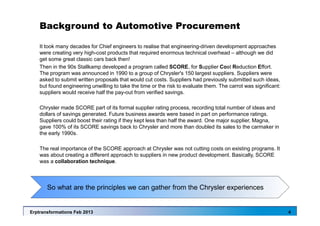
Background to Automotive Procurement
It took many decades for Chief engineers to realise that engineering-driven development approaches
were creating very high-cost products that required enormous technical overhead – although we did
get some great classic cars back then!
Then in the 90s Stallkamp developed a program called SCORE, for Supplier Cost Reduction Effort.
The program was announced in 1990 to a group of Chrysler's 150 largest suppliers. Suppliers were
asked to submit written proposals that would cut costs. Suppliers had previously submitted such ideas,
but found engineering unwilling to take the time or the risk to evaluate them. The carrot was significant:
suppliers would receive half the pay-out from verified savings.
Chrysler made SCORE part of its formal supplier rating process, recording total number of ideas and
dollars of savings generated. Future business awards were based in part on performance ratings.
Suppliers could boost their rating if they kept less than half the award. One major supplier, Magna,
gave 100% of its SCORE savings back to Chrysler and more than doubled its sales to the carmaker in
the early 1990s.
The real importance of the SCORE approach at Chrysler was not cutting costs on existing programs. It
was about creating a different approach to suppliers in new product development. Basically, SCORE
was a collaboration technique.
So what are the principles we can gather from the Chrysler experiences
Erptransformations Feb 2013 5
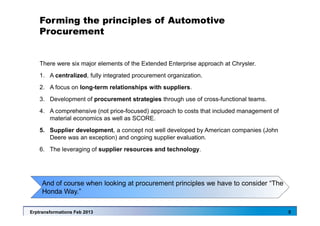
Forming the principles of Automotive
Procurement
There were six major elements of the Extended Enterprise approach at Chrysler.
1. A centralized, fully integrated procurement organization.
2. A focus on long-term relationships with suppliers.
3. Development of procurement strategies through use of cross-functional teams.
4. A comprehensive (not price-focused) approach to costs that included management of
material economics as well as SCORE.
5. Supplier development, a concept not well developed by American companies (John
Deere was an exception) and ongoing supplier evaluation.
6. The leveraging of supplier resources and technology.
And of course when looking at procurement principles we have to consider “The
Honda Way.”
Erptransformations Feb 2013 6
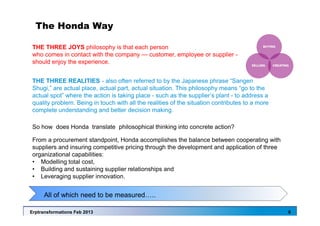
The Honda Way
So how does Honda translate philosophical thinking into concrete action?
From a procurement standpoint, Honda accomplishes the balance between cooperating with
suppliers and insuring competitive pricing through the development and application of three
organizational capabilities:
• Modelling total cost,
• Building and sustaining supplier relationships and
• Leveraging supplier innovation.
THE THREE REALITIES - also often referred to by the Japanese phrase “Sangen
Shugi,” are actual place, actual part, actual situation. This philosophy means “go to the
actual spot” where the action is taking place - such as the supplier’s plant - to address a
quality problem. Being in touch with all the realities of the situation contributes to a more
complete understanding and better decision making.
THE THREE JOYS philosophy is that each person
who comes in contact with the company — customer, employee or supplier -
should enjoy the experience.
All of which need to be measured…..
Erptransformations Feb 2013 7
The KPI’s used to Monitor Supplier Cooperation and
Value
• Total cost savings
• Quality
• Delivery
• Cost avoidance
• Implemented cost reduction savings
• Procurement Cycle Time
• Percentage of suppliers accounting for 80% of the spend
• Procurement ROI
• Managed spend as percentage of total spend
• Contract compliance
The detail of how we do this is the subject of a later deck but what does the
Supplier get out of all this monitoring and control?
Erptransformations Feb 2013 8
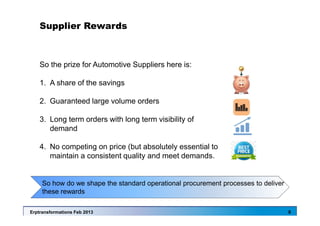
Supplier Rewards
So the prize for Automotive Suppliers here is:
1. A share of the savings
2. Guaranteed large volume orders
3. Long term orders with long term visibility of
demand
4. No competing on price (but absolutely essential to
maintain a consistent quality and meet demands.
So how do we shape the standard operational procurement processes to deliver
these rewards
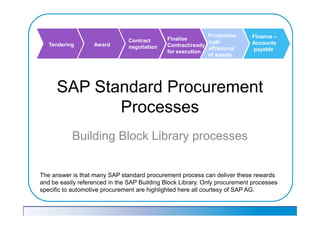
SAP Standard Procurement
Processes
Building Block Library processes
The answer is that many SAP standard procurement process can deliver these rewards
and be easily referenced in the SAP Building Block Library. Only procurement processes
specific to automotive procurement are highlighted here all courtesy of SAP AG.
Tendering Award
Contract
negotiation
Finalise
Contract/ready
for execution
Finance –
Accounts
payable
Production
/call-
off/source
of supply
Erptransformations Feb 2013 10
Convert
Planned
order
Requirements
Dependent
requirements
Projects
Reservations
Purchasing
functions
POs
Sched. agmt
delivery
schedules
Purchase
requisition
Warehouse/
stores
Production
order
Invoice
verification
Requirements
planning
Demand
management
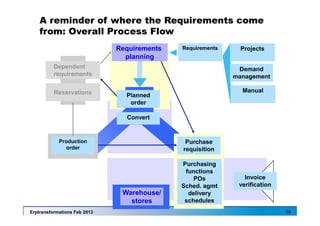
A reminder of where the Requirements come
from: Overall Process Flow
Manual
Erptransformations Feb 2013 11
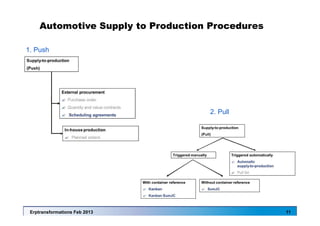
Automotive Supply to Production Procedures
1. Push
2. Pull
Erptransformations Feb 2013 12
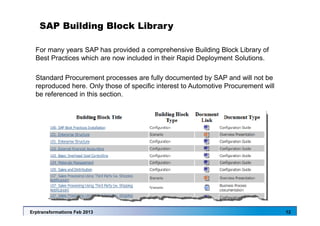
SAP Building Block Library
For many years SAP has provided a comprehensive Building Block Library of
Best Practices which are now included in their Rapid Deployment Solutions.
Standard Procurement processes are fully documented by SAP and will not be
reproduced here. Only those of specific interest to Automotive Procurement will
be referenced in this section.
Erptransformations Feb 2013 13
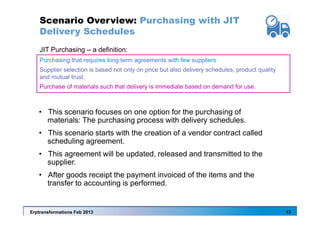
Scenario Overview: Purchasing with JIT
Delivery Schedules
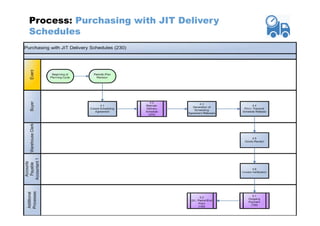
• This scenario focuses on one option for the purchasing of
materials: The purchasing process with delivery schedules.
• This scenario starts with the creation of a vendor contract called
scheduling agreement.
• This agreement will be updated, released and transmitted to the
supplier.
• After goods receipt the payment invoiced of the items and the
transfer to accounting is performed.
JIT Purchasing – a definition:
Purchasing that requires long term agreements with few suppliers
Supplier selection is based not only on price but also delivery schedules, product quality
and mutual trust.
Purchase of materials such that delivery is immediate based on demand for use.
Erptransformations Feb 2013 14
Process: Purchasing with JIT Delivery
Schedules
Erptransformations Feb 2013 15
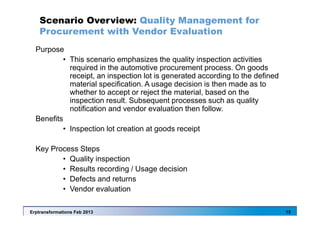
Scenario Overview: Quality Management for
Procurement with Vendor Evaluation
Purpose
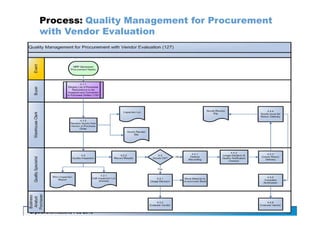
• This scenario emphasizes the quality inspection activities
required in the automotive procurement process. On goods
receipt, an inspection lot is generated according to the defined
material specification. A usage decision is then made as to
whether to accept or reject the material, based on the
inspection result. Subsequent processes such as quality
notification and vendor evaluation then follow.
Benefits
• Inspection lot creation at goods receipt
Key Process Steps
• Quality inspection
• Results recording / Usage decision
• Defects and returns
• Vendor evaluation
Erptransformations Feb 2013 16
Process: Quality Management for Procurement
with Vendor Evaluation
Summary of Complete
Process
Text
Erptransformations Feb 2013 18
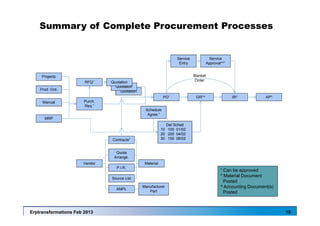
Summary of Complete Procurement Processes
Quotation
Quotation
Purch.
Req.”
RFQ” Quotation
PO” GR*^ IR^ AP^
MRP
Projects
Prod. Ord.
Manual
Schedule
Agree.”
Del Sched
10 100 01/02
20 200 04/02
30 150 06/02Contracts”
Source List
Quota
Arrange.
P.I.R.
Vendor Material
Manufacturer
Part
AMPL
Service
Entry
Service
Approval*^”
“ Can be approved
* Material Document
Posted
^ Accounting Document(s)
Posted
Blanket
Order
Erptransformations Feb 2013 19
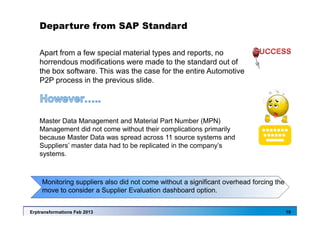
Departure from SAP Standard
Apart from a few special material types and reports, no
horrendous modifications were made to the standard out of
the box software. This was the case for the entire Automotive
P2P process in the previous slide.
Master Data Management and Material Part Number (MPN)
Management did not come without their complications primarily
because Master Data was spread across 11 source systems and
Suppliers’ master data had to be replicated in the company’s
systems.
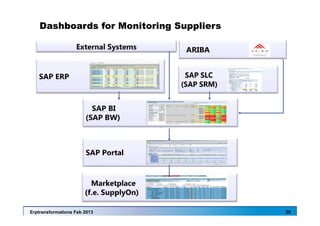
Monitoring suppliers also did not come without a significant overhead forcing the
move to consider a Supplier Evaluation dashboard option.
Erptransformations Feb 2013 20
Dashboards for Monitoring Suppliers
Erptransformations Feb 2013 21
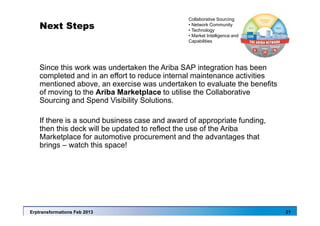
Next Steps
Since this work was undertaken the Ariba SAP integration has been
completed and in an effort to reduce internal maintenance activities
mentioned above, an exercise was undertaken to evaluate the benefits
of moving to the Ariba Marketplace to utilise the Collaborative
Sourcing and Spend Visibility Solutions.
If there is a sound business case and award of appropriate funding,
then this deck will be updated to reflect the use of the Ariba
Marketplace for automotive procurement and the advantages that
brings – watch this space!
Collaborative Sourcing
• Network Community
• Technology
• Market Intelligence and
Capabilities
About
Aboutt Contact
erptransformations is an independent consultancy run by Kevin Harmon-Smith who is a
senior programme manager with a technical twist. With over 30 years’ continuous
employment in Industry and Consulting (including the last 13 years with SAP) Kevin has
helped companies define and realise value from technology investments.
This experience includes leading the delivery of large-scale multi-million pound
programmes, shaping the enterprise architecture of several blue chip organisations, as
well as leading teams of up to 40 personnel.
Kevin has also successfully delivered tangible value adding Solution Architecture, Road-
mapping and Value Assessment projects across a wide range of Industry sectors.
Over the last three years, Kevin has been managing SAP UK’s Business Transformation
Services driving consulting revenue growth by developing services, building the teams
and by acting as a "trusted advisor" to FTSE 100 companies.
erptransformations has an extensive network amongst SAP consultants and partners
plus across a wide spectrum of the management consultancy sector. This network is
often utilised to deliver the optimum service for our customers.
Aboutt Contact
Kevin Harmon-Smith MBA, MSc, PMP, MCMI
T +44 (0)7423 224 785
E khs@erptransformations.co.uk
www.erptransformations.co.uk

Procurement Processes in Automotive Manufacturing

  • 1.
    An overview ofthe SAP Automotive Procurement processes implemented in a major car manufacturer. Note: Some of this work was carried out whilst the author was employed by one of the major ERP System Implementers so names and customer detail have been removed to preserve confidentiality. Kevin Harmon-Smith Feb 2013
  • 2.
    AGENDA AGENDA Topic Background to AutomotiveProcurement SAP Standard Procurement Processes Summary of Complete Procurement Process implemented and next steps
  • 3.
    Background & Principles Learningfrom previous automotive experiences
  • 4.
    Erptransformations Feb 20134 Background to Automotive Procurement It took many decades for Chief engineers to realise that engineering-driven development approaches were creating very high-cost products that required enormous technical overhead – although we did get some great classic cars back then! Then in the 90s Stallkamp developed a program called SCORE, for Supplier Cost Reduction Effort. The program was announced in 1990 to a group of Chrysler's 150 largest suppliers. Suppliers were asked to submit written proposals that would cut costs. Suppliers had previously submitted such ideas, but found engineering unwilling to take the time or the risk to evaluate them. The carrot was significant: suppliers would receive half the pay-out from verified savings. Chrysler made SCORE part of its formal supplier rating process, recording total number of ideas and dollars of savings generated. Future business awards were based in part on performance ratings. Suppliers could boost their rating if they kept less than half the award. One major supplier, Magna, gave 100% of its SCORE savings back to Chrysler and more than doubled its sales to the carmaker in the early 1990s. The real importance of the SCORE approach at Chrysler was not cutting costs on existing programs. It was about creating a different approach to suppliers in new product development. Basically, SCORE was a collaboration technique. So what are the principles we can gather from the Chrysler experiences
  • 5.
    Erptransformations Feb 20135 Forming the principles of Automotive Procurement There were six major elements of the Extended Enterprise approach at Chrysler. 1. A centralized, fully integrated procurement organization. 2. A focus on long-term relationships with suppliers. 3. Development of procurement strategies through use of cross-functional teams. 4. A comprehensive (not price-focused) approach to costs that included management of material economics as well as SCORE. 5. Supplier development, a concept not well developed by American companies (John Deere was an exception) and ongoing supplier evaluation. 6. The leveraging of supplier resources and technology. And of course when looking at procurement principles we have to consider “The Honda Way.”
  • 6.
    Erptransformations Feb 20136 The Honda Way So how does Honda translate philosophical thinking into concrete action? From a procurement standpoint, Honda accomplishes the balance between cooperating with suppliers and insuring competitive pricing through the development and application of three organizational capabilities: • Modelling total cost, • Building and sustaining supplier relationships and • Leveraging supplier innovation. THE THREE REALITIES - also often referred to by the Japanese phrase “Sangen Shugi,” are actual place, actual part, actual situation. This philosophy means “go to the actual spot” where the action is taking place - such as the supplier’s plant - to address a quality problem. Being in touch with all the realities of the situation contributes to a more complete understanding and better decision making. THE THREE JOYS philosophy is that each person who comes in contact with the company — customer, employee or supplier - should enjoy the experience. All of which need to be measured…..
  • 7.
    Erptransformations Feb 20137 The KPI’s used to Monitor Supplier Cooperation and Value • Total cost savings • Quality • Delivery • Cost avoidance • Implemented cost reduction savings • Procurement Cycle Time • Percentage of suppliers accounting for 80% of the spend • Procurement ROI • Managed spend as percentage of total spend • Contract compliance The detail of how we do this is the subject of a later deck but what does the Supplier get out of all this monitoring and control?
  • 8.
    Erptransformations Feb 20138 Supplier Rewards So the prize for Automotive Suppliers here is: 1. A share of the savings 2. Guaranteed large volume orders 3. Long term orders with long term visibility of demand 4. No competing on price (but absolutely essential to maintain a consistent quality and meet demands. So how do we shape the standard operational procurement processes to deliver these rewards
  • 9.
    SAP Standard Procurement Processes BuildingBlock Library processes The answer is that many SAP standard procurement process can deliver these rewards and be easily referenced in the SAP Building Block Library. Only procurement processes specific to automotive procurement are highlighted here all courtesy of SAP AG. Tendering Award Contract negotiation Finalise Contract/ready for execution Finance – Accounts payable Production /call- off/source of supply
  • 10.
    Erptransformations Feb 201310 Convert Planned order Requirements Dependent requirements Projects Reservations Purchasing functions POs Sched. agmt delivery schedules Purchase requisition Warehouse/ stores Production order Invoice verification Requirements planning Demand management A reminder of where the Requirements come from: Overall Process Flow Manual
  • 11.
    Erptransformations Feb 201311 Automotive Supply to Production Procedures 1. Push 2. Pull
  • 12.
    Erptransformations Feb 201312 SAP Building Block Library For many years SAP has provided a comprehensive Building Block Library of Best Practices which are now included in their Rapid Deployment Solutions. Standard Procurement processes are fully documented by SAP and will not be reproduced here. Only those of specific interest to Automotive Procurement will be referenced in this section.
  • 13.
    Erptransformations Feb 201313 Scenario Overview: Purchasing with JIT Delivery Schedules • This scenario focuses on one option for the purchasing of materials: The purchasing process with delivery schedules. • This scenario starts with the creation of a vendor contract called scheduling agreement. • This agreement will be updated, released and transmitted to the supplier. • After goods receipt the payment invoiced of the items and the transfer to accounting is performed. JIT Purchasing – a definition: Purchasing that requires long term agreements with few suppliers Supplier selection is based not only on price but also delivery schedules, product quality and mutual trust. Purchase of materials such that delivery is immediate based on demand for use.
  • 14.
    Erptransformations Feb 201314 Process: Purchasing with JIT Delivery Schedules
  • 15.
    Erptransformations Feb 201315 Scenario Overview: Quality Management for Procurement with Vendor Evaluation Purpose • This scenario emphasizes the quality inspection activities required in the automotive procurement process. On goods receipt, an inspection lot is generated according to the defined material specification. A usage decision is then made as to whether to accept or reject the material, based on the inspection result. Subsequent processes such as quality notification and vendor evaluation then follow. Benefits • Inspection lot creation at goods receipt Key Process Steps • Quality inspection • Results recording / Usage decision • Defects and returns • Vendor evaluation
  • 16.
    Erptransformations Feb 201316 Process: Quality Management for Procurement with Vendor Evaluation
  • 17.
  • 18.
    Erptransformations Feb 201318 Summary of Complete Procurement Processes Quotation Quotation Purch. Req.” RFQ” Quotation PO” GR*^ IR^ AP^ MRP Projects Prod. Ord. Manual Schedule Agree.” Del Sched 10 100 01/02 20 200 04/02 30 150 06/02Contracts” Source List Quota Arrange. P.I.R. Vendor Material Manufacturer Part AMPL Service Entry Service Approval*^” “ Can be approved * Material Document Posted ^ Accounting Document(s) Posted Blanket Order
  • 19.
    Erptransformations Feb 201319 Departure from SAP Standard Apart from a few special material types and reports, no horrendous modifications were made to the standard out of the box software. This was the case for the entire Automotive P2P process in the previous slide. Master Data Management and Material Part Number (MPN) Management did not come without their complications primarily because Master Data was spread across 11 source systems and Suppliers’ master data had to be replicated in the company’s systems. Monitoring suppliers also did not come without a significant overhead forcing the move to consider a Supplier Evaluation dashboard option.
  • 20.
    Erptransformations Feb 201320 Dashboards for Monitoring Suppliers
  • 21.
    Erptransformations Feb 201321 Next Steps Since this work was undertaken the Ariba SAP integration has been completed and in an effort to reduce internal maintenance activities mentioned above, an exercise was undertaken to evaluate the benefits of moving to the Ariba Marketplace to utilise the Collaborative Sourcing and Spend Visibility Solutions. If there is a sound business case and award of appropriate funding, then this deck will be updated to reflect the use of the Ariba Marketplace for automotive procurement and the advantages that brings – watch this space! Collaborative Sourcing • Network Community • Technology • Market Intelligence and Capabilities
  • 22.
  • 23.
    Aboutt Contact erptransformations isan independent consultancy run by Kevin Harmon-Smith who is a senior programme manager with a technical twist. With over 30 years’ continuous employment in Industry and Consulting (including the last 13 years with SAP) Kevin has helped companies define and realise value from technology investments. This experience includes leading the delivery of large-scale multi-million pound programmes, shaping the enterprise architecture of several blue chip organisations, as well as leading teams of up to 40 personnel. Kevin has also successfully delivered tangible value adding Solution Architecture, Road- mapping and Value Assessment projects across a wide range of Industry sectors. Over the last three years, Kevin has been managing SAP UK’s Business Transformation Services driving consulting revenue growth by developing services, building the teams and by acting as a "trusted advisor" to FTSE 100 companies. erptransformations has an extensive network amongst SAP consultants and partners plus across a wide spectrum of the management consultancy sector. This network is often utilised to deliver the optimum service for our customers.
  • 24.
    Aboutt Contact Kevin Harmon-SmithMBA, MSc, PMP, MCMI T +44 (0)7423 224 785 E khs@erptransformations.co.uk www.erptransformations.co.uk