International Research Journal of Engineering and Technology (IRJET) e-ISSN: 2395 -0056
Volume: 04 Issue: 02 | Feb -2017 www.irjet.net p-ISSN: 2395-0072
© 2017, IRJET | Impact Factor value: 5.181 | ISO 9001:2008 Certified Journal | Page 1674
Automatic Water Tank Cleaning Machine
Thonge Suraj D.1, Shelke Prasad K.2, Wakte Vaibhav B.3, Thonge Sharad A.4,
Prof. Shinde R.S.5
1BE Student, Department of Mechanical Engineering, SND COE & RC, Maharashtra, India
2BE Student, Department of Mechanical Engineering, SND COE & RC, Maharashtra, India
3BE Student, Department of Mechanical Engineering, SND COE & RC, Maharashtra, India
4BE Student, Department of Mechanical Engineering, SND COE & RC, Maharashtra, India
5 Professor, Department of Mechanical Engineering, SND COE & RC, Maharashtra, India
---------------------------------------------------------------------***---------------------------------------------------------------------
Abstract - Aim of this project is to develop a mechanical
system for cleaning domestic cylindrical water tank. The
mechanical system includes two main mechanisms which
are rack and pinion gear mechanism and reciprocating four
bar linkage mechanism. The rack and pinion arrangement is
used to move whole mechanical system up and down for
cleaning the cylindrical tank. The rack is fixed on the motor
and the four-bar mechanism is attached to the motor shaft.
PVC brushes are attached to the ends of the four-bar
linkage. Four bar linkage is made in such a way that it can
be adjusted according to inside diameter of the tank. When
the motor is started the linkage rotates and with the help of
brushes, cleaning of wall and base of tank takes place. The
purpose of this project is to reduce the human efforts and to
avoid the chemical influence on health of person entering
the tank for cleaning.
Key Words: Cylindrical water tank, four bar linkage,
motor shaft, rack and pinion, PVC brush.
1.INTRODUCTION
1.1 Necessity of Cleaning Water Tank
Every day we use the tank water for brushing and
bathing, for cleaning and moping, for washing clothes and
in other household chores. With the passage of time,
sediments, scale and algae get deposited on the walls,
ceiling and floor of the water tank. This deposition
contaminates the water and makes is unfit for use. With
time algae and bacteria grow and breed in this water
infect it and could make us fall sick eventually. Hence
water tank cleaning is very important.
1.2 Methods of water tank cleaning
Manual scrubbing in which wall and floor of tank
are scrubbed to remove dirt, sediments, fungus and stains,
but this method is more tedious and time consuming.
The water tank can also be cleaned by using
chemicals to remove the dirt and sediments. The
chemicals used may affect the human health.
Pressurized water can be sprayed on the walls of
the tank which will remove the dirt from the tank surface.
These methods are time consuming and require
more efforts for cleaning.
1.3 Alternate Method
All methods of cleaning water tank as discussed
above are time consuming and require more human
efforts. So alternate method is required for cleaning
purpose which will overcome the drawbacks of all other
methods. Therefore we are developing water tank
cleaning equipment which requires less time and human
efforts for cleaning.
2. MAIN COMPONENTS
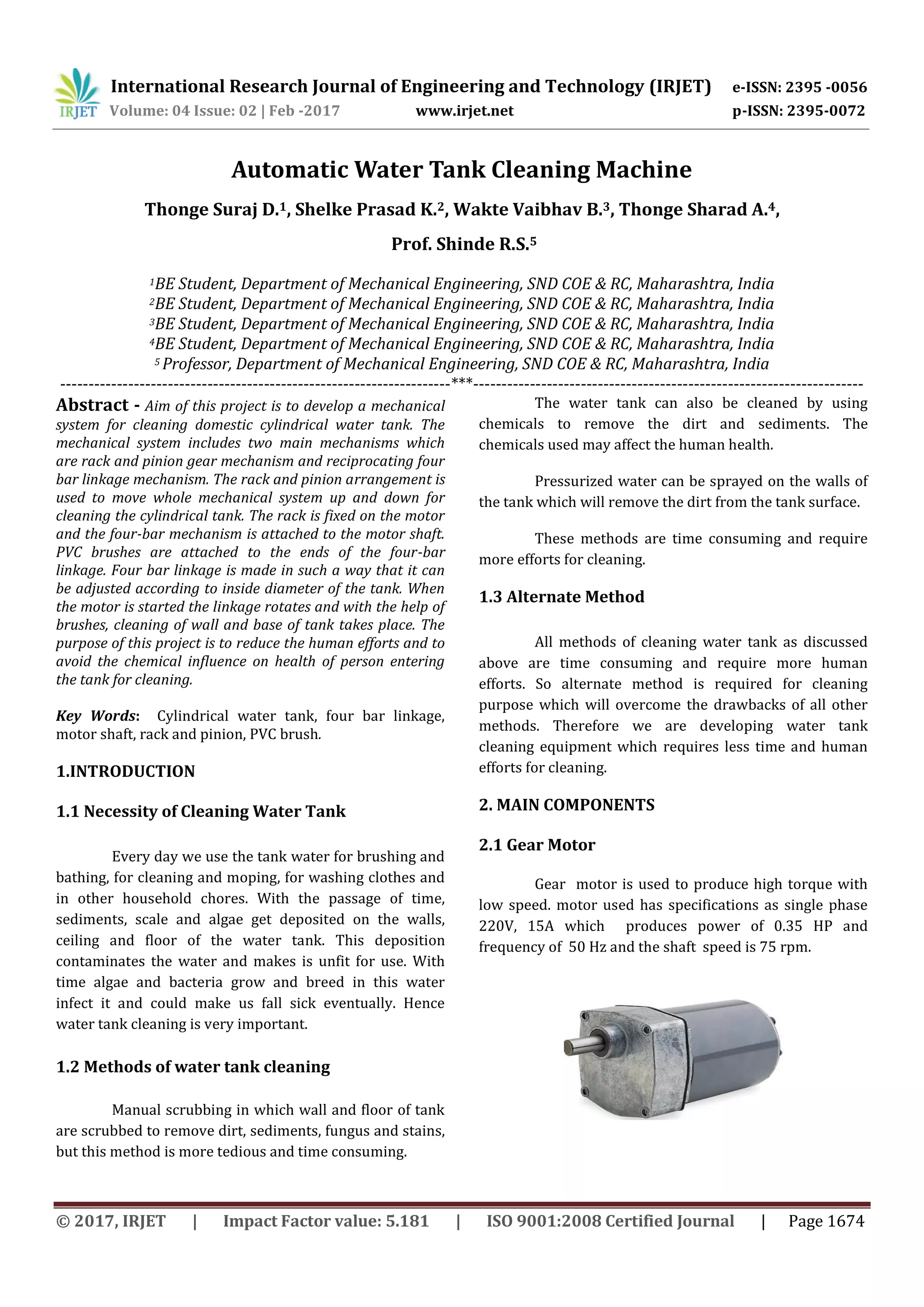
2.1 Gear Motor
Gear motor is used to produce high torque with
low speed. motor used has specifications as single phase
220V, 15A which produces power of 0.35 HP and
frequency of 50 Hz and the shaft speed is 75 rpm.
International Research Journal of Engineering and Technology (IRJET) e-ISSN: 2395 -0056
Volume: 04 Issue: 02 | Feb -2017 www.irjet.net p-ISSN: 2395-0072
© 2017, IRJET | Impact Factor value: 5.181 | ISO 9001:2008 Certified Journal | Page 1675
2.2 Four Bar Linkage
A plane linkage consisting of four links pinned tail
to head in a closed loop with lower or closed joints. It is a
plane mechanism consisting of four links that form
rotating kinematic pairs. The four bar linkage is arranged
in such a way that it adjusts the inner diameter of the tank.
2.3 Rack and Pinion
A rack and pinion is a type of linear actuator that
comprises a pair of gears which converts rotational
motion into linear motion. A circular gear called “the
pinion” engages teeth on a linear “gear” bar called “the
rack”. Rotational motion applied to the pinion causes the
rack to move relative to pinion. Thus the motor attached
to the rack is moved in vertical direction along the guide
way with the help of handle attached to the pinion.
2.4 Shaft
Shaft made up of mild steel of diameter 15mm is
used to transmit rotary motion from motor to the four bar
linkage. Holes provided on the shaft, adjust the four bar
linkage according to the diameter of the tank.
2.5 Brush
The brushes are made up of Poly Vinyl Chloride
(PVC) polymer. Brushes attached to the ends of four bar
linkage revolve due to rotation of motor shaft to clean the
inner surface of the tank.
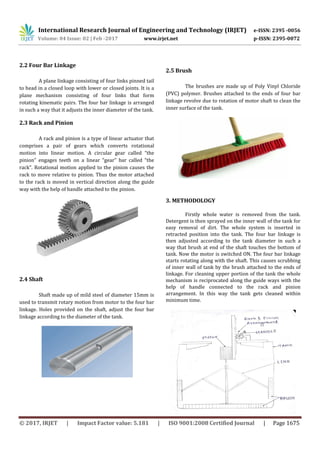
3. METHODOLOGY
Firstly whole water is removed from the tank.
Detergent is then sprayed on the inner wall of the tank for
easy removal of dirt. The whole system is inserted in
retracted position into the tank. The four bar linkage is
then adjusted according to the tank diameter in such a
way that brush at end of the shaft touches the bottom of
tank. Now the motor is switched ON. The four bar linkage
starts rotating along with the shaft. This causes scrubbing
of inner wall of tank by the brush attached to the ends of
linkage. For cleaning upper portion of the tank the whole
mechanism is reciprocated along the guide ways with the
help of handle connected to the rack and pinion
arrangement. In this way the tank gets cleaned within
minimum time.
International Research Journal of Engineering and Technology (IRJET) e-ISSN: 2395 -0056
Volume: 04 Issue: 02 | Feb -2017 www.irjet.net p-ISSN: 2395-0072
© 2017, IRJET | Impact Factor value: 5.181 | ISO 9001:2008 Certified Journal | Page 1676
4. CONCLUSION
The water tank cleaner was used to clean the
water tanks by using rotating brushes. This method was
more effective and safe than the conventional methods.
This method is capable to clean water tanks within less
time and human efforts.
ACKNOWLEDGEMENT
It is a pleasure for us to present this paper where
guidance plays an invaluable key and provides a concrete
platform for completion of the paper.
We would like to thank our internal guide Prof.
Shinde R.S. Department of Mechanical Engineering, for his
valuable encouragement and constant guidance without
which we wouldn’t have looked deeper into our work and
realized both our shortcomings and our feats. This work
would not have been possible without him.
REFERENCES
[1] Dr.R.K.Bansal, Kinematics of machine, Laxmi
Publications (P) Ltd (2011).
[2] Shubham Shrivastav, Hari Om Kumar, “Design and
Development of Cylindrical Water tank cleaner”, vol. 6,
2016, pp. 262-264.

Automatic Water Tank Cleaning Machine

  • 1.
    International Research Journalof Engineering and Technology (IRJET) e-ISSN: 2395 -0056 Volume: 04 Issue: 02 | Feb -2017 www.irjet.net p-ISSN: 2395-0072 © 2017, IRJET | Impact Factor value: 5.181 | ISO 9001:2008 Certified Journal | Page 1674 Automatic Water Tank Cleaning Machine Thonge Suraj D.1, Shelke Prasad K.2, Wakte Vaibhav B.3, Thonge Sharad A.4, Prof. Shinde R.S.5 1BE Student, Department of Mechanical Engineering, SND COE & RC, Maharashtra, India 2BE Student, Department of Mechanical Engineering, SND COE & RC, Maharashtra, India 3BE Student, Department of Mechanical Engineering, SND COE & RC, Maharashtra, India 4BE Student, Department of Mechanical Engineering, SND COE & RC, Maharashtra, India 5 Professor, Department of Mechanical Engineering, SND COE & RC, Maharashtra, India ---------------------------------------------------------------------***--------------------------------------------------------------------- Abstract - Aim of this project is to develop a mechanical system for cleaning domestic cylindrical water tank. The mechanical system includes two main mechanisms which are rack and pinion gear mechanism and reciprocating four bar linkage mechanism. The rack and pinion arrangement is used to move whole mechanical system up and down for cleaning the cylindrical tank. The rack is fixed on the motor and the four-bar mechanism is attached to the motor shaft. PVC brushes are attached to the ends of the four-bar linkage. Four bar linkage is made in such a way that it can be adjusted according to inside diameter of the tank. When the motor is started the linkage rotates and with the help of brushes, cleaning of wall and base of tank takes place. The purpose of this project is to reduce the human efforts and to avoid the chemical influence on health of person entering the tank for cleaning. Key Words: Cylindrical water tank, four bar linkage, motor shaft, rack and pinion, PVC brush. 1.INTRODUCTION 1.1 Necessity of Cleaning Water Tank Every day we use the tank water for brushing and bathing, for cleaning and moping, for washing clothes and in other household chores. With the passage of time, sediments, scale and algae get deposited on the walls, ceiling and floor of the water tank. This deposition contaminates the water and makes is unfit for use. With time algae and bacteria grow and breed in this water infect it and could make us fall sick eventually. Hence water tank cleaning is very important. 1.2 Methods of water tank cleaning Manual scrubbing in which wall and floor of tank are scrubbed to remove dirt, sediments, fungus and stains, but this method is more tedious and time consuming. The water tank can also be cleaned by using chemicals to remove the dirt and sediments. The chemicals used may affect the human health. Pressurized water can be sprayed on the walls of the tank which will remove the dirt from the tank surface. These methods are time consuming and require more efforts for cleaning. 1.3 Alternate Method All methods of cleaning water tank as discussed above are time consuming and require more human efforts. So alternate method is required for cleaning purpose which will overcome the drawbacks of all other methods. Therefore we are developing water tank cleaning equipment which requires less time and human efforts for cleaning. 2. MAIN COMPONENTS 2.1 Gear Motor Gear motor is used to produce high torque with low speed. motor used has specifications as single phase 220V, 15A which produces power of 0.35 HP and frequency of 50 Hz and the shaft speed is 75 rpm.
  • 2.
    International Research Journalof Engineering and Technology (IRJET) e-ISSN: 2395 -0056 Volume: 04 Issue: 02 | Feb -2017 www.irjet.net p-ISSN: 2395-0072 © 2017, IRJET | Impact Factor value: 5.181 | ISO 9001:2008 Certified Journal | Page 1675 2.2 Four Bar Linkage A plane linkage consisting of four links pinned tail to head in a closed loop with lower or closed joints. It is a plane mechanism consisting of four links that form rotating kinematic pairs. The four bar linkage is arranged in such a way that it adjusts the inner diameter of the tank. 2.3 Rack and Pinion A rack and pinion is a type of linear actuator that comprises a pair of gears which converts rotational motion into linear motion. A circular gear called “the pinion” engages teeth on a linear “gear” bar called “the rack”. Rotational motion applied to the pinion causes the rack to move relative to pinion. Thus the motor attached to the rack is moved in vertical direction along the guide way with the help of handle attached to the pinion. 2.4 Shaft Shaft made up of mild steel of diameter 15mm is used to transmit rotary motion from motor to the four bar linkage. Holes provided on the shaft, adjust the four bar linkage according to the diameter of the tank. 2.5 Brush The brushes are made up of Poly Vinyl Chloride (PVC) polymer. Brushes attached to the ends of four bar linkage revolve due to rotation of motor shaft to clean the inner surface of the tank. 3. METHODOLOGY Firstly whole water is removed from the tank. Detergent is then sprayed on the inner wall of the tank for easy removal of dirt. The whole system is inserted in retracted position into the tank. The four bar linkage is then adjusted according to the tank diameter in such a way that brush at end of the shaft touches the bottom of tank. Now the motor is switched ON. The four bar linkage starts rotating along with the shaft. This causes scrubbing of inner wall of tank by the brush attached to the ends of linkage. For cleaning upper portion of the tank the whole mechanism is reciprocated along the guide ways with the help of handle connected to the rack and pinion arrangement. In this way the tank gets cleaned within minimum time.
  • 3.
    International Research Journalof Engineering and Technology (IRJET) e-ISSN: 2395 -0056 Volume: 04 Issue: 02 | Feb -2017 www.irjet.net p-ISSN: 2395-0072 © 2017, IRJET | Impact Factor value: 5.181 | ISO 9001:2008 Certified Journal | Page 1676 4. CONCLUSION The water tank cleaner was used to clean the water tanks by using rotating brushes. This method was more effective and safe than the conventional methods. This method is capable to clean water tanks within less time and human efforts. ACKNOWLEDGEMENT It is a pleasure for us to present this paper where guidance plays an invaluable key and provides a concrete platform for completion of the paper. We would like to thank our internal guide Prof. Shinde R.S. Department of Mechanical Engineering, for his valuable encouragement and constant guidance without which we wouldn’t have looked deeper into our work and realized both our shortcomings and our feats. This work would not have been possible without him. REFERENCES [1] Dr.R.K.Bansal, Kinematics of machine, Laxmi Publications (P) Ltd (2011). [2] Shubham Shrivastav, Hari Om Kumar, “Design and Development of Cylindrical Water tank cleaner”, vol. 6, 2016, pp. 262-264.