BANGLADESH UNIVERSITY OF ENGINEERING &TECHNOLOGY
AUTOMATIC WHITEBOARD CLEANEr
Course No. – ME – 366
Course Name – Electro MechanicalSystem Design& Practice
Group No. – B 14
Dateof Submission: 30 -07- 2018
Submitted by-
Durjoy Kumar Paul (1510064)
Fahim Mahmud (1510071)
Aminul Islam (1510078)
Rafsan Ahmed (1510085)
INDEX
Abstract…………………………………………….01
Introduction………………………………………...02
Parts and Equipment………………………………..03
Features and Applications………………………….14
Constructionof Main
Structure………...………………………………….15
Working Procedure………………………………....16
Working Flow Chart………………………………..16
Code………………………………………………...17
Limitation…………………………………………...19
Futureimprovements………………………………..20
Conclusion…………………………………………..21
Reference……………………………………………21
Abstract
It is said that “Education is the backboneof a nation”. Education plays an essential
role in society, creating knowledge, transferring it to students and fostering
innovation. Making the knowledge more easier to get for the students & more easier
to give for the teachers is the main objective of the modern educational institution.
To reach our goal some basic criteria must be fulfilled. Establishment of a modern
class roomis one ofthem to increase the interaction between the teachers & students.
Where we are taking preparation to make the “Mars” habitable for us, our teachers
use their hand to clean the whiteboard which is acceptable in this era of modern
science & technology. So here in this coursewe try to make sucha machine that can
make the education more effective & to lessen the load on a teacher. As mechanical
engineers we try give more emphasis on mechanical part. So we try to make a
whiteboard cleaner which can clean the board more effectively within a permissible
time period. We have tried to keep our project as simple as we can so that it can be
economical & also affordable for the country like Bangladesh.
01
Acknowledgement
First of all we would like to thank Almighty for the successful submission of our
project within the time. Then we would like to express our gratitude to our
respectable teachers Partha Kumar Das, Musanna Galib, Rakib Hossain. They help
us with their experience and technical knowledge by giving us their valuable
suggestion about the design and components related to our project. We also want to
thank all the other persons who give us both technical and motivational support.
Introduction
An automatic whiteboard cleaner is a device that is generally used to clean board
automatically with the help of a mechanically driven duster. By the use of this
automatic whiteboard cleaner we can save time and energy. It is a new technology
that is generally used now a day. The principal object of the present automatic
whiteboard cleaner is to provide an attachment forwhiteboard in the form of a power
driven erasing apparatus which can beset in operation by the throw of a switch, thus
eliminating the drudgery of manually cleaning whiteboard. The utility model relates
to teaching aid. The prior whiteboard has no automatic cleaning function, a teacher
wastes time in writing and erasing, and the use is not ideal. The method of cleaning
the board manually also decreases the interaction time between the teachers and
students. A teacher spends aboutone minute on average to clean the board fully. But
here our proposed structureis simple; more economical; the use is convenient, clean
and sanitary; and the effect of saving time is good.
02
Parts And Equipment (With brief description)
Mechanical Components
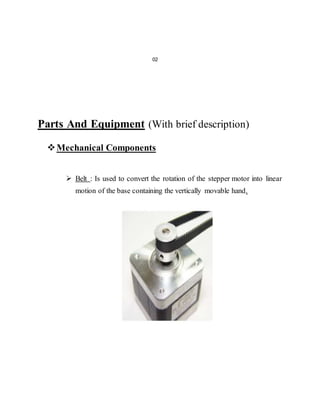
 Belt : Is used to convert the rotation of the stepper motor into linear
motion of the base containing the vertically movable hand.
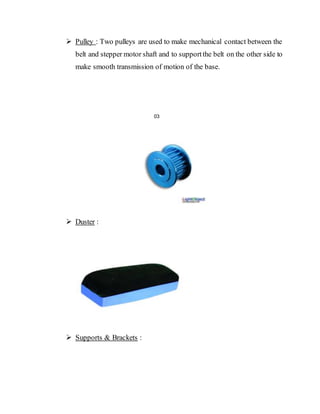
 Pulley : Two pulleys are used to make mechanical contact between the
belt and stepper motor shaft and to supportthe belt on the other side to
make smooth transmission of motion of the base.
03
 Duster :
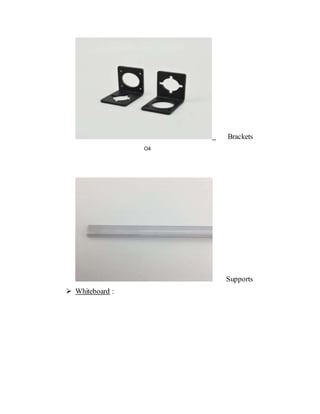
 Supports & Brackets :
Brackets
O4
Supports
 Whiteboard :
Electrical Components
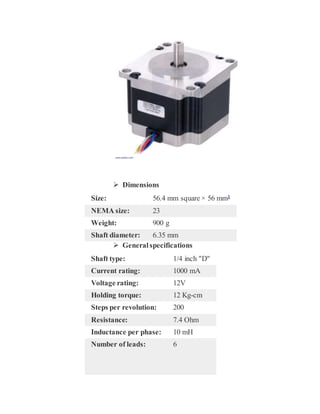
 Stepper Motor : NEMA 23
05
 Dimensions
Size: 56.4 mm square × 56 mm1
NEMA size: 23
Weight: 900 g
Shaft diameter: 6.35 mm
 General specifications
Shaft type: 1/4 inch "D"
Current rating: 1000 mA
Voltage rating: 12V
Holding torque: 12 Kg-cm
Steps per revolution: 200
Resistance: 7.4 Ohm
Inductance per phase: 10 mH
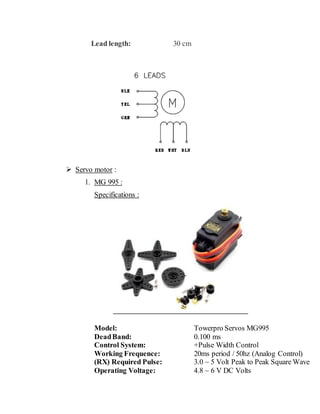
Number of leads: 6
Lead length: 30 cm
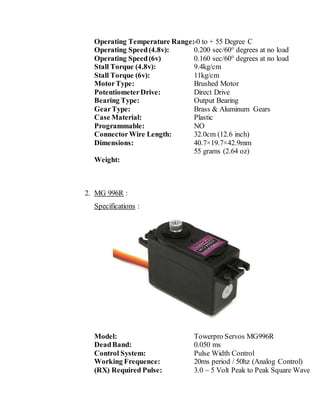
 Servo motor :
1. MG 995 :
Specifications :
Model: Towerpro Servos MG995
DeadBand: 0.100 ms
Control System: +Pulse Width Control
Working Frequence: 20ms period / 50hz (Analog Control)
(RX) Required Pulse: 3.0 ~ 5 Volt Peak to Peak Square Wave
Operating Voltage: 4.8 ~ 6 V DC Volts
Operating Temperature Range:-0 to + 55 Degree C
Operating Speed(4.8v): 0.200 sec/60° degrees at no load
Operating Speed(6v) 0.160 sec/60° degrees at no load
Stall Torque (4.8v): 9.4kg/cm
Stall Torque (6v): 11kg/cm
MotorType: Brushed Motor
PotentiometerDrive: Direct Drive
Bearing Type: Output Bearing
GearType: Brass & Aluminum Gears
Case Material: Plastic
Programmable: NO
ConnectorWire Length: 32.0cm (12.6 inch)
Dimensions: 40.7×19.7×42.9mm
Weight:
55 grams (2.64 oz)
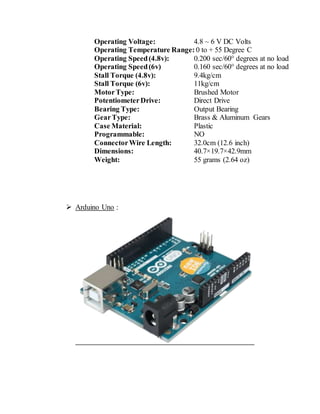
2. MG 996R :
Specifications :
Model: Towerpro Servos MG996R
DeadBand: 0.050 ms
Control System: Pulse Width Control
Working Frequence: 20ms period / 50hz (Analog Control)
(RX) Required Pulse: 3.0 ~ 5 Volt Peak to Peak Square Wave
Operating Voltage: 4.8 ~ 6 V DC Volts
Operating Temperature Range: 0 to + 55 Degree C
Operating Speed(4.8v): 0.200 sec/60° degrees at no load
Operating Speed(6v) 0.160 sec/60° degrees at no load
Stall Torque (4.8v): 9.4kg/cm
Stall Torque (6v): 11kg/cm
MotorType: Brushed Motor
PotentiometerDrive: Direct Drive
Bearing Type: Output Bearing
GearType: Brass & Aluminum Gears
Case Material: Plastic
Programmable: NO
ConnectorWire Length: 32.0cm (12.6 inch)
Dimensions: 40.7×19.7×42.9mm
Weight: 55 grams (2.64 oz)
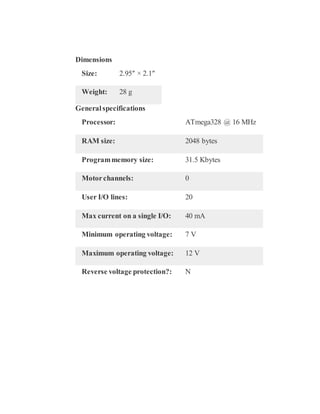
 Arduino Uno :
Dimensions
Size: 2.95″ × 2.1″
Weight: 28 g
Generalspecifications
Processor: ATmega328 @ 16 MHz
RAM size: 2048 bytes
Programmemory size: 31.5 Kbytes
Motorchannels: 0
User I/O lines: 20
Max current on a single I/O: 40 mA
Minimum operating voltage: 7 V
Maximum operating voltage: 12 V
Reverse voltage protection?: N
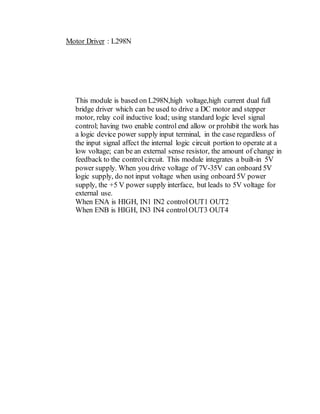
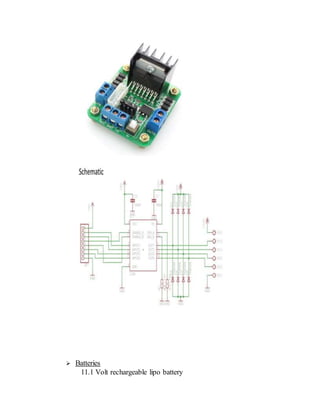
Motor Driver : L298N
This module is based on L298N,high voltage,high current dual full
bridge driver which can be used to drive a DC motor and stepper
motor, relay coil inductive load; using standard logic level signal
control; having two enable control end allow or prohibit the work has
a logic device power supply input terminal, in the case regardless of
the input signal affect the internal logic circuit portion to operate at a
low voltage; can be an external sense resistor, the amount of change in
feedback to the controlcircuit. This module integrates a built-in 5V
power supply. When you drive voltage of 7V-35V can onboard 5V
logic supply, do not input voltage when using onboard 5V power
supply, the +5 V power supply interface, but leads to 5V voltage for
external use.
When ENA is HIGH, IN1 IN2 controlOUT1 OUT2
When ENB is HIGH, IN3 IN4 controlOUT3 OUT4
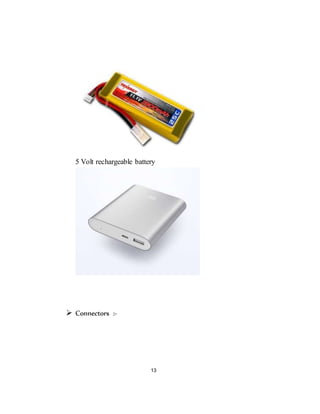
 Batteries
11.1 Volt rechargeable lipo battery
5 Volt rechargeable battery
 Connectors :-
13
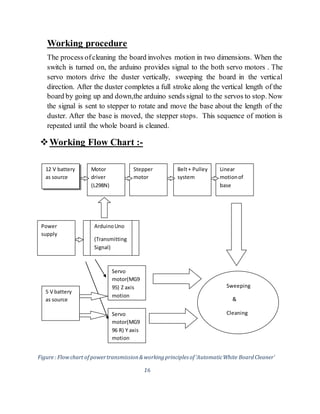
Working procedure
The process ofcleaning the board involves motion in two dimensions. When the
switch is turned on, the arduino provides signal to the both servo motors . The
servo motors drive the duster vertically, sweeping the board in the vertical
direction. After the duster completes a full stroke along the vertical length of the
board by going up and down,the arduino sends signal to the servos to stop. Now
the signal is sent to stepper to rotate and move the base about the length of the
duster. After the base is moved, the stepper stops. This sequence of motion is
repeated until the whole board is cleaned.
Working Flow Chart :-
Figure: Flowchart of powertransmission&workingprinciples of ‘AutomaticWhite BoardCleaner’
16
12 V battery
as source
Motor
driver
(L298N)
Stepper
motor
Belt+ Pulley
system
Linear
motionof
base
ArduinoUno
(Transmitting
Signal)
5 V battery
as source
Servo
motor(MG9
95) Z axis
motion
Servo
motor(MG9
96 R) Y axis
motion
Power
supply
Sweeping
&
Cleaning
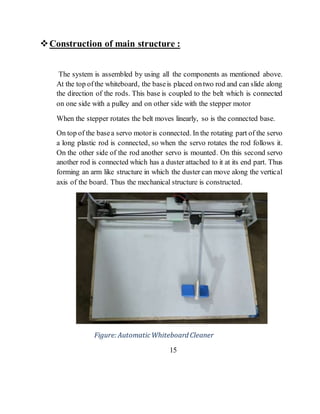
Construction of main structure :
The system is assembled by using all the components as mentioned above.
At the top ofthe whiteboard, the baseis placed ontwo rod and can slide along
the direction of the rods. This base is coupled to the belt which is connected
on one side with a pulley and on other side with the stepper motor
When the stepper rotates the belt moves linearly, so is the connected base.
On top of the basea servo motoris connected. In the rotating part of the servo
a long plastic rod is connected, so when the servo rotates the rod follows it.
On the other side of the rod another servo is mounted. On this second servo
another rod is connected which has a duster attached to it at its end part. Thus
forming an arm like structure in which the duster can move along the vertical
axis of the board. Thus the mechanical structure is constructed.
Figure: AutomaticWhiteboard Cleaner
15
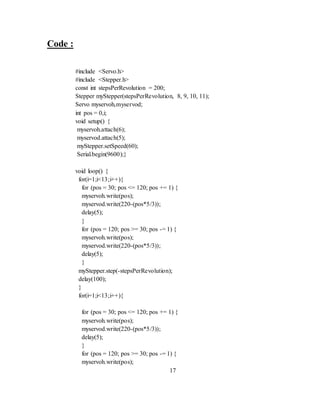
Code :
#include <Servo.h>
#include <Stepper.h>
const int stepsPerRevolution = 200;
Stepper myStepper(stepsPerRevolution, 8, 9, 10, 11);
Servo myservoh,myservod;
int pos = 0,i;
void setup() {
myservoh.attach(6);
myservod.attach(5);
myStepper.setSpeed(60);
Serial.begin(9600);}
void loop() {
for(i=1;i<13;i++){
for (pos = 30; pos <= 120; pos += 1) {
myservoh.write(pos);
myservod.write(220-(pos*5/3));
delay(5);
}
for (pos = 120; pos >= 30; pos -= 1) {
myservoh.write(pos);
myservod.write(220-(pos*5/3));
delay(5);
}
myStepper.step(-stepsPerRevolution);
delay(100);
}
for(i=1;i<13;i++){
for (pos = 30; pos <= 120; pos += 1) {
myservoh.write(pos);
myservod.write(220-(pos*5/3));
delay(5);
}
for (pos = 120; pos >= 30; pos -= 1) {
myservoh.write(pos);
17
myservod.write(220-(pos*5/3));
delay(5);
}
myStepper.step(stepsPerRevolution);
delay(100);
}
}
Features & Application :
 Swift cleaning : It takes approximately half a minute where as human
takes about 15 secs. So, it is comparatively swift.
 Smooth cleaning : It cleans the whiteboard properly within 10 strokes
without any stains remaining.
 Workload lessening : It removes effort of a teacher or students by
cleaning the board and also their hands remain clean and neat.
 Easy installation: It is easy to install on the wall using minimum
amount of clamping. It is lightweight. So, it does not bother the writer
on the board.
 Easy to supply power : We used only a 11.1 volt rechargeable battery
and a power bank to supply power to the motors and Arduino which
are easily available and cheap.
14
Limitations
 Noise coming from motors
 Costly
 Takes some space of main board
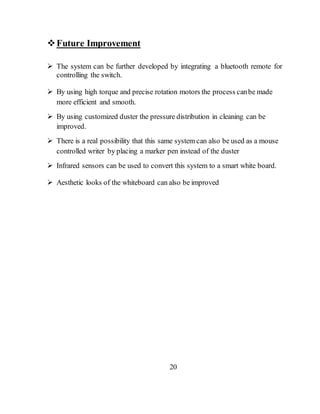
Future Improvement
 The system can be further developed by integrating a bluetooth remote for
controlling the switch.
 By using high torque and precise rotation motors the process canbe made
more efficient and smooth.
 By using customized duster the pressure distribution in cleaning can be
improved.
 There is a real possibility that this same system can also be used as a mouse
controlled writer by placing a marker pen instead of the duster
 Infrared sensors can be used to convert this system to a smart white board.
 Aesthetic looks of the whiteboard can also be improved
20
Conclusions
It is concluded that automatic whiteboard cleaner has successfully designed.
The system has designed with innovative features which reduces human
efforts and makes teaching efficient. This type of whiteboard could be very
effectively used in schools, colleges and universities as it increases the interest
of the students to study with different technology. The machine has reduced
bothtime and human effort. The constructionofautomatic whiteboard cleaner
consists of Arduino microcontroller which is very user friendly in
programming.
On the other hand to construct the main structure, very simple tool work is
needed, and the materials used in this project are cheap and easily available in
market. So it is not complicated to construct this machine and it will help to
introduce an automation system.
.
References
[1] Tsado Jacob, “A Remote Controlled Motorized White Board Cleaner”, AU Journal of
Technology, Vol.15, No.4, pp. 273-280, 2012.
[2] Praveen. G, “Microcontroller Based Automatic Electronic Duster”, Proceedings Of
International Academic Conference On Electrical, Electronics And Computer
Engineering, pp. 10-13, 2013.
[3] Puneet Mathur et. al., “Automated Motorized Whiteboard”, International Journal Of
Engineering, Business And Enterprise Applications (IJEBEA), Vol.6, No.1, pp. 01-04,
2013.
[4] Bhushan Tukaram Chougule and Puneet Mathur, “Automated Motorized Sensing
Whiteboard”, International Journal Of Advanced Research In Engineering And
Technology (IJARET), Vol. 5, No. 3, pp. 155-163, 2014.
[5] Simolowo and O. E., “Preliminary Design of an Automated White Board Cleaner”,
International Multidisciplinary Journal, Vol. 8 (2), No. 33, pp. 68-82, 2014.
[6] Imam-Ul-Ferdous and A.H.M Fazle Elahi, “Development of an Automatic Board
Cleaning system using Microcontroller”, International Conference on Mechanical,
Industrial and Energy Engineering 2014 (ICMIEE: PI-140307).
[7] Chris Betcher and Mal lee, “The Interactive Whiteboard Revolution”, Aust Council
for Ed Research, pp. 10-12, 2009
18

AUTOMATIC WHITEBOARD CLEANER

  • 1.
    BANGLADESH UNIVERSITY OFENGINEERING &TECHNOLOGY AUTOMATIC WHITEBOARD CLEANEr Course No. – ME – 366 Course Name – Electro MechanicalSystem Design& Practice Group No. – B 14 Dateof Submission: 30 -07- 2018 Submitted by- Durjoy Kumar Paul (1510064) Fahim Mahmud (1510071) Aminul Islam (1510078) Rafsan Ahmed (1510085)
  • 2.
    INDEX Abstract…………………………………………….01 Introduction………………………………………...02 Parts and Equipment………………………………..03 Featuresand Applications………………………….14 Constructionof Main Structure………...………………………………….15 Working Procedure………………………………....16 Working Flow Chart………………………………..16 Code………………………………………………...17 Limitation…………………………………………...19 Futureimprovements………………………………..20 Conclusion…………………………………………..21 Reference……………………………………………21
  • 3.
    Abstract It is saidthat “Education is the backboneof a nation”. Education plays an essential role in society, creating knowledge, transferring it to students and fostering innovation. Making the knowledge more easier to get for the students & more easier to give for the teachers is the main objective of the modern educational institution. To reach our goal some basic criteria must be fulfilled. Establishment of a modern class roomis one ofthem to increase the interaction between the teachers & students. Where we are taking preparation to make the “Mars” habitable for us, our teachers use their hand to clean the whiteboard which is acceptable in this era of modern science & technology. So here in this coursewe try to make sucha machine that can make the education more effective & to lessen the load on a teacher. As mechanical engineers we try give more emphasis on mechanical part. So we try to make a whiteboard cleaner which can clean the board more effectively within a permissible time period. We have tried to keep our project as simple as we can so that it can be economical & also affordable for the country like Bangladesh.
  • 4.
    01 Acknowledgement First of allwe would like to thank Almighty for the successful submission of our project within the time. Then we would like to express our gratitude to our respectable teachers Partha Kumar Das, Musanna Galib, Rakib Hossain. They help us with their experience and technical knowledge by giving us their valuable suggestion about the design and components related to our project. We also want to thank all the other persons who give us both technical and motivational support.
  • 5.
    Introduction An automatic whiteboardcleaner is a device that is generally used to clean board automatically with the help of a mechanically driven duster. By the use of this automatic whiteboard cleaner we can save time and energy. It is a new technology that is generally used now a day. The principal object of the present automatic whiteboard cleaner is to provide an attachment forwhiteboard in the form of a power driven erasing apparatus which can beset in operation by the throw of a switch, thus eliminating the drudgery of manually cleaning whiteboard. The utility model relates to teaching aid. The prior whiteboard has no automatic cleaning function, a teacher wastes time in writing and erasing, and the use is not ideal. The method of cleaning the board manually also decreases the interaction time between the teachers and students. A teacher spends aboutone minute on average to clean the board fully. But here our proposed structureis simple; more economical; the use is convenient, clean and sanitary; and the effect of saving time is good.
  • 6.
    02 Parts And Equipment(With brief description) Mechanical Components  Belt : Is used to convert the rotation of the stepper motor into linear motion of the base containing the vertically movable hand.
  • 7.
     Pulley :Two pulleys are used to make mechanical contact between the belt and stepper motor shaft and to supportthe belt on the other side to make smooth transmission of motion of the base. 03  Duster :  Supports & Brackets :
  • 8.
  • 9.
  • 10.
     Dimensions Size: 56.4mm square × 56 mm1 NEMA size: 23 Weight: 900 g Shaft diameter: 6.35 mm  General specifications Shaft type: 1/4 inch "D" Current rating: 1000 mA Voltage rating: 12V Holding torque: 12 Kg-cm Steps per revolution: 200 Resistance: 7.4 Ohm Inductance per phase: 10 mH Number of leads: 6
  • 11.
    Lead length: 30cm  Servo motor : 1. MG 995 : Specifications : Model: Towerpro Servos MG995 DeadBand: 0.100 ms Control System: +Pulse Width Control Working Frequence: 20ms period / 50hz (Analog Control) (RX) Required Pulse: 3.0 ~ 5 Volt Peak to Peak Square Wave Operating Voltage: 4.8 ~ 6 V DC Volts
  • 12.
    Operating Temperature Range:-0to + 55 Degree C Operating Speed(4.8v): 0.200 sec/60° degrees at no load Operating Speed(6v) 0.160 sec/60° degrees at no load Stall Torque (4.8v): 9.4kg/cm Stall Torque (6v): 11kg/cm MotorType: Brushed Motor PotentiometerDrive: Direct Drive Bearing Type: Output Bearing GearType: Brass & Aluminum Gears Case Material: Plastic Programmable: NO ConnectorWire Length: 32.0cm (12.6 inch) Dimensions: 40.7×19.7×42.9mm Weight: 55 grams (2.64 oz) 2. MG 996R : Specifications : Model: Towerpro Servos MG996R DeadBand: 0.050 ms Control System: Pulse Width Control Working Frequence: 20ms period / 50hz (Analog Control) (RX) Required Pulse: 3.0 ~ 5 Volt Peak to Peak Square Wave
  • 13.
    Operating Voltage: 4.8~ 6 V DC Volts Operating Temperature Range: 0 to + 55 Degree C Operating Speed(4.8v): 0.200 sec/60° degrees at no load Operating Speed(6v) 0.160 sec/60° degrees at no load Stall Torque (4.8v): 9.4kg/cm Stall Torque (6v): 11kg/cm MotorType: Brushed Motor PotentiometerDrive: Direct Drive Bearing Type: Output Bearing GearType: Brass & Aluminum Gears Case Material: Plastic Programmable: NO ConnectorWire Length: 32.0cm (12.6 inch) Dimensions: 40.7×19.7×42.9mm Weight: 55 grams (2.64 oz)  Arduino Uno :
  • 14.
    Dimensions Size: 2.95″ ×2.1″ Weight: 28 g Generalspecifications Processor: ATmega328 @ 16 MHz RAM size: 2048 bytes Programmemory size: 31.5 Kbytes Motorchannels: 0 User I/O lines: 20 Max current on a single I/O: 40 mA Minimum operating voltage: 7 V Maximum operating voltage: 12 V Reverse voltage protection?: N
  • 15.
    Motor Driver :L298N This module is based on L298N,high voltage,high current dual full bridge driver which can be used to drive a DC motor and stepper motor, relay coil inductive load; using standard logic level signal control; having two enable control end allow or prohibit the work has a logic device power supply input terminal, in the case regardless of the input signal affect the internal logic circuit portion to operate at a low voltage; can be an external sense resistor, the amount of change in feedback to the controlcircuit. This module integrates a built-in 5V power supply. When you drive voltage of 7V-35V can onboard 5V logic supply, do not input voltage when using onboard 5V power supply, the +5 V power supply interface, but leads to 5V voltage for external use. When ENA is HIGH, IN1 IN2 controlOUT1 OUT2 When ENB is HIGH, IN3 IN4 controlOUT3 OUT4
  • 16.
     Batteries 11.1 Voltrechargeable lipo battery
  • 17.
    5 Volt rechargeablebattery  Connectors :- 13
  • 19.
    Working procedure The processofcleaning the board involves motion in two dimensions. When the switch is turned on, the arduino provides signal to the both servo motors . The servo motors drive the duster vertically, sweeping the board in the vertical direction. After the duster completes a full stroke along the vertical length of the board by going up and down,the arduino sends signal to the servos to stop. Now the signal is sent to stepper to rotate and move the base about the length of the duster. After the base is moved, the stepper stops. This sequence of motion is repeated until the whole board is cleaned. Working Flow Chart :- Figure: Flowchart of powertransmission&workingprinciples of ‘AutomaticWhite BoardCleaner’ 16 12 V battery as source Motor driver (L298N) Stepper motor Belt+ Pulley system Linear motionof base ArduinoUno (Transmitting Signal) 5 V battery as source Servo motor(MG9 95) Z axis motion Servo motor(MG9 96 R) Y axis motion Power supply Sweeping & Cleaning
  • 20.
    Construction of mainstructure : The system is assembled by using all the components as mentioned above. At the top ofthe whiteboard, the baseis placed ontwo rod and can slide along the direction of the rods. This base is coupled to the belt which is connected on one side with a pulley and on other side with the stepper motor When the stepper rotates the belt moves linearly, so is the connected base. On top of the basea servo motoris connected. In the rotating part of the servo a long plastic rod is connected, so when the servo rotates the rod follows it. On the other side of the rod another servo is mounted. On this second servo another rod is connected which has a duster attached to it at its end part. Thus forming an arm like structure in which the duster can move along the vertical axis of the board. Thus the mechanical structure is constructed. Figure: AutomaticWhiteboard Cleaner 15
  • 21.
    Code : #include <Servo.h> #include<Stepper.h> const int stepsPerRevolution = 200; Stepper myStepper(stepsPerRevolution, 8, 9, 10, 11); Servo myservoh,myservod; int pos = 0,i; void setup() { myservoh.attach(6); myservod.attach(5); myStepper.setSpeed(60); Serial.begin(9600);} void loop() { for(i=1;i<13;i++){ for (pos = 30; pos <= 120; pos += 1) { myservoh.write(pos); myservod.write(220-(pos*5/3)); delay(5); } for (pos = 120; pos >= 30; pos -= 1) { myservoh.write(pos); myservod.write(220-(pos*5/3)); delay(5); } myStepper.step(-stepsPerRevolution); delay(100); } for(i=1;i<13;i++){ for (pos = 30; pos <= 120; pos += 1) { myservoh.write(pos); myservod.write(220-(pos*5/3)); delay(5); } for (pos = 120; pos >= 30; pos -= 1) { myservoh.write(pos); 17
  • 22.
    myservod.write(220-(pos*5/3)); delay(5); } myStepper.step(stepsPerRevolution); delay(100); } } Features & Application:  Swift cleaning : It takes approximately half a minute where as human takes about 15 secs. So, it is comparatively swift.  Smooth cleaning : It cleans the whiteboard properly within 10 strokes without any stains remaining.  Workload lessening : It removes effort of a teacher or students by cleaning the board and also their hands remain clean and neat.  Easy installation: It is easy to install on the wall using minimum amount of clamping. It is lightweight. So, it does not bother the writer on the board.  Easy to supply power : We used only a 11.1 volt rechargeable battery and a power bank to supply power to the motors and Arduino which are easily available and cheap. 14
  • 23.
    Limitations  Noise comingfrom motors  Costly  Takes some space of main board
  • 24.
    Future Improvement  Thesystem can be further developed by integrating a bluetooth remote for controlling the switch.  By using high torque and precise rotation motors the process canbe made more efficient and smooth.  By using customized duster the pressure distribution in cleaning can be improved.  There is a real possibility that this same system can also be used as a mouse controlled writer by placing a marker pen instead of the duster  Infrared sensors can be used to convert this system to a smart white board.  Aesthetic looks of the whiteboard can also be improved 20
  • 25.
    Conclusions It is concludedthat automatic whiteboard cleaner has successfully designed. The system has designed with innovative features which reduces human efforts and makes teaching efficient. This type of whiteboard could be very effectively used in schools, colleges and universities as it increases the interest of the students to study with different technology. The machine has reduced bothtime and human effort. The constructionofautomatic whiteboard cleaner consists of Arduino microcontroller which is very user friendly in programming. On the other hand to construct the main structure, very simple tool work is needed, and the materials used in this project are cheap and easily available in market. So it is not complicated to construct this machine and it will help to introduce an automation system. . References
  • 26.
    [1] Tsado Jacob,“A Remote Controlled Motorized White Board Cleaner”, AU Journal of Technology, Vol.15, No.4, pp. 273-280, 2012. [2] Praveen. G, “Microcontroller Based Automatic Electronic Duster”, Proceedings Of International Academic Conference On Electrical, Electronics And Computer Engineering, pp. 10-13, 2013. [3] Puneet Mathur et. al., “Automated Motorized Whiteboard”, International Journal Of Engineering, Business And Enterprise Applications (IJEBEA), Vol.6, No.1, pp. 01-04, 2013. [4] Bhushan Tukaram Chougule and Puneet Mathur, “Automated Motorized Sensing Whiteboard”, International Journal Of Advanced Research In Engineering And Technology (IJARET), Vol. 5, No. 3, pp. 155-163, 2014. [5] Simolowo and O. E., “Preliminary Design of an Automated White Board Cleaner”, International Multidisciplinary Journal, Vol. 8 (2), No. 33, pp. 68-82, 2014. [6] Imam-Ul-Ferdous and A.H.M Fazle Elahi, “Development of an Automatic Board Cleaning system using Microcontroller”, International Conference on Mechanical, Industrial and Energy Engineering 2014 (ICMIEE: PI-140307). [7] Chris Betcher and Mal lee, “The Interactive Whiteboard Revolution”, Aust Council for Ed Research, pp. 10-12, 2009
  • 27.