International Research Journal of Engineering and Technology (IRJET) e-ISSN: 2395-0056
Volume: 10 Issue: 11 | Nov 2023 www.irjet.net p-ISSN: 2395-0072
© 2023, IRJET | Impact Factor value: 8.226 | ISO 9001:2008 Certified Journal | Page 854
AUTOMATIC QUESTION GENERATION USING NATURAL LANGUAGE
PROCESSING
Mohmmad Yasir Khan, Lincy Rebello, Trishali Rao, Nitika Rai
123UG student, Dept. of Information Technology, St. Francis institute of Technology
4 Associate Professor, Dept. of Information Technology, St. Francis institute of Technology
---------------------------------------------------------------------***---------------------------------------------------------------------
Abstract - Natural language processing (NLP) is an
upcoming field that encompasses computer science
alone with artificial intelligence (AI) along with spoken
language and is used to carry out a diverse range of
applications such as sentimental analysis, speech
recognition, content categorization, and analysis, to
name a few. One of the domains where NLP can aid the
educational system is a comprehensive question
generator thatcanformunbiased questionsfrom agiven
subject matter, which is otherwise a tedious and time-
consuming task for instructors. Our proposed work
focuses on developing an automatic question generator
(AQG) using NLP that can generate a set of questions
from a given paragraph of text. The approach used is
test-to-text transformer-based transfer (T5) learning
models, which can emphasize the critical points of a
sentence and the language structure to generate
questions without the creator inputting profound
grammar rules. The proposed system can also assist
students in learning and then test their understanding.
Keywords - T5 Text-to-Text Transfer Transformer,
Question Generation, Natural Language Processing,
UniLM-Unified Pre-training for Language Understanding
and Generation, SQuAD-Stanford Question Answering
Dataset
1.INTRODUCTION
The process of producing syntactically sound,
semantically valid, and relevant questions from various
input forms such as a block of text, a structured database, or
a knowledge base is known as automatic question
generation (AQG). The purpose of question generation is to
produce legitimate, meaningful and fluent questions based
on a supplied paragraph that has a discrete target answer.
Automatic Question Generation can be applied to a
variety of domains and for a plethora of use cases, including
autonomous tutoringsystems,increasingthe effectivenessof
question-answering (QA)models,allowingchatbotstoleada
conversation, and many more. Regardless of its versatility,
manually framing and writing meaningful and relevant
questions is a tedious, time-consuming and difficultprocess.
For instance, whiletestingstudents learningthrough reading
comprehension, the evaluator must manuallyframesuitable
questions, prepare response sheet and then evaluate the
responses accordingly. This exercise can at times be biased
and not thorough if the instructor does not pay the needed
attention to this otherwise critical aspect in the teaching
learning process.
This paper focuses on test-to-text transformer-based
transfer (T5) learning models, which can emphasize the
critical points of a sentence and the language structure to
generate questions without the creator inputting profound
grammar rules. The T5 AQG model is trainedontheStanford
Question Answering Dataset (SQuAD) version 2.0 [1]
2.LITERATURE REVIEW
Various approaches to implement automatic question
generation have been reported in the literature.Thissection
presents a few of the significant ones.
One of the approaches reported is based on the concept
of answer recognition questiongeneration.Inanswer-aware
question generation, the model is presented with an answer
and a passage of script and is asked to generate a question
for that answer given the context of the passage. There is
enough literature available on AQG approaches, buttheyare
not as widely used as QA. One of the reasons is that most of
the available literature employscomplexmodels/processing
pipelines and no pre-trained models are available. Some of
the recent works, notably UniLM and ProphetNet, have
reported the use of SOTA pre-trained weights that can be
used in QG, but using them seems overly complicated [1].
Another approach reported focuses on transformer-
based finetuning techniques that can be used to create
robust question generation systems using only a single pre-
trained language model, without the use of additional
mechanisms, or answer metadata, which has extensive
features [2]. This work also analyses the effect of various
factors the affect the performanceofthe model,suchasinput
data formatting, the length of the context paragraphs, and
the use of answer awareness. Additionally,thefailure modes
of the model are explored along with identification of
possible reasons of failure of the model. The question
generation model is trained on version 1.1 of the Stanford
Question Answering Dataset (SQuAD). The SQuAD contains
context passages, each with corresponding sets of questions
and responses related to the content of the passages. SQuAD
contains morethan100,000 community-providedquestions.
International Research Journal of Engineering and Technology (IRJET) e-ISSN: 2395-0056
Volume: 10 Issue: 11 | Nov 2023 www.irjet.net p-ISSN: 2395-0072
© 2023, IRJET | Impact Factor value: 8.226 | ISO 9001:2008 Certified Journal | Page 855
The model reported is smaller, less complex, and faster to
operate, making it a possible alternative for a variety of use
cases related to question generation. The paper
demonstrates that a simple single transformer-based
question generation model is able to outperform more
complex Seq2Seq methods without the need for additional
features, techniques, and trainingsteps.Theyhaveevaluated
the model on BLEU 1, BLEU 2, BLEU 3, BLEU4,ROUGEL,and
METEOR. The evaluation package is used to quantify the
performance of the model. The flawidentifiedinthe model is
that the values selected are not good in terms of BLEU 4 and
ROUGE L, and slightly worse in terms of METEOR.
In [3], a fully data-driven neural network approach to
automatic question generationfor readingcomprehensionis
presented. They used an attention-based neural networks
approach for the task and investigated the effect ofencoding
sentence- vs.paragraph-level information.Thepaper reports
both automatic evaluations and human evaluations. It
incorporates an into-operated SQuAD dataset wherein the
questions are posed by crowd workers and are of relatively
high quality. A sequence-to-sequence approach is used
which is a basic encoder-decoder sequence learning system
for machine translation which is implemented in
TensorFlow. The models using RNN encoder-decoder
architecture with two variations are investigated where the
first one only encodes the sentence and the other encodes
both sentence and paragraph-level information.Fortraining
and inferencing/predicting the output, beam search is used.
For implementation, the models are blended in Torch7 with
OpenNMT. A comparison of different baselines like IR,
Seq2seq, H&S, etc. with packages/systems viz. Bleu1-4,
Meteor, and Rogue is also carried out. Moreover,
performance studies were done where the sample output
questions were generated by humans, by their system, and
by the H&S system (rule-based over-generate and rank
system). It was reported that the resulting model could
generate better-quality questions than the H&S system. The
flaw identified in the model proposed is that it encodes only
sentence-level information and achieves the best
performance across all the metrics but not so in paragraph-
level information.
In [4], the authors propose a novel neural network model
with better-encodingco-referenceknowledgeforparagraph-
level question generation,andresearchstudiesmethodsthat
incorporate correlation information into the training of a
question-generationsystem. Specifically,thepaperproposes
a closed reference knowledgefor neural questiongeneration
(CorefNNG), a neural chain model with a novel gate
generation mechanism that exploits continuous
representations of reference clusters -a setofmentionsused
to refer to each entity - for better language coding. the
knowledge introducedbythereference,togeneratepassage-
level questions. Evaluations with various metrics on the
SQuAD autoplay dataset show that its model outperforms
leading baselines. The resection studyshowedtheefficacyof
different components in our model. Finally, the proposed
question generation framework is applied to produce a
corpus of 1.26 million question-answer pairs.
In [5], the authors propose a system that automatically
generates a quiz on the basis of the learning material
provided. This can be used by both instructors and learners
to be able to recall and apply major concepts from the study
material. The proposed system focuses on generating
educationally relevant gap-fill multiple choice questions
from educational texts in three ways, viz. (a) Sentence
Selection: Selecting coherent and important sentences from
the text to ask about (b) Gap Selection: Identitywhichpartof
the resulting sentence to choose as the gap. The gap
essentially represents theconcept beingtested(c)Distractor
Selection: Crafting effective distractors to be part of the set
of options to confuse the learner to ensurethathehasa good
grasp of the concept being tested. Preliminary testing was
also done with students. First, the quality of the questions
generated was assessed. It was reported that 94% of the
question sentences, 87% of the gaps, and 60% of the
distractors were considered to be educationally relevant.
Secondly, they found that 14 out of the 15 studentssurveyed
found the system to be effective in helping them to reinforce
concepts.
3. PROPOSED METHODOLOGY
3.1 T5 - Text-To-Text Transfer Transformer
Fig. 1. T5: Text-to-Text Framework [6]
Ourproposedwork employsT5:Text-to-TextFramework
(Fig. 1), where a model is first pre-trainedona data-richtask
before being tuned for downstream tasks, T5 is an
encoder/decoder that transforms an NLP based problem
into text-to-text form, ie. there is always a need for an input
sequence and a corresponding target sequence for training.
T5 works well with different tasks by adding different
prefixes to the inputs corresponding to each task, e.g., for
International Research Journal of Engineering and Technology (IRJET) e-ISSN: 2395-0056
Volume: 10 Issue: 11 | Nov 2023 www.irjet.net p-ISSN: 2395-0072
© 2023, IRJET | Impact Factor value: 8.226 | ISO 9001:2008 Certified Journal | Page 856
translation: translate English toGerman;forsummarization:
summarize. T5 introduces “Colossal Cleaned Crawled
Corpus” (C4), a dataset consisting of hundreds of gigabytes
of clean English text scraped from the Internet.
Transformers are new models that overpowered recurrent
neural networks (RNNs). The primary building block of the
transformers is self-attention which processes a sequence
with a weighted average of the rest of the sequence. The
architecture is not novel and resembles the original
transformer's encoder-decoder architecture. Encoder
models are designed to produce a singlepredictionperinput
token or a single prediction for an entire input sequence.
This makes them applicable for classification tasks but not
for generative summarization. The decoder-only model can
take an input sequence and generate the rest of the text
based on the input sequence. So, it is well-suited to fill up an
input prompt but not well-suited for rewriting the input
sequence into something else.T5takesthe bestofwords and
uses the encoder-decoder architecture to perform any
sequence-to-sequence tasks effectively [6].
Fig. 2 shows an example of T5 model functioning. Here,
the words “organized”, and” theme” (marked with an ×) are
randomly chosen for corruption. Each consecutive span of
corrupted tokens is replaced by a sentinel token (shown as
<X> and <Y>) that is unique over the sentence. The goal is to
conceal consecutive token spans and estimate only tokens
that were overlooked during the pretraining process.
Fig. 2. Example of T5 Model Functioning
Fig. 3. Teacher Enforcing
Further, the primary building block of the transformer is
self-attention, which processes a sequence byreplacingeach
element with a weighted average of the rest of the sequence.
T5 is trained using Teacher Enforcingandcross-entropyloss
(Fig 3). A denoising (masked language modelling) objective
is used. During a denoising operation, themodel istrainedto
predict missing or corrupted tokens in the input. At test
time, T5 uses beam decoding (i.e., choosing the highest
probability word at every timestamp).Teacherenforcingisa
technique where a target word is passed as the next input to
the decoder. Teacher enforcing works by using the actual or
expected output from the trainingdatasetatthecurrenttime
step y(t) as input in the next time step X(t+1), rather than
the output generated by the network. For example, John is
going to… (college), even if the generated output is different
eg, college we feed the expected target word(school)back to
the decoder [7]. Beginning with"The,"thealgorithmchooses
succeeding words in a greedy manner basedontheirhighest
probabilities. As a result, the resulting word sequence is
("The," "nice," "guy"), with an overall probability of 0.5 * 0.4
= 0.2. as shown in Fig. 4 [7]
International Research Journal of Engineering and Technology (IRJET) e-ISSN: 2395-0056
Volume: 10 Issue: 11 | Nov 2023 www.irjet.net p-ISSN: 2395-0072
© 2023, IRJET | Impact Factor value: 8.226 | ISO 9001:2008 Certified Journal | Page 857
Fig. 4. Traditional beam search
3.2Data Setup
The T5 model is trained on the Stanford Question
Answering Dataset (SQuAD). SQuAD is a reading
comprehension dataset built by crowd workers using
questions based on a collection of Wikipedia articles. Each
question requires a response in the form of a text segment,
or span, retrieved from the linked reading passage, though
some may not have a distinct answer. Squad 1.1 dataset,
contains 100,000+ question-answer pairs on 500+ articles.
Fig. 5. Squad1.1 Dataset Visualization [9]
However, it selects the first question for each paragraph
for training. The context and answer are parsed into model
inputs as a continuous body of texts, separated by a special
token. Meanwhile, the question is parsed as the targeted
value or "labels". The train-test split of 80-20isused,ie.80%
of the data were used for training, and the remaining 20%
were used for validation (Fig. 5).
3.3Understanding T5 Tokenizer
The tokenizer is responsible for preparing the inputs for
the model. Tokenize (split a string into sub-word token
strings), convert a token string to an ID and back,
encode/decode (i.e. tokenize and convert to an integer).
Managing special tokens(likea mask,beginning-of-sentence,
etc.): Add, assign, and prevent attributes from being split
during tokenization in the tokenizer for easy access.
Encoding: Translating text to numbers is known as
encoding. Encoding is done in a two-step process:
tokenization, followed by the conversion to input IDs. As we
have seen, the first step is to split the text into words (or
parts of words, punctuation marks, etc.), usually called
tokens. The second step is to convert these tokens to
numbers so that we can build tensors from them and feed
them into our model. Tokenizers have a vocabulary for this.
Decoding: Decoding is going the other way around: from
vocabulary indices, we want to get a string. It not only
converts the indices back to tokens but also groups the
tokens that were part of the same words to produce a
readable sentence. The decoding method used is beam
search. Beam search maintains the number of beam's most
probable hypotheses at each time step and finallyselectsthe
hypothesis with the highest overall probability,reducing the
risk of missing high-probability hidden word sequences [7].
3.5 Training
Fig. 6 shows the training pipeline of the model. In the
training loop, the context, for example, a SQuAD paragraph
about the first software the answer (“1948”)isconcatenated
into a single text.
Fig. 6. Question generation by summarizing context the
using that text to frame the question
International Research Journal of Engineering and Technology (IRJET) e-ISSN: 2395-0056
Volume: 10 Issue: 11 | Nov 2023 www.irjet.net p-ISSN: 2395-0072
© 2023, IRJET | Impact Factor value: 8.226 | ISO 9001:2008 Certified Journal | Page 858
Both context and answer are then passed through a T5
tokenizer, which converts the texts into numerical vectors
that the T5 model can understand. Then, T5 will predict the
output vectors, which also canbede-tokenizedback intotext
questions. Meanwhile, the given question, “When was the
first piece of software written?” is also passed through a
tokenizer. The vector representation of the ground-truth
question is compared with T5 output vectors using a loss
function. Then, T5 will iterate training to update its weights
to minimize loss. PyTorch’s cross-entropy loss function is
used to calculate the loss.
3.5Training Optimization
During training, the number of epochs, batch size,
and learning rate are adjusted to ensure the model is well-
fitted. The best model has a maximum number of epochs at
100, batch size 8, learning rate 10-6, with AdamW learning
rate optimizer and additional L2 regularization at 0.1 to
prevent overfitting at large numbers of epochs. The best
validation loss for this model is 1.62 with batch size 4,
maximum epochs one on a single GPU.
4. RESULTS AND DISCUSSION
Test cases were executed and a comparison was carried
out between the questions generated by the model and the
questions originally reported in the data set. Two such
comparative study is presented below. However, the
similarity shall hold good for any given context
4.1 Test Case I:
Context 1: The Normans (Norman: Nourmands; French:
Normands; Latin: Normanni) were the people who in the
10th and 11th centuries gave their name to Normandy, a
region in France. Their ancestors were Norse ("Norman"
comes from "Norseman") raidersandpiratesfromDenmark,
Iceland, and Norway. They swore loyalty to King Charles III
of West Francia under Rollo's leadership. Over time, their
children easily blended with the Carolingian-based
civilizations of West Francia through a process of
assimilationandinterminglingwithindigenousFrankishand
Roman-Gaulish groups. The Normans' distinct cultural and
ethnic identity began to take shape in the early decades of
the 10th century, evolving and shifting over the following
centuries.
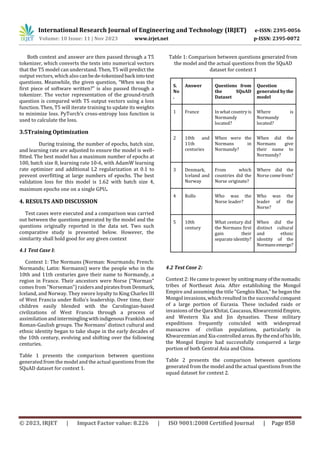
Table 1 presents the comparison between questions
generated from the model and the actual questions from the
SQuAD dataset for context 1.
Table 1: Comparison between questions generated from
the model and the actual questions from the SQuAD
dataset for context 1
S.
No
.
Answer Questions from
the SQuAD
Dataset
Question
generated bythe
model
1 France In what country is
Normandy
located?
Where is
Normandy
located?
2 10th and
11th
centuries
When were the
Normans in
Normandy?
When did the
Normans give
their name to
Normandy?
3 Denmark,
Iceland and
Norway
From which
countries did the
Norse originate?
Where did the
Norse comefrom?
4 Rollo Who was the
Norse leader?
Who was the
leader of the
Norse?
5 10th
century
What century did
the Normans first
gain their
separate identity?
When did the
distinct cultural
and ethnic
identity of the
Normansemerge?
4.2 Test Case 2:
Context 2: He came to power by unitingmanyofthe nomadic
tribes of Northeast Asia. After establishing the Mongol
Empire and assuming the title "Genghis Khan," he began the
Mongol invasions, which resulted in the successful conquest
of a large portion of Eurasia. These included raids or
invasions of the Qara Khitai, Caucasus, KhwarezmidEmpire,
and Western Xia and Jin dynasties. These military
expeditions frequently coincided with widespread
massacres of civilian populations, particularly in
Khwarezmian and Xia-controlled areas. Bytheendofhislife,
the Mongol Empire had successfully conquered a large
portion of both Central Asia and China.
Table 2 presents the comparison between questions
generated from the model and the actual questions from the
squad dataset for context 2.
International Research Journal of Engineering and Technology (IRJET) e-ISSN: 2395-0056
Volume: 10 Issue: 11 | Nov 2023 www.irjet.net p-ISSN: 2395-0072
© 2023, IRJET | Impact Factor value: 8.226 | ISO 9001:2008 Certified Journal | Page 859
Table 2: Comparison between questions generated from
the model and the actual questions from the squad dataset
for context 2
S.
No
.
Answer Questions from
the SQuADDataset
Question
generated bythe
model
1 Mongol
Empire
What do we call the
empire thatGenghis
Khan founded?
What empire did
Genghis Khan
founded?
2 Nomadic
tribes of
Northeast
Asia
Who did Genghis
Khan unite before
he began
conquering the rest
of Eurasia?
What tribes did
Genghis Khan
unite?
3 Khwarezmi
an and Xia
In which regions, in
particular, did
Genghis Khan's
armies massacre
civilians?
Which two
dynasties were
particularly
targeted by
massacres?
4 Central Asia
and China
What areas did
Genghis Khan
control at the endof
his life?
What areas did
the Mongol
Empire occupy by
the end of
Genghis Khan's
life?
5 Qara Khitai,
Caucasus,
Khwarezmi
d Empire,
WesternXia
and Jin
Which other
empires or
dynasties did
Genghis Khan
conquer?
What dynasties
did Genghis Khan
conquer?
A comparative analysis is carried out between the
Question-answer pair from the SQuAD dataset with the
questions generated from our given model. For each
paragraph provided with a single answer, one question is
generated by the model. The context above about Normans
and Genghis Khan is taken from the SQuAD dataset. The
paraphrasing of the questions is almost similar to the
questions from the SQuAD dataset. From Table 1, the best
matching question was “Who was the leader of the Norse?”
and from Table 2, “What dynasties did Genghis Khan
conquer?" The T5 model generated cutting-edge results,
generating articulate questions based on the provided
answers.
5. CONCLUSIONS
instructors/ evaluators. It is important that questions
framed are unbiased, not human-dependent and
comprehensive to cover the entirescopeofthecontextbeing
tested. Hence, the need for an automated system for
generation of multiple questions from a given text was felt.
Our work aims to automatically generate multiplequestions
from a given paragraph of textusingNLP.Theapproachused
is test-to-text transformer-based transfer (T5) learning
models, which can emphasize the critical points of a
sentence and the language structure to generate questions
without the creator inputting profound grammar rules. The
T5 AQG model is trained on the Stanford Question
Answering Dataset (SQuAD) version 2.0.
REFERENCES
[1] Dong, Li, et al. "Unified language model pre-training for
natural language understanding and generation."
Advances in neural information processing systems 32
(2019).
[2] Lopez, Luis Enrico, et al. "Simplifying paragraph-level
question generation via transformer language models."
PRICAI 2021: Trends in Artificial Intelligence: 18th
Pacific Rim International Conference on Artificial
Intelligence, PRICAI2021,Hanoi,Vietnam,November8–
12, 2021, Proceedings, Part II 18. Springer International
Publishing, 2021.
[3] Du, Xinya, Junru Shao, and Claire Cardie. "Learning to
ask: Neural question generation for reading
comprehension." arXiv preprint arXiv:1705.00106
(2017).
[4] Du, Xinya, and Claire Cardie. "Harvesting paragraph-
level question-answer pairs from wikipedia." arXiv
preprint arXiv:1805.05942 (2018).
[5] Kumar, Girish, Rafael E. Banchs, and Luis Fernando
D'Haro. "Automatic fill-the-blank questiongeneratorfor
student self-assessment." 2015 IEEE Frontiers in
Education Conference (FIE). IEEE, 2015.
[6] “Exploring the Limits of Transfer Learning with a
Unified Text-to-Text Transformer”, Colin Raffel, Noam
Shazeer, Adam Roberts, Katherine Lee, Sharan Narang,
Michael Matena, Yanqi Zhou, Wei Li, Peter J. Liu, 2020
[7] “Guiding TextGenerationwithConstrainedBeam Search
in Transformers”, constrained-beam-search, [Online].
Available: https://huggingface.co/blog/constrained-
beam-search
[8] “SQuAD-explorer”, [Online]. Available:
https://rajpurkar.github.io/SQuAD-explorer/
[9] Rajpurkar, Pranav, et al. "Squad: 100,000+questionsfor
machine comprehension of text." arXiv preprint
arXiv:1606.05250 (2016).
Question generation is an essential aspect for various use-
cases centred around evaluation methodologies, like testing
of student learning in conventional teaching and learning
system, autonomous tutoring systems, etc. Manual
generation is a tedious and time-consuming process for

AUTOMATIC QUESTION GENERATION USING NATURAL LANGUAGE PROCESSING

  • 1.
    International Research Journalof Engineering and Technology (IRJET) e-ISSN: 2395-0056 Volume: 10 Issue: 11 | Nov 2023 www.irjet.net p-ISSN: 2395-0072 © 2023, IRJET | Impact Factor value: 8.226 | ISO 9001:2008 Certified Journal | Page 854 AUTOMATIC QUESTION GENERATION USING NATURAL LANGUAGE PROCESSING Mohmmad Yasir Khan, Lincy Rebello, Trishali Rao, Nitika Rai 123UG student, Dept. of Information Technology, St. Francis institute of Technology 4 Associate Professor, Dept. of Information Technology, St. Francis institute of Technology ---------------------------------------------------------------------***--------------------------------------------------------------------- Abstract - Natural language processing (NLP) is an upcoming field that encompasses computer science alone with artificial intelligence (AI) along with spoken language and is used to carry out a diverse range of applications such as sentimental analysis, speech recognition, content categorization, and analysis, to name a few. One of the domains where NLP can aid the educational system is a comprehensive question generator thatcanformunbiased questionsfrom agiven subject matter, which is otherwise a tedious and time- consuming task for instructors. Our proposed work focuses on developing an automatic question generator (AQG) using NLP that can generate a set of questions from a given paragraph of text. The approach used is test-to-text transformer-based transfer (T5) learning models, which can emphasize the critical points of a sentence and the language structure to generate questions without the creator inputting profound grammar rules. The proposed system can also assist students in learning and then test their understanding. Keywords - T5 Text-to-Text Transfer Transformer, Question Generation, Natural Language Processing, UniLM-Unified Pre-training for Language Understanding and Generation, SQuAD-Stanford Question Answering Dataset 1.INTRODUCTION The process of producing syntactically sound, semantically valid, and relevant questions from various input forms such as a block of text, a structured database, or a knowledge base is known as automatic question generation (AQG). The purpose of question generation is to produce legitimate, meaningful and fluent questions based on a supplied paragraph that has a discrete target answer. Automatic Question Generation can be applied to a variety of domains and for a plethora of use cases, including autonomous tutoringsystems,increasingthe effectivenessof question-answering (QA)models,allowingchatbotstoleada conversation, and many more. Regardless of its versatility, manually framing and writing meaningful and relevant questions is a tedious, time-consuming and difficultprocess. For instance, whiletestingstudents learningthrough reading comprehension, the evaluator must manuallyframesuitable questions, prepare response sheet and then evaluate the responses accordingly. This exercise can at times be biased and not thorough if the instructor does not pay the needed attention to this otherwise critical aspect in the teaching learning process. This paper focuses on test-to-text transformer-based transfer (T5) learning models, which can emphasize the critical points of a sentence and the language structure to generate questions without the creator inputting profound grammar rules. The T5 AQG model is trainedontheStanford Question Answering Dataset (SQuAD) version 2.0 [1] 2.LITERATURE REVIEW Various approaches to implement automatic question generation have been reported in the literature.Thissection presents a few of the significant ones. One of the approaches reported is based on the concept of answer recognition questiongeneration.Inanswer-aware question generation, the model is presented with an answer and a passage of script and is asked to generate a question for that answer given the context of the passage. There is enough literature available on AQG approaches, buttheyare not as widely used as QA. One of the reasons is that most of the available literature employscomplexmodels/processing pipelines and no pre-trained models are available. Some of the recent works, notably UniLM and ProphetNet, have reported the use of SOTA pre-trained weights that can be used in QG, but using them seems overly complicated [1]. Another approach reported focuses on transformer- based finetuning techniques that can be used to create robust question generation systems using only a single pre- trained language model, without the use of additional mechanisms, or answer metadata, which has extensive features [2]. This work also analyses the effect of various factors the affect the performanceofthe model,suchasinput data formatting, the length of the context paragraphs, and the use of answer awareness. Additionally,thefailure modes of the model are explored along with identification of possible reasons of failure of the model. The question generation model is trained on version 1.1 of the Stanford Question Answering Dataset (SQuAD). The SQuAD contains context passages, each with corresponding sets of questions and responses related to the content of the passages. SQuAD contains morethan100,000 community-providedquestions.
  • 2.
    International Research Journalof Engineering and Technology (IRJET) e-ISSN: 2395-0056 Volume: 10 Issue: 11 | Nov 2023 www.irjet.net p-ISSN: 2395-0072 © 2023, IRJET | Impact Factor value: 8.226 | ISO 9001:2008 Certified Journal | Page 855 The model reported is smaller, less complex, and faster to operate, making it a possible alternative for a variety of use cases related to question generation. The paper demonstrates that a simple single transformer-based question generation model is able to outperform more complex Seq2Seq methods without the need for additional features, techniques, and trainingsteps.Theyhaveevaluated the model on BLEU 1, BLEU 2, BLEU 3, BLEU4,ROUGEL,and METEOR. The evaluation package is used to quantify the performance of the model. The flawidentifiedinthe model is that the values selected are not good in terms of BLEU 4 and ROUGE L, and slightly worse in terms of METEOR. In [3], a fully data-driven neural network approach to automatic question generationfor readingcomprehensionis presented. They used an attention-based neural networks approach for the task and investigated the effect ofencoding sentence- vs.paragraph-level information.Thepaper reports both automatic evaluations and human evaluations. It incorporates an into-operated SQuAD dataset wherein the questions are posed by crowd workers and are of relatively high quality. A sequence-to-sequence approach is used which is a basic encoder-decoder sequence learning system for machine translation which is implemented in TensorFlow. The models using RNN encoder-decoder architecture with two variations are investigated where the first one only encodes the sentence and the other encodes both sentence and paragraph-level information.Fortraining and inferencing/predicting the output, beam search is used. For implementation, the models are blended in Torch7 with OpenNMT. A comparison of different baselines like IR, Seq2seq, H&S, etc. with packages/systems viz. Bleu1-4, Meteor, and Rogue is also carried out. Moreover, performance studies were done where the sample output questions were generated by humans, by their system, and by the H&S system (rule-based over-generate and rank system). It was reported that the resulting model could generate better-quality questions than the H&S system. The flaw identified in the model proposed is that it encodes only sentence-level information and achieves the best performance across all the metrics but not so in paragraph- level information. In [4], the authors propose a novel neural network model with better-encodingco-referenceknowledgeforparagraph- level question generation,andresearchstudiesmethodsthat incorporate correlation information into the training of a question-generationsystem. Specifically,thepaperproposes a closed reference knowledgefor neural questiongeneration (CorefNNG), a neural chain model with a novel gate generation mechanism that exploits continuous representations of reference clusters -a setofmentionsused to refer to each entity - for better language coding. the knowledge introducedbythereference,togeneratepassage- level questions. Evaluations with various metrics on the SQuAD autoplay dataset show that its model outperforms leading baselines. The resection studyshowedtheefficacyof different components in our model. Finally, the proposed question generation framework is applied to produce a corpus of 1.26 million question-answer pairs. In [5], the authors propose a system that automatically generates a quiz on the basis of the learning material provided. This can be used by both instructors and learners to be able to recall and apply major concepts from the study material. The proposed system focuses on generating educationally relevant gap-fill multiple choice questions from educational texts in three ways, viz. (a) Sentence Selection: Selecting coherent and important sentences from the text to ask about (b) Gap Selection: Identitywhichpartof the resulting sentence to choose as the gap. The gap essentially represents theconcept beingtested(c)Distractor Selection: Crafting effective distractors to be part of the set of options to confuse the learner to ensurethathehasa good grasp of the concept being tested. Preliminary testing was also done with students. First, the quality of the questions generated was assessed. It was reported that 94% of the question sentences, 87% of the gaps, and 60% of the distractors were considered to be educationally relevant. Secondly, they found that 14 out of the 15 studentssurveyed found the system to be effective in helping them to reinforce concepts. 3. PROPOSED METHODOLOGY 3.1 T5 - Text-To-Text Transfer Transformer Fig. 1. T5: Text-to-Text Framework [6] Ourproposedwork employsT5:Text-to-TextFramework (Fig. 1), where a model is first pre-trainedona data-richtask before being tuned for downstream tasks, T5 is an encoder/decoder that transforms an NLP based problem into text-to-text form, ie. there is always a need for an input sequence and a corresponding target sequence for training. T5 works well with different tasks by adding different prefixes to the inputs corresponding to each task, e.g., for
  • 3.
    International Research Journalof Engineering and Technology (IRJET) e-ISSN: 2395-0056 Volume: 10 Issue: 11 | Nov 2023 www.irjet.net p-ISSN: 2395-0072 © 2023, IRJET | Impact Factor value: 8.226 | ISO 9001:2008 Certified Journal | Page 856 translation: translate English toGerman;forsummarization: summarize. T5 introduces “Colossal Cleaned Crawled Corpus” (C4), a dataset consisting of hundreds of gigabytes of clean English text scraped from the Internet. Transformers are new models that overpowered recurrent neural networks (RNNs). The primary building block of the transformers is self-attention which processes a sequence with a weighted average of the rest of the sequence. The architecture is not novel and resembles the original transformer's encoder-decoder architecture. Encoder models are designed to produce a singlepredictionperinput token or a single prediction for an entire input sequence. This makes them applicable for classification tasks but not for generative summarization. The decoder-only model can take an input sequence and generate the rest of the text based on the input sequence. So, it is well-suited to fill up an input prompt but not well-suited for rewriting the input sequence into something else.T5takesthe bestofwords and uses the encoder-decoder architecture to perform any sequence-to-sequence tasks effectively [6]. Fig. 2 shows an example of T5 model functioning. Here, the words “organized”, and” theme” (marked with an ×) are randomly chosen for corruption. Each consecutive span of corrupted tokens is replaced by a sentinel token (shown as <X> and <Y>) that is unique over the sentence. The goal is to conceal consecutive token spans and estimate only tokens that were overlooked during the pretraining process. Fig. 2. Example of T5 Model Functioning Fig. 3. Teacher Enforcing Further, the primary building block of the transformer is self-attention, which processes a sequence byreplacingeach element with a weighted average of the rest of the sequence. T5 is trained using Teacher Enforcingandcross-entropyloss (Fig 3). A denoising (masked language modelling) objective is used. During a denoising operation, themodel istrainedto predict missing or corrupted tokens in the input. At test time, T5 uses beam decoding (i.e., choosing the highest probability word at every timestamp).Teacherenforcingisa technique where a target word is passed as the next input to the decoder. Teacher enforcing works by using the actual or expected output from the trainingdatasetatthecurrenttime step y(t) as input in the next time step X(t+1), rather than the output generated by the network. For example, John is going to… (college), even if the generated output is different eg, college we feed the expected target word(school)back to the decoder [7]. Beginning with"The,"thealgorithmchooses succeeding words in a greedy manner basedontheirhighest probabilities. As a result, the resulting word sequence is ("The," "nice," "guy"), with an overall probability of 0.5 * 0.4 = 0.2. as shown in Fig. 4 [7]
  • 4.
    International Research Journalof Engineering and Technology (IRJET) e-ISSN: 2395-0056 Volume: 10 Issue: 11 | Nov 2023 www.irjet.net p-ISSN: 2395-0072 © 2023, IRJET | Impact Factor value: 8.226 | ISO 9001:2008 Certified Journal | Page 857 Fig. 4. Traditional beam search 3.2Data Setup The T5 model is trained on the Stanford Question Answering Dataset (SQuAD). SQuAD is a reading comprehension dataset built by crowd workers using questions based on a collection of Wikipedia articles. Each question requires a response in the form of a text segment, or span, retrieved from the linked reading passage, though some may not have a distinct answer. Squad 1.1 dataset, contains 100,000+ question-answer pairs on 500+ articles. Fig. 5. Squad1.1 Dataset Visualization [9] However, it selects the first question for each paragraph for training. The context and answer are parsed into model inputs as a continuous body of texts, separated by a special token. Meanwhile, the question is parsed as the targeted value or "labels". The train-test split of 80-20isused,ie.80% of the data were used for training, and the remaining 20% were used for validation (Fig. 5). 3.3Understanding T5 Tokenizer The tokenizer is responsible for preparing the inputs for the model. Tokenize (split a string into sub-word token strings), convert a token string to an ID and back, encode/decode (i.e. tokenize and convert to an integer). Managing special tokens(likea mask,beginning-of-sentence, etc.): Add, assign, and prevent attributes from being split during tokenization in the tokenizer for easy access. Encoding: Translating text to numbers is known as encoding. Encoding is done in a two-step process: tokenization, followed by the conversion to input IDs. As we have seen, the first step is to split the text into words (or parts of words, punctuation marks, etc.), usually called tokens. The second step is to convert these tokens to numbers so that we can build tensors from them and feed them into our model. Tokenizers have a vocabulary for this. Decoding: Decoding is going the other way around: from vocabulary indices, we want to get a string. It not only converts the indices back to tokens but also groups the tokens that were part of the same words to produce a readable sentence. The decoding method used is beam search. Beam search maintains the number of beam's most probable hypotheses at each time step and finallyselectsthe hypothesis with the highest overall probability,reducing the risk of missing high-probability hidden word sequences [7]. 3.5 Training Fig. 6 shows the training pipeline of the model. In the training loop, the context, for example, a SQuAD paragraph about the first software the answer (“1948”)isconcatenated into a single text. Fig. 6. Question generation by summarizing context the using that text to frame the question
  • 5.
    International Research Journalof Engineering and Technology (IRJET) e-ISSN: 2395-0056 Volume: 10 Issue: 11 | Nov 2023 www.irjet.net p-ISSN: 2395-0072 © 2023, IRJET | Impact Factor value: 8.226 | ISO 9001:2008 Certified Journal | Page 858 Both context and answer are then passed through a T5 tokenizer, which converts the texts into numerical vectors that the T5 model can understand. Then, T5 will predict the output vectors, which also canbede-tokenizedback intotext questions. Meanwhile, the given question, “When was the first piece of software written?” is also passed through a tokenizer. The vector representation of the ground-truth question is compared with T5 output vectors using a loss function. Then, T5 will iterate training to update its weights to minimize loss. PyTorch’s cross-entropy loss function is used to calculate the loss. 3.5Training Optimization During training, the number of epochs, batch size, and learning rate are adjusted to ensure the model is well- fitted. The best model has a maximum number of epochs at 100, batch size 8, learning rate 10-6, with AdamW learning rate optimizer and additional L2 regularization at 0.1 to prevent overfitting at large numbers of epochs. The best validation loss for this model is 1.62 with batch size 4, maximum epochs one on a single GPU. 4. RESULTS AND DISCUSSION Test cases were executed and a comparison was carried out between the questions generated by the model and the questions originally reported in the data set. Two such comparative study is presented below. However, the similarity shall hold good for any given context 4.1 Test Case I: Context 1: The Normans (Norman: Nourmands; French: Normands; Latin: Normanni) were the people who in the 10th and 11th centuries gave their name to Normandy, a region in France. Their ancestors were Norse ("Norman" comes from "Norseman") raidersandpiratesfromDenmark, Iceland, and Norway. They swore loyalty to King Charles III of West Francia under Rollo's leadership. Over time, their children easily blended with the Carolingian-based civilizations of West Francia through a process of assimilationandinterminglingwithindigenousFrankishand Roman-Gaulish groups. The Normans' distinct cultural and ethnic identity began to take shape in the early decades of the 10th century, evolving and shifting over the following centuries. Table 1 presents the comparison between questions generated from the model and the actual questions from the SQuAD dataset for context 1. Table 1: Comparison between questions generated from the model and the actual questions from the SQuAD dataset for context 1 S. No . Answer Questions from the SQuAD Dataset Question generated bythe model 1 France In what country is Normandy located? Where is Normandy located? 2 10th and 11th centuries When were the Normans in Normandy? When did the Normans give their name to Normandy? 3 Denmark, Iceland and Norway From which countries did the Norse originate? Where did the Norse comefrom? 4 Rollo Who was the Norse leader? Who was the leader of the Norse? 5 10th century What century did the Normans first gain their separate identity? When did the distinct cultural and ethnic identity of the Normansemerge? 4.2 Test Case 2: Context 2: He came to power by unitingmanyofthe nomadic tribes of Northeast Asia. After establishing the Mongol Empire and assuming the title "Genghis Khan," he began the Mongol invasions, which resulted in the successful conquest of a large portion of Eurasia. These included raids or invasions of the Qara Khitai, Caucasus, KhwarezmidEmpire, and Western Xia and Jin dynasties. These military expeditions frequently coincided with widespread massacres of civilian populations, particularly in Khwarezmian and Xia-controlled areas. Bytheendofhislife, the Mongol Empire had successfully conquered a large portion of both Central Asia and China. Table 2 presents the comparison between questions generated from the model and the actual questions from the squad dataset for context 2.
  • 6.
    International Research Journalof Engineering and Technology (IRJET) e-ISSN: 2395-0056 Volume: 10 Issue: 11 | Nov 2023 www.irjet.net p-ISSN: 2395-0072 © 2023, IRJET | Impact Factor value: 8.226 | ISO 9001:2008 Certified Journal | Page 859 Table 2: Comparison between questions generated from the model and the actual questions from the squad dataset for context 2 S. No . Answer Questions from the SQuADDataset Question generated bythe model 1 Mongol Empire What do we call the empire thatGenghis Khan founded? What empire did Genghis Khan founded? 2 Nomadic tribes of Northeast Asia Who did Genghis Khan unite before he began conquering the rest of Eurasia? What tribes did Genghis Khan unite? 3 Khwarezmi an and Xia In which regions, in particular, did Genghis Khan's armies massacre civilians? Which two dynasties were particularly targeted by massacres? 4 Central Asia and China What areas did Genghis Khan control at the endof his life? What areas did the Mongol Empire occupy by the end of Genghis Khan's life? 5 Qara Khitai, Caucasus, Khwarezmi d Empire, WesternXia and Jin Which other empires or dynasties did Genghis Khan conquer? What dynasties did Genghis Khan conquer? A comparative analysis is carried out between the Question-answer pair from the SQuAD dataset with the questions generated from our given model. For each paragraph provided with a single answer, one question is generated by the model. The context above about Normans and Genghis Khan is taken from the SQuAD dataset. The paraphrasing of the questions is almost similar to the questions from the SQuAD dataset. From Table 1, the best matching question was “Who was the leader of the Norse?” and from Table 2, “What dynasties did Genghis Khan conquer?" The T5 model generated cutting-edge results, generating articulate questions based on the provided answers. 5. CONCLUSIONS instructors/ evaluators. It is important that questions framed are unbiased, not human-dependent and comprehensive to cover the entirescopeofthecontextbeing tested. Hence, the need for an automated system for generation of multiple questions from a given text was felt. Our work aims to automatically generate multiplequestions from a given paragraph of textusingNLP.Theapproachused is test-to-text transformer-based transfer (T5) learning models, which can emphasize the critical points of a sentence and the language structure to generate questions without the creator inputting profound grammar rules. The T5 AQG model is trained on the Stanford Question Answering Dataset (SQuAD) version 2.0. REFERENCES [1] Dong, Li, et al. "Unified language model pre-training for natural language understanding and generation." Advances in neural information processing systems 32 (2019). [2] Lopez, Luis Enrico, et al. "Simplifying paragraph-level question generation via transformer language models." PRICAI 2021: Trends in Artificial Intelligence: 18th Pacific Rim International Conference on Artificial Intelligence, PRICAI2021,Hanoi,Vietnam,November8– 12, 2021, Proceedings, Part II 18. Springer International Publishing, 2021. [3] Du, Xinya, Junru Shao, and Claire Cardie. "Learning to ask: Neural question generation for reading comprehension." arXiv preprint arXiv:1705.00106 (2017). [4] Du, Xinya, and Claire Cardie. "Harvesting paragraph- level question-answer pairs from wikipedia." arXiv preprint arXiv:1805.05942 (2018). [5] Kumar, Girish, Rafael E. Banchs, and Luis Fernando D'Haro. "Automatic fill-the-blank questiongeneratorfor student self-assessment." 2015 IEEE Frontiers in Education Conference (FIE). IEEE, 2015. [6] “Exploring the Limits of Transfer Learning with a Unified Text-to-Text Transformer”, Colin Raffel, Noam Shazeer, Adam Roberts, Katherine Lee, Sharan Narang, Michael Matena, Yanqi Zhou, Wei Li, Peter J. Liu, 2020 [7] “Guiding TextGenerationwithConstrainedBeam Search in Transformers”, constrained-beam-search, [Online]. Available: https://huggingface.co/blog/constrained- beam-search [8] “SQuAD-explorer”, [Online]. Available: https://rajpurkar.github.io/SQuAD-explorer/ [9] Rajpurkar, Pranav, et al. "Squad: 100,000+questionsfor machine comprehension of text." arXiv preprint arXiv:1606.05250 (2016). Question generation is an essential aspect for various use- cases centred around evaluation methodologies, like testing of student learning in conventional teaching and learning system, autonomous tutoring systems, etc. Manual generation is a tedious and time-consuming process for