Manual Cell Counting and Automated Cell Counting
Introduction
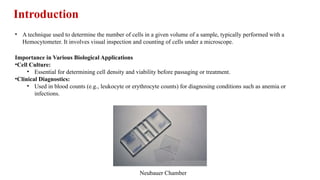
• A technique used to determine the number of cells in a given volume of a sample, typically performed with a
Hemocytometer. It involves visual inspection and counting of cells under a microscope.
Importance in Various Biological Applications
•Cell Culture:
• Essential for determining cell density and viability before passaging or treatment.
•Clinical Diagnostics:
• Used in blood counts (e.g., leukocyte or erythrocyte counts) for diagnosing conditions such as anemia or
infections.
Neubauer Chamber
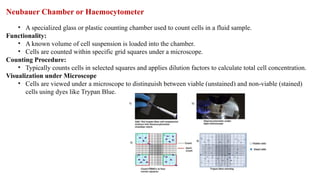
Neubauer Chamber or Haemocytometer
• A specialized glass or plastic counting chamber used to count cells in a fluid sample.
Functionality:
• A known volume of cell suspension is loaded into the chamber.
• Cells are counted within specific grid squares under a microscope.
Counting Procedure:
• Typically counts cells in selected squares and applies dilution factors to calculate total cell concentration.
Visualization under Microscope
• Cells are viewed under a microscope to distinguish between viable (unstained) and non-viable (stained)
cells using dyes like Trypan Blue.
Disadvantages of Manual Cell Counting
 Time-Consuming: The counting process can take time, especially with larger samples.
 Labor-Intensive: Requires meticulous attention and effort, which can lead to fatigue and errors over time.
 Subject to Human Error: Variability in counting techniques can lead to inconsistent results.
• Mistakes can occur in identifying and counting cells, particularly at high densities.
 Limited Sample Size: Practical for small volumes; large samples may require multiple counts, increasing potential for error.
 Inability to Process High Throughput: Not suitable for large-scale studies where thousands of samples need counting
efficiently.
 Staining Limitations: Reliance on staining methods (e.g., Trypan Blue) may not be suitable for all cell types or can alter cell
viability.
 Equipment Maintenance: Requires proper care and calibration of the Hemocytometer to ensure accurate results.
These disadvantages highlight why automated cell counting methods are often preferred in high-throughput settings or for precise
quantitative analyses
Applications:
•Widely used in cell biology, microbiology, and clinical laboratories for various applications, including cell viability assays
and population assessments.
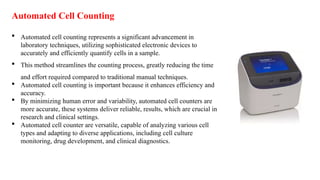
Automated Cell Counting
 Automated cell counting represents a significant advancement in
laboratory techniques, utilizing sophisticated electronic devices to
accurately and efficiently quantify cells in a sample.
 This method streamlines the counting process, greatly reducing the time
and effort required compared to traditional manual techniques.
 Automated cell counting is important because it enhances efficiency and
accuracy.
 By minimizing human error and variability, automated cell counters are
more accurate, these systems deliver reliable, results, which are crucial in
research and clinical settings.
 Automated cell counter are versatile, capable of analyzing various cell
types and adapting to diverse applications, including cell culture
monitoring, drug development, and clinical diagnostics.
Key Features
1. Advanced Imaging Technology
• High-Resolution Cameras: Capture detailed images of cells for accurate counting and analysis.
• Automated Image Analysis: Uses sophisticated algorithms to identify and quantify cells based on specific parameters,
enhancing precision.
2. Rapid Results
• Quick Processing Time: Delivers cell counts and viability assessments in just seconds, significantly improving
workflow efficiency.
• High Throughput Capability: Enables lab to process large numbers of samples rapidly, facilitating time-sensitive
research and diagnostics.
3. User-Friendly Interface
• Touchscreen Controls: Intuitive interface that simplifies operation, allowing users to easily navigate through functions
and settings.
4. Multi-Functionality for Various Analyses
• Cell Viability Assessment: Distinguishes between live and dead cells using fluorescent dyes, providing insights into
cell health.
• Size and Morphology Analysis: Offers additional metrics on cell size and shape, valuable for characterizing different
cell types and conditions.
• Versatile Applications: Adaptable for various research needs, from basic cell culture to complex clinical diagnostics.
Types of Automated Cell Counters
There are many types of automated cell counters like
• Image-based counters,
• Fluorescence-Based Counters,
• Flow Cytometer,
• Microfluidic Devices.
How Automated Cell Counters Work
Sample Preparation
•Mixing the Sample:
• Cells are typically mixed with appropriate dyes (e.g., Trypan Blue) to assess viability.
• This step helps distinguish between live (unstained) and dead (stained) cells.
•Loading the Sample:
• The prepared sample is loaded into a disposable counting chamber or slide.
• Ensures a uniform volume for accurate analysis.
Counting Process
•Automated Imaging:
• The device captures high-resolution images of the cells within the counting chamber.
• Images are processed using sophisticated algorithms.
•Analysis:
• The software automatically identifies and counts cells based on predefined parameters.
• Calculates cell concentration and viability, providing results within seconds.
Advantages of Automated Cell Counting
•Rapid Processing: Automated cell counters deliver results in seconds, significantly reducing the time spent on sample analysis.
•High Throughput: Capable of handling multiple samples simultaneously, ideal for busy lab that require quick turnaround times.
•Minimized Human Error: Automated systems eliminate variability associated with manual counting, leading to more reliable
outcomes.
•Consistent Results: Provides reproducible data across different experiments and operators, crucial for scientific research and
diagnostics.
•Adaptable for Various Cell Types: Suitable for a wide range of cells, including mammalian, bacterial, and yeast cells.
•Diverse Applications: Applicable in various fields, such as cell culture, clinical diagnostics, and biotechnology, accommodating
different research needs
Applications of Automated Cell Counters
Cell Culture
•Monitoring Growth:
• Essential for tracking cell density and confluency during cell culture.
•Viability Assessment:
• Quickly evaluates cell health and viability, informing decisions on passaging and treatment.
Clinical Diagnostics
•Blood Cell Counts:
• Used for complete blood counts (CBC), providing critical information for diagnosing conditions such as
anemia, infections, and leukemias.
Thank You

Automated Cell Counting for cell counting

  • 1.
    Manual Cell Countingand Automated Cell Counting
  • 2.
    Introduction • A techniqueused to determine the number of cells in a given volume of a sample, typically performed with a Hemocytometer. It involves visual inspection and counting of cells under a microscope. Importance in Various Biological Applications •Cell Culture: • Essential for determining cell density and viability before passaging or treatment. •Clinical Diagnostics: • Used in blood counts (e.g., leukocyte or erythrocyte counts) for diagnosing conditions such as anemia or infections. Neubauer Chamber
  • 3.
    Neubauer Chamber orHaemocytometer • A specialized glass or plastic counting chamber used to count cells in a fluid sample. Functionality: • A known volume of cell suspension is loaded into the chamber. • Cells are counted within specific grid squares under a microscope. Counting Procedure: • Typically counts cells in selected squares and applies dilution factors to calculate total cell concentration. Visualization under Microscope • Cells are viewed under a microscope to distinguish between viable (unstained) and non-viable (stained) cells using dyes like Trypan Blue.
  • 4.
    Disadvantages of ManualCell Counting  Time-Consuming: The counting process can take time, especially with larger samples.  Labor-Intensive: Requires meticulous attention and effort, which can lead to fatigue and errors over time.  Subject to Human Error: Variability in counting techniques can lead to inconsistent results. • Mistakes can occur in identifying and counting cells, particularly at high densities.  Limited Sample Size: Practical for small volumes; large samples may require multiple counts, increasing potential for error.  Inability to Process High Throughput: Not suitable for large-scale studies where thousands of samples need counting efficiently.  Staining Limitations: Reliance on staining methods (e.g., Trypan Blue) may not be suitable for all cell types or can alter cell viability.  Equipment Maintenance: Requires proper care and calibration of the Hemocytometer to ensure accurate results. These disadvantages highlight why automated cell counting methods are often preferred in high-throughput settings or for precise quantitative analyses Applications: •Widely used in cell biology, microbiology, and clinical laboratories for various applications, including cell viability assays and population assessments.
  • 5.
    Automated Cell Counting Automated cell counting represents a significant advancement in laboratory techniques, utilizing sophisticated electronic devices to accurately and efficiently quantify cells in a sample.  This method streamlines the counting process, greatly reducing the time and effort required compared to traditional manual techniques.  Automated cell counting is important because it enhances efficiency and accuracy.  By minimizing human error and variability, automated cell counters are more accurate, these systems deliver reliable, results, which are crucial in research and clinical settings.  Automated cell counter are versatile, capable of analyzing various cell types and adapting to diverse applications, including cell culture monitoring, drug development, and clinical diagnostics.
  • 6.
    Key Features 1. AdvancedImaging Technology • High-Resolution Cameras: Capture detailed images of cells for accurate counting and analysis. • Automated Image Analysis: Uses sophisticated algorithms to identify and quantify cells based on specific parameters, enhancing precision. 2. Rapid Results • Quick Processing Time: Delivers cell counts and viability assessments in just seconds, significantly improving workflow efficiency. • High Throughput Capability: Enables lab to process large numbers of samples rapidly, facilitating time-sensitive research and diagnostics. 3. User-Friendly Interface • Touchscreen Controls: Intuitive interface that simplifies operation, allowing users to easily navigate through functions and settings. 4. Multi-Functionality for Various Analyses • Cell Viability Assessment: Distinguishes between live and dead cells using fluorescent dyes, providing insights into cell health. • Size and Morphology Analysis: Offers additional metrics on cell size and shape, valuable for characterizing different cell types and conditions. • Versatile Applications: Adaptable for various research needs, from basic cell culture to complex clinical diagnostics.
  • 7.
    Types of AutomatedCell Counters There are many types of automated cell counters like • Image-based counters, • Fluorescence-Based Counters, • Flow Cytometer, • Microfluidic Devices. How Automated Cell Counters Work Sample Preparation •Mixing the Sample: • Cells are typically mixed with appropriate dyes (e.g., Trypan Blue) to assess viability. • This step helps distinguish between live (unstained) and dead (stained) cells. •Loading the Sample: • The prepared sample is loaded into a disposable counting chamber or slide. • Ensures a uniform volume for accurate analysis. Counting Process •Automated Imaging: • The device captures high-resolution images of the cells within the counting chamber. • Images are processed using sophisticated algorithms. •Analysis: • The software automatically identifies and counts cells based on predefined parameters. • Calculates cell concentration and viability, providing results within seconds.
  • 8.
    Advantages of AutomatedCell Counting •Rapid Processing: Automated cell counters deliver results in seconds, significantly reducing the time spent on sample analysis. •High Throughput: Capable of handling multiple samples simultaneously, ideal for busy lab that require quick turnaround times. •Minimized Human Error: Automated systems eliminate variability associated with manual counting, leading to more reliable outcomes. •Consistent Results: Provides reproducible data across different experiments and operators, crucial for scientific research and diagnostics. •Adaptable for Various Cell Types: Suitable for a wide range of cells, including mammalian, bacterial, and yeast cells. •Diverse Applications: Applicable in various fields, such as cell culture, clinical diagnostics, and biotechnology, accommodating different research needs
  • 9.
    Applications of AutomatedCell Counters Cell Culture •Monitoring Growth: • Essential for tracking cell density and confluency during cell culture. •Viability Assessment: • Quickly evaluates cell health and viability, informing decisions on passaging and treatment. Clinical Diagnostics •Blood Cell Counts: • Used for complete blood counts (CBC), providing critical information for diagnosing conditions such as anemia, infections, and leukemias.
  • 10.