Autism Spectrum Disorder
Brief Overview
ASD in children
• Getting a diagnosis is important for future
funding and support in schools
• When choosing a school, find one where
teachers are familiar with ASD
• Begin early intervention programs before school
▫ Speech therapy
▫ Occupational therapy

• Don’t panic. It is getting more common and a lot
of people with ASD finish school, go to uni and
get successful careers in IT or engineering
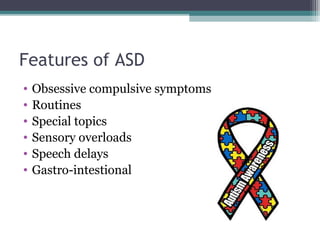
Features of ASD
•
•
•
•
•
•

Obsessive compulsive symptoms
Routines
Special topics
Sensory overloads
Speech delays
Gastro-intestional
Obsessive compulsive symptoms
• Many people with ASD also have OCD
• This relates to doing ritualised behaviour for a
long time (>1min)
• May happen after stress
• If you notice this kind of behaviour and it is
inappropriate
▫ Example: Opening and closing refrigerator and
clapping hands

• Try to change to a more appropriate
▫ Example: Playing with a puzzle toy
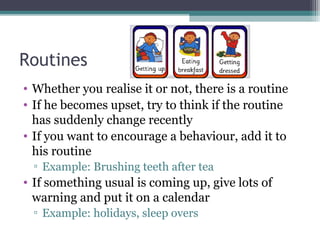
Routines
• Whether you realise it or not, there is a routine
• If he becomes upset, try to think if the routine
has suddenly change recently
• If you want to encourage a behaviour, add it to
his routine
▫ Example: Brushing teeth after tea

• If something usual is coming up, give lots of
warning and put it on a calendar
▫ Example: holidays, sleep overs
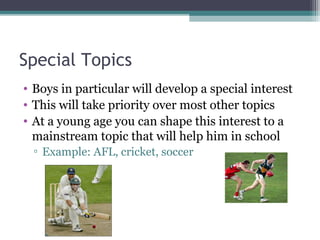
Special Topics
• Boys in particular will develop a special interest
• This will take priority over most other topics
• At a young age you can shape this interest to a
mainstream topic that will help him in school
▫ Example: AFL, cricket, soccer
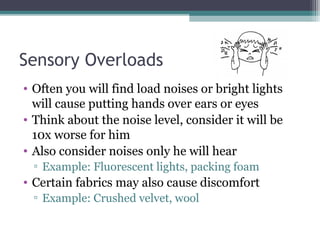
Sensory Overloads
• Often you will find load noises or bright lights
will cause putting hands over ears or eyes
• Think about the noise level, consider it will be
10x worse for him
• Also consider noises only he will hear
▫ Example: Fluorescent lights, packing foam

• Certain fabrics may also cause discomfort
▫ Example: Crushed velvet, wool
Speech Delays
• One of the main diagnostic criteria in ASD
• Most children:
▫ Will start talking before 1 year
▫ At 2 years they will speak >50 words in 2 word sentences
▫ At 3 they will have nearly full sentences with a wide vocab

• Children with ASD generally see no reason to talk so will
need a lot of encouragement
• Areas to focus on:
▫ Pronunciation
▫ Pro-nouns (may find difficult telling difference between
genders)
▫ Asking politely or at all
Gastro-intestional
• ASD was first seen as a gastro-intestional
disorder
• Some food may trigger stress and embellishment
of symptoms
▫ Example: MSG, milk products

• Taking these out of their diet can show near
immediate improvement
Conclusion
• The above symptoms are typical off all children with
ASD
• There are some aspects that can be helped but others will
be pervasive – Pick your battles
• However it is a continuum and no two children with ASD
will be the same
• There is a growing awareness and acceptance of ASD in
the community with many programs and support groups
• Talk with as many parents and professionals as possible
and get as much info as you can, it all helps
• If you have any questions please contact me on:
▫ 0437950089 or 9706 7616
▫ Rhiana.heath@gmail.com

Autism spectrum disorder

  • 1.
  • 2.
    ASD in children •Getting a diagnosis is important for future funding and support in schools • When choosing a school, find one where teachers are familiar with ASD • Begin early intervention programs before school ▫ Speech therapy ▫ Occupational therapy • Don’t panic. It is getting more common and a lot of people with ASD finish school, go to uni and get successful careers in IT or engineering
  • 3.
    Features of ASD • • • • • • Obsessivecompulsive symptoms Routines Special topics Sensory overloads Speech delays Gastro-intestional
  • 4.
    Obsessive compulsive symptoms •Many people with ASD also have OCD • This relates to doing ritualised behaviour for a long time (>1min) • May happen after stress • If you notice this kind of behaviour and it is inappropriate ▫ Example: Opening and closing refrigerator and clapping hands • Try to change to a more appropriate ▫ Example: Playing with a puzzle toy
  • 5.
    Routines • Whether yourealise it or not, there is a routine • If he becomes upset, try to think if the routine has suddenly change recently • If you want to encourage a behaviour, add it to his routine ▫ Example: Brushing teeth after tea • If something usual is coming up, give lots of warning and put it on a calendar ▫ Example: holidays, sleep overs
  • 6.
    Special Topics • Boysin particular will develop a special interest • This will take priority over most other topics • At a young age you can shape this interest to a mainstream topic that will help him in school ▫ Example: AFL, cricket, soccer
  • 7.
    Sensory Overloads • Oftenyou will find load noises or bright lights will cause putting hands over ears or eyes • Think about the noise level, consider it will be 10x worse for him • Also consider noises only he will hear ▫ Example: Fluorescent lights, packing foam • Certain fabrics may also cause discomfort ▫ Example: Crushed velvet, wool
  • 8.
    Speech Delays • Oneof the main diagnostic criteria in ASD • Most children: ▫ Will start talking before 1 year ▫ At 2 years they will speak >50 words in 2 word sentences ▫ At 3 they will have nearly full sentences with a wide vocab • Children with ASD generally see no reason to talk so will need a lot of encouragement • Areas to focus on: ▫ Pronunciation ▫ Pro-nouns (may find difficult telling difference between genders) ▫ Asking politely or at all
  • 9.
    Gastro-intestional • ASD wasfirst seen as a gastro-intestional disorder • Some food may trigger stress and embellishment of symptoms ▫ Example: MSG, milk products • Taking these out of their diet can show near immediate improvement
  • 10.
    Conclusion • The abovesymptoms are typical off all children with ASD • There are some aspects that can be helped but others will be pervasive – Pick your battles • However it is a continuum and no two children with ASD will be the same • There is a growing awareness and acceptance of ASD in the community with many programs and support groups • Talk with as many parents and professionals as possible and get as much info as you can, it all helps • If you have any questions please contact me on: ▫ 0437950089 or 9706 7616 ▫ Rhiana.heath@gmail.com