AUTISM SPECTRUM DISORDER
BY DR SHIVANANDA
MD PEDIATRICS
AVMCH & R, PUDUCHERRY
DEFINITION
• Complex Neurodevelopmental disorder
• Key features
impairment in Social communication
Social interaction
accompanied by restricted repetitive
behaviours
AUTISM
CHANGES FROM DSM IV TO DSM5
• Currently DSM 5 is used for diagnosis of ASD
• Removal of the diagnostic subcategories
(Asperger’s disorder, childhood disintegrative
disorder, &Rett’s disorder)
• Change in the terminology from pervasive
developmental disorder-not otherwise
specified (PDD-NOS) to Autism spectrum
disorder
Continued......
• Reduction in diagnostic domains from 3 to 2
by merging social & communication domain
into single category
• Inclusion of sensory processing abnormalities
for diagnosis
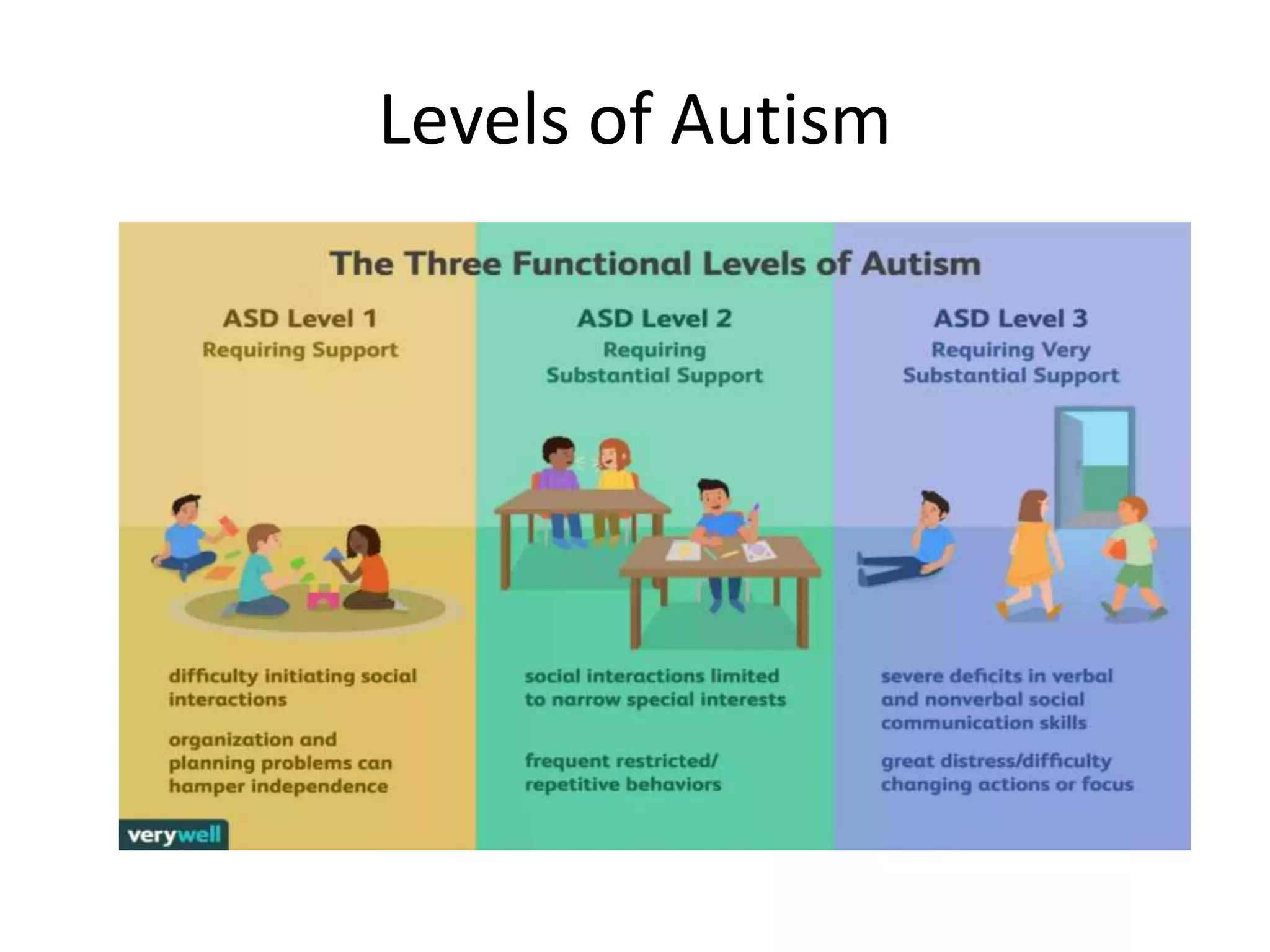
• Classification of ASD based on severity
Levels of Autism
ETIOLOGY
• Etiology of ASD remains complex and
multifactorial with interplay of
Genetics
Epigenetics
Environmental factors
Continued.....
• Various theories proposed to explain
pathophysiology of ASD
* The theory of mind
* The theory of impeded brain plasticity
*Excitation &inhibition dysregulation in
neuroapsesnal synapses
*Dysfunction in mirror neuron system
DSM 5 CRITERIA FOR ASD
• PERSISTENT DEFICIT IN SOCIAL COMMUNICATION
AND SOCIAL INTERACTION ACROSS MULTIPLE
CONTESTS currently or history
• Restricted , repetitive patterns of
behaviour, interests , or activities
• Symptoms must be present in early
developmental period( may not manifest until
social demand exceeds until capacity,& may
masked by ; learning strategies in later life)
Continued....
• Symptoms should cause clinically significant
impairment in social, occupational (or) other
important areas of current functioning
• These disturbances are not better explained
by intelectual developemental disorder (or)
global developemental delay
PERSISTENT DEFICIT IN SOCIAL
COMMUNICATION AND SOCIAL INTERACTION
ACROSS MULTIPLE CONTESTS currently or history include :
• Deficit in social emotional reciprocity
• Deficit in non verbal communicative
behaviours
• Deficit in maintaining , developing,
&understanding relationship
SOCIAL EMOTIONAL RECIPROCITY
(reduced social interaction)
• Ranges from activity avoidance or reduced social
response
• Lacking ability to initiate or sustain an interaction i.e.
*May not respond when his name is called
*May exhibit limited showing (or) sharing
behaviour
*May prefer solitary play
*May avoid attempts by others to play
*May not participate in activities that require taking
turns & trouble with rules
DEFICIT IN NON VERBAL
COMMUNICATIVE BEHAVIOURS
• USED FOR SOCIAL INTERACTION
• Reduced eye contact and pointing gesture
• Reduced awareness or response to eye gaze
(or) pointing of others
• Feels difficulty in engaging in groups
Restricted, Repetitive patterns of
behavior , interests, or activities
(AT LEAST 2 OF THE FOLLOWING)
• Stereotyped or repetitive
motor movements, use of
objects, or speech
• Insistence on sameness,
inflexible adherence to
routines, or ritualized
patterns or verbal
nonverbal behavior
• Example: lining up of
materials, repetitive
phrases or questioning,
repetitive movements –
flapping
• Must sit in same seat, be
first in line, difficulty in
transitioning between
activities like play ground
to class, difficulty with
changes in routine like
substitute teacher
Continued....
• Highly restricted , fixated
interests that are
abnormal in intensity or
focus
• Hyper or hypo reactivity
to sensory input or
unusual interests in
sensory aspects of the
environment
• Really likes unusual
objects, hyper focused on
particular interest, play
with limited range of toys,
limited range of interests
• Over sensitive to sensory
inputs such as smell,
noise, texture, may hate
certain foods or odours,
feel distress after hearing
some sounds, may refuse
to wear certain dresses
COMMON CO-OCCURING CONDITIONS
IN AUTISM SPECTRUM DISORDERS
• INTELLECTUAL DISABILITY
• MOTOR ABNORMALITIES
• SLEEP DISORDERS
• ANXIETY
• DEPRESSION
• GASTROINTERSTINAL PROBLEMS
• AGGRESSIVE BEHAVIOURS
• SELF INJURIOUS BEHAVIOURS
• PICA
• DEPRESSION
• ADHD
DIFFERENTIAL DIAGNOSIS
• LANGUAGE DISORDER
• HEARING LOSS
• SOCIAL COMMUNICATION DISORDER
• INTELLCTUAL DISABILITY OR GLOBAL
DEVELOPMENTAL DELAY
• ADHD
• LANDAU KLEFFNER SYNDROME(LKS)
SCREENING
• SCREENING IS DONE WHEN THERE IS
INCREASED RISK FOR ASD SUCH AS a child
with an older sibling who has ASD, or concern
for possible ASD
• Screening can be done by parent checklist or
direct assessment
• Most frequently used screening tool is THE
MODIFIED CHECKLIST FOR AUTISM, REVISED /
FOLLOWUP (MCHAT-R/FU)
MCHAT-R/FU
CONTINUED......
• Can be used from age 16 to 30 months
• For items 2,5,&12 YES indicates ASD risk
• For remaining items NO indicates ASD risk
• LOW RISK – if score is 0 – 2; if child is <24
months screen after second birthday. No
further action required unless surveillance
indicates risk for ASD
Continued....
• Medium risk – 3 to 7 score. If MCHAT Score is
2 or above the child screened positive. Action
required is refer child for diagnostic evaluation
and eligibility evaluation for early
intervention.
• High risk – 8 to 20 score. Refer immediately
for diagnostic evaluation and eligibility
evaluation for early intervention
ASSESSMENT
• INCLUDES DIRECT OBSERVATION to evaluate
social skills & behaviour
• Autism Diagnostic Observation Shedule,
Second edition (ADOS-2)
• Autism Diagnostic observation schedule,
toddler module (ADOS-T)
• The Childhood Autism Rating Scale, second
edition (CARS-2) is 15 item direct clinical
observation instrument that can assist
clinician in the diagnosis of Autism
Medical and Genetic Evaluation of Children With
Autism Spectrum Disorder
• Physical examination:
dysmorphic physical features
Muscle tone and Reflexes
Head circumference
Wood lamp Examination for tuberous sclerosis
• Diagnostic testing:
Chromosomal micro array (CMA) in all individuals
fragile X DNA test in males
Audiology evaluation
Lead test in children with pica
Continued....
Additional targeted Genetic testing
• MECP2 sequence in females
• PTEN mutation testing if head circumference
> 2.5 SD above the mean
• MECP 2 deletion or duplication testing in
males with significant developmental
regression , drooling, respiratory infection,
and hypotonia
Additional targeted diagnostic testing
• EEG in children with seizures, staring spells, or
developmental regression
• Brain MRI in children with microcephaly, focal
neurologic findings, or developmental
regression
• Metabolic testing in children with hypotonia,
seizures, hearing loss, ataxia and coarse facial
features
Treatement & Management
• The primary treatment for ASD is done out
side the medical setting includes
developmental and educational programming
• The most important therapy is intensive
behavioural therapies
• Earlier age at initiation of treatment and
higher intensity of treatment –better out
come
• Programme must be individualized
Continue....
• Behavioural approaches based on the
principles of applied behavioural analysis-
teaching of skills in traditional behavioural
framework, careful data collection, analysis,
and adjustment of treatment
• Educational approaches such as The
Treatment and Education of autistic and
communication Handicapped children
(TEACCH) – structured teaching & adjustment
of environment according to individual needs
Continued....
• Speech and language therapy
• Augmentative communication approaches by
using pictures and icons
• Social skill programs
• For some high school children training in life
skills and vocational skills for maximizing
independence in adulthood
Pharmacology
• There are currently no medications that treate the core
symptoms of ASD
• Medications can be used to target specific co occurring
conditions or symptoms
• For Hyperactivity and/or inattention- Selective
norepinephrine reuptake inhibitors, & alpha 2 agonists
• For Anxiety – selective sertonin reuptake inhibitors
• For Irritability – Atypical antipsychotics
• For Insomnia - Melatonin
OUTCOME
• Autism spectrum disorder is a life long
condition
• Many adults with ASD are socially isolated,
lack of gainful employment, or independent
living
• Have higher rates of depression and anxiety
Thank you

Autism spectrum disorder

  • 1.
    AUTISM SPECTRUM DISORDER BYDR SHIVANANDA MD PEDIATRICS AVMCH & R, PUDUCHERRY
  • 2.
    DEFINITION • Complex Neurodevelopmentaldisorder • Key features impairment in Social communication Social interaction accompanied by restricted repetitive behaviours
  • 3.
  • 4.
    CHANGES FROM DSMIV TO DSM5 • Currently DSM 5 is used for diagnosis of ASD • Removal of the diagnostic subcategories (Asperger’s disorder, childhood disintegrative disorder, &Rett’s disorder) • Change in the terminology from pervasive developmental disorder-not otherwise specified (PDD-NOS) to Autism spectrum disorder
  • 5.
    Continued...... • Reduction indiagnostic domains from 3 to 2 by merging social & communication domain into single category • Inclusion of sensory processing abnormalities for diagnosis • Classification of ASD based on severity
  • 6.
  • 7.
    ETIOLOGY • Etiology ofASD remains complex and multifactorial with interplay of Genetics Epigenetics Environmental factors
  • 8.
    Continued..... • Various theoriesproposed to explain pathophysiology of ASD * The theory of mind * The theory of impeded brain plasticity *Excitation &inhibition dysregulation in neuroapsesnal synapses *Dysfunction in mirror neuron system
  • 9.
    DSM 5 CRITERIAFOR ASD • PERSISTENT DEFICIT IN SOCIAL COMMUNICATION AND SOCIAL INTERACTION ACROSS MULTIPLE CONTESTS currently or history • Restricted , repetitive patterns of behaviour, interests , or activities • Symptoms must be present in early developmental period( may not manifest until social demand exceeds until capacity,& may masked by ; learning strategies in later life)
  • 10.
    Continued.... • Symptoms shouldcause clinically significant impairment in social, occupational (or) other important areas of current functioning • These disturbances are not better explained by intelectual developemental disorder (or) global developemental delay
  • 11.
    PERSISTENT DEFICIT INSOCIAL COMMUNICATION AND SOCIAL INTERACTION ACROSS MULTIPLE CONTESTS currently or history include : • Deficit in social emotional reciprocity • Deficit in non verbal communicative behaviours • Deficit in maintaining , developing, &understanding relationship
  • 12.
    SOCIAL EMOTIONAL RECIPROCITY (reducedsocial interaction) • Ranges from activity avoidance or reduced social response • Lacking ability to initiate or sustain an interaction i.e. *May not respond when his name is called *May exhibit limited showing (or) sharing behaviour *May prefer solitary play *May avoid attempts by others to play *May not participate in activities that require taking turns & trouble with rules
  • 13.
    DEFICIT IN NONVERBAL COMMUNICATIVE BEHAVIOURS • USED FOR SOCIAL INTERACTION • Reduced eye contact and pointing gesture • Reduced awareness or response to eye gaze (or) pointing of others • Feels difficulty in engaging in groups
  • 14.
    Restricted, Repetitive patternsof behavior , interests, or activities (AT LEAST 2 OF THE FOLLOWING) • Stereotyped or repetitive motor movements, use of objects, or speech • Insistence on sameness, inflexible adherence to routines, or ritualized patterns or verbal nonverbal behavior • Example: lining up of materials, repetitive phrases or questioning, repetitive movements – flapping • Must sit in same seat, be first in line, difficulty in transitioning between activities like play ground to class, difficulty with changes in routine like substitute teacher
  • 15.
    Continued.... • Highly restricted, fixated interests that are abnormal in intensity or focus • Hyper or hypo reactivity to sensory input or unusual interests in sensory aspects of the environment • Really likes unusual objects, hyper focused on particular interest, play with limited range of toys, limited range of interests • Over sensitive to sensory inputs such as smell, noise, texture, may hate certain foods or odours, feel distress after hearing some sounds, may refuse to wear certain dresses
  • 16.
    COMMON CO-OCCURING CONDITIONS INAUTISM SPECTRUM DISORDERS • INTELLECTUAL DISABILITY • MOTOR ABNORMALITIES • SLEEP DISORDERS • ANXIETY • DEPRESSION • GASTROINTERSTINAL PROBLEMS • AGGRESSIVE BEHAVIOURS • SELF INJURIOUS BEHAVIOURS • PICA • DEPRESSION • ADHD
  • 17.
    DIFFERENTIAL DIAGNOSIS • LANGUAGEDISORDER • HEARING LOSS • SOCIAL COMMUNICATION DISORDER • INTELLCTUAL DISABILITY OR GLOBAL DEVELOPMENTAL DELAY • ADHD • LANDAU KLEFFNER SYNDROME(LKS)
  • 18.
    SCREENING • SCREENING ISDONE WHEN THERE IS INCREASED RISK FOR ASD SUCH AS a child with an older sibling who has ASD, or concern for possible ASD • Screening can be done by parent checklist or direct assessment • Most frequently used screening tool is THE MODIFIED CHECKLIST FOR AUTISM, REVISED / FOLLOWUP (MCHAT-R/FU)
  • 19.
  • 20.
    CONTINUED...... • Can beused from age 16 to 30 months • For items 2,5,&12 YES indicates ASD risk • For remaining items NO indicates ASD risk • LOW RISK – if score is 0 – 2; if child is <24 months screen after second birthday. No further action required unless surveillance indicates risk for ASD
  • 21.
    Continued.... • Medium risk– 3 to 7 score. If MCHAT Score is 2 or above the child screened positive. Action required is refer child for diagnostic evaluation and eligibility evaluation for early intervention. • High risk – 8 to 20 score. Refer immediately for diagnostic evaluation and eligibility evaluation for early intervention
  • 22.
    ASSESSMENT • INCLUDES DIRECTOBSERVATION to evaluate social skills & behaviour • Autism Diagnostic Observation Shedule, Second edition (ADOS-2) • Autism Diagnostic observation schedule, toddler module (ADOS-T) • The Childhood Autism Rating Scale, second edition (CARS-2) is 15 item direct clinical observation instrument that can assist clinician in the diagnosis of Autism
  • 23.
    Medical and GeneticEvaluation of Children With Autism Spectrum Disorder • Physical examination: dysmorphic physical features Muscle tone and Reflexes Head circumference Wood lamp Examination for tuberous sclerosis • Diagnostic testing: Chromosomal micro array (CMA) in all individuals fragile X DNA test in males Audiology evaluation Lead test in children with pica
  • 24.
    Continued.... Additional targeted Genetictesting • MECP2 sequence in females • PTEN mutation testing if head circumference > 2.5 SD above the mean • MECP 2 deletion or duplication testing in males with significant developmental regression , drooling, respiratory infection, and hypotonia
  • 25.
    Additional targeted diagnostictesting • EEG in children with seizures, staring spells, or developmental regression • Brain MRI in children with microcephaly, focal neurologic findings, or developmental regression • Metabolic testing in children with hypotonia, seizures, hearing loss, ataxia and coarse facial features
  • 26.
    Treatement & Management •The primary treatment for ASD is done out side the medical setting includes developmental and educational programming • The most important therapy is intensive behavioural therapies • Earlier age at initiation of treatment and higher intensity of treatment –better out come • Programme must be individualized
  • 27.
    Continue.... • Behavioural approachesbased on the principles of applied behavioural analysis- teaching of skills in traditional behavioural framework, careful data collection, analysis, and adjustment of treatment • Educational approaches such as The Treatment and Education of autistic and communication Handicapped children (TEACCH) – structured teaching & adjustment of environment according to individual needs
  • 28.
    Continued.... • Speech andlanguage therapy • Augmentative communication approaches by using pictures and icons • Social skill programs • For some high school children training in life skills and vocational skills for maximizing independence in adulthood
  • 29.
    Pharmacology • There arecurrently no medications that treate the core symptoms of ASD • Medications can be used to target specific co occurring conditions or symptoms • For Hyperactivity and/or inattention- Selective norepinephrine reuptake inhibitors, & alpha 2 agonists • For Anxiety – selective sertonin reuptake inhibitors • For Irritability – Atypical antipsychotics • For Insomnia - Melatonin
  • 30.
    OUTCOME • Autism spectrumdisorder is a life long condition • Many adults with ASD are socially isolated, lack of gainful employment, or independent living • Have higher rates of depression and anxiety
  • 31.