Complexity, Innovation and
   Quality in UG IPE
   theory background for development of educational design
                 in NCIPECP shared papers

                       Stanley Frielick
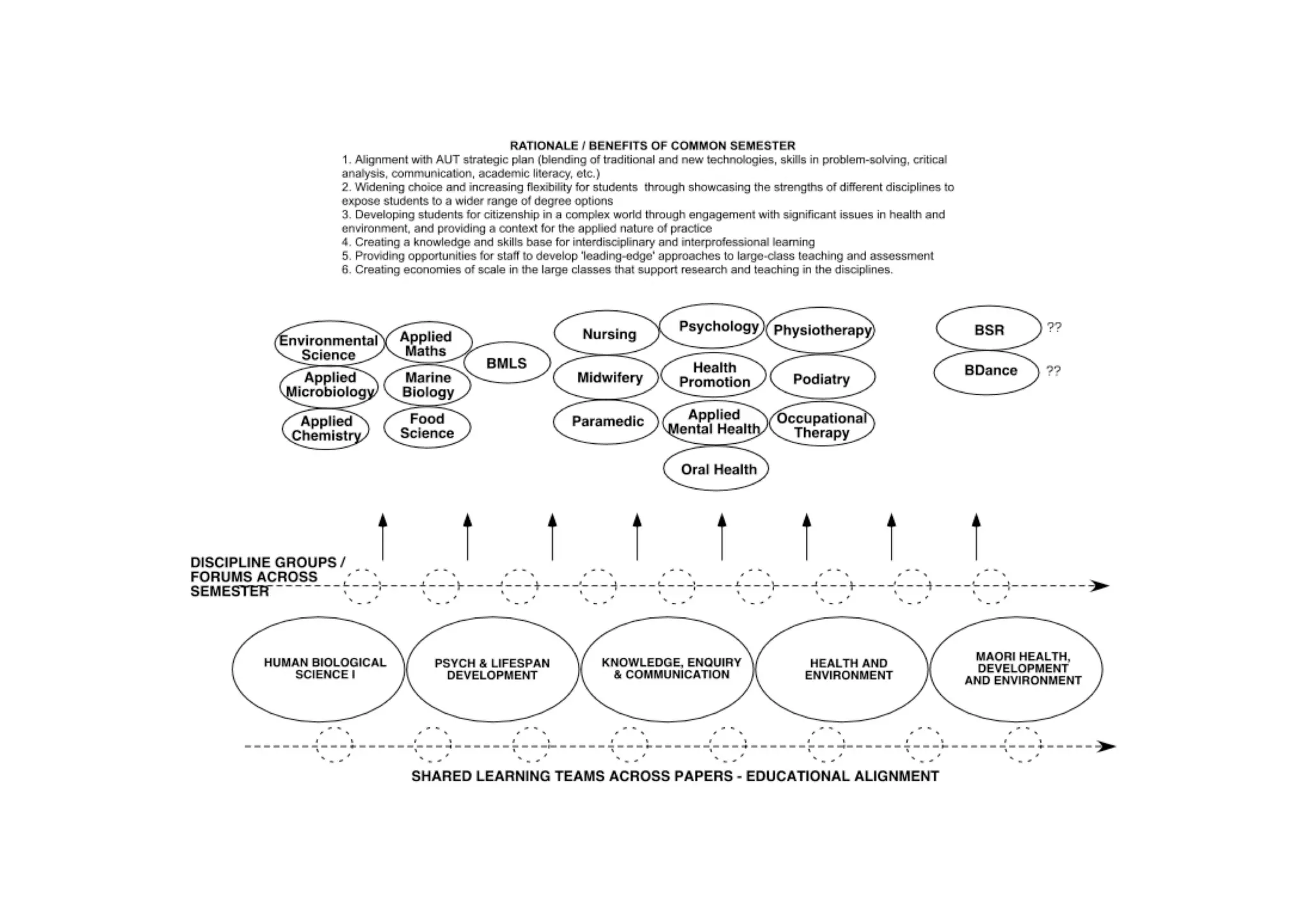
Common semester curriculum development project
                     (2007)

To address and resolve issues of: coherence,
consistency, resourcing, structure, relationship of
papers to disciplines, development of appropriate
knowledge base and skill set for interprofessional
learning, development of key skills and competencies
as outlined in theme 1 of the AUT strategic plan and
draft Faculty plan, and the quality of student learning
outcomes in the core papers; so as to develop a more
integrated and ‘common’ semester in the Faculty, and
provide a more interactive and engaging learning
experience for novice undergraduate students.
Key learning/teaching aspects of AUT strategic plan

• Curricula and programmes at the leading edge of practice
• Assist students to become intellectually independent with a thorough
understanding of the relevant body of knowledge
• Strong linkages with the professions and industry
• Blending traditional and new learning / teaching approaches and
technologies
• Ensuring that our graduates are skilled in communication, problem-solving,
critical analysis, are information literate, and can use the relevant
technologies.
• Ensuring that our graduates have the ability to work collaboratively, make
informed decisions and bring ethical analysis to practice.
• Ensuring that our graduates have the ability to challenge to challenge the
status quo, promote change and bring a forward looking dimension to their
chosen career.
• Ensuring that all students are equipped with a range of skills, including
information literacy.
• Ensuring the development of excellent teachers, able to use a range of
approaches and technologies in ways that meet the needs of their students.
Deep approaches to learning
                    Educational alignment (coherence)

Alignment within papers
         - constructive alignment (enactive coherence)
         - optimal environment for deep approaches
         - alignment with AUT generic outcomes

Alignment across papers
- Connected course design
- Consistency in assessment
- Relationship of common papers to discipline pathways
- Promotion of shared learning
- alignment with AUT generic outcomes
No one starts out teaching well
Paul Ramsden

What the students do is more important
than what the teacher does
John Biggs

The shift from teaching to learning ….
Barr and Tagg

The relational or ecological perspective
on university teaching and learning
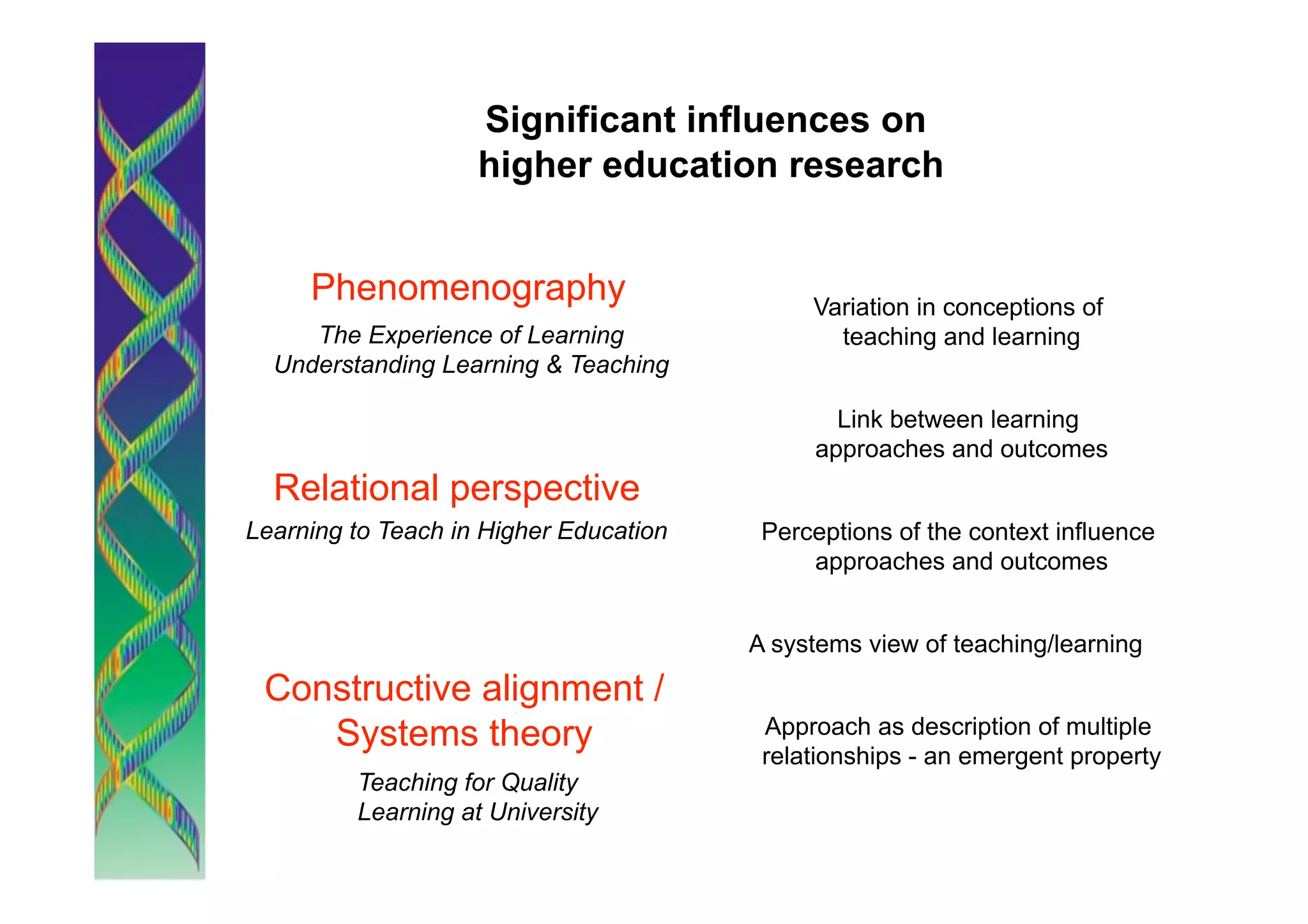
Significant influences on
                    higher education research


     Phenomenography                         Variation in conceptions of
     The Experience of Learning                teaching and learning
  Understanding Learning & Teaching

                                               Link between learning
                                             approaches and outcomes
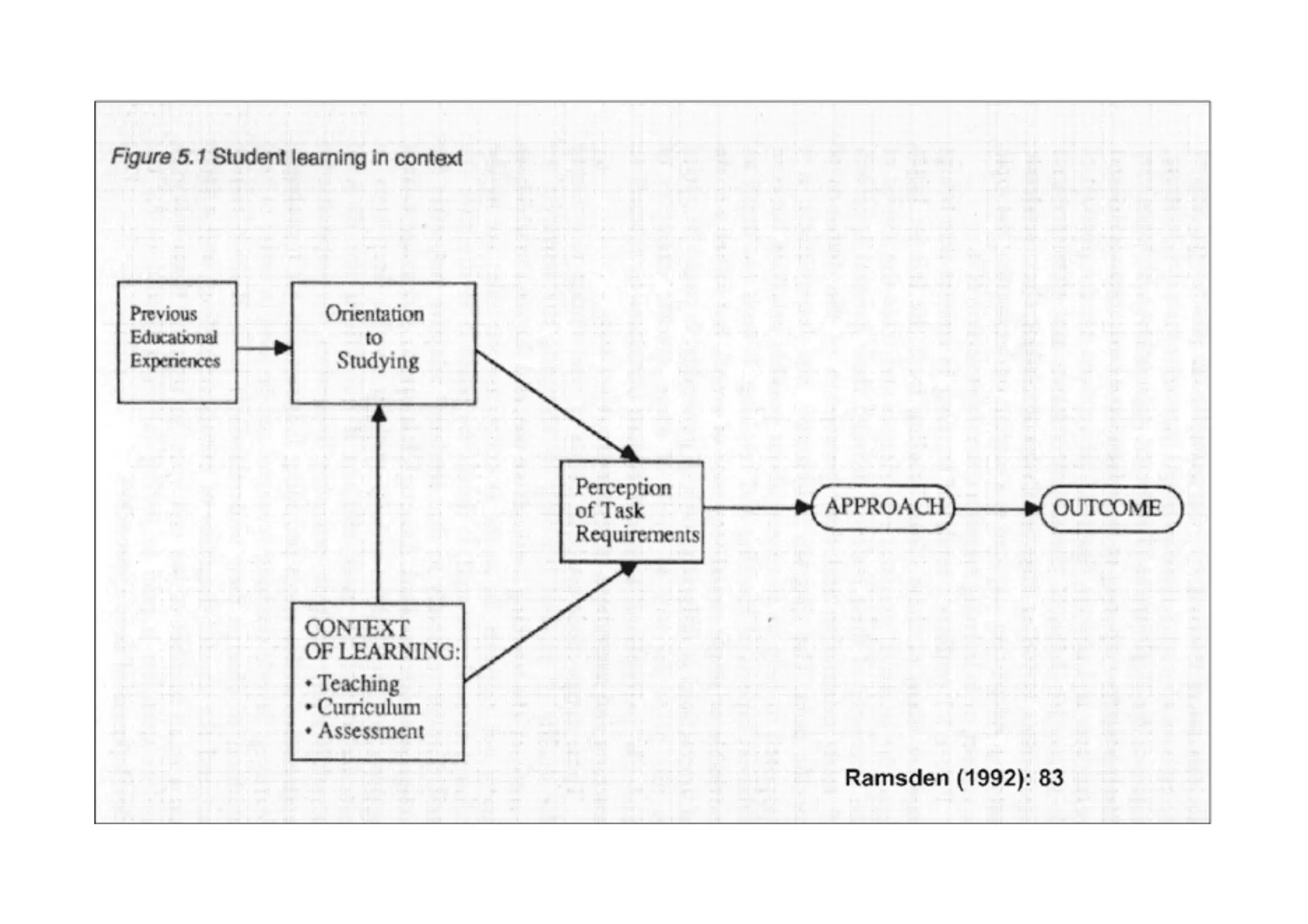
  Relational perspective
Learning to Teach in Higher Education    Perceptions of the context influence
                                             approaches and outcomes


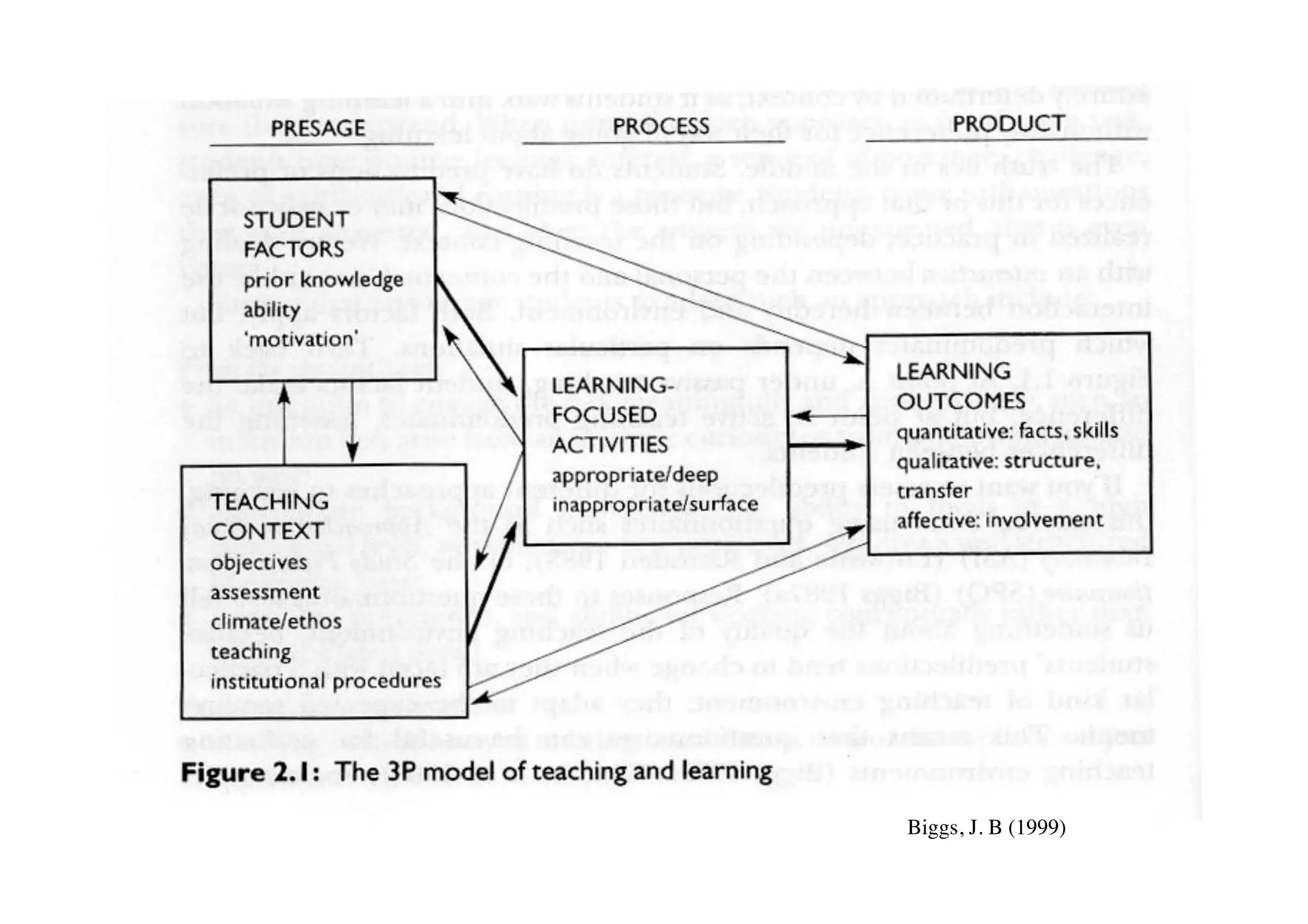
                                        A systems view of teaching/learning
 Constructive alignment /
    Systems theory                       Approach as description of multiple
                                         relationships - an emergent property
         Teaching for Quality
         Learning at University
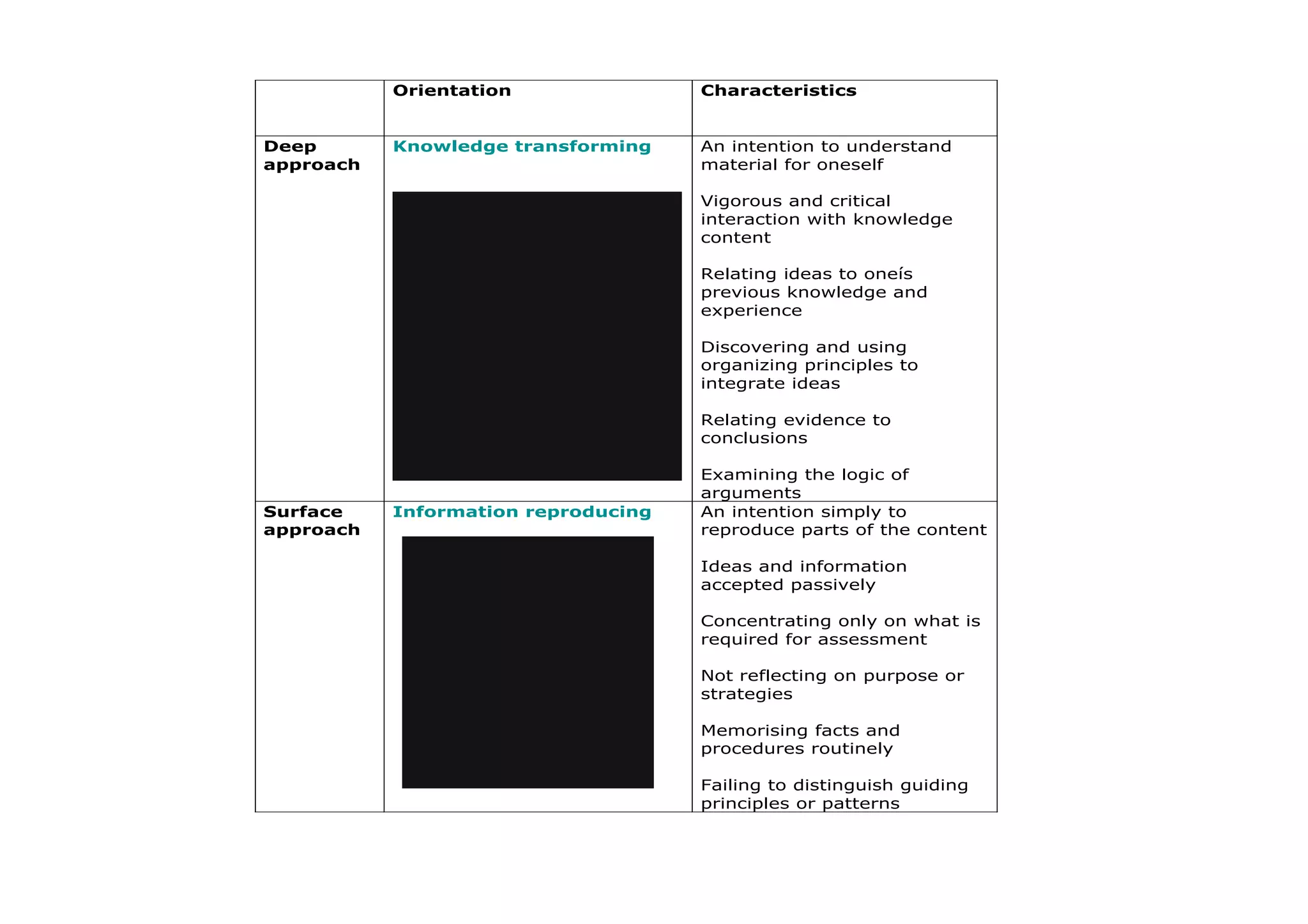
Orientation               Characteristics


Deep       Knowledge transforming    An intention to understand
approach                             material for oneself

                                     Vigorous and critical
                                     interaction with knowledge
                                     content

                                     Relating ideas to oneís
                                     previous knowledge and
                                     experience

                                     Discovering and using
                                     organizing principles to
                                     integrate ideas

                                     Relating evidence to
                                     conclusions

                                     Examining the logic of
                                     arguments
Surface    Information reproducing   An intention simply to
approach                             reproduce parts of the content

                                     Ideas and information
                                     accepted passively

                                     Concentrating only on what is
                                     required for assessment

                                     Not reflecting on purpose or
                                     strategies

                                     Memorising facts and
                                     procedures routinely

                                     Failing to distinguish guiding
                                     principles or patterns
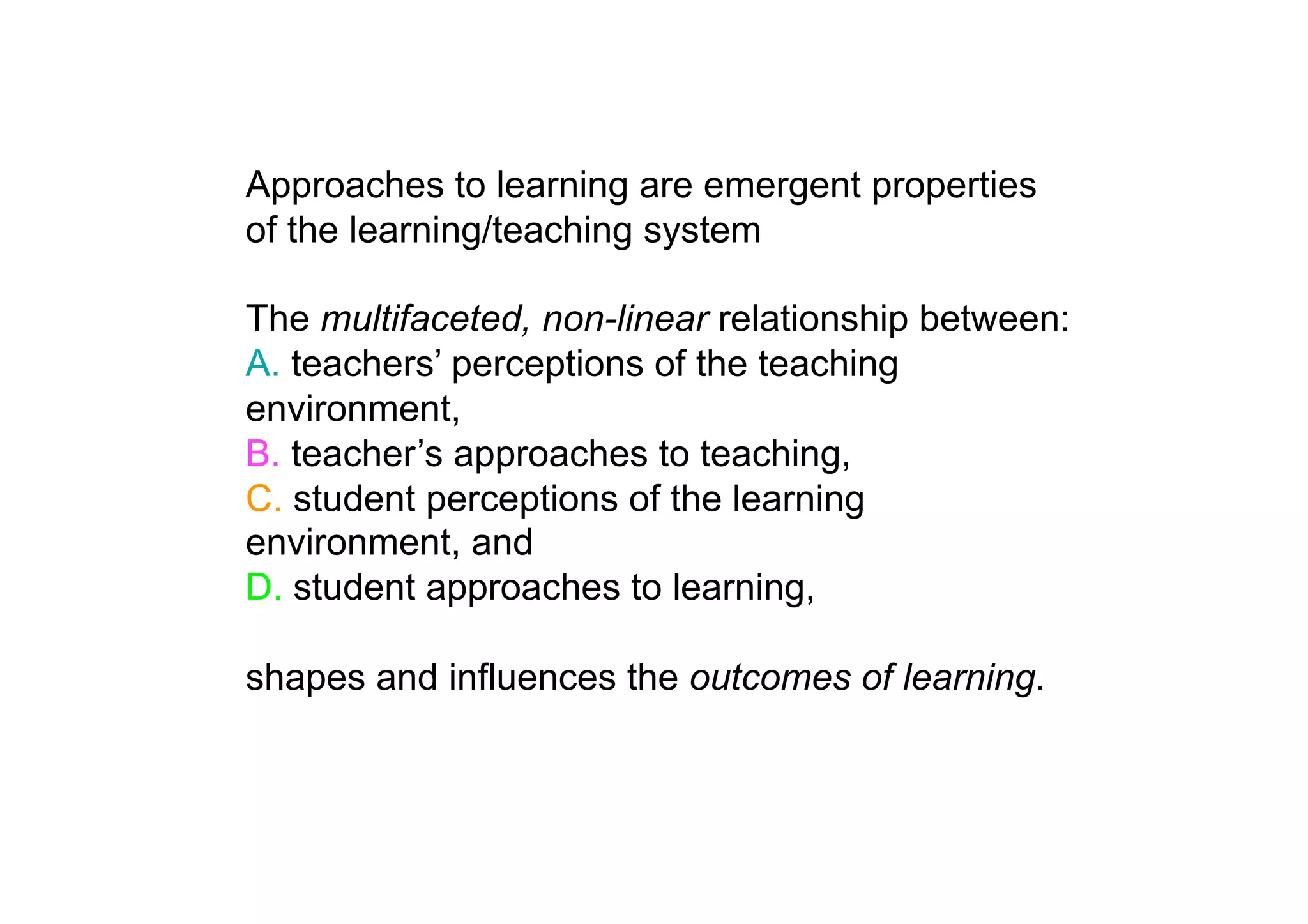
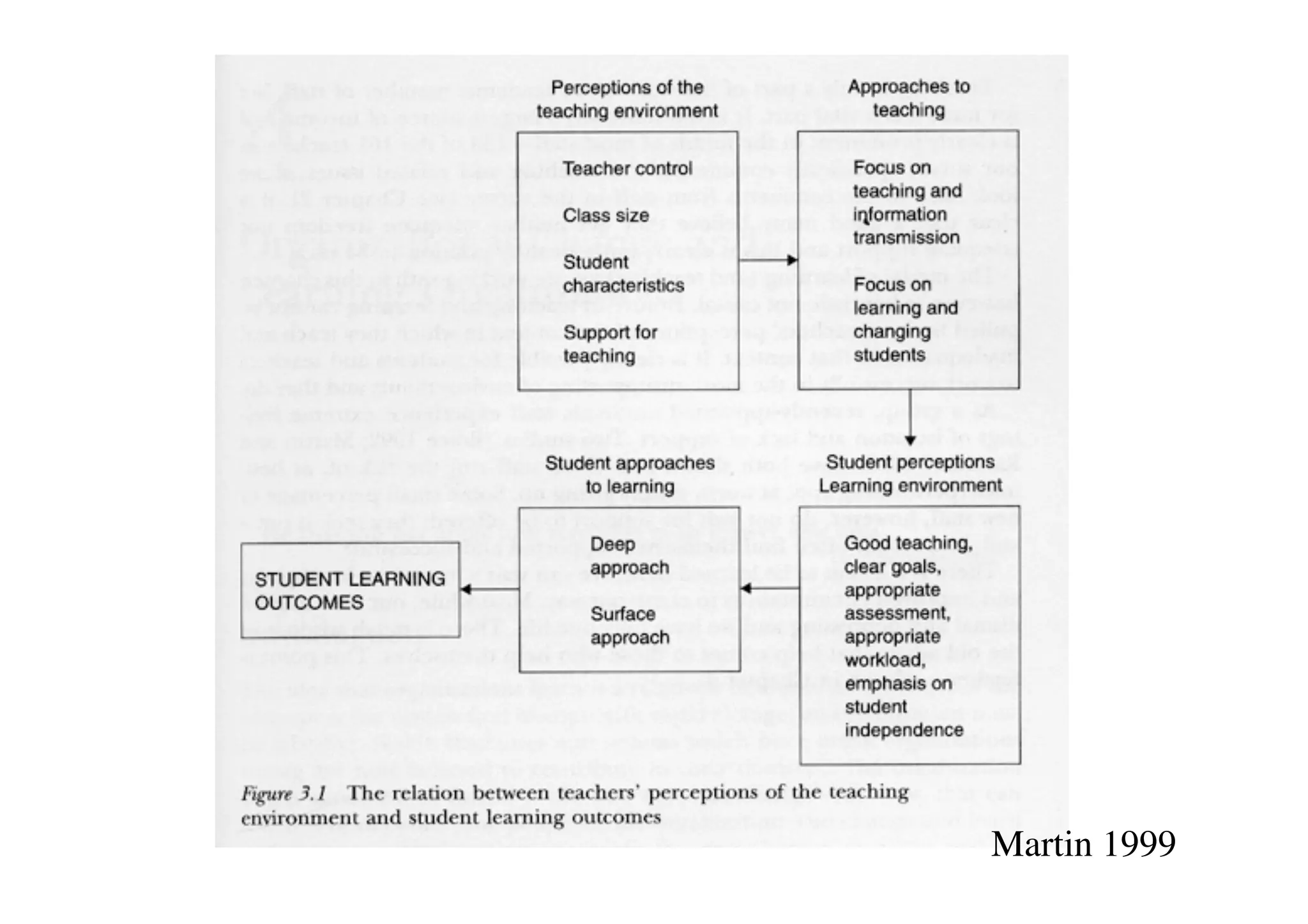
Approaches to learning are emergent properties
of the learning/teaching system

The multifaceted, non-linear relationship between:
A. teachers’ perceptions of the teaching
environment,
B. teacher’s approaches to teaching,
C. student perceptions of the learning
environment, and
D. student approaches to learning,

shapes and influences the outcomes of learning.
Martin 1999
Biggs, J. B (1999)
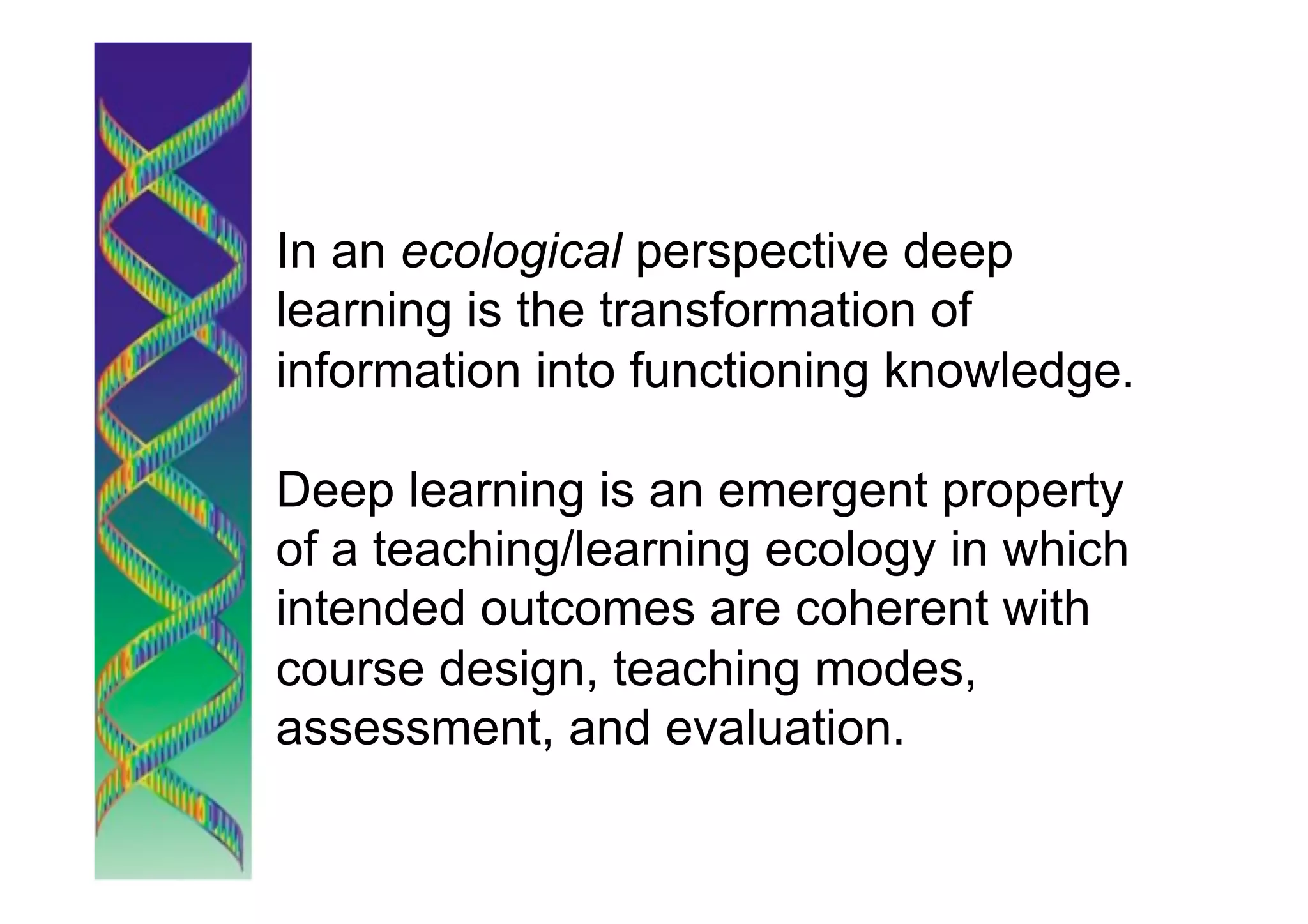
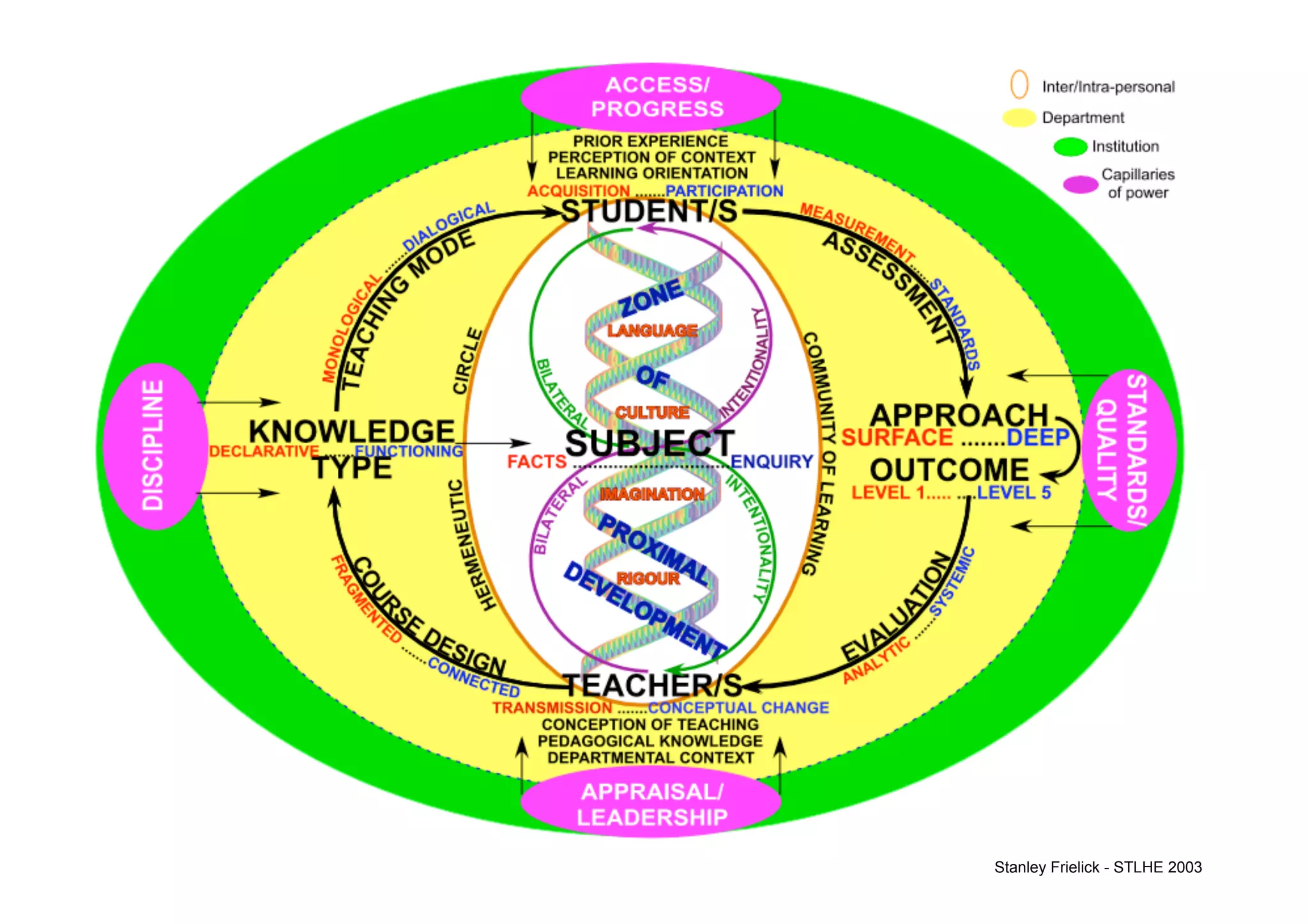
In an ecological perspective deep
learning is the transformation of
information into functioning knowledge.

Deep learning is an emergent property
of a teaching/learning ecology in which
intended outcomes are coherent with
course design, teaching modes,
assessment, and evaluation.
‘good’ TEACHING/LEARNING

is a process of creating learning
environments in which students are
encouraged to engage deeply with the
subject and emerge with a
transformed understanding that is
transferable to further inquiry and
practical applications in different
contexts.
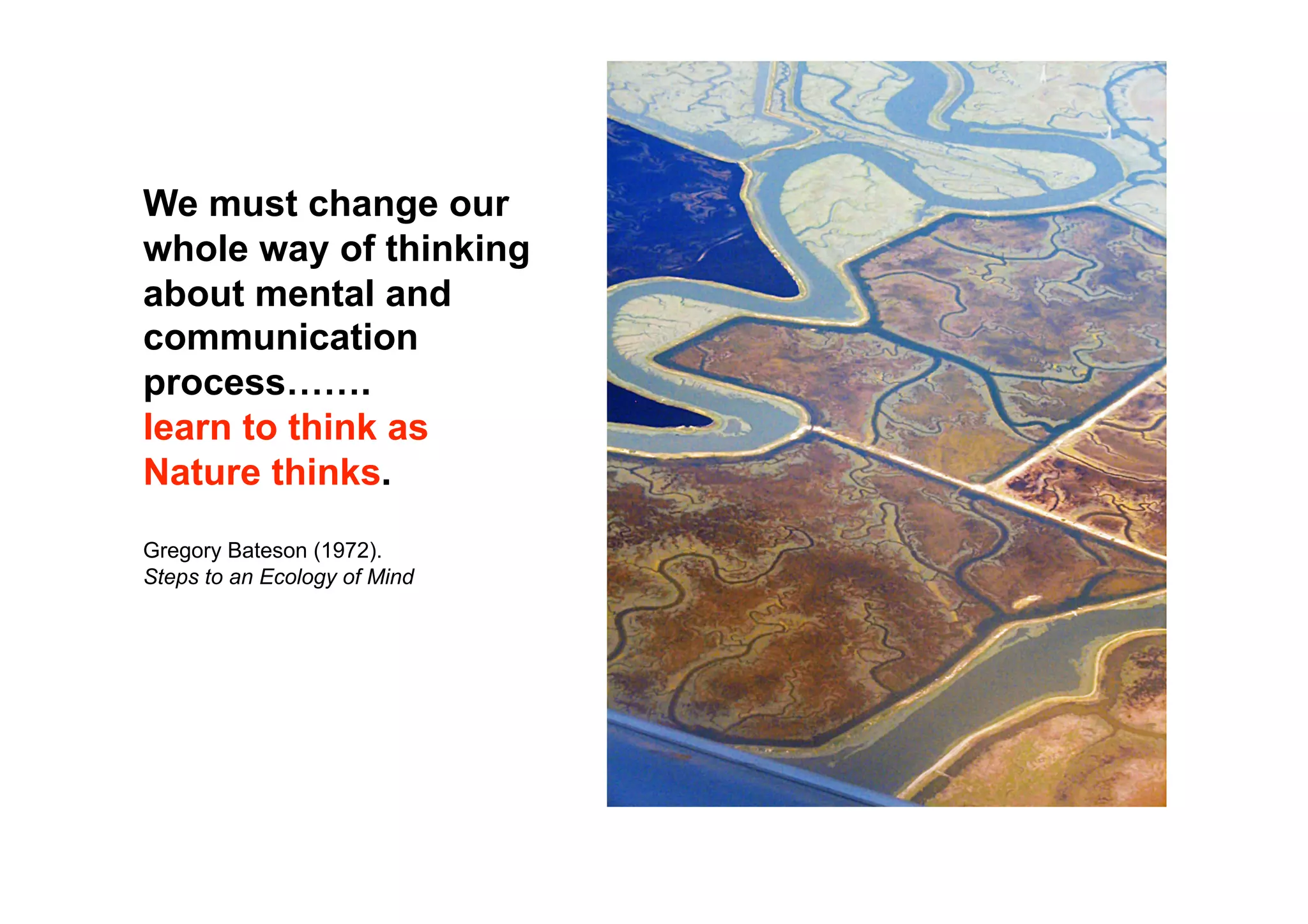
We must change our
whole way of thinking
about mental and
communication
process…….
learn to think as
Nature thinks.
Gregory Bateson (1972).
Steps to an Ecology of Mind
The underlying fabric of
the university is stitched
in 17th century dualistic /
mechanistic thought ….

The great research
university is old at heart
…
For as it grasps us it splits
us into minds and bodies.

 Wilshire (1990). The Moral Collapse of the
                                 University


                                                             'man sliced in half'
                                              www.flickr.com/photos/54899856@N00/40349181
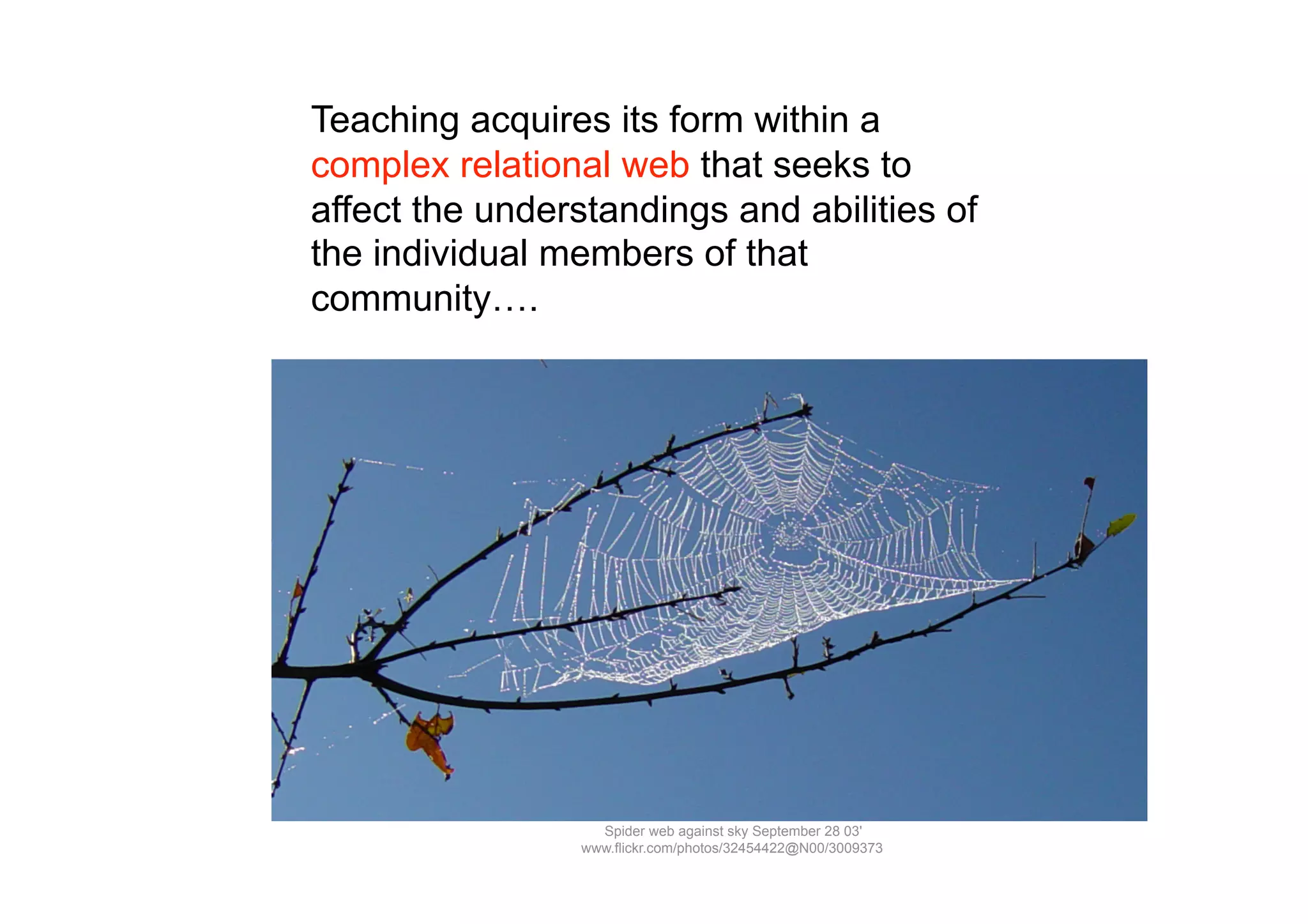
Teaching acquires its form within a
complex relational web that seeks to
affect the understandings and abilities of
the individual members of that
community….


                   Spider web against sky September 28 03'
                 www.flickr.com/photos/32454422@N00/3009373
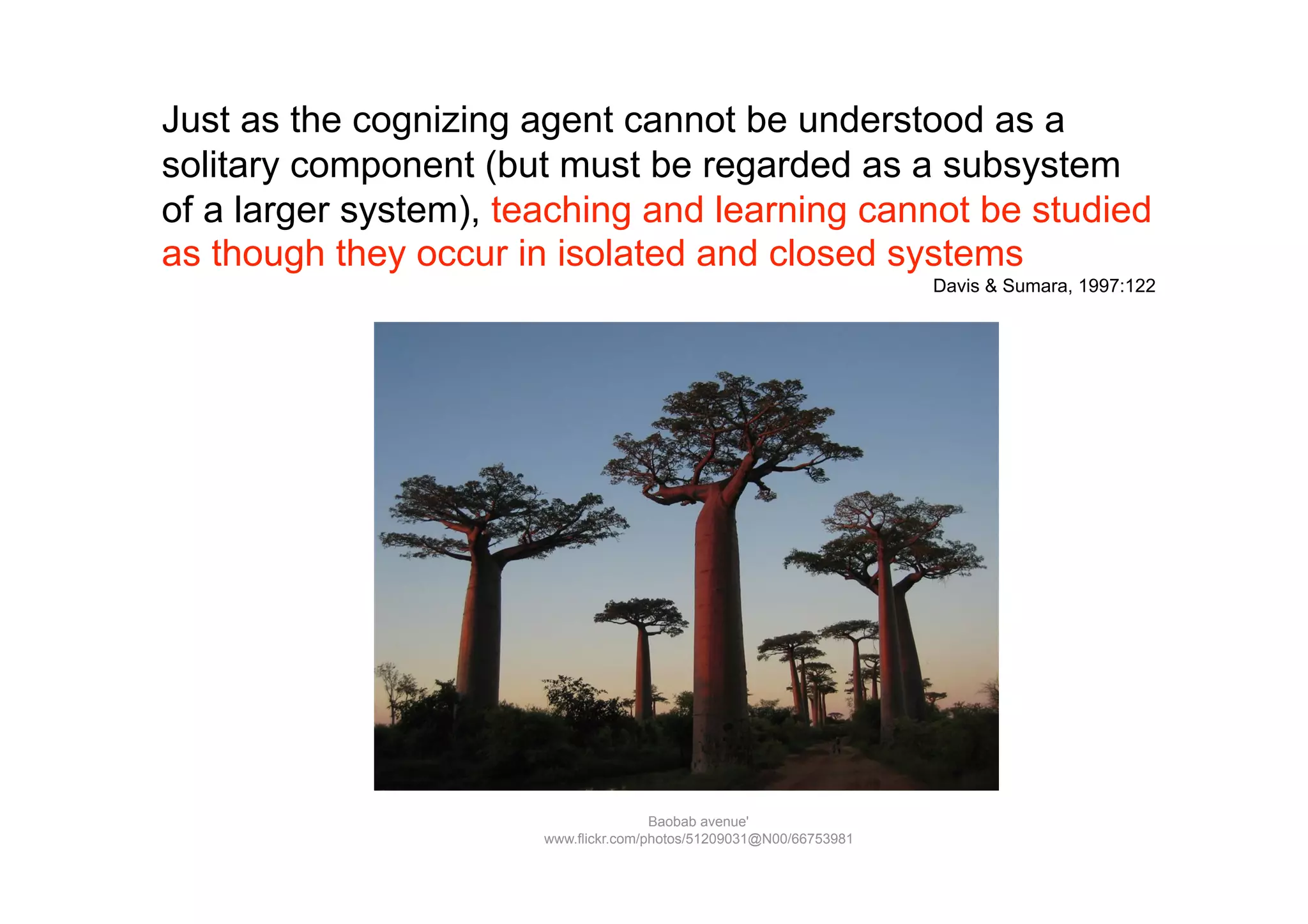
Just as the cognizing agent cannot be understood as a
solitary component (but must be regarded as a subsystem
of a larger system), teaching and learning cannot be studied
as though they occur in isolated and closed systems
                                                                     Davis & Sumara, 1997:122


                                       Baobab avenue'
                       www.flickr.com/photos/51209031@N00/66753981
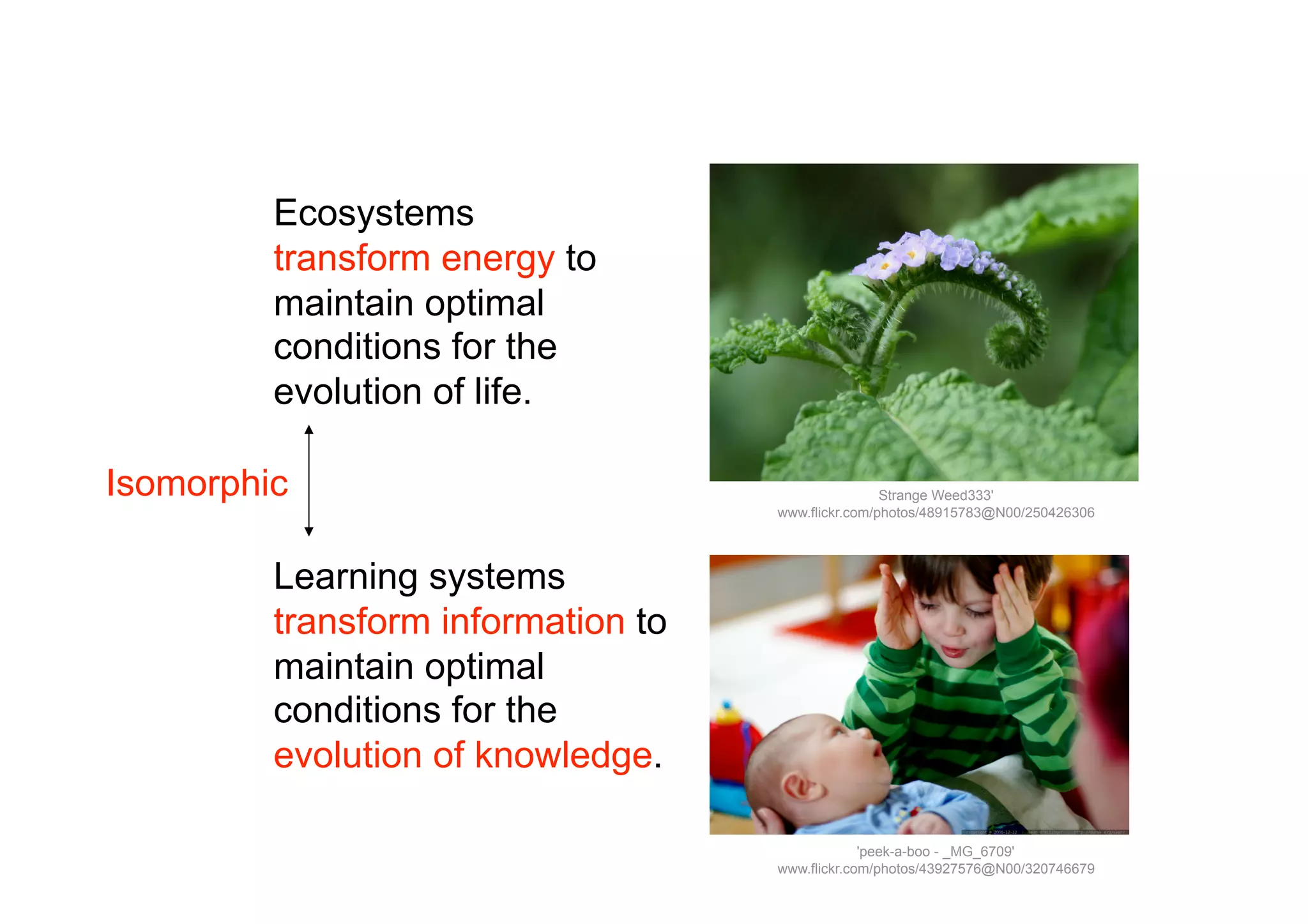
Ecosystems
         transform energy to
         maintain optimal
         conditions for the
         evolution of life.

Isomorphic                                          Strange Weed333'
                                    www.flickr.com/photos/48915783@N00/250426306


         Learning systems
         transform information to
         maintain optimal
         conditions for the
         evolution of knowledge.

                                                 'peek-a-boo - _MG_6709'
                                    www.flickr.com/photos/43927576@N00/320746679
Break the pattern which connects
the items of learning and you
necessarily destroy all quality…
(Bateson 1979: 16)
Stanley Frielick - STLHE 2003
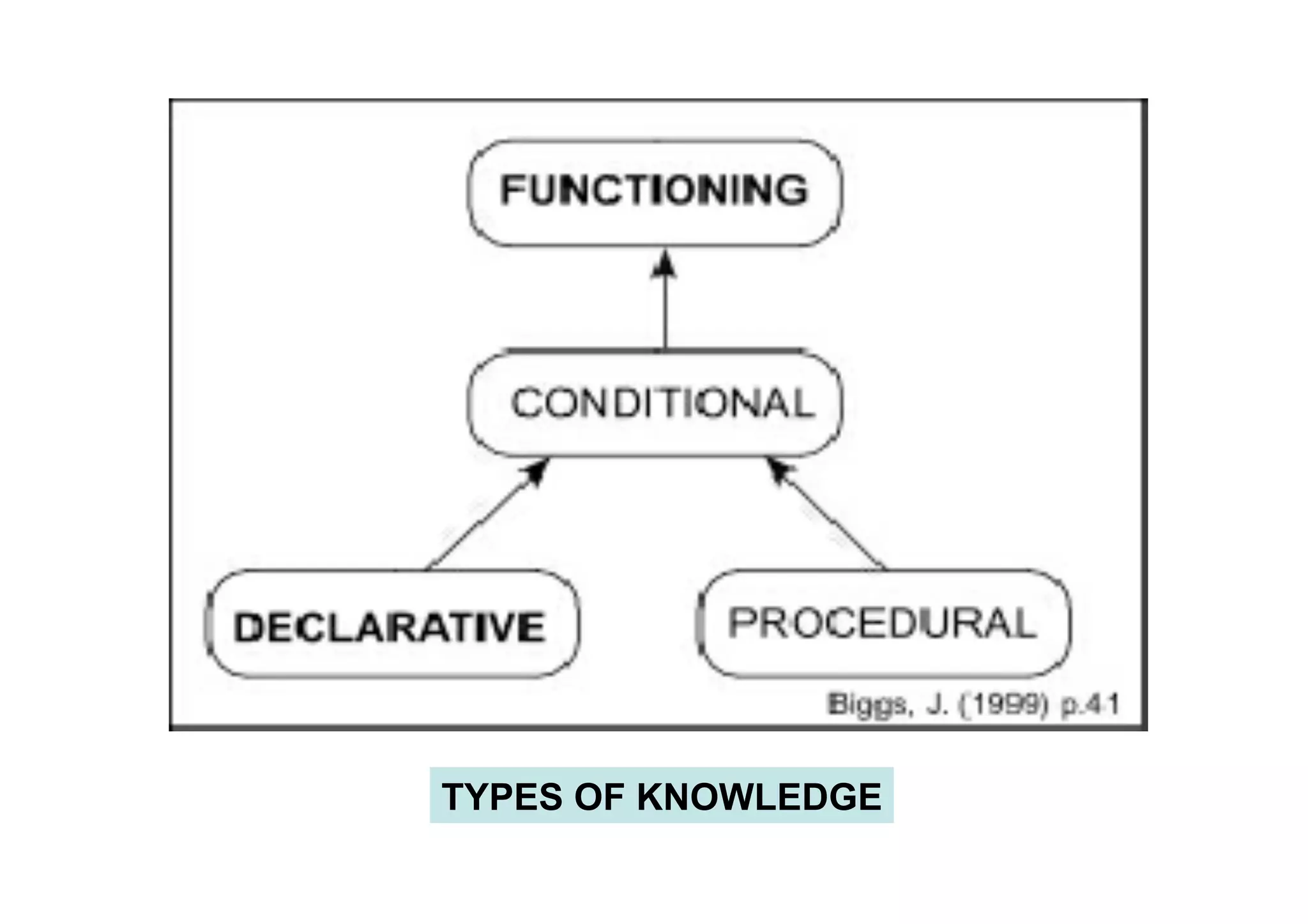
TYPES OF KNOWLEDGE
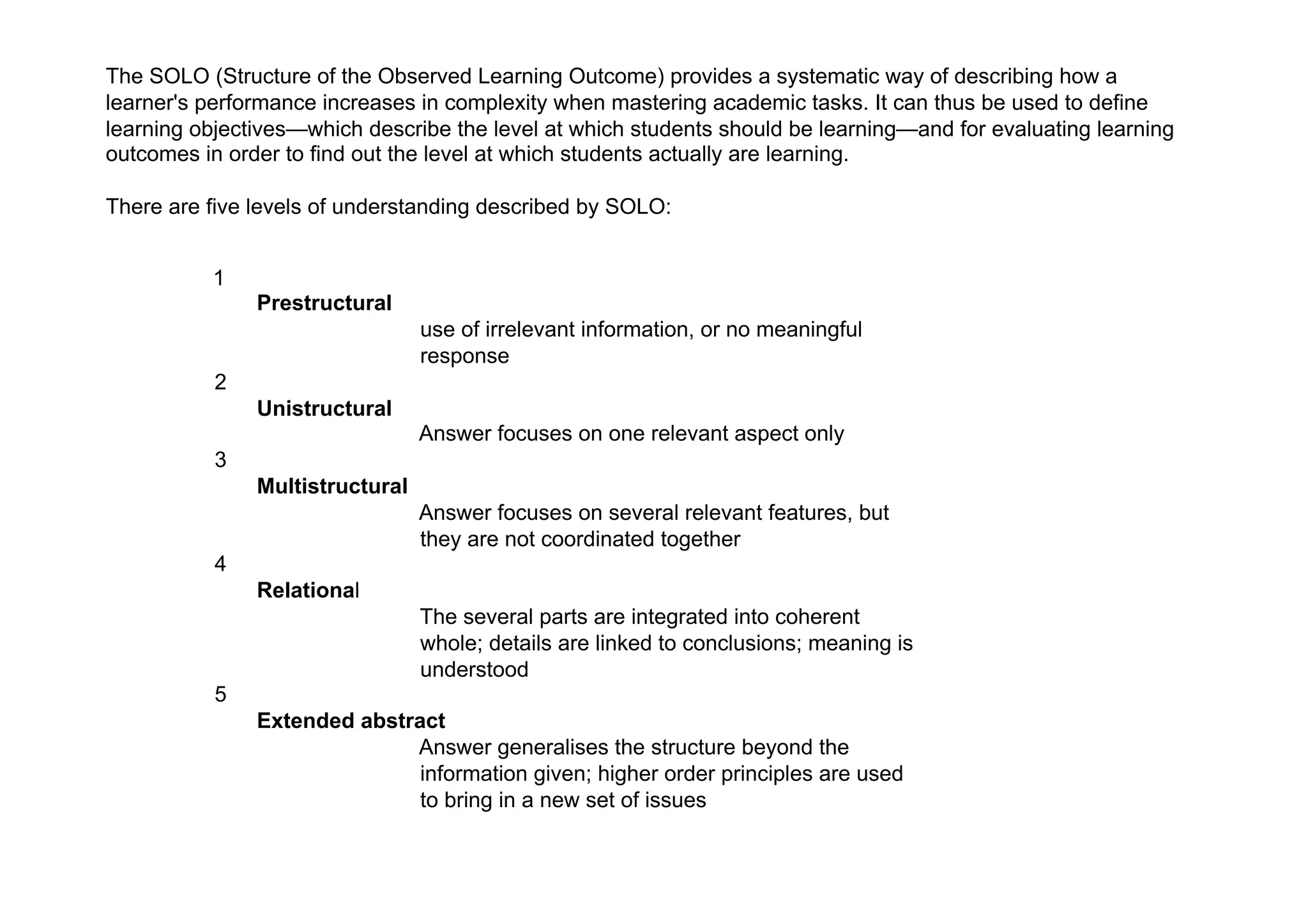
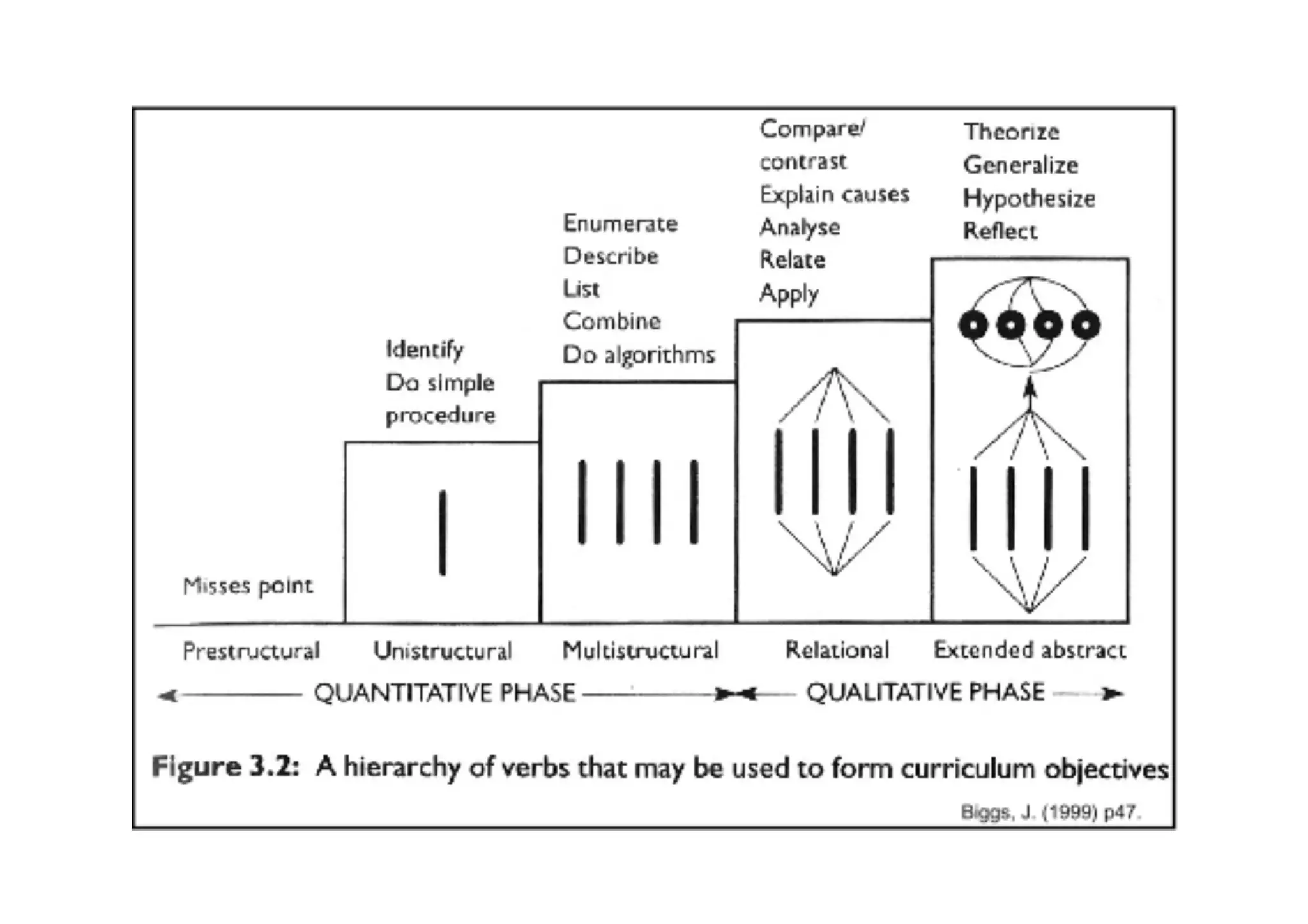
The SOLO (Structure of the Observed Learning Outcome) provides a systematic way of describing how a
learner's performance increases in complexity when mastering academic tasks. It can thus be used to define
learning objectives—which describe the level at which students should be learning—and for evaluating learning
outcomes in order to find out the level at which students actually are learning.

There are five levels of understanding described by SOLO:


          1
               Prestructural
                                 use of irrelevant information, or no meaningful
                                 response
           2
               Unistructural
                                 Answer focuses on one relevant aspect only
           3
               Multistructural
                                 Answer focuses on several relevant features, but
                                 they are not coordinated together
           4
               Relational
                                 The several parts are integrated into coherent
                                 whole; details are linked to conclusions; meaning is
                                 understood
           5
               Extended abstract
                             Answer generalises the structure beyond the
                              information given; higher order principles are used
                              to bring in a new set of issues
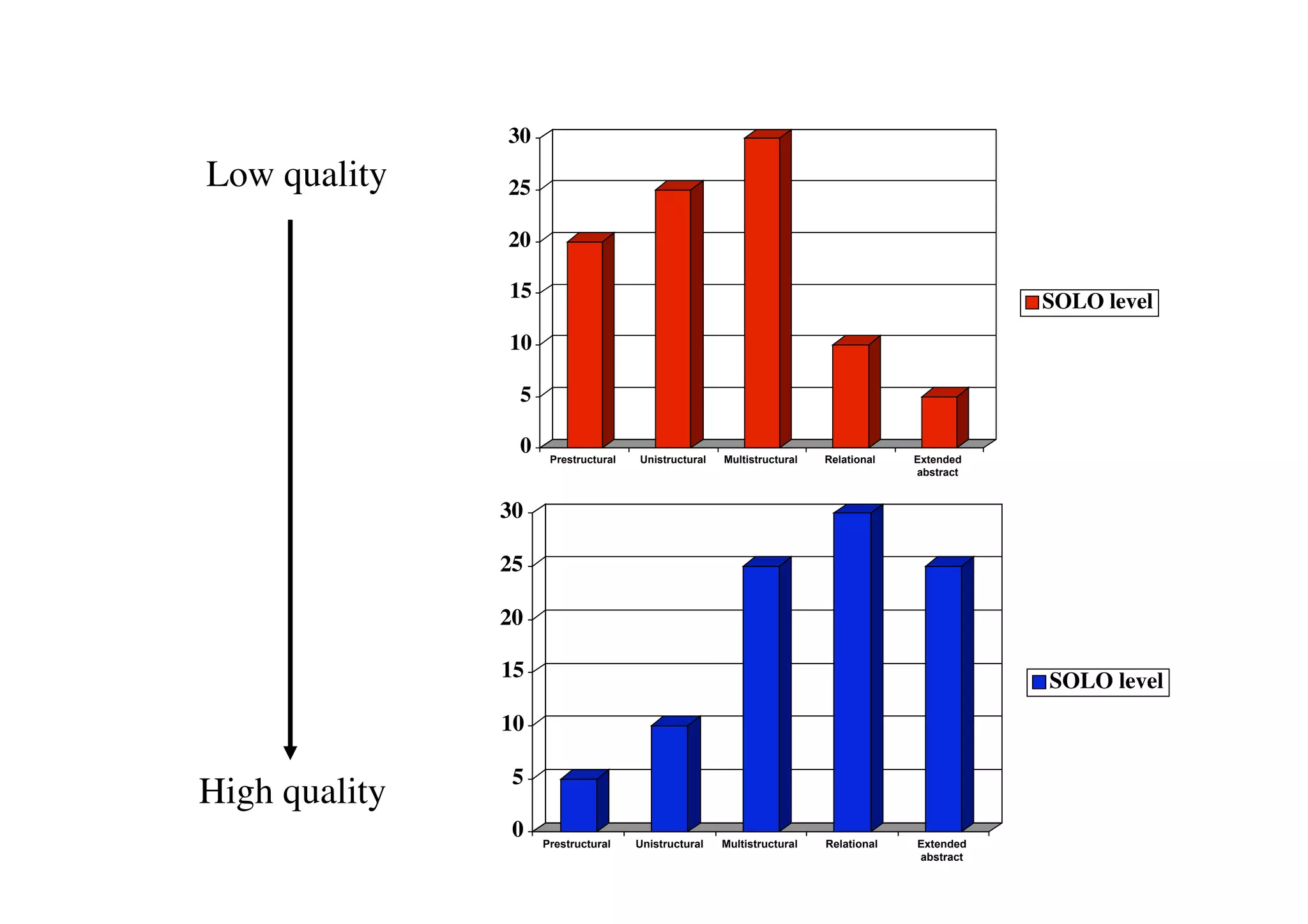
30
Low quality
    25

                20

                15                                                                              SOLO level
                10

                 5

                 0    Prestructural   Unistructural   Multistructural   Relational   Extended
                                                                                     abstract


                30

                25

                20

                15                                                                              SOLO level
                10

                 5
High quality
                 0   Prestructural    Unistructural   Multistructural   Relational   Extended
                                                                                     abstract
Stanley Frielick - STLHE 2003
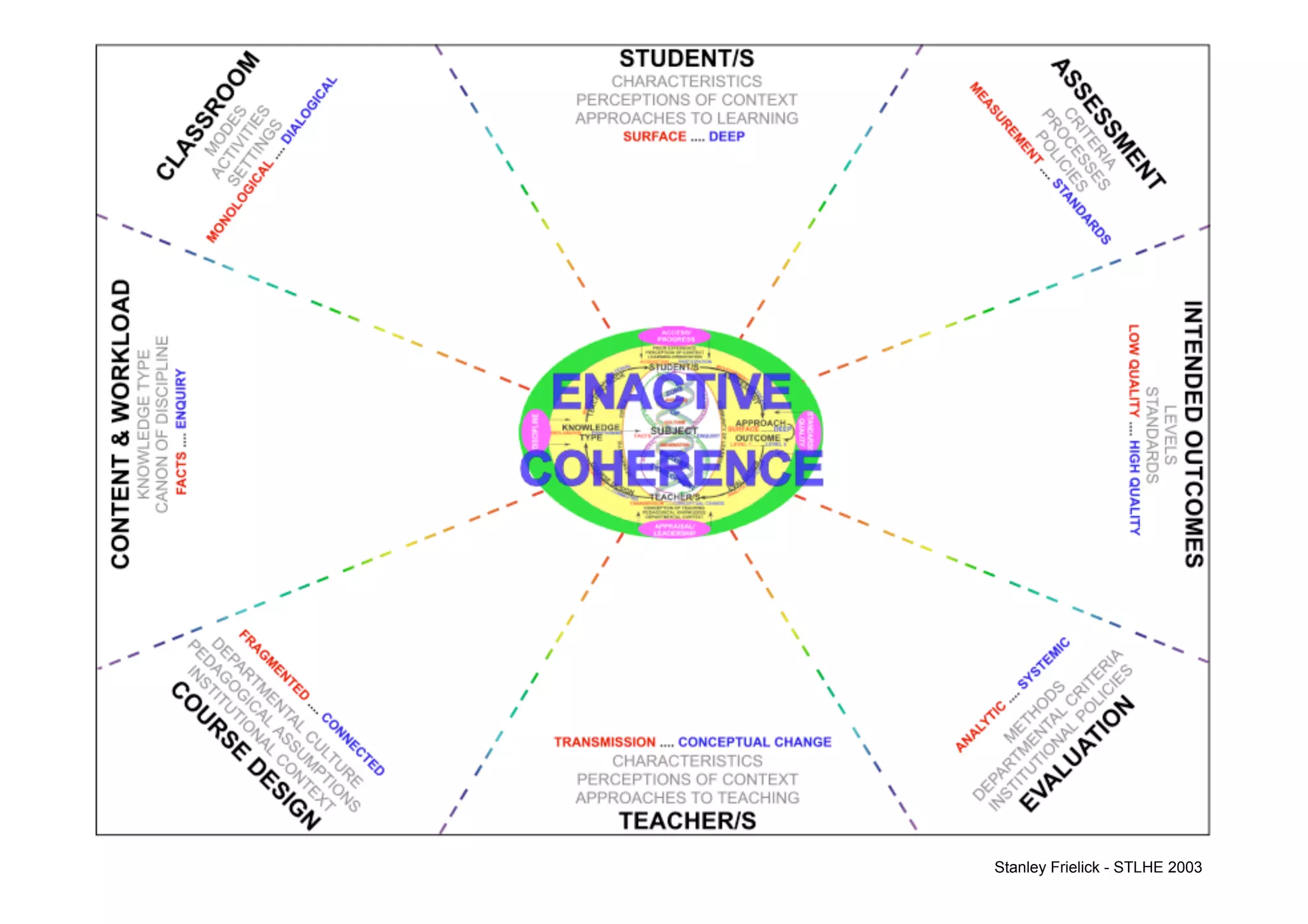
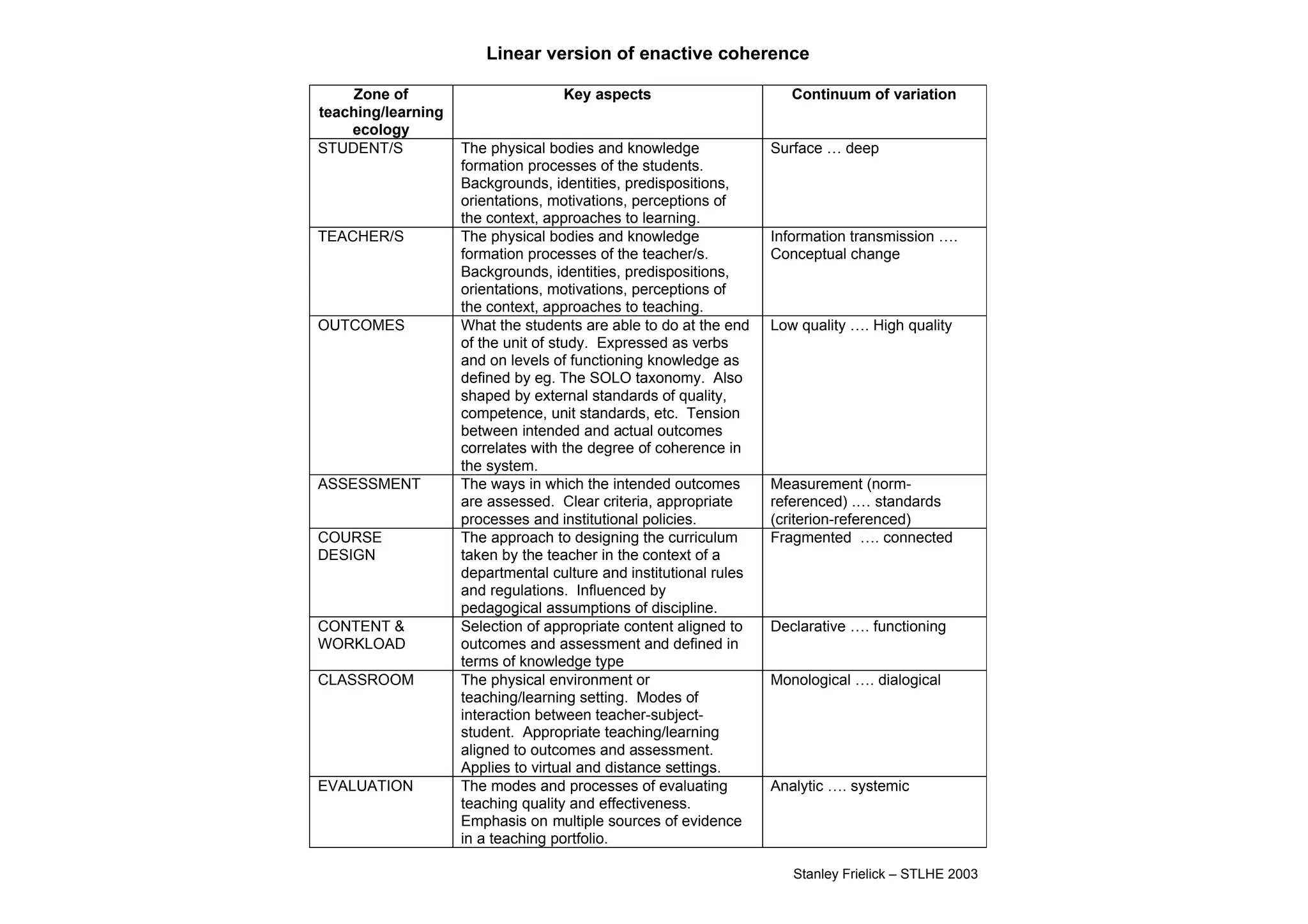
Linear version of enactive coherence

     Zone of                       Key aspects                        Continuum of variation
teaching/learning
    ecology
STUDENT/S           The physical bodies and knowledge              Surface … deep
                    formation processes of the students.
                    Backgrounds, identities, predispositions,
                    orientations, motivations, perceptions of
                    the context, approaches to learning.
TEACHER/S           The physical bodies and knowledge              Information transmission ….
                    formation processes of the teacher/s.          Conceptual change
                    Backgrounds, identities, predispositions,
                    orientations, motivations, perceptions of
                    the context, approaches to teaching.
OUTCOMES            What the students are able to do at the end    Low quality …. High quality
                    of the unit of study. Expressed as verbs
                    and on levels of functioning knowledge as
                    defined by eg. The SOLO taxonomy. Also
                    shaped by external standards of quality,
                    competence, unit standards, etc. Tension
                    between intended and actual outcomes
                    correlates with the degree of coherence in
                    the system.
ASSESSMENT          The ways in which the intended outcomes        Measurement (norm-
                    are assessed. Clear criteria, appropriate      referenced) .… standards
                    processes and institutional policies.          (criterion-referenced)
COURSE              The approach to designing the curriculum       Fragmented …. connected
DESIGN              taken by the teacher in the context of a
                    departmental culture and institutional rules
                    and regulations. Influenced by
                    pedagogical assumptions of discipline.
CONTENT &           Selection of appropriate content aligned to    Declarative …. functioning
WORKLOAD            outcomes and assessment and defined in
                    terms of knowledge type
CLASSROOM           The physical environment or                    Monological …. dialogical
                    teaching/learning setting. Modes of
                    interaction between teacher-subject-
                    student. Appropriate teaching/learning
                    aligned to outcomes and assessment.
                    Applies to virtual and distance settings.
EVALUATION          The modes and processes of evaluating          Analytic …. systemic
                    teaching quality and effectiveness.
                    Emphasis on multiple sources of evidence
                    in a teaching portfolio.

                                                                      Stanley Frielick – STLHE 2003
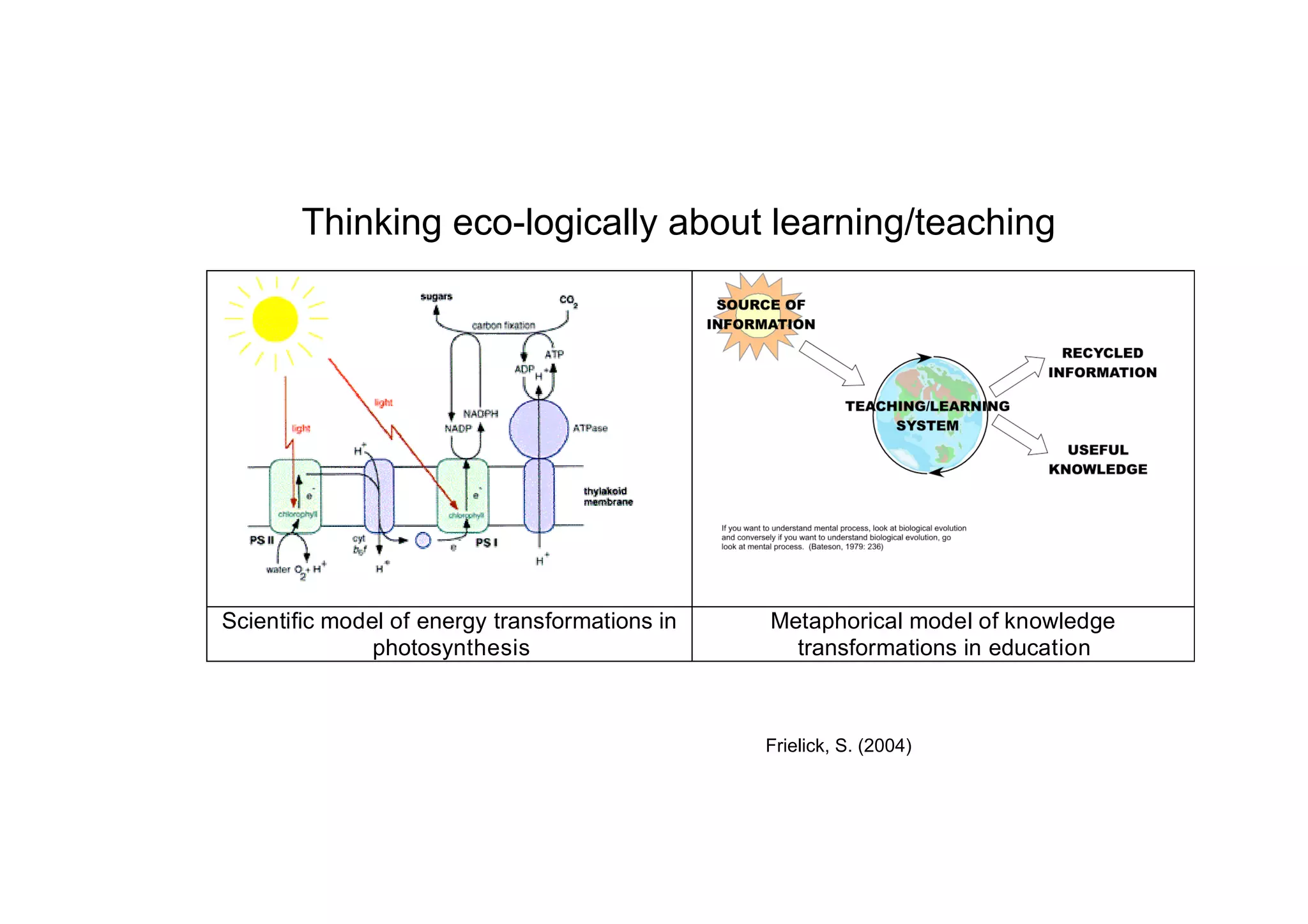
Thinking eco-logically about learning/teaching


Scientific model of energy transformations in   Metaphorical model of knowledge
               photosynthesis                     transformations in education


                                                Frielick, S. (2004)
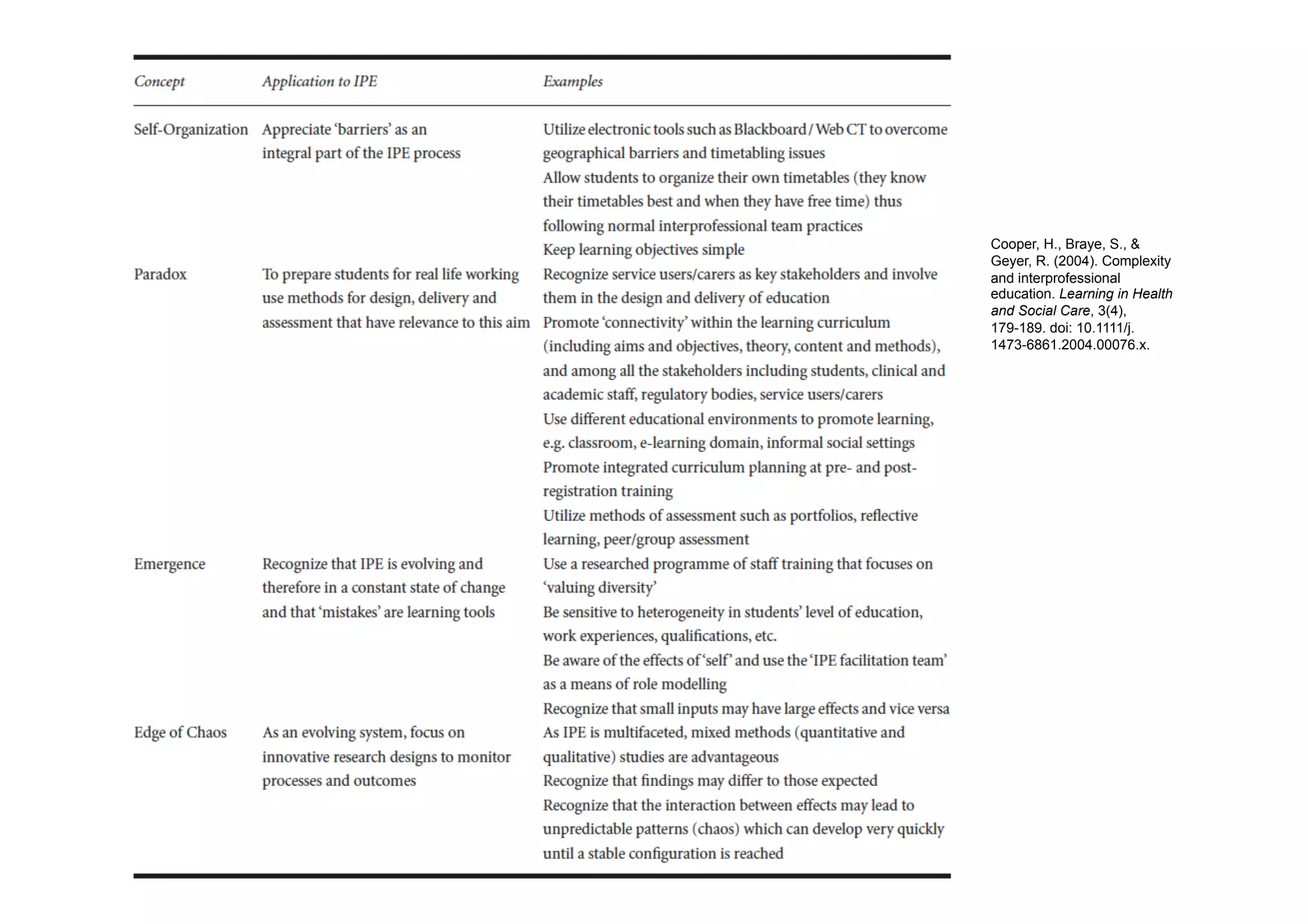
Cooper, H., Braye, S., &
Geyer, R. (2004). Complexity
and interprofessional
education. Learning in Health
and Social Care, 3(4),
179-189. doi: 10.1111/j.
1473-6861.2004.00076.x.
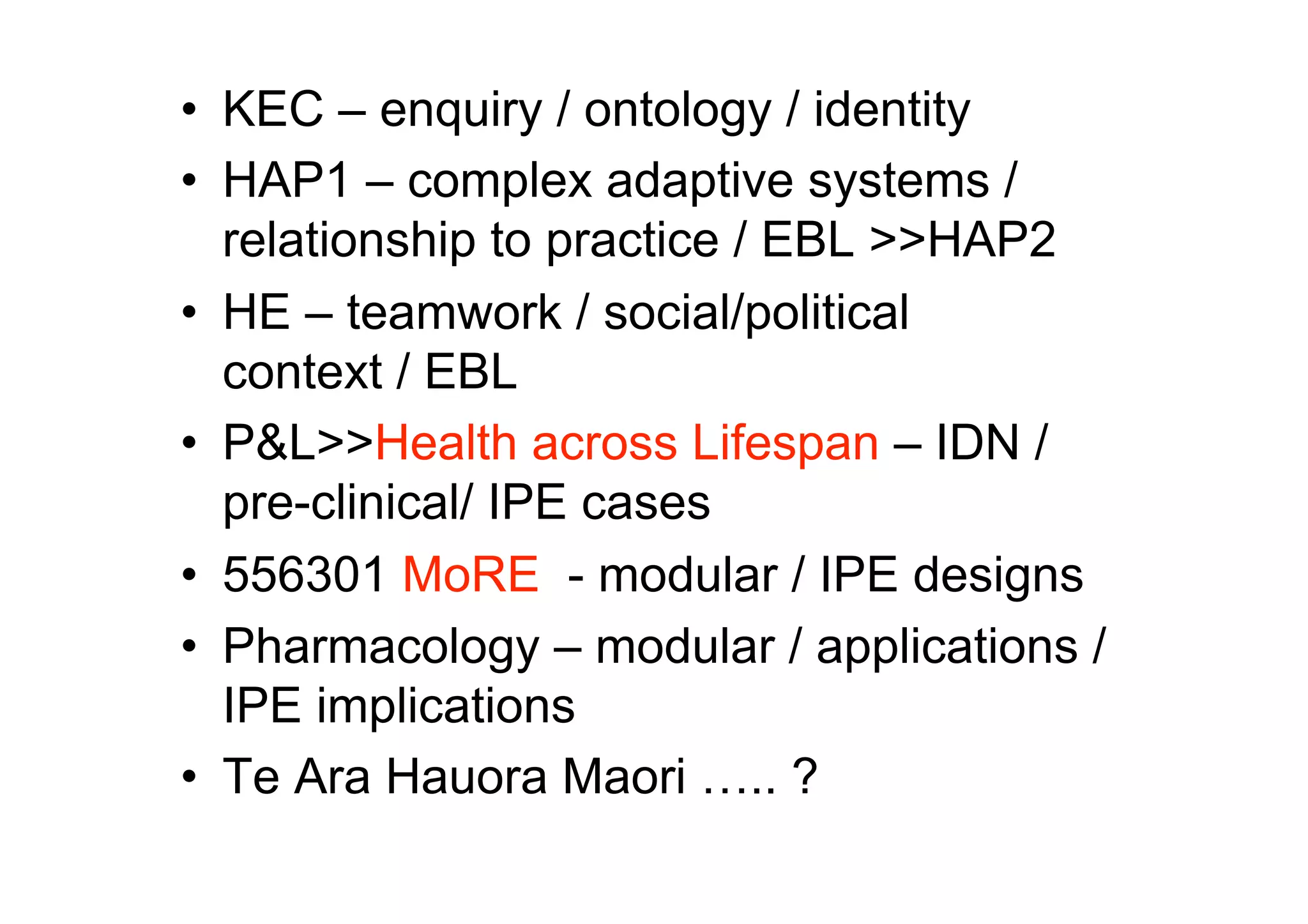
•  KEC – enquiry / ontology / identity
•  HAP1 – complex adaptive systems /
   relationship to practice / EBL >>HAP2
•  HE – teamwork / social/political
   context / EBL
•  P&L>>Health across Lifespan – IDN /
   pre-clinical/ IPE cases
•  556301 MoRE - modular / IPE designs
•  Pharmacology – modular / applications /
   IPE implications
•  Te Ara Hauora Maori ….. ?

ComplexityInnovationQualityIPE

  • 1.
    Complexity, Innovation and Quality in UG IPE theory background for development of educational design in NCIPECP shared papers Stanley Frielick
  • 2.
    Common semester curriculumdevelopment project (2007) To address and resolve issues of: coherence, consistency, resourcing, structure, relationship of papers to disciplines, development of appropriate knowledge base and skill set for interprofessional learning, development of key skills and competencies as outlined in theme 1 of the AUT strategic plan and draft Faculty plan, and the quality of student learning outcomes in the core papers; so as to develop a more integrated and ‘common’ semester in the Faculty, and provide a more interactive and engaging learning experience for novice undergraduate students.
  • 3.
    Key learning/teaching aspectsof AUT strategic plan • Curricula and programmes at the leading edge of practice • Assist students to become intellectually independent with a thorough understanding of the relevant body of knowledge • Strong linkages with the professions and industry • Blending traditional and new learning / teaching approaches and technologies • Ensuring that our graduates are skilled in communication, problem-solving, critical analysis, are information literate, and can use the relevant technologies. • Ensuring that our graduates have the ability to work collaboratively, make informed decisions and bring ethical analysis to practice. • Ensuring that our graduates have the ability to challenge to challenge the status quo, promote change and bring a forward looking dimension to their chosen career. • Ensuring that all students are equipped with a range of skills, including information literacy. • Ensuring the development of excellent teachers, able to use a range of approaches and technologies in ways that meet the needs of their students.
  • 4.
    Deep approaches tolearning Educational alignment (coherence) Alignment within papers - constructive alignment (enactive coherence) - optimal environment for deep approaches - alignment with AUT generic outcomes Alignment across papers - Connected course design - Consistency in assessment - Relationship of common papers to discipline pathways - Promotion of shared learning - alignment with AUT generic outcomes
  • 5.
    No one startsout teaching well Paul Ramsden What the students do is more important than what the teacher does John Biggs The shift from teaching to learning …. Barr and Tagg The relational or ecological perspective on university teaching and learning
  • 6.
    Significant influences on higher education research Phenomenography Variation in conceptions of The Experience of Learning teaching and learning Understanding Learning & Teaching Link between learning approaches and outcomes Relational perspective Learning to Teach in Higher Education Perceptions of the context influence approaches and outcomes A systems view of teaching/learning Constructive alignment / Systems theory Approach as description of multiple relationships - an emergent property Teaching for Quality Learning at University
  • 7.
    Orientation Characteristics Deep Knowledge transforming An intention to understand approach material for oneself Vigorous and critical interaction with knowledge content Relating ideas to oneís previous knowledge and experience Discovering and using organizing principles to integrate ideas Relating evidence to conclusions Examining the logic of arguments Surface Information reproducing An intention simply to approach reproduce parts of the content Ideas and information accepted passively Concentrating only on what is required for assessment Not reflecting on purpose or strategies Memorising facts and procedures routinely Failing to distinguish guiding principles or patterns
  • 8.
    Approaches to learningare emergent properties of the learning/teaching system The multifaceted, non-linear relationship between: A. teachers’ perceptions of the teaching environment, B. teacher’s approaches to teaching, C. student perceptions of the learning environment, and D. student approaches to learning, shapes and influences the outcomes of learning.
  • 10.
  • 11.
  • 12.
    In an ecologicalperspective deep learning is the transformation of information into functioning knowledge. Deep learning is an emergent property of a teaching/learning ecology in which intended outcomes are coherent with course design, teaching modes, assessment, and evaluation.
  • 13.
    ‘good’ TEACHING/LEARNING is aprocess of creating learning environments in which students are encouraged to engage deeply with the subject and emerge with a transformed understanding that is transferable to further inquiry and practical applications in different contexts.
  • 14.
    We must changeour whole way of thinking about mental and communication process……. learn to think as Nature thinks. Gregory Bateson (1972). Steps to an Ecology of Mind
  • 15.
    The underlying fabricof the university is stitched in 17th century dualistic / mechanistic thought …. The great research university is old at heart … For as it grasps us it splits us into minds and bodies. Wilshire (1990). The Moral Collapse of the University 'man sliced in half' www.flickr.com/photos/54899856@N00/40349181
  • 16.
    Teaching acquires itsform within a complex relational web that seeks to affect the understandings and abilities of the individual members of that community…. Spider web against sky September 28 03' www.flickr.com/photos/32454422@N00/3009373
  • 17.
    Just as thecognizing agent cannot be understood as a solitary component (but must be regarded as a subsystem of a larger system), teaching and learning cannot be studied as though they occur in isolated and closed systems Davis & Sumara, 1997:122 Baobab avenue' www.flickr.com/photos/51209031@N00/66753981
  • 18.
    Ecosystems transform energy to maintain optimal conditions for the evolution of life. Isomorphic Strange Weed333' www.flickr.com/photos/48915783@N00/250426306 Learning systems transform information to maintain optimal conditions for the evolution of knowledge. 'peek-a-boo - _MG_6709' www.flickr.com/photos/43927576@N00/320746679
  • 19.
    Break the patternwhich connects the items of learning and you necessarily destroy all quality… (Bateson 1979: 16)
  • 20.
  • 21.
  • 22.
    The SOLO (Structureof the Observed Learning Outcome) provides a systematic way of describing how a learner's performance increases in complexity when mastering academic tasks. It can thus be used to define learning objectives—which describe the level at which students should be learning—and for evaluating learning outcomes in order to find out the level at which students actually are learning. There are five levels of understanding described by SOLO: 1 Prestructural use of irrelevant information, or no meaningful response 2 Unistructural Answer focuses on one relevant aspect only 3 Multistructural Answer focuses on several relevant features, but they are not coordinated together 4 Relational The several parts are integrated into coherent whole; details are linked to conclusions; meaning is understood 5 Extended abstract Answer generalises the structure beyond the information given; higher order principles are used to bring in a new set of issues
  • 24.
    30 Low quality 25 20 15 SOLO level 10 5 0 Prestructural Unistructural Multistructural Relational Extended abstract 30 25 20 15 SOLO level 10 5 High quality 0 Prestructural Unistructural Multistructural Relational Extended abstract
  • 25.
  • 26.
    Linear version ofenactive coherence Zone of Key aspects Continuum of variation teaching/learning ecology STUDENT/S The physical bodies and knowledge Surface … deep formation processes of the students. Backgrounds, identities, predispositions, orientations, motivations, perceptions of the context, approaches to learning. TEACHER/S The physical bodies and knowledge Information transmission …. formation processes of the teacher/s. Conceptual change Backgrounds, identities, predispositions, orientations, motivations, perceptions of the context, approaches to teaching. OUTCOMES What the students are able to do at the end Low quality …. High quality of the unit of study. Expressed as verbs and on levels of functioning knowledge as defined by eg. The SOLO taxonomy. Also shaped by external standards of quality, competence, unit standards, etc. Tension between intended and actual outcomes correlates with the degree of coherence in the system. ASSESSMENT The ways in which the intended outcomes Measurement (norm- are assessed. Clear criteria, appropriate referenced) .… standards processes and institutional policies. (criterion-referenced) COURSE The approach to designing the curriculum Fragmented …. connected DESIGN taken by the teacher in the context of a departmental culture and institutional rules and regulations. Influenced by pedagogical assumptions of discipline. CONTENT & Selection of appropriate content aligned to Declarative …. functioning WORKLOAD outcomes and assessment and defined in terms of knowledge type CLASSROOM The physical environment or Monological …. dialogical teaching/learning setting. Modes of interaction between teacher-subject- student. Appropriate teaching/learning aligned to outcomes and assessment. Applies to virtual and distance settings. EVALUATION The modes and processes of evaluating Analytic …. systemic teaching quality and effectiveness. Emphasis on multiple sources of evidence in a teaching portfolio. Stanley Frielick – STLHE 2003
  • 27.
    Thinking eco-logically aboutlearning/teaching Scientific model of energy transformations in Metaphorical model of knowledge photosynthesis transformations in education Frielick, S. (2004)
  • 30.
    Cooper, H., Braye,S., & Geyer, R. (2004). Complexity and interprofessional education. Learning in Health and Social Care, 3(4), 179-189. doi: 10.1111/j. 1473-6861.2004.00076.x.
  • 31.
    •  KEC –enquiry / ontology / identity •  HAP1 – complex adaptive systems / relationship to practice / EBL >>HAP2 •  HE – teamwork / social/political context / EBL •  P&L>>Health across Lifespan – IDN / pre-clinical/ IPE cases •  556301 MoRE - modular / IPE designs •  Pharmacology – modular / applications / IPE implications •  Te Ara Hauora Maori ….. ?