AURICULAR PROSTHESIS
MUGILARASAN MUNISAMY CRRI
DEPARTMENT OF PROSTHODONTICS
PDCH
CONTENTS
• INTRODUCTION
• DEFINITION
• OBJECTIVES OF MAXILLOFACIAL REHABILITATION
• ADVANTAGES
• DISADVANTAGES
• FABRICATION OF AURICULAR PROSTHESIS
• COLORING TECHNIQUE
• RETENTION OF PROSTHESIS
• CONCLUSION
INTRODUCTION
• Man's need for artificial replacements to supply missing or
lost body parts has probably existed as long as man himself.
• Body abnormalities or defects compromise appearance,
function render an individual incapable of leading a
relatively normal life.
• The replacement of anatomical parts is a challenge to those
properly trained to construct acceptable substitutes.
DEFINITION
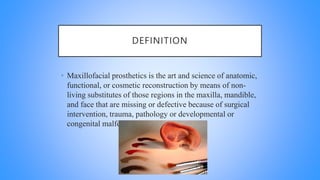
• Maxillofacial prosthetics is the art and science of anatomic,
functional, or cosmetic reconstruction by means of non-
living substitutes of those regions in the maxilla, mandible,
and face that are missing or defective because of surgical
intervention, trauma, pathology or developmental or
congenital malformation.
OBJECTIVES
• Restoration of esthetics or cosmetic appearance of the
patient.
• Restoration of function.
• Protection of tissues.
• Therapeutic or healing effect.
• Psychologic therapy.
ADVANTAGES
• It requires little surgery or no surgery,
• The patient spends less time away from home and job
• The reconstruction is often more natural-looking
DISADVANTAGES
• The necessity of fastening the appliance to the skin
• Removing it every day.
• The occasional need of constructing a new prosthesis.
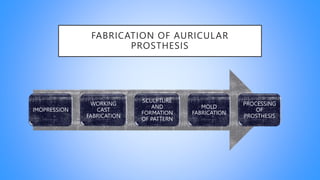
FABRICATION OF AURICULAR
PROSTHESIS
IMOPRESSION
WORKING
CAST
FABRICATION
SCULPTURE
AND
FORMATION
OF PATTERN
MOLD
FABRICATION
PROCESSING
OF
PROSTHESIS
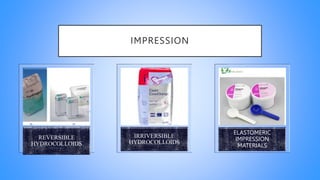
IMPRESSION
REVERSIBLE
HYDROCOLLOIDS
IRRIVERSIBLE
HYDROCOLLOIDS
ELASTOMERIC
IMPRESSION
MATERIALS
REVERSIBLE HYDROCOLLOIDS
Advantages are;
• applied to skin in thin layers and impress large areas, can
reproduce fine details.
Disadvantages are;
• preparation time for liquefying the gel, hot temperature at
the time of application, material tear easily, distorts during
the removal from undercut areas.
IRRIVERSIBLE HYDROCOLLOIDS
Advantages are;
• inexpensive, long shelf life, good detail reproduction,
satisfactory physical properties.
Disadvantages;
• possible entrapment of air during application, possibility of
distortion, tearing during removal from large
under cut areas.
ELASTOMERIC IMPRESSION MATERIALS
Advantages
• excellent detail reproductions, high tear strength, good
flow properties
Disadvantages
• short working time, difficult in mixing large quantities,
high cost Elastomeric materials are excellent for small
defects and relatively flat surfaces, such as an auricular
defect.
WORKING CAST FABRICATION
The patient must be prepared for the impression procedure both
physically and mentally.
Patient should be questioned about a history of claustrophobia (fear
of confined spaces), achluphobia (fear of darkness)
Marks should be made with an indelible pencil in the defect area, so
as to allow correct alignment of the prosthesis with the natural ear.
Various materials can be used to define and contain the impression;
among these are plasticine stripes, red boxing wax.
The cheapest and the easiest are the plastic tubs. A
portion is cut out of the middle of the tub to allow access
to the defect area.
The external auditory canal should be blocked off with
cotton wool or Vaseline gauze
Alginate mixed to fluid consistency is then poured. No
need to
provide a plaster backing, good thickness of
alginate is enough.
To enable good carving an impression of the existing
ear is taken
When pouring the alginate pour the back part of the helix
first, so as to provide support for the helix when full
amount of alginate is added. Poured in stone.
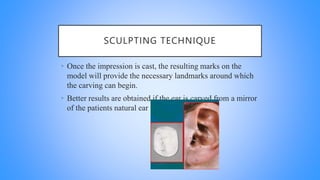
SCULPTING TECHNIQUE
• Once the impression is cast, the resulting marks on the
model will provide the necessary landmarks around which
the carving can begin.
• Better results are obtained if the ear is carved from a mirror
of the patients natural ear
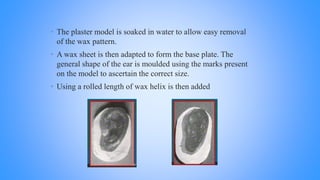
• The plaster model is soaked in water to allow easy removal
of the wax pattern.
• A wax sheet is then adapted to form the base plate. The
general shape of the ear is moulded using the marks present
on the model to ascertain the correct size.
• Using a rolled length of wax helix is then added
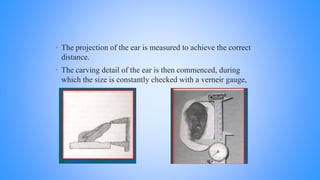
• The projection of the ear is measured to achieve the correct
distance.
• The carving detail of the ear is then commenced, during
which the size is constantly checked with a verneir gauge,
TRY IN
• The fit of the prosthesis on the tissue
• The correct horizontal alignment with the natural ear.
• The projection of the car in relation to the side of the head
• The integrity of the margins during simple jaw movements
INVESTMENT AND FABRICATION OF
MOULD
• The wax prosthesis is now sealed to the model and the
leading edge is thinned as much as possible so as to allow
the silicone edges to feather into the natural skin.
• A three part mould is necessary to achieve easy
placement of silicone
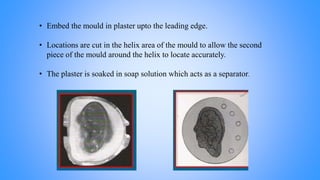
• Embed the mould in plaster upto the leading edge.
• Locations are cut in the helix area of the mould to allow the second
piece of the mould around the helix to locate accurately.
• The plaster is soaked in soap solution which acts as a separator.
• Additions of wax spacer which will help remove the helix section when
the ear has secured
• Apply wax pattern with aurofilm to breakdown the surface tension, the ear
is fully invested.
• when set the wax is boiled out of the flask leaving the three piece mould.
PROCESSING OF THE
PROSTHESIS
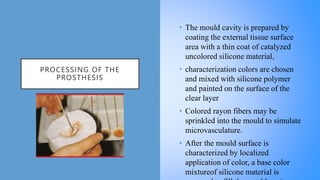
• The mould cavity is prepared by
coating the external tissue surface
area with a thin coat of catalyzed
uncolored silicone material,
• characterization colors are chosen
and mixed with silicone polymer
and painted on the surface of the
clear layer
• Colored rayon fibers may be
sprinkled into the mould to simulate
microvasculature.
• After the mould surface is
characterized by localized
application of color, a base color
mixtureof silicone material is
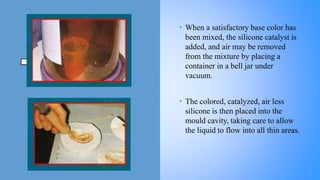
• When a satisfactory base color has
been mixed, the silicone catalyst is
added, and air may be removed
from the mixture by placing a
container in a bell jar under
vacuum.
• The colored, catalyzed, air less
silicone is then placed into the
mould cavity, taking care to allow
the liquid to flow into all thin areas.
• The mould is then clamped and placed into dry heat oven at the
manufacturers prescribed polymerization time and temperature
• Residual silicone may be left on the external surface of the mould to test
for complete polymerization.
• After the polymerization cycle is complete, the mould should be allowed
to cool to room temperature before removing the completed prosthesis.
COLORING TECHNIQUE
Intrinsic coloration
• Intrinsic coloration is color
applied within the mould
during the casting
procedure.
Extrinsic coloration
• Extrinsic coloration is
color applied to the
surface of a prosthesis
that has been cured and
removed from the mould.
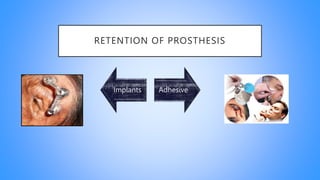
RETENTION OF PROSTHESIS
Implants Adhesive
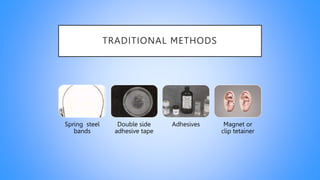
TRADITIONAL METHODS
Spring steel
bands
Double side
adhesive tape
Adhesives Magnet or
clip tetainer
CONCLUSION
• Restore function and cosmesis.
• Use techniques during surgery to aid prosthetic
management..
• Consultation with maxillofacial prosthodontist for
optimal rehabilitation.
THANK YOU

AURICULAR PROSTHESIS (SEMI 3).pptx

  • 1.
    AURICULAR PROSTHESIS MUGILARASAN MUNISAMYCRRI DEPARTMENT OF PROSTHODONTICS PDCH
  • 2.
    CONTENTS • INTRODUCTION • DEFINITION •OBJECTIVES OF MAXILLOFACIAL REHABILITATION • ADVANTAGES • DISADVANTAGES • FABRICATION OF AURICULAR PROSTHESIS • COLORING TECHNIQUE • RETENTION OF PROSTHESIS • CONCLUSION
  • 3.
    INTRODUCTION • Man's needfor artificial replacements to supply missing or lost body parts has probably existed as long as man himself. • Body abnormalities or defects compromise appearance, function render an individual incapable of leading a relatively normal life. • The replacement of anatomical parts is a challenge to those properly trained to construct acceptable substitutes.
  • 4.
    DEFINITION • Maxillofacial prostheticsis the art and science of anatomic, functional, or cosmetic reconstruction by means of non- living substitutes of those regions in the maxilla, mandible, and face that are missing or defective because of surgical intervention, trauma, pathology or developmental or congenital malformation.
  • 5.
    OBJECTIVES • Restoration ofesthetics or cosmetic appearance of the patient. • Restoration of function. • Protection of tissues. • Therapeutic or healing effect. • Psychologic therapy.
  • 6.
    ADVANTAGES • It requireslittle surgery or no surgery, • The patient spends less time away from home and job • The reconstruction is often more natural-looking
  • 7.
    DISADVANTAGES • The necessityof fastening the appliance to the skin • Removing it every day. • The occasional need of constructing a new prosthesis.
  • 8.
  • 9.
  • 10.
    REVERSIBLE HYDROCOLLOIDS Advantages are; •applied to skin in thin layers and impress large areas, can reproduce fine details. Disadvantages are; • preparation time for liquefying the gel, hot temperature at the time of application, material tear easily, distorts during the removal from undercut areas.
  • 11.
    IRRIVERSIBLE HYDROCOLLOIDS Advantages are; •inexpensive, long shelf life, good detail reproduction, satisfactory physical properties. Disadvantages; • possible entrapment of air during application, possibility of distortion, tearing during removal from large under cut areas.
  • 12.
    ELASTOMERIC IMPRESSION MATERIALS Advantages •excellent detail reproductions, high tear strength, good flow properties Disadvantages • short working time, difficult in mixing large quantities, high cost Elastomeric materials are excellent for small defects and relatively flat surfaces, such as an auricular defect.
  • 13.
    WORKING CAST FABRICATION Thepatient must be prepared for the impression procedure both physically and mentally. Patient should be questioned about a history of claustrophobia (fear of confined spaces), achluphobia (fear of darkness) Marks should be made with an indelible pencil in the defect area, so as to allow correct alignment of the prosthesis with the natural ear. Various materials can be used to define and contain the impression; among these are plasticine stripes, red boxing wax.
  • 14.
    The cheapest andthe easiest are the plastic tubs. A portion is cut out of the middle of the tub to allow access to the defect area. The external auditory canal should be blocked off with cotton wool or Vaseline gauze Alginate mixed to fluid consistency is then poured. No need to provide a plaster backing, good thickness of alginate is enough. To enable good carving an impression of the existing ear is taken When pouring the alginate pour the back part of the helix first, so as to provide support for the helix when full amount of alginate is added. Poured in stone.
  • 15.
    SCULPTING TECHNIQUE • Oncethe impression is cast, the resulting marks on the model will provide the necessary landmarks around which the carving can begin. • Better results are obtained if the ear is carved from a mirror of the patients natural ear
  • 16.
    • The plastermodel is soaked in water to allow easy removal of the wax pattern. • A wax sheet is then adapted to form the base plate. The general shape of the ear is moulded using the marks present on the model to ascertain the correct size. • Using a rolled length of wax helix is then added
  • 17.
    • The projectionof the ear is measured to achieve the correct distance. • The carving detail of the ear is then commenced, during which the size is constantly checked with a verneir gauge,
  • 18.
    TRY IN • Thefit of the prosthesis on the tissue • The correct horizontal alignment with the natural ear. • The projection of the car in relation to the side of the head • The integrity of the margins during simple jaw movements
  • 19.
    INVESTMENT AND FABRICATIONOF MOULD • The wax prosthesis is now sealed to the model and the leading edge is thinned as much as possible so as to allow the silicone edges to feather into the natural skin. • A three part mould is necessary to achieve easy placement of silicone
  • 20.
    • Embed themould in plaster upto the leading edge. • Locations are cut in the helix area of the mould to allow the second piece of the mould around the helix to locate accurately. • The plaster is soaked in soap solution which acts as a separator.
  • 21.
    • Additions ofwax spacer which will help remove the helix section when the ear has secured • Apply wax pattern with aurofilm to breakdown the surface tension, the ear is fully invested. • when set the wax is boiled out of the flask leaving the three piece mould.
  • 22.
    PROCESSING OF THE PROSTHESIS •The mould cavity is prepared by coating the external tissue surface area with a thin coat of catalyzed uncolored silicone material, • characterization colors are chosen and mixed with silicone polymer and painted on the surface of the clear layer • Colored rayon fibers may be sprinkled into the mould to simulate microvasculature. • After the mould surface is characterized by localized application of color, a base color mixtureof silicone material is
  • 23.
    • When asatisfactory base color has been mixed, the silicone catalyst is added, and air may be removed from the mixture by placing a container in a bell jar under vacuum. • The colored, catalyzed, air less silicone is then placed into the mould cavity, taking care to allow the liquid to flow into all thin areas.
  • 24.
    • The mouldis then clamped and placed into dry heat oven at the manufacturers prescribed polymerization time and temperature • Residual silicone may be left on the external surface of the mould to test for complete polymerization. • After the polymerization cycle is complete, the mould should be allowed to cool to room temperature before removing the completed prosthesis.
  • 25.
    COLORING TECHNIQUE Intrinsic coloration •Intrinsic coloration is color applied within the mould during the casting procedure. Extrinsic coloration • Extrinsic coloration is color applied to the surface of a prosthesis that has been cured and removed from the mould.
  • 26.
  • 27.
    TRADITIONAL METHODS Spring steel bands Doubleside adhesive tape Adhesives Magnet or clip tetainer
  • 28.
    CONCLUSION • Restore functionand cosmesis. • Use techniques during surgery to aid prosthetic management.. • Consultation with maxillofacial prosthodontist for optimal rehabilitation.
  • 29.