3
INTRODUCTION
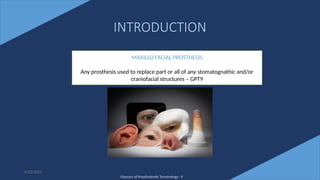
MAXILLO FACIAL PROSTHESIS
Anyprosthesis used to replace part or all of any stomatognathic and/or
craniofacial structures – GPT9
Glossary of Prosthodontic Terminology - 9
6/22/2022
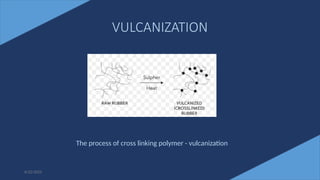
4.
4
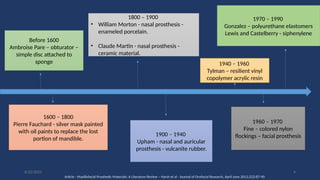
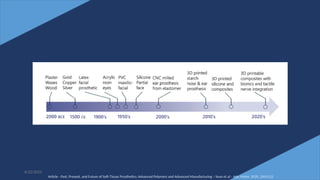
Before 1600
Ambroise Pare– obturator –
simple disc attached to
sponge
1600 – 1800
Pierre Fauchard - silver mask painted
with oil paints to replace the lost
portion of mandible.
1800 – 1900
• William Morton - nasal prosthesis -
enameled porcelain.
• Claude Martin - nasal prosthesis -
ceramic material.
1900 – 1940
Upham - nasal and auricular
prosthesis - vulcanite rubber.
1940 – 1960
Tylman – resilient vinyl
copolymer acrylic resin
1960 – 1970
Fine – colored nylon
flockings – facial prosthesis
1970 – 1990
Gonzalez – polyurethane elastomers
Lewis and Castelberry - siphenylene
Article - Maxillofacial Prosthetic Materials: A Literature Review – Harsh et al - Journal of Orofacial Research, April-June 2012;2(2):87-90
6/22/2022
5.
5
6/22/2022
Article - Past,Present, and Future of Soft-Tissue Prosthetics: Advanced Polymers and Advanced Manufacturing – Sean et al - Adv. Mater. 2020, 2001122
6.
6
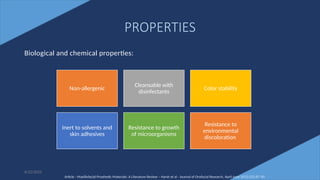
PROPERTIES
Biological and chemicalproperties:
Non-allergenic
Cleansable with
disinfectants
Color stability
Inert to solvents and
skin adhesives
Resistance to growth
of microorganisms
Resistance to
environmental
discoloration
Article - Maxillofacial Prosthetic Materials: A Literature Review – Harsh et al - Journal of Orofacial Research, April-June 2012;2(2):87-90
6/22/2022
7.
7
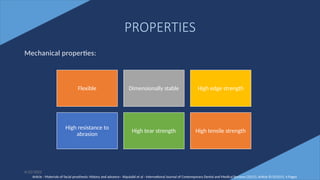
PROPERTIES
Mechanical properties:
Flexible Dimensionallystable High edge strength
High resistance to
abrasion
High tear strength High tensile strength
Article - Materials of facial prosthesis: History and advance– Alqutaibi et al - International Journal of Contemporary Dental and Medical Reviews (2015), Article ID 021015, 4 Pages
6/22/2022
8.
8
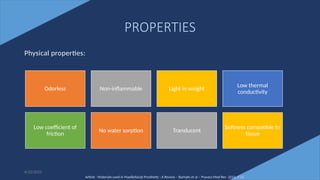
PROPERTIES
Physical properties:
Odorless Non-inflammableLight in weight
Low thermal
conductivity
Low coefficient of
friction
No water sorption Translucent
Softness compatible to
tissue
Article - Materials used in Maxillofacial Prosthetic : A Review – Barhate et al – Pravara Med Rev 2015; 7 (1)
6/22/2022
9.
9
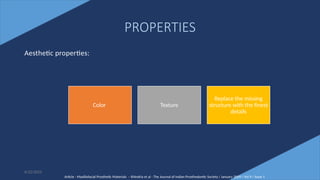
PROPERTIES
Aesthetic properties:
Color Texture
Replacethe missing
structure with the finest
details
Article - Maxillofacial Prosthetic Materials – Khindria et al - The Journal of Indian Prosthodontic Society / January 2009 / Vol 9 / Issue 1
6/22/2022
10.
10
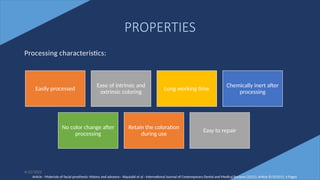
PROPERTIES
Processing characteristics:
Easily processed
Easeof intrinsic and
extrinsic coloring
Long working time
Chemically inert after
processing
No color change after
processing
Retain the coloration
during use
Easy to repair
Article - Materials of facial prosthesis: History and advance– Alqutaibi et al - International Journal of Contemporary Dental and Medical Reviews (2015), Article ID 021015, 4 Pages
6/22/2022
17
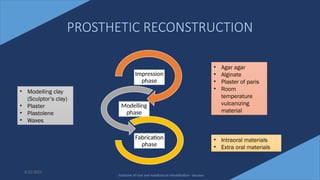
MODELLING PHASE
• Modellingmaterials should be ideally malleable with sufficient strength.
• Should accept texture that will be imparted to the final prosthesis.
• The closer the colour of material to skin, less is the visual distortion.
6/22/2022
Textbook of Oral and maxillofacial rehabilitation - beumer
18.
18
MODELLING CLAY
6/22/2022
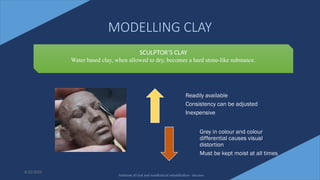
SCULPTOR’S CLAY
Waterbased clay, when allowed to dry, becomes a hard stone-like substance.
Readily available
Consistency can be adjusted
Inexpensive
Grey in colour and colour
differential causes visual
distortion
Must be kept moist at all times
Textbook of Oral and maxillofacial rehabilitation - beumer
19.
19
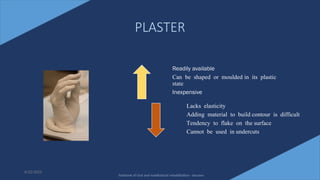
PLASTER
6/22/2022
Readily available
Can beshaped or moulded in its plastic
state
Inexpensive
Lacks elasticity
Adding material to build contour is difficult
Tendency to flake on the surface
Cannot be used in undercuts
Textbook of Oral and maxillofacial rehabilitation - beumer
20.
20
PLASTOLENE
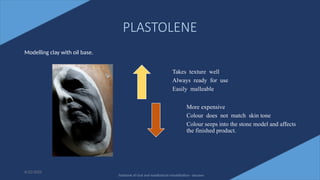
Modelling clay withoil base.
6/22/2022
Takes texture well
Always ready for use
Easily malleable
More expensive
Colour does not match skin tone
Colour seeps into the stone model and affects
the finished product.
Textbook of Oral and maxillofacial rehabilitation - beumer
23
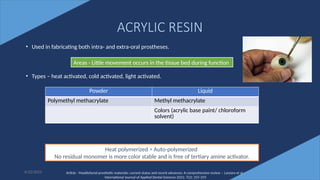
ACRYLIC RESIN
• Usedin fabricating both intra- and extra-oral prostheses.
• Types – heat activated, cold activated, light activated.
6/22/2022
Areas - Little movement occurs in the tissue bed during function
Powder Liquid
Polymethyl methacrylate Methyl methacrylate
Colors (acrylic base paint/ chloroform
solvent)
Heat polymerized ˃ Auto-polymerized
No residual monomer is more color stable and is free of tertiary amine activator.
Article - Maxillofacial prosthetic materials: current status and recent advances: A comprehensive review – Lanzara et al -
International Journal of Applied Dental Sciences 2021; 7(2): 255-259
24.
24
ACRYLIC RESIN
Durable
Color stable
Canbe relined/ repaired
Both intrinsic and extrinsic
coloring can be done
Compatible with most adhesive
system
Rigid
Duplication – not possible
High thermal conductivity
Less/ no movement of prosthesis
Poor margin esthetics
6/22/2022 Article - Maxillofacial prosthetic materials: current status and recent advances: A comprehensive review – Lanzara et al -
International Journal of Applied Dental Sciences 2021; 7(2): 255-259
25.
25
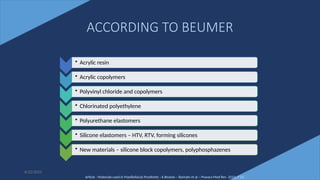
ACRYLIC COPOLYMERS
6/22/2022
Plasticized methylmethacrylate polymers, which show elastic properties.
PALAMED – Tylman, 1943
Soft
Elastic
Light weight
Poor edge strength
Poor durability
Degrade in sunlight
Processing and
coloration – difficult
Article - Maxillofacial prosthetic materials: current status and recent advances: A comprehensive review – Lanzara et al -
International Journal of Applied Dental Sciences 2021; 7(2): 255-259
26.
26
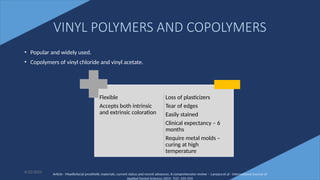
VINYL POLYMERS ANDCOPOLYMERS
• Popular and widely used.
• Copolymers of vinyl chloride and vinyl acetate.
6/22/2022
Flexible
Accepts both intrinsic
and extrinsic coloration
Loss of plasticizers
Tear of edges
Easily stained
Clinical expectancy – 6
months
Require metal molds –
curing at high
temperature
Article - Maxillofacial prosthetic materials: current status and recent advances: A comprehensive review – Lanzara et al - International Journal of
Applied Dental Sciences 2021; 7(2): 255-259
28
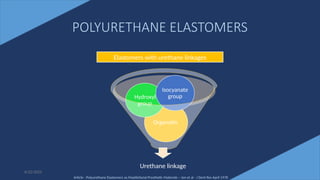
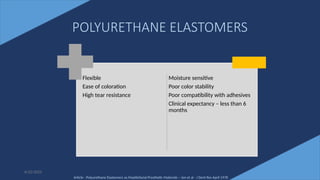
POLYURETHANE ELASTOMERS
Flexible
Ease ofcoloration
High tear resistance
Moisture sensitive
Poor color stability
Poor compatibility with adhesives
Clinical expectancy – less than 6
months
6/22/2022
Article - Polyurethane Elastomers as Maxillofacial Prosthetic Materials – Jon et al - J Dent Res April 1978
29.
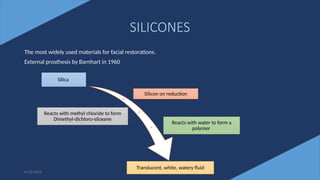
SILICONES
The most widelyused materials for facial restorations.
External prosthesis by Barnhart in 1960
6/22/2022 29
Silica
Silicon on reduction
Reacts with methyl chloride to form
Dimethyl-dichloro-siloxane
Reacts with water to form a
polymer
Translucent, white, watery fluid
31
CLASSIFICATION- SILICONES
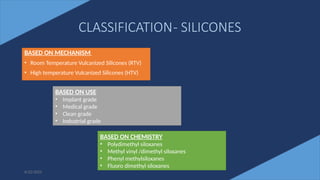
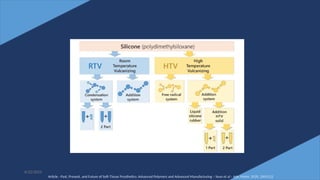
BASED ONMECHANISM
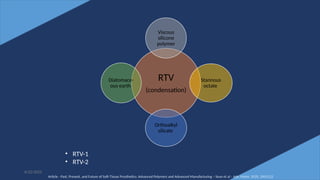
• Room Temperature Vulcanized Silicones (RTV)
• High temperature Vulcanized Silicones (HTV)
6/22/2022
BASED ON USE
• Implant grade
• Medical grade
• Clean grade
• Industrial grade
BASED ON CHEMISTRY
• Polydimethyl siloxanes
• Methyl vinyl /dimethyl siloxanes
• Phenyl methylsiloxanes
• Fluoro dimethyl siloxanes
32.
32
6/22/2022
Article - Past,Present, and Future of Soft-Tissue Prosthetics: Advanced Polymers and Advanced Manufacturing – Sean et al - Adv. Mater. 2020, 2001122
33.
33
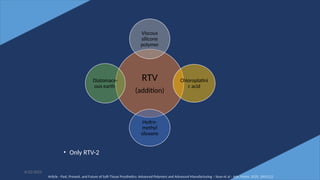
ROOM TEMPERATURE VULCANIZING
SILICONE
6/22/2022
Comparativelyshort chain silicone polymers which are partially end-blocked
with hydroxyl groups
Eg – Silastic 382, 399, MDX4-4210, Silastic 891, Cosmesil
Article - Past, Present, and Future of Soft-Tissue Prosthetics: Advanced Polymers and Advanced Manufacturing – Sean et al - Adv. Mater. 2020, 2001122
36
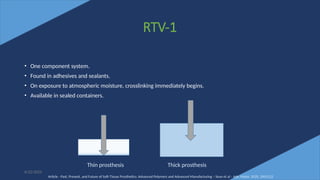
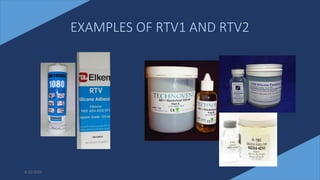
RTV-1
• One componentsystem.
• Found in adhesives and sealants.
• On exposure to atmospheric moisture, crosslinking immediately begins.
• Available in sealed containers.
6/22/2022
Thin prosthesis Thick prosthesis
Article - Past, Present, and Future of Soft-Tissue Prosthetics: Advanced Polymers and Advanced Manufacturing – Sean et al - Adv. Mater. 2020, 2001122
37.
37
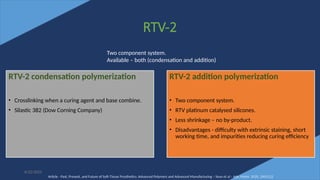
RTV-2
6/22/2022
RTV-2 condensation polymerization
•Crosslinking when a curing agent and base combine.
• Silastic 382 (Dow Corning Company)
RTV-2 addition polymerization
• Two component system.
• RTV platinum catalysed silicones.
• Less shrinkage – no by-product.
• Disadvantages - difficulty with extrinsic staining, short
working time, and impurities reducing curing efficiency
Two component system.
Available – both (condensation and addition)
Article - Past, Present, and Future of Soft-Tissue Prosthetics: Advanced Polymers and Advanced Manufacturing – Sean et al - Adv. Mater. 2020, 2001122
39
Colour stable.
Biologically inert.
Easierto process.
Prosthesis can be polymerized in
stone molds.
Retain physical and chemical
properties at wide range of
temperature.
Poor edge strength.
Costly.
Cosmetic appearance of the
material inferior to that of
polyurethanes, acrylic resins,
polyvinyl chloride.
6/22/2022
ROOM TEMPERATURE VULCANIZING
SILICONE
Article - Past, Present, and Future of Soft-Tissue Prosthetics: Advanced Polymers and Advanced Manufacturing – Sean et al - Adv. Mater. 2020, 2001122
40.
40
• Crosslinking -addition or free radical polymerization
• Temperature - 100 and 200°C for up to 30 min.
6/22/2022
HIGH TEMPERATURE VULCANIZING
SILICONE
Eg – Silastic 370, 372, PDM siloxane, Q7 -4635, 4650
Article - Past, Present, and Future of Soft-Tissue Prosthetics: Advanced Polymers and Advanced Manufacturing – Sean et al - Adv. Mater. 2020, 2001122
41.
41
6/22/2022
Addition polymerization HTVsilicones
• Transparent with no yellowing
• Odorless
• Demolded easily
• Do not require any processing after curing
• Relatively high tensile and tear strength.
Free radical HTV silicones
• Yellowing after curing
• Strong odor both during and after
processing
• Tacky to touch - high surface friction
• High-consistency
• High tear resistance
• Thermally stable.
Article - Maxillofacial Prosthetic Materials - An Inclination Towards Silicones - Aparajita Mitra et al - Journal of Clinical and Diagnostic Research. 2014 Dec, Vol-8(12): ZE08-ZE13
42.
42
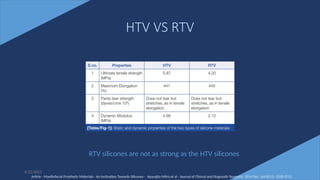
HTV VS RTV
6/22/2022
RTVsilicones are not as strong as the HTV silicones
Article - Maxillofacial Prosthetic Materials - An Inclination Towards Silicones - Aparajita Mitra et al - Journal of Clinical and Diagnostic Research. 2014 Dec, Vol-8(12): ZE08-ZE13
43.
43
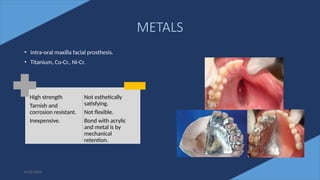
METALS
• Intra-oral maxillafacial prosthesis.
• Titanium, Co-Cr., Ni-Cr.
6/22/2022
High strength
Tarnish and
corrosion resistant.
Inexpensive.
Not esthetically
satisfying.
Not flexible.
Bond with acrylic
and metal is by
mechanical
retention.
45
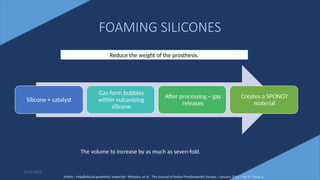
FOAMING SILICONES
Silicone +catalyst
Gas form bubbles
within vulcanizing
silicone
After processing – gas
releases
Creates a SPONGY
material
6/22/2022
Reduce the weight of the prosthesis.
The volume to increase by as much as seven-fold.
Article - Maxillofacial prosthetic materials - Khindria, et al - The Journal of Indian Prosthodontic Society / January 2009 / Vol 9 / Issue 1
46.
46
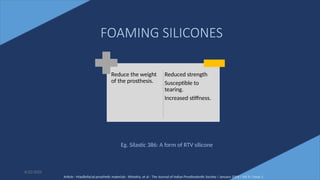
Reduce the weight
ofthe prosthesis.
Reduced strength
Susceptible to
tearing.
Increased stiffness.
6/22/2022
FOAMING SILICONES
Eg. Silastic 386: A form of RTV silicone
Article - Maxillofacial prosthetic materials - Khindria, et al - The Journal of Indian Prosthodontic Society / January 2009 / Vol 9 / Issue 1
47.
47
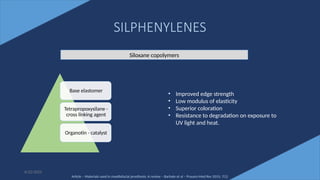
SILPHENYLENES
Base elastomer
Tetrapropoxysilane -
crosslinking agent
Organotin - catalyst
6/22/2022
Siloxane copolymers
• Improved edge strength
• Low modulus of elasticity
• Superior coloration
• Resistance to degradation on exposure to
UV light and heat.
Article – Materials used in maxillofacial prosthesis: A review – Barhate et al – Pravara Med Rev 2015; 7(1)
48.
48
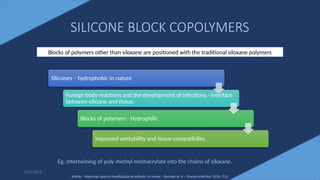
SILICONE BLOCK COPOLYMERS
6/22/2022
Blocksof polymers other than siloxane are positioned with the traditional siloxane polymers
Silicones – hydrophobic in nature
Foreign body reactions and the development of infections - interface
between silicone and tissue.
Blocks of polymers - Hydrophilic
Improved wettability and tissue compatibility.
Eg. Intertwining of poly methyl methacrylate into the chains of siloxane.
Article – Materials used in maxillofacial prosthesis: A review – Barhate et al – Pravara Med Rev 2015; 7(1)
49.
49
POLYPHOSPHAZENES
• Fluoro-elastomers havebeen developed for use as resilient denture liners.
• Potential to be used as maxillofacial prosthetic materials.
6/22/2022
Researchers in New Orleans,
• Polyphosphazenes with little or no fillers and decreasing the ratio of acrylic to rubber
yields a softer rubber, similar to human skin.
• The rubber is compounded with pigments for appropriate matching with the patients’
skin.
Article – Materials used in maxillofacial prosthesis: A review – Barhate et al – Pravara Med Rev 2015; 7(1)
50.
50
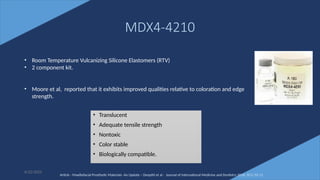
MDX4-4210
• Translucent
• Adequatetensile strength
• Nontoxic
• Color stable
• Biologically compatible.
6/22/2022
• Room Temperature Vulcanizing Silicone Elastomers (RTV)
• 2 component kit.
• Moore et al, reported that it exhibits improved qualities relative to coloration and edge
strength.
Article - Maxillofacial Prosthetic Materials -An Update – Deepthi et al - Journal of International Medicine and Dentistry 2016; 3(1): 02-11
51.
51
MPDS
• Modification ofsilicone elastomer.
• Incorporation of methacrylate groups in the silicone reduces the hydrophobicity of the silicone.
• Enhances the adhesive bond strength to the non-silicone based adhesives.
• Works thru thermal polymerization.
6/22/2022
Methacryloxypropyl terminated polydimethyl siloxane
Article – New organosilicon maxillofacial prosthetic materials – J.H.Lai et al – Dental materials 18 (2002) 281-286
52.
52
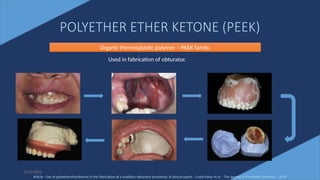
POLYETHER ETHER KETONE(PEEK)
Used in fabrication of obturator.
6/22/2022
Organic thermoplastic polymer – PAEK family.
Article - Use of polyetheretherketone in the fabrication of a maxillary obturator prosthesis: A clinical report - Costa-Palau et al - The Journal of Prosthetic Dentistry - 2014
53.
53
Biocompatibility
Low specific gravity(1.31 g/cm3 )
Flexural bone-like modulus
Resistance to cracking
Ease of polishing and
machinability
White in colour
Not preferred for extra-oral
prosthesis.
6/22/2022
POLYETHER ETHER KETONE (PEEK)
Article - PEEK in dentistry, properties and application areas – Akay et al - IDR — Volume 10, Number 2, 2020
54.
54
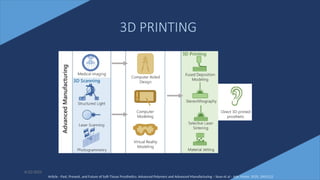
3D PRINTING
6/22/2022
Article -Past, Present, and Future of Soft-Tissue Prosthetics: Advanced Polymers and Advanced Manufacturing – Sean et al - Adv. Mater. 2020, 2001122
55.
55
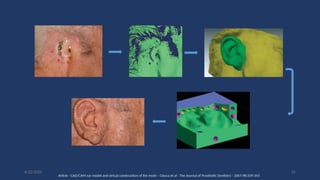
6/22/2022
Article - CAD/CAMear model and virtual construction of the mold – Ciocca et al - The Journal of Prosthetic Dentistry - 2007;98:339-343
56.
56
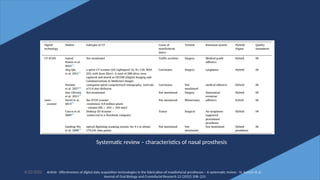
6/22/2022 Article -Effectiveness of digital data acquisition technologies in the fabrication of maxillofacial prostheses – A systematic review - N. Suresh et al -
Journal of Oral Biology and Craniofacial Research 12 (2022) 208–215
Systematic review – characteristics of nasal prosthesis
57.
57
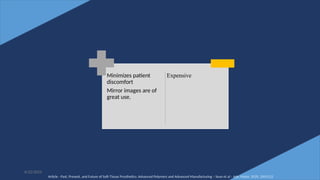
Minimizes patient
discomfort
Mirror imagesare of
great use.
Expensive
6/22/2022
Article - Past, Present, and Future of Soft-Tissue Prosthetics: Advanced Polymers and Advanced Manufacturing – Sean et al - Adv. Mater. 2020, 2001122
58.
58
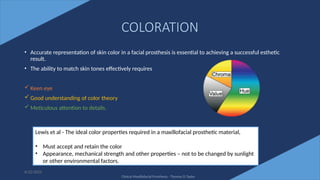
COLORATION
• Accurate representationof skin color in a facial prosthesis is essential to achieving a successful esthetic
result.
• The ability to match skin tones effectively requires
Keen eye
Good understanding of color theory
Meticulous attention to details.
6/22/2022
Lewis et al - The ideal color properties required in a maxillofacial prosthetic material,
• Must accept and retain the color
• Appearance, mechanical strength and other properties – not to be changed by sunlight
or other environmental factors.
Clinical Maxillofacial Prosthesis - Thomas D Taylor
59.
59
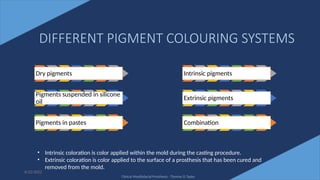
DIFFERENT PIGMENT COLOURINGSYSTEMS
Dry pigments
Pigments suspended in silicone
oil
Pigments in pastes
6/22/2022
Intrinsic pigments
Extrinsic pigments
Combination
• Intrinsic coloration is color applied within the mold during the casting procedure.
• Extrinsic coloration is color applied to the surface of a prosthesis that has been cured and
removed from the mold.
Clinical Maxillofacial Prosthesis - Thomas D Taylor
60.
60
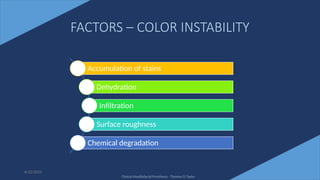
FACTORS – COLORINSTABILITY
Accumulation of stains
Dehydration
Infiltration
Surface roughness
Chemical degradation
6/22/2022
Clinical Maxillofacial Prosthesis - Thomas D Taylor
62
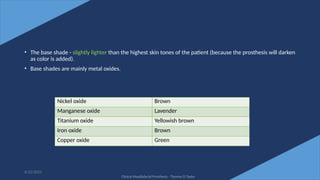
• The baseshade - slightly lighter than the highest skin tones of the patient (because the prosthesis will darken
as color is added).
• Base shades are mainly metal oxides.
6/22/2022
Nickel oxide Brown
Manganese oxide Lavender
Titanium oxide Yellowish brown
Iron oxide Brown
Copper oxide Green
Clinical Maxillofacial Prosthesis - Thomas D Taylor
63.
63
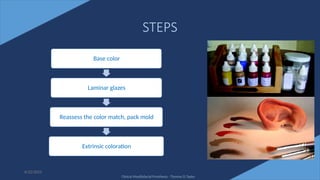
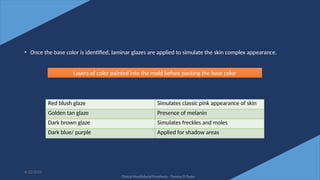
• Once thebase color is identified, laminar glazes are applied to simulate the skin complex appearance.
6/22/2022
Layers of color painted into the mold before packing the base color
Red blush glaze Simulates classic pink appearance of skin
Golden tan glaze Presence of melanin
Dark brown glaze Simulates freckles and moles
Dark blue/ purple Applied for shadow areas
Clinical Maxillofacial Prosthesis - Thomas D Taylor
64.
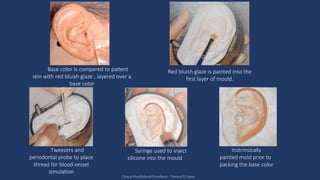
Base color iscompared to patient
skin with red bluish glaze , layered over a
base color
Red bluish glaze is painted into the
first layer of mould.
Tweezers and
periodontal probe to place
thread for blood vessel
simulation
Syringe used to inject
silicone into the mould
Instrinsically
painted mold prior to
packing the base color
Clinical Maxillofacial Prosthesis - Thomas D Taylor
65.
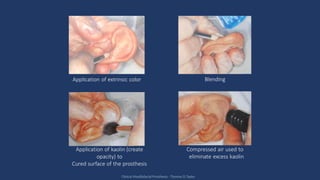
Application of extrinsiccolor Blending
Application of kaolin (create
opacity) to
Cured surface of the prosthesis
Compressed air used to
eliminate excess kaolin
Clinical Maxillofacial Prosthesis - Thomas D Taylor
66.
66
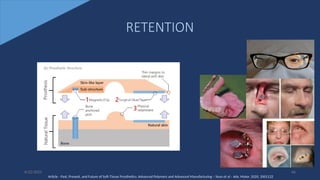
RETENTION
6/22/2022
Article - Past,Present, and Future of Soft-Tissue Prosthetics: Advanced Polymers and Advanced Manufacturing – Sean et al - Adv. Mater. 2020, 2001122
67.
67
ADHESIVES
• To retainthe facial prosthesis in position.
6/22/2022
• Pastes
• Liquids
• Emulsions
• Spray-ons
• Double sided tapes
Article - Materials of facial prosthesis: History and advance – Alqutaibi et al - International Journal of Contemporary Dental and Medical Reviews (2015), Article ID 021015
68.
68
FACTORS – SELECTIONOF ADHESIVE
• Biocompatibility
• The strength of the adhesive bond to skin and the prosthetic material
• Ease of applicability
• Removal on daily basis
• Nature of the material - prosthesis
6/22/2022
Article - Retentive aids in maxillofacial prosthesis: A review - Rohit Saini et al. - IP Annals of Prosthodontics and Restorative Dentistry, January-March, 2019;5(1):1-4
70
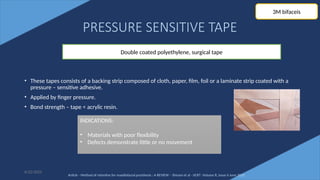
PRESSURE SENSITIVE TAPE
•These tapes consists of a backing strip composed of cloth, paper, film, foil or a laminate strip coated with a
pressure – sensitive adhesive.
• Applied by finger pressure.
• Bond strength – tape < acrylic resin.
6/22/2022
Double coated polyethylene, surgical tape
INDICATIONS:
• Materials with poor flexibility
• Defects demonstrate little or no movement
3M bifaceis
Article - Method of retentive for maxillofacial prosthesis : A REVIEW – Shivani et al - IJCRT -Volume 8, Issue 6 June 2020
71.
71
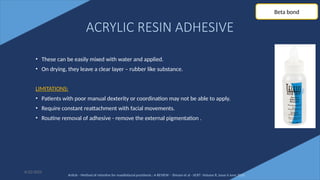
ACRYLIC RESIN ADHESIVE
•These can be easily mixed with water and applied.
• On drying, they leave a clear layer – rubber like substance.
LIMITATIONS:
• Patients with poor manual dexterity or coordination may not be able to apply.
• Require constant reattachment with facial movements.
• Routine removal of adhesive - remove the external pigmentation .
6/22/2022
Beta bond
Article - Method of retentive for maxillofacial prosthesis : A REVIEW – Shivani et al - IJCRT -Volume 8, Issue 6 June 2020
72.
72
BOND STRENGTH OFACRYLIC RESIN
ADHESIVES WITH SILICONE PROSTHESIS
Bond strength between acrylic resin and maxillofacial silicone – Marcela et al (Journal of Applied
Oral Science - 2012;20(6):649-54)
6/22/2022
Since the composition of these two materials is different, no strong bond between them was noted
when no primer was applied.
73.
73
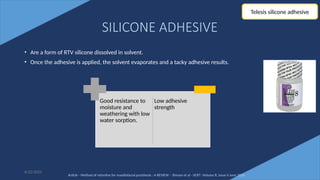
SILICONE ADHESIVE
• Area form of RTV silicone dissolved in solvent.
• Once the adhesive is applied, the solvent evaporates and a tacky adhesive results.
6/22/2022
Good resistance to
moisture and
weathering with low
water sorption.
Low adhesive
strength
Telesis silicone adhesive
Article - Method of retentive for maxillofacial prosthesis : A REVIEW – Shivani et al - IJCRT -Volume 8, Issue 6 June 2020
74.
74
LIMITATIONS OF MFPMATERIAL
6/22/2022
No single maxillofacial material is ideal for every patient.
1. Continued effect of sunlight and vascular dilatation & contraction on the natural tissues cannot be
duplicated in the prosthesis.
2. Variations of skin tone when the patient is exposed to different light sources (e.g., incandescent,
fluorescent, & natural light) cannot be duplicated in the prosthesis.
3. The prosthesis cannot duplicate the full facial movement of the non defective side.
4. Varying physiologic conditions of the patient in everyday living (e.g., lack of sleep, infectious diseases, and
edema resulting from interrupted lymph drainage caused by surgery) cannot be duplicated in the
prosthesis.
5. Lack of predictability of the life of the prosthesis, because of variations among patients (i.e., secretions,
smoking, and environment).
Article - Maxillofacial Prosthetic Materials: A Literature Review - Harsh et al - Journal of Orofacial Research, April-June
2012;2(2):87-90
75.
75
CONCLUSION
• The successof the prosthetic rehabilitation of the facial defect limited by mechanical and physical
properties of the material.
• None of the materials meet our needs completely.
• There are certain advantages and disadvantages of materials.
• It is in clinicians hand, to choose the material wisely based on clinical scenario.
6/22/2022
76.
76
REFERENCES
• Glossary ofProsthodontic Terminology – 9
• Textbook of Oral and maxillofacial rehabilitation - beumer
• Clinical Maxillofacial Prosthesis - Thomas D Taylor
• Article - Maxillofacial Prosthetic Materials: A Literature Review – Harsh et al - Journal of Orofacial
Research, April-June 2012;2(2):87-90
• Article - Past, Present, and Future of Soft-Tissue Prosthetics: Advanced Polymers and Advanced
Manufacturing – Sean et al - Adv. Mater. 2020, 2001122
• Article - Materials of facial prosthesis: History and advance– Alqutaibi et al - International Journal
of Contemporary Dental and Medical Reviews (2015), Article ID 021015, 4 Pages
• Article - Materials used in Maxillofacial Prosthetic : A Review – Barhate et al – Pravara Med Rev
2015; 7 (1)
6/22/2022
77.
77
REFERENCES
• Article -Maxillofacial Prosthetic Materials – Khindria et al - The Journal of Indian Prosthodontic
Society / January 2009 / Vol 9 / Issue 1
• Article - Maxillofacial prosthetic materials: current status and recent advances: A comprehensive
review – Lanzara et al - International Journal of Applied Dental Sciences 2021; 7(2): 255-259
• Article - Polyurethane Elastomers as Maxillofacial Prosthetic Materials – Jon et al - J Dent Res April
1978
• Article - Past, Present, and Future of Soft-Tissue Prosthetics: Advanced Polymers and Advanced
Manufacturing – Sean et al - Adv. Mater. 2020, 2001122
• Article - Maxillofacial Prosthetic Materials - An Inclination Towards Silicones - Aparajita Mitra et al
- Journal of Clinical and Diagnostic Research. 2014 Dec, Vol-8(12): ZE08-ZE13
• Article - Maxillofacial prosthetic materials - Khindria, et al - The Journal of Indian Prosthodontic
Society / January 2009 / Vol 9 / Issue 1
6/22/2022
78.
78
REFERENCES
• Article –Materials used in maxillofacial prosthesis: A review – Barhate et al – Pravara Med Rev
2015; 7(1)
• Article - Maxillofacial Prosthetic Materials -An Update – Deepthi et al - Journal of International
Medicine and Dentistry 2016; 3(1): 02-11
• Article – New organosilicon maxillofacial prosthetic materials – J.H.Lai et al – Dental materials 18
(2002) 281-286
• Article - Use of polyetheretherketone in the fabrication of a maxillary obturator prosthesis: A
clinical report - Costa-Palau et al - The Journal of Prosthetic Dentistry - 2014
• Article - PEEK in dentistry, properties and application areas – Akay et al - IDR — Volume 10,
Number 2, 2020
• Article - CAD/CAM ear model and virtual construction of the mold – Ciocca et al - The Journal of
Prosthetic Dentistry - 2007;98:339-343
6/22/2022
79.
79
• Article -Effectiveness of digital data acquisition technologies in the fabrication of maxillofacial
prostheses – A systematic review - N. Suresh et al - Journal of Oral Biology and Craniofacial
Research 12 (2022) 208–215
• Article - Retentive aids in maxillofacial prosthesis: A review - Rohit Saini et al. - IP Annals of
Prosthodontics and Restorative Dentistry, January-March, 2019;5(1):1-4
• Article - Method of retentive for maxillofacial prosthesis : A REVIEW – Shivani et al - IJCRT -
Volume 8, Issue 6 June 2020
6/22/2022
REFERENCES
#23 Visible light cured resin is also being used, which has an organic filler made of acrylic resin beads of different sizes that become part of the polymer network structure upon curing. The matrix is a urethane dimethacrylate with microfine silica and contains a camphoroquinone amine as photoinitiator
#31 Implant grade: They are placed within the tissues (breast implants).
Medical grade: They are approved for external use only. It is the most commonly used variety for fabricating maxillofacial prosthesis.
Clean grade: Industrial use
Industrial grade: Industrial use.
#33 According to curing – 2 types
viscous silicone polymer
Chloroplatinic acid, Stannous octate - catalyst
Hydro-methyl siloxane, Orthoalkyl silicate – cross linking agent
Diatomaceous earth – filler – strength
The addition type give off very little or no byproducts during the curing process
#36 moisture cannot penetrate deep enough for polymerization.
#37 Impurities - (e.g., amines, sulfurous, or other catalyst poisons)






![1] ELASTOMERIC IMPRESSION MATERIALS.pptx](https://cdn.slidesharecdn.com/ss_thumbnails/1elastomericimpressionmaterials-260129153436-2be86f83-thumbnail.jpg?width=640&height=640&fit=bounds)


