Simple Present
André Luiz R. de Camargo
Simple Present
Verbs to be, there to be, to have
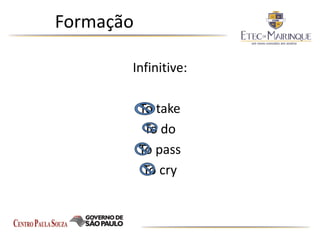
Formação
Infinitive:
To take
To do
To pass
To cry
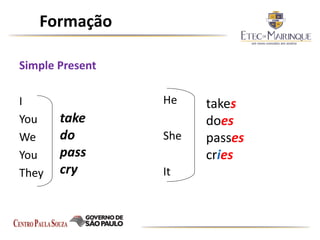
Formação
Simple Present
I
You
We
You
They
He
She
It
take
do
pass
cry
takes
does
passes
cries
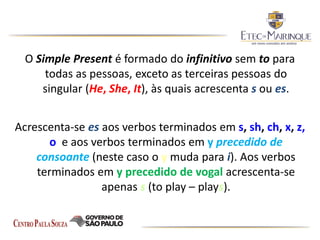
O Simple Present é formado do infinitivo sem to para
todas as pessoas, exceto as terceiras pessoas do
singular (He, She, It), às quais acrescenta s ou es.
Acrescenta-se es aos verbos terminados em s, sh, ch, x, z,
o e aos verbos terminados em y precedido de
consoante (neste caso o y muda para i). Aos verbos
terminados em y precedido de vogal acrescenta-se
apenas s (to play – plays).
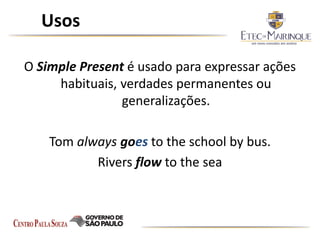
Usos
O Simple Present é usado para expressar ações
habituais, verdades permanentes ou
generalizações.
Tom always goes to the school by bus.
Rivers flow to the sea
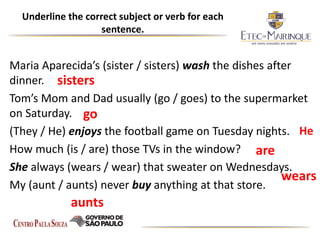
Underline the correct subject or verb for each
sentence.
Maria Aparecida’s (sister / sisters) wash the dishes after
dinner.
Tom’s Mom and Dad usually (go / goes) to the supermarket
on Saturday.
(They / He) enjoys the football game on Tuesday nights.
How much (is / are) those TVs in the window?
She always (wears / wear) that sweater on Wednesdays.
My (aunt / aunts) never buy anything at that store.
go
He
are
wears
aunts
sisters
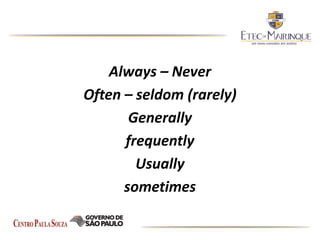
Os seguintes advérbios e locuções
adverbiais são comumente usados com o
Simple Present.
Always – Never
Often – seldom (rarely)
Generally
frequently
Usually
sometimes
Once
Twice
Three times
etc
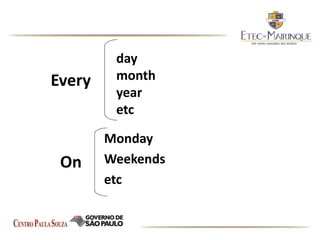
day
month
year
etc
a
Monday
Weekends
etc
Every
day
month
year
etc
On
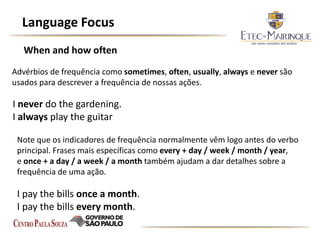
Language Focus
When and how often
Advérbios de frequência como sometimes, often, usually, always e never são
usados para descrever a frequência de nossas ações.
I never do the gardening.
I always play the guitar
Note que os indicadores de frequência normalmente vêm logo antes do verbo
principal. Frases mais específicas como every + day / week / month / year,
e once + a day / a week / a month também ajudam a dar detalhes sobre a
frequência de uma ação.
I pay the bills once a month.
I pay the bills every month.
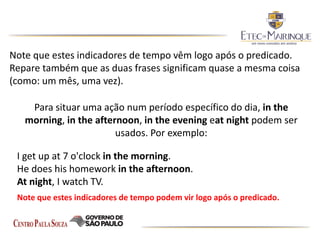
Note que estes indicadores de tempo vêm logo após o predicado.
Repare também que as duas frases significam quase a mesma coisa
(como: um mês, uma vez).
Para situar uma ação num período específico do dia, in the
morning, in the afternoon, in the evening eat night podem ser
usados. Por exemplo:
I get up at 7 o'clock in the morning.
He does his homework in the afternoon.
At night, I watch TV.
Note que estes indicadores de tempo podem vir logo após o predicado.
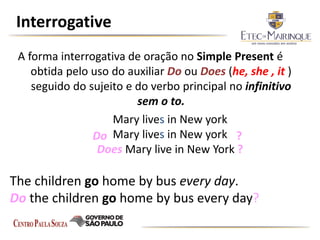
Interrogative
A forma interrogativa de oração no Simple Present é
obtida pelo uso do auxiliar Do ou Does (he, she , it )
seguido do sujeito e do verbo principal no infinitivo
sem o to.
The children go home by bus every day.
Do the children go home by bus every day?
Mary lives in New york
Does Mary live in New York ?
Do ?
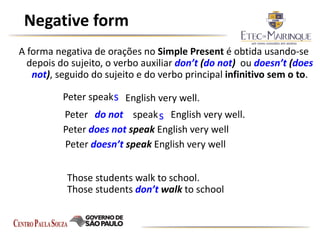
Negative form
A forma negativa de orações no Simple Present é obtida usando-se
depois do sujeito, o verbo auxiliar don’t (do not) ou doesn’t (does
not), seguido do sujeito e do verbo principal infinitivo sem o to.
Those students walk to school.
Those students don’t walk to school
Peter speak English very well.s
Peter do not speaks English very well.
Peter doesn’t speak English very well
Peter does not speak English very well
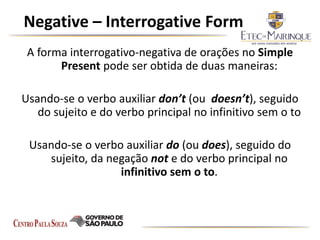
Negative – Interrogative Form
A forma interrogativo-negativa de orações no Simple
Present pode ser obtida de duas maneiras:
Usando-se o verbo auxiliar don’t (ou doesn’t), seguido
do sujeito e do verbo principal no infinitivo sem o to
Usando-se o verbo auxiliar do (ou does), seguido do
sujeito, da negação not e do verbo principal no
infinitivo sem o to.
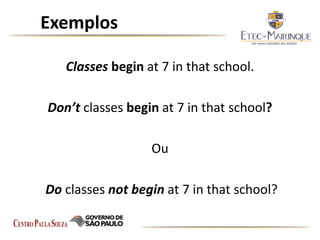
Exemplos
Classes begin at 7 in that school.
Don’t classes begin at 7 in that school?
Ou
Do classes not begin at 7 in that school?
To be
There To be
To Have
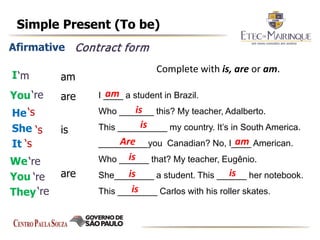
Simple Present (To be)
Afirmative
I
You
He
She
It
We
You
They
am
are
are
is
Contract form
‘m
‘re
‘re
‘re
‘re
‘s
‘s
‘s
Complete with is, are or am.
I ____ a student in Brazil.
Who _______ this? My teacher, Adalberto.
This __________ my country. It’s in South America.
__________you Canadian? No, I____ American.
Who ______ that? My teacher, Eugênio.
She________ a student. This ______ her notebook.
This ________ Carlos with his roller skates.
am
am
is
is
is
is is
is
Are
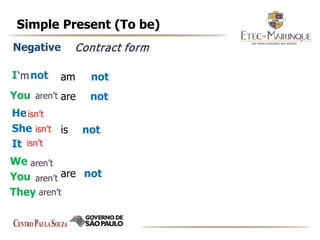
Simple Present (To be)
Negative
I
You
He
She
It
We
You
They
am
are
are
is
Contract form
‘m
aren’t
isn’t
not
not
not
not
not
aren’t
aren’t
aren’t
isn’t
isn’t
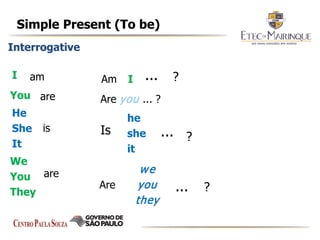
Simple Present (To be)
Interrogative
I
You
He
She
It
We
You
They
am
are
are
is
IAm
Are you ... ?
Is
he
she
it
?...
Are
we
you
they
... ?
... ?
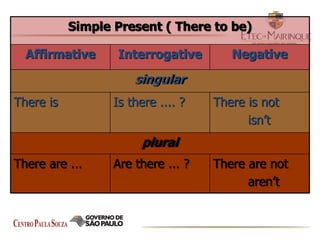
Simple Present ( There to be)
Affirmative Interrogative Negative
singular
There is Is there .... ? There is not
isn’t
plural
There are ... Are there ... ? There are not
aren’t
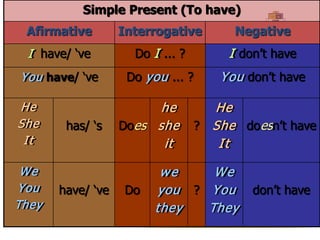
Simple Present (To have)
Afirmative Interrogative Negative
I have/ ‘ve Do I ... ? I don’t have
You have/ ‘ve Do you ... ? You don’t have
He
She
It
has/ ‘s Does
he
she
it
?
He
She
It
doesn’t have
We
You
They
have/ ‘ve Do
we
you
they
?
We
You
They
don’t have
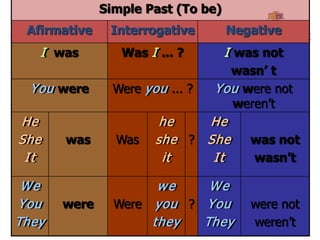
Simple Past (To be)
Afirmative Interrogative Negative
I was Was I ... ? I was not
wasn’ t
You were Were you ... ? You were not
weren’t
He
She
It
was Was
he
she
it
?
He
She
It
was not
wasn’t
We
You
They
were Were
we
you
they
?
We
You
They
were not
weren’t
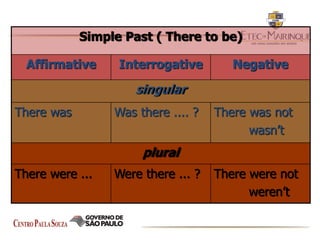
Simple Past ( There to be)
Affirmative Interrogative Negative
singular
There was Was there .... ? There was not
wasn’t
plural
There were ... Were there ... ? There were not
weren’t
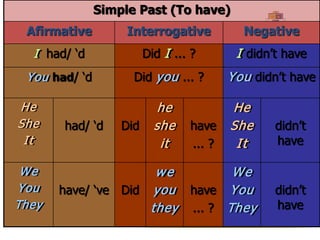
Simple Past (To have)
Afirmative Interrogative Negative
I had/ ‘d Did I ... ? I didn’t have
You had/ ‘d Did you ... ? You didn’t have
He
She
It
had/ ‘d Did
he
she
it
have
... ?
He
She
It
didn’t
have
We
You
They
have/ ‘ve Did
we
you
they
have
... ?
We
You
They
didn’t
have
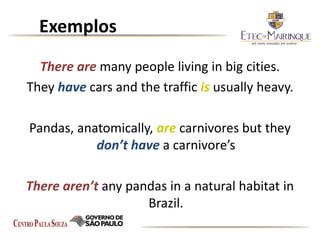
Exemplos
There are many people living in big cities.
They have cars and the traffic is usually heavy.
Pandas, anatomically, are carnivores but they
don’t have a carnivore’s
There aren’t any pandas in a natural habitat in
Brazil.
Exercise 2
Fill in the text below with the correct forms of
Simple Present.
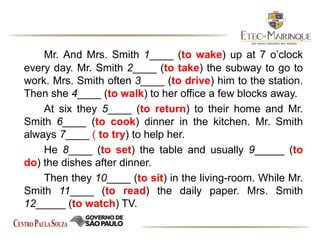
Mr. And Mrs. Smith 1____ (to wake) up at 7 o’clock
every day. Mr. Smith 2____ (to take) the subway to go to
work. Mrs. Smith often 3____ (to drive) him to the station.
Then she 4____ (to walk) to her office a few blocks away.
At six they 5____ (to return) to their home and Mr.
Smith 6____ (to cook) dinner in the kitchen. Mr. Smith
always 7____ ( to try) to help her.
He 8____ (to set) the table and usually 9_____ (to
do) the dishes after dinner.
Then they 10____ (to sit) in the living-room. While Mr.
Smith 11____ (to read) the daily paper. Mrs. Smith
12_____ (to watch) TV.
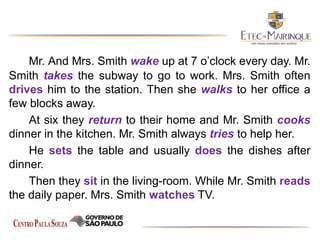
Mr. And Mrs. Smith wake up at 7 o’clock every day. Mr.
Smith takes the subway to go to work. Mrs. Smith often
drives him to the station. Then she walks to her office a
few blocks away.
At six they return to their home and Mr. Smith cooks
dinner in the kitchen. Mr. Smith always tries to help her.
He sets the table and usually does the dishes after
dinner.
Then they sit in the living-room. While Mr. Smith reads
the daily paper. Mrs. Smith watches TV.

AULAS_LÍNGUA INGLESA_SIMPLE PRESENT_TEXTO

  • 1.
  • 2.
    Simple Present Verbs tobe, there to be, to have
  • 3.
  • 4.
  • 5.
    O Simple Presenté formado do infinitivo sem to para todas as pessoas, exceto as terceiras pessoas do singular (He, She, It), às quais acrescenta s ou es. Acrescenta-se es aos verbos terminados em s, sh, ch, x, z, o e aos verbos terminados em y precedido de consoante (neste caso o y muda para i). Aos verbos terminados em y precedido de vogal acrescenta-se apenas s (to play – plays).
  • 6.
    Usos O Simple Presenté usado para expressar ações habituais, verdades permanentes ou generalizações. Tom always goes to the school by bus. Rivers flow to the sea
  • 7.
    Underline the correctsubject or verb for each sentence. Maria Aparecida’s (sister / sisters) wash the dishes after dinner. Tom’s Mom and Dad usually (go / goes) to the supermarket on Saturday. (They / He) enjoys the football game on Tuesday nights. How much (is / are) those TVs in the window? She always (wears / wear) that sweater on Wednesdays. My (aunt / aunts) never buy anything at that store. go He are wears aunts sisters
  • 8.
    Os seguintes advérbiose locuções adverbiais são comumente usados com o Simple Present.
  • 9.
    Always – Never Often– seldom (rarely) Generally frequently Usually sometimes
  • 10.
  • 11.
  • 12.
    Language Focus When andhow often Advérbios de frequência como sometimes, often, usually, always e never são usados para descrever a frequência de nossas ações. I never do the gardening. I always play the guitar Note que os indicadores de frequência normalmente vêm logo antes do verbo principal. Frases mais específicas como every + day / week / month / year, e once + a day / a week / a month também ajudam a dar detalhes sobre a frequência de uma ação. I pay the bills once a month. I pay the bills every month.
  • 13.
    Note que estesindicadores de tempo vêm logo após o predicado. Repare também que as duas frases significam quase a mesma coisa (como: um mês, uma vez). Para situar uma ação num período específico do dia, in the morning, in the afternoon, in the evening eat night podem ser usados. Por exemplo: I get up at 7 o'clock in the morning. He does his homework in the afternoon. At night, I watch TV. Note que estes indicadores de tempo podem vir logo após o predicado.
  • 14.
    Interrogative A forma interrogativade oração no Simple Present é obtida pelo uso do auxiliar Do ou Does (he, she , it ) seguido do sujeito e do verbo principal no infinitivo sem o to. The children go home by bus every day. Do the children go home by bus every day? Mary lives in New york Mary lives in New york Does Mary live in New York ? Do ?
  • 15.
    Negative form A formanegativa de orações no Simple Present é obtida usando-se depois do sujeito, o verbo auxiliar don’t (do not) ou doesn’t (does not), seguido do sujeito e do verbo principal infinitivo sem o to. Those students walk to school. Those students don’t walk to school Peter speak English very well.s Peter do not speaks English very well. Peter doesn’t speak English very well Peter does not speak English very well
  • 16.
    Negative – InterrogativeForm A forma interrogativo-negativa de orações no Simple Present pode ser obtida de duas maneiras: Usando-se o verbo auxiliar don’t (ou doesn’t), seguido do sujeito e do verbo principal no infinitivo sem o to Usando-se o verbo auxiliar do (ou does), seguido do sujeito, da negação not e do verbo principal no infinitivo sem o to.
  • 17.
    Exemplos Classes begin at7 in that school. Don’t classes begin at 7 in that school? Ou Do classes not begin at 7 in that school?
  • 18.
    To be There Tobe To Have
  • 19.
    Simple Present (Tobe) Afirmative I You He She It We You They am are are is Contract form ‘m ‘re ‘re ‘re ‘re ‘s ‘s ‘s Complete with is, are or am. I ____ a student in Brazil. Who _______ this? My teacher, Adalberto. This __________ my country. It’s in South America. __________you Canadian? No, I____ American. Who ______ that? My teacher, Eugênio. She________ a student. This ______ her notebook. This ________ Carlos with his roller skates. am am is is is is is is Are
  • 20.
    Simple Present (Tobe) Negative I You He She It We You They am are are is Contract form ‘m aren’t isn’t not not not not not aren’t aren’t aren’t isn’t isn’t
  • 21.
    Simple Present (Tobe) Interrogative I You He She It We You They am are are is IAm Are you ... ? Is he she it ?... Are we you they ... ? ... ?
  • 22.
    Simple Present (There to be) Affirmative Interrogative Negative singular There is Is there .... ? There is not isn’t plural There are ... Are there ... ? There are not aren’t
  • 23.
    Simple Present (Tohave) Afirmative Interrogative Negative I have/ ‘ve Do I ... ? I don’t have You have/ ‘ve Do you ... ? You don’t have He She It has/ ‘s Does he she it ? He She It doesn’t have We You They have/ ‘ve Do we you they ? We You They don’t have
  • 24.
    Simple Past (Tobe) Afirmative Interrogative Negative I was Was I ... ? I was not wasn’ t You were Were you ... ? You were not weren’t He She It was Was he she it ? He She It was not wasn’t We You They were Were we you they ? We You They were not weren’t
  • 25.
    Simple Past (There to be) Affirmative Interrogative Negative singular There was Was there .... ? There was not wasn’t plural There were ... Were there ... ? There were not weren’t
  • 26.
    Simple Past (Tohave) Afirmative Interrogative Negative I had/ ‘d Did I ... ? I didn’t have You had/ ‘d Did you ... ? You didn’t have He She It had/ ‘d Did he she it have ... ? He She It didn’t have We You They have/ ‘ve Did we you they have ... ? We You They didn’t have
  • 27.
    Exemplos There are manypeople living in big cities. They have cars and the traffic is usually heavy. Pandas, anatomically, are carnivores but they don’t have a carnivore’s There aren’t any pandas in a natural habitat in Brazil.
  • 28.
    Exercise 2 Fill inthe text below with the correct forms of Simple Present.
  • 29.
    Mr. And Mrs.Smith 1____ (to wake) up at 7 o’clock every day. Mr. Smith 2____ (to take) the subway to go to work. Mrs. Smith often 3____ (to drive) him to the station. Then she 4____ (to walk) to her office a few blocks away. At six they 5____ (to return) to their home and Mr. Smith 6____ (to cook) dinner in the kitchen. Mr. Smith always 7____ ( to try) to help her. He 8____ (to set) the table and usually 9_____ (to do) the dishes after dinner. Then they 10____ (to sit) in the living-room. While Mr. Smith 11____ (to read) the daily paper. Mrs. Smith 12_____ (to watch) TV.
  • 30.
    Mr. And Mrs.Smith wake up at 7 o’clock every day. Mr. Smith takes the subway to go to work. Mrs. Smith often drives him to the station. Then she walks to her office a few blocks away. At six they return to their home and Mr. Smith cooks dinner in the kitchen. Mr. Smith always tries to help her. He sets the table and usually does the dishes after dinner. Then they sit in the living-room. While Mr. Smith reads the daily paper. Mrs. Smith watches TV.