Enhancing the Attractiveness of
Learning through Augmented Reality
Adrian Iftene, Dragoș Silion
adiftene@info.uaic.ro, dragos.silion@gmail.com
18 September 2019, Iasi, Romania
Alexandru Ioan Cuza University of Iasi
Faculty of Computer Science
Content
 Augmented reality
 What is augmented reality?
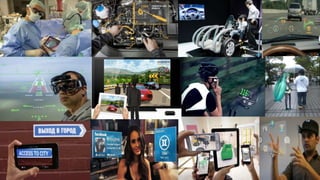
 Domains of augmented reality
 Lessons for the Primary and Secondary Cycles
 ARBio Application
 GeoAR Application
 Developing Communication Skills and Teamwork
 Supporting Ships in the Air
 Hunting Treasure
 Conclusions
 Bibliography
What is “augmented reality”?
 Augmented Reality (AR) content can be accessed by scanning or viewing a trigger image with a
mobile device that creates a subsequent action [1]
4
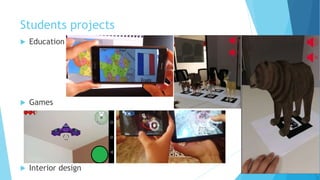
Students projects
 Education
 Games
 Interior design
5
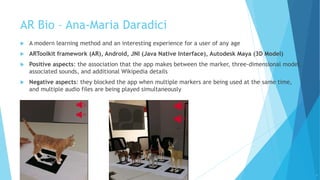
AR Bio – Ana-Maria Daradici
 A modern learning method and an interesting experience for a user of any age
 ARToolkit framework (AR), Android, JNI (Java Native Interface), Autodesk Maya (3D Model)
 Positive aspects: the association that the app makes between the marker, three-dimensional model,
associated sounds, and additional Wikipedia details
 Negative aspects: they blocked the app when multiple markers are being used at the same time,
and multiple audio files are being played simultaneously
6
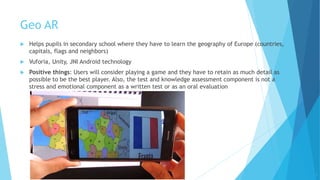
Geo AR
 Helps pupils in secondary school where they have to learn the geography of Europe (countries,
capitals, flags and neighbors)
 Vuforia, Unity, JNI Android technology
 Positive things: Users will consider playing a game and they have to retain as much detail as
possible to be the best player. Also, the test and knowledge assessment component is not a
stress and emotional component as a written test or as an oral evaluation
7
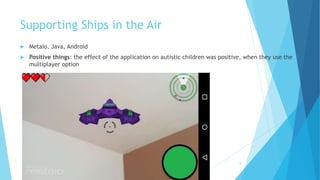
Supporting Ships in the Air
 Metaio, Java, Android
 Positive things: the effect of the application on autistic children was positive, when they use the
multiplayer option
8
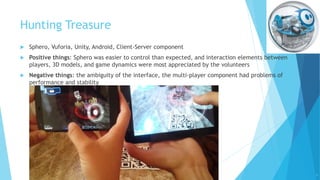
Hunting Treasure
 Sphero, Vuforia, Unity, Android, Client-Server component
 Positive things: Sphero was easier to control than expected, and interaction elements between
players, 3D models, and game dynamics were most appreciated by the volunteers
 Negative things: the ambiguity of the interface, the multi-player component had problems of
performance and stability
9
Advantages to use AR in Education
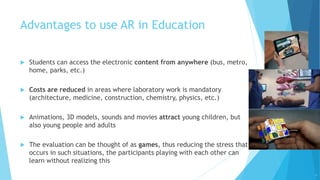
 Students can access the electronic content from anywhere (bus, metro,
home, parks, etc.)
 Costs are reduced in areas where laboratory work is mandatory
(architecture, medicine, construction, chemistry, physics, etc.)
 Animations, 3D models, sounds and movies attract young children, but
also young people and adults
 The evaluation can be thought of as games, thus reducing the stress that
occurs in such situations, the participants playing with each other can
learn without realizing this
10
Conclusions
 AR will not replace the existing pedagogical paradigms
 Our aims were to help professors and students in educational process
 We want to adapt existing technologies and to use them in our advantages
 Our current work include other domains like chemistry, history
11
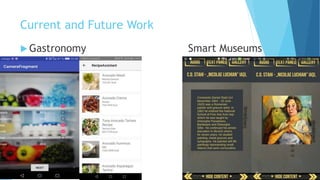
Current and Future Work
 Gastronomy Smart Museums
Bibliography
[1] https://www.edsurge.com/news/2015-11-02-how-to-transform-your-classroom-with-augmented-reality
[2] http://www.augment.com/blog/5-reasons-use-augmented-reality-education/
Thank you!
14

Augmented Reality in Education

  • 1.
    Enhancing the Attractivenessof Learning through Augmented Reality Adrian Iftene, Dragoș Silion adiftene@info.uaic.ro, dragos.silion@gmail.com 18 September 2019, Iasi, Romania Alexandru Ioan Cuza University of Iasi Faculty of Computer Science
  • 2.
    Content  Augmented reality What is augmented reality?  Domains of augmented reality  Lessons for the Primary and Secondary Cycles  ARBio Application  GeoAR Application  Developing Communication Skills and Teamwork  Supporting Ships in the Air  Hunting Treasure  Conclusions  Bibliography
  • 3.
    What is “augmentedreality”?  Augmented Reality (AR) content can be accessed by scanning or viewing a trigger image with a mobile device that creates a subsequent action [1]
  • 4.
  • 5.
    Students projects  Education Games  Interior design 5
  • 6.
    AR Bio –Ana-Maria Daradici  A modern learning method and an interesting experience for a user of any age  ARToolkit framework (AR), Android, JNI (Java Native Interface), Autodesk Maya (3D Model)  Positive aspects: the association that the app makes between the marker, three-dimensional model, associated sounds, and additional Wikipedia details  Negative aspects: they blocked the app when multiple markers are being used at the same time, and multiple audio files are being played simultaneously 6
  • 7.
    Geo AR  Helpspupils in secondary school where they have to learn the geography of Europe (countries, capitals, flags and neighbors)  Vuforia, Unity, JNI Android technology  Positive things: Users will consider playing a game and they have to retain as much detail as possible to be the best player. Also, the test and knowledge assessment component is not a stress and emotional component as a written test or as an oral evaluation 7
  • 8.
    Supporting Ships inthe Air  Metaio, Java, Android  Positive things: the effect of the application on autistic children was positive, when they use the multiplayer option 8
  • 9.
    Hunting Treasure  Sphero,Vuforia, Unity, Android, Client-Server component  Positive things: Sphero was easier to control than expected, and interaction elements between players, 3D models, and game dynamics were most appreciated by the volunteers  Negative things: the ambiguity of the interface, the multi-player component had problems of performance and stability 9
  • 10.
    Advantages to useAR in Education  Students can access the electronic content from anywhere (bus, metro, home, parks, etc.)  Costs are reduced in areas where laboratory work is mandatory (architecture, medicine, construction, chemistry, physics, etc.)  Animations, 3D models, sounds and movies attract young children, but also young people and adults  The evaluation can be thought of as games, thus reducing the stress that occurs in such situations, the participants playing with each other can learn without realizing this 10
  • 11.
    Conclusions  AR willnot replace the existing pedagogical paradigms  Our aims were to help professors and students in educational process  We want to adapt existing technologies and to use them in our advantages  Our current work include other domains like chemistry, history 11
  • 12.
    Current and FutureWork  Gastronomy Smart Museums
  • 13.
  • 14.

Editor's Notes

  • #5 landing take-off Traveled distance Cartoon character
  • #6 + visual, audio, text, video information come to help us to understand better + we can learn anywhere (it’s not mandatory to be at school, at home, near computer or book) + can reduce the cost in the case of experimental tests - Interaction with professor and with real materials is mandatory to understand in the right way the new information
  • #7 dress the animals with the fur