Augmented Reality
CSC428 – HUMAN-COMPUTER INTERACTION |YSTALLONNE ALVES
9
Agenda
                                                       
                                                       2


    Introduction
    How AR works
    History and AR’s technologies
    Effective AR Innovations
    Expected Improvements in AR
    Final thoughts/Q&A              © PSD Graphics.


    References
9
Introduction
                                                       
                                                       3


    According to Azuma, the de facto definition for
     AR includes three caracteristhics: (2)

       1. It combines real and virtual.
       2. It is interactive in real time.
       3. It is registered in 3D.
9
How AR works
                                                       
                                                       4


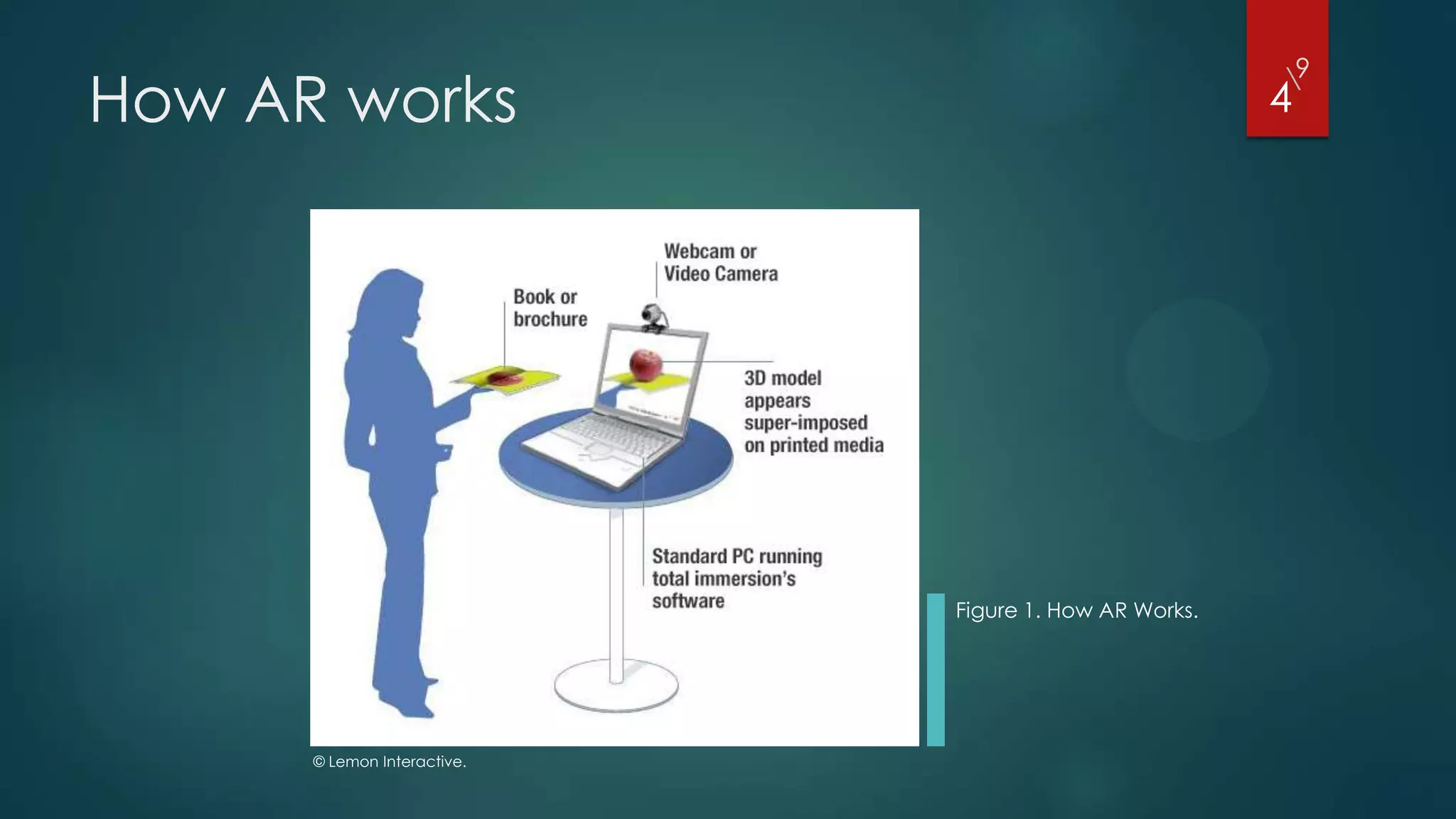
                             Figure 1. How AR Works.


      © Lemon Interactive.
9
History and AR’s technologies
                                                                     
                                                                 5


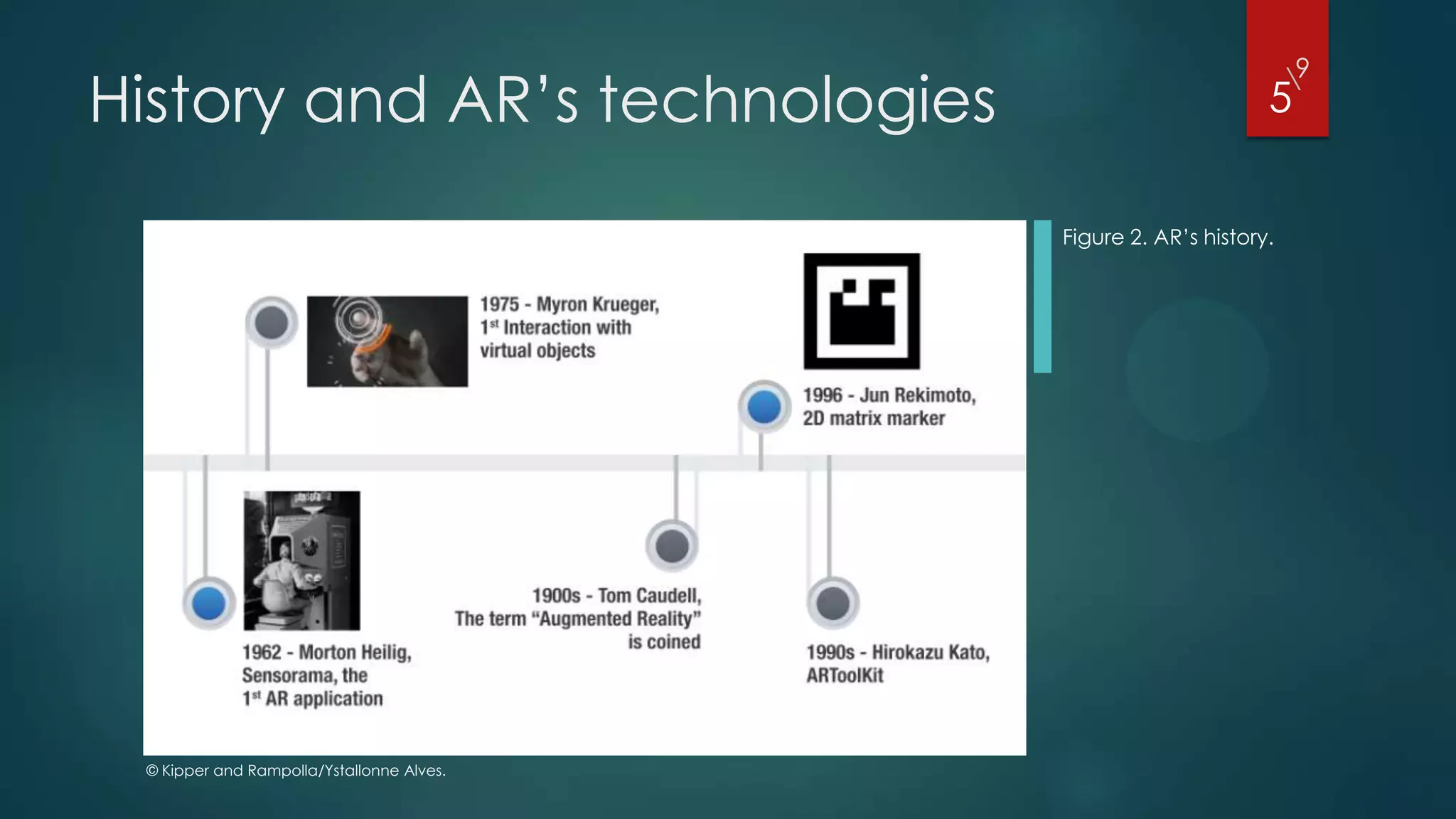
                                           Figure 2. AR’s history.


 © Kipper and Rampolla/Ystallonne Alves.
9
Effective AR Innovations
                                                                              
                                                                              6


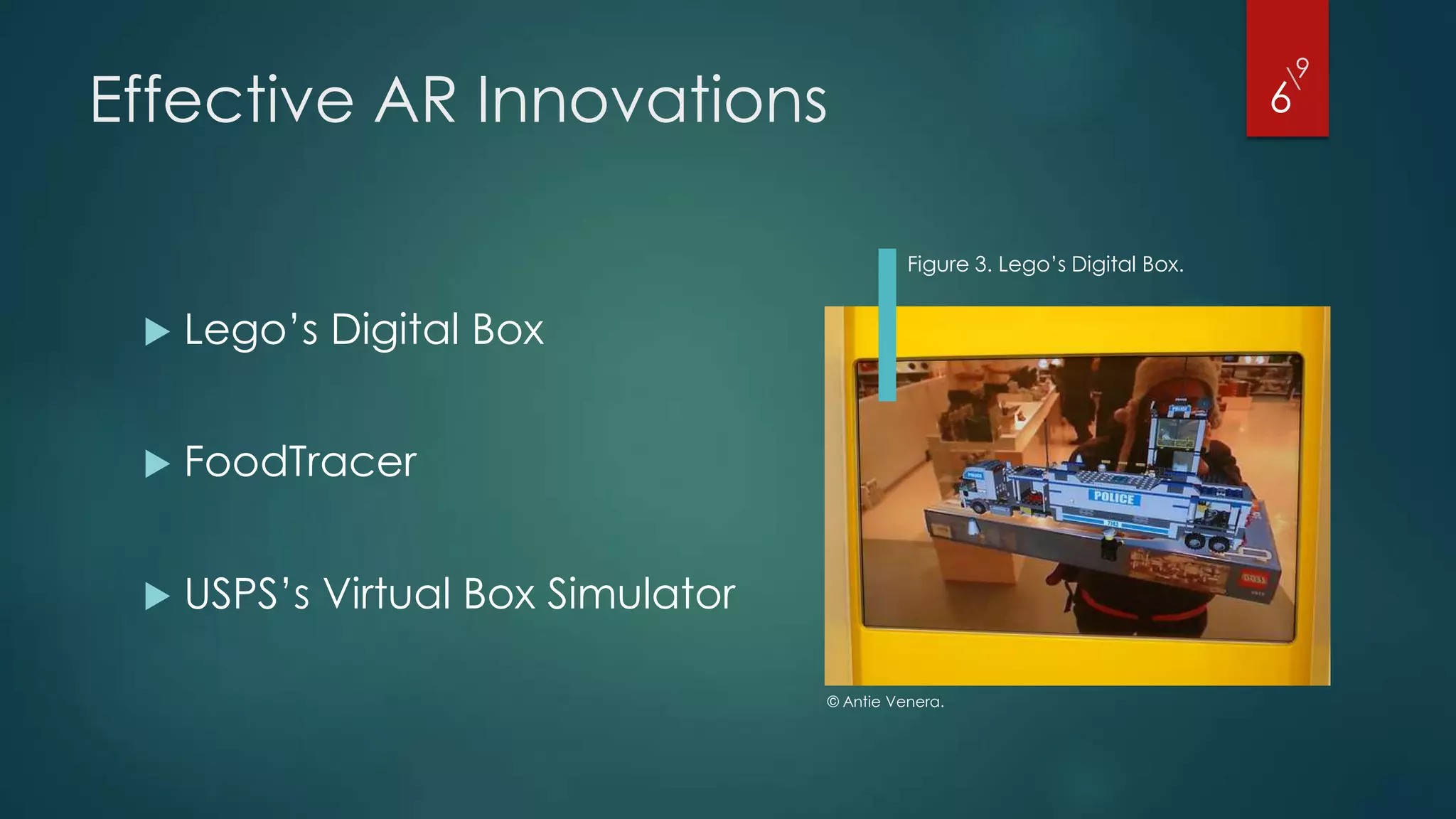
                                              Figure 3. Lego’s Digital Box.


    Lego’s Digital Box


    FoodTracer


    USPS’s Virtual Box Simulator

                                    © Antie Venera.
9
Expected Improvements in AR
                                               
                                               7


  Hybrid   approaches
  Real-time     systems
  Perceptual     and psychophysical studies
  Portability
  Multi-modal     displays
  Social   and political issues
9
Final thoughts/Q&A
                                        
                                       8


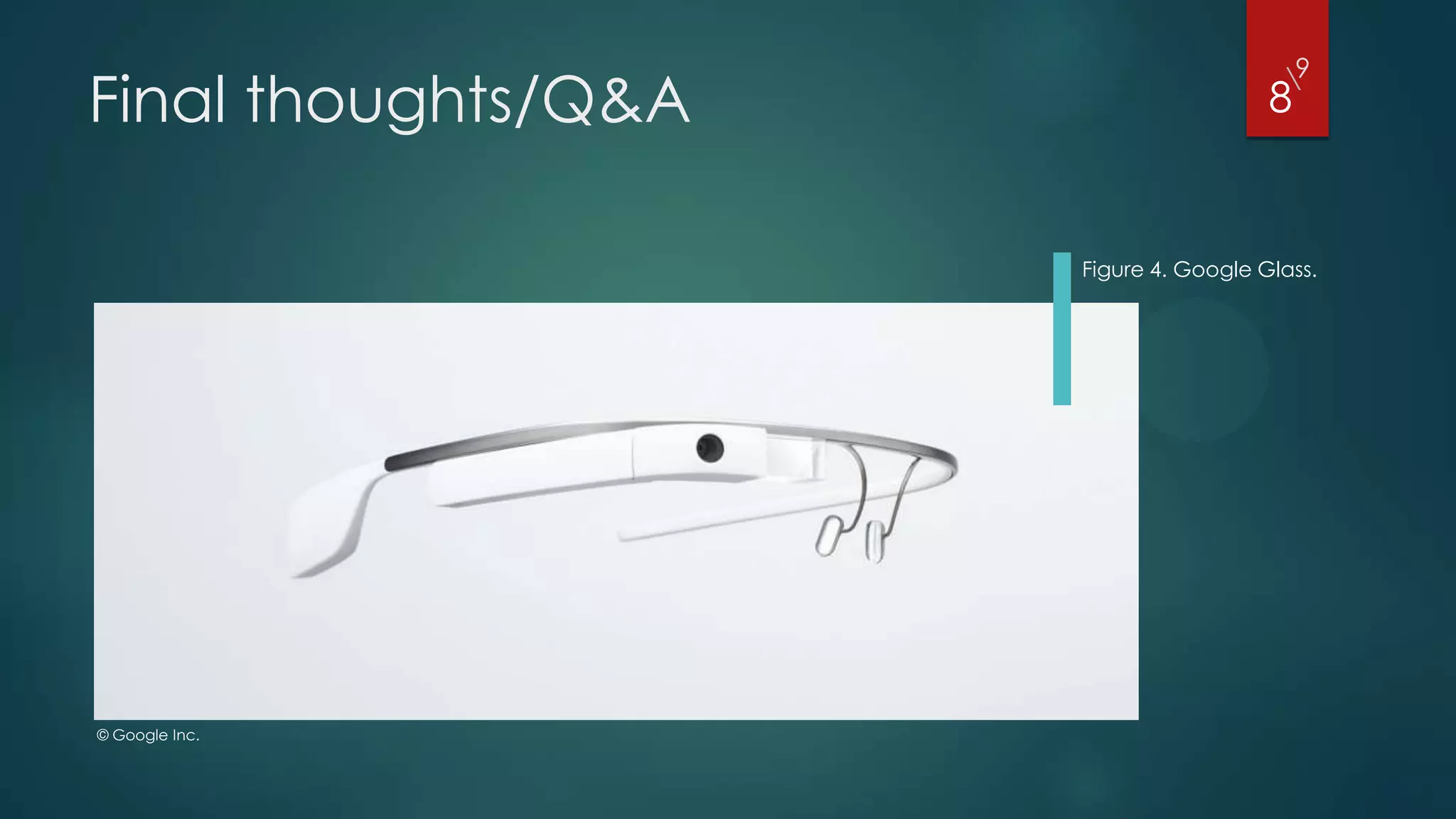
                     Figure 4. Google Glass.


© Google Inc.
9
References
                                                                                                                                   
                                                                                                                                   9


  1.    Ajanki, Antti et al. An augmented reality interface to contextual information. London: Springer-Verlag; Dec 2010. Web.

  2.    Azuma, Ronald. A survey of augmented reality. Malibu: In Presence: Teleoperators and Virtual Environments 6, 4, 355-385;
        Aug. 1997. Print.

  3.    Bonsor, Kevin. How Augmented Reality Works. 19 Feb. 2001. HowStuffWorks.com.
        <http://computer.howstuffworks.com/augmented-reality.htm>. 21 Mar. 2013. Web.

  4.    Carmigniani, Julie et al. Augmented reality technologies, systems and applications. Springer; 14 Dec. 2010. Web.

  5.    Kipper, Greg; Rampolla, Joseph. Augmented Reality - An Emerging Technologies Guide to AR. Waltham: Syngress; Dec.
        2012. Print.

  6.    Lemon Interactive. <http://www.lemoninteractive.co.uk/images/how%20augmented%20reality%20works.jpg>. 21 Mar.
        2013. Web.

  7.    Madden, Lester. Professional Augmented Reality Browsers for Smartphones: Programming for junaio, Layar, and Wikitude.
        Chichester: John Wiley & Sons; 2 Aug. 2011. Print.

  8.    Mastrion, Guy. Augmented Reality: The New, New Media. UK: Pharmaceutical Executive 30. 7: 82-83; Jul. 2010. Print.

  9.    Mullen, Tony. Prototyping Augmented Reality. Indianapolis: John Wiley & Sons, Inc.; 18 Oct. 2011. Print.

  10.   Roche, Kyle. Pro iOS 5 Augmented Reality. Apress; 14 Dec. 2011. Print.

  11.   Ward, Trevor. Augmented Reality using Appcelerator Titanium Starter. Birmingham: Packt Publishing; Oct. 2012. Web.

Augmented reality

  • 1.
    Augmented Reality CSC428 –HUMAN-COMPUTER INTERACTION |YSTALLONNE ALVES
  • 2.
    9 Agenda 2  Introduction  How AR works  History and AR’s technologies  Effective AR Innovations  Expected Improvements in AR  Final thoughts/Q&A © PSD Graphics.  References
  • 3.
    9 Introduction 3  According to Azuma, the de facto definition for AR includes three caracteristhics: (2) 1. It combines real and virtual. 2. It is interactive in real time. 3. It is registered in 3D.
  • 4.
    9 How AR works 4 Figure 1. How AR Works. © Lemon Interactive.
  • 5.
    9 History and AR’stechnologies 5 Figure 2. AR’s history. © Kipper and Rampolla/Ystallonne Alves.
  • 6.
    9 Effective AR Innovations 6 Figure 3. Lego’s Digital Box.  Lego’s Digital Box  FoodTracer  USPS’s Virtual Box Simulator © Antie Venera.
  • 7.
    9 Expected Improvements inAR 7  Hybrid approaches  Real-time systems  Perceptual and psychophysical studies  Portability  Multi-modal displays  Social and political issues
  • 8.
    9 Final thoughts/Q&A 8 Figure 4. Google Glass. © Google Inc.
  • 9.
    9 References 9 1. Ajanki, Antti et al. An augmented reality interface to contextual information. London: Springer-Verlag; Dec 2010. Web. 2. Azuma, Ronald. A survey of augmented reality. Malibu: In Presence: Teleoperators and Virtual Environments 6, 4, 355-385; Aug. 1997. Print. 3. Bonsor, Kevin. How Augmented Reality Works. 19 Feb. 2001. HowStuffWorks.com. <http://computer.howstuffworks.com/augmented-reality.htm>. 21 Mar. 2013. Web. 4. Carmigniani, Julie et al. Augmented reality technologies, systems and applications. Springer; 14 Dec. 2010. Web. 5. Kipper, Greg; Rampolla, Joseph. Augmented Reality - An Emerging Technologies Guide to AR. Waltham: Syngress; Dec. 2012. Print. 6. Lemon Interactive. <http://www.lemoninteractive.co.uk/images/how%20augmented%20reality%20works.jpg>. 21 Mar. 2013. Web. 7. Madden, Lester. Professional Augmented Reality Browsers for Smartphones: Programming for junaio, Layar, and Wikitude. Chichester: John Wiley & Sons; 2 Aug. 2011. Print. 8. Mastrion, Guy. Augmented Reality: The New, New Media. UK: Pharmaceutical Executive 30. 7: 82-83; Jul. 2010. Print. 9. Mullen, Tony. Prototyping Augmented Reality. Indianapolis: John Wiley & Sons, Inc.; 18 Oct. 2011. Print. 10. Roche, Kyle. Pro iOS 5 Augmented Reality. Apress; 14 Dec. 2011. Print. 11. Ward, Trevor. Augmented Reality using Appcelerator Titanium Starter. Birmingham: Packt Publishing; Oct. 2012. Web.