Defining augmented reality,virtual reality and mix reality
• Augmented Reality
The word ‘augmented’ means to add. It might not sound as exciting as VR but has impacted
our lives deeply. Augmented reality uses different tools to make the real and existing environment
better and provides an improved version of reality.
Example Of AR:
• Snapchat filters
• Instagram filters
• Pokémon Go
Some AR apps that allow a customer to place virtual furniture in their house before buying.
Projection-based AR applications allow human interaction by sending light onto a real surface and
then sensing human touch, learning has become way more interesting and easy with AR, marker less
AR provides data based on our location, it is also a powerful tool for marketing as it allows users to
try products before buying.
3.
• Virtual Reality(VR)
• The word ‘virtual’ means something that is conceptual and does not exist physically and the word
‘reality’ means the state of being real. So the term ‘virtual reality’ is itself conflicting. It means
something that is almost real.
• The best Example of We will probably never be on the top of Mount Everest or dive deep into the
Mariana Trench or step on the Moon, but we might be able to do all these things without even
stepping out of our homes, this is where Virtual Reality comes to the rescue.
• In simple words, Virtual Reality means we can experience things that never actually happen. It
actually tricks our brain into thinking that we are in a different place using 3 of our senses-seeing,
hearing, and touching. It creates a different world, and we feel we are a part of it, both physically
and mentally.
4.
• Virtual Reality(VR) has a lot of applications, some of them are:
1.Entertainment-Used for gaming, 3D cinema, and in theme parks.
2.Medicine-Used for surgery training, exposure therapy for people with phobia or anxiety disorder.
3.Skill training-Used for astronaut training, flight training, military training, etc.
• Mixed Reality (MR):
• It brings real-world and digital elements together. But wait, this is what AR does, so what is the
difference?
• It integrates digital objects and real-world in such a way that it makes it look like the objects really
belong there.
• Mixed Reality works by scanning our physical environment and creating a map of our
surroundings so that the device will know exactly how to place digital content into that space –
realistically –allowing us to interact with it.
5.
• A fewExamples of MR apps are:
1.An app that allows users to place notes around their environment.
2.A television app placed in comfortable spots for viewing.
3.A cooking app placed on the kitchen wall.
4.Microsoft’s HoloLens is also a famous example of MR.
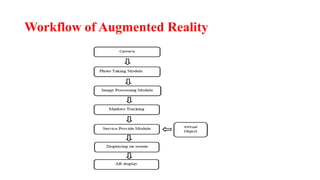
• Augmented Reality(AR) is a technology that overlays digital information, such as
images, videos, 3D models, or text, onto the real-world environment, typically
viewed through a device like a smartphone or AR glasses. The workflow of
augmented reality can be divided into several key steps:
1. Content Creation and Development:
Design and create the digital content that will be overlaid onto the
real world. This content can include 3D models, animations, videos, text,
or other interactive elements.
2. Tracking and Recognition:
Define the markers or tracking points in the real world that the AR
system will use to understand its position and orientation in the
environment. This can include image recognition, GPS, sensors, or other
tracking methods.
3. Device and App Development:
Develop the AR application or experience for the target device,
which could be a smartphone, tablet, or AR glasses. This involves
programming the app to recognize tracking markers and display the
8.
4. Sensors andData Collection:
Use various sensors, such as cameras, accelerometers, and gyroscopes, to collect real-
time data about the user's environment. This data helps the AR system understand the user's
position and orientation in the physical world.
5. Image Processing and Computer Vision:
Employ image processing and computer vision algorithms to analyze the data from
the device's sensors and cameras. This allows the system to recognize tracking markers and
other objects in the real world.
6. Content Rendering and Display:
Overlay the digital content onto the real-world view provided by the device's camera.
The content must be rendered accurately and in the right perspective to create a seamless AR
experience.
7. Interaction and User Interface:
Implement user interfaces and interaction methods that allow users to interact with
and manipulate the AR content. This can include gestures, voice commands, touch inputs, or
other control mechanisms.
8. Networking and Data Communication:
If applicable, establish network connections for sharing AR experiences or data with
other users or remote servers. This is crucial for multiplayer AR applications or for retrieving
additional information from the internet.
9.
9. Testing andQuality Assurance:
Thoroughly test the AR application to ensure it works correctly in various real-
world scenarios. Address any bugs or issues that arise during testing.
10. Deployment:
Publish the AR application to the appropriate platform, such as app stores for
smartphones or dedicated distribution channels for AR glasses. Make it available for
users to download and install.
11. User Training and Education:
Provide user guides or tutorials to help users understand how to use the AR
application and interact with the augmented content effectively.
12. Updates and Maintenance:
Continuously update and maintain the AR application to improve performance, fix
bugs, and add new features or content to keep the experience fresh and engaging.
The workflow of augmented reality development can vary depending on the complexity
of the AR experience and the target platform. It involves a combination of hardware,
software, and creative design to deliver immersive and interactive augmented reality
experiences to users.
10.
Component Of AugmentedReality:
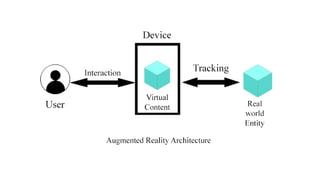
• Augmented reality (AR) consists of six different components:
1.User
2.Device
3.Interaction
4.Virtual Content
5.Tracking
6.Real life Entity
• This Architecture comprised of all above components and interactive relationship between them
helps to develop augmented reality working model.
11.
1.User: The mostessential part of augmented reality is its user. The user can be a student, doctor,
employee. This user is responsible for creation of AR models.
2.Interaction: It is a process between device and user. The word itself consist of its meaning some action
perform by one entity as result in creation or some action performed by other entity.
3.Device: This component is responsible for creation, display and interaction of 3D models. The device
can be portal or in static state. Example, mobile, computer, AR headsets etc.
4. Virtual Content: The virtual content is nothing but the 3D model created or generated by the system
or AR application. Virtual content is type of information that can be integrated in real world user’s
environment. This Virtual content can be 3D models, texture, text, images etc.
5. Tracking: This component is basically process which makes possible creation of AR models. Tracking
is sort of algorithm which help to determine the device where to place or integrate the 3D model in real
world environment. There are many types of Tracking algorithm available which can be used in
development of AR applications.
6. Real-life entity: The last component AR architecture is real world entities. This entities can be tree,
book, fruits, computer or anything which is visible in screen. AR application does not change position of
real life entity. It only integrate the digital information with this entities.