Group Members
Adam Ebiro
Adam Abdulaziz
Bune
Midaga Mengistu
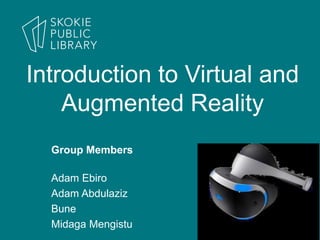
Introduction to Virtual and
Augmented Reality
What is virtual reality?
Virtual reality (VR) is an artificial,
computer-generated simulation or
recreation of a real life environment or
situation. It immerses the user primarily by
stimulating their vision and hearing.
• Replaces real world
• Immersive multimedia/computer-simulated
• Replicates environment
• Simulates physical presence
• Allows interaction
• First introduced in the 1950s
• Push in gaming world in 1990s
• Headset consumer market today
Virtual Reality (VR)
• Virtual travel, field trips
–Places, spaces, and SPACE
• Immersive training
–Military
–Driving
–Other Simulations
• Storytelling
• Gaming
• Therapy
• Marketing
Who’s the best of the best for VR?
VR is typically achieved through wearable hardware,
Like:-
 Facebook’s Oculus,
 The HTC Vive,
 Samsung Gear VR, or
 The Microsoft HoloLens (also capable of AR).
What’s augmented reality?
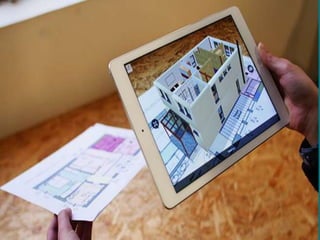
Augmented reality (AR) is a technology that
layers interactive, virtual enhancements atop an
existing reality. AR is developed into apps and
used on mobile devices to blends digital
components.
Augmented Reality (AR)
• Augments or adds to real world
• Blends digital with physical world
• Upcoming technology, using glasses or
headsets with smart devices (phones,
tablets)
The Mixed Reality Comparison
Virtual reality offers a digital
recreation of a real life setting, while
augmented reality delivers virtual
elements as an overlay to the real
world.
Headsets, Glasses and
Devices
Oculus Rift
HTC Vive
Samsung Gear
Google Cardboard
Zeiss VR One and Zeiss VR
One GX
Sony PS4
Google Glass
Microsoft Hololens
Exploration Time
• Mattel View-Master ® VR Viewer (4) to use
with 2 library devices and personal devices
• DSCVR I am Cardboard Viewer for Google
Expeditions demo
• Google Cardboard (original)to use with
personal devices
• iPads with Pokemon Go, inkHunter
• zSpace
Devices and Apps to Try
Want a copy of this presentation?
Visit www.skokielibrary.info/handouts/xxxxx
where this presentation will be available for four
weeks.
Thank you!

Introduction to Virtual and Augmented Reality

  • 1.
    Group Members Adam Ebiro AdamAbdulaziz Bune Midaga Mengistu Introduction to Virtual and Augmented Reality
  • 2.
    What is virtualreality? Virtual reality (VR) is an artificial, computer-generated simulation or recreation of a real life environment or situation. It immerses the user primarily by stimulating their vision and hearing.
  • 5.
    • Replaces realworld • Immersive multimedia/computer-simulated • Replicates environment • Simulates physical presence • Allows interaction • First introduced in the 1950s • Push in gaming world in 1990s • Headset consumer market today Virtual Reality (VR)
  • 6.
    • Virtual travel,field trips –Places, spaces, and SPACE • Immersive training –Military –Driving –Other Simulations • Storytelling • Gaming • Therapy • Marketing
  • 7.
    Who’s the bestof the best for VR? VR is typically achieved through wearable hardware, Like:-  Facebook’s Oculus,  The HTC Vive,  Samsung Gear VR, or  The Microsoft HoloLens (also capable of AR).
  • 8.
    What’s augmented reality? Augmentedreality (AR) is a technology that layers interactive, virtual enhancements atop an existing reality. AR is developed into apps and used on mobile devices to blends digital components.
  • 11.
    Augmented Reality (AR) •Augments or adds to real world • Blends digital with physical world • Upcoming technology, using glasses or headsets with smart devices (phones, tablets)
  • 12.
    The Mixed RealityComparison Virtual reality offers a digital recreation of a real life setting, while augmented reality delivers virtual elements as an overlay to the real world.
  • 13.
  • 14.
  • 15.
  • 16.
  • 17.
  • 18.
    Zeiss VR Oneand Zeiss VR One GX
  • 19.
  • 20.
  • 21.
  • 22.
  • 23.
    • Mattel View-Master® VR Viewer (4) to use with 2 library devices and personal devices • DSCVR I am Cardboard Viewer for Google Expeditions demo • Google Cardboard (original)to use with personal devices • iPads with Pokemon Go, inkHunter • zSpace Devices and Apps to Try
  • 24.
    Want a copyof this presentation? Visit www.skokielibrary.info/handouts/xxxxx where this presentation will be available for four weeks. Thank you!

Editor's Notes

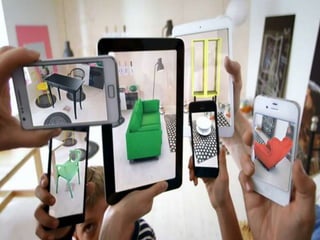
  • #11 IKEA Augmented Reality catalog (for 2017) to visualize how furniture will fit in your personal spaces. Uses 3D and AR technologies.
  • #15 Rift includes the headset with built-in headphones and mic, sensor, and an Xbox One controller. The controller is perfect for a variety of games, including Lucky’s Tale, the amazing VR platformer developed by Playful, that we’re including free with every Rift. Requires PC computer with specific hardware requirements. graphics card: NVIDIA GTX 970 / AMD R9 290 equivalent or greater processor: Intel i5-4590 equivalent or greater memory: 8GB+ RAM output: Compatible HDMI 1.3 video output input: 3x USB 3.0 ports plus 1x USB 2.0 port operating system: Windows 7 SP1 64 bit or newer
  • #16 Can order now for $799. Includes headset, two wireless controllers, and two base stations for 360 degrees room-scale motion-tracking. Need optimized PC like with Oculus Rift. Works with Steam entertainment platform.
  • #17 Powered by Oculus. $99 headset model meant to use with Samsung smartphone. Download VR apps.
  • #18 Least expensive, starting at $15. Uses magnetic controller. Can build your own or purchase. Several Google Cardboard viewers now, including Mattel View-Master that we’ll try later.
  • #19 Headset that works with specific smartphones starting at $129. GX version meant to work with Google Cardboard apps. Has magnetic controller.
  • #20 VR Device. In development. Meant to work with PlayStation 4 gaming console. Bundle pack starting at $499. https://www.playstation.com/en-us/explore/playstation-vr/
  • #21 discontinued
  • #22 AR device targeting users for gaming, working, connecting. Beyond AR and actually Mixed Reality according to Microsoft. Mixed reality blends 3D holographic content into your physical world, giving your holograms real-world context and scale, allowing you to interact with both digital content and the world around you.