Audiometric Testing and Analysis
Occupational Health Doctor
© 2020 NIOSH Malaysia. All rights reserved.
1
Learning Objectives
At the end of the session, participants will be
able to:
❖ Define the concept of Audiometric Testing under
Noise Exposure Regulations 2019
❖ Explain how to interpret audiogram
❖ Understand DOSH notification criteria for Noise
related hearing disorders.
© 2020 NIOSH Malaysia. All rights reserved.
2
Scope
❖ Basic Principle of Audiometric
❖ General Duties of Employer, OHD, Audiometric Testing Centre,
and Audiometric Technician
❖ Type of Audiogram
❖ Audiometric Equipment
❖ Audiometric Testing Flow Chart
❖ Audiometric Report
❖ Audiogram Interpretation
❖ Medical Examination and Referral
❖ Notification
❖ Case Study
© 2020 NIOSH Malaysia. All rights reserved.
3
Basic Principle of Audiometric
❖Early identification of hearing damage
❖Not a preventive mechanism - complement
the comprehensive hearing conservation
program (HCP)
❖Testing program shall be available to any
employee exposed to NEL
❖Conducted at no cost to the employees
© 2020 NIOSH Malaysia. All rights reserved.
4
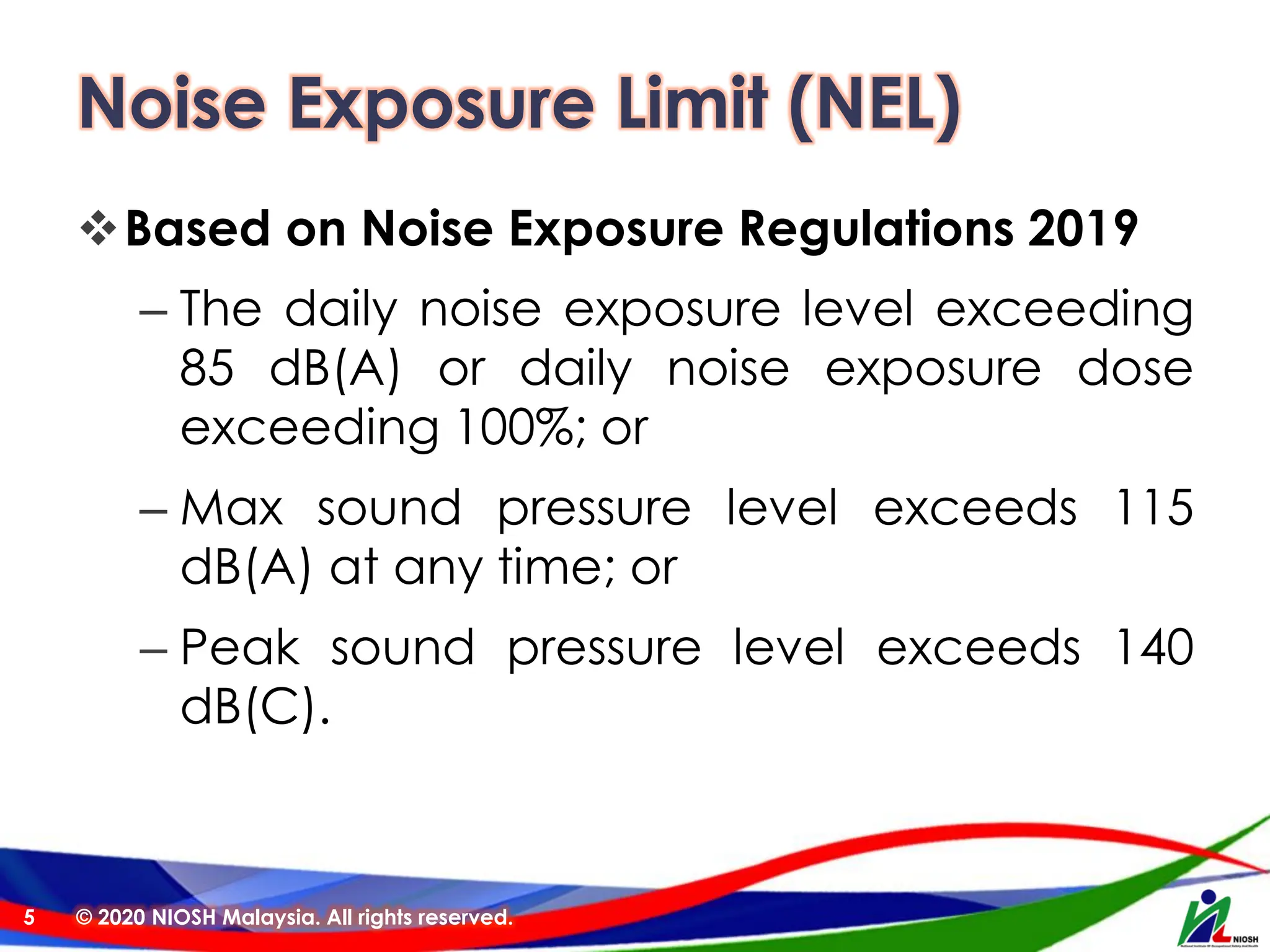
Noise Exposure Limit (NEL)
❖Based on Noise Exposure Regulations 2019
– The daily noise exposure level exceeding
85 dB(A) or daily noise exposure dose
exceeding 100%; or
– Max sound pressure level exceeds 115
dB(A) at any time; or
– Peak sound pressure level exceeds 140
dB(C).
© 2020 NIOSH Malaysia. All rights reserved.
5
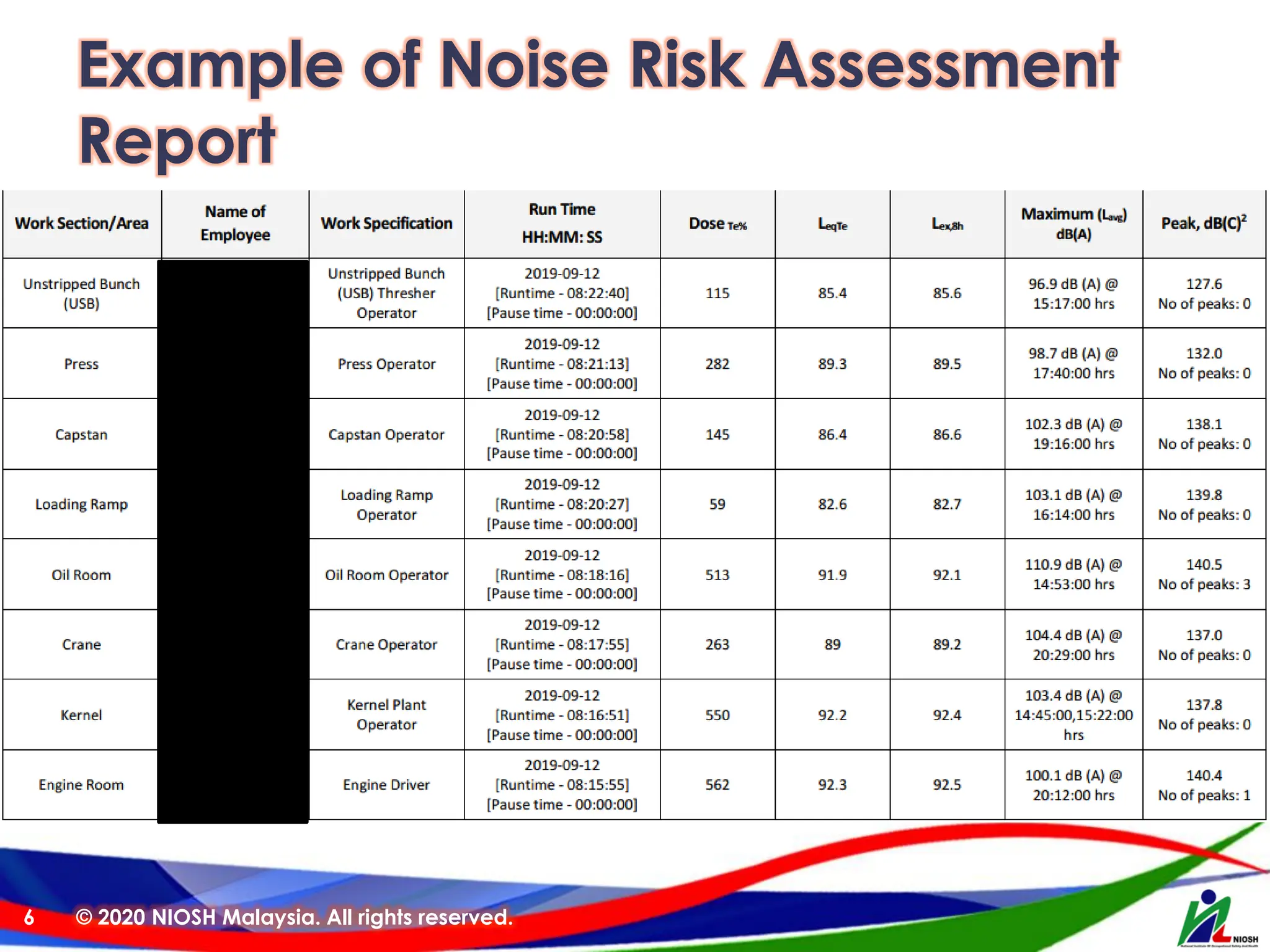
Example of Noise Risk Assessment
Report
© 2020 NIOSH Malaysia. All rights reserved.
6
Duties of Employer
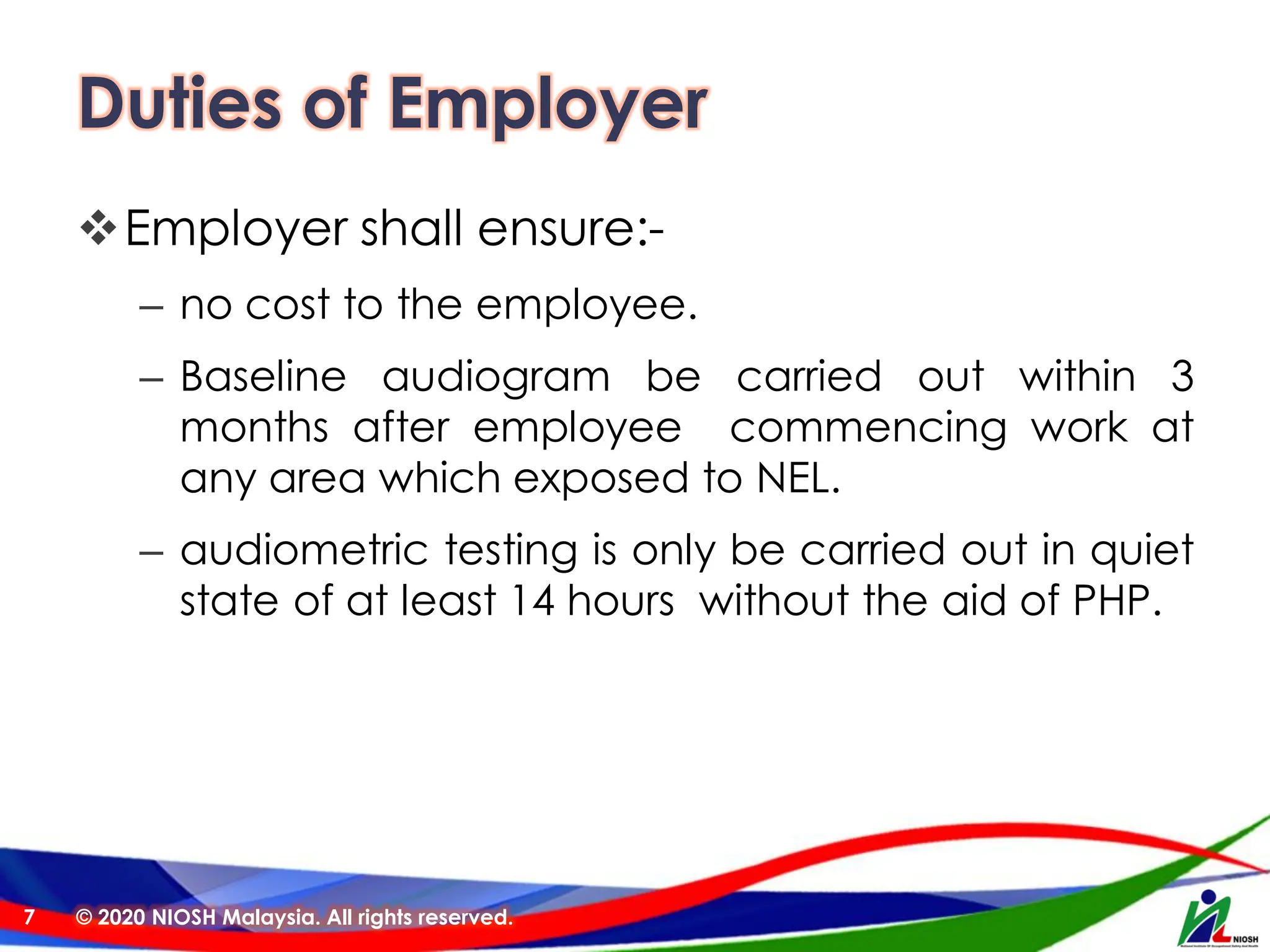
❖Employer shall ensure:-
– no cost to the employee.
– Baseline audiogram be carried out within 3
months after employee commencing work at
any area which exposed to NEL.
– audiometric testing is only be carried out in quiet
state of at least 14 hours without the aid of PHP.
© 2020 NIOSH Malaysia. All rights reserved.
7
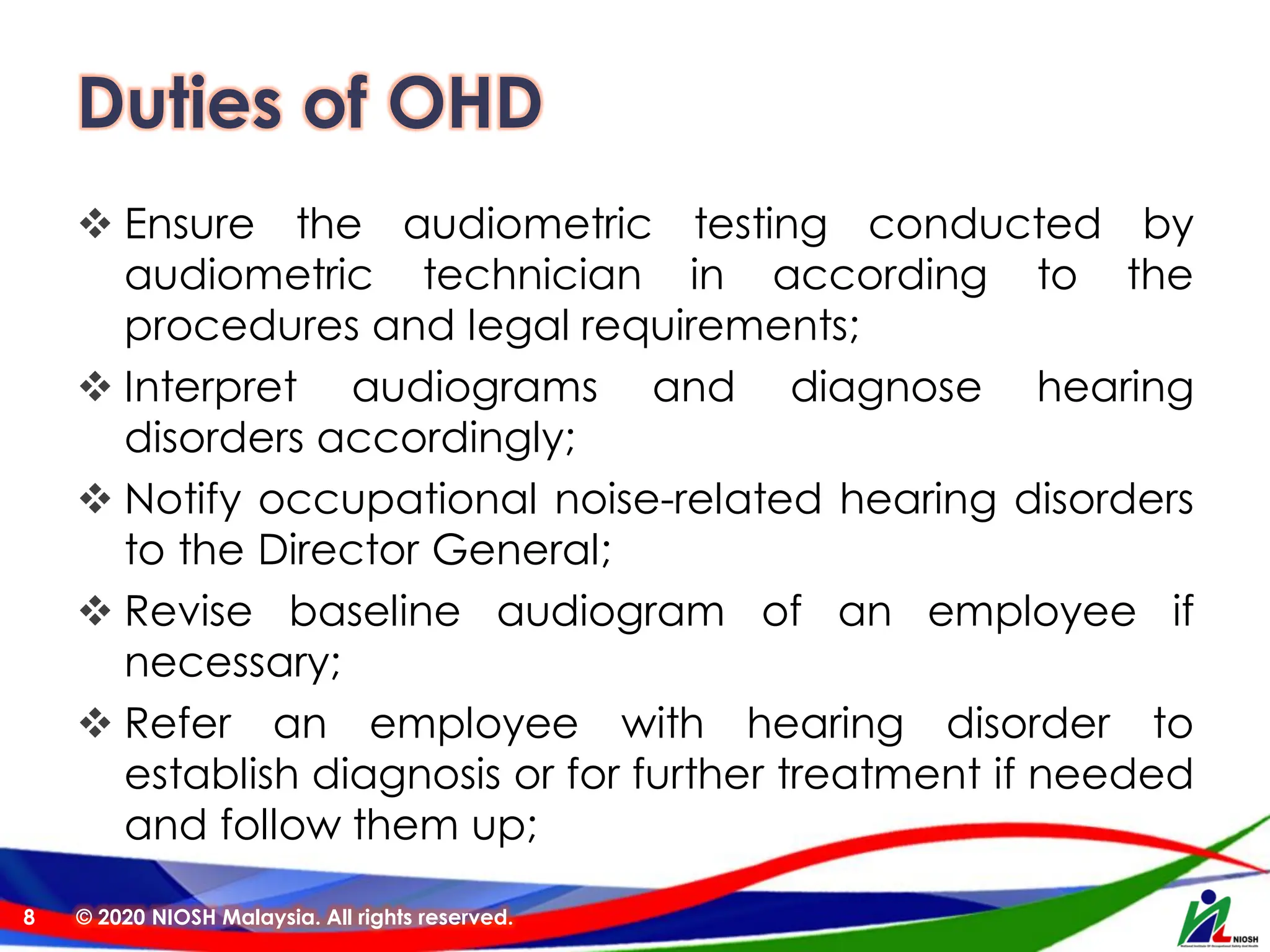
Duties of OHD
❖ Ensure the audiometric testing conducted by
audiometric technician in according to the
procedures and legal requirements;
❖ Interpret audiograms and diagnose hearing
disorders accordingly;
❖ Notify occupational noise-related hearing disorders
to the Director General;
❖ Revise baseline audiogram of an employee if
necessary;
❖ Refer an employee with hearing disorder to
establish diagnosis or for further treatment if needed
and follow them up;
© 2020 NIOSH Malaysia. All rights reserved.
8
Duties of OHD (Cont...)
❖ Instruct the employer to repeat the audiometric
testing of an employee with STS within three (3)
months from the date of previous audiometric test;
❖ Perform medical examination for an employee with
an abnormal audiogram;
❖ Instruct the employer to refit and retrain in the use
of PHP for an employee with hearing impairment,
hearing loss or permanent STS;
❖ Inform an employee with an abnormal audiogram
regarding his condition and educate him on best
practices to conserve hearing.
© 2020 NIOSH Malaysia. All rights reserved.
9
Duties of Audiometric Technician
❖Audiometric technician shall be under
supervision by OHD
❖Conduct audiometric testing within the valid
registration period of audiometric test
centre;
❖Ensure audiometers and related equipment
are functioning properly;
❖Collect information regarding a worker’s
conditions which may affect the test results
and determining his fitness for the test;
© 2020 NIOSH Malaysia. All rights reserved.
10
Duties of Audiometric Technician
(Cont…)
❖ Visually examine worker’s ears to look for signs of
infection, excessive ear wax or any other physical
condition that may affect the test;
❖ Describe the purpose and procedure of test;
❖ Perform audiometric test for each ear separately;
❖ Maintain a relevant record for each audiometer
that includes calibration records;
❖ Ensure workers’ medical information is kept
confidential; and
❖ Provide other support services for OHD and related
healthcare professionals.
© 2020 NIOSH Malaysia. All rights reserved.
11
Duties of Audiometric Test Centre
❖ Make arrangement with employer with regards to audiometric
testing program;
❖ Ensure audiometric testing conducted within the valid
registration period of audiometric test centre;
❖ Ensure that the audiometric testing is only be carried out on
employee after the employee is being put in a state of quiet
of at least 14 hours without the aid of PHP;
❖ Notify at least two (2) weeks before conducting any
audiometric testing program to Director of the respective
DOSH state office;
❖ Submit a report of the result of audiometric testing to the
employer within 30 days from the date of audiometric testing;
© 2020 NIOSH Malaysia. All rights reserved.
12
Duties of Audiometric Test Centre
(Cont…)
❖ Notify the Director General of any changes
regarding the approved audiometric test centre,
including: appointed audiometric technician;
– appointed OHD;
– owner of audiometric test centre;
– change in the location of static audiometric testing
centre;
– facilities of the static and mobile audiometric testing
centre;
❖ Ensure regular maintenance and annual calibration
of audiometric test centre facilities;
© 2020 NIOSH Malaysia. All rights reserved.
13
Duties of Audiometric Test Centre
(Cont…)
❖ maintain a good recordkeeping of audiometric
testing; submit a summary of all audiometric report
for each calendar year to the Director General not
later than 31st January of the following year.
© 2020 NIOSH Malaysia. All rights reserved.
14
Testing
© 2020 NIOSH Malaysia. All rights reserved.
15
Types of Audiogram
❖Baseline audiograms
– Use to compare subsequent audiogram.
– Carried out baseline audiogramme within 3
months of the employee commencing work
which would expose to NEL.
❖Annual Audiograms
– To periodically monitor auditory status of
employee who exposed to noise > NEL
© 2020 NIOSH Malaysia. All rights reserved.
16
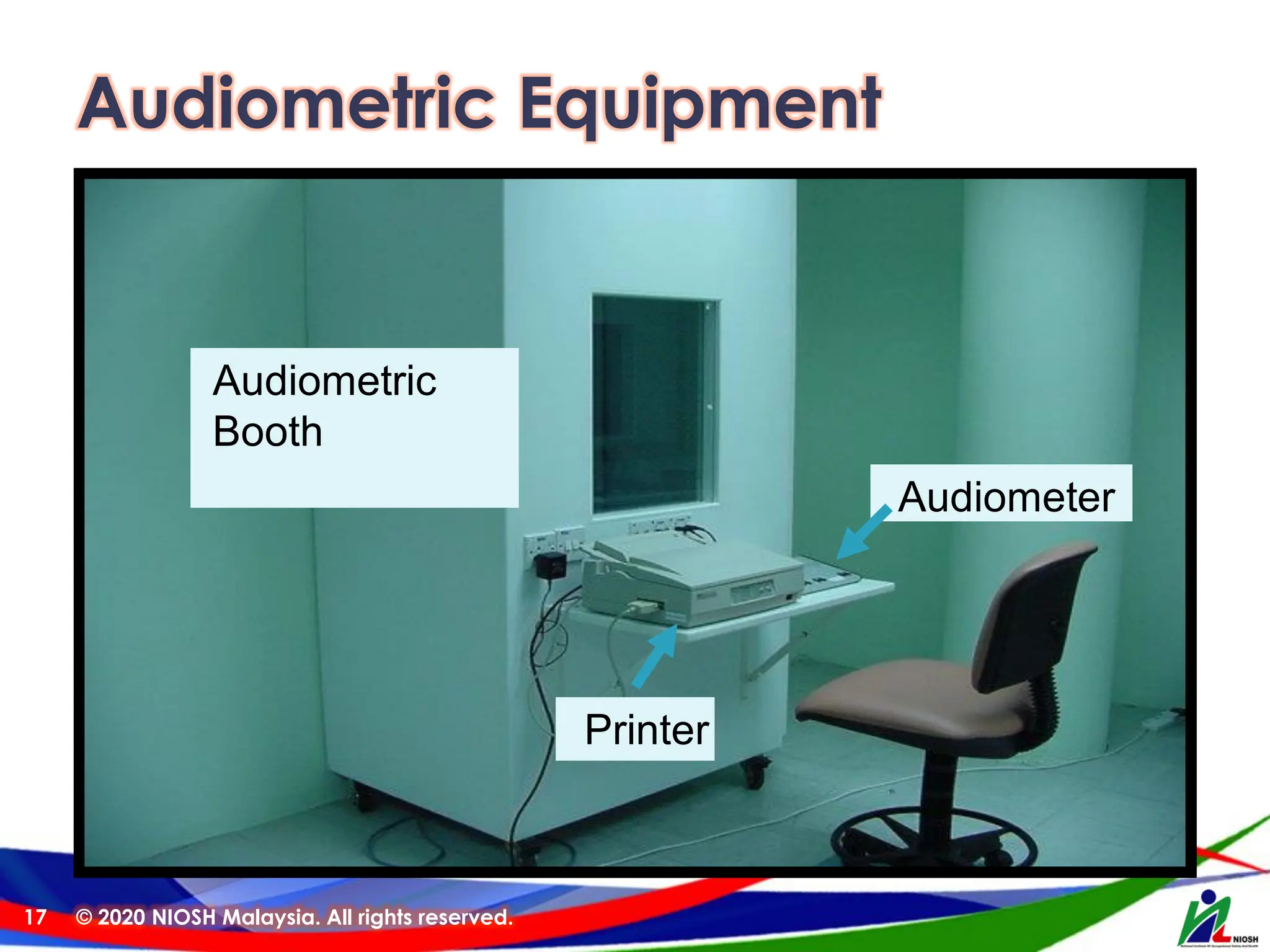
Audiometric Equipment
© 2020 NIOSH Malaysia. All rights reserved.
17
Audiometric
Booth
Audiometer
Printer
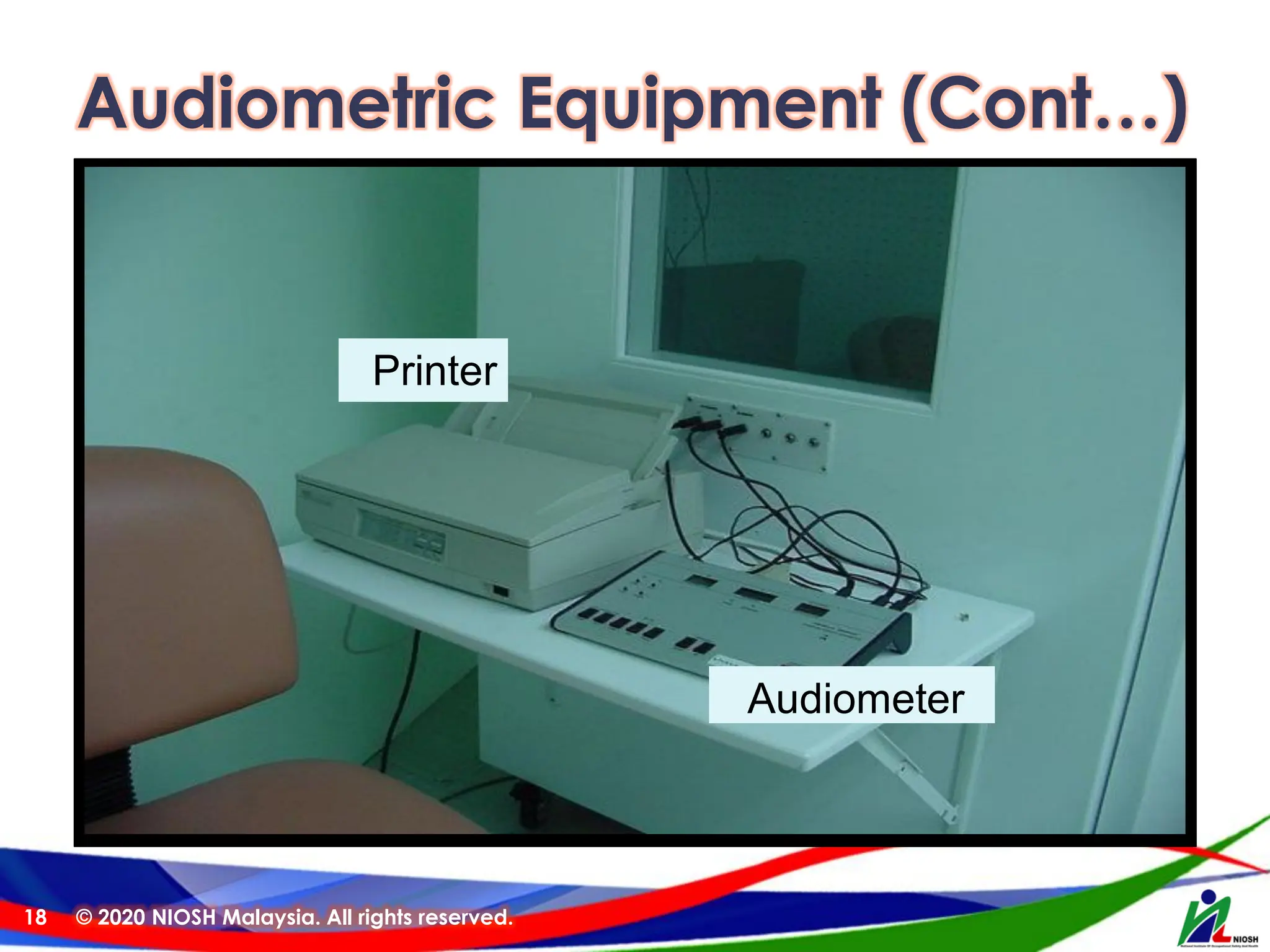
Audiometric Equipment (Cont…)
© 2020 NIOSH Malaysia. All rights reserved.
18
Audiometer
Printer
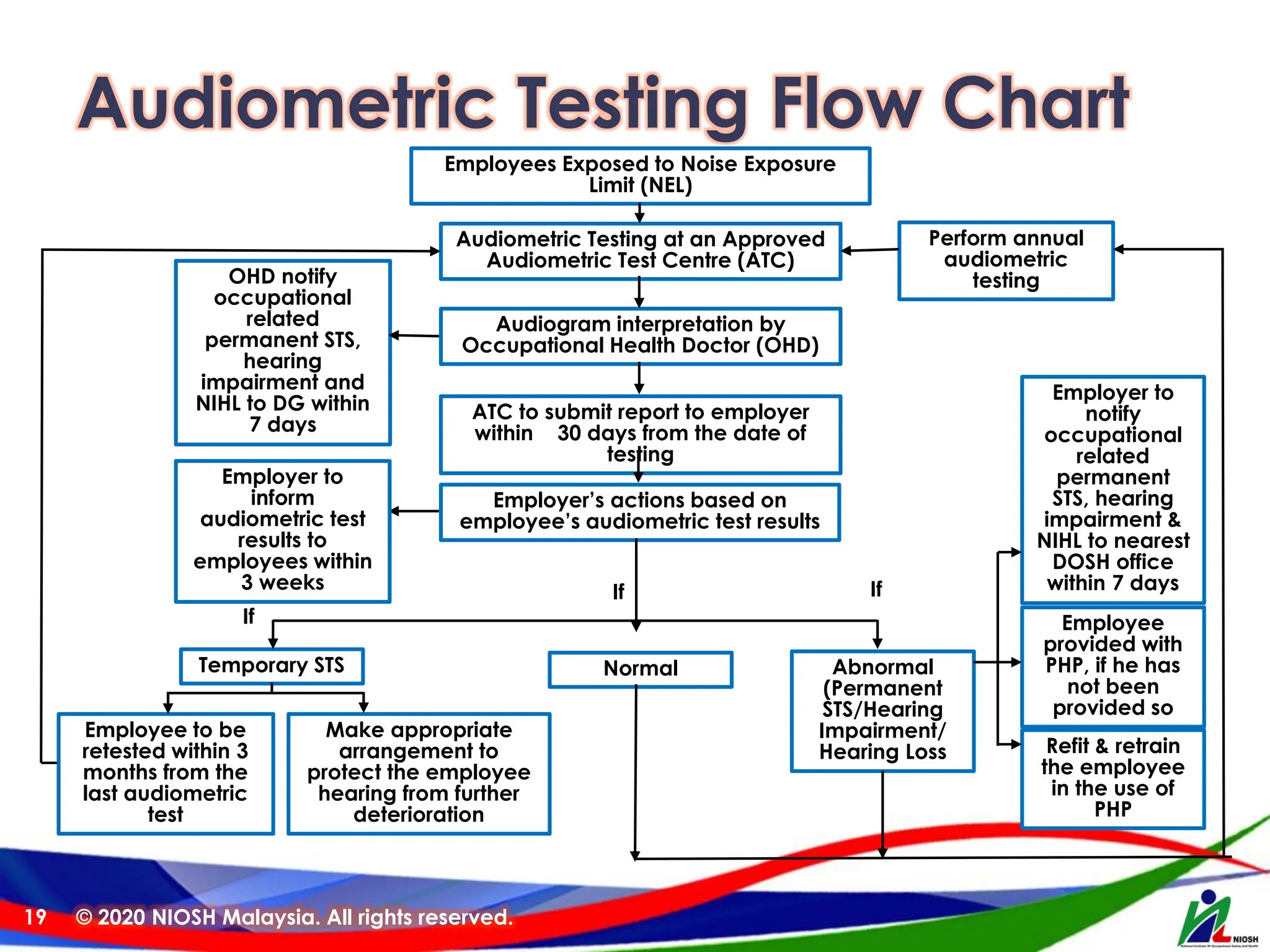
Audiometric Testing Flow Chart
© 2020 NIOSH Malaysia. All rights reserved.
19
Employees Exposed to Noise Exposure
Limit (NEL)
Audiometric Testing at an Approved
Audiometric Test Centre (ATC)
ATC to submit report to employer
within 30 days from the date of
testing
Temporary STS Normal Abnormal
(Permanent
STS/Hearing
Impairment/
Hearing Loss
Employer to
notify
occupational
related
permanent
STS, hearing
impairment &
NIHL to nearest
DOSH office
within 7 days
Employee
provided with
PHP, if he has
not been
provided so
Refit & retrain
the employee
in the use of
PHP
Employee to be
retested within 3
months from the
last audiometric
test
Make appropriate
arrangement to
protect the employee
hearing from further
deterioration
Employer to
inform
audiometric test
results to
employees within
3 weeks
OHD notify
occupational
related
permanent STS,
hearing
impairment and
NIHL to DG within
7 days
Perform annual
audiometric
testing
If
If
If
Employer’s actions based on
employee’s audiometric test results
Audiogram interpretation by
Occupational Health Doctor (OHD)
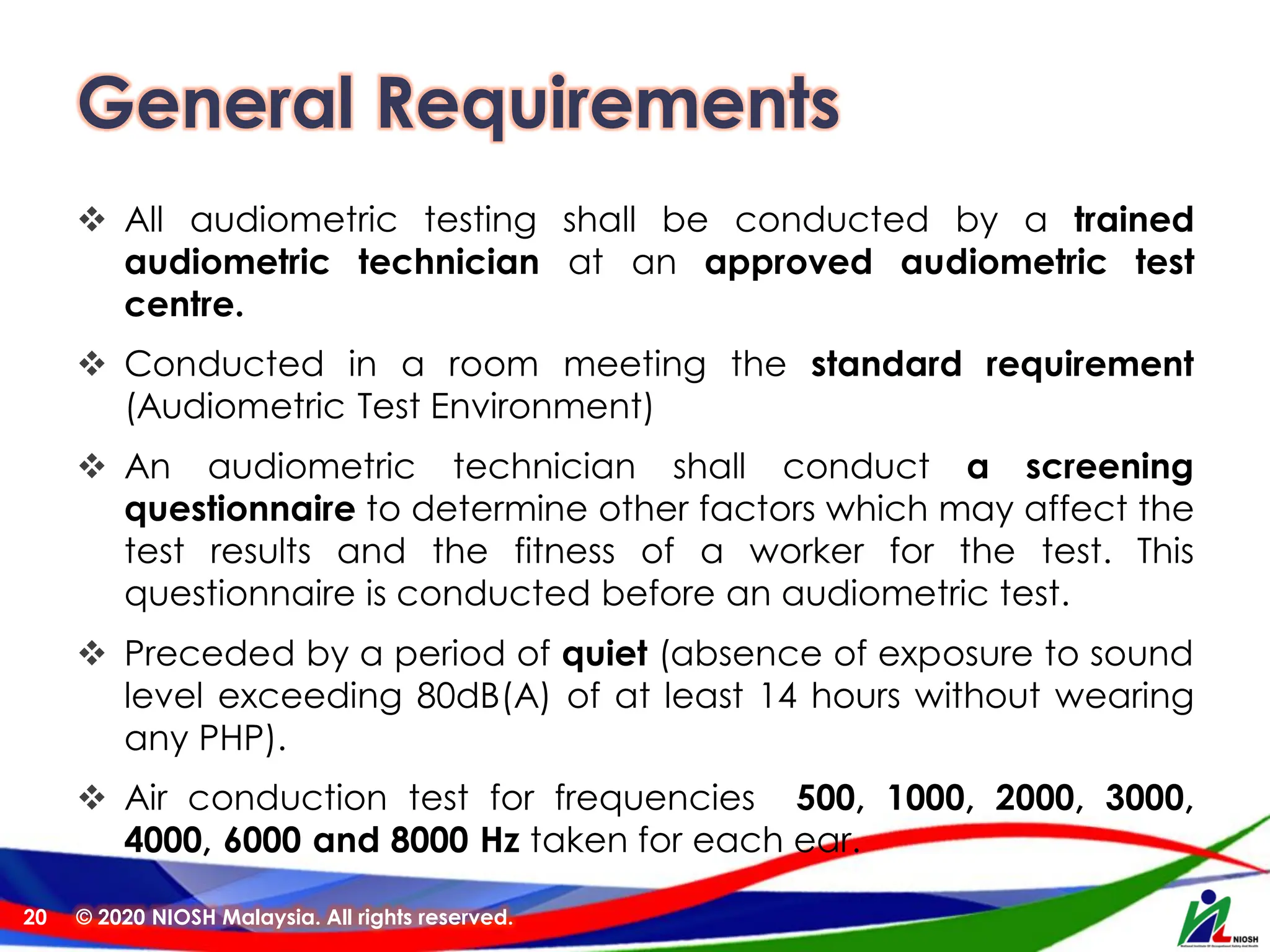
General Requirements
❖ All audiometric testing shall be conducted by a trained
audiometric technician at an approved audiometric test
centre.
❖ Conducted in a room meeting the standard requirement
(Audiometric Test Environment)
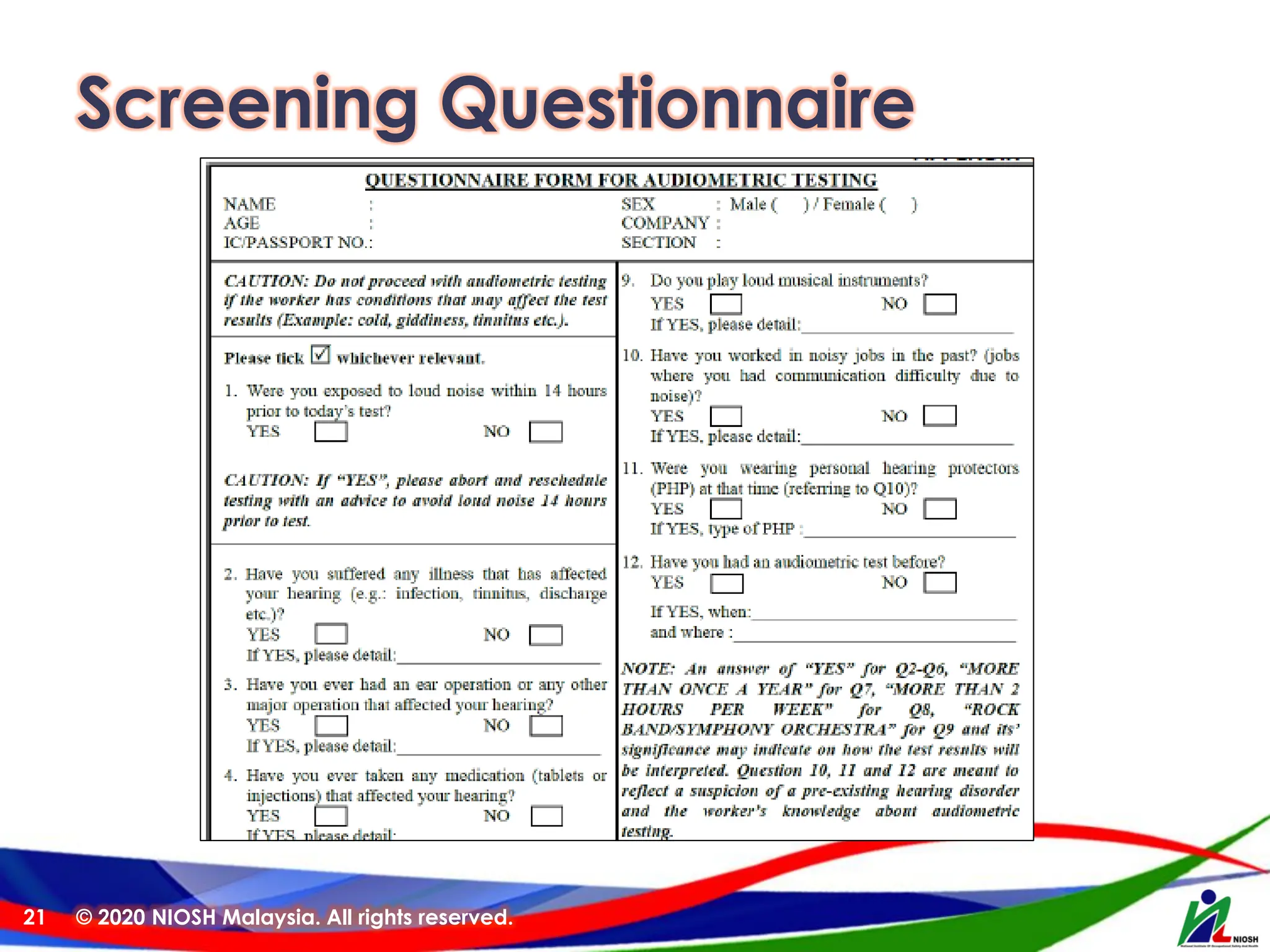
❖ An audiometric technician shall conduct a screening
questionnaire to determine other factors which may affect the
test results and the fitness of a worker for the test. This
questionnaire is conducted before an audiometric test.
❖ Preceded by a period of quiet (absence of exposure to sound
level exceeding 80dB(A) of at least 14 hours without wearing
any PHP).
❖ Air conduction test for frequencies 500, 1000, 2000, 3000,
4000, 6000 and 8000 Hz taken for each ear.
© 2020 NIOSH Malaysia. All rights reserved.
20
Screening Questionnaire
© 2020 NIOSH Malaysia. All rights reserved.
21
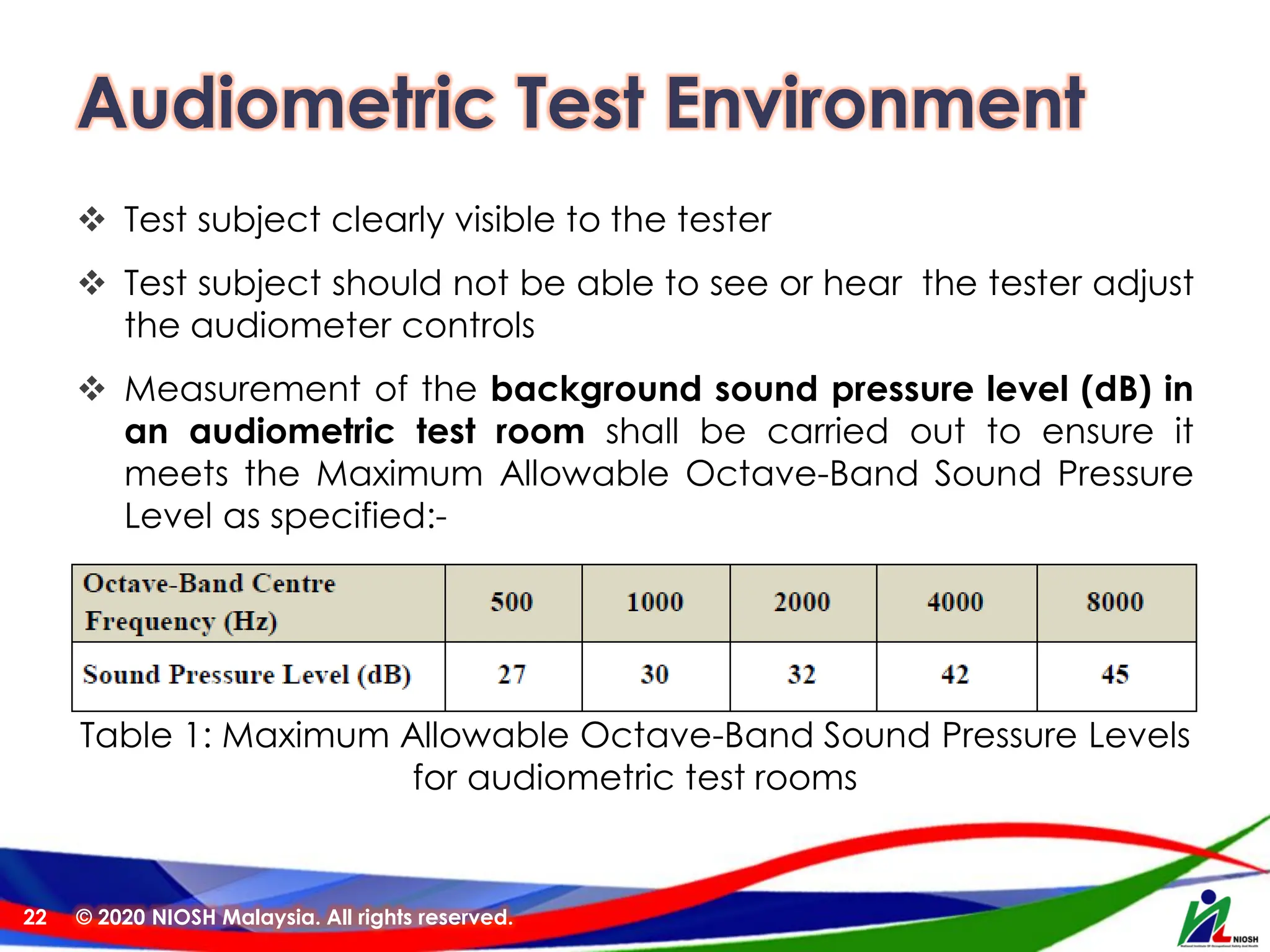
Audiometric Test Environment
❖ Test subject clearly visible to the tester
❖ Test subject should not be able to see or hear the tester adjust
the audiometer controls
❖ Measurement of the background sound pressure level (dB) in
an audiometric test room shall be carried out to ensure it
meets the Maximum Allowable Octave-Band Sound Pressure
Level as specified:-
© 2020 NIOSH Malaysia. All rights reserved.
22
Table 1: Maximum Allowable Octave-Band Sound Pressure Levels
for audiometric test rooms
Preparation for Testing
❖Fill up screening questionnaire
❖Explain to the worker about the test & the
regulatory requirement.
❖Preparation of test subjects:
– History
• Recent noise exposure
• Tinnitus etc.
❖Test the better ear first!
❖Explain testing procedure to employee
© 2020 NIOSH Malaysia. All rights reserved.
23
Explain Testing Procedure
❖ Educate how to use signal respond by pressing &
releasing immediately.
❖ Familiarize the worker with the tone by letting the
worker listen to the tone & signal.
❖ Headset placement:
– Remove eye glasses & earrings
– Audiocup: red – right; blue – left
– Place earphones directly at the opening of the ear canal
– Adjust to ensure tight fit
– Seat employee sideways from the tester so there is no
visible clue.
© 2020 NIOSH Malaysia. All rights reserved.
24
Instructions to the Worker
❖ “I am going to test your hearing by measuring the
quietest sounds that you can hear. As soon as you
hear a sound/tone, press the button. Press the
button when you hear the sound/tone, no matter
which ear you hear it in. Whatever the sound and
no matter how faint the sound, press the button as
soon as you think you hear it, and release it as soon
as you think it stops.”
❖ Ask if they understand the instructions
© 2020 NIOSH Malaysia. All rights reserved.
25
Subject’s Response
❖The subject’s response to the test tone
should clearly indicate when the test tone is
heard and when it is no longer heard.
© 2020 NIOSH Malaysia. All rights reserved.
26
Test Order
❖ Start with the better-hearing ear at a frequency of 1000 Hz.
❖ Then threshold is determined at 500 Hz, followed by a retest of
threshold at 1000 Hz. If the first and second thresholds at 1000
Hz agree within 5 dB, testing may continue for 2000, 3000,
4000, 6000, and 8000 Hz
❖ For the first ear only, retest at 1000 Hz.
❖ Take the more sensitive threshold as the final value.
❖ Then testing is started for the worse/left ear with the frequency
sequence of 1000, 500, 2000, 3000, 4000, 6000, and 8000 Hz.
❖ The retest at 1000 Hz is normally not required in the second
ear to be tested unless tests in the first ear revealed significant
variability.
© 2020 NIOSH Malaysia. All rights reserved.
27
Test Stimuli
❖Varied between 1 and 3 seconds
❖The tester must ensure that the timing of
each tone is not predictable
© 2020 NIOSH Malaysia. All rights reserved.
28
Initial Familiarisation
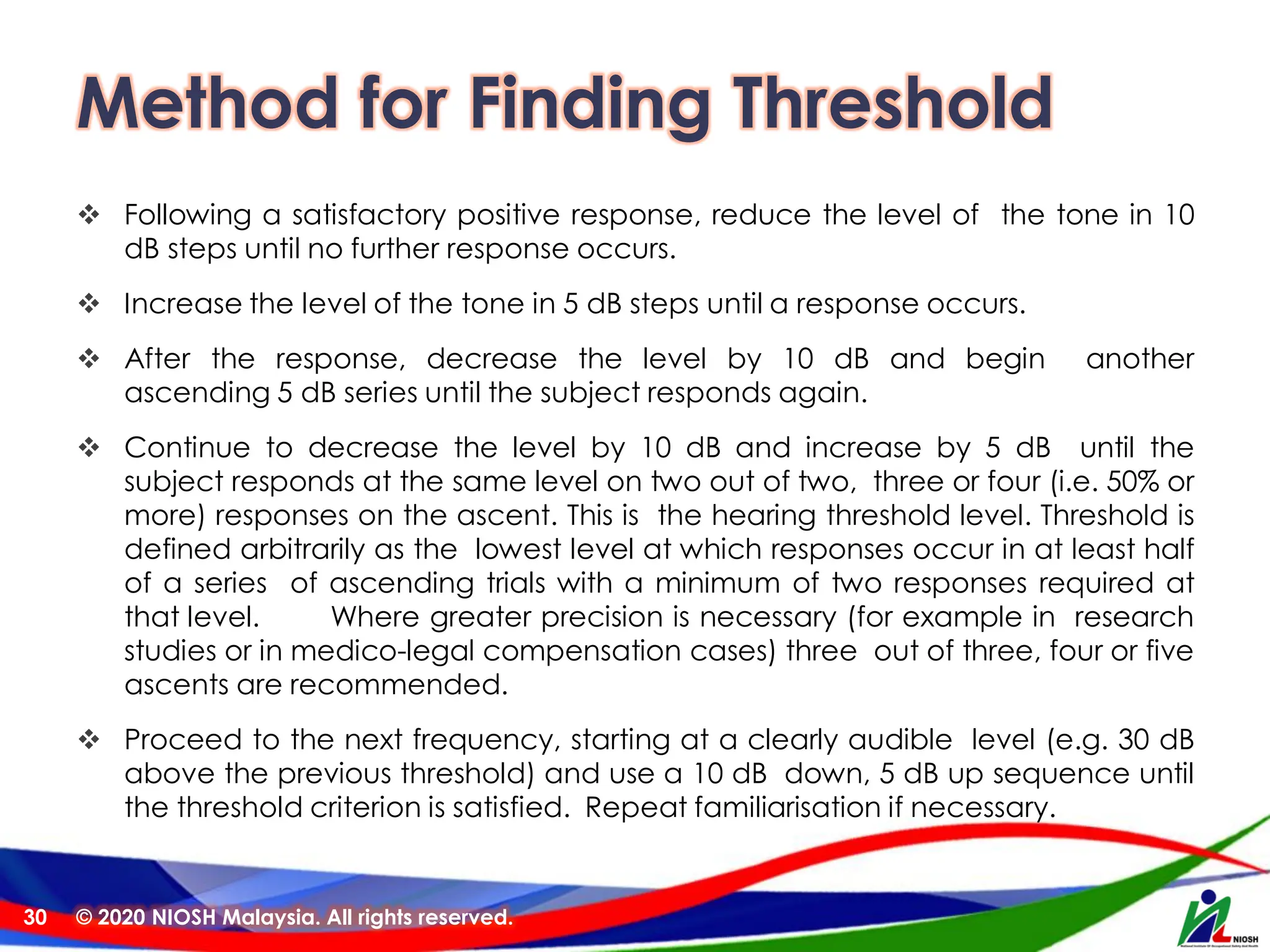
❖ Present a tone of 1000 Hz that is clearly audible, e.g. at
40 dB (A)
❖ If there is no response at this level, increase the level of
the tone in 10 dB (A) steps until a response occurs. If the
tone is still inaudible at 80 dB HL, increase the level of
the tone in 5 dB steps until a response occurs, taking
care to monitor the subject for discomfort.
❖ If the responses are consistent with the tone
presentation, i.e. onset and offset, the subject is
familiarised with the task. If not, repeat. If after this
repeat, their responses are unsatisfactory, re-instruct the
subject.
© 2020 NIOSH Malaysia. All rights reserved.
29
Method for Finding Threshold
❖ Following a satisfactory positive response, reduce the level of the tone in 10
dB steps until no further response occurs.
❖ Increase the level of the tone in 5 dB steps until a response occurs.
❖ After the response, decrease the level by 10 dB and begin another
ascending 5 dB series until the subject responds again.
❖ Continue to decrease the level by 10 dB and increase by 5 dB until the
subject responds at the same level on two out of two, three or four (i.e. 50% or
more) responses on the ascent. This is the hearing threshold level. Threshold is
defined arbitrarily as the lowest level at which responses occur in at least half
of a series of ascending trials with a minimum of two responses required at
that level. Where greater precision is necessary (for example in research
studies or in medico-legal compensation cases) three out of three, four or five
ascents are recommended.
❖ Proceed to the next frequency, starting at a clearly audible level (e.g. 30 dB
above the previous threshold) and use a 10 dB down, 5 dB up sequence until
the threshold criterion is satisfied. Repeat familiarisation if necessary.
© 2020 NIOSH Malaysia. All rights reserved.
30
Audiometric Report
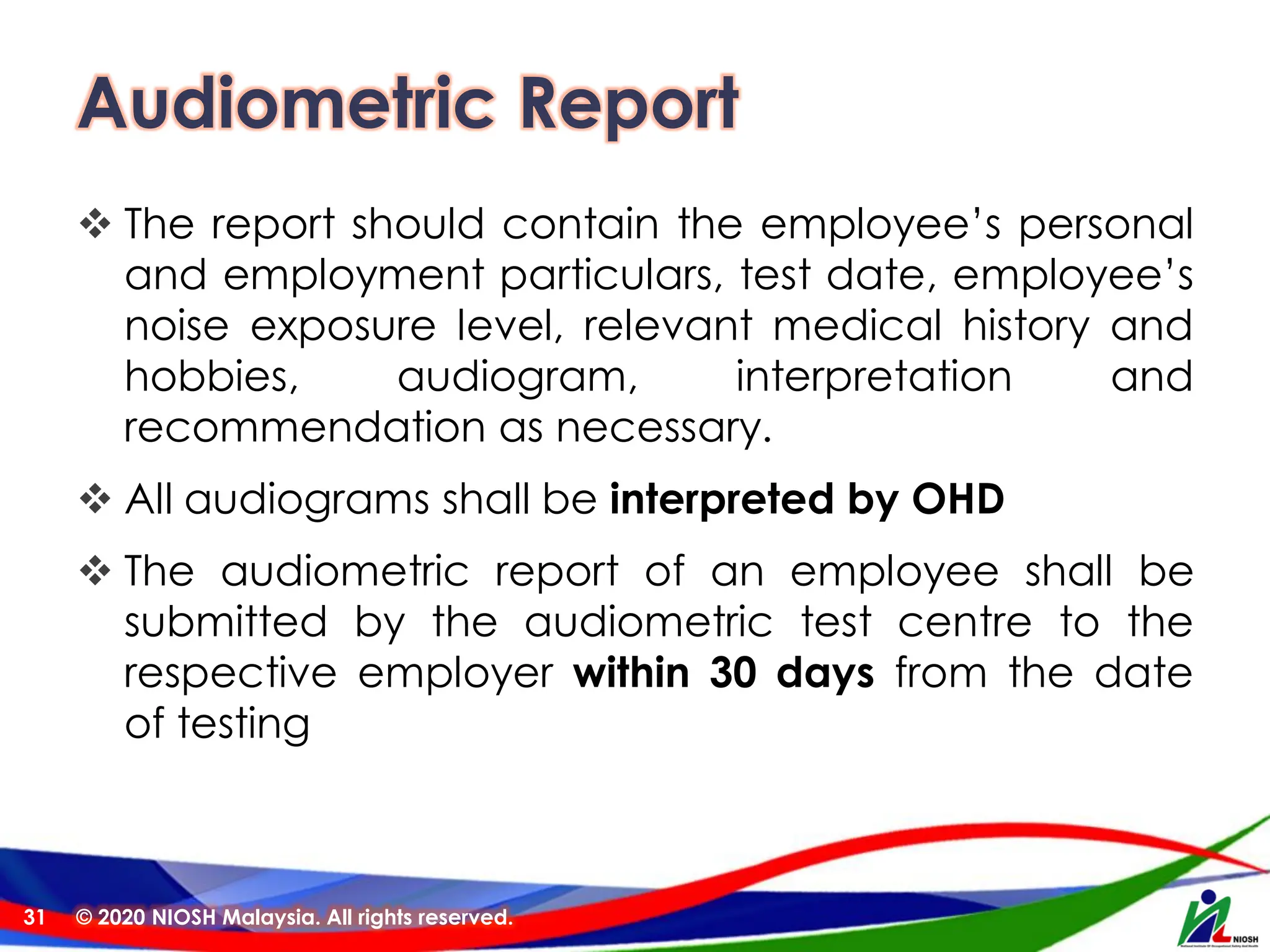
❖ The report should contain the employee’s personal
and employment particulars, test date, employee’s
noise exposure level, relevant medical history and
hobbies, audiogram, interpretation and
recommendation as necessary.
❖ All audiograms shall be interpreted by OHD
❖ The audiometric report of an employee shall be
submitted by the audiometric test centre to the
respective employer within 30 days from the date
of testing
© 2020 NIOSH Malaysia. All rights reserved.
31
Audiogram Interpretation
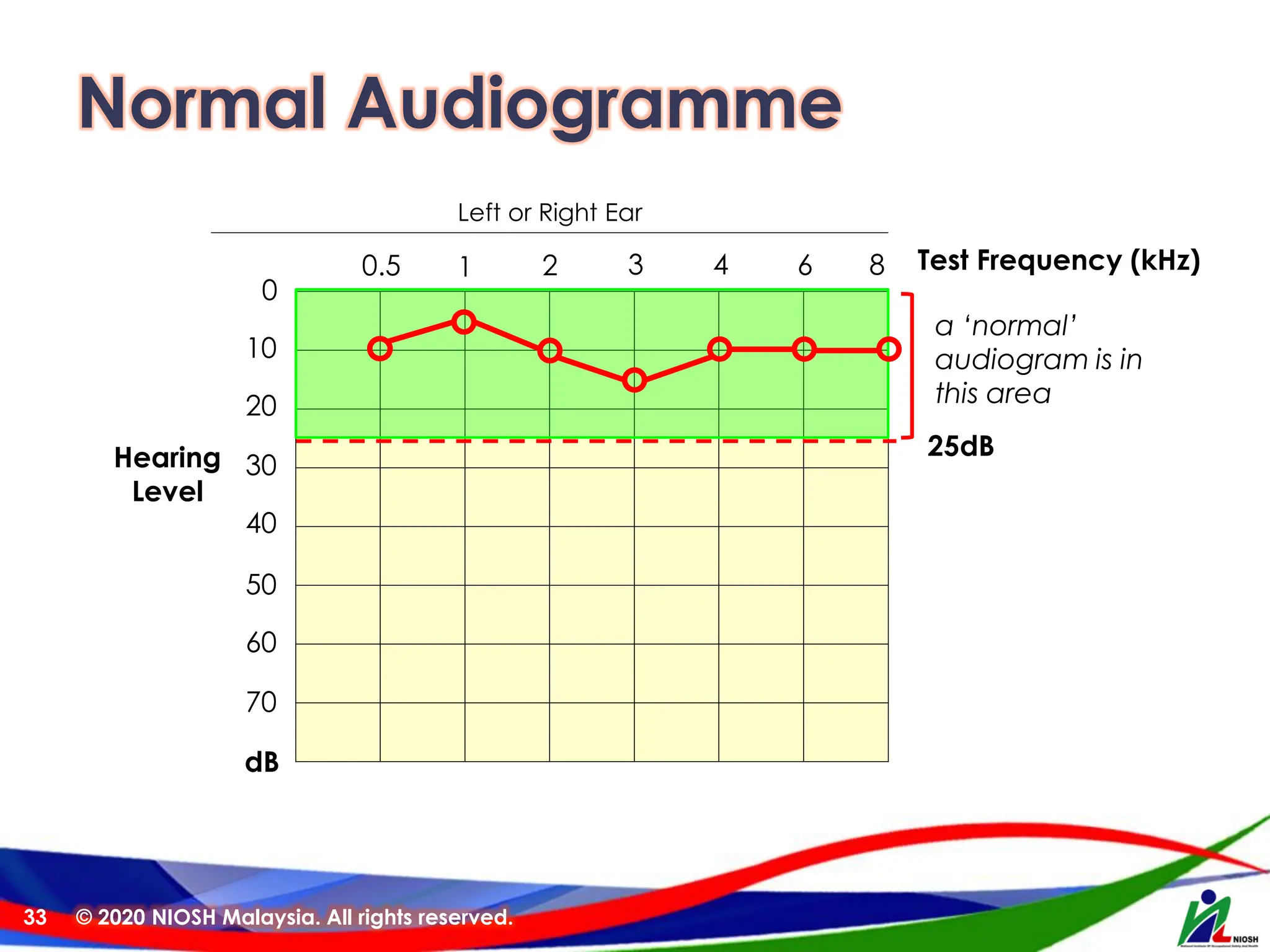
❖ Normal
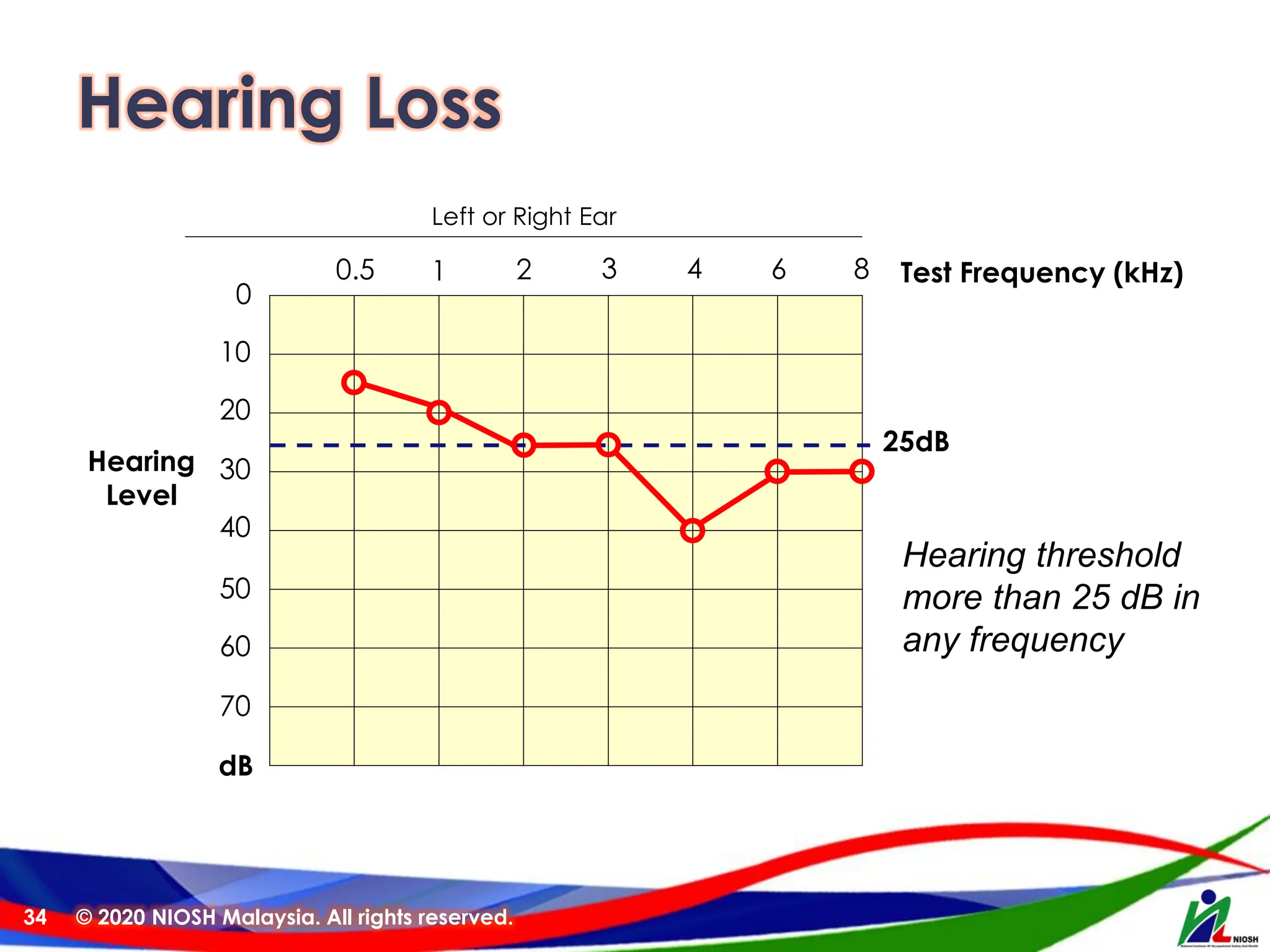
❖ Hearing loss
– partial or total inability to hear marked by a hearing threshold
worse than 25dB at any audiometric test frequency. Hearing
loss may be mild (26 to 40dB), moderate (41 to 70dB), severe
(71 to 90dB) or profound (equal or more than 91dB)
❖ Hearing impairment
– Arithmetic average of the permanent hearing threshold level
of an employee at 500 Hz, 1 kHz, 2 kHz and 3 kHz which is
shifted by 25 dB or more compared to the standard
audiometric reference level.
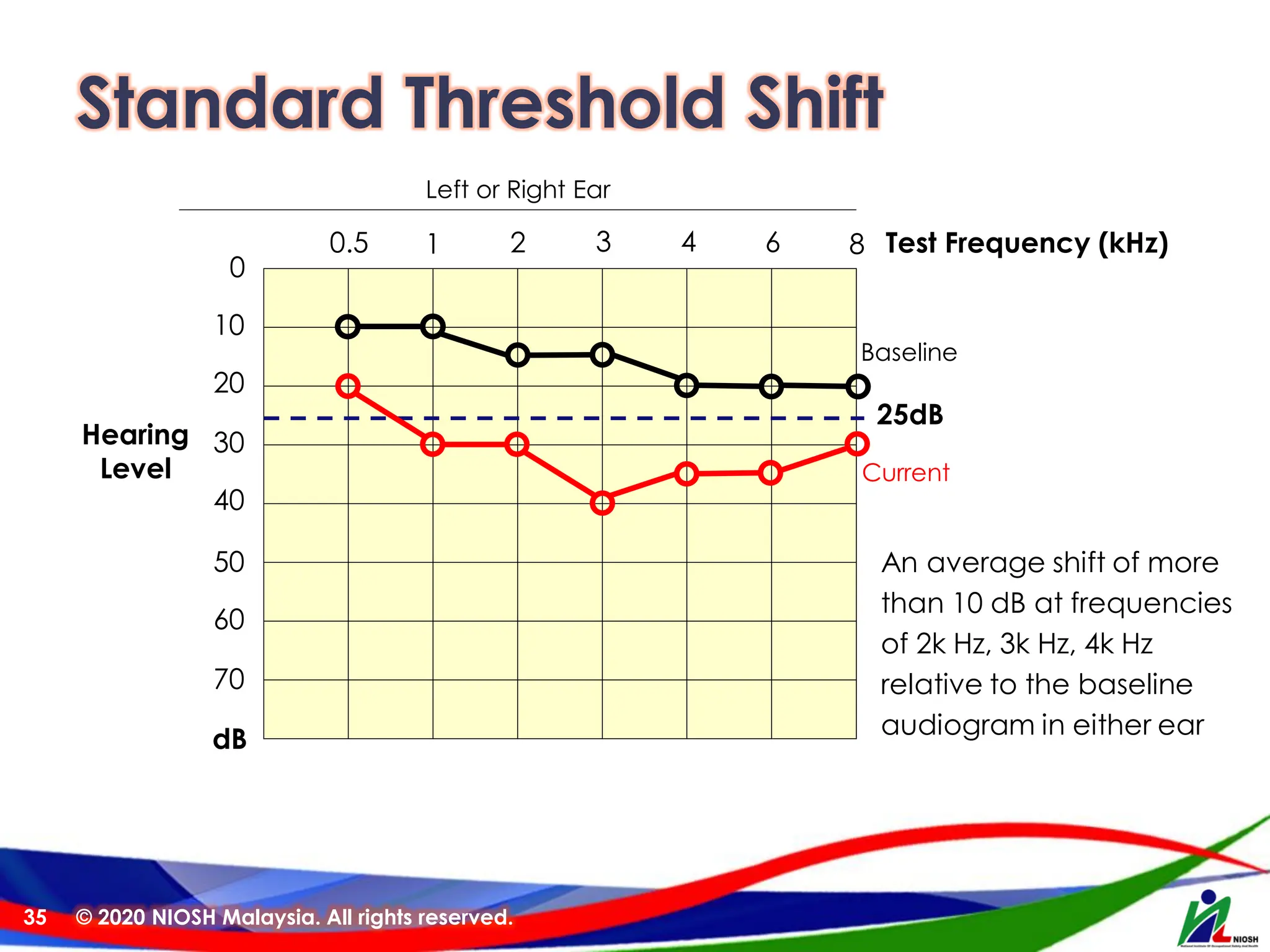
❖ Standard Threshold Shift
– An average shift of 10 dB or more at frequencies of 2000 ,
3000, 4000 Hz compared to the baseline audiogram in either
ear
© 2020 NIOSH Malaysia. All rights reserved.
32
Normal Audiogramme
© 2020 NIOSH Malaysia. All rights reserved.
33
Left or Right Ear
Test Frequency (kHz)
0
0.5 1 2 3 4 6
10
20
30
40
50
60
70
dB
Hearing
Level
25dB
a ‘normal’
audiogram is in
this area
8
Hearing Loss
© 2020 NIOSH Malaysia. All rights reserved.
34
Left or Right Ear
Test Frequency (kHz)
0
0.5 1 2 3 4 6
10
20
30
40
50
60
70
dB
Hearing
Level
25dB
Hearing threshold
more than 25 dB in
any frequency
8
Standard Threshold Shift
© 2020 NIOSH Malaysia. All rights reserved.
35
Left or Right Ear
Test Frequency (kHz)
Hearing
Level
25dB
Baseline
Current
An average shift of more
than 10 dB at frequencies
of 2k Hz, 3k Hz, 4k Hz
relative to the baseline
audiogram in either ear
0
0.5 1 2 3 4 6
10
20
30
40
50
60
70
dB
8
Temporary Standard Threshold Shift
❖Auditory fatigue where the shifted hearing
threshold shows progressive reduction
(improvement in hearing threshold) with the
passage of time when the employee is no
longer exposed to noise.
❖Need to retest within 3 months.
– If persistent, consider Permanent Standard
Threshold Shift
© 2020 NIOSH Malaysia. All rights reserved.
36
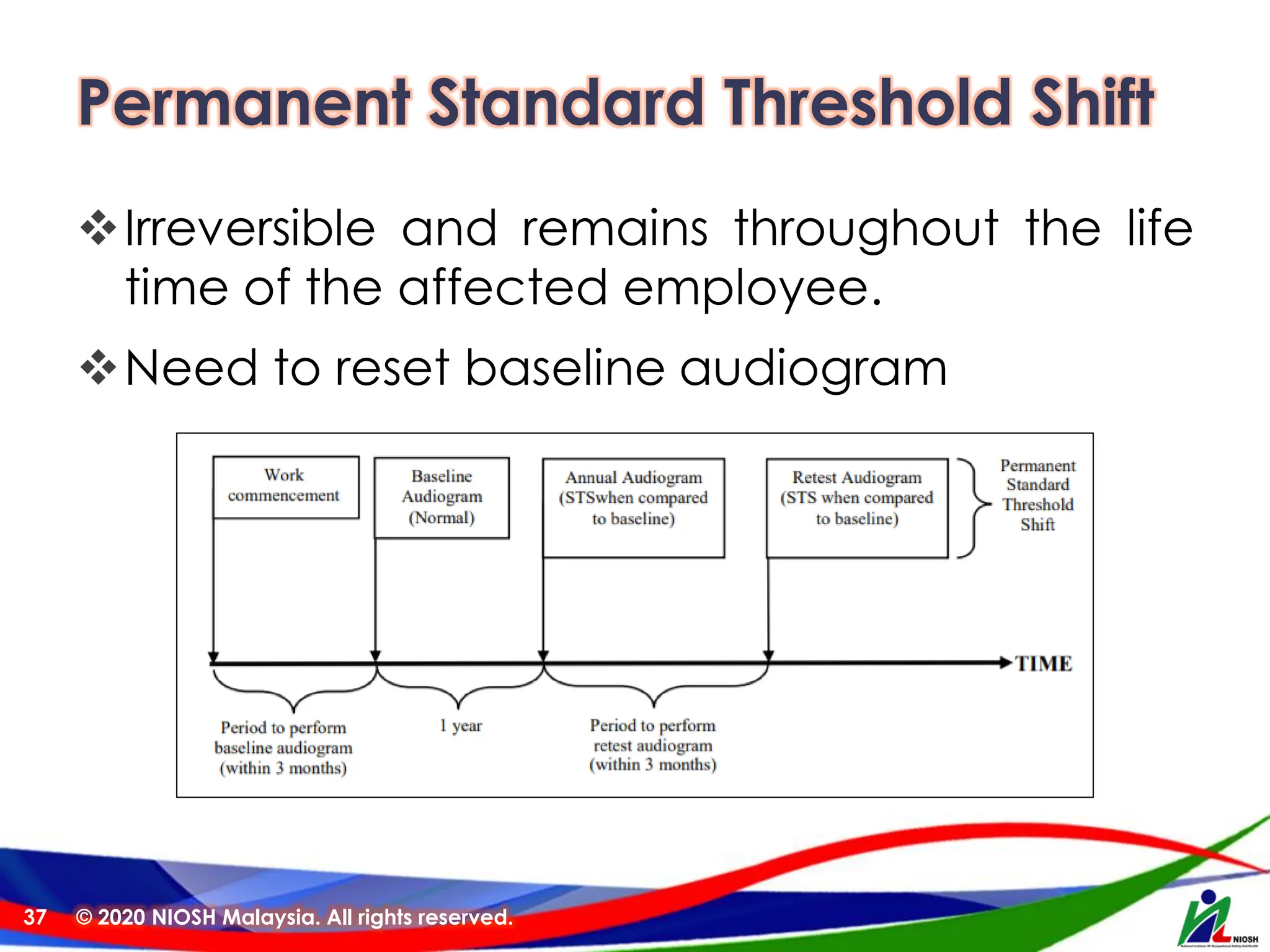
Permanent Standard Threshold Shift
❖Irreversible and remains throughout the life
time of the affected employee.
❖Need to reset baseline audiogram
© 2020 NIOSH Malaysia. All rights reserved.
37
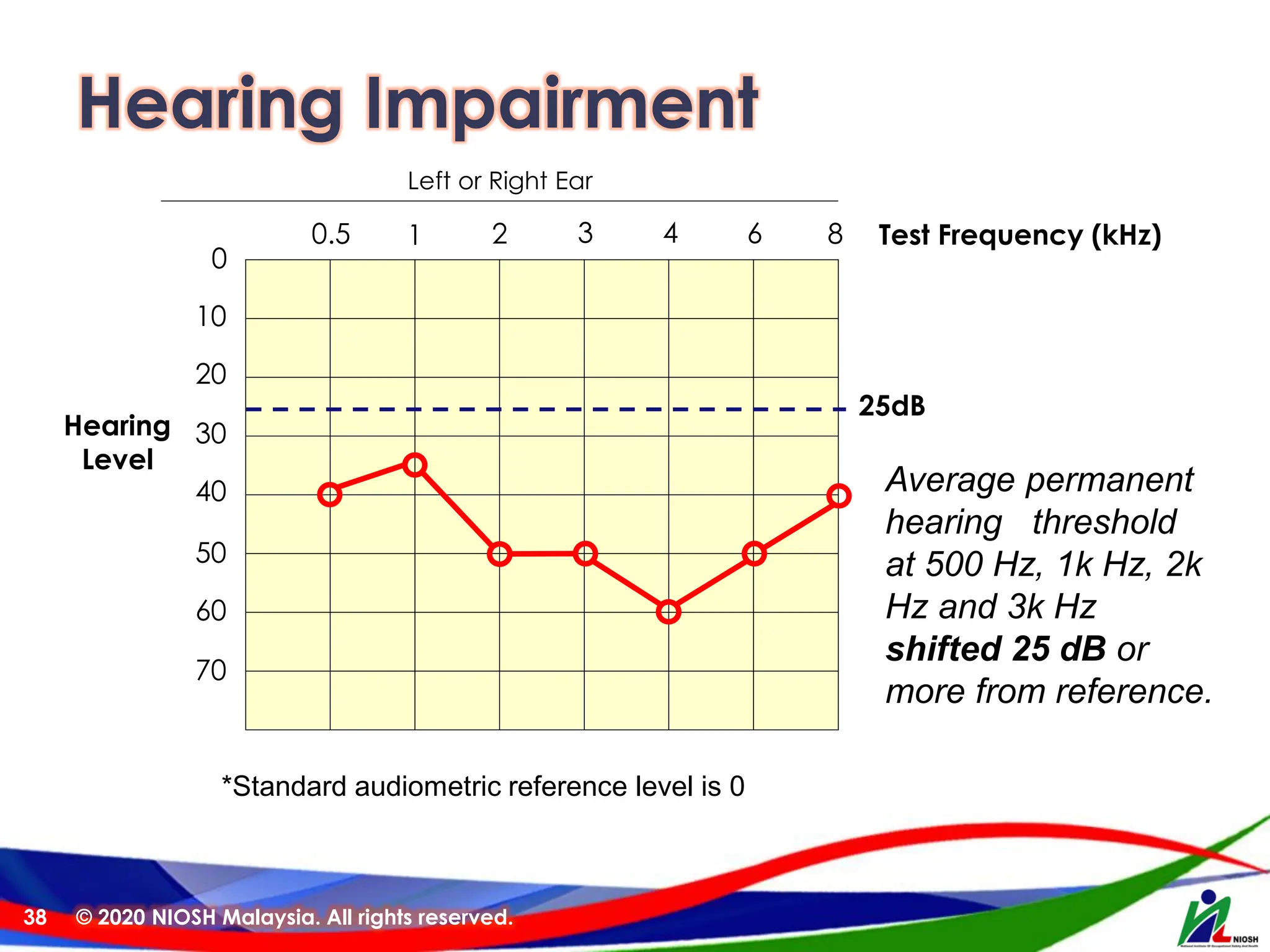
Hearing Impairment
© 2020 NIOSH Malaysia. All rights reserved.
38
Left or Right Ear
Test Frequency (kHz)
0
0.5 1 2 3 4 6
10
20
30
40
50
60
70
Hearing
Level
25dB
Average permanent
hearing threshold
at 500 Hz, 1k Hz, 2k
Hz and 3k Hz
shifted 25 dB or
more from reference.
8
*Standard audiometric reference level is 0
When to Reset Baseline Audiogram
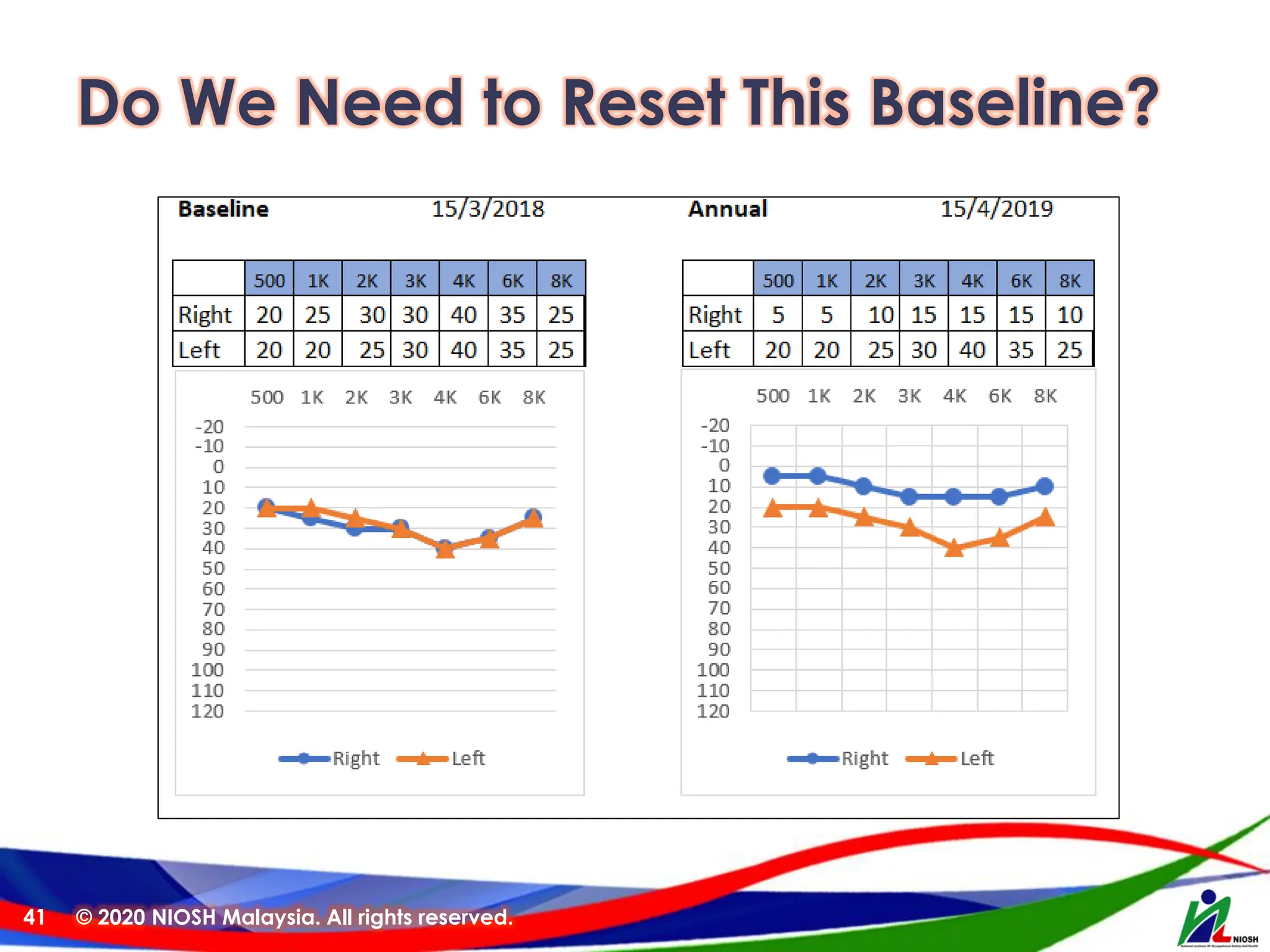
❖Permanent STS
❖Improved hearing threshold with respect to
the baseline at two (2) or more test
frequencies.
© 2020 NIOSH Malaysia. All rights reserved.
39
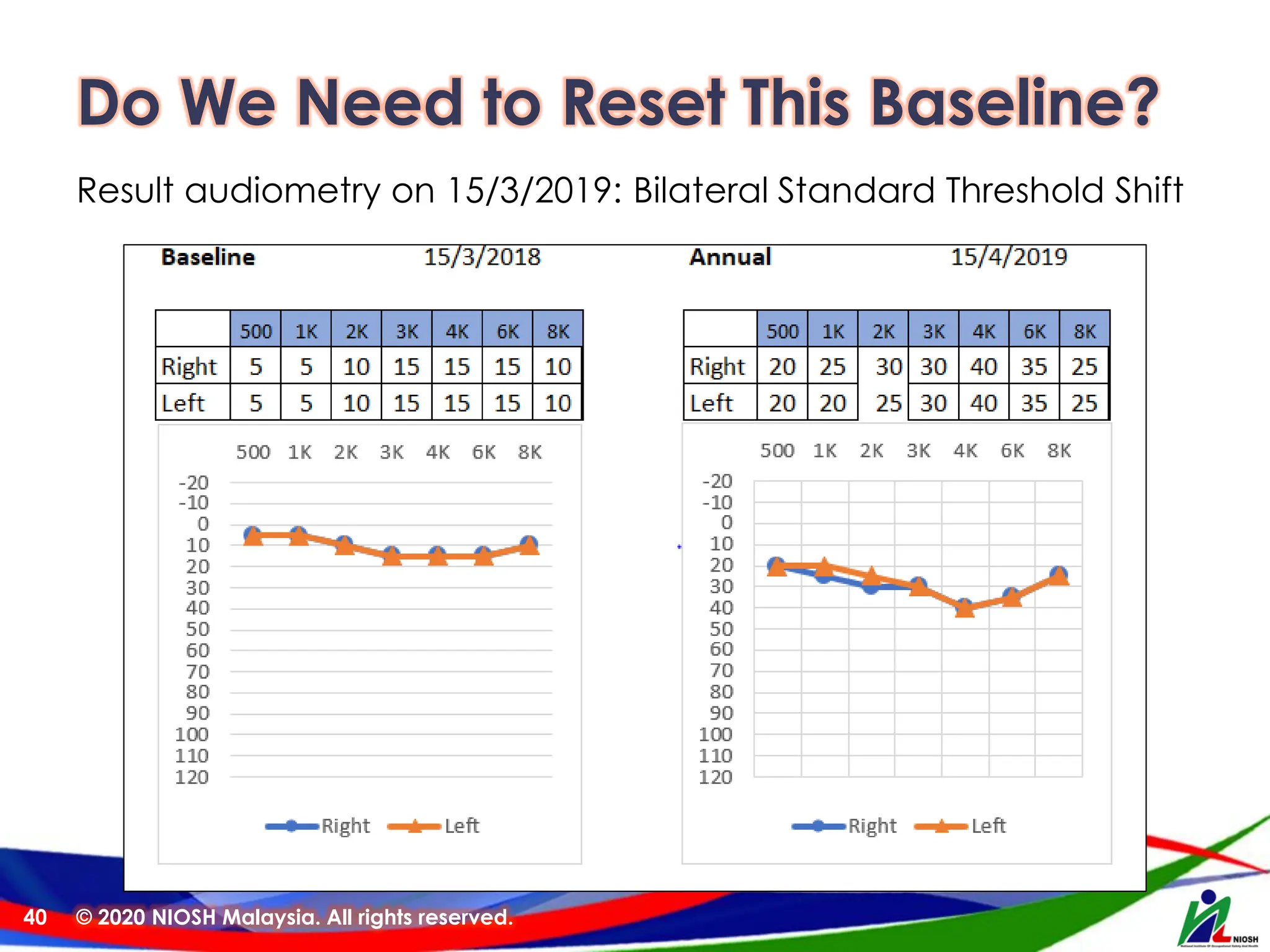
Do We Need to Reset This Baseline?
© 2020 NIOSH Malaysia. All rights reserved.
40
Result audiometry on 15/3/2019: Bilateral Standard Threshold Shift
Do We Need to Reset This Baseline?
© 2020 NIOSH Malaysia. All rights reserved.
41
Medical Examination and Referral
❖ Abnormal audiogram: an audiogram that shows a hearing
loss, hearing impairment or permanent Standard Threshold
Shift (STS)
– the attending OHD shall carry out medical examination.
❖ Audiogram interpretation and medical examination need to
be carried out by the same OHD.
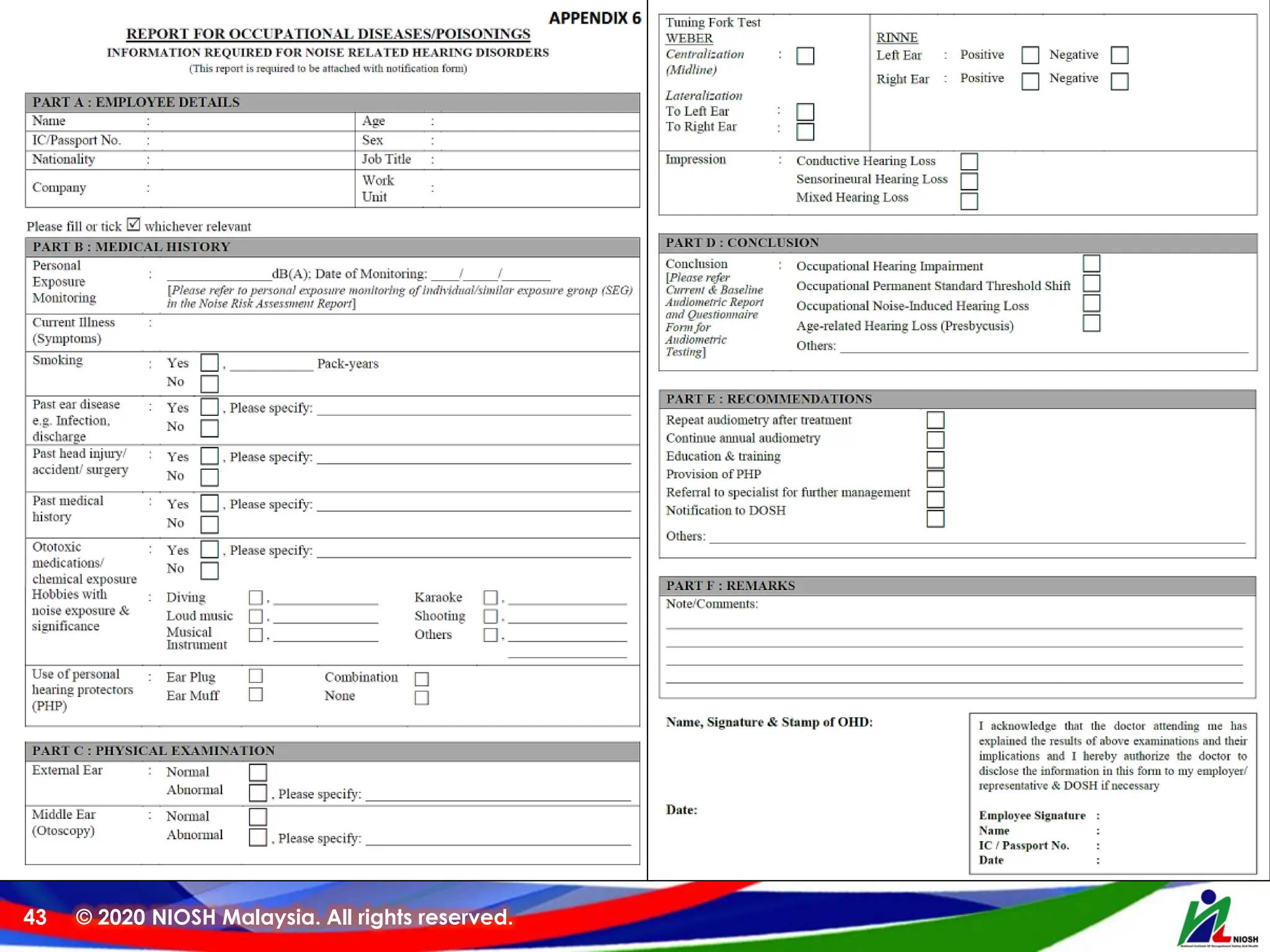
❖ Components of medical examination (Appendix 6 ICOP)
– medical history
– physical examination
– other relevant investigation
❖ OHD shall decide whether a referral is necessary for further
management
© 2020 NIOSH Malaysia. All rights reserved.
42
© 2020 NIOSH Malaysia. All rights reserved.
43
Notification
❖Employer and OHD:
– notify within 7 days
– notify to the nearest DOSH office
– shall notify any related occupational PSTS, NIHL,
HI
❖Exception:
– If HI, NIHL for baseline audiogram done within 3
months of work commencement
– If no significant change in the workers hearing
threshold (annual audiometry)
© 2020 NIOSH Malaysia. All rights reserved.
44
© 2020 NIOSH Malaysia. All rights reserved.
45
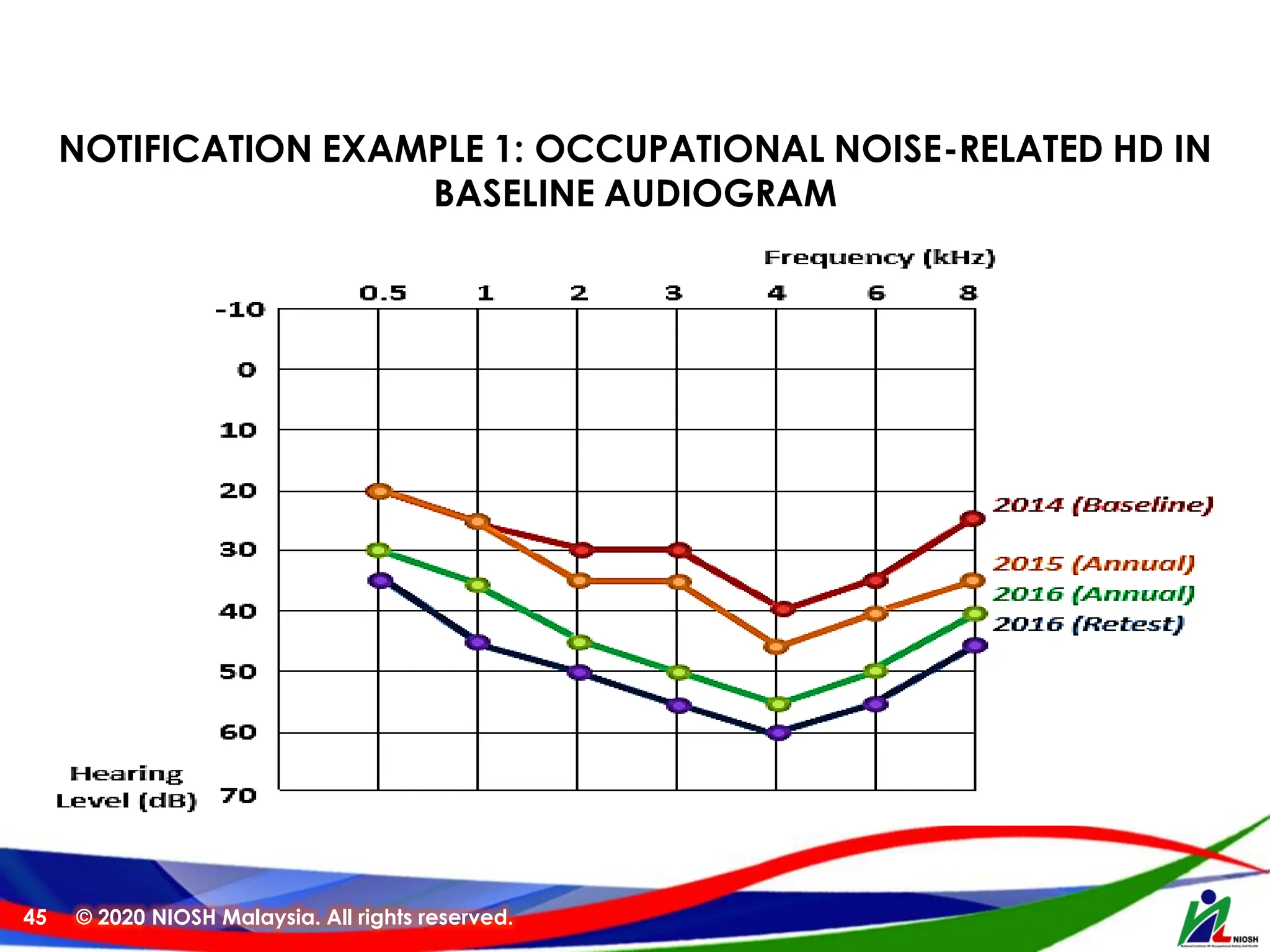
NOTIFICATION EXAMPLE 1: OCCUPATIONAL NOISE-RELATED HD IN
BASELINE AUDIOGRAM
© 2020 NIOSH Malaysia. All rights reserved.
46
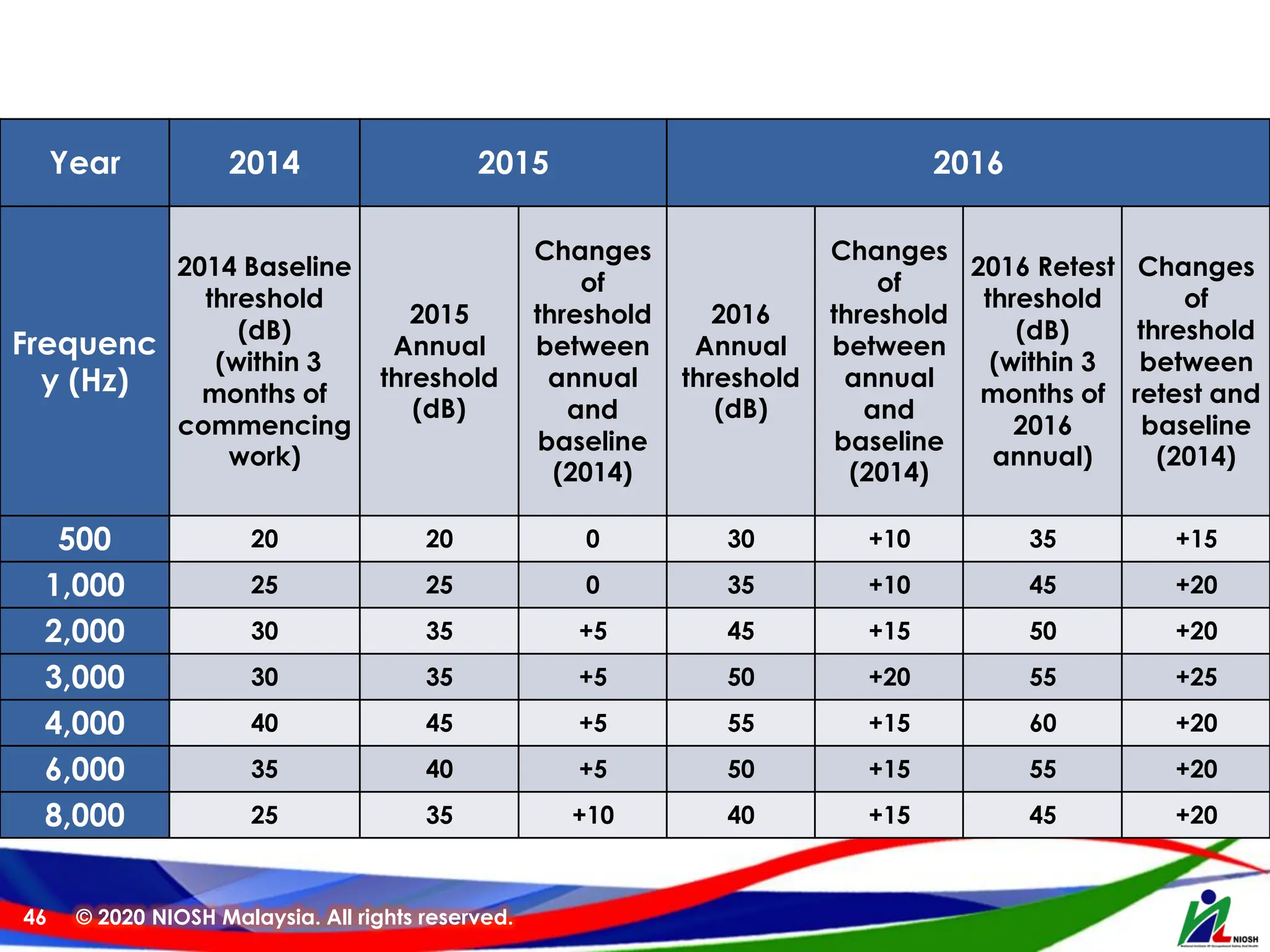
Year 2014 2015 2016
Frequenc
y (Hz)
2014 Baseline
threshold
(dB)
(within 3
months of
commencing
work)
2015
Annual
threshold
(dB)
Changes
of
threshold
between
annual
and
baseline
(2014)
2016
Annual
threshold
(dB)
Changes
of
threshold
between
annual
and
baseline
(2014)
2016 Retest
threshold
(dB)
(within 3
months of
2016
annual)
Changes
of
threshold
between
retest and
baseline
(2014)
500 20 20 0 30 +10 35 +15
1,000 25 25 0 35 +10 45 +20
2,000 30 35 +5 45 +15 50 +20
3,000 30 35 +5 50 +20 55 +25
4,000 40 45 +5 55 +15 60 +20
6,000 35 40 +5 50 +15 55 +20
8,000 25 35 +10 40 +15 45 +20
© 2020 NIOSH Malaysia. All rights reserved.
47
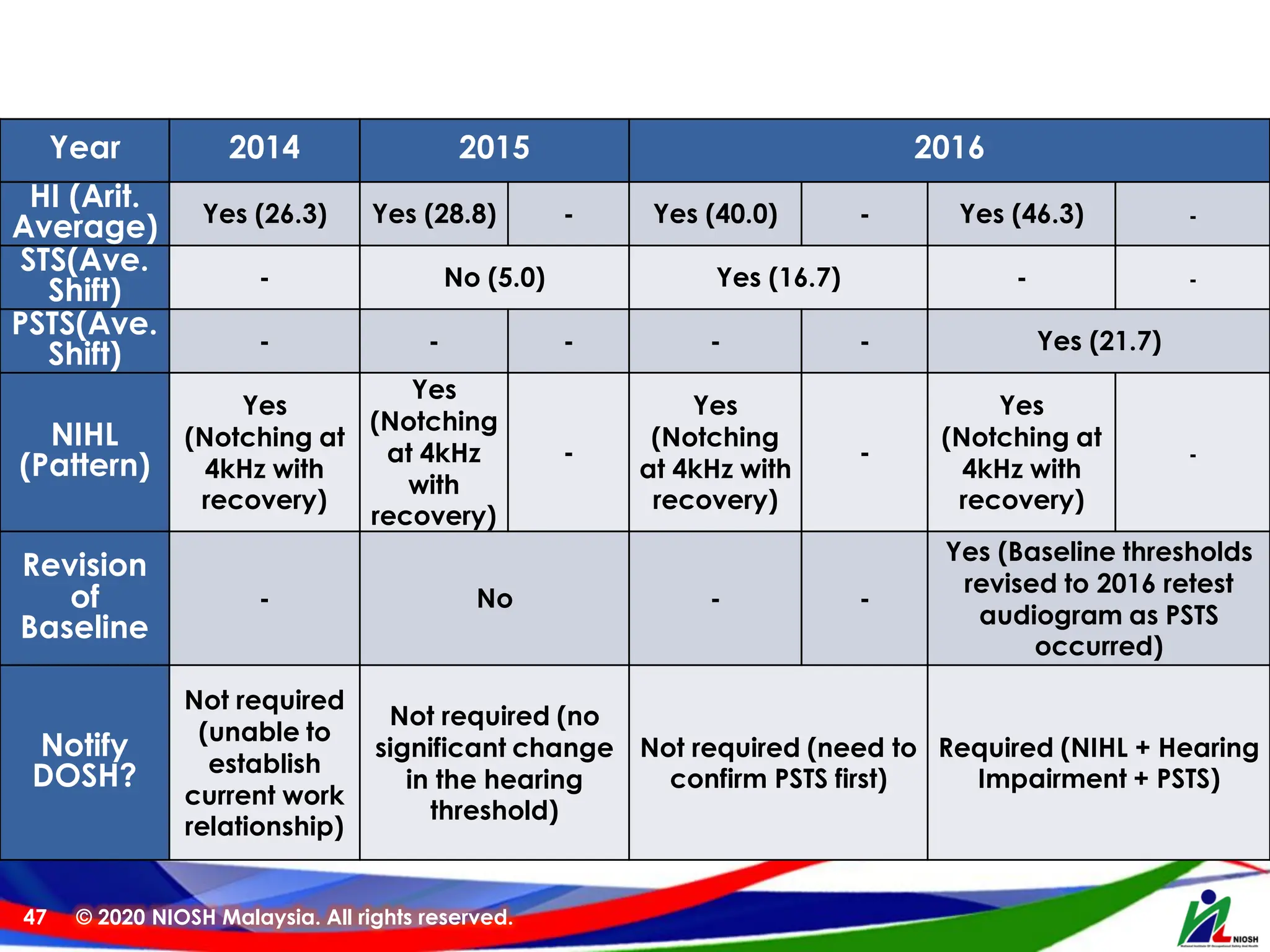
Year 2014 2015 2016
HI (Arit.
Average) Yes (26.3) Yes (28.8) - Yes (40.0) - Yes (46.3) -
STS(Ave.
Shift) - No (5.0) Yes (16.7) - -
PSTS(Ave.
Shift) - - - - - Yes (21.7)
NIHL
(Pattern)
Yes
(Notching at
4kHz with
recovery)
Yes
(Notching
at 4kHz
with
recovery)
-
Yes
(Notching
at 4kHz with
recovery)
-
Yes
(Notching at
4kHz with
recovery)
-
Revision
of
Baseline
- No - -
Yes (Baseline thresholds
revised to 2016 retest
audiogram as PSTS
occurred)
Notify
DOSH?
Not required
(unable to
establish
current work
relationship)
Not required (no
significant change
in the hearing
threshold)
Not required (need to
confirm PSTS first)
Required (NIHL + Hearing
Impairment + PSTS)
© 2020 NIOSH Malaysia. All rights reserved.
48
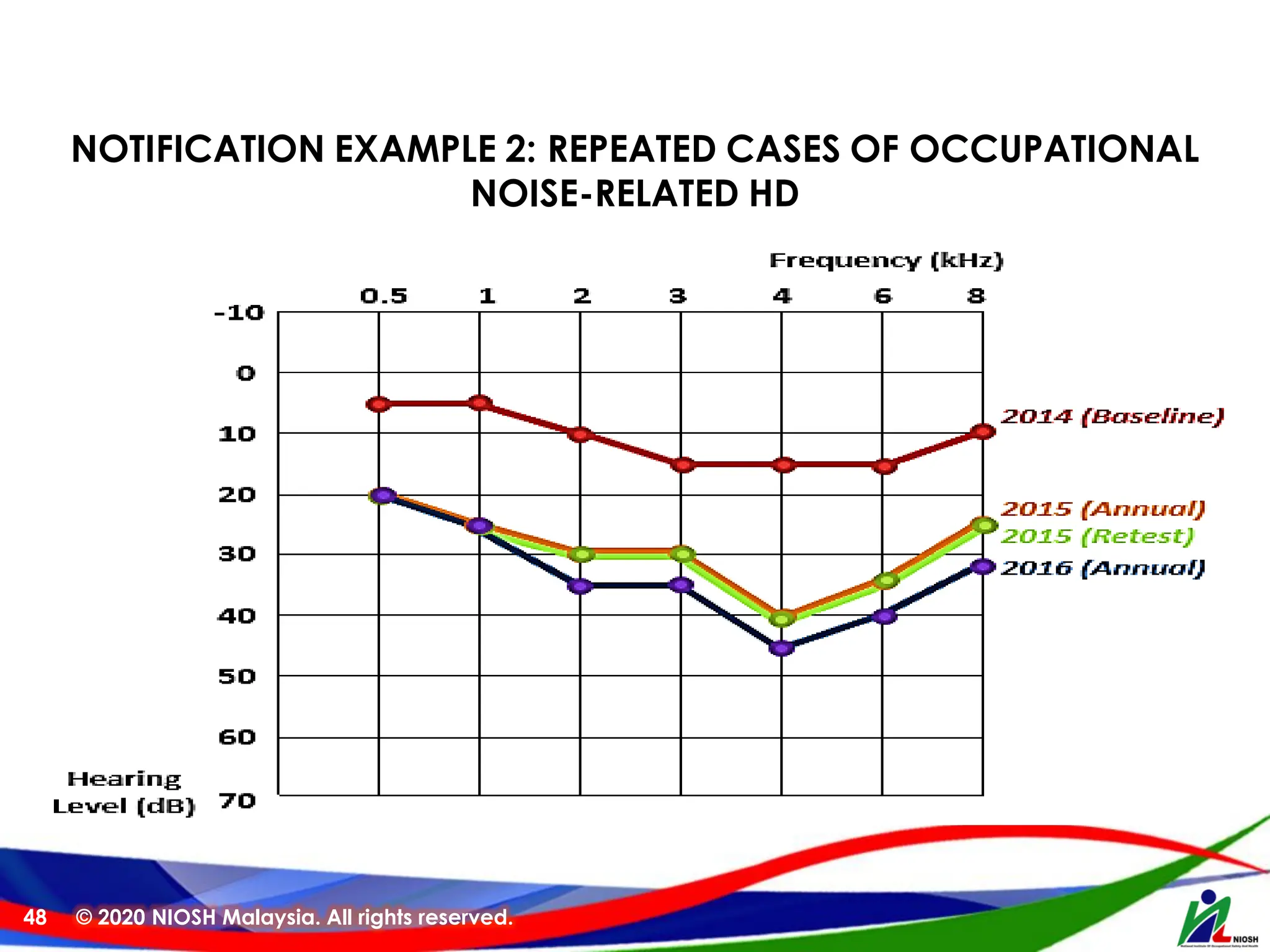
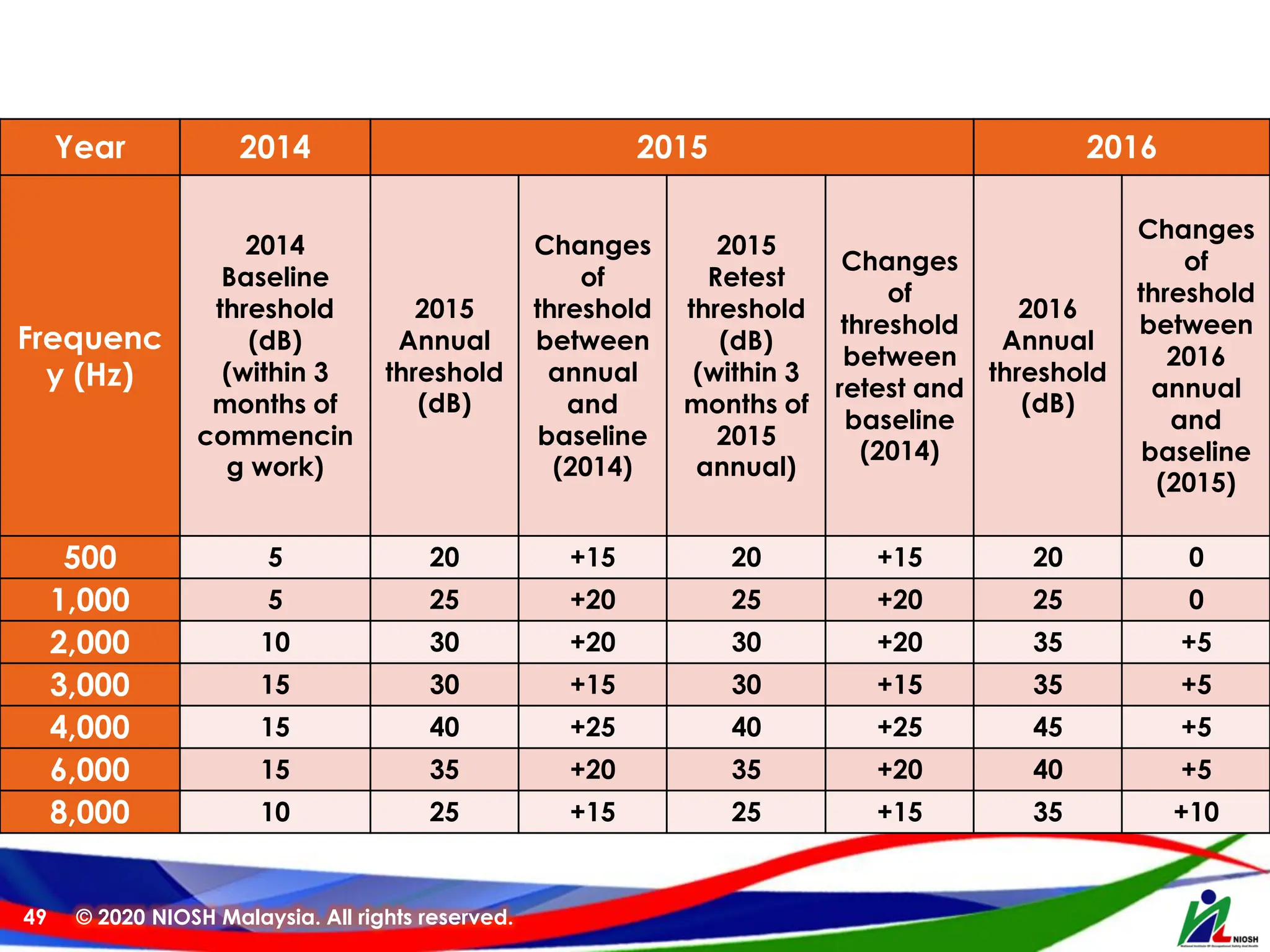
NOTIFICATION EXAMPLE 2: REPEATED CASES OF OCCUPATIONAL
NOISE-RELATED HD
© 2020 NIOSH Malaysia. All rights reserved.
49
Year 2014 2015 2016
Frequenc
y (Hz)
2014
Baseline
threshold
(dB)
(within 3
months of
commencin
g work)
2015
Annual
threshold
(dB)
Changes
of
threshold
between
annual
and
baseline
(2014)
2015
Retest
threshold
(dB)
(within 3
months of
2015
annual)
Changes
of
threshold
between
retest and
baseline
(2014)
2016
Annual
threshold
(dB)
Changes
of
threshold
between
2016
annual
and
baseline
(2015)
500 5 20 +15 20 +15 20 0
1,000 5 25 +20 25 +20 25 0
2,000 10 30 +20 30 +20 35 +5
3,000 15 30 +15 30 +15 35 +5
4,000 15 40 +25 40 +25 45 +5
6,000 15 35 +20 35 +20 40 +5
8,000 10 25 +15 25 +15 35 +10
© 2020 NIOSH Malaysia. All rights reserved.
50
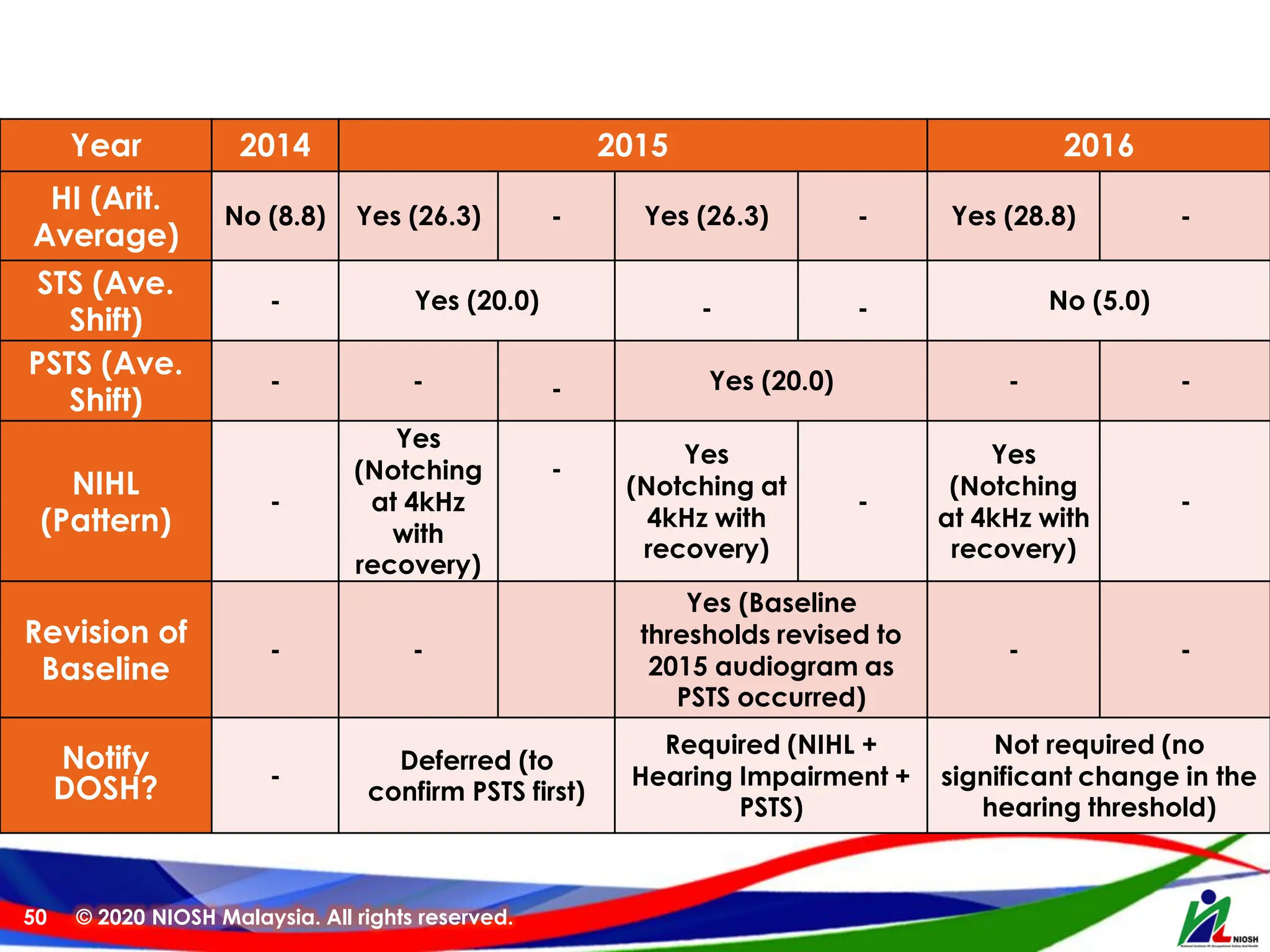
Year 2014 2015 2016
HI (Arit.
Average)
No (8.8) Yes (26.3) - Yes (26.3) - Yes (28.8) -
STS (Ave.
Shift)
- Yes (20.0) - - No (5.0)
PSTS (Ave.
Shift)
- - - Yes (20.0) - -
NIHL
(Pattern)
-
Yes
(Notching
at 4kHz
with
recovery)
-
Yes
(Notching at
4kHz with
recovery)
-
Yes
(Notching
at 4kHz with
recovery)
-
Revision of
Baseline
- -
Yes (Baseline
thresholds revised to
2015 audiogram as
PSTS occurred)
- -
Notify
DOSH? -
Deferred (to
confirm PSTS first)
Required (NIHL +
Hearing Impairment +
PSTS)
Not required (no
significant change in the
hearing threshold)
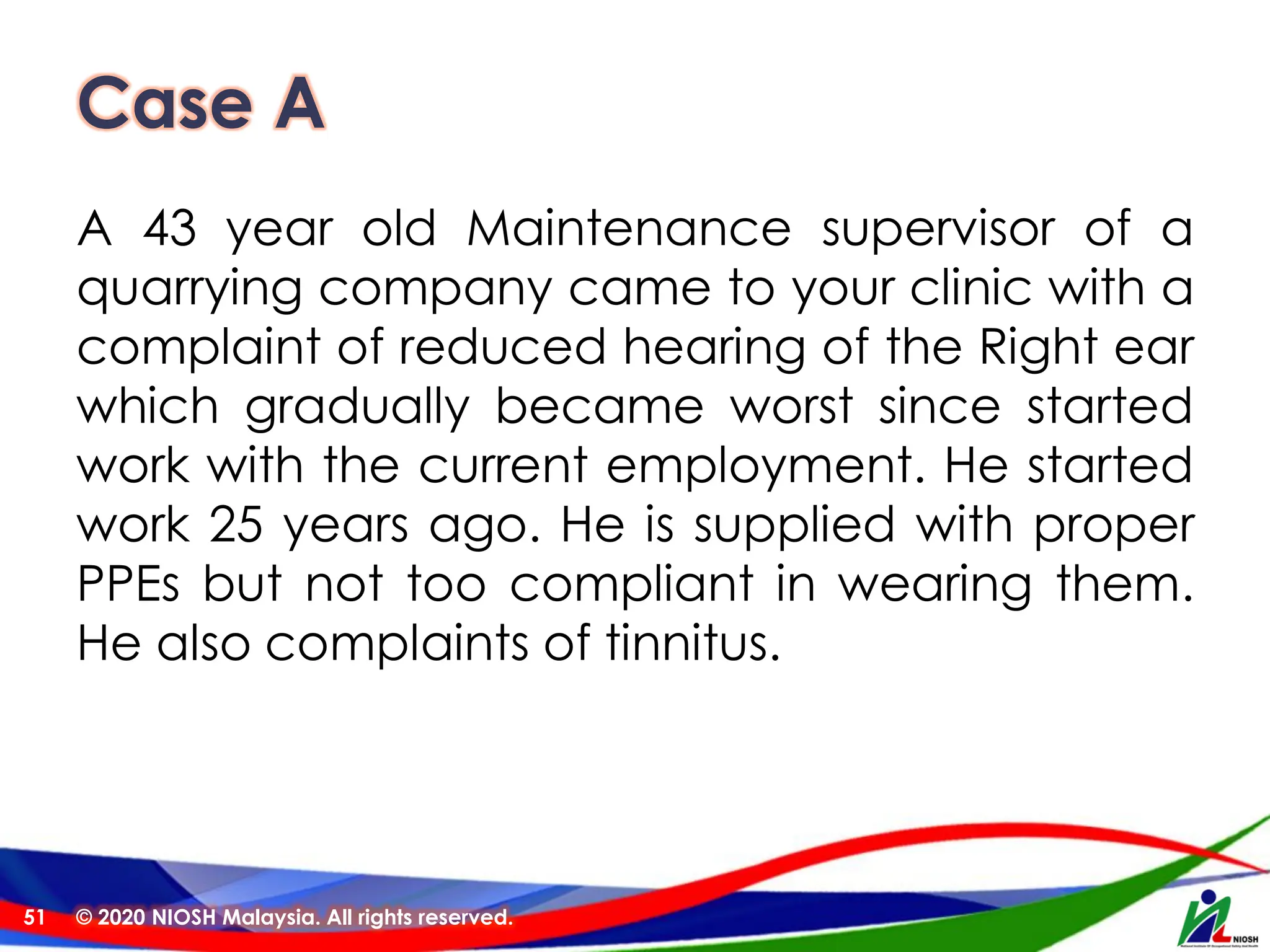
Case A
A 43 year old Maintenance supervisor of a
quarrying company came to your clinic with a
complaint of reduced hearing of the Right ear
which gradually became worst since started
work with the current employment. He started
work 25 years ago. He is supplied with proper
PPEs but not too compliant in wearing them.
He also complaints of tinnitus.
© 2020 NIOSH Malaysia. All rights reserved.
51
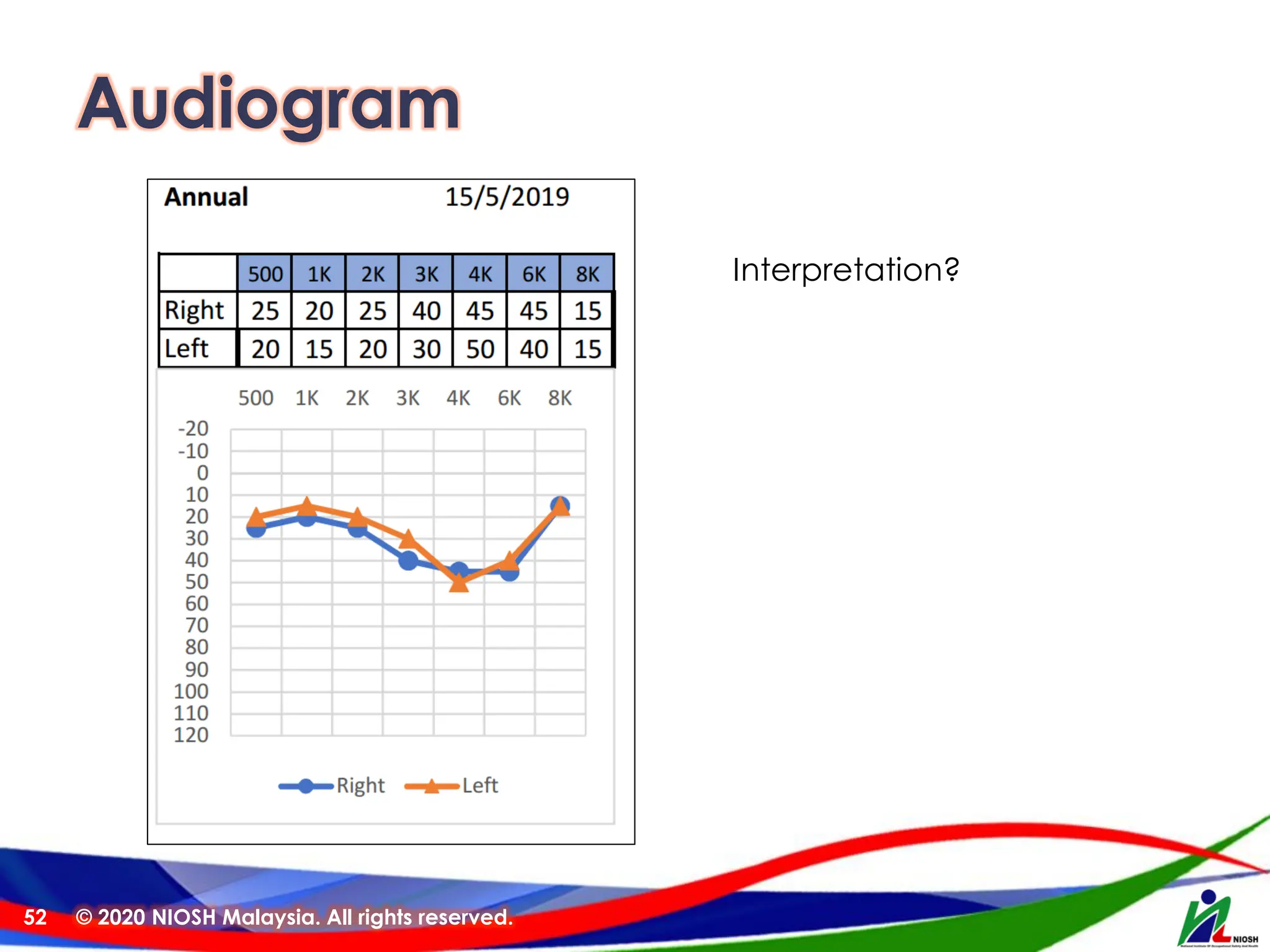
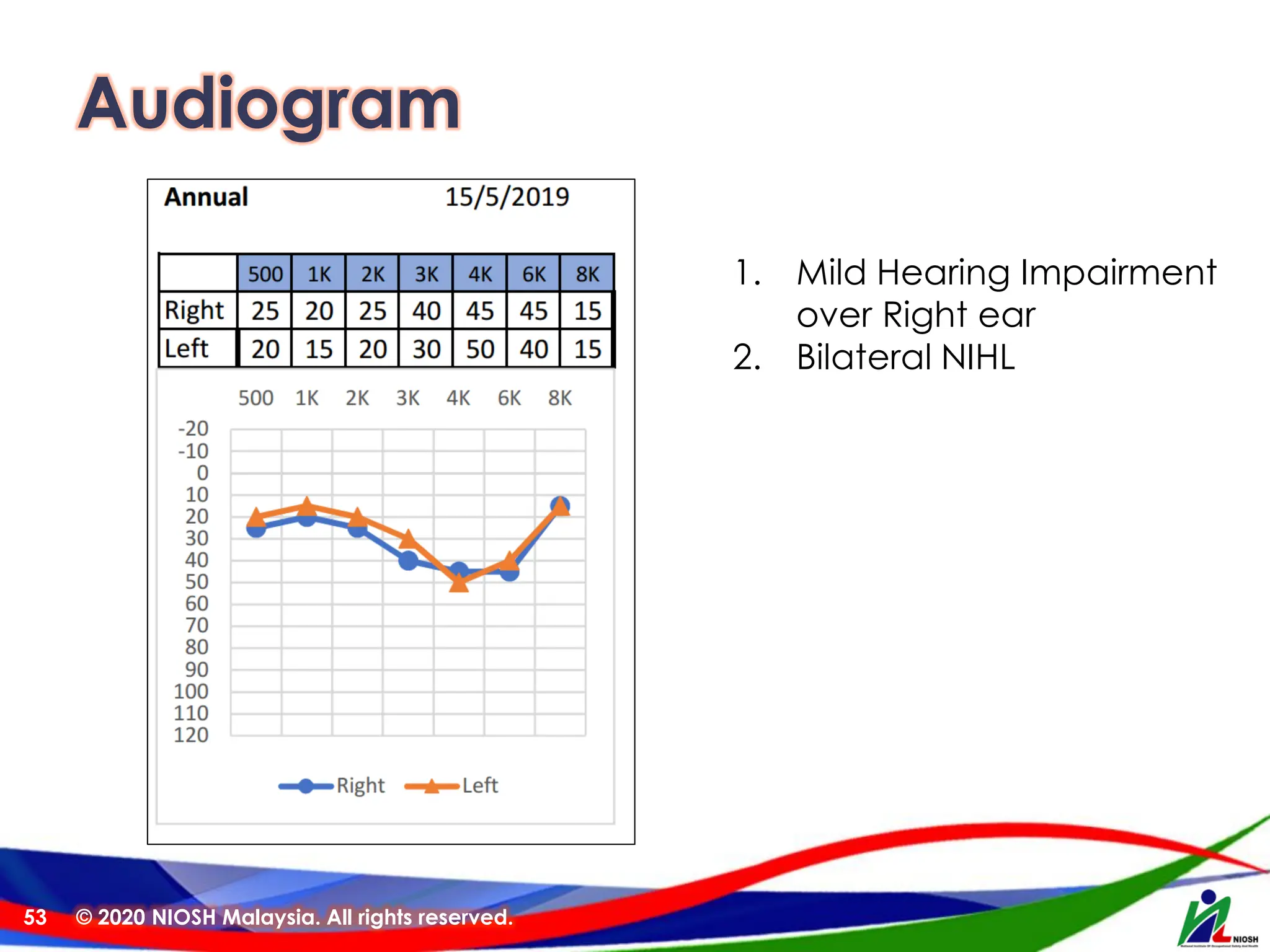
Audiogram
© 2020 NIOSH Malaysia. All rights reserved.
52
Interpretation?
Audiogram
© 2020 NIOSH Malaysia. All rights reserved.
53
1. Mild Hearing Impairment
over Right ear
2. Bilateral NIHL
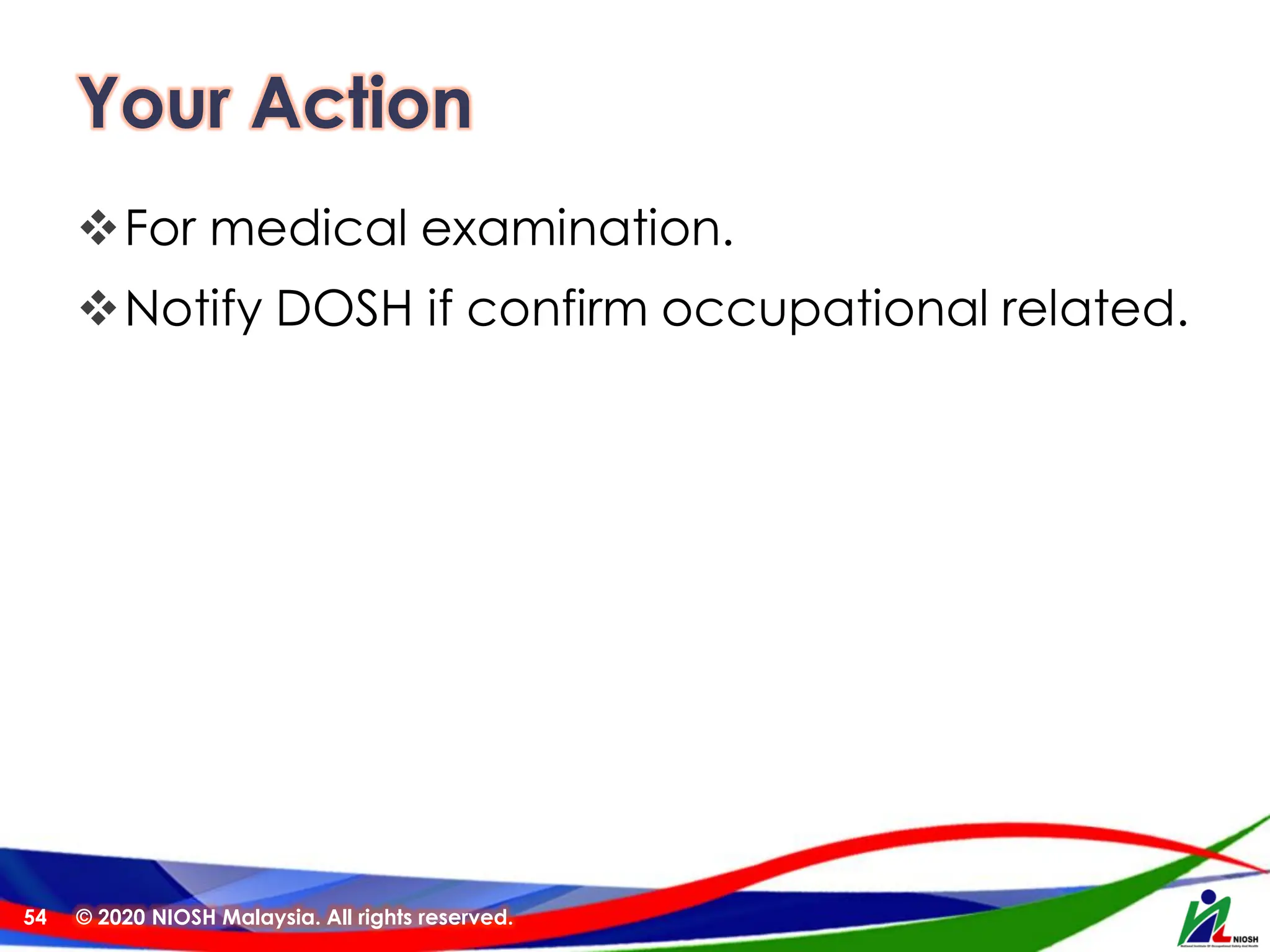
Your Action
❖For medical examination.
❖Notify DOSH if confirm occupational related.
© 2020 NIOSH Malaysia. All rights reserved.
54
Thank You
© 2020 NIOSH Malaysia. All rights reserved.
55

Audiometric Testing and Analysis Occupational Health Disease

  • 1.
    Audiometric Testing andAnalysis Occupational Health Doctor © 2020 NIOSH Malaysia. All rights reserved. 1
  • 2.
    Learning Objectives At theend of the session, participants will be able to: ❖ Define the concept of Audiometric Testing under Noise Exposure Regulations 2019 ❖ Explain how to interpret audiogram ❖ Understand DOSH notification criteria for Noise related hearing disorders. © 2020 NIOSH Malaysia. All rights reserved. 2
  • 3.
    Scope ❖ Basic Principleof Audiometric ❖ General Duties of Employer, OHD, Audiometric Testing Centre, and Audiometric Technician ❖ Type of Audiogram ❖ Audiometric Equipment ❖ Audiometric Testing Flow Chart ❖ Audiometric Report ❖ Audiogram Interpretation ❖ Medical Examination and Referral ❖ Notification ❖ Case Study © 2020 NIOSH Malaysia. All rights reserved. 3
  • 4.
    Basic Principle ofAudiometric ❖Early identification of hearing damage ❖Not a preventive mechanism - complement the comprehensive hearing conservation program (HCP) ❖Testing program shall be available to any employee exposed to NEL ❖Conducted at no cost to the employees © 2020 NIOSH Malaysia. All rights reserved. 4
  • 5.
    Noise Exposure Limit(NEL) ❖Based on Noise Exposure Regulations 2019 – The daily noise exposure level exceeding 85 dB(A) or daily noise exposure dose exceeding 100%; or – Max sound pressure level exceeds 115 dB(A) at any time; or – Peak sound pressure level exceeds 140 dB(C). © 2020 NIOSH Malaysia. All rights reserved. 5
  • 6.
    Example of NoiseRisk Assessment Report © 2020 NIOSH Malaysia. All rights reserved. 6
  • 7.
    Duties of Employer ❖Employershall ensure:- – no cost to the employee. – Baseline audiogram be carried out within 3 months after employee commencing work at any area which exposed to NEL. – audiometric testing is only be carried out in quiet state of at least 14 hours without the aid of PHP. © 2020 NIOSH Malaysia. All rights reserved. 7
  • 8.
    Duties of OHD ❖Ensure the audiometric testing conducted by audiometric technician in according to the procedures and legal requirements; ❖ Interpret audiograms and diagnose hearing disorders accordingly; ❖ Notify occupational noise-related hearing disorders to the Director General; ❖ Revise baseline audiogram of an employee if necessary; ❖ Refer an employee with hearing disorder to establish diagnosis or for further treatment if needed and follow them up; © 2020 NIOSH Malaysia. All rights reserved. 8
  • 9.
    Duties of OHD(Cont...) ❖ Instruct the employer to repeat the audiometric testing of an employee with STS within three (3) months from the date of previous audiometric test; ❖ Perform medical examination for an employee with an abnormal audiogram; ❖ Instruct the employer to refit and retrain in the use of PHP for an employee with hearing impairment, hearing loss or permanent STS; ❖ Inform an employee with an abnormal audiogram regarding his condition and educate him on best practices to conserve hearing. © 2020 NIOSH Malaysia. All rights reserved. 9
  • 10.
    Duties of AudiometricTechnician ❖Audiometric technician shall be under supervision by OHD ❖Conduct audiometric testing within the valid registration period of audiometric test centre; ❖Ensure audiometers and related equipment are functioning properly; ❖Collect information regarding a worker’s conditions which may affect the test results and determining his fitness for the test; © 2020 NIOSH Malaysia. All rights reserved. 10
  • 11.
    Duties of AudiometricTechnician (Cont…) ❖ Visually examine worker’s ears to look for signs of infection, excessive ear wax or any other physical condition that may affect the test; ❖ Describe the purpose and procedure of test; ❖ Perform audiometric test for each ear separately; ❖ Maintain a relevant record for each audiometer that includes calibration records; ❖ Ensure workers’ medical information is kept confidential; and ❖ Provide other support services for OHD and related healthcare professionals. © 2020 NIOSH Malaysia. All rights reserved. 11
  • 12.
    Duties of AudiometricTest Centre ❖ Make arrangement with employer with regards to audiometric testing program; ❖ Ensure audiometric testing conducted within the valid registration period of audiometric test centre; ❖ Ensure that the audiometric testing is only be carried out on employee after the employee is being put in a state of quiet of at least 14 hours without the aid of PHP; ❖ Notify at least two (2) weeks before conducting any audiometric testing program to Director of the respective DOSH state office; ❖ Submit a report of the result of audiometric testing to the employer within 30 days from the date of audiometric testing; © 2020 NIOSH Malaysia. All rights reserved. 12
  • 13.
    Duties of AudiometricTest Centre (Cont…) ❖ Notify the Director General of any changes regarding the approved audiometric test centre, including: appointed audiometric technician; – appointed OHD; – owner of audiometric test centre; – change in the location of static audiometric testing centre; – facilities of the static and mobile audiometric testing centre; ❖ Ensure regular maintenance and annual calibration of audiometric test centre facilities; © 2020 NIOSH Malaysia. All rights reserved. 13
  • 14.
    Duties of AudiometricTest Centre (Cont…) ❖ maintain a good recordkeeping of audiometric testing; submit a summary of all audiometric report for each calendar year to the Director General not later than 31st January of the following year. © 2020 NIOSH Malaysia. All rights reserved. 14
  • 15.
    Testing © 2020 NIOSHMalaysia. All rights reserved. 15
  • 16.
    Types of Audiogram ❖Baselineaudiograms – Use to compare subsequent audiogram. – Carried out baseline audiogramme within 3 months of the employee commencing work which would expose to NEL. ❖Annual Audiograms – To periodically monitor auditory status of employee who exposed to noise > NEL © 2020 NIOSH Malaysia. All rights reserved. 16
  • 17.
    Audiometric Equipment © 2020NIOSH Malaysia. All rights reserved. 17 Audiometric Booth Audiometer Printer
  • 18.
    Audiometric Equipment (Cont…) ©2020 NIOSH Malaysia. All rights reserved. 18 Audiometer Printer
  • 19.
    Audiometric Testing FlowChart © 2020 NIOSH Malaysia. All rights reserved. 19 Employees Exposed to Noise Exposure Limit (NEL) Audiometric Testing at an Approved Audiometric Test Centre (ATC) ATC to submit report to employer within 30 days from the date of testing Temporary STS Normal Abnormal (Permanent STS/Hearing Impairment/ Hearing Loss Employer to notify occupational related permanent STS, hearing impairment & NIHL to nearest DOSH office within 7 days Employee provided with PHP, if he has not been provided so Refit & retrain the employee in the use of PHP Employee to be retested within 3 months from the last audiometric test Make appropriate arrangement to protect the employee hearing from further deterioration Employer to inform audiometric test results to employees within 3 weeks OHD notify occupational related permanent STS, hearing impairment and NIHL to DG within 7 days Perform annual audiometric testing If If If Employer’s actions based on employee’s audiometric test results Audiogram interpretation by Occupational Health Doctor (OHD)
  • 20.
    General Requirements ❖ Allaudiometric testing shall be conducted by a trained audiometric technician at an approved audiometric test centre. ❖ Conducted in a room meeting the standard requirement (Audiometric Test Environment) ❖ An audiometric technician shall conduct a screening questionnaire to determine other factors which may affect the test results and the fitness of a worker for the test. This questionnaire is conducted before an audiometric test. ❖ Preceded by a period of quiet (absence of exposure to sound level exceeding 80dB(A) of at least 14 hours without wearing any PHP). ❖ Air conduction test for frequencies 500, 1000, 2000, 3000, 4000, 6000 and 8000 Hz taken for each ear. © 2020 NIOSH Malaysia. All rights reserved. 20
  • 21.
    Screening Questionnaire © 2020NIOSH Malaysia. All rights reserved. 21
  • 22.
    Audiometric Test Environment ❖Test subject clearly visible to the tester ❖ Test subject should not be able to see or hear the tester adjust the audiometer controls ❖ Measurement of the background sound pressure level (dB) in an audiometric test room shall be carried out to ensure it meets the Maximum Allowable Octave-Band Sound Pressure Level as specified:- © 2020 NIOSH Malaysia. All rights reserved. 22 Table 1: Maximum Allowable Octave-Band Sound Pressure Levels for audiometric test rooms
  • 23.
    Preparation for Testing ❖Fillup screening questionnaire ❖Explain to the worker about the test & the regulatory requirement. ❖Preparation of test subjects: – History • Recent noise exposure • Tinnitus etc. ❖Test the better ear first! ❖Explain testing procedure to employee © 2020 NIOSH Malaysia. All rights reserved. 23
  • 24.
    Explain Testing Procedure ❖Educate how to use signal respond by pressing & releasing immediately. ❖ Familiarize the worker with the tone by letting the worker listen to the tone & signal. ❖ Headset placement: – Remove eye glasses & earrings – Audiocup: red – right; blue – left – Place earphones directly at the opening of the ear canal – Adjust to ensure tight fit – Seat employee sideways from the tester so there is no visible clue. © 2020 NIOSH Malaysia. All rights reserved. 24
  • 25.
    Instructions to theWorker ❖ “I am going to test your hearing by measuring the quietest sounds that you can hear. As soon as you hear a sound/tone, press the button. Press the button when you hear the sound/tone, no matter which ear you hear it in. Whatever the sound and no matter how faint the sound, press the button as soon as you think you hear it, and release it as soon as you think it stops.” ❖ Ask if they understand the instructions © 2020 NIOSH Malaysia. All rights reserved. 25
  • 26.
    Subject’s Response ❖The subject’sresponse to the test tone should clearly indicate when the test tone is heard and when it is no longer heard. © 2020 NIOSH Malaysia. All rights reserved. 26
  • 27.
    Test Order ❖ Startwith the better-hearing ear at a frequency of 1000 Hz. ❖ Then threshold is determined at 500 Hz, followed by a retest of threshold at 1000 Hz. If the first and second thresholds at 1000 Hz agree within 5 dB, testing may continue for 2000, 3000, 4000, 6000, and 8000 Hz ❖ For the first ear only, retest at 1000 Hz. ❖ Take the more sensitive threshold as the final value. ❖ Then testing is started for the worse/left ear with the frequency sequence of 1000, 500, 2000, 3000, 4000, 6000, and 8000 Hz. ❖ The retest at 1000 Hz is normally not required in the second ear to be tested unless tests in the first ear revealed significant variability. © 2020 NIOSH Malaysia. All rights reserved. 27
  • 28.
    Test Stimuli ❖Varied between1 and 3 seconds ❖The tester must ensure that the timing of each tone is not predictable © 2020 NIOSH Malaysia. All rights reserved. 28
  • 29.
    Initial Familiarisation ❖ Presenta tone of 1000 Hz that is clearly audible, e.g. at 40 dB (A) ❖ If there is no response at this level, increase the level of the tone in 10 dB (A) steps until a response occurs. If the tone is still inaudible at 80 dB HL, increase the level of the tone in 5 dB steps until a response occurs, taking care to monitor the subject for discomfort. ❖ If the responses are consistent with the tone presentation, i.e. onset and offset, the subject is familiarised with the task. If not, repeat. If after this repeat, their responses are unsatisfactory, re-instruct the subject. © 2020 NIOSH Malaysia. All rights reserved. 29
  • 30.
    Method for FindingThreshold ❖ Following a satisfactory positive response, reduce the level of the tone in 10 dB steps until no further response occurs. ❖ Increase the level of the tone in 5 dB steps until a response occurs. ❖ After the response, decrease the level by 10 dB and begin another ascending 5 dB series until the subject responds again. ❖ Continue to decrease the level by 10 dB and increase by 5 dB until the subject responds at the same level on two out of two, three or four (i.e. 50% or more) responses on the ascent. This is the hearing threshold level. Threshold is defined arbitrarily as the lowest level at which responses occur in at least half of a series of ascending trials with a minimum of two responses required at that level. Where greater precision is necessary (for example in research studies or in medico-legal compensation cases) three out of three, four or five ascents are recommended. ❖ Proceed to the next frequency, starting at a clearly audible level (e.g. 30 dB above the previous threshold) and use a 10 dB down, 5 dB up sequence until the threshold criterion is satisfied. Repeat familiarisation if necessary. © 2020 NIOSH Malaysia. All rights reserved. 30
  • 31.
    Audiometric Report ❖ Thereport should contain the employee’s personal and employment particulars, test date, employee’s noise exposure level, relevant medical history and hobbies, audiogram, interpretation and recommendation as necessary. ❖ All audiograms shall be interpreted by OHD ❖ The audiometric report of an employee shall be submitted by the audiometric test centre to the respective employer within 30 days from the date of testing © 2020 NIOSH Malaysia. All rights reserved. 31
  • 32.
    Audiogram Interpretation ❖ Normal ❖Hearing loss – partial or total inability to hear marked by a hearing threshold worse than 25dB at any audiometric test frequency. Hearing loss may be mild (26 to 40dB), moderate (41 to 70dB), severe (71 to 90dB) or profound (equal or more than 91dB) ❖ Hearing impairment – Arithmetic average of the permanent hearing threshold level of an employee at 500 Hz, 1 kHz, 2 kHz and 3 kHz which is shifted by 25 dB or more compared to the standard audiometric reference level. ❖ Standard Threshold Shift – An average shift of 10 dB or more at frequencies of 2000 , 3000, 4000 Hz compared to the baseline audiogram in either ear © 2020 NIOSH Malaysia. All rights reserved. 32
  • 33.
    Normal Audiogramme © 2020NIOSH Malaysia. All rights reserved. 33 Left or Right Ear Test Frequency (kHz) 0 0.5 1 2 3 4 6 10 20 30 40 50 60 70 dB Hearing Level 25dB a ‘normal’ audiogram is in this area 8
  • 34.
    Hearing Loss © 2020NIOSH Malaysia. All rights reserved. 34 Left or Right Ear Test Frequency (kHz) 0 0.5 1 2 3 4 6 10 20 30 40 50 60 70 dB Hearing Level 25dB Hearing threshold more than 25 dB in any frequency 8
  • 35.
    Standard Threshold Shift ©2020 NIOSH Malaysia. All rights reserved. 35 Left or Right Ear Test Frequency (kHz) Hearing Level 25dB Baseline Current An average shift of more than 10 dB at frequencies of 2k Hz, 3k Hz, 4k Hz relative to the baseline audiogram in either ear 0 0.5 1 2 3 4 6 10 20 30 40 50 60 70 dB 8
  • 36.
    Temporary Standard ThresholdShift ❖Auditory fatigue where the shifted hearing threshold shows progressive reduction (improvement in hearing threshold) with the passage of time when the employee is no longer exposed to noise. ❖Need to retest within 3 months. – If persistent, consider Permanent Standard Threshold Shift © 2020 NIOSH Malaysia. All rights reserved. 36
  • 37.
    Permanent Standard ThresholdShift ❖Irreversible and remains throughout the life time of the affected employee. ❖Need to reset baseline audiogram © 2020 NIOSH Malaysia. All rights reserved. 37
  • 38.
    Hearing Impairment © 2020NIOSH Malaysia. All rights reserved. 38 Left or Right Ear Test Frequency (kHz) 0 0.5 1 2 3 4 6 10 20 30 40 50 60 70 Hearing Level 25dB Average permanent hearing threshold at 500 Hz, 1k Hz, 2k Hz and 3k Hz shifted 25 dB or more from reference. 8 *Standard audiometric reference level is 0
  • 39.
    When to ResetBaseline Audiogram ❖Permanent STS ❖Improved hearing threshold with respect to the baseline at two (2) or more test frequencies. © 2020 NIOSH Malaysia. All rights reserved. 39
  • 40.
    Do We Needto Reset This Baseline? © 2020 NIOSH Malaysia. All rights reserved. 40 Result audiometry on 15/3/2019: Bilateral Standard Threshold Shift
  • 41.
    Do We Needto Reset This Baseline? © 2020 NIOSH Malaysia. All rights reserved. 41
  • 42.
    Medical Examination andReferral ❖ Abnormal audiogram: an audiogram that shows a hearing loss, hearing impairment or permanent Standard Threshold Shift (STS) – the attending OHD shall carry out medical examination. ❖ Audiogram interpretation and medical examination need to be carried out by the same OHD. ❖ Components of medical examination (Appendix 6 ICOP) – medical history – physical examination – other relevant investigation ❖ OHD shall decide whether a referral is necessary for further management © 2020 NIOSH Malaysia. All rights reserved. 42
  • 43.
    © 2020 NIOSHMalaysia. All rights reserved. 43
  • 44.
    Notification ❖Employer and OHD: –notify within 7 days – notify to the nearest DOSH office – shall notify any related occupational PSTS, NIHL, HI ❖Exception: – If HI, NIHL for baseline audiogram done within 3 months of work commencement – If no significant change in the workers hearing threshold (annual audiometry) © 2020 NIOSH Malaysia. All rights reserved. 44
  • 45.
    © 2020 NIOSHMalaysia. All rights reserved. 45 NOTIFICATION EXAMPLE 1: OCCUPATIONAL NOISE-RELATED HD IN BASELINE AUDIOGRAM
  • 46.
    © 2020 NIOSHMalaysia. All rights reserved. 46 Year 2014 2015 2016 Frequenc y (Hz) 2014 Baseline threshold (dB) (within 3 months of commencing work) 2015 Annual threshold (dB) Changes of threshold between annual and baseline (2014) 2016 Annual threshold (dB) Changes of threshold between annual and baseline (2014) 2016 Retest threshold (dB) (within 3 months of 2016 annual) Changes of threshold between retest and baseline (2014) 500 20 20 0 30 +10 35 +15 1,000 25 25 0 35 +10 45 +20 2,000 30 35 +5 45 +15 50 +20 3,000 30 35 +5 50 +20 55 +25 4,000 40 45 +5 55 +15 60 +20 6,000 35 40 +5 50 +15 55 +20 8,000 25 35 +10 40 +15 45 +20
  • 47.
    © 2020 NIOSHMalaysia. All rights reserved. 47 Year 2014 2015 2016 HI (Arit. Average) Yes (26.3) Yes (28.8) - Yes (40.0) - Yes (46.3) - STS(Ave. Shift) - No (5.0) Yes (16.7) - - PSTS(Ave. Shift) - - - - - Yes (21.7) NIHL (Pattern) Yes (Notching at 4kHz with recovery) Yes (Notching at 4kHz with recovery) - Yes (Notching at 4kHz with recovery) - Yes (Notching at 4kHz with recovery) - Revision of Baseline - No - - Yes (Baseline thresholds revised to 2016 retest audiogram as PSTS occurred) Notify DOSH? Not required (unable to establish current work relationship) Not required (no significant change in the hearing threshold) Not required (need to confirm PSTS first) Required (NIHL + Hearing Impairment + PSTS)
  • 48.
    © 2020 NIOSHMalaysia. All rights reserved. 48 NOTIFICATION EXAMPLE 2: REPEATED CASES OF OCCUPATIONAL NOISE-RELATED HD
  • 49.
    © 2020 NIOSHMalaysia. All rights reserved. 49 Year 2014 2015 2016 Frequenc y (Hz) 2014 Baseline threshold (dB) (within 3 months of commencin g work) 2015 Annual threshold (dB) Changes of threshold between annual and baseline (2014) 2015 Retest threshold (dB) (within 3 months of 2015 annual) Changes of threshold between retest and baseline (2014) 2016 Annual threshold (dB) Changes of threshold between 2016 annual and baseline (2015) 500 5 20 +15 20 +15 20 0 1,000 5 25 +20 25 +20 25 0 2,000 10 30 +20 30 +20 35 +5 3,000 15 30 +15 30 +15 35 +5 4,000 15 40 +25 40 +25 45 +5 6,000 15 35 +20 35 +20 40 +5 8,000 10 25 +15 25 +15 35 +10
  • 50.
    © 2020 NIOSHMalaysia. All rights reserved. 50 Year 2014 2015 2016 HI (Arit. Average) No (8.8) Yes (26.3) - Yes (26.3) - Yes (28.8) - STS (Ave. Shift) - Yes (20.0) - - No (5.0) PSTS (Ave. Shift) - - - Yes (20.0) - - NIHL (Pattern) - Yes (Notching at 4kHz with recovery) - Yes (Notching at 4kHz with recovery) - Yes (Notching at 4kHz with recovery) - Revision of Baseline - - Yes (Baseline thresholds revised to 2015 audiogram as PSTS occurred) - - Notify DOSH? - Deferred (to confirm PSTS first) Required (NIHL + Hearing Impairment + PSTS) Not required (no significant change in the hearing threshold)
  • 51.
    Case A A 43year old Maintenance supervisor of a quarrying company came to your clinic with a complaint of reduced hearing of the Right ear which gradually became worst since started work with the current employment. He started work 25 years ago. He is supplied with proper PPEs but not too compliant in wearing them. He also complaints of tinnitus. © 2020 NIOSH Malaysia. All rights reserved. 51
  • 52.
    Audiogram © 2020 NIOSHMalaysia. All rights reserved. 52 Interpretation?
  • 53.
    Audiogram © 2020 NIOSHMalaysia. All rights reserved. 53 1. Mild Hearing Impairment over Right ear 2. Bilateral NIHL
  • 54.
    Your Action ❖For medicalexamination. ❖Notify DOSH if confirm occupational related. © 2020 NIOSH Malaysia. All rights reserved. 54
  • 55.
    Thank You © 2020NIOSH Malaysia. All rights reserved. 55