AUDIO-LINGUAL METHOD 
USA 
(1945)
Oral-based approach 
Strong base in: 
Structural Linguistics (Charles Fries 
1945) 
Behavioural psychology (Skinner 1957)
PRINCIPLES UNDERLYING THE METHOD 
Use of the target language 
communicatively. 
Students should “overlearn”. 
Language learning is a process of habit 
formation. 
Objective: getting students to overcome 
the habits of their native language.
PRINCIPLES UNDERLYING THE METHOD 
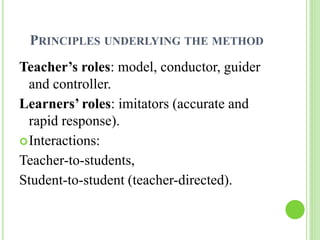
Teacher’s roles: model, conductor, guider 
and controller. 
Learners’ roles: imitators (accurate and 
rapid response). 
Interactions: 
Teacher-to-students, 
Student-to-student (teacher-directed).
PRINCIPLES UNDERLYING THE METHOD 
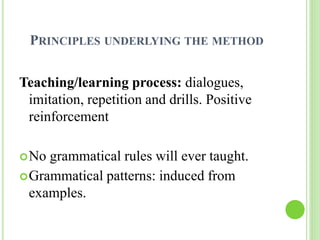
Teaching/learning process: dialogues, 
imitation, repetition and drills. Positive 
reinforcement 
No grammatical rules will ever taught. 
Grammatical patterns: induced from 
examples.
PRINCIPLES UNDERLYING THE METHOD 
Language: a unique system 
Culture: everyday behaviour and lifestyle 
of the target language
PRINCIPLES UNDERLYING THE METHOD 
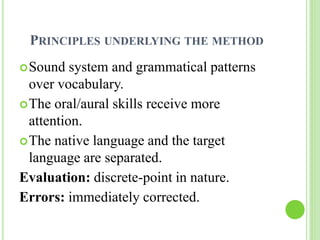
Sound system and grammatical patterns 
over vocabulary. 
The oral/aural skills receive more 
attention. 
The native language and the target 
language are separated. 
Evaluation: discrete-point in nature. 
Errors: immediately corrected.
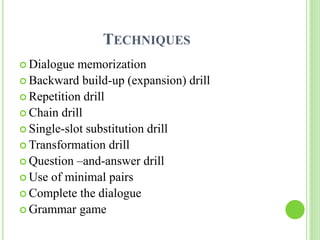
TECHNIQUES 
 Dialogue memorization 
 Backward build-up (expansion) drill 
 Repetition drill 
 Chain drill 
 Single-slot substitution drill 
Transformation drill 
 Question –and-answer drill 
 Use of minimal pairs 
Complete the dialogue 
 Grammar game
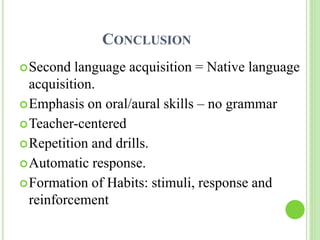
CONCLUSION 
Second language acquisition = Native language 
acquisition. 
Emphasis on oral/aural skills – no grammar 
Teacher-centered 
Repetition and drills. 
Automatic response. 
Formation of Habits: stimuli, response and 
reinforcement

Audio lingual method

  • 1.
  • 2.
    Oral-based approach Strongbase in: Structural Linguistics (Charles Fries 1945) Behavioural psychology (Skinner 1957)
  • 3.
    PRINCIPLES UNDERLYING THEMETHOD Use of the target language communicatively. Students should “overlearn”. Language learning is a process of habit formation. Objective: getting students to overcome the habits of their native language.
  • 4.
    PRINCIPLES UNDERLYING THEMETHOD Teacher’s roles: model, conductor, guider and controller. Learners’ roles: imitators (accurate and rapid response). Interactions: Teacher-to-students, Student-to-student (teacher-directed).
  • 5.
    PRINCIPLES UNDERLYING THEMETHOD Teaching/learning process: dialogues, imitation, repetition and drills. Positive reinforcement No grammatical rules will ever taught. Grammatical patterns: induced from examples.
  • 6.
    PRINCIPLES UNDERLYING THEMETHOD Language: a unique system Culture: everyday behaviour and lifestyle of the target language
  • 7.
    PRINCIPLES UNDERLYING THEMETHOD Sound system and grammatical patterns over vocabulary. The oral/aural skills receive more attention. The native language and the target language are separated. Evaluation: discrete-point in nature. Errors: immediately corrected.
  • 8.
    TECHNIQUES  Dialoguememorization  Backward build-up (expansion) drill  Repetition drill  Chain drill  Single-slot substitution drill Transformation drill  Question –and-answer drill  Use of minimal pairs Complete the dialogue  Grammar game
  • 9.
    CONCLUSION Second languageacquisition = Native language acquisition. Emphasis on oral/aural skills – no grammar Teacher-centered Repetition and drills. Automatic response. Formation of Habits: stimuli, response and reinforcement