Theoretical Research
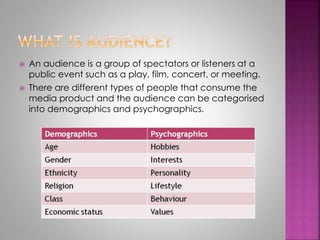
 An audience is a group of spectators or listeners at a 
public event such as a play, film, concert, or meeting. 
 There are different types of people that consume the 
media product and the audience can be categorised 
into demographics and psychographics.
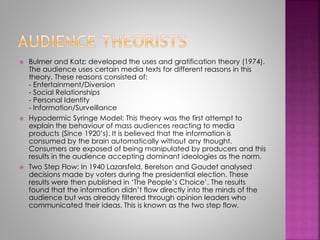
 Bulmer and Katz: developed the uses and gratification theory (1974). 
The audience uses certain media texts for different reasons in this 
theory. These reasons consisted of: 
- Entertainment/Diversion 
- Social Relationships 
- Personal Identity 
- Information/Surveillance 
 Hypodermic Syringe Model: This theory was the first attempt to 
explain the behaviour of mass audiences reacting to media 
products (Since 1920’s). It is believed that the information is 
consumed by the brain automatically without any thought. 
Consumers are exposed of being manipulated by producers and this 
results in the audience accepting dominant ideologies as the norm. 
 Two Step Flow: In 1940 Lazarsfeld, Berelson and Gaudet analysed 
decisions made by voters during the presidential election. These 
results were then published in ‘The People’s Choice’. The results 
found that the information didn’t flow directly into the minds of the 
audience but was already filtered through opinion leaders who 
communicated their ideas. This is known as the two step flow.
 The Male Gaze: Laura Mulvey’s male gaze theory is formed 
from the way the audience view people. She believed that 
the audience view people in the eyes of a heterosexual 
male. 
 Stuart Hall: believed that audiences take their own theories 
from media text because people are all individual. Making 
them all have different ideologies.
 Audience theorists can be linked to the horror genre very easily. The 
‘Hypodermic Syringe Model’ can be linked to horror films as some 
people may watch a violent film and go and recreate the scene in 
real life. This has lead to specific films being banned from the 
cinema. This is also one of the reasons that films have age ratings 
and why strong horror films are rated as an 18. 
 Laura Mulvey’s male gaze theory can be applied to many horror 
films as the woman is usually seen as weak and vulnerable. In many 
horror films the women relies strongly on the man.

Audience investigation

  • 1.
  • 2.
     An audienceis a group of spectators or listeners at a public event such as a play, film, concert, or meeting.  There are different types of people that consume the media product and the audience can be categorised into demographics and psychographics.
  • 3.
     Bulmer andKatz: developed the uses and gratification theory (1974). The audience uses certain media texts for different reasons in this theory. These reasons consisted of: - Entertainment/Diversion - Social Relationships - Personal Identity - Information/Surveillance  Hypodermic Syringe Model: This theory was the first attempt to explain the behaviour of mass audiences reacting to media products (Since 1920’s). It is believed that the information is consumed by the brain automatically without any thought. Consumers are exposed of being manipulated by producers and this results in the audience accepting dominant ideologies as the norm.  Two Step Flow: In 1940 Lazarsfeld, Berelson and Gaudet analysed decisions made by voters during the presidential election. These results were then published in ‘The People’s Choice’. The results found that the information didn’t flow directly into the minds of the audience but was already filtered through opinion leaders who communicated their ideas. This is known as the two step flow.
  • 4.
     The MaleGaze: Laura Mulvey’s male gaze theory is formed from the way the audience view people. She believed that the audience view people in the eyes of a heterosexual male.  Stuart Hall: believed that audiences take their own theories from media text because people are all individual. Making them all have different ideologies.
  • 5.
     Audience theoristscan be linked to the horror genre very easily. The ‘Hypodermic Syringe Model’ can be linked to horror films as some people may watch a violent film and go and recreate the scene in real life. This has lead to specific films being banned from the cinema. This is also one of the reasons that films have age ratings and why strong horror films are rated as an 18.  Laura Mulvey’s male gaze theory can be applied to many horror films as the woman is usually seen as weak and vulnerable. In many horror films the women relies strongly on the man.