Audience Engagement
Tools
Lessons Learned After 10,000 Events
Poll Question
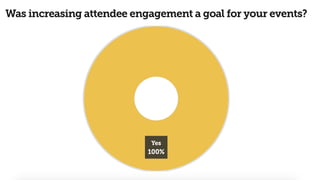
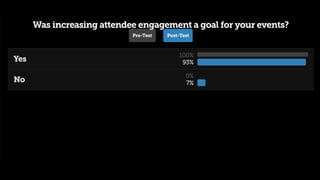
Was increasing attendee engagement a goal for
your events in 2019?
A) Yes
B) No
Poll Question
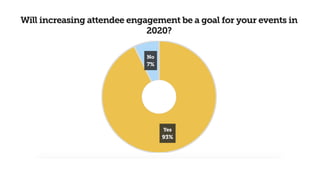
A) Yes
B) No
Will increasing attendee engagement be a goal for
your events in 2020?
If There Are So Many Tools
Making Engagement So Easy …
Why Are Event Organizers
Constantly Searching For Ways
To Improve Engagement?
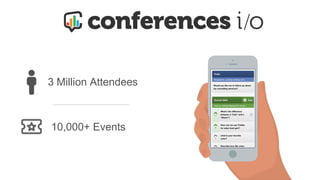
3 Million Attendees
10,000+ Events
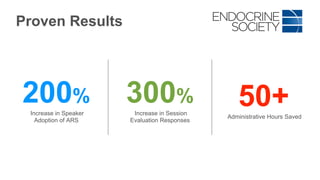
Proven Results
200%
Increase in Speaker
Adoption of ARS
300%
Increase in Session
Evaluation Responses
50+Administrative Hours Saved
We’ve learned a lot about what it
takes to successfully Engage
attendees
What Does Engagement Mean
For Events?
Event Engagement is the degree to which
attendees are fully participating in and
captivated by your event.
Event Engagement involves all aspects of
your event — from registration to
education to networking
I’m going to focus on engagement
as it relates to the educational
sessions
Why Engagement Matters
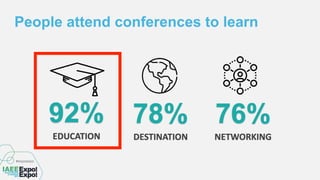
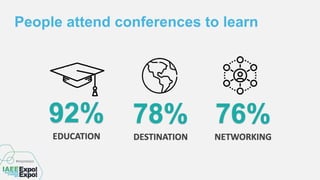
People attend conferences to learn
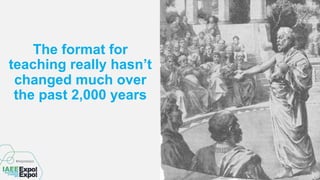
The format for
teaching really hasn’t
changed much over
the past 2,000 years
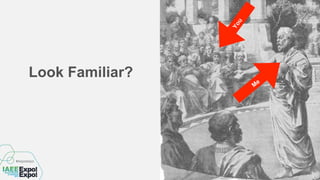
Look Familiar?
You
M
e
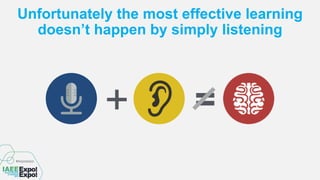
Unfortunately the most effective learning
doesn’t happen by simply listening
=+
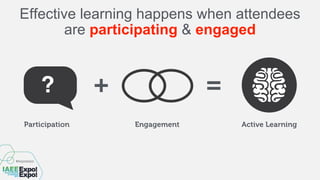
Effective learning happens when attendees
are participating & engaged
+ =
Participation Engagement Active Learning
?
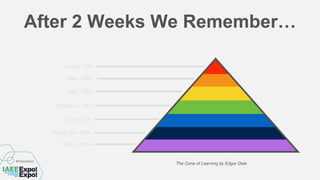
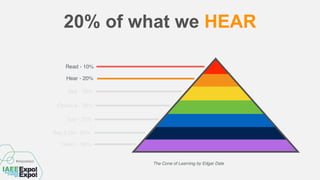
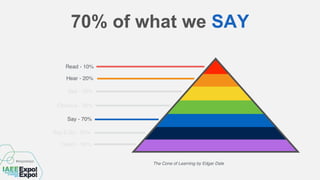
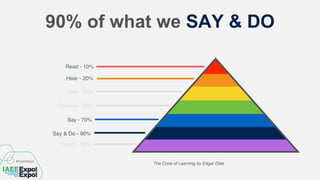
After 2 Weeks We Remember…
Read - 10%
Hear - 20%
See - 30%
Observe - 50%
Say - 70%
Say & Do - 90%
Teach - 99%
The Cone of Learning by Edgar Dale
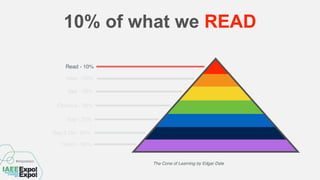
10% of what we READ
Read - 10%
Hear - 20%
See - 30%
Observe - 50%
Say - 70%
Say & Do - 90%
Teach - 99%
The Cone of Learning by Edgar Dale
Read - 10%
Hear - 20%
See - 30%
Observe - 50%
Say - 70%
Say & Do - 90%
Teach - 99%
The Cone of Learning by Edgar Dale
20% of what we HEAR
Read - 10%
Hear - 20%
See - 30%
Observe - 50%
Say - 70%
Say & Do - 90%
Teach - 99%
The Cone of Learning by Edgar Dale
70% of what we SAY
Read - 10%
Hear - 20%
See - 30%
Observe - 50%
Say - 70%
Say & Do - 90%
Teach - 99%
The Cone of Learning by Edgar Dale
90% of what we SAY & DO
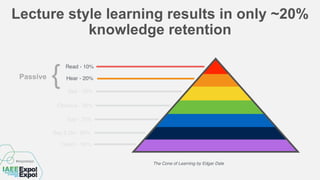
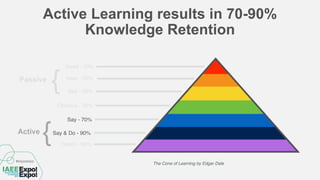
Lecture style learning results in only ~20%
knowledge retention
Read - 10%
Hear - 20%
See - 30%
Observe - 50%
Say - 70%
Say & Do - 90%
Teach - 99%
The Cone of Learning by Edgar Dale
{Passive
Active Learning results in 70-90%
Knowledge Retention
Read - 10%
Hear - 20%
See - 30%
Observe - 50%
Say - 70%
Say & Do - 90%
Teach - 99%
The Cone of Learning by Edgar Dale
{Passive
{Active
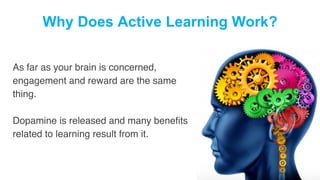
Why Does Active Learning Work?
As far as your brain is concerned,
engagement and reward are the same
thing.
Dopamine is released and many benefits
related to learning result from it.
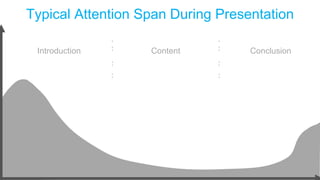
Typical Attention Span During Presentation
Introduction Content Conclusion
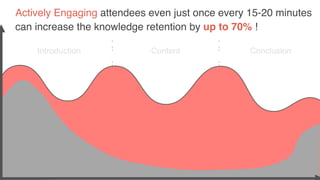
Actively Engaging attendees even just once every 15-20 minutes
can increase the knowledge retention by up to 70% !
Introduction Content Conclusion
People Want To Engage
Everyone Wants To Engage
So Why Does Engagement
Matter?
People attend conferences to learn
Being Engaged Improves Learning…
Effective
Learning
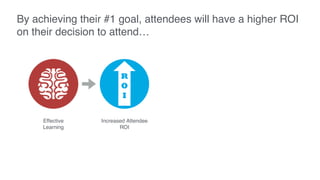
By achieving their #1 goal, attendees will have a higher ROI
on their decision to attend…
Effective
Learning
Increased Attendee
ROI
R
O
I
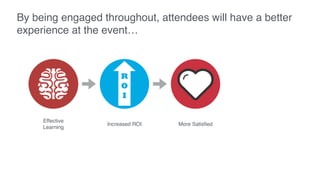
By being engaged throughout, attendees will have a better
experience at the event…
Effective
Learning
Increased ROI More Satisfied
R
O
I
And thus more likely to attend again next year, attend other
events you offer and tell others about their experience
Effective
Learning
Increased ROI More Satisfied Repeat Attendance &
Referrals
$
R
O
I
Why To Use Engagement
Technology
The Hard Part Is Keeping Attendees
Engaged
What Made Steve Jobs So Engaging?
Most Presenters Are Not Steve Jobs
Not All Content Is Sexy
We know that active learning works
but what options do presenters have
to create that active environment?
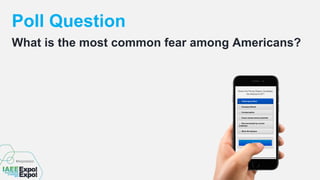
Poll Question
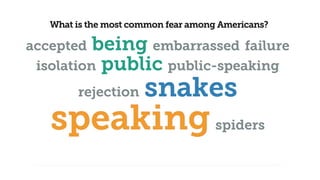
What is the most common fear among Americans?
Public Speaking is
The Most Common
Fear in America
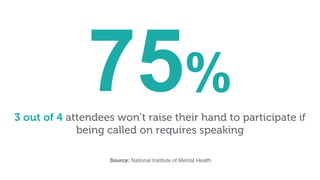
75%
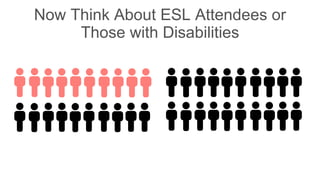
3 out of 4 attendees won’t raise their hand to participate if
being called on requires speaking
Source: National Institute of Mental Health
But this is the traditional way
attendees are asked to participate
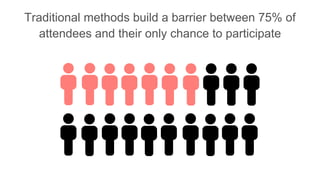
Traditional methods build a barrier between 75% of
attendees and their only chance to participate
Now Think About ESL Attendees or
Those with Disabilities
We Surveyed 500 People About
Their Feelings on Traditional Q&A
There Was An Overwhelming Response in
Terms of the Most Despised Aspect…
Microphone Hijackers _
Hijackers Aren’t in the 75% That
Won’t Raise Their Hand
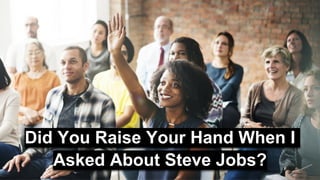
Did You Raise Your Hand When I
Asked About Steve Jobs?
Everyone Wants To Engage.
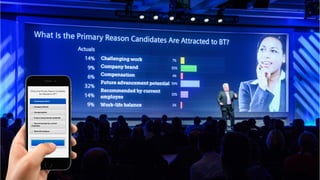
What’s More Engaging?
This is Where Technology
Comes Into Play
Engagement Tools Are Just
Better Mousetraps
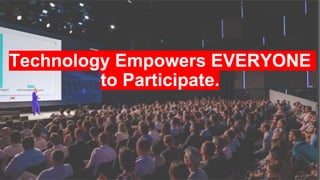
Technology Empowers EVERYONE
to Participate.
Not Just Those Willing to Raise Their Hand
Technology Alone Is Not a
Solution
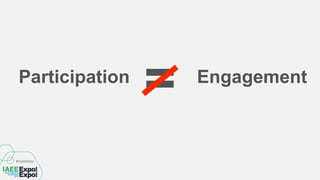
Participation Engagement
=
To truly engage we need to go further —
something needs to result out of that
participation.
Attendees need to see why it matters.
How To Successfully Engage
What Causes Low Engagement?
1. Attendees Don’t Participate
2. Presenters Don’t Adopt the Tools
3. “On-Site Only” Engagement
How To Successfully Engage
1. Tips that are simple to implement
2. Ideas that will excite you
3. Recommendations that will scare you
What Causes Low Engagement?
1. Attendees Don’t Participate
2. Presenters Don’t Adopt the Tools
3. “On-Site Only” Engagement
People Want To Engage.
Why Attendees Don’t Participate
‣ Aren’t encouraged to participate
‣ Can’t figure out how to participate
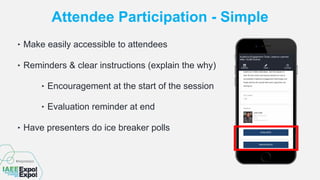
Attendee Participation - Simple
‣ Make easily accessible to attendees
‣ Reminders & clear instructions (explain the why)
‣ Encouragement at the start of the session
‣ Evaluation reminder at end
‣ Have presenters do ice breaker polls
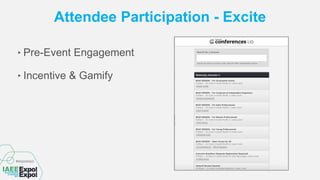
Attendee Participation - Excite
‣ Pre-Event Engagement
‣ Incentive & Gamify
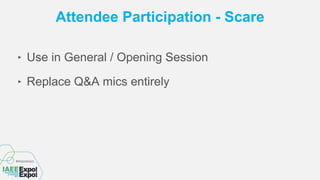
Attendee Participation - Scare
‣ Use in General / Opening Session
‣ Replace Q&A mics entirely
What Causes Low Engagement?
1. Attendees Don’t Participate
2. Presenters Don’t Adopt the Tools
3. “On-Site Only” Engagement
Presenter Adoption Is The Largest
Challenge You’ll Face Related To
Engagement
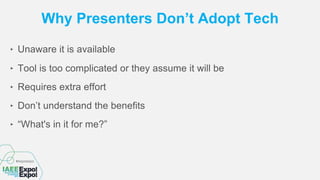
Why Presenters Don’t Adopt Tech
‣ Unaware it is available
‣ Tool is too complicated or they assume it will be
‣ Requires extra effort
‣ Don’t understand the benefits
‣ “What's in it for me?”
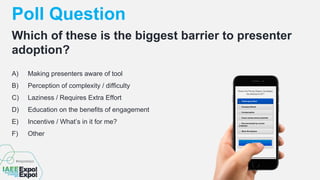
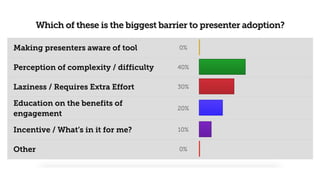
Poll Question
A) Making presenters aware of tool
B) Perception of complexity / difficulty
C) Laziness / Requires Extra Effort
D) Education on the benefits of engagement
E) Incentive / What’s in it for me?
F) Other
Which of these is the biggest barrier to presenter
adoption?
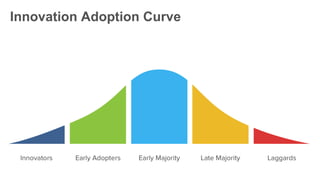
Innovation Adoption Curve
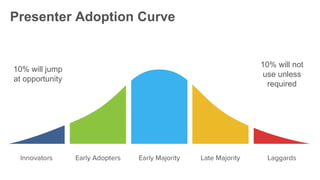
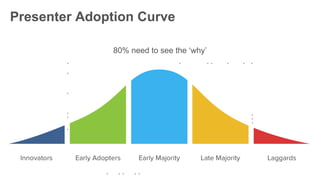
Presenter Adoption Curve
10% will jump
at opportunity
10% will not
use unless
required
Presenter Adoption Curve
80% need to see the ‘why’
Presenters - Simple
‣ Have an organized presenter communication strategy
‣ Educate on benefits, Show the “why”, focus on ease, provide inspiration
‣ Engage w/ presenters that show interest
‣ Host informational webinar
‣ Be there for questions
Presenters - Excite
‣ Pre Event Engagement
‣ More likely to use tool if they see engagement
‣ Can use insights to adjust content
‣ Use successful presenters in process, as inspiration
Presenters - Scare
‣ Get rid of Q&A mics entirely
‣ Consider a dedicated engagement staff role
‣ Require presenters to follow up on unaddressed Q&A
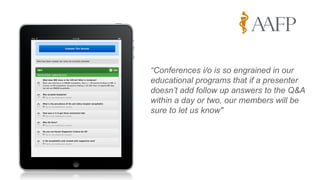
“Conferences i/o is so engrained in our
educational programs that if a presenter
doesn’t add follow up answers to the Q&A
within a day or two, our members will be
sure to let us know"
What Causes Low Engagement?
1. Attendees Don’t Participate
2. Presenters Don’t Adopt the Tools
3. “On-Site Only” Engagement
On-Site Only Engagement
‣ Orgs don’t measure or don’t know what to measure
‣ Participation does not equal Engagement
‣ Start with a clear goal and define what success means for you
‣ Plan how to measure goal
‣ Use data / insights collected and create content afterwards
‣ Show you're listening / care
On-Site Only Engagement
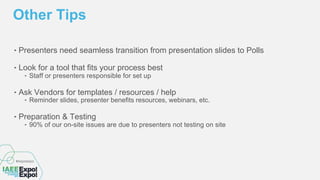
‣ Presenters need seamless transition from presentation slides to Polls
‣ Look for a tool that fits your process best
‣ Staff or presenters responsible for set up
‣ Ask Vendors for templates / resources / help
‣ Reminder slides, presenter benefits resources, webinars, etc.
‣ Preparation & Testing
‣ 90% of our on-site issues are due to presenters not testing on site
Other Tips
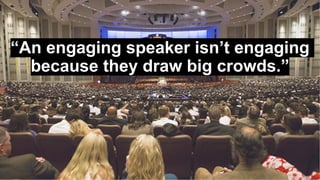
“An engaging speaker isn’t engaging
because they draw big crowds.”
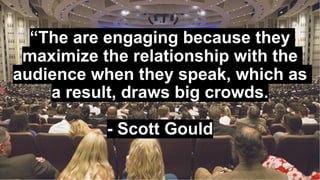
“The are engaging because they
maximize the relationship with the
audience when they speak, which as
a result, draws big crowds.
- Scott Gould

Audience Engagement Tools - Lessons learned after 10,000 events

  • 2.
  • 3.
    Poll Question Was increasingattendee engagement a goal for your events in 2019? A) Yes B) No
  • 5.
    Poll Question A) Yes B)No Will increasing attendee engagement be a goal for your events in 2020?
  • 13.
    If There AreSo Many Tools Making Engagement So Easy …
  • 14.
    Why Are EventOrganizers Constantly Searching For Ways To Improve Engagement?
  • 15.
  • 16.
    Proven Results 200% Increase inSpeaker Adoption of ARS 300% Increase in Session Evaluation Responses 50+Administrative Hours Saved
  • 17.
    We’ve learned alot about what it takes to successfully Engage attendees
  • 18.
    What Does EngagementMean For Events?
  • 19.
    Event Engagement isthe degree to which attendees are fully participating in and captivated by your event.
  • 20.
    Event Engagement involvesall aspects of your event — from registration to education to networking
  • 21.
    I’m going tofocus on engagement as it relates to the educational sessions
  • 22.
  • 23.
  • 24.
    The format for teachingreally hasn’t changed much over the past 2,000 years
  • 25.
  • 26.
    Unfortunately the mosteffective learning doesn’t happen by simply listening =+
  • 27.
    Effective learning happenswhen attendees are participating & engaged + = Participation Engagement Active Learning ?
  • 28.
    After 2 WeeksWe Remember… Read - 10% Hear - 20% See - 30% Observe - 50% Say - 70% Say & Do - 90% Teach - 99% The Cone of Learning by Edgar Dale
  • 29.
    10% of whatwe READ Read - 10% Hear - 20% See - 30% Observe - 50% Say - 70% Say & Do - 90% Teach - 99% The Cone of Learning by Edgar Dale
  • 30.
    Read - 10% Hear- 20% See - 30% Observe - 50% Say - 70% Say & Do - 90% Teach - 99% The Cone of Learning by Edgar Dale 20% of what we HEAR
  • 31.
    Read - 10% Hear- 20% See - 30% Observe - 50% Say - 70% Say & Do - 90% Teach - 99% The Cone of Learning by Edgar Dale 70% of what we SAY
  • 32.
    Read - 10% Hear- 20% See - 30% Observe - 50% Say - 70% Say & Do - 90% Teach - 99% The Cone of Learning by Edgar Dale 90% of what we SAY & DO
  • 33.
    Lecture style learningresults in only ~20% knowledge retention Read - 10% Hear - 20% See - 30% Observe - 50% Say - 70% Say & Do - 90% Teach - 99% The Cone of Learning by Edgar Dale {Passive
  • 34.
    Active Learning resultsin 70-90% Knowledge Retention Read - 10% Hear - 20% See - 30% Observe - 50% Say - 70% Say & Do - 90% Teach - 99% The Cone of Learning by Edgar Dale {Passive {Active
  • 35.
    Why Does ActiveLearning Work? As far as your brain is concerned, engagement and reward are the same thing. Dopamine is released and many benefits related to learning result from it.
  • 36.
    Typical Attention SpanDuring Presentation Introduction Content Conclusion
  • 37.
    Actively Engaging attendeeseven just once every 15-20 minutes can increase the knowledge retention by up to 70% ! Introduction Content Conclusion
  • 38.
  • 39.
  • 40.
    So Why DoesEngagement Matter?
  • 41.
  • 42.
    Being Engaged ImprovesLearning… Effective Learning
  • 43.
    By achieving their#1 goal, attendees will have a higher ROI on their decision to attend… Effective Learning Increased Attendee ROI R O I
  • 44.
    By being engagedthroughout, attendees will have a better experience at the event… Effective Learning Increased ROI More Satisfied R O I
  • 45.
    And thus morelikely to attend again next year, attend other events you offer and tell others about their experience Effective Learning Increased ROI More Satisfied Repeat Attendance & Referrals $ R O I
  • 46.
    Why To UseEngagement Technology
  • 47.
    The Hard PartIs Keeping Attendees Engaged
  • 48.
    What Made SteveJobs So Engaging?
  • 49.
    Most Presenters AreNot Steve Jobs
  • 50.
  • 51.
    We know thatactive learning works but what options do presenters have to create that active environment?
  • 55.
    Poll Question What isthe most common fear among Americans?
  • 57.
    Public Speaking is TheMost Common Fear in America
  • 58.
    75% 3 out of4 attendees won’t raise their hand to participate if being called on requires speaking Source: National Institute of Mental Health
  • 59.
    But this isthe traditional way attendees are asked to participate
  • 60.
    Traditional methods builda barrier between 75% of attendees and their only chance to participate
  • 61.
    Now Think AboutESL Attendees or Those with Disabilities
  • 62.
    We Surveyed 500People About Their Feelings on Traditional Q&A
  • 63.
    There Was AnOverwhelming Response in Terms of the Most Despised Aspect…
  • 64.
  • 65.
    Hijackers Aren’t inthe 75% That Won’t Raise Their Hand
  • 66.
    Did You RaiseYour Hand When I Asked About Steve Jobs?
  • 67.
  • 68.
  • 71.
    This is WhereTechnology Comes Into Play
  • 72.
    Engagement Tools AreJust Better Mousetraps
  • 73.
  • 74.
    Not Just ThoseWilling to Raise Their Hand
  • 75.
    Technology Alone IsNot a Solution
  • 76.
  • 77.
    To truly engagewe need to go further — something needs to result out of that participation. Attendees need to see why it matters.
  • 78.
  • 79.
    What Causes LowEngagement? 1. Attendees Don’t Participate 2. Presenters Don’t Adopt the Tools 3. “On-Site Only” Engagement
  • 80.
    How To SuccessfullyEngage 1. Tips that are simple to implement 2. Ideas that will excite you 3. Recommendations that will scare you
  • 81.
    What Causes LowEngagement? 1. Attendees Don’t Participate 2. Presenters Don’t Adopt the Tools 3. “On-Site Only” Engagement
  • 82.
  • 83.
    Why Attendees Don’tParticipate ‣ Aren’t encouraged to participate ‣ Can’t figure out how to participate
  • 84.
    Attendee Participation -Simple ‣ Make easily accessible to attendees ‣ Reminders & clear instructions (explain the why) ‣ Encouragement at the start of the session ‣ Evaluation reminder at end ‣ Have presenters do ice breaker polls
  • 85.
    Attendee Participation -Excite ‣ Pre-Event Engagement ‣ Incentive & Gamify
  • 88.
    Attendee Participation -Scare ‣ Use in General / Opening Session ‣ Replace Q&A mics entirely
  • 89.
    What Causes LowEngagement? 1. Attendees Don’t Participate 2. Presenters Don’t Adopt the Tools 3. “On-Site Only” Engagement
  • 90.
    Presenter Adoption IsThe Largest Challenge You’ll Face Related To Engagement
  • 91.
    Why Presenters Don’tAdopt Tech ‣ Unaware it is available ‣ Tool is too complicated or they assume it will be ‣ Requires extra effort ‣ Don’t understand the benefits ‣ “What's in it for me?”
  • 92.
    Poll Question A) Makingpresenters aware of tool B) Perception of complexity / difficulty C) Laziness / Requires Extra Effort D) Education on the benefits of engagement E) Incentive / What’s in it for me? F) Other Which of these is the biggest barrier to presenter adoption?
  • 94.
  • 95.
    Presenter Adoption Curve 10%will jump at opportunity 10% will not use unless required
  • 96.
    Presenter Adoption Curve 80%need to see the ‘why’
  • 97.
    Presenters - Simple ‣Have an organized presenter communication strategy ‣ Educate on benefits, Show the “why”, focus on ease, provide inspiration ‣ Engage w/ presenters that show interest ‣ Host informational webinar ‣ Be there for questions
  • 98.
    Presenters - Excite ‣Pre Event Engagement ‣ More likely to use tool if they see engagement ‣ Can use insights to adjust content ‣ Use successful presenters in process, as inspiration
  • 100.
    Presenters - Scare ‣Get rid of Q&A mics entirely ‣ Consider a dedicated engagement staff role ‣ Require presenters to follow up on unaddressed Q&A
  • 101.
    “Conferences i/o isso engrained in our educational programs that if a presenter doesn’t add follow up answers to the Q&A within a day or two, our members will be sure to let us know"
  • 102.
    What Causes LowEngagement? 1. Attendees Don’t Participate 2. Presenters Don’t Adopt the Tools 3. “On-Site Only” Engagement
  • 103.
    On-Site Only Engagement ‣Orgs don’t measure or don’t know what to measure ‣ Participation does not equal Engagement
  • 104.
    ‣ Start witha clear goal and define what success means for you ‣ Plan how to measure goal ‣ Use data / insights collected and create content afterwards ‣ Show you're listening / care On-Site Only Engagement
  • 105.
    ‣ Presenters needseamless transition from presentation slides to Polls ‣ Look for a tool that fits your process best ‣ Staff or presenters responsible for set up ‣ Ask Vendors for templates / resources / help ‣ Reminder slides, presenter benefits resources, webinars, etc. ‣ Preparation & Testing ‣ 90% of our on-site issues are due to presenters not testing on site Other Tips
  • 106.
    “An engaging speakerisn’t engaging because they draw big crowds.”
  • 107.
    “The are engagingbecause they maximize the relationship with the audience when they speak, which as a result, draws big crowds. - Scott Gould