Biodiesel Production for On-Farm Use
A Curriculum for Agricultural Producers
Prepared by
For the
National Center for Appropriate Technology
With funding and cooperation from the
USDA Risk Management Agency
Overview
• Introduction
• The Chemistry of Biodiesel
• Advantages and Disadvantages
• Biodiesel Feedstocks
• Oil Processing
• Small Scale Biodiesel Production
• On-farm Case Studies
Introduction: What is Biodiesel?
• A permanently thinned
vegetable oil
• A diesel fuel replacement
produced from vegetable oils or
animal fats through the chemical
process of transesterification
• Biodiesel can be used in any
diesel engine in any proportion
from 1-100% with little or no
modifications to the engine
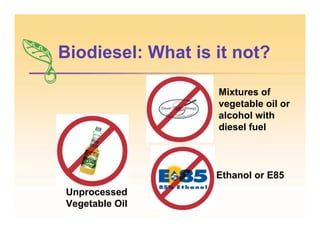
Biodiesel: What is it not?
Ethanol or E85
Unprocessed
Vegetable Oil
Mixtures of
vegetable oil or
alcohol with
diesel fuel
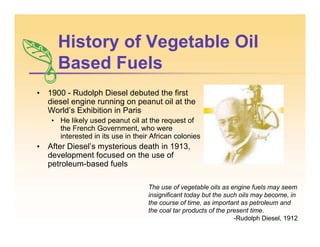
History of Vegetable Oil
Based Fuels
• 1900 - Rudolph Diesel debuted the first
diesel engine running on peanut oil at the
World’s Exhibition in Paris
• He likely used peanut oil at the request of
the French Government, who were
interested in its use in their African colonies
• After Diesel’s mysterious death in 1913,
development focused on the use of
petroleum-based fuels
The use of vegetable oils as engine fuels may seem
insignificant today but the such oils may become, in
the course of time, as important as petroleum and
the coal tar products of the present time.
-Rudolph Diesel, 1912
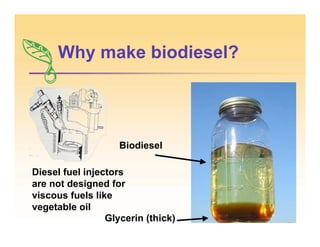
Why make biodiesel?
Diesel fuel injectors
are not designed for
viscous fuels like
vegetable oil
Glycerin (thick)
Biodiesel
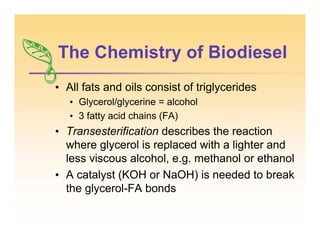
The Chemistry of Biodiesel
• All fats and oils consist of triglycerides
• Glycerol/glycerine = alcohol
• 3 fatty acid chains (FA)
• Transesterification describes the reaction
where glycerol is replaced with a lighter and
less viscous alcohol, e.g. methanol or ethanol
• A catalyst (KOH or NaOH) is needed to break
the glycerol-FA bonds
Advantages of Biodiesel
• Biodegradable
• Non-toxic
• Favorable Emissions Profile
• Renewable
• Carbon Neutrality
• Domestic production
Advantages of Biodiesel
• Requires no engine modifications (except
replacing some fuel lines on older engines).
• Can be blended in any proportion with
petroleum diesel fuel.
• High cetane number and excellent lubricity.
• Very high flashpoint (>300°F) means greater
safety
• Can be made from waste restaurant oils and
animal fats
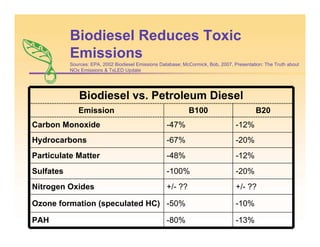
Biodiesel Reduces Toxic
Emissions
Sources: EPA, 2002 Biodiesel Emissions Database; McCormick, Bob, 2007, Presentation: The Truth about
NOx Emissions & TxLED Update
Biodiesel vs. Petroleum Diesel
-10%-50%Ozone formation (speculated HC)
-13%-80%PAH
+/- ??+/- ??Nitrogen Oxides
-20%-100%Sulfates
-12%-48%Particulate Matter
-20%-67%Hydrocarbons
-12%-47%Carbon Monoxide
B20B100Emission
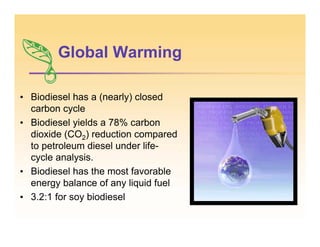
Global Warming
• Biodiesel has a (nearly) closed
carbon cycle
• Biodiesel yields a 78% carbon
dioxide (CO2) reduction compared
to petroleum diesel under life-
cycle analysis.
• Biodiesel has the most favorable
energy balance of any liquid fuel
• 3.2:1 for soy biodiesel
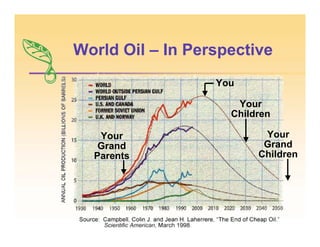
World Oil – In Perspective
You
Your
Children
Your
Grand
Children
Your
Grand
Parents
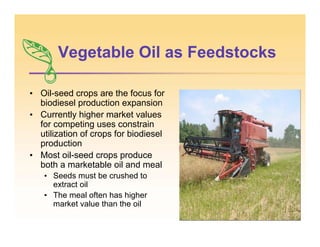
Vegetable Oil as Feedstocks
• Oil-seed crops are the focus for
biodiesel production expansion
• Currently higher market values
for competing uses constrain
utilization of crops for biodiesel
production
• Most oil-seed crops produce
both a marketable oil and meal
• Seeds must be crushed to
extract oil
• The meal often has higher
market value than the oil
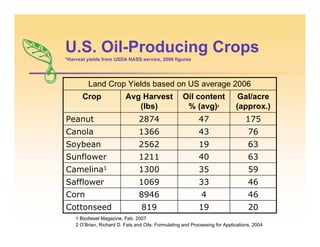
U.S. Oil-Producing Crops
*Harvest yields from USDA NASS service, 2006 figures
1 Biodiesel Magazine, Feb. 2007
2 O’Brian, Richard D. Fats and Oils: Formulating and Processing for Applications, 2004
2019819Cottonseed
59351300Camelina1
63401211Sunflower
63192562Soybean
76431366Canola
175472874Peanut
46
46
Gal/acre
(approx.)
4
33
Oil content
% (avg)2
Land Crop Yields based on US average 2006
8946Corn
1069Safflower
Avg Harvest
(lbs)
Crop
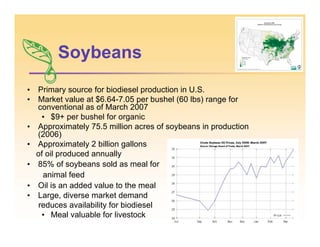
Soybeans
• Primary source for biodiesel production in U.S.
• Market value at $6.64-7.05 per bushel (60 lbs) range for
conventional as of March 2007
• $9+ per bushel for organic
• Approximately 75.5 million acres of soybeans in production
(2006)
• Approximately 2 billion gallons
of oil produced annually
• 85% of soybeans sold as meal for
animal feed
• Oil is an added value to the meal
• Large, diverse market demand
reduces availability for biodiesel
• Meal valuable for livestock
Canola/Rapeseed
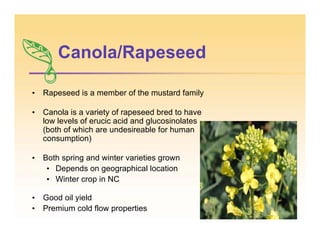
• Rapeseed is a member of the mustard family
• Canola is a variety of rapeseed bred to have
low levels of erucic acid and glucosinolates
(both of which are undesireable for human
consumption)
• Both spring and winter varieties grown
• Depends on geographical location
• Winter crop in NC
• Good oil yield
• Premium cold flow properties
Peanuts
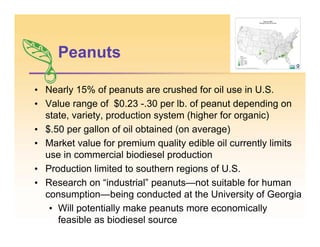
• Nearly 15% of peanuts are crushed for oil use in U.S.
• Value range of $0.23 -.30 per lb. of peanut depending on
state, variety, production system (higher for organic)
• $.50 per gallon of oil obtained (on average)
• Market value for premium quality edible oil currently limits
use in commercial biodiesel production
• Production limited to southern regions of U.S.
• Research on “industrial” peanuts—not suitable for human
consumption—being conducted at the University of Georgia
• Will potentially make peanuts more economically
feasible as biodiesel source
Sunflowers
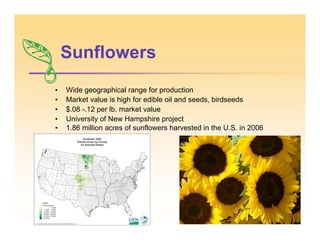
• Wide geographical range for production
• Market value is high for edible oil and seeds, birdseeds
• $.08 -.12 per lb. market value
• University of New Hampshire project
• 1.86 million acres of sunflowers harvested in the U.S. in 2006
Camelina
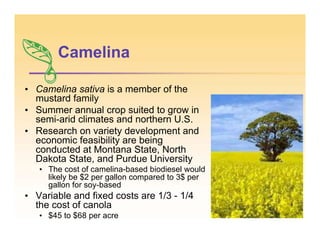
• Camelina sativa is a member of the
mustard family
• Summer annual crop suited to grow in
semi-arid climates and northern U.S.
• Research on variety development and
economic feasibility are being
conducted at Montana State, North
Dakota State, and Purdue University
• The cost of camelina-based biodiesel would
likely be $2 per gallon compared to 3$ per
gallon for soy-based
• Variable and fixed costs are 1/3 - 1/4
the cost of canola
• $45 to $68 per acre
Other oil crops
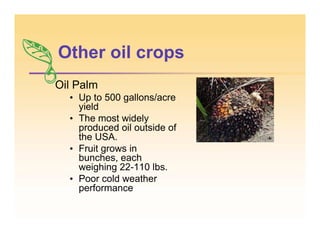
Oil Palm
• Up to 500 gallons/acre
yield
• The most widely
produced oil outside of
the USA.
• Fruit grows in
bunches, each
weighing 22-110 lbs.
• Poor cold weather
performance
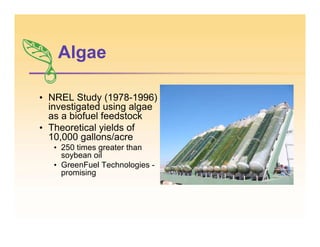
Algae
• NREL Study (1978-1996)
investigated using algae
as a biofuel feedstock
• Theoretical yields of
10,000 gallons/acre
• 250 times greater than
soybean oil
• GreenFuel Technologies -
promising
Oil Processing
• Oil-seed crops must be crushed to extract oil
• This can be done on-farm or at a crushing facility
• Small scale systems use mechanical crushing
• Commercial crushers often also use hexane
extraction
• Hexane is toxic but removes more than 99% of oil
• Before conversion, oil must be degummed:
• Treat with phosphoric acid for 4-8 hours (300-1000
ppm for soy, 1000-3000 ppm for canola)
• Water wash
• Vacuum drying
• Oil often purchased as “Crude, degummed.”
RBD = Refined, Bleached, Deodorized
Disadvantages of biodiesel
• Lower Energy Content
• 8% fewer BTU’s per gallon, but also higher cetane #,
lubricity, etc.
• Poor cold weather performance
• This can be mitigated by blending with diesel fuel or with
additives, or using low gel-point feedstocks such as
rapeseed/canola.
• Stability Concerns
• Biodiesel is less oxidatively stable than petroleum diesel
fuel. Old fuel can become acidic and form sediments and
varnish. Additives can prevent this.
• Scalability
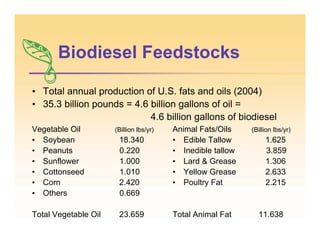
Biodiesel Feedstocks
Vegetable Oil (Billion lbs/yr)
• Soybean 18.340
• Peanuts 0.220
• Sunflower 1.000
• Cottonseed 1.010
• Corn 2.420
• Others 0.669
Total Vegetable Oil 23.659
Animal Fats/Oils (Billion lbs/yr)
• Edible Tallow 1.625
• Inedible tallow 3.859
• Lard & Grease 1.306
• Yellow Grease 2.633
• Poultry Fat 2.215
Total Animal Fat 11.638
• Total annual production of U.S. fats and oils (2004)
• 35.3 billion pounds = 4.6 billion gallons of oil =
4.6 billion gallons of biodiesel
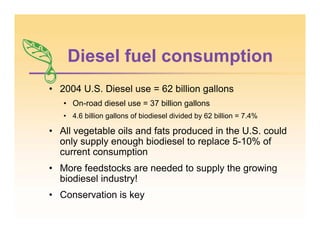
Diesel fuel consumption
• 2004 U.S. Diesel use = 62 billion gallons
• On-road diesel use = 37 billion gallons
• 4.6 billion gallons of biodiesel divided by 62 billion = 7.4%
• All vegetable oils and fats produced in the U.S. could
only supply enough biodiesel to replace 5-10% of
current consumption
• More feedstocks are needed to supply the growing
biodiesel industry!
• Conservation is key
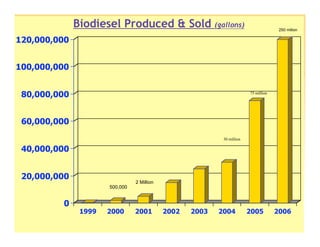
0
20,000,000
40,000,000
60,000,000
80,000,000
100,000,000
120,000,000
1999 2000 2001 2002 2003 2004 2005 2006
Biodiesel Produced & Sold (gallons)
500,000
2 Million
30 million
75 million
250 milion
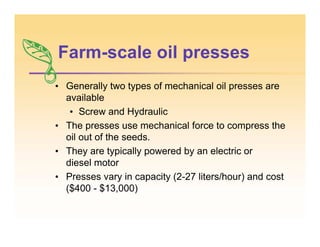
Farm-scale oil presses
• Generally two types of mechanical oil presses are
available
• Screw and Hydraulic
• The presses use mechanical force to compress the
oil out of the seeds.
• They are typically powered by an electric or
diesel motor
• Presses vary in capacity (2-27 liters/hour) and cost
($400 - $13,000)
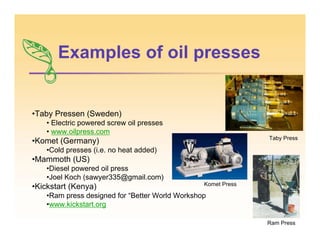
Examples of oil presses
•Taby Pressen (Sweden)
• Electric powered screw oil presses
• www.oilpress.com
•Komet (Germany)
•Cold presses (i.e. no heat added)
•Mammoth (US)
•Diesel powered oil press
•Joel Koch (sawyer335@gmail.com)
•Kickstart (Kenya)
•Ram press designed for “Better World Workshop
•www.kickstart.org
Komet Press
Ram Press
Taby Press
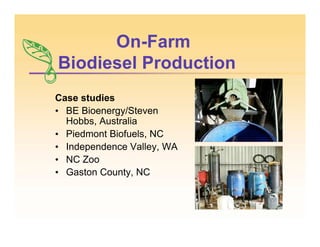
On-Farm
Biodiesel Production
Case studies
• BE Bioenergy/Steven
Hobbs, Australia
• Piedmont Biofuels, NC
• Independence Valley, WA
• NC Zoo
• Gaston County, NC
On-farm/ off-road biodiesel
• Biodiesel used as off-road fuel is exempt
from state or federal road excise taxes
• Fuel should meet the ASTM specification
D 6751
• EPA registration is exempt for off-road
fuel production
• Can be produced using either waste oils
brought in or using locally grown energy
crops such as canola, soy, sunflower,
mustard, etc.
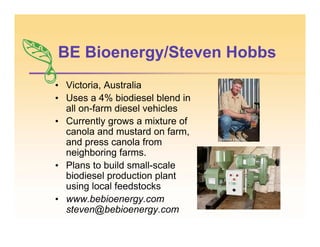
BE Bioenergy/Steven Hobbs
• Victoria, Australia
• Uses a 4% biodiesel blend in
all on-farm diesel vehicles
• Currently grows a mixture of
canola and mustard on farm,
and press canola from
neighboring farms.
• Plans to build small-scale
biodiesel production plant
using local feedstocks
• www.bebioenergy.com
steven@bebioenergy.com
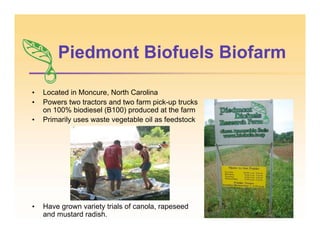
• Located in Moncure, North Carolina
• Powers two tractors and two farm pick-up trucks
on 100% biodiesel (B100) produced at the farm
• Primarily uses waste vegetable oil as feedstock
• Have grown variety trials of canola, rapeseed
and mustard radish.
Piedmont Biofuels Biofarm
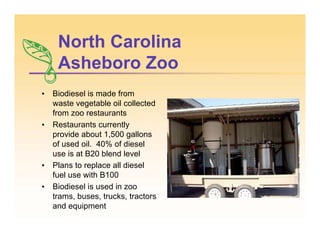
North Carolina
Asheboro Zoo
• Biodiesel is made from
waste vegetable oil collected
from zoo restaurants
• Restaurants currently
provide about 1,500 gallons
of used oil. 40% of diesel
use is at B20 blend level
• Plans to replace all diesel
fuel use with B100
• Biodiesel is used in zoo
trams, buses, trucks, tractors
and equipment
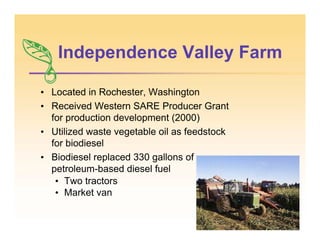
Independence Valley Farm
• Located in Rochester, Washington
• Received Western SARE Producer Grant
for production development (2000)
• Utilized waste vegetable oil as feedstock
for biodiesel
• Biodiesel replaced 330 gallons of
petroleum-based diesel fuel
• Two tractors
• Market van
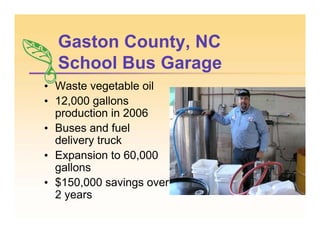
Gaston County, NC
School Bus Garage
• Waste vegetable oil
• 12,000 gallons
production in 2006
• Buses and fuel
delivery truck
• Expansion to 60,000
gallons
• $150,000 savings over
2 years
Further Resources
• www.attra.org — Small scale oilseed processing guide,
Biodiesel: A Brief Overview
• www.bebioenergy.com — Biodiesel, Farming for the Future
• www.landinstitute.org — Insights from Sunshine Farm
• www.folkecenter.dk — Cold-Pressing of Oilseeds,
Organic Rape Cultivation, Pure Plant Oil (3 separate articles)
• www.wsare.usu.edu — On Farm Biodiesel Production with WVO
• www.green-trust.org — Sunflower Seed Huller & Oil-seed Press
• www.oilpress.com — Taby-pressen oil seed presses
• www.journeytoforever.org/biofuel_food.html — Food or Fuel?
• www.unh.edu/p2/biodiesel/index.html
• www.eere.energy.gov/biomass/publications.html
• www.bioproducts-bioenergy.gov/pdfs/bcota/abstracts/19/z347.pdf
National Biodiesel Board
(NBB)
• National Soydiesel Development Board changed its
name to NBB in 1995 and began to focus its efforts
on addressing technical and regulatory needs to
commercialize biodiesel.
Two main accomplishments:
1. Helped develop an ASTM specification
for biodiesel
2. Registered biodiesel with the EPA by
completing Tier 1 and Tier 2 health data
testing at a cost of over $2.2 million
• Annual NBB conference (Orlando, FL February 2008)
Contact Information
Piedmont Biofuels
(919) 321-8260
www.biofuels.coop

Biodiesel Production for On-Farm Use

  • 1.
    Biodiesel Production forOn-Farm Use A Curriculum for Agricultural Producers Prepared by For the National Center for Appropriate Technology With funding and cooperation from the USDA Risk Management Agency
  • 2.
    Overview • Introduction • TheChemistry of Biodiesel • Advantages and Disadvantages • Biodiesel Feedstocks • Oil Processing • Small Scale Biodiesel Production • On-farm Case Studies
  • 3.
    Introduction: What isBiodiesel? • A permanently thinned vegetable oil • A diesel fuel replacement produced from vegetable oils or animal fats through the chemical process of transesterification • Biodiesel can be used in any diesel engine in any proportion from 1-100% with little or no modifications to the engine
  • 4.
    Biodiesel: What isit not? Ethanol or E85 Unprocessed Vegetable Oil Mixtures of vegetable oil or alcohol with diesel fuel
  • 5.
    History of VegetableOil Based Fuels • 1900 - Rudolph Diesel debuted the first diesel engine running on peanut oil at the World’s Exhibition in Paris • He likely used peanut oil at the request of the French Government, who were interested in its use in their African colonies • After Diesel’s mysterious death in 1913, development focused on the use of petroleum-based fuels The use of vegetable oils as engine fuels may seem insignificant today but the such oils may become, in the course of time, as important as petroleum and the coal tar products of the present time. -Rudolph Diesel, 1912
  • 6.
    Why make biodiesel? Dieselfuel injectors are not designed for viscous fuels like vegetable oil Glycerin (thick) Biodiesel
  • 7.
    The Chemistry ofBiodiesel • All fats and oils consist of triglycerides • Glycerol/glycerine = alcohol • 3 fatty acid chains (FA) • Transesterification describes the reaction where glycerol is replaced with a lighter and less viscous alcohol, e.g. methanol or ethanol • A catalyst (KOH or NaOH) is needed to break the glycerol-FA bonds
  • 8.
    Advantages of Biodiesel •Biodegradable • Non-toxic • Favorable Emissions Profile • Renewable • Carbon Neutrality • Domestic production
  • 9.
    Advantages of Biodiesel •Requires no engine modifications (except replacing some fuel lines on older engines). • Can be blended in any proportion with petroleum diesel fuel. • High cetane number and excellent lubricity. • Very high flashpoint (>300°F) means greater safety • Can be made from waste restaurant oils and animal fats
  • 10.
    Biodiesel Reduces Toxic Emissions Sources:EPA, 2002 Biodiesel Emissions Database; McCormick, Bob, 2007, Presentation: The Truth about NOx Emissions & TxLED Update Biodiesel vs. Petroleum Diesel -10%-50%Ozone formation (speculated HC) -13%-80%PAH +/- ??+/- ??Nitrogen Oxides -20%-100%Sulfates -12%-48%Particulate Matter -20%-67%Hydrocarbons -12%-47%Carbon Monoxide B20B100Emission
  • 11.
    Global Warming • Biodieselhas a (nearly) closed carbon cycle • Biodiesel yields a 78% carbon dioxide (CO2) reduction compared to petroleum diesel under life- cycle analysis. • Biodiesel has the most favorable energy balance of any liquid fuel • 3.2:1 for soy biodiesel
  • 12.
    World Oil –In Perspective You Your Children Your Grand Children Your Grand Parents
  • 13.
    Vegetable Oil asFeedstocks • Oil-seed crops are the focus for biodiesel production expansion • Currently higher market values for competing uses constrain utilization of crops for biodiesel production • Most oil-seed crops produce both a marketable oil and meal • Seeds must be crushed to extract oil • The meal often has higher market value than the oil
  • 14.
    U.S. Oil-Producing Crops *Harvestyields from USDA NASS service, 2006 figures 1 Biodiesel Magazine, Feb. 2007 2 O’Brian, Richard D. Fats and Oils: Formulating and Processing for Applications, 2004 2019819Cottonseed 59351300Camelina1 63401211Sunflower 63192562Soybean 76431366Canola 175472874Peanut 46 46 Gal/acre (approx.) 4 33 Oil content % (avg)2 Land Crop Yields based on US average 2006 8946Corn 1069Safflower Avg Harvest (lbs) Crop
  • 15.
    Soybeans • Primary sourcefor biodiesel production in U.S. • Market value at $6.64-7.05 per bushel (60 lbs) range for conventional as of March 2007 • $9+ per bushel for organic • Approximately 75.5 million acres of soybeans in production (2006) • Approximately 2 billion gallons of oil produced annually • 85% of soybeans sold as meal for animal feed • Oil is an added value to the meal • Large, diverse market demand reduces availability for biodiesel • Meal valuable for livestock
  • 16.
    Canola/Rapeseed • Rapeseed isa member of the mustard family • Canola is a variety of rapeseed bred to have low levels of erucic acid and glucosinolates (both of which are undesireable for human consumption) • Both spring and winter varieties grown • Depends on geographical location • Winter crop in NC • Good oil yield • Premium cold flow properties
  • 17.
    Peanuts • Nearly 15%of peanuts are crushed for oil use in U.S. • Value range of $0.23 -.30 per lb. of peanut depending on state, variety, production system (higher for organic) • $.50 per gallon of oil obtained (on average) • Market value for premium quality edible oil currently limits use in commercial biodiesel production • Production limited to southern regions of U.S. • Research on “industrial” peanuts—not suitable for human consumption—being conducted at the University of Georgia • Will potentially make peanuts more economically feasible as biodiesel source
  • 18.
    Sunflowers • Wide geographicalrange for production • Market value is high for edible oil and seeds, birdseeds • $.08 -.12 per lb. market value • University of New Hampshire project • 1.86 million acres of sunflowers harvested in the U.S. in 2006
  • 19.
    Camelina • Camelina sativais a member of the mustard family • Summer annual crop suited to grow in semi-arid climates and northern U.S. • Research on variety development and economic feasibility are being conducted at Montana State, North Dakota State, and Purdue University • The cost of camelina-based biodiesel would likely be $2 per gallon compared to 3$ per gallon for soy-based • Variable and fixed costs are 1/3 - 1/4 the cost of canola • $45 to $68 per acre
  • 20.
    Other oil crops OilPalm • Up to 500 gallons/acre yield • The most widely produced oil outside of the USA. • Fruit grows in bunches, each weighing 22-110 lbs. • Poor cold weather performance
  • 21.
    Algae • NREL Study(1978-1996) investigated using algae as a biofuel feedstock • Theoretical yields of 10,000 gallons/acre • 250 times greater than soybean oil • GreenFuel Technologies - promising
  • 22.
    Oil Processing • Oil-seedcrops must be crushed to extract oil • This can be done on-farm or at a crushing facility • Small scale systems use mechanical crushing • Commercial crushers often also use hexane extraction • Hexane is toxic but removes more than 99% of oil • Before conversion, oil must be degummed: • Treat with phosphoric acid for 4-8 hours (300-1000 ppm for soy, 1000-3000 ppm for canola) • Water wash • Vacuum drying • Oil often purchased as “Crude, degummed.” RBD = Refined, Bleached, Deodorized
  • 23.
    Disadvantages of biodiesel •Lower Energy Content • 8% fewer BTU’s per gallon, but also higher cetane #, lubricity, etc. • Poor cold weather performance • This can be mitigated by blending with diesel fuel or with additives, or using low gel-point feedstocks such as rapeseed/canola. • Stability Concerns • Biodiesel is less oxidatively stable than petroleum diesel fuel. Old fuel can become acidic and form sediments and varnish. Additives can prevent this. • Scalability
  • 24.
    Biodiesel Feedstocks Vegetable Oil(Billion lbs/yr) • Soybean 18.340 • Peanuts 0.220 • Sunflower 1.000 • Cottonseed 1.010 • Corn 2.420 • Others 0.669 Total Vegetable Oil 23.659 Animal Fats/Oils (Billion lbs/yr) • Edible Tallow 1.625 • Inedible tallow 3.859 • Lard & Grease 1.306 • Yellow Grease 2.633 • Poultry Fat 2.215 Total Animal Fat 11.638 • Total annual production of U.S. fats and oils (2004) • 35.3 billion pounds = 4.6 billion gallons of oil = 4.6 billion gallons of biodiesel
  • 25.
    Diesel fuel consumption •2004 U.S. Diesel use = 62 billion gallons • On-road diesel use = 37 billion gallons • 4.6 billion gallons of biodiesel divided by 62 billion = 7.4% • All vegetable oils and fats produced in the U.S. could only supply enough biodiesel to replace 5-10% of current consumption • More feedstocks are needed to supply the growing biodiesel industry! • Conservation is key
  • 26.
    0 20,000,000 40,000,000 60,000,000 80,000,000 100,000,000 120,000,000 1999 2000 20012002 2003 2004 2005 2006 Biodiesel Produced & Sold (gallons) 500,000 2 Million 30 million 75 million 250 milion
  • 27.
    Farm-scale oil presses •Generally two types of mechanical oil presses are available • Screw and Hydraulic • The presses use mechanical force to compress the oil out of the seeds. • They are typically powered by an electric or diesel motor • Presses vary in capacity (2-27 liters/hour) and cost ($400 - $13,000)
  • 28.
    Examples of oilpresses •Taby Pressen (Sweden) • Electric powered screw oil presses • www.oilpress.com •Komet (Germany) •Cold presses (i.e. no heat added) •Mammoth (US) •Diesel powered oil press •Joel Koch (sawyer335@gmail.com) •Kickstart (Kenya) •Ram press designed for “Better World Workshop •www.kickstart.org Komet Press Ram Press Taby Press
  • 29.
    On-Farm Biodiesel Production Case studies •BE Bioenergy/Steven Hobbs, Australia • Piedmont Biofuels, NC • Independence Valley, WA • NC Zoo • Gaston County, NC
  • 30.
    On-farm/ off-road biodiesel •Biodiesel used as off-road fuel is exempt from state or federal road excise taxes • Fuel should meet the ASTM specification D 6751 • EPA registration is exempt for off-road fuel production • Can be produced using either waste oils brought in or using locally grown energy crops such as canola, soy, sunflower, mustard, etc.
  • 31.
    BE Bioenergy/Steven Hobbs •Victoria, Australia • Uses a 4% biodiesel blend in all on-farm diesel vehicles • Currently grows a mixture of canola and mustard on farm, and press canola from neighboring farms. • Plans to build small-scale biodiesel production plant using local feedstocks • www.bebioenergy.com steven@bebioenergy.com
  • 32.
    • Located inMoncure, North Carolina • Powers two tractors and two farm pick-up trucks on 100% biodiesel (B100) produced at the farm • Primarily uses waste vegetable oil as feedstock • Have grown variety trials of canola, rapeseed and mustard radish. Piedmont Biofuels Biofarm
  • 33.
    North Carolina Asheboro Zoo •Biodiesel is made from waste vegetable oil collected from zoo restaurants • Restaurants currently provide about 1,500 gallons of used oil. 40% of diesel use is at B20 blend level • Plans to replace all diesel fuel use with B100 • Biodiesel is used in zoo trams, buses, trucks, tractors and equipment
  • 34.
    Independence Valley Farm •Located in Rochester, Washington • Received Western SARE Producer Grant for production development (2000) • Utilized waste vegetable oil as feedstock for biodiesel • Biodiesel replaced 330 gallons of petroleum-based diesel fuel • Two tractors • Market van
  • 35.
    Gaston County, NC SchoolBus Garage • Waste vegetable oil • 12,000 gallons production in 2006 • Buses and fuel delivery truck • Expansion to 60,000 gallons • $150,000 savings over 2 years
  • 36.
    Further Resources • www.attra.org— Small scale oilseed processing guide, Biodiesel: A Brief Overview • www.bebioenergy.com — Biodiesel, Farming for the Future • www.landinstitute.org — Insights from Sunshine Farm • www.folkecenter.dk — Cold-Pressing of Oilseeds, Organic Rape Cultivation, Pure Plant Oil (3 separate articles) • www.wsare.usu.edu — On Farm Biodiesel Production with WVO • www.green-trust.org — Sunflower Seed Huller & Oil-seed Press • www.oilpress.com — Taby-pressen oil seed presses • www.journeytoforever.org/biofuel_food.html — Food or Fuel? • www.unh.edu/p2/biodiesel/index.html • www.eere.energy.gov/biomass/publications.html • www.bioproducts-bioenergy.gov/pdfs/bcota/abstracts/19/z347.pdf
  • 37.
    National Biodiesel Board (NBB) •National Soydiesel Development Board changed its name to NBB in 1995 and began to focus its efforts on addressing technical and regulatory needs to commercialize biodiesel. Two main accomplishments: 1. Helped develop an ASTM specification for biodiesel 2. Registered biodiesel with the EPA by completing Tier 1 and Tier 2 health data testing at a cost of over $2.2 million • Annual NBB conference (Orlando, FL February 2008)
  • 38.