The Water Cycle
What is it and how does it work?
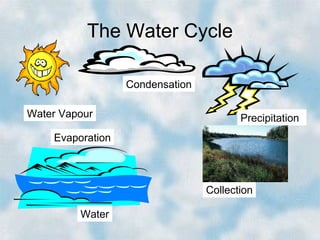
The Water Cycle

                  Condensation

Water Vapour                            Precipitation
    Evaporation


                                 Collection

         Water
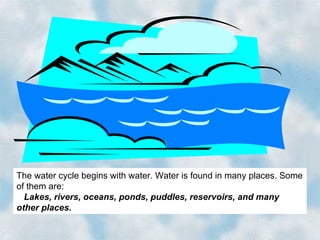
The water cycle begins with water. Water is found in many places. Some
of them are:
  Lakes, rivers, oceans, ponds, puddles, reservoirs, and many
other places.
The next stage is evaporation. This is a process where the water is heated
and turned into a water vapour. The sun is the main heat source for this
process.
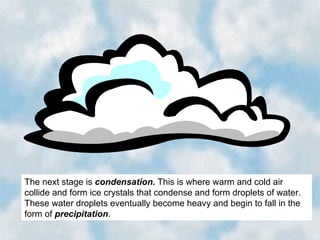
The next stage is condensation. This is where warm and cold air
collide and form ice crystals that condense and form droplets of water.
These water droplets eventually become heavy and begin to fall in the
form of precipitation.
The next stage is precipitation. This is water falling to the earth in the
form of snow, hail, rain, sleet, or glaze.
The next stage is collection. Finally, raindrops end up falling on a stream
and then unto the river, which carries him back to the ocean and this will
happen all over again -- this is called collection. It is important to add that
some of the rain will fall on land and become ground water - the water we,
animals, and plants use.
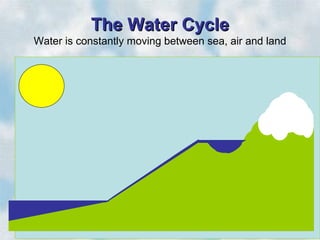
The Water Cycle
Water is constantly moving between sea, air and land
The Water Cycle
Water is constantly moving between sea, air and land


        The sun shines and
        the sea is heated
heat
The Water Cycle
Water is constantly moving between sea, air and land


                          The water
                          evaporates and
                          forms clouds
            Evaporation
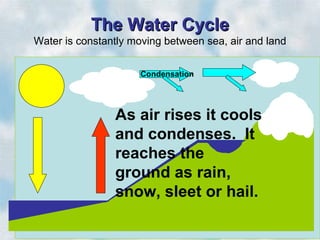
The Water Cycle
Water is constantly moving between sea, air and land


                     Condensation


                As air rises it cools
                and condenses. It
                reaches the
                ground as rain,
                snow, sleet or hail.
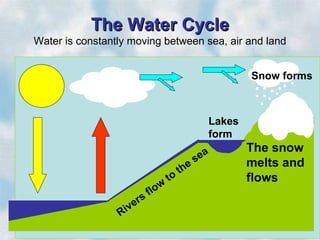
The Water Cycle
Water is constantly moving between sea, air and land


                                                        Snow forms


                                                Lakes
                                                form
                                                        The snow
                                               ea
                                             es         melts and
                                           th
                                      to                flows
                                  w
                        s   flo
                    v er
                 Ri
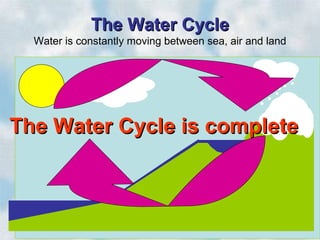
The Water Cycle
  Water is constantly moving between sea, air and land


The Water Cycle is complete
Now you’re ready for the
   EXAMINATION!

 On the next page, complete the chart.
The Water Cycle Examination!

                  _______________


_______________                              _______________

   _______________


                                    ______________________

     ________________
The Water Cycle Answers!

                 Condensation


Water Vapor                                  Precipitation
   Evaporation


                                Collection

        Water
Water Cycle Song
(to the tune of “She’ll Be Coming Around the Mountain”)

Water travels in a cycle, yes it does.
Use pointer finger to draw large circle in air.

Water travels in a cycle, yes it does.
Repeat above motion.

It goes up as evaporation,
Raise arms at side with palms up.

Forms clouds as condensation,
Brings hands together above head, forming large cloud shape with arms.

Then falls down as precipitation, yes it does.
Slowly lower arms at side with palms down, fingers moving.

Attached document nº 3 : "Water Cycle" Activity

  • 1.
    The Water Cycle Whatis it and how does it work?
  • 2.
    The Water Cycle Condensation Water Vapour Precipitation Evaporation Collection Water
  • 3.
    The water cyclebegins with water. Water is found in many places. Some of them are: Lakes, rivers, oceans, ponds, puddles, reservoirs, and many other places.
  • 4.
    The next stageis evaporation. This is a process where the water is heated and turned into a water vapour. The sun is the main heat source for this process.
  • 5.
    The next stageis condensation. This is where warm and cold air collide and form ice crystals that condense and form droplets of water. These water droplets eventually become heavy and begin to fall in the form of precipitation.
  • 6.
    The next stageis precipitation. This is water falling to the earth in the form of snow, hail, rain, sleet, or glaze.
  • 7.
    The next stageis collection. Finally, raindrops end up falling on a stream and then unto the river, which carries him back to the ocean and this will happen all over again -- this is called collection. It is important to add that some of the rain will fall on land and become ground water - the water we, animals, and plants use.
  • 8.
    The Water Cycle Wateris constantly moving between sea, air and land
  • 9.
    The Water Cycle Wateris constantly moving between sea, air and land The sun shines and the sea is heated heat
  • 10.
    The Water Cycle Wateris constantly moving between sea, air and land The water evaporates and forms clouds Evaporation
  • 11.
    The Water Cycle Wateris constantly moving between sea, air and land Condensation As air rises it cools and condenses. It reaches the ground as rain, snow, sleet or hail.
  • 12.
    The Water Cycle Wateris constantly moving between sea, air and land Snow forms Lakes form The snow ea es melts and th to flows w s flo v er Ri
  • 13.
    The Water Cycle Water is constantly moving between sea, air and land The Water Cycle is complete
  • 14.
    Now you’re readyfor the EXAMINATION! On the next page, complete the chart.
  • 15.
    The Water CycleExamination! _______________ _______________ _______________ _______________ ______________________ ________________
  • 16.
    The Water CycleAnswers! Condensation Water Vapor Precipitation Evaporation Collection Water
  • 17.
    Water Cycle Song (tothe tune of “She’ll Be Coming Around the Mountain”) Water travels in a cycle, yes it does. Use pointer finger to draw large circle in air. Water travels in a cycle, yes it does. Repeat above motion. It goes up as evaporation, Raise arms at side with palms up. Forms clouds as condensation, Brings hands together above head, forming large cloud shape with arms. Then falls down as precipitation, yes it does. Slowly lower arms at side with palms down, fingers moving.