Value Objects
Brendan Eich
<brendan@mozilla.org>
Sunday, July 28, 13
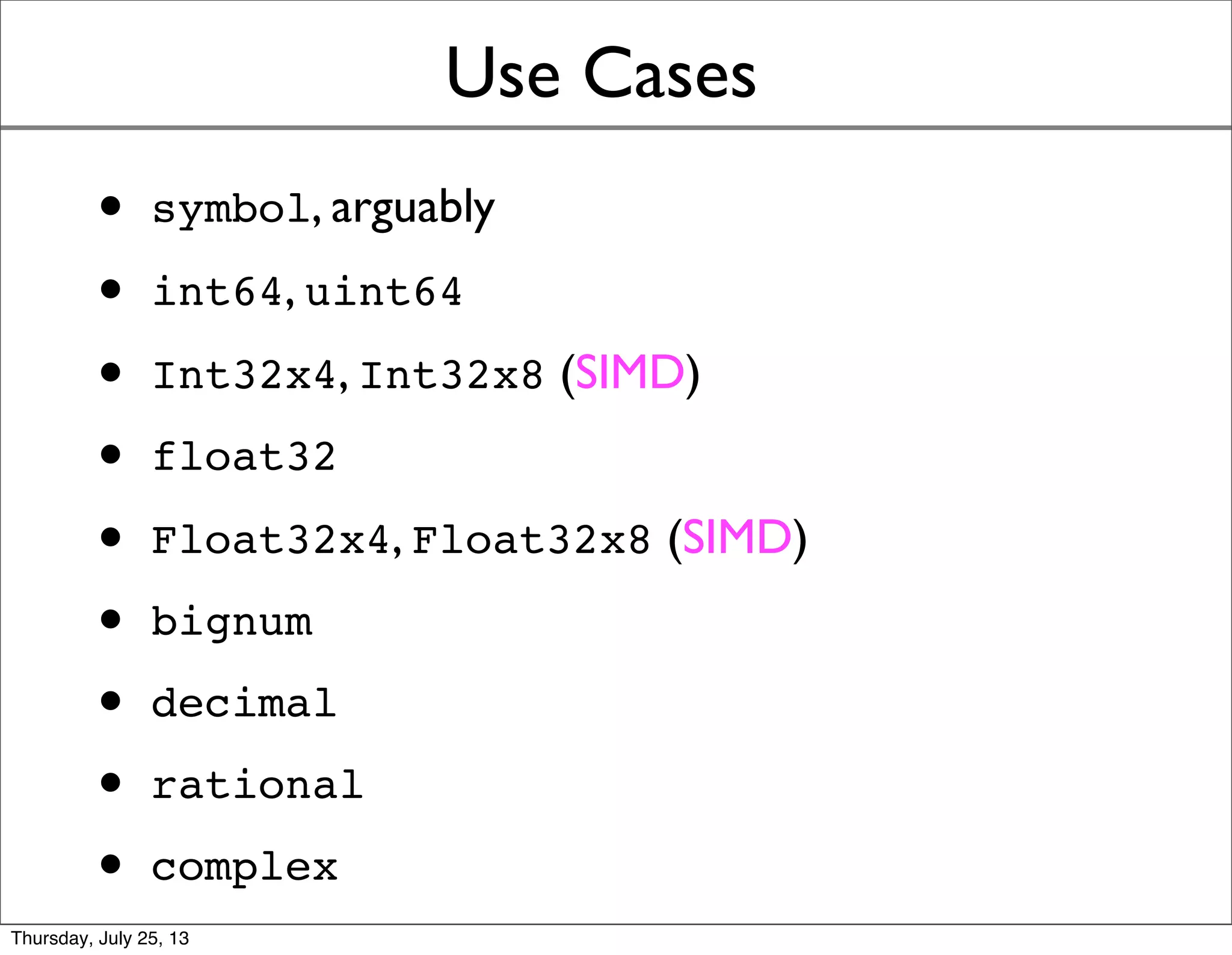
Use Cases
• symbol, arguably
• int64, uint64
• Int32x4, Int32x8 (SIMD)
• float32
• Float32x4, Float32x8 (SIMD)
• bignum
• decimal
• rational
• complex
Sunday, July 28, 13
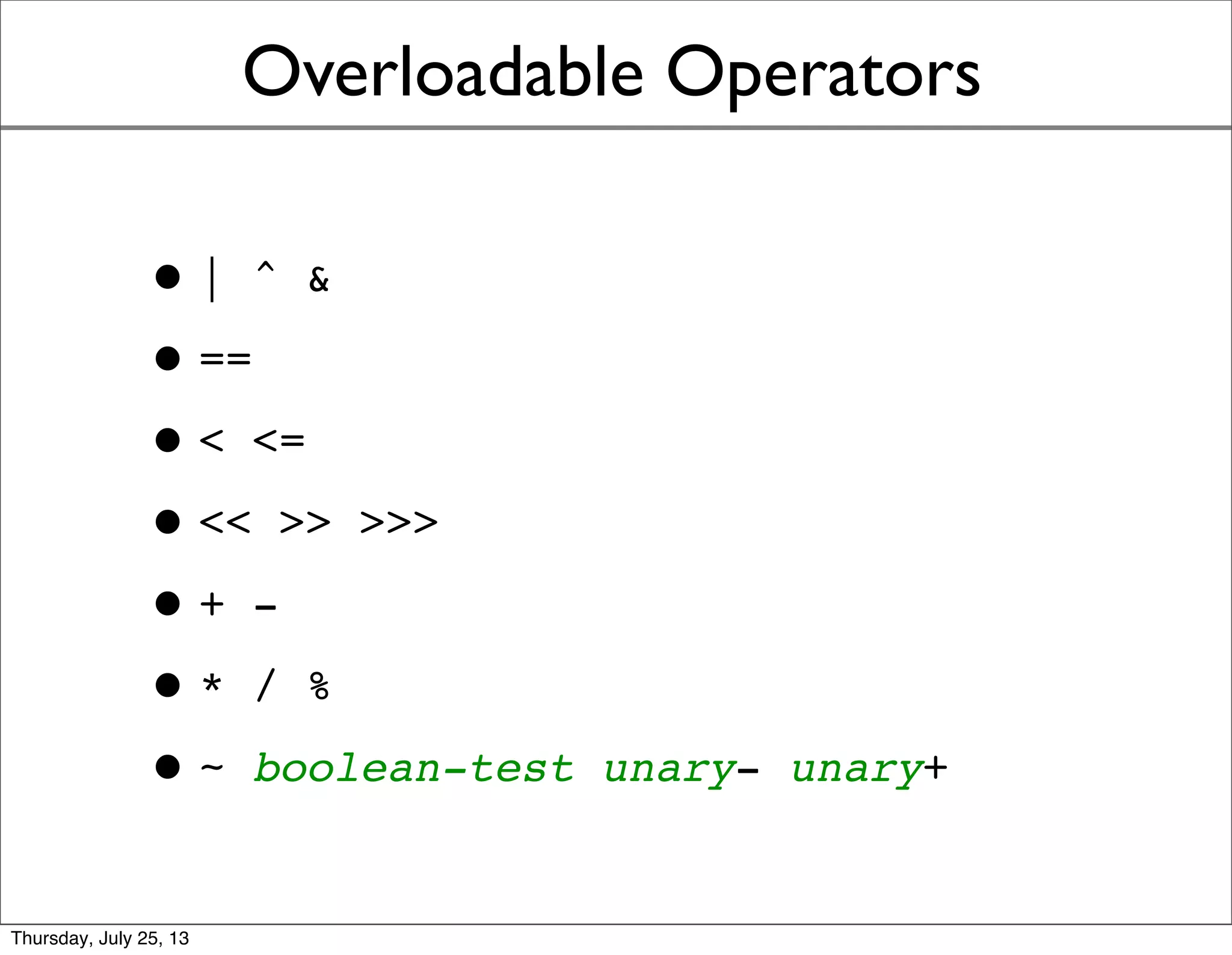
Overloadable Operators
•| ^ &
•==
•< <=
•<< >> >>>
•+ -
•* / %
•~ boolean-test unary- unary+
Sunday, July 28, 13
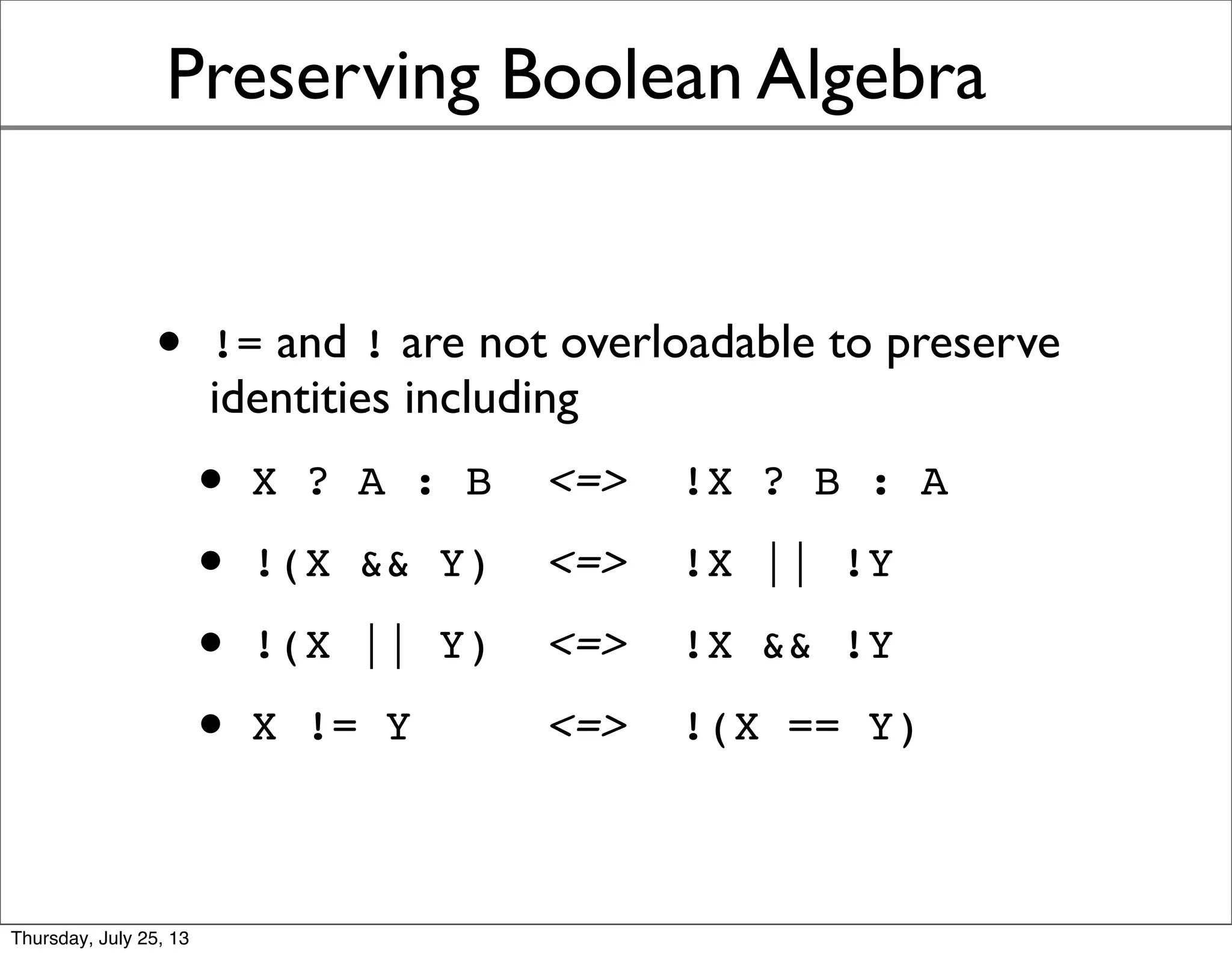
Preserving Boolean Algebra
• != and ! are not overloadable to preserve
identities including
• X ? A : B <=> !X ? B : A
• !(X && Y) <=> !X || !Y
• !(X || Y) <=> !X && !Y
• X != Y <=> !(X == Y)
Sunday, July 28, 13
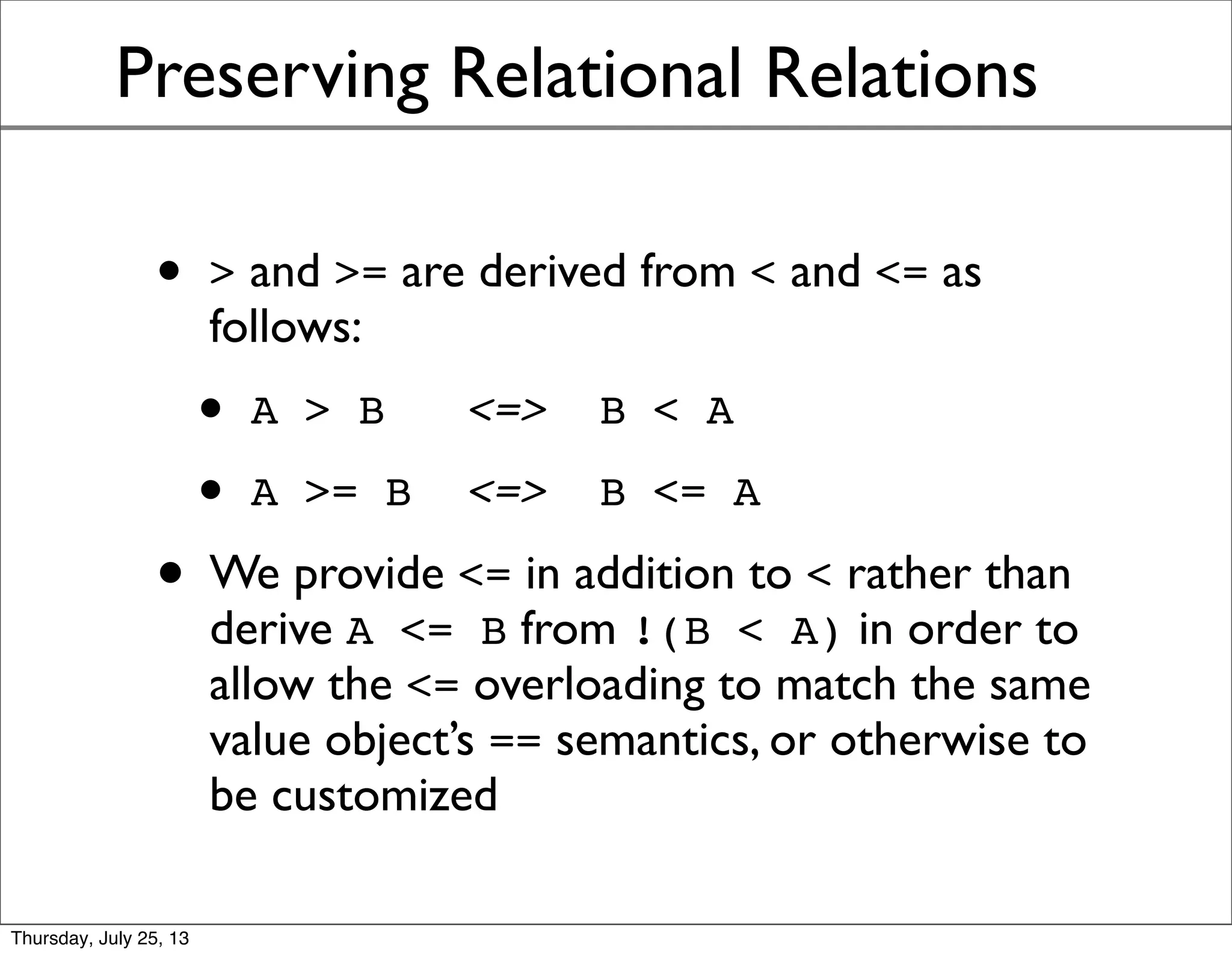
Preserving Relational Relations
• > and >= are derived from < and <= as
follows:
• A > B <=> B < A
• A >= B <=> B <= A
• We provide <= in addition to < rather than
derive A <= B from !(B < A) in order to
allow the <= overloading to match the same
value object’s == semantics -- and for special
cases, e.g., unordered values (NaNs)
Sunday, July 28, 13
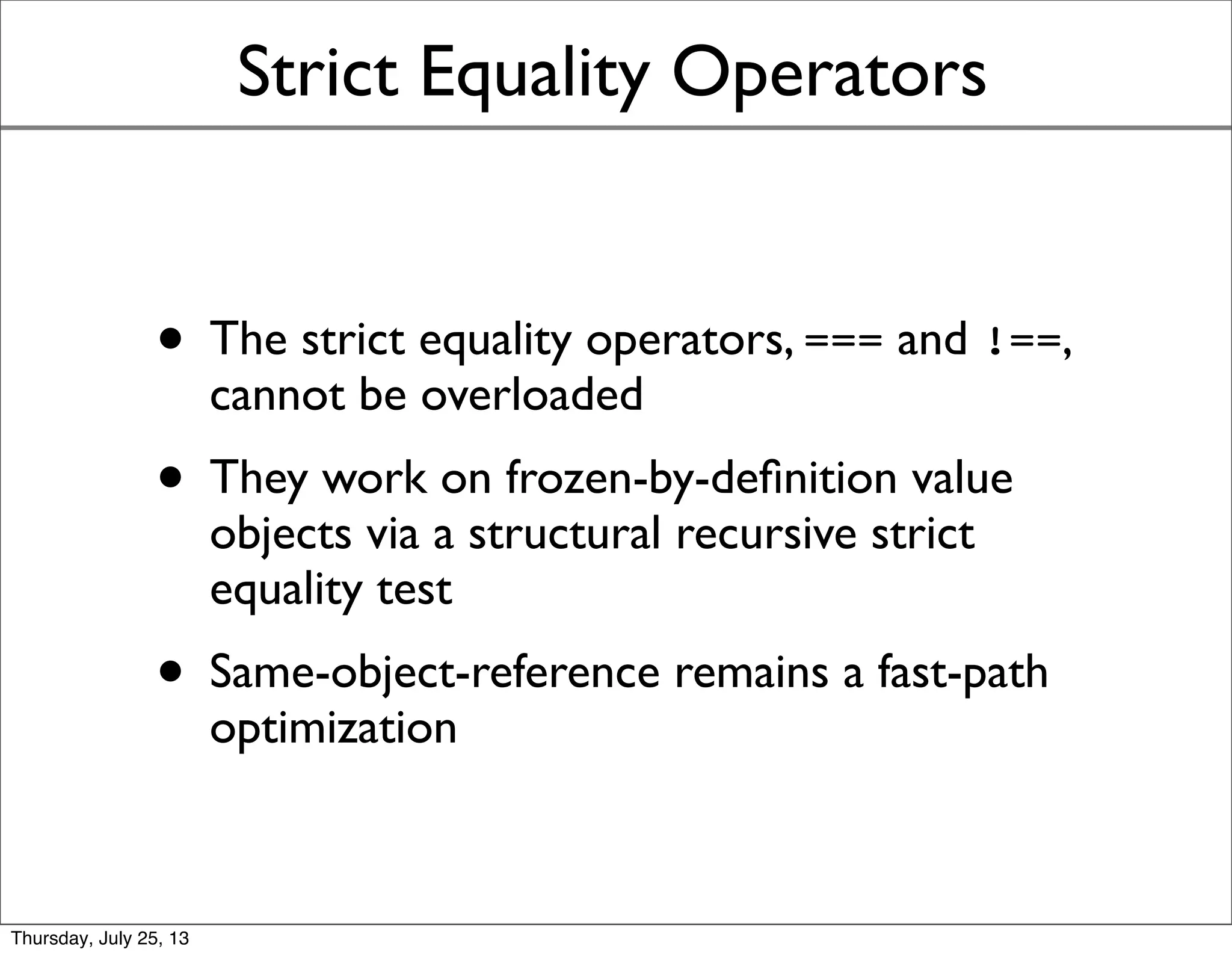
Strict Equality Operators
• The strict equality operators, === and !==,
cannot be overloaded
• They work on frozen-by-definition value
objects via a structural recursive strict
equality test
• Same-object-reference remains a fast-path
optimization
Sunday, July 28, 13
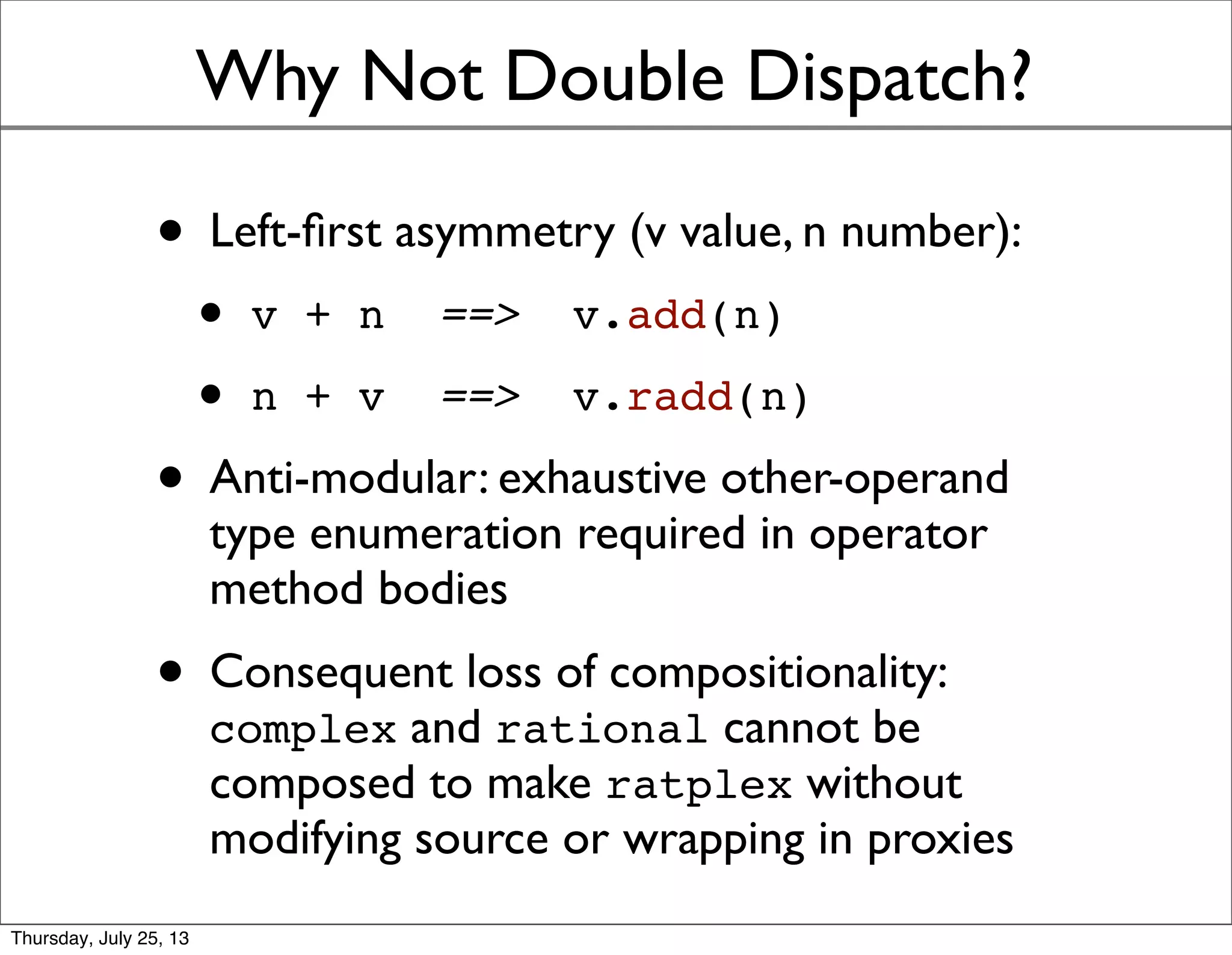
Why Not Double Dispatch?
• Left-first asymmetry (v value, n number):
• v + n ==> v.add(n)
• n + v ==> v.radd(n)
• Anti-modular: exhaustive other-operand
type enumeration required in operator
method bodies
• Consequent loss of compositionality:
complex and rational cannot be
composed to make ratplex without
modifying source or wrapping in proxies
Sunday, July 28, 13
Cacheable Multimethods
• Proposed in 2009 by Christian Plesner Hansen
(Google) in es-discuss
• Avoids double-dispatch drawbacks from last
slide: binary operators implemented by 2-ary
functions for each pair of types
• Supports PIC optimizations (Christian was on
theV8 team)
• Background reading: [Chambers 1992]
Sunday, July 28, 13
Binary Operator Example
• For the expression v + u
• Let p = v.[[Get]](@@ADD)
• If p is not an Array, throw a TypeError
• Let q = u.[[Get]](@@ADD_R)
• If q is not an Array, throw a TypeError
• Let r = p intersect q
• If r.length != 1 throw a TypeError
• Let f = r[0]; if f is not a function, throw
• Evaluate f(v, u) and return the result
Sunday, July 28, 13
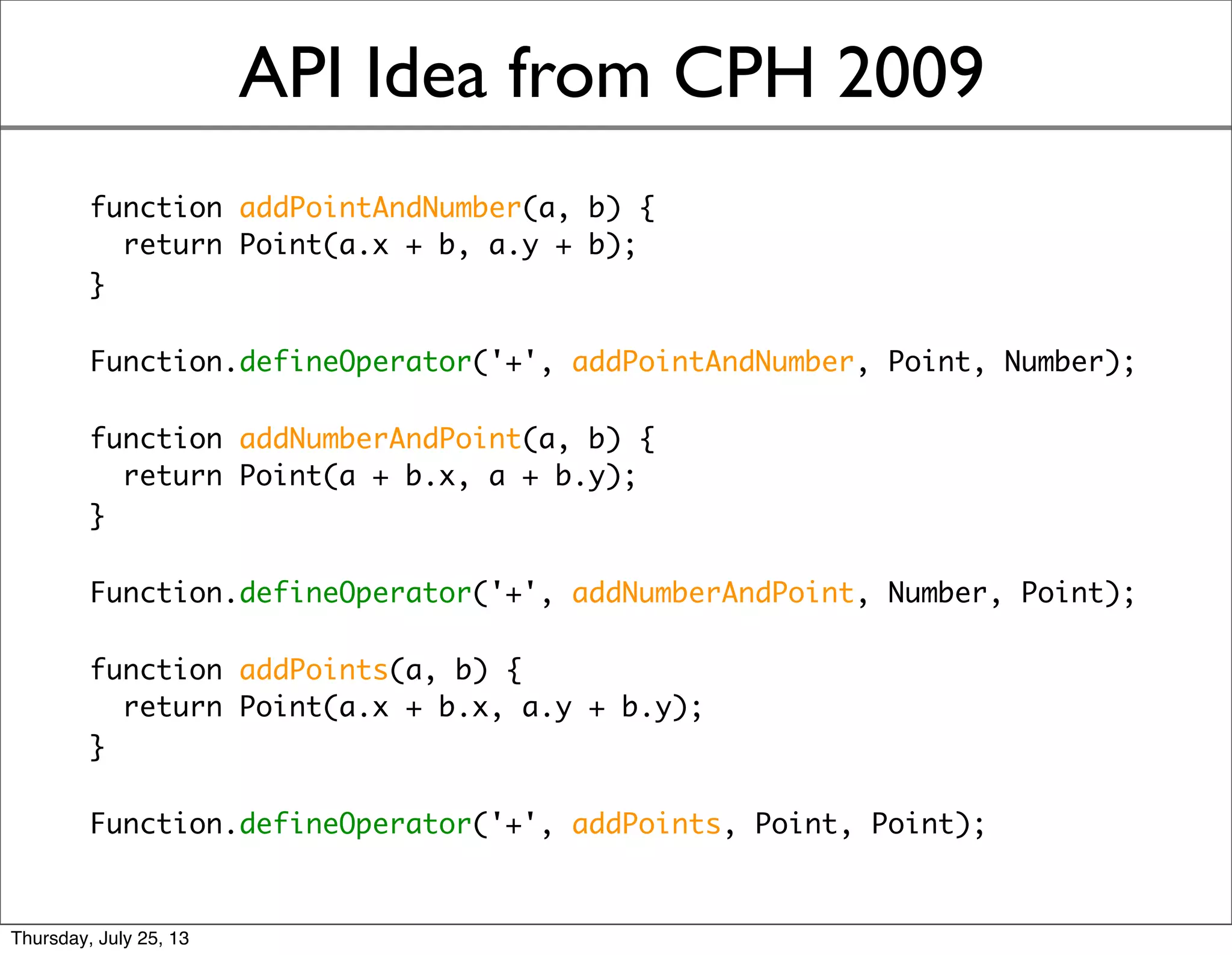
API Idea from CPH 2009
function addPointAndNumber(a, b) {
return Point(a.x + b, a.y + b);
}
Function.defineOperator('+', addPointAndNumber, Point, Number);
function addNumberAndPoint(a, b) {
return Point(a + b.x, a + b.y);
}
Function.defineOperator('+', addNumberAndPoint, Number, Point);
function addPoints(a, b) {
return Point(a.x + b.x, a.y + b.y);
}
Function.defineOperator('+', addPoints, Point, Point);
Sunday, July 28, 13
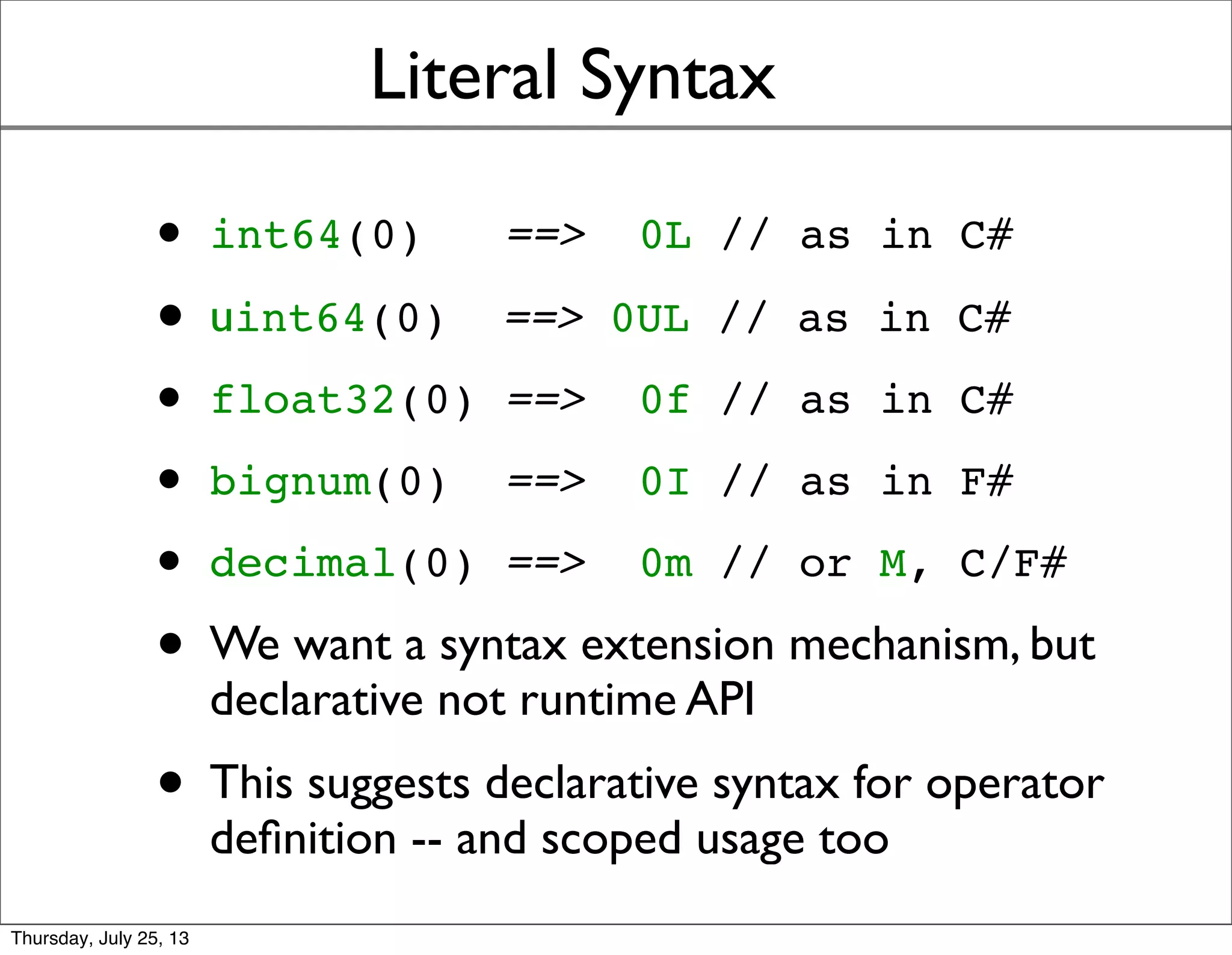
Literal Syntax
• int64(0) ==> 0L // as in C#
• uint64(0) ==> 0UL // as in C#
• float32(0) ==> 0f // as in C#
• bignum(0) ==> 0I // as in F#
• decimal(0) ==> 0m // or M, C/F#
• We want a syntax extension mechanism, but
declarative not runtime API
• This suggests declarative syntax for operator
definition -- and scoped usage too
Sunday, July 28, 13
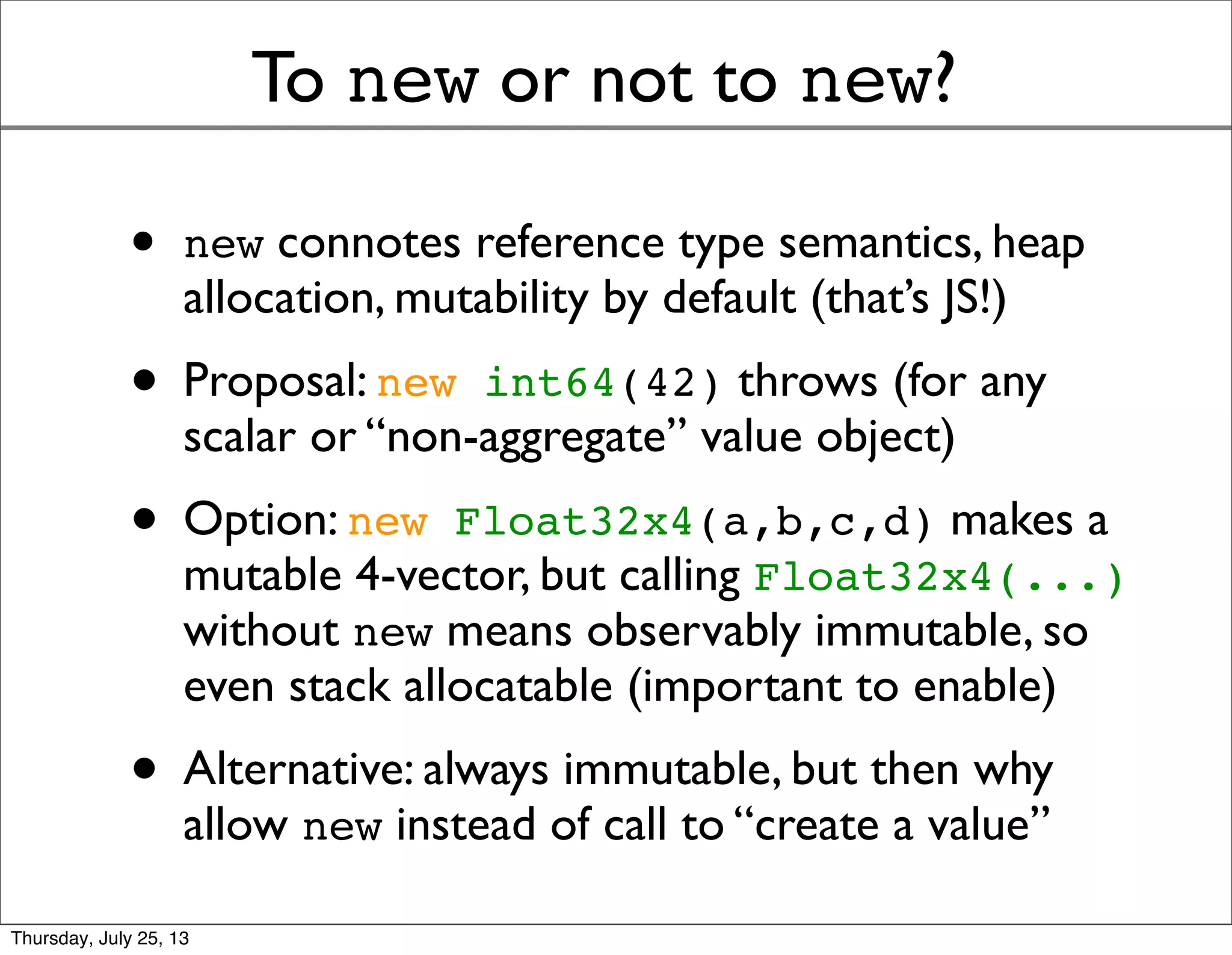
To new or not to new?
• new connotes reference type semantics, heap
allocation, mutability by default (that’s JS!)
• Proposal: new int64(42) throws (for any
scalar or “non-aggregate” value object)
• Option: new Float32x4(a,b,c,d) makes a
mutable 4-vector, but calling Float32x4(...)
without new means observably immutable, so
even stack allocatable (important to enable)
• Alternative: always immutable, but then why
allow new instead of call to “create a value”
Sunday, July 28, 13
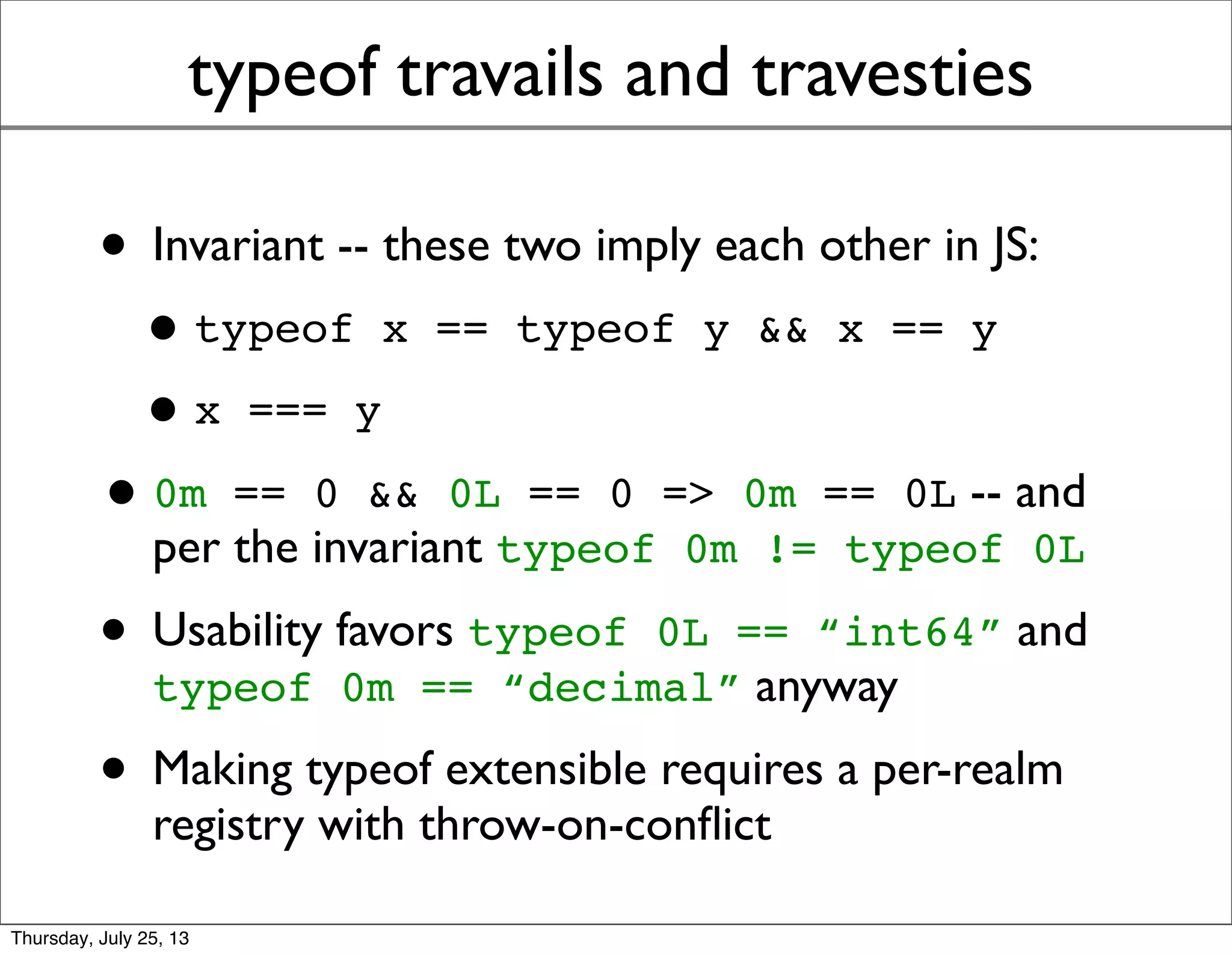
typeof travails and travesties
• Invariant -- these two imply each other in JS:
•typeof x == typeof y && x == y
•x === y
•0m == 0 && 0L == 0 means 0m == 0L
(transitivity), but 0m !== 0L (different precision
and radix) so typeof 0m != typeof 0L per
the invariant
• Usability favors typeof 0L == “int64” and
typeof 0m == “decimal” anyway
• Making typeof extensible requires a per-realm
registry with throw-on-conflict
Sunday, July 28, 13
25 July 2013 TC39 Resolutions
• Waldemar points out that NaN requires
separately overloadable <= and < [Slide 5]
• Intersection means function identity matters, so
multimethods can break cross-realm [Slide 9]
• Mark objects that I as bignum suffix conflicts
with complex [Slide 11]
• Always throw on new -- value objects are never
mutable and should not appear to be so, even if
aggregate [Slide 12]
• Need to work through any side channel hazard of
the typeof registry [Slide 13]
Sunday, July 28, 13

Value objects in JS - an ES7 work in progress

  • 1.
  • 2.
    Use Cases • symbol,arguably • int64, uint64 • Int32x4, Int32x8 (SIMD) • float32 • Float32x4, Float32x8 (SIMD) • bignum • decimal • rational • complex Sunday, July 28, 13
  • 3.
    Overloadable Operators •| ^& •== •< <= •<< >> >>> •+ - •* / % •~ boolean-test unary- unary+ Sunday, July 28, 13
  • 4.
    Preserving Boolean Algebra •!= and ! are not overloadable to preserve identities including • X ? A : B <=> !X ? B : A • !(X && Y) <=> !X || !Y • !(X || Y) <=> !X && !Y • X != Y <=> !(X == Y) Sunday, July 28, 13
  • 5.
    Preserving Relational Relations •> and >= are derived from < and <= as follows: • A > B <=> B < A • A >= B <=> B <= A • We provide <= in addition to < rather than derive A <= B from !(B < A) in order to allow the <= overloading to match the same value object’s == semantics -- and for special cases, e.g., unordered values (NaNs) Sunday, July 28, 13
  • 6.
    Strict Equality Operators •The strict equality operators, === and !==, cannot be overloaded • They work on frozen-by-definition value objects via a structural recursive strict equality test • Same-object-reference remains a fast-path optimization Sunday, July 28, 13
  • 7.
    Why Not DoubleDispatch? • Left-first asymmetry (v value, n number): • v + n ==> v.add(n) • n + v ==> v.radd(n) • Anti-modular: exhaustive other-operand type enumeration required in operator method bodies • Consequent loss of compositionality: complex and rational cannot be composed to make ratplex without modifying source or wrapping in proxies Sunday, July 28, 13
  • 8.
    Cacheable Multimethods • Proposedin 2009 by Christian Plesner Hansen (Google) in es-discuss • Avoids double-dispatch drawbacks from last slide: binary operators implemented by 2-ary functions for each pair of types • Supports PIC optimizations (Christian was on theV8 team) • Background reading: [Chambers 1992] Sunday, July 28, 13
  • 9.
    Binary Operator Example •For the expression v + u • Let p = v.[[Get]](@@ADD) • If p is not an Array, throw a TypeError • Let q = u.[[Get]](@@ADD_R) • If q is not an Array, throw a TypeError • Let r = p intersect q • If r.length != 1 throw a TypeError • Let f = r[0]; if f is not a function, throw • Evaluate f(v, u) and return the result Sunday, July 28, 13
  • 10.
    API Idea fromCPH 2009 function addPointAndNumber(a, b) { return Point(a.x + b, a.y + b); } Function.defineOperator('+', addPointAndNumber, Point, Number); function addNumberAndPoint(a, b) { return Point(a + b.x, a + b.y); } Function.defineOperator('+', addNumberAndPoint, Number, Point); function addPoints(a, b) { return Point(a.x + b.x, a.y + b.y); } Function.defineOperator('+', addPoints, Point, Point); Sunday, July 28, 13
  • 11.
    Literal Syntax • int64(0)==> 0L // as in C# • uint64(0) ==> 0UL // as in C# • float32(0) ==> 0f // as in C# • bignum(0) ==> 0I // as in F# • decimal(0) ==> 0m // or M, C/F# • We want a syntax extension mechanism, but declarative not runtime API • This suggests declarative syntax for operator definition -- and scoped usage too Sunday, July 28, 13
  • 12.
    To new ornot to new? • new connotes reference type semantics, heap allocation, mutability by default (that’s JS!) • Proposal: new int64(42) throws (for any scalar or “non-aggregate” value object) • Option: new Float32x4(a,b,c,d) makes a mutable 4-vector, but calling Float32x4(...) without new means observably immutable, so even stack allocatable (important to enable) • Alternative: always immutable, but then why allow new instead of call to “create a value” Sunday, July 28, 13
  • 13.
    typeof travails andtravesties • Invariant -- these two imply each other in JS: •typeof x == typeof y && x == y •x === y •0m == 0 && 0L == 0 means 0m == 0L (transitivity), but 0m !== 0L (different precision and radix) so typeof 0m != typeof 0L per the invariant • Usability favors typeof 0L == “int64” and typeof 0m == “decimal” anyway • Making typeof extensible requires a per-realm registry with throw-on-conflict Sunday, July 28, 13
  • 14.
    25 July 2013TC39 Resolutions • Waldemar points out that NaN requires separately overloadable <= and < [Slide 5] • Intersection means function identity matters, so multimethods can break cross-realm [Slide 9] • Mark objects that I as bignum suffix conflicts with complex [Slide 11] • Always throw on new -- value objects are never mutable and should not appear to be so, even if aggregate [Slide 12] • Need to work through any side channel hazard of the typeof registry [Slide 13] Sunday, July 28, 13