ATOPIC
DERMATITIS/ECZEMA
DR. MAUREEN KASHEM
06/03/2020
OUTLINE
 Definition of terms
 Epidemiology
 Clinical presentation
 Management
Definition of Terms
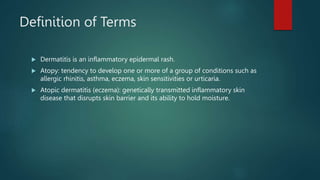
 Dermatitis is an inflammatory epidermal rash.
 Atopy: tendency to develop one or more of a group of conditions such as
allergic rhinitis, asthma, eczema, skin sensitivities or urticaria.
 Atopic dermatitis (eczema): genetically transmitted inflammatory skin
disease that disrupts skin barrier and its ability to hold moisture.
EPIDEMIOLOGY
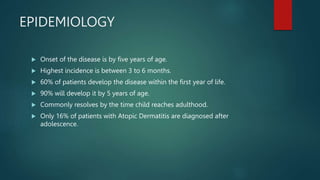
 Onset of the disease is by five years of age.
 Highest incidence is between 3 to 6 months.
 60% of patients develop the disease within the first year of life.
 90% will develop it by 5 years of age.
 Commonly resolves by the time child reaches adulthood.
 Only 16% of patients with Atopic Dermatitis are diagnosed after
adolescence.
EPIDEMIOLOGY…cont
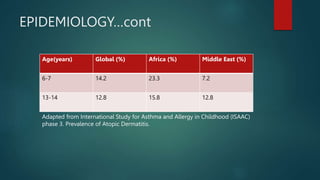
Age(years) Global (%) Africa (%) Middle East (%)
6-7 14.2 23.3 7.2
13-14 12.8 15.8 12.8
Adapted from International Study for Asthma and Allergy in Childhood (ISAAC)
phase 3. Prevalence of Atopic Dermatitis.
EPIDEMIOLOGY…cont
 In Kenya prevalence of atopic dermatitis was found to be 28.5% in children
aged 13-14 years in 2002 compared to 13.9% in 19951.
Risk Factors
1. Family history 2
2. Environmental factors e.g. urban vs rural dwelling, obesity, breastfeeding,
diet, obesity, pollution.3
1.Esamai F1, Ayaya S, Nyandiko W.Prevalence of asthma, allergic rhinitis and dermatitis in primary school children in Uasin Gishu district, Kenya. East Afr Med J. 2002
Oct;79(10):514-8.
2. Weidinger S, Novak N. Atopic dermatitis. Lancet. 2016;387:1109–
3. Nutten S. Atopic dermatitis: global epidemiology and risk factors. Ann Nutr Metab. 2015;66(Suppl 1):8–16
CLINICAL PRESENTATION
 Itch
 Usually a family history of atopy.
 Often known trigger factor.
 Typical morphology and distribution of skin lesions.
 Dry skin
 Chronic relapsing dermatitis.
CLINICAL PRESENTATNION…cont
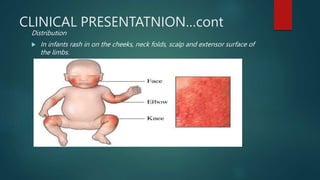
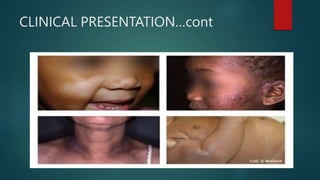
Distribution
 In infants rash in on the cheeks, neck folds, scalp and extensor surface of
the limbs.
CLINICAL PRESENTATION…cont
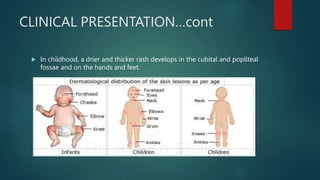
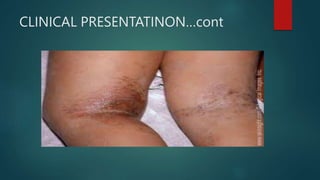
 In childhood, a drier and thicker rash develops in the cubital and popliteal
fossae and on the hands and feet.
CLINICAL PRESENTATION…cont
CLINICAL PRESENTATINON…cont
CLINICAL PRESENTATION…cont
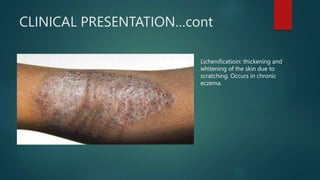
Lichenificatioin: thickening and
whitening of the skin due to
scratching. Occurs in chronic
eczema.
MANAGEMENT
Advice parents of affected child to:
 Avoid soap and perfumed products. Use soap substitutes e.g. cleansers
and shampoos with low Ph.
 Apply an emollient soon after bath.
 Short tepid showers for older children.
 Avoid rubbing and scratching, use gauze bandages with hand splints for
infants.
 Keep fingernails short.
 Avoid overheating particularly at night.
MANAAGEMENT…cont
 Avoid wool next to the skin.
 Keep skin moisturized with emollients.
 Dust mite strategies e.g. dust mite covers, wash linen in hot water and
consider changing fabric on chairs and changing carpets.
MEDICATION…cont
 Mild Atopic Dermatitis
1. Soap substitutes – choose clensers and shampoo with low pH (4.5-6).
2. Emollients e.g. Cetomacrogol, Bennets, Physiogel etc.
3. 1% hydrocortisone if not responding to the above OD or BD. (short term
for flares)
 Moderate Atopic Dermatitis
1. As for mild (1&2)
2. Topical corticosteroids (moderate strength to trunk and limbs and weaker
strength to face and flexures, no longer than 2 weeks)
MEDICATION…cont
3. Non steroidal alternative (Topical pimecrolimus) BD for facial dermatitis.
Best for flares then cease.
4. Oral antihistamines for itch.
Severe Dermatitis
1. As for mild and moderate eczema.
2. Potent topical corticosteroids (+/-occlusive dressing in affected areas.)
3. Consider hospitalization.
4. Systemic corticosteroids.
MEDICATION…cont
5. Allergy assessment if unresponsive.
6. Consider UV therapy.
7. Systemic immunosuppressants may be used.
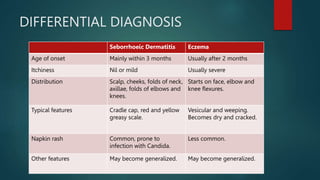
DIFFERENTIAL DIAGNOSIS
Seborrhoeic Dermatitis Eczema
Age of onset Mainly within 3 months Usually after 2 months
Itchiness Nil or mild Usually severe
Distribution Scalp, cheeks, folds of neck,
axillae, folds of elbows and
knees.
Starts on face, elbow and
knee flexures.
Typical features Cradle cap, red and yellow
greasy scale.
Vesicular and weeping.
Becomes dry and cracked.
Napkin rash Common, prone to
infection with Candida.
Less common.
Other features May become generalized. May become generalized.
SEBORRHOEIC DERMATITIS DISTRIBUTION

ATOPIC DERMATITIS, diagnosis &management

  • 1.
  • 2.
    OUTLINE  Definition ofterms  Epidemiology  Clinical presentation  Management
  • 3.
    Definition of Terms Dermatitis is an inflammatory epidermal rash.  Atopy: tendency to develop one or more of a group of conditions such as allergic rhinitis, asthma, eczema, skin sensitivities or urticaria.  Atopic dermatitis (eczema): genetically transmitted inflammatory skin disease that disrupts skin barrier and its ability to hold moisture.
  • 4.
    EPIDEMIOLOGY  Onset ofthe disease is by five years of age.  Highest incidence is between 3 to 6 months.  60% of patients develop the disease within the first year of life.  90% will develop it by 5 years of age.  Commonly resolves by the time child reaches adulthood.  Only 16% of patients with Atopic Dermatitis are diagnosed after adolescence.
  • 5.
    EPIDEMIOLOGY…cont Age(years) Global (%)Africa (%) Middle East (%) 6-7 14.2 23.3 7.2 13-14 12.8 15.8 12.8 Adapted from International Study for Asthma and Allergy in Childhood (ISAAC) phase 3. Prevalence of Atopic Dermatitis.
  • 6.
    EPIDEMIOLOGY…cont  In Kenyaprevalence of atopic dermatitis was found to be 28.5% in children aged 13-14 years in 2002 compared to 13.9% in 19951. Risk Factors 1. Family history 2 2. Environmental factors e.g. urban vs rural dwelling, obesity, breastfeeding, diet, obesity, pollution.3 1.Esamai F1, Ayaya S, Nyandiko W.Prevalence of asthma, allergic rhinitis and dermatitis in primary school children in Uasin Gishu district, Kenya. East Afr Med J. 2002 Oct;79(10):514-8. 2. Weidinger S, Novak N. Atopic dermatitis. Lancet. 2016;387:1109– 3. Nutten S. Atopic dermatitis: global epidemiology and risk factors. Ann Nutr Metab. 2015;66(Suppl 1):8–16
  • 7.
    CLINICAL PRESENTATION  Itch Usually a family history of atopy.  Often known trigger factor.  Typical morphology and distribution of skin lesions.  Dry skin  Chronic relapsing dermatitis.
  • 8.
    CLINICAL PRESENTATNION…cont Distribution  Ininfants rash in on the cheeks, neck folds, scalp and extensor surface of the limbs.
  • 9.
    CLINICAL PRESENTATION…cont  Inchildhood, a drier and thicker rash develops in the cubital and popliteal fossae and on the hands and feet.
  • 10.
  • 11.
  • 12.
    CLINICAL PRESENTATION…cont Lichenificatioin: thickeningand whitening of the skin due to scratching. Occurs in chronic eczema.
  • 13.
    MANAGEMENT Advice parents ofaffected child to:  Avoid soap and perfumed products. Use soap substitutes e.g. cleansers and shampoos with low Ph.  Apply an emollient soon after bath.  Short tepid showers for older children.  Avoid rubbing and scratching, use gauze bandages with hand splints for infants.  Keep fingernails short.  Avoid overheating particularly at night.
  • 14.
    MANAAGEMENT…cont  Avoid woolnext to the skin.  Keep skin moisturized with emollients.  Dust mite strategies e.g. dust mite covers, wash linen in hot water and consider changing fabric on chairs and changing carpets.
  • 15.
    MEDICATION…cont  Mild AtopicDermatitis 1. Soap substitutes – choose clensers and shampoo with low pH (4.5-6). 2. Emollients e.g. Cetomacrogol, Bennets, Physiogel etc. 3. 1% hydrocortisone if not responding to the above OD or BD. (short term for flares)  Moderate Atopic Dermatitis 1. As for mild (1&2) 2. Topical corticosteroids (moderate strength to trunk and limbs and weaker strength to face and flexures, no longer than 2 weeks)
  • 16.
    MEDICATION…cont 3. Non steroidalalternative (Topical pimecrolimus) BD for facial dermatitis. Best for flares then cease. 4. Oral antihistamines for itch. Severe Dermatitis 1. As for mild and moderate eczema. 2. Potent topical corticosteroids (+/-occlusive dressing in affected areas.) 3. Consider hospitalization. 4. Systemic corticosteroids.
  • 17.
    MEDICATION…cont 5. Allergy assessmentif unresponsive. 6. Consider UV therapy. 7. Systemic immunosuppressants may be used.
  • 18.
    DIFFERENTIAL DIAGNOSIS Seborrhoeic DermatitisEczema Age of onset Mainly within 3 months Usually after 2 months Itchiness Nil or mild Usually severe Distribution Scalp, cheeks, folds of neck, axillae, folds of elbows and knees. Starts on face, elbow and knee flexures. Typical features Cradle cap, red and yellow greasy scale. Vesicular and weeping. Becomes dry and cracked. Napkin rash Common, prone to infection with Candida. Less common. Other features May become generalized. May become generalized.
  • 19.