Matter
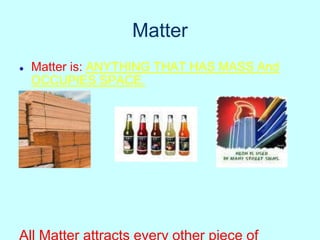
● Matter is: ANYTHING THAT HAS MASS And
OCCUPIES SPACE.
Element
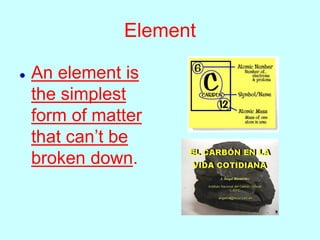
● An element is
the simplest
form of matter
that can’t be
broken down.
Atom
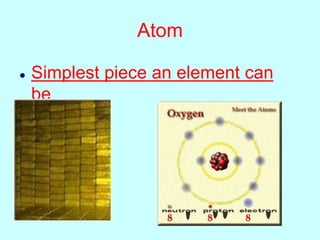
● Simplest piece an element can
be
Are Atoms to Small to See?
● Power of tens
Molecule
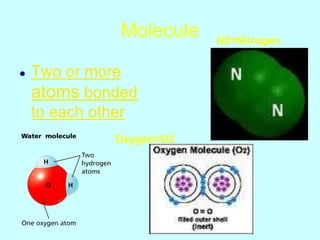
● Two or more
atoms bonded
to each other
N2=Nitrogen
Oxygen=O2
Compound
● Two or more
different
elements bonded
together
Salt
NaCl
Water H2O
Sugar
Kinetic theory
● All matter is made of atoms
● Atoms are always in motion
● Heavier particles move slower than
lighter ones
Periodic table
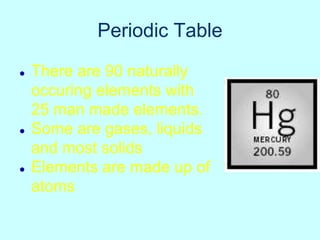
Periodic Table
● There are 90 naturally
occuring elements with
25 man made elements.
● Some are gases, liquids
and most solids
● Elements are made up of
atoms
Parts of an atom
● NUCLEUS: center of the atom
contains protons and neutrons
● Proton: Positively charged in Nucleus
● Neutron: Neutral Particle in Nucleus
● Electron: Negatively charged, moving in
shells outside the nucleus
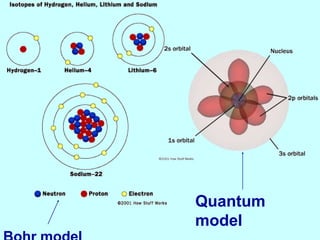
Quantum
model
Atomic Number
● You read this off the periodic table
● Tells how many Protons and
Electrons (not together)
● MASS NUMBER HOW MANY
PROTONS AND NEUTRONS
TOGETHER
● NEUTRONS=THE ATOMIC
NUMBER-THE MASS NUMBER
ELECTRON
● ELECTRONS ARE IN SHELLS
AROUND THE NUCLEUS
● 1ST SHELL HAS 2 ELECTRONS
● 2ND SHELL HAS 8 ELECTRONS
● 3RD SHELL HAS 18 ELECTRONS
● 4TH SHELL HAS 32 ELECTRONS
Atomic
Symbol
Atomic #
Atomic mass #
Mass
● The amount of
matter in any
object
● Mass shows a
resistance to
being moved
Gravity
● The force between objects of mass
● The bigger the mass, more force of gravity
● All matter is attracted to other matter
● To reduce the force of gravity between
objects, spread the distance between the
two
●
Gravity on Different Planets
● Suppose you weigh 100 pounds here on
Earth. list.
● Earth - 100 lbs
● Moon - 17 lbs
● Mercury - 38 lbs
● Jupiter - 236 lbs
● Pluto - 7 lbs
● sun - 2407 lbs
Newton’s Gravity
● Newton also found that gravity
Increases with bigger objects
● Different plants have different
Masses
Galileo two object drop
Weight
● This is the pull of
gravity against
your Mass.
● Remember that
mass is matter
and gravity is the
pull against the
matter
Mass x gravity = weight
● We measure mass using grams (g)
● Weight, we use Newton (N)
The units for Newtons is kg x mass/seconds
Potential Energy
●Potential energy is energy that is stored
in an object. Mainly GRAVITY
Rivers and lakes with dams
●Kinetic energy is energy of motion.
Newton laws of Motion
● 1st law: objects will stay at rest or in
motion unless acted upon (Inertia)
2nd law: Force=Mass x Acceleration
3rd Law: Opposite and equal
reaction

Atoms and elements.ppt.pptx

  • 1.
    Matter ● Matter is:ANYTHING THAT HAS MASS And OCCUPIES SPACE.
  • 2.
    Element ● An elementis the simplest form of matter that can’t be broken down.
  • 3.
    Atom ● Simplest piecean element can be
  • 4.
    Are Atoms toSmall to See? ● Power of tens
  • 5.
    Molecule ● Two ormore atoms bonded to each other N2=Nitrogen Oxygen=O2
  • 6.
    Compound ● Two ormore different elements bonded together Salt NaCl Water H2O Sugar
  • 7.
    Kinetic theory ● Allmatter is made of atoms ● Atoms are always in motion ● Heavier particles move slower than lighter ones
  • 8.
  • 9.
    Periodic Table ● Thereare 90 naturally occuring elements with 25 man made elements. ● Some are gases, liquids and most solids ● Elements are made up of atoms
  • 10.
    Parts of anatom ● NUCLEUS: center of the atom contains protons and neutrons ● Proton: Positively charged in Nucleus ● Neutron: Neutral Particle in Nucleus ● Electron: Negatively charged, moving in shells outside the nucleus
  • 12.
  • 13.
    Atomic Number ● Youread this off the periodic table ● Tells how many Protons and Electrons (not together) ● MASS NUMBER HOW MANY PROTONS AND NEUTRONS TOGETHER ● NEUTRONS=THE ATOMIC NUMBER-THE MASS NUMBER
  • 14.
    ELECTRON ● ELECTRONS AREIN SHELLS AROUND THE NUCLEUS ● 1ST SHELL HAS 2 ELECTRONS ● 2ND SHELL HAS 8 ELECTRONS ● 3RD SHELL HAS 18 ELECTRONS ● 4TH SHELL HAS 32 ELECTRONS
  • 15.
  • 16.
    Mass ● The amountof matter in any object ● Mass shows a resistance to being moved
  • 17.
    Gravity ● The forcebetween objects of mass ● The bigger the mass, more force of gravity ● All matter is attracted to other matter ● To reduce the force of gravity between objects, spread the distance between the two ●
  • 18.
    Gravity on DifferentPlanets ● Suppose you weigh 100 pounds here on Earth. list. ● Earth - 100 lbs ● Moon - 17 lbs ● Mercury - 38 lbs ● Jupiter - 236 lbs ● Pluto - 7 lbs ● sun - 2407 lbs
  • 19.
    Newton’s Gravity ● Newtonalso found that gravity Increases with bigger objects ● Different plants have different Masses Galileo two object drop
  • 20.
    Weight ● This isthe pull of gravity against your Mass. ● Remember that mass is matter and gravity is the pull against the matter
  • 21.
    Mass x gravity= weight ● We measure mass using grams (g) ● Weight, we use Newton (N) The units for Newtons is kg x mass/seconds
  • 22.
    Potential Energy ●Potential energyis energy that is stored in an object. Mainly GRAVITY Rivers and lakes with dams ●Kinetic energy is energy of motion.
  • 23.
    Newton laws ofMotion ● 1st law: objects will stay at rest or in motion unless acted upon (Inertia)
  • 24.
    2nd law: Force=Massx Acceleration
  • 25.
    3rd Law: Oppositeand equal reaction