The Power of Inquiry: Coaching Tips for
                      You!

                    Raja Bavani


26-Oct-12            www.agiletour.com
What is the meaning of inquiry?
• Inquire – seek information about something or
    do a formal investigation, explore, probe,
    investigate, examine, analyze, review, enquire

• Inquiry – exploration, probing, investigation,
    examination, analysis, review, enquiry

 Effective inquiry consists of powerful questions!
26-Oct-12             www.agiletour.com              2
Where can we learn the power of inquiry from?
“If I had an hour to solve a problem and my life
depended on the solution, I would spend the first 55
minutes determining the proper question to ask, for
once I know the proper question, I could solve the
problem in less than five minutes.”
                                    - ALBERT EINSTEIN


26-Oct-12            www.agiletour.com              3
Do you know the seven powers of questions?
Questions
1. demand answers
2. stimulate thinking
3. put us in control
4. get people to open up        Source: 7 Powers of
                                Questions, Book authored
5. give us valuable info        by Dorothy Leeds

6. lead to quality listening
7. get people to persuade themselves
26-Oct-12              www.agiletour.com               4
How can we learn more with this agenda?
•   Why powerful questions?
•   What are powerful questions?
•   How do we go about asking powerful questions?
•   How can we retain the takeaways, stay
    connected and share our coaching experiences?


26-Oct-12               www.agiletour.com         5
Why powerful questions?
Powerful questions
• Initiate reflective and productive conversations
• Surface assumptions
• Generate enthusiasm and energy
• Provide focus on attention and inquiry
• Induce more questions


26-Oct-12            www.agiletour.com               6
Which ones do you prefer?
• Are we doing well in this iteration?
• Which user story are you working on?
• Did you do unit testing?
• What does it mean to provide quality
  deliverables to our testers?
• What risks exist that we have not thought of
  yet?
• What is the possibility we see now?
26-Oct-12           www.agiletour.com            7
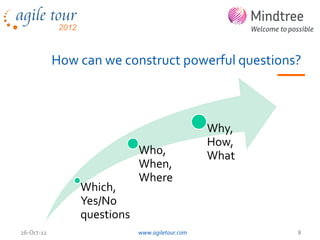
How can we construct powerful questions?


                                                Why,
                                                How,
                            Who,                What
                            When,
                            Where
                Which,
                Yes/No
                questions
26-Oct-12                   www.agiletour.com          8
Do you know?
• Sometimes ‘Why’, ‘How’, ‘What’ questions can
    be damaging!

Examples:
• Why do we have unfinished stories?
• What makes our folks be on IM all the time?
• How can we even think about such a bad
  design?
26-Oct-12           www.agiletour.com              9
What can be a good set of examples?
• Are we satisfied with the quality of code we
  deliver?
• When have we been most satisfied with what
  we deliver? How did we accomplish that?
• What is it about our way of writing code that
  you find most satisfying?
• Why might it be that the feedback on our code
  quality has had its ups and down?
26-Oct-12            www.agiletour.com            10
How about these?
• As a team member how can you write high
  quality code so that we can meet our goal of
  delighting our customer?
• With your experience in writing high quality
  code, how can we enable our team in writing
  similar code?


26-Oct-12           www.agiletour.com                  11
Why does the scope of your question matter?
• How can we educate everyone in our
  organization in writing high quality code?
• Why don’t you take ‘code quality’ as an initiative
  at our business unit level?
• As a team member how can you write high
  quality code so that we can meet our goal of
  delighting our customer?


26-Oct-12            www.agiletour.com             12
How do we read underlying assumptions?
• Can we do something to produce good quality
  code? (assumes that nobody in the team has
  written good quality code)
• How can we learn from the other project team
  about writing unit tests and adopting TDD?
  (assumes that nobody in your project can
  contribute)
• Why is it not working? Why has it crashed? 
• Can you help me understand the situation? 
26-Oct-12               www.agiletour.com        13
Which would you prefer?
• Why do we receive these customer complaints?
  Who is responsible? What did we do wrong? Can
  someone explain?
• What can we learn from our customer’s email
  and the current situation? What are the possible
  options do we have? How can we help each
  other and serve our customer better? Any ideas?


26-Oct-12           www.agiletour.com            14
How about these?
• How can we improve quality and do things
  faster as compared to the other team?
• How can we collaborate with the other team
  and understand which of their practices will
  work for us and provide benefits?


26-Oct-12           www.agiletour.com                  15
How can we become collaborative coaches?
• Collaboration can be nurtured through genuine
  questions
• Genuine questions, when powerful will result in
  genuine answers
• That is a virtuous cycle!


26-Oct-12             www.agiletour.com             16
How about going through this checklist to
                     formulate powerful questions?
1. Is this question relevant?
2. Is it genuine?
3. What do we want to accomplish with this
   question? What kind of questions,
   conversations or emotions can be triggered
   when we ask this?
4. Will this question invite fresh thinking/feeling?
5. What beliefs and assumptions are hidden here?
26-Oct-12                www.agiletour.com          17
What can be good additions to this list?
6. Will this question increase our focus on
   problems and shortcomings? Or will this
   question generate hope, engagement,
   collaboration, action and new possibilities?
7. Does this question leave room for new and
   different questions to be raised as the initial
   question is explored?
                                                 Adapted from Sally Ann Roth
                                           Public Conversations Project c.1998


26-Oct-12              www.agiletour.com                                    18
What are the tips?
•   Prepare your questions
•   Eliminate the questions that are less powerful
•   Rehearse
•   Go through the checklist
•   Apply
•   Experience the process of inquiry and improve


26-Oct-12             www.agiletour.com                   19
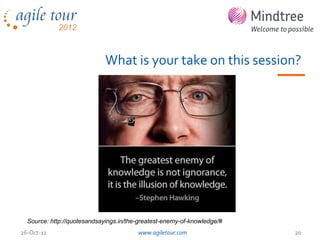
What is your take on this session?


  Source: http://quotesandsayings.in/the-greatest-enemy-of-knowledge/#
26-Oct-12                               www.agiletour.com                20
Did we miss anything in our agenda?
•   Why powerful questions?
•   What are powerful questions?
•   How do we go about asking powerful questions?
•   How can we retain the takeaways, stay
    connected and share our coaching experiences?


26-Oct-12            www.agiletour.com          21
Don’t we like to stay connected?
LinkedIn: Raja Bavani
Twitter: @rajabavani
Blogs: http://www.mindtree.com -> blogs
       http://www.blogs.mindtree.com
       http://se-thoughtograph.blogspot.com
       http://rajabavani.blogspot.com


26-Oct-12          www.agiletour.com          22
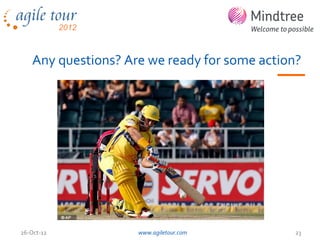
Any questions? Are we ready for some action?


26-Oct-12           www.agiletour.com         23
Thank You!


26-Oct-12   www.agiletour.com

At2012 chennai powerof_inquiry_rajab

  • 1.
    The Power ofInquiry: Coaching Tips for You! Raja Bavani 26-Oct-12 www.agiletour.com
  • 2.
    What is themeaning of inquiry? • Inquire – seek information about something or do a formal investigation, explore, probe, investigate, examine, analyze, review, enquire • Inquiry – exploration, probing, investigation, examination, analysis, review, enquiry Effective inquiry consists of powerful questions! 26-Oct-12 www.agiletour.com 2
  • 3.
    Where can welearn the power of inquiry from? “If I had an hour to solve a problem and my life depended on the solution, I would spend the first 55 minutes determining the proper question to ask, for once I know the proper question, I could solve the problem in less than five minutes.” - ALBERT EINSTEIN 26-Oct-12 www.agiletour.com 3
  • 4.
    Do you knowthe seven powers of questions? Questions 1. demand answers 2. stimulate thinking 3. put us in control 4. get people to open up Source: 7 Powers of Questions, Book authored 5. give us valuable info by Dorothy Leeds 6. lead to quality listening 7. get people to persuade themselves 26-Oct-12 www.agiletour.com 4
  • 5.
    How can welearn more with this agenda? • Why powerful questions? • What are powerful questions? • How do we go about asking powerful questions? • How can we retain the takeaways, stay connected and share our coaching experiences? 26-Oct-12 www.agiletour.com 5
  • 6.
    Why powerful questions? Powerfulquestions • Initiate reflective and productive conversations • Surface assumptions • Generate enthusiasm and energy • Provide focus on attention and inquiry • Induce more questions 26-Oct-12 www.agiletour.com 6
  • 7.
    Which ones doyou prefer? • Are we doing well in this iteration? • Which user story are you working on? • Did you do unit testing? • What does it mean to provide quality deliverables to our testers? • What risks exist that we have not thought of yet? • What is the possibility we see now? 26-Oct-12 www.agiletour.com 7
  • 8.
    How can weconstruct powerful questions? Why, How, Who, What When, Where Which, Yes/No questions 26-Oct-12 www.agiletour.com 8
  • 9.
    Do you know? •Sometimes ‘Why’, ‘How’, ‘What’ questions can be damaging! Examples: • Why do we have unfinished stories? • What makes our folks be on IM all the time? • How can we even think about such a bad design? 26-Oct-12 www.agiletour.com 9
  • 10.
    What can bea good set of examples? • Are we satisfied with the quality of code we deliver? • When have we been most satisfied with what we deliver? How did we accomplish that? • What is it about our way of writing code that you find most satisfying? • Why might it be that the feedback on our code quality has had its ups and down? 26-Oct-12 www.agiletour.com 10
  • 11.
    How about these? •As a team member how can you write high quality code so that we can meet our goal of delighting our customer? • With your experience in writing high quality code, how can we enable our team in writing similar code? 26-Oct-12 www.agiletour.com 11
  • 12.
    Why does thescope of your question matter? • How can we educate everyone in our organization in writing high quality code? • Why don’t you take ‘code quality’ as an initiative at our business unit level? • As a team member how can you write high quality code so that we can meet our goal of delighting our customer? 26-Oct-12 www.agiletour.com 12
  • 13.
    How do weread underlying assumptions? • Can we do something to produce good quality code? (assumes that nobody in the team has written good quality code) • How can we learn from the other project team about writing unit tests and adopting TDD? (assumes that nobody in your project can contribute) • Why is it not working? Why has it crashed?  • Can you help me understand the situation?  26-Oct-12 www.agiletour.com 13
  • 14.
    Which would youprefer? • Why do we receive these customer complaints? Who is responsible? What did we do wrong? Can someone explain? • What can we learn from our customer’s email and the current situation? What are the possible options do we have? How can we help each other and serve our customer better? Any ideas? 26-Oct-12 www.agiletour.com 14
  • 15.
    How about these? •How can we improve quality and do things faster as compared to the other team? • How can we collaborate with the other team and understand which of their practices will work for us and provide benefits? 26-Oct-12 www.agiletour.com 15
  • 16.
    How can webecome collaborative coaches? • Collaboration can be nurtured through genuine questions • Genuine questions, when powerful will result in genuine answers • That is a virtuous cycle! 26-Oct-12 www.agiletour.com 16
  • 17.
    How about goingthrough this checklist to formulate powerful questions? 1. Is this question relevant? 2. Is it genuine? 3. What do we want to accomplish with this question? What kind of questions, conversations or emotions can be triggered when we ask this? 4. Will this question invite fresh thinking/feeling? 5. What beliefs and assumptions are hidden here? 26-Oct-12 www.agiletour.com 17
  • 18.
    What can begood additions to this list? 6. Will this question increase our focus on problems and shortcomings? Or will this question generate hope, engagement, collaboration, action and new possibilities? 7. Does this question leave room for new and different questions to be raised as the initial question is explored? Adapted from Sally Ann Roth Public Conversations Project c.1998 26-Oct-12 www.agiletour.com 18
  • 19.
    What are thetips? • Prepare your questions • Eliminate the questions that are less powerful • Rehearse • Go through the checklist • Apply • Experience the process of inquiry and improve 26-Oct-12 www.agiletour.com 19
  • 20.
    What is yourtake on this session? Source: http://quotesandsayings.in/the-greatest-enemy-of-knowledge/# 26-Oct-12 www.agiletour.com 20
  • 21.
    Did we missanything in our agenda? • Why powerful questions? • What are powerful questions? • How do we go about asking powerful questions? • How can we retain the takeaways, stay connected and share our coaching experiences? 26-Oct-12 www.agiletour.com 21
  • 22.
    Don’t we liketo stay connected? LinkedIn: Raja Bavani Twitter: @rajabavani Blogs: http://www.mindtree.com -> blogs http://www.blogs.mindtree.com http://se-thoughtograph.blogspot.com http://rajabavani.blogspot.com 26-Oct-12 www.agiletour.com 22
  • 23.
    Any questions? Arewe ready for some action? 26-Oct-12 www.agiletour.com 23
  • 24.
    Thank You! 26-Oct-12 www.agiletour.com