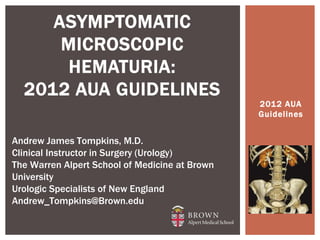
2012 AUA
Guidelines
ASYMPTOMATIC
MICROSCOPIC
HEMATURIA:
2012 AUA GUIDELINES
Andrew James Tompkins, M.D.
Clinical Instructor in Surgery (Urology)
The Warren Alpert School of Medicine at Brown
University
Urologic Specialists of New England
Andrew_Tompkins@Brown.edu
 I’m not actually 5’11
 I don’t usually wear a suit
 Didn’t get much sleep
 Nothing to disclose
DISCLOSURES
 To define asymptomatic microscopic hematuria (AMH).
 Identify patients that require urologic referral.
 Discuss the ideal evaluation of AMH.
 What should I send to the urologist that would be helpful?
 Focus less on “data” and more on evaluation process.
OBJECTIVES
 58 yo female with history of smoking, HTN, DM, and recurrent
UTI’s presents for evaluation of urinary frequency.
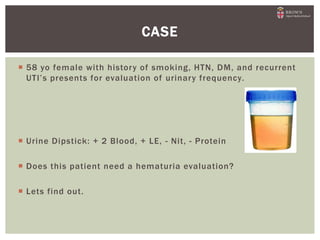
 Urine Dipstick: + 2 Blood, + LE, - Nit, - Protein
 Does this patient need a hematuria evaluation?
 Lets find out.
CASE
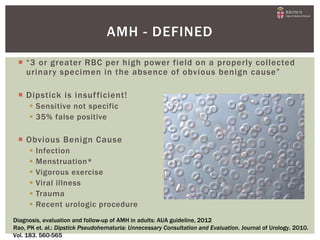
 “3 or greater RBC per high power field on a properly collected
urinary specimen in the absence of obvious benign cause”
 Dipstick is insufficient!
 Sensitive not specific
 35% false positive
 Obvious Benign Cause
 Infection
 Menstruation*
 Vigorous exercise
 Viral illness
 Trauma
 Recent urologic procedure
AMH - DEFINED
Diagnosis, evaluation and follow-up of AMH in adults: AUA guideline, 2012
Rao, PK et. al.: Dipstick Pseudohematuria: Unnecessary Consultation and Evaluation. Journal of Urology. 2010.
Vol. 183. 560-565
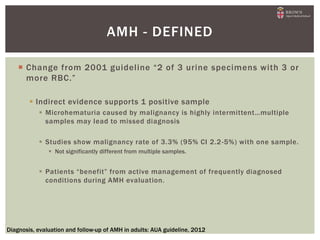
 Change from 2001 guideline “2 of 3 urine specimens with 3 or
more RBC.”
 Indirect evidence supports 1 positive sample
 Microhematuria caused by malignancy is highly intermittent…multiple
samples may lead to missed diagnosis
 Studies show malignancy rate of 3.3% (95% CI 2.2-5%) with one sample.
 Not significantly different from multiple samples.
 Patients “benefit” from active management of frequently diagnosed
conditions during AMH evaluation.
AMH - DEFINED
Diagnosis, evaluation and follow-up of AMH in adults: AUA guideline, 2012
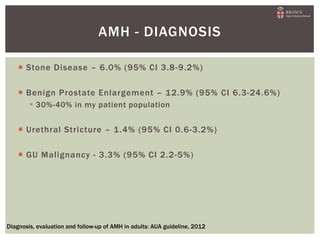
 Stone Disease – 6.0% (95% CI 3.8-9.2%)
 Benign Prostate Enlargement – 12.9% (95% CI 6.3-24.6%)
 30%-40% in my patient population
 Urethral Stricture – 1.4% (95% CI 0.6-3.2%)
 GU Malignancy - 3.3% (95% CI 2.2-5%)
AMH - DIAGNOSIS
Diagnosis, evaluation and follow-up of AMH in adults: AUA guideline, 2012
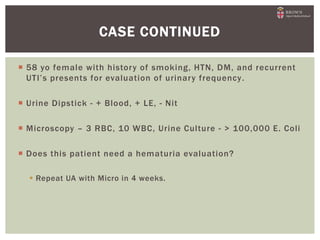
 58 yo female with history of smoking, HTN, DM, and recurrent
UTI’s presents for evaluation of urinary frequency.
 Urine Dipstick - + Blood, + LE, - Nit
 Microscopy – 3 RBC, 10 WBC, Urine Culture - > 100,000 E. Coli
 Does this patient need a hematuria evaluation?
 Repeat UA with Micro in 4 weeks.
CASE CONTINUED
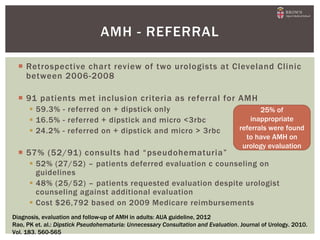
 Retrospective chart review of two urologists at Cleveland Clinic
between 2006-2008
 91 patients met inclusion criteria as referral for AMH
 59.3% - referred on + dipstick only
 16.5% - referred + dipstick and micro <3rbc
 24.2% - referred on + dipstick and micro > 3rbc
 57% (52/91) consults had “pseudohematuria”
 52% (27/52) – patients deferred evaluation c counseling on
guidelines
 48% (25/52) – patients requested evaluation despite urologist
counseling against additional evaluation
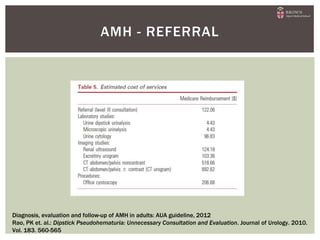
 Cost $26,792 based on 2009 Medicare reimbursements
AMH - REFERRAL
Diagnosis, evaluation and follow-up of AMH in adults: AUA guideline, 2012
Rao, PK et. al.: Dipstick Pseudohematuria: Unnecessary Consultation and Evaluation. Journal of Urology. 2010.
Vol. 183. 560-565
25% of
inappropriate
referrals were found
to have AMH on
urology evaluation
AMH - REFERRAL
Diagnosis, evaluation and follow-up of AMH in adults: AUA guideline, 2012
Rao, PK et. al.: Dipstick Pseudohematuria: Unnecessary Consultation and Evaluation. Journal of Urology. 2010.
Vol. 183. 560-565
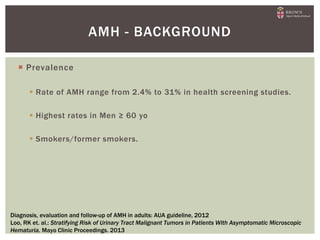
 Prevalence
 Rate of AMH range from 2.4% to 31% in health screening studies.
 Highest rates in Men ≥ 60 yo
 Smokers/former smokers.
AMH - BACKGROUND
Diagnosis, evaluation and follow-up of AMH in adults: AUA guideline, 2012
Loo, RK et. al.: Stratifying Risk of Urinary Tract Malignant Tumors in Patients With Asymptomatic Microscopic
Hematuria. Mayo Clinic Proceedings. 2013
Male gender
Age ≥ 35
Past/Current
smoking
Chemical exposure
Analgesic abuse
Hx gross hematuria
Hx irritive voiding
symptoms
AMH – AUA RISK FACTORS FOR
MALIGNANCY
Diagnosis, evaluation and follow-up of AMH in adults: AUA guideline, 2012
Hx pelvic irradiation
Hx chronic uti
Hx of cyclophosphamide*
Chronic indwelling
foreign body
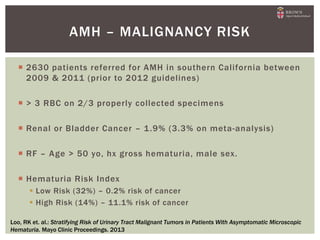
 2630 patients referred for AMH in southern California between
2009 & 2011 (prior to 2012 guidelines)
 > 3 RBC on 2/3 properly collected specimens
 Renal or Bladder Cancer – 1.9% (3.3% on meta-analysis)
 RF – Age > 50 yo, hx gross hematuria, male sex.
 Hematuria Risk Index
 Low Risk (32%) – 0.2% risk of cancer
 High Risk (14%) – 11.1% risk of cancer
AMH – MALIGNANCY RISK
Loo, RK et. al.: Stratifying Risk of Urinary Tract Malignant Tumors in Patients With Asymptomatic Microscopic
Hematuria. Mayo Clinic Proceedings. 2013
 58 yo female with history of smoking, HTN, DM, and recurrent
UTI’s presents for evaluation of urinary frequency.
 Microscopy – 3 RBC, 10 WBC, Urine Culture - > 100,000 E. Coli,
 Repeat UA with Micro in 4 weeks
 3 RBC, 5 WBC Urine Culture - No Growth
 Should I refer to urology?
 Yes!
CASE CONTINUED
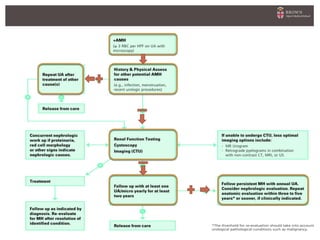
 Urinalysis & Microscopy – dysmorphic RBC, proteinuria, cellular
casts, renal insufficiency → nephrology consult
 GFR – (BUN, Cr) → Impaired renal function → nephrology
consult
 Imaging - CTU
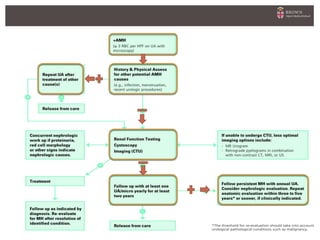
 Cystoscopy - All patients ≥ 35 years old & < 35 years old with
risk factors
AMH - EVALUATION
Diagnosis, evaluation and follow-up of AMH in adults: AUA guideline, 2012
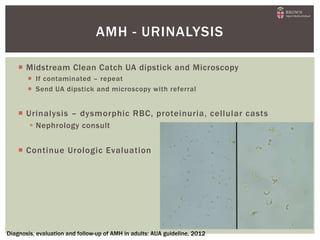
 Midstream Clean Catch UA dipstick and Microscopy
 If contaminated – repeat
 Send UA dipstick and microscopy with referral
 Urinalysis – dysmorphic RBC, proteinuria, cellular casts
 Nephrology consult
 Continue Urologic Evaluation
AMH - URINALYSIS
Diagnosis, evaluation and follow-up of AMH in adults: AUA guideline, 2012
 GFR – (BUN, Cr) → Impaired renal function → nephrology
consult
 *Send recent BMP with referral
 GFR has implications with CTU & MRU
 Continue Urologic Evaluation
AMH - GFR
Diagnosis, evaluation and follow-up of AMH in adults: AUA guideline, 2012
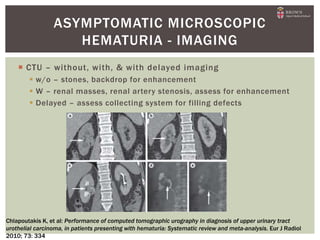
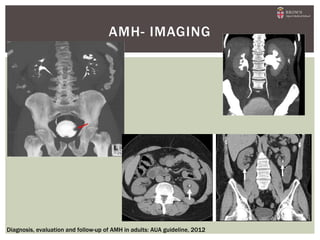
 CTU – without, with, & with delayed imaging
 w/o – stones, backdrop for enhancement
 W – renal masses, renal artery stenosis, assess for enhancement
 Delayed – assess collecting system for filling defects
ASYMPTOMATIC MICROSCOPIC
HEMATURIA - IMAGING
Chlapoutakis K, et al: Performance of computed tomographic urography in diagnosis of upper urinary tract
urothelial carcinoma, in patients presenting with hematuria: Systematic review and meta-analysis. Eur J Radiol
2010; 73: 334
AMH- IMAGING
Diagnosis, evaluation and follow-up of AMH in adults: AUA guideline, 2012
 58 yo female with history of smoking, HTN, DM, and recurrent
UTI’s presents for evaluation of urinary frequency.
 Microscopy – 3 RBC, 10 WBC, Urine Culture - > 100,000 E.
Coli,
 Repeat UA with Micro in 4 weeks
 3 RBC, 5 WBC Urine Culture - No Growth
 Serum Cr 1.7 eGFR 39ml/min/1.73m2
 You want to get the ball rolling and order imaging. What
imaging test should you order?
 CTU! Hold metformin, IVF 500cc-1L D5NS prior to scan
CASE CONTINUED
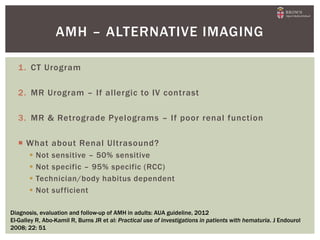
1. CT Urogram
2. MR Urogram – If allergic to IV contrast
3. MR & Retrograde Pyelograms – If poor renal function
 What about Renal Ultrasound?
 Not sensitive – 50% sensitive
 Not specific – 95% specific (RCC)
 Technician/body habitus dependent
 Not sufficient
AMH – ALTERNATIVE IMAGING
Diagnosis, evaluation and follow-up of AMH in adults: AUA guideline, 2012
El-Galley R, Abo-Kamil R, Burns JR et al: Practical use of investigations in patients with hematuria. J Endourol
2008; 22: 51
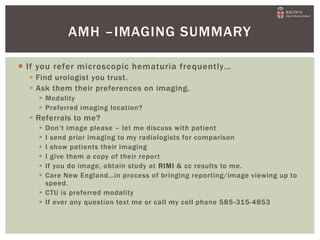
 If you refer microscopic hematuria frequently…
 Find urologist you trust.
 Ask them their preferences on imaging.
 Modality
 Preferred imaging location?
 Referrals to me?
 Don’t image please – let me discuss with patient
 I send prior imaging to my radiologists for comparison
 I show patients their imaging
 I give them a copy of their report
 If you do image, obtain study at RIMI & cc results to me.
 Care New England…in process of bringing reporting/image viewing up to
speed.
 CTU is preferred modality
 If ever any question text me or call my cell phone 585-315-4853
AMH –IMAGING SUMMARY
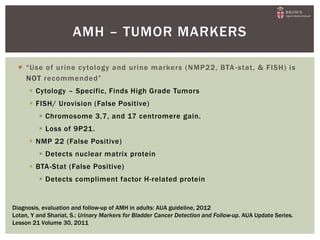
 “Use of urine cytology and urine markers (NMP22, BTA -stat, & FISH) is
NOT recommended”
 Cytology – Specific, Finds High Grade Tumors
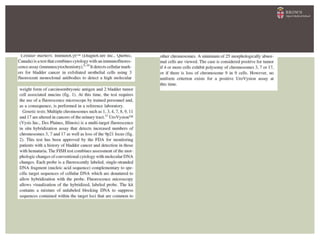
 FISH/ Urovision (False Positive)
 Chromosome 3,7, and 17 centromere gain.
 Loss of 9P21.
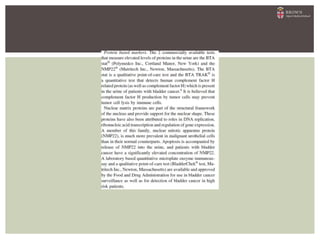
 NMP 22 (False Positive)
 Detects nuclear matrix protein
 BTA-Stat (False Positive)
 Detects compliment factor H-related protein
AMH – TUMOR MARKERS
Diagnosis, evaluation and follow-up of AMH in adults: AUA guideline, 2012
Lotan, Y and Shariat, S.: Urinary Markers for Bladder Cancer Detection and Follow-up. AUA Update Series.
Lesson 21 Volume 30, 2011
Any questions
before I need
to run?
THANK YOU
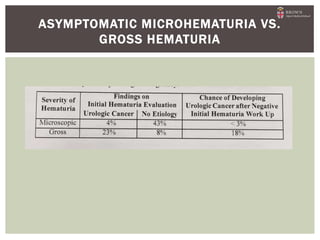
ASYMPTOMATIC MICROHEMATURIA VS.
GROSS HEMATURIA
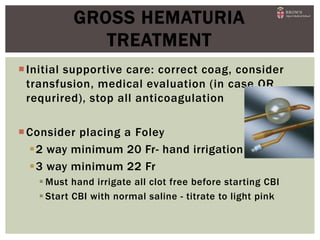
Initial supportive care: correct coag, consider
transfusion, medical evaluation (in case OR
requrired), stop all anticoagulation
Consider placing a Foley
2 way minimum 20 Fr- hand irrigation
3 way minimum 22 Fr
 Must hand irrigate all clot free before starting CBI
 Start CBI with normal saline - titrate to light pink
GROSS HEMATURIA
TREATMENT
 Additional therapies
 Amicar- IV, PO or intravesical
 Must have no clot in bladder
 Intravesical: Amicar, alum, formalin, silver nitrate.
 Hyperbaric Oxygen
 Cystoscopic evaluation with clot evacuation and
fulguration.
GROSS HEMATURIA TREATMENT
 The pregnant female AMH patient requires special
consideration. The majority of AMH cases are associated with
non-life threatening conditions, and less than 5% are
associated with malignancy. Further, the incidence of AMH in
pregnant and non-pregnant women is similar (approximately
4%).176 Brown177 reported that women with and without AMH
during pregnancy had offspring of similar birth weight and
gestational age at delivery, and similar rates of gestational
hypertension and pre-eclampsia. Given that malignancies in
this low risk group (typically < 40 years of age) are rare, the
Panel recommends use of MRU, MRI with RPGs, or US to screen
for major renal lesions with a full workup after delivery once
gynecological bleeding and persistent infection have been
ruled out.
SPECIAL CONSIDERATIONS IN THE
PREGNANT FEMALE
 The use of urine cytology and urine markers (NMP22, BTA -stat,
and UroVysion FISH) is NOT recommended as a part of the
routine evaluation of the asymptomatic microhematuria
patient. Recommendation
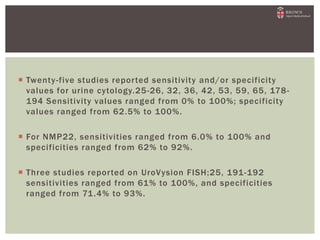
 Twenty-five studies reported sensitivity and/or specificity
values for urine cytology.25-26, 32, 36, 42, 53, 59, 65, 178-
194 Sensitivity values ranged from 0% to 100%; specificity
values ranged from 62.5% to 100%.
 For NMP22, sensitivities ranged from 6.0% to 100% and
specificities ranged from 62% to 92%.
 Three studies reported on UroVysion FISH;25, 191-192
sensitivities ranged from 61% to 100%, and specificities
ranged from 71.4% to 93%.
Asymptomatic Microscopic Hemature : 2012 AUA Guidelines

Asymptomatic Microscopic Hemature : 2012 AUA Guidelines

  • 1.
    2012 AUA Guidelines ASYMPTOMATIC MICROSCOPIC HEMATURIA: 2012 AUAGUIDELINES Andrew James Tompkins, M.D. Clinical Instructor in Surgery (Urology) The Warren Alpert School of Medicine at Brown University Urologic Specialists of New England Andrew_Tompkins@Brown.edu
  • 2.
     I’m notactually 5’11  I don’t usually wear a suit  Didn’t get much sleep  Nothing to disclose DISCLOSURES
  • 3.
     To defineasymptomatic microscopic hematuria (AMH).  Identify patients that require urologic referral.  Discuss the ideal evaluation of AMH.  What should I send to the urologist that would be helpful?  Focus less on “data” and more on evaluation process. OBJECTIVES
  • 4.
     58 yofemale with history of smoking, HTN, DM, and recurrent UTI’s presents for evaluation of urinary frequency.  Urine Dipstick: + 2 Blood, + LE, - Nit, - Protein  Does this patient need a hematuria evaluation?  Lets find out. CASE
  • 5.
     “3 orgreater RBC per high power field on a properly collected urinary specimen in the absence of obvious benign cause”  Dipstick is insufficient!  Sensitive not specific  35% false positive  Obvious Benign Cause  Infection  Menstruation*  Vigorous exercise  Viral illness  Trauma  Recent urologic procedure AMH - DEFINED Diagnosis, evaluation and follow-up of AMH in adults: AUA guideline, 2012 Rao, PK et. al.: Dipstick Pseudohematuria: Unnecessary Consultation and Evaluation. Journal of Urology. 2010. Vol. 183. 560-565
  • 6.
     Change from2001 guideline “2 of 3 urine specimens with 3 or more RBC.”  Indirect evidence supports 1 positive sample  Microhematuria caused by malignancy is highly intermittent…multiple samples may lead to missed diagnosis  Studies show malignancy rate of 3.3% (95% CI 2.2-5%) with one sample.  Not significantly different from multiple samples.  Patients “benefit” from active management of frequently diagnosed conditions during AMH evaluation. AMH - DEFINED Diagnosis, evaluation and follow-up of AMH in adults: AUA guideline, 2012
  • 7.
     Stone Disease– 6.0% (95% CI 3.8-9.2%)  Benign Prostate Enlargement – 12.9% (95% CI 6.3-24.6%)  30%-40% in my patient population  Urethral Stricture – 1.4% (95% CI 0.6-3.2%)  GU Malignancy - 3.3% (95% CI 2.2-5%) AMH - DIAGNOSIS Diagnosis, evaluation and follow-up of AMH in adults: AUA guideline, 2012
  • 8.
     58 yofemale with history of smoking, HTN, DM, and recurrent UTI’s presents for evaluation of urinary frequency.  Urine Dipstick - + Blood, + LE, - Nit  Microscopy – 3 RBC, 10 WBC, Urine Culture - > 100,000 E. Coli  Does this patient need a hematuria evaluation?  Repeat UA with Micro in 4 weeks. CASE CONTINUED
  • 9.
     Retrospective chartreview of two urologists at Cleveland Clinic between 2006-2008  91 patients met inclusion criteria as referral for AMH  59.3% - referred on + dipstick only  16.5% - referred + dipstick and micro <3rbc  24.2% - referred on + dipstick and micro > 3rbc  57% (52/91) consults had “pseudohematuria”  52% (27/52) – patients deferred evaluation c counseling on guidelines  48% (25/52) – patients requested evaluation despite urologist counseling against additional evaluation  Cost $26,792 based on 2009 Medicare reimbursements AMH - REFERRAL Diagnosis, evaluation and follow-up of AMH in adults: AUA guideline, 2012 Rao, PK et. al.: Dipstick Pseudohematuria: Unnecessary Consultation and Evaluation. Journal of Urology. 2010. Vol. 183. 560-565 25% of inappropriate referrals were found to have AMH on urology evaluation
  • 10.
    AMH - REFERRAL Diagnosis,evaluation and follow-up of AMH in adults: AUA guideline, 2012 Rao, PK et. al.: Dipstick Pseudohematuria: Unnecessary Consultation and Evaluation. Journal of Urology. 2010. Vol. 183. 560-565
  • 12.
     Prevalence  Rateof AMH range from 2.4% to 31% in health screening studies.  Highest rates in Men ≥ 60 yo  Smokers/former smokers. AMH - BACKGROUND Diagnosis, evaluation and follow-up of AMH in adults: AUA guideline, 2012 Loo, RK et. al.: Stratifying Risk of Urinary Tract Malignant Tumors in Patients With Asymptomatic Microscopic Hematuria. Mayo Clinic Proceedings. 2013
  • 13.
    Male gender Age ≥35 Past/Current smoking Chemical exposure Analgesic abuse Hx gross hematuria Hx irritive voiding symptoms AMH – AUA RISK FACTORS FOR MALIGNANCY Diagnosis, evaluation and follow-up of AMH in adults: AUA guideline, 2012 Hx pelvic irradiation Hx chronic uti Hx of cyclophosphamide* Chronic indwelling foreign body
  • 14.
     2630 patientsreferred for AMH in southern California between 2009 & 2011 (prior to 2012 guidelines)  > 3 RBC on 2/3 properly collected specimens  Renal or Bladder Cancer – 1.9% (3.3% on meta-analysis)  RF – Age > 50 yo, hx gross hematuria, male sex.  Hematuria Risk Index  Low Risk (32%) – 0.2% risk of cancer  High Risk (14%) – 11.1% risk of cancer AMH – MALIGNANCY RISK Loo, RK et. al.: Stratifying Risk of Urinary Tract Malignant Tumors in Patients With Asymptomatic Microscopic Hematuria. Mayo Clinic Proceedings. 2013
  • 15.
     58 yofemale with history of smoking, HTN, DM, and recurrent UTI’s presents for evaluation of urinary frequency.  Microscopy – 3 RBC, 10 WBC, Urine Culture - > 100,000 E. Coli,  Repeat UA with Micro in 4 weeks  3 RBC, 5 WBC Urine Culture - No Growth  Should I refer to urology?  Yes! CASE CONTINUED
  • 16.
     Urinalysis &Microscopy – dysmorphic RBC, proteinuria, cellular casts, renal insufficiency → nephrology consult  GFR – (BUN, Cr) → Impaired renal function → nephrology consult  Imaging - CTU  Cystoscopy - All patients ≥ 35 years old & < 35 years old with risk factors AMH - EVALUATION Diagnosis, evaluation and follow-up of AMH in adults: AUA guideline, 2012
  • 17.
     Midstream CleanCatch UA dipstick and Microscopy  If contaminated – repeat  Send UA dipstick and microscopy with referral  Urinalysis – dysmorphic RBC, proteinuria, cellular casts  Nephrology consult  Continue Urologic Evaluation AMH - URINALYSIS Diagnosis, evaluation and follow-up of AMH in adults: AUA guideline, 2012
  • 18.
     GFR –(BUN, Cr) → Impaired renal function → nephrology consult  *Send recent BMP with referral  GFR has implications with CTU & MRU  Continue Urologic Evaluation AMH - GFR Diagnosis, evaluation and follow-up of AMH in adults: AUA guideline, 2012
  • 19.
     CTU –without, with, & with delayed imaging  w/o – stones, backdrop for enhancement  W – renal masses, renal artery stenosis, assess for enhancement  Delayed – assess collecting system for filling defects ASYMPTOMATIC MICROSCOPIC HEMATURIA - IMAGING Chlapoutakis K, et al: Performance of computed tomographic urography in diagnosis of upper urinary tract urothelial carcinoma, in patients presenting with hematuria: Systematic review and meta-analysis. Eur J Radiol 2010; 73: 334
  • 20.
    AMH- IMAGING Diagnosis, evaluationand follow-up of AMH in adults: AUA guideline, 2012
  • 21.
     58 yofemale with history of smoking, HTN, DM, and recurrent UTI’s presents for evaluation of urinary frequency.  Microscopy – 3 RBC, 10 WBC, Urine Culture - > 100,000 E. Coli,  Repeat UA with Micro in 4 weeks  3 RBC, 5 WBC Urine Culture - No Growth  Serum Cr 1.7 eGFR 39ml/min/1.73m2  You want to get the ball rolling and order imaging. What imaging test should you order?  CTU! Hold metformin, IVF 500cc-1L D5NS prior to scan CASE CONTINUED
  • 22.
    1. CT Urogram 2.MR Urogram – If allergic to IV contrast 3. MR & Retrograde Pyelograms – If poor renal function  What about Renal Ultrasound?  Not sensitive – 50% sensitive  Not specific – 95% specific (RCC)  Technician/body habitus dependent  Not sufficient AMH – ALTERNATIVE IMAGING Diagnosis, evaluation and follow-up of AMH in adults: AUA guideline, 2012 El-Galley R, Abo-Kamil R, Burns JR et al: Practical use of investigations in patients with hematuria. J Endourol 2008; 22: 51
  • 23.
     If yourefer microscopic hematuria frequently…  Find urologist you trust.  Ask them their preferences on imaging.  Modality  Preferred imaging location?  Referrals to me?  Don’t image please – let me discuss with patient  I send prior imaging to my radiologists for comparison  I show patients their imaging  I give them a copy of their report  If you do image, obtain study at RIMI & cc results to me.  Care New England…in process of bringing reporting/image viewing up to speed.  CTU is preferred modality  If ever any question text me or call my cell phone 585-315-4853 AMH –IMAGING SUMMARY
  • 24.
     “Use ofurine cytology and urine markers (NMP22, BTA -stat, & FISH) is NOT recommended”  Cytology – Specific, Finds High Grade Tumors  FISH/ Urovision (False Positive)  Chromosome 3,7, and 17 centromere gain.  Loss of 9P21.  NMP 22 (False Positive)  Detects nuclear matrix protein  BTA-Stat (False Positive)  Detects compliment factor H-related protein AMH – TUMOR MARKERS Diagnosis, evaluation and follow-up of AMH in adults: AUA guideline, 2012 Lotan, Y and Shariat, S.: Urinary Markers for Bladder Cancer Detection and Follow-up. AUA Update Series. Lesson 21 Volume 30, 2011
  • 26.
    Any questions before Ineed to run? THANK YOU
  • 27.
  • 28.
    Initial supportive care:correct coag, consider transfusion, medical evaluation (in case OR requrired), stop all anticoagulation Consider placing a Foley 2 way minimum 20 Fr- hand irrigation 3 way minimum 22 Fr  Must hand irrigate all clot free before starting CBI  Start CBI with normal saline - titrate to light pink GROSS HEMATURIA TREATMENT
  • 29.
     Additional therapies Amicar- IV, PO or intravesical  Must have no clot in bladder  Intravesical: Amicar, alum, formalin, silver nitrate.  Hyperbaric Oxygen  Cystoscopic evaluation with clot evacuation and fulguration. GROSS HEMATURIA TREATMENT
  • 30.
     The pregnantfemale AMH patient requires special consideration. The majority of AMH cases are associated with non-life threatening conditions, and less than 5% are associated with malignancy. Further, the incidence of AMH in pregnant and non-pregnant women is similar (approximately 4%).176 Brown177 reported that women with and without AMH during pregnancy had offspring of similar birth weight and gestational age at delivery, and similar rates of gestational hypertension and pre-eclampsia. Given that malignancies in this low risk group (typically < 40 years of age) are rare, the Panel recommends use of MRU, MRI with RPGs, or US to screen for major renal lesions with a full workup after delivery once gynecological bleeding and persistent infection have been ruled out. SPECIAL CONSIDERATIONS IN THE PREGNANT FEMALE
  • 31.
     The useof urine cytology and urine markers (NMP22, BTA -stat, and UroVysion FISH) is NOT recommended as a part of the routine evaluation of the asymptomatic microhematuria patient. Recommendation
  • 32.
     Twenty-five studiesreported sensitivity and/or specificity values for urine cytology.25-26, 32, 36, 42, 53, 59, 65, 178- 194 Sensitivity values ranged from 0% to 100%; specificity values ranged from 62.5% to 100%.  For NMP22, sensitivities ranged from 6.0% to 100% and specificities ranged from 62% to 92%.  Three studies reported on UroVysion FISH;25, 191-192 sensitivities ranged from 61% to 100%, and specificities ranged from 71.4% to 93%.

Editor's Notes

  • #6 Random Midstream clean catch urine. If squamous cells present -> need new specimen Not first am void.
  • #7 So you're asking yourself what exactly are you urology monsters diagnosing that improves patient slides if you're only finding a malignancy rate of 3.3% ? A comparable analysis of studies that required more than one positive sample before undertaking an evaluation 30-41 revealed somewhat lower rates of urinary tract malignancies (1.8% with 95% CI = 1.0 – 3.0%) and all malignancies (1.8% with 95% CI = 1.0 – 3.2%). Whether malignancy detection rates are actually lower in studies that required more than one positive sample, however, is difficult to know given that in a third group of studies it was not clear how many positive samples were required before evaluation.42-59 Meta-analysis of these studies revealed rates of 4.3% for urinary tract malignancies (95% CI: 3.3 to 5.5%) and 4.8% for all malignancies (95% CI: 3.7 to 6.2%). It is likely that this group of studies includes both those that undertook evaluation after one positive sample as well as those that required more than one positive sample before evaluation. The Panel interpreted these data overall to indicate that evaluation in response to a single positive sample was warranted.
  • #8 Studies that looked at diagnoses identified on evaluation of asymptomatic microscopic hematuria on the basis of a single well collected specimen
  • #13 Studies that looked at diagnoses identified on evaluation of asymptomatic microscopic hematuria on the basis of a single well collected specimen
  • #14 AUA What is the metabolite that injures the bladder from cyclophosphamide? Acroline What is given at time of chemo to prevent bladder injury? MESNA
  • #15 Trends are now to find high risk populations and screen them rather than all comers. Hematuria Risk Index developed from stat sig risk factors age, hx gross hematuria, male sex. AUC was 0.829 Validation in process.
  • #16 Yes. Needs urology referral.
  • #20 Non con b) contrast nephrogenic phase c) excretory phase d) retrograde filling defect e) retrograde biopsy upper tract tcc Pooled reporting values for CTU – 96% sensitive and 99% specific for malignancy and stones (upper tract)
  • #22 CTU Hold metformin Pre-Scan – 500cc to 1L D5NS 300 AMH evaluations this year. Zero complications from imaging. Review of 18 studies reporting outcomes in 261,657 patients only 4 deaths. Hx of contrast reaction -> premedicate with prednisolone and diphenhydromine.