Exploring the Fundamental Particles
          in the Universe


                       Exploring the Fundamental Particles in the Universe – p.1/29
Outline

   Standard Model of Particle Physics

   Beyond the Standard Model

   Astroparticle Physics


                                   Exploring the Fundamental Particles in the Universe – p.2/29
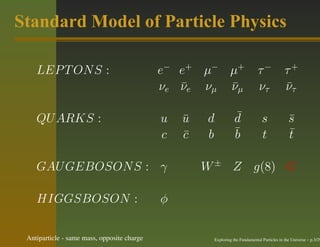
Standard Model of Particle Physics

    LEP T ON S :                             e − e+ µ− µ+                        τ−             τ+
                                                 ¯     ¯
                                             νe νe νµ νµ                         ντ             ¯
                                                                                                ντ

    QU ARKS :                                u   ¯
                                                 u   d              ¯
                                                                    d              s              ¯
                                                                                                  s
                                             c   ¯
                                                 c   b              ¯
                                                                    b              t              ¯
                                                                                                  t

    GAU GEBOSON S : γ                                W ± Z g(8) G

    HIGGSBOSON :                             φ

 Antiparticle - same mass, opposite charge               Exploring the Fundamental Particles in the Universe – p.3/29
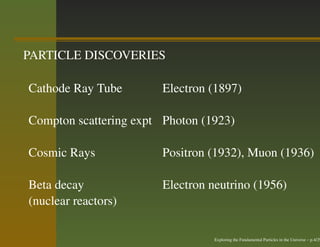
PARTICLE DISCOVERIES

Cathode Ray Tube        Electron (1897)

Compton scattering expt Photon (1923)

Cosmic Rays             Positron (1932), Muon (1936)

Beta decay              Electron neutrino (1956)
(nuclear reactors)

                                  Exploring the Fundamental Particles in the Universe – p.4/29
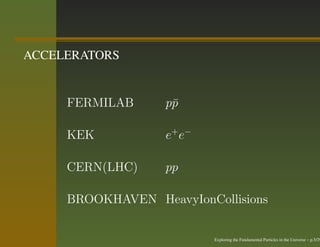
ACCELERATORS


     FERMILAB      p¯
                    p

     KEK           e + e−

     CERN(LHC)     pp

     BROOKHAVEN HeavyIonCollisions


                            Exploring the Fundamental Particles in the Universe – p.5/29
CERN -   [27km, 100m, 11K rev/s, 1011 p per bunch]


                                                     Exploring the Fundamental Particles in the Universe – p.6/29
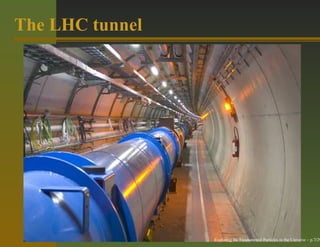
The LHC tunnel


                 Exploring the Fundamental Particles in the Universe – p.7/29
Exploring the Fundamental Particles in the Universe – p.8/29
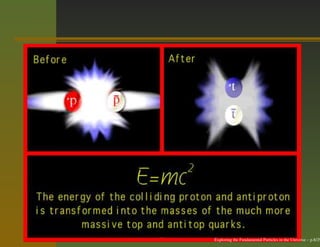
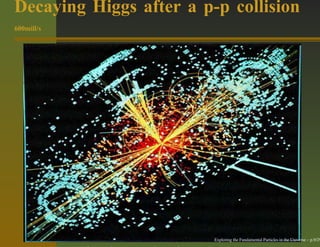
Decaying Higgs after a p-p collision
600mill/s


                         Exploring the Fundamental Particles in the Universe – p.9/29
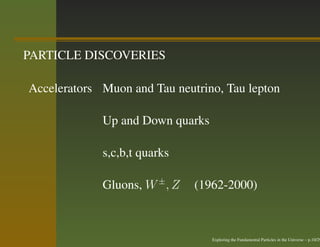
PARTICLE DISCOVERIES

Accelerators Muon and Tau neutrino, Tau lepton

             Up and Down quarks

             s,c,b,t quarks

             Gluons, W ± , Z   (1962-2000)


                                  Exploring the Fundamental Particles in the Universe – p.10/29
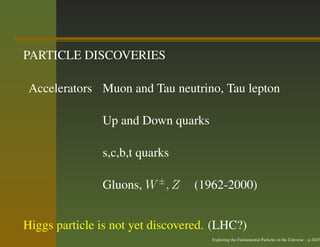
PARTICLE DISCOVERIES

 Accelerators Muon and Tau neutrino, Tau lepton

               Up and Down quarks

               s,c,b,t quarks

               Gluons, W ± , Z   (1962-2000)


Higgs particle is not yet discovered. (LHC?)
                                     Exploring the Fundamental Particles in the Universe – p.10/29
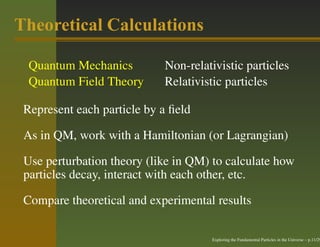
Theoretical Calculations

  Quantum Mechanics         Non-relativistic particles
  Quantum Field Theory      Relativistic particles

 Represent each particle by a field

 As in QM, work with a Hamiltonian (or Lagrangian)

 Use perturbation theory (like in QM) to calculate how
 particles decay, interact with each other, etc.

 Compare theoretical and experimental results

                                     Exploring the Fundamental Particles in the Universe – p.11/29
The Lagrangian of the Standard Model
       1 i       iµν   1      µν      1 j jµν      θ2 g2          ˜
  L = − Wµν W        − Bµν B − Gµν G             +     2
                                                         Tr Gj Gjµν
                                                               µν
       4               4              4            16π
       ¯ γ µ (1 − γ5 ) i∂µ − g 1 τ i W i − g Y Bµ − gs 1 λj Gj fD
      +f D                             µ                     µ
                               2             2         2
       ¯γ µ (1 + γ5 ) i∂µ − g Y Bµ − gs 1 λj Gj f
      +f                                        µ
                              2            2
                                                               2
                     1            Y       1
         + i∂µ − g τ i Wµ − g Bµ − gs λj Gj φ − V (φ)
                          i
                                                 µ
                     2            2       2
              ¯             ¯
         −mf φf1 f1 − mf φc f2 f2   [i = 1, 2, 3; j = 1, 2, .., 8]

 where f are fermions ( leptons and quarks), Gj , Wµ and
                                               µ
                                                   j

Bµ are the strong and electroweak gauge bosons
  i

respectively, and φ is the Higgs boson. The Lagrangian
has SU (3)c × SU (2)L × U (1)Y mathematical symmetry,
which spontaneously breaks into SU (3)c × U (1)EM .
                                                  Exploring the Fundamental Particles in the Universe – p.12/29
Unease with the Standard Model

    The Standard Model of Particle Physics has 19
    parameters.
    The large number of arbitrary parameters in the
    Standard Model is a cause of concern.


                                    Exploring the Fundamental Particles in the Universe – p.13/29
Unease with the Standard Model

    The Standard Model of Particle Physics has 19
    parameters.
    The large number of arbitrary parameters in the
    Standard Model is a cause of concern.

    Also neutrinos are massless in the Standard Model.
    (1998 - ν mass)


                                    Exploring the Fundamental Particles in the Universe – p.13/29
Unease with the Standard Model

    The Standard Model of Particle Physics has 19
    parameters.
    The large number of arbitrary parameters in the
    Standard Model is a cause of concern.

    Also neutrinos are massless in the Standard Model.
    (1998 - ν mass)

    Some theoretical calculations of the Higgs mass
    make it too large (unless one carefully adjusts
    parameters).

                                    Exploring the Fundamental Particles in the Universe – p.13/29
Unease with the Standard Model

    The Standard Model of Particle Physics has 19
    parameters.
    The large number of arbitrary parameters in the
    Standard Model is a cause of concern.

    Also neutrinos are massless in the Standard Model.
    (1998 - ν mass)

    Some theoretical calculations of the Higgs mass
    make it too large (unless one carefully adjusts
    parameters).

    GO BEYOND THE STANDARD MODEL    Exploring the Fundamental Particles in the Universe – p.13/29
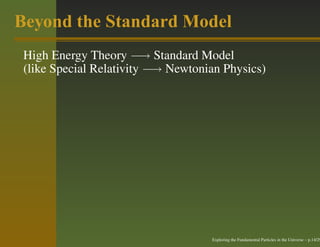
Beyond the Standard Model
 High Energy Theory −→ Standard Model
 (like Special Relativity −→ Newtonian Physics)


                                    Exploring the Fundamental Particles in the Universe – p.14/29
Beyond the Standard Model
 High Energy Theory −→ Standard Model
 (like Special Relativity −→ Newtonian Physics)

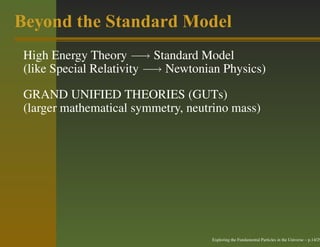
 GRAND UNIFIED THEORIES (GUTs)
 (larger mathematical symmetry, neutrino mass)


                                    Exploring the Fundamental Particles in the Universe – p.14/29
Beyond the Standard Model
 High Energy Theory −→ Standard Model
 (like Special Relativity −→ Newtonian Physics)

 GRAND UNIFIED THEORIES (GUTs)
 (larger mathematical symmetry, neutrino mass)

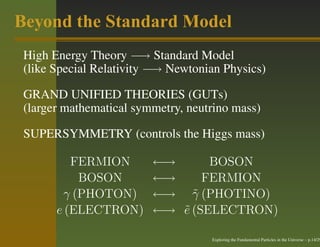
 SUPERSYMMETRY (controls the Higgs mass)

          FERMION        ←→      BOSON
           BOSON         ←→     FERMION
        γ (PHOTON)       ←→ γ (PHOTINO)
                              ˜
       e (ELECTRON)      ←→ e (SELECTRON)
                            ˜

                                    Exploring the Fundamental Particles in the Universe – p.14/29
Beyond the Standard Model
 High Energy Theory −→ Standard Model
 (like Special Relativity −→ Newtonian Physics)

 GRAND UNIFIED THEORIES (GUTs)
 (larger mathematical symmetry, neutrino mass)

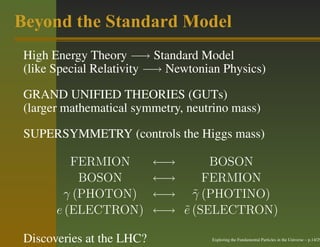
 SUPERSYMMETRY (controls the Higgs mass)

          FERMION          ←→      BOSON
           BOSON           ←→     FERMION
        γ (PHOTON)         ←→ γ (PHOTINO)
                                ˜
       e (ELECTRON)        ←→ e (SELECTRON)
                              ˜

 Discoveries at the LHC?            Exploring the Fundamental Particles in the Universe – p.14/29
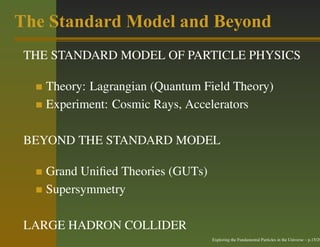
The Standard Model and Beyond
 THE STANDARD MODEL OF PARTICLE PHYSICS

    Theory: Lagrangian (Quantum Field Theory)
    Experiment: Cosmic Rays, Accelerators

 BEYOND THE STANDARD MODEL

    Grand Unified Theories (GUTs)
    Supersymmetry

 LARGE HADRON COLLIDER
                                   Exploring the Fundamental Particles in the Universe – p.15/29
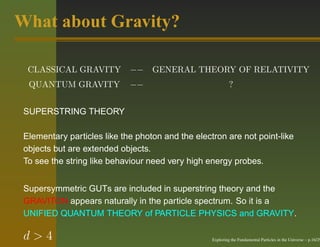
What about Gravity?

 CLASSICAL GRAVITY   −− GENERAL THEORY OF RELATIVITY
 QUANTUM GRAVITY     −−                     ?


                                   Exploring the Fundamental Particles in the Universe – p.16/29
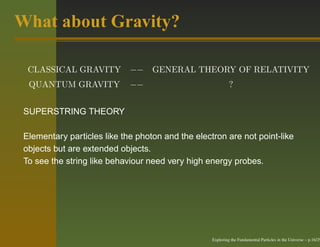
What about Gravity?

  CLASSICAL GRAVITY          −− GENERAL THEORY OF RELATIVITY
  QUANTUM GRAVITY            −−                             ?


 SUPERSTRING THEORY

 Elementary particles like the photon and the electron are not point-like
 objects but are extended objects.
 To see the string like behaviour need very high energy probes.


                                                   Exploring the Fundamental Particles in the Universe – p.16/29
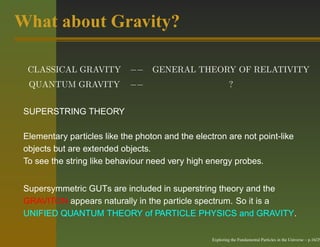
What about Gravity?

  CLASSICAL GRAVITY          −− GENERAL THEORY OF RELATIVITY
  QUANTUM GRAVITY            −−                             ?


 SUPERSTRING THEORY

 Elementary particles like the photon and the electron are not point-like
 objects but are extended objects.
 To see the string like behaviour need very high energy probes.


 Supersymmetric GUTs are included in superstring theory and the
 GRAVITON appears naturally in the particle spectrum. So it is a
 UNIFIED QUANTUM THEORY of PARTICLE PHYSICS and GRAVITY.

                                                   Exploring the Fundamental Particles in the Universe – p.16/29
What about Gravity?

  CLASSICAL GRAVITY          −− GENERAL THEORY OF RELATIVITY
  QUANTUM GRAVITY            −−                             ?


 SUPERSTRING THEORY

 Elementary particles like the photon and the electron are not point-like
 objects but are extended objects.
 To see the string like behaviour need very high energy probes.


 Supersymmetric GUTs are included in superstring theory and the
 GRAVITON appears naturally in the particle spectrum. So it is a
 UNIFIED QUANTUM THEORY of PARTICLE PHYSICS and GRAVITY.

 d>4                                               Exploring the Fundamental Particles in the Universe – p.16/29
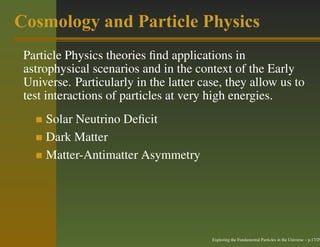
Cosmology and Particle Physics
 Particle Physics theories find applications in
 astrophysical scenarios and in the context of the Early
 Universe. Particularly in the latter case, they allow us to
 test interactions of particles at very high energies.
     Solar Neutrino Deficit
     Dark Matter
     Matter-Antimatter Asymmetry


                                        Exploring the Fundamental Particles in the Universe – p.17/29
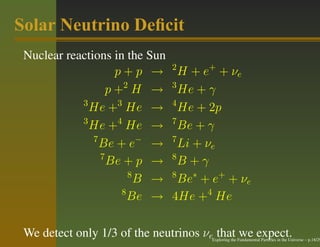
Solar Neutrino Deficit
 Nuclear reactions in the Sun
                                2
                     p+p →        H + e + + νe
                   p +2 H →     3
                                  He + γ
            3
              He +3 He →        4
                                  He + 2p
            3
              He +4 He →        7
                                  Be + γ
               7                7
                 Be + e− →        Li + νe
                 7              8
                   Be + p →       B+γ
                        8       8
                          B →     Be∗ + e+ + νe
                      8
                        Be →    4He +4 He

 We detect only 1/3 of the neutrinos νe that we expect.
                                       Exploring the Fundamental Particles in the Universe – p.18/29
Neutrino Oscillations
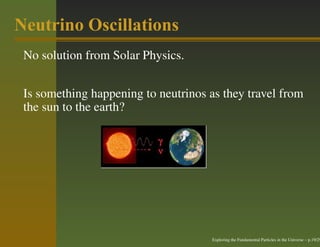
 No solution from Solar Physics.


                                   Exploring the Fundamental Particles in the Universe – p.19/29
Neutrino Oscillations
 No solution from Solar Physics.


 Is something happening to neutrinos as they travel from
 the sun to the earth?


                                      Exploring the Fundamental Particles in the Universe – p.19/29
Neutrino Oscillations


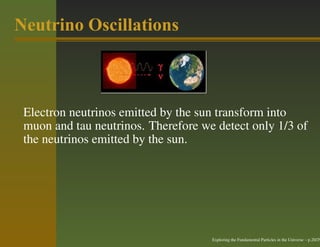
 Electron neutrinos emitted by the sun transform into
 muon and tau neutrinos. Therefore we detect only 1/3 of
 the neutrinos emitted by the sun.


                                     Exploring the Fundamental Particles in the Universe – p.20/29
Neutrino Oscillations


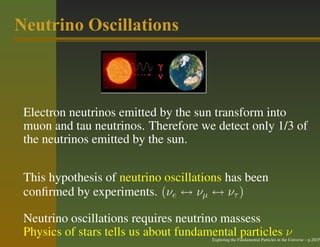
 Electron neutrinos emitted by the sun transform into
 muon and tau neutrinos. Therefore we detect only 1/3 of
 the neutrinos emitted by the sun.


 This hypothesis of neutrino oscillations has been
 confirmed by experiments. (νe ↔ νµ ↔ ντ )

 Neutrino oscillations requires neutrino massess
 Physics of stars tells us about fundamental particles ν
                                       Exploring the Fundamental Particles in the Universe – p.20/29
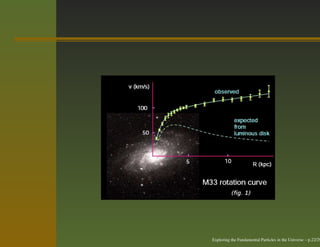
Dark Matter
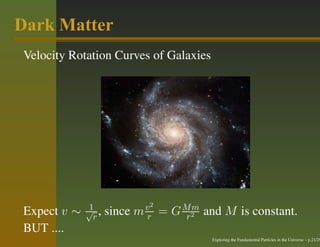
 Velocity Rotation Curves of Galaxies


 Expect v ∼   √ ,
              1
               r
                    since    v2
                            mr    = G M2 and M is constant.
                                       r
                                         m

 BUT ....
                                           Exploring the Fundamental Particles in the Universe – p.21/29
Exploring the Fundamental Particles in the Universe – p.22/29
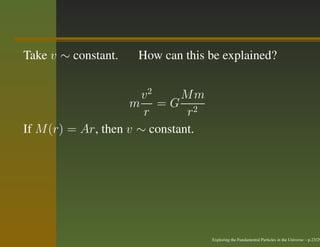
Take v ∼ constant.   How can this be explained?


                                  Exploring the Fundamental Particles in the Universe – p.23/29
Take v ∼ constant.   How can this be explained?


                       v2     Mm
                     m =G 2
                       r       r
If M (r) = Ar, then v ∼ constant.


                                    Exploring the Fundamental Particles in the Universe – p.23/29
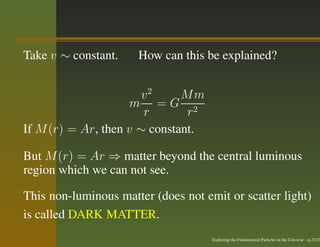
Take v ∼ constant.    How can this be explained?


                       v2     Mm
                     m =G 2
                       r       r
If M (r) = Ar, then v ∼ constant.

But M (r) = Ar ⇒ matter beyond the central luminous
region which we can not see.

This non-luminous matter (does not emit or scatter light)
is called DARK MATTER.
                                     Exploring the Fundamental Particles in the Universe – p.23/29
DARK MATTER does not emit or scatter light so it is
difficult to detect.
What is it?

Consists primarily of non-Standard Model matter –
supersymmetric particles, axions, massive neutrinos, ...


High energy physics theories provide possible candidates
for dark matter


                                      Exploring the Fundamental Particles in the Universe – p.24/29
Matter-Antimatter Asymmetry
 Observed Universe is made up of only matter.
                        ¯
                 M + M → photons
 Antimatter seen in laboratories since 1930s.

 We believe that at early times (t < 1s) there were
 equal amounts of matter and antimatter in the Universe.

 WHERE DID THE ANTIMATTER GO?


                                      Exploring the Fundamental Particles in the Universe – p.25/29
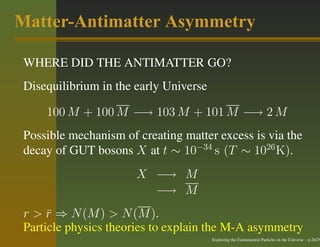
Matter-Antimatter Asymmetry

 WHERE DID THE ANTIMATTER GO?
 Disequilibrium in the early Universe

     100 M + 100 M −→ 103 M + 101 M −→ 2 M
 Possible mechanism of creating matter excess is via the
 decay of GUT bosons X at t ∼ 10−34 s (T ∼ 1026 K).
                       X −→ M
                         −→ M
 r > r ⇒ N (M ) > N (M ).
      ¯
 Particle physics theories to explain the M-A asymmetry
                                        Exploring the Fundamental Particles in the Universe – p.26/29
Conclusion

   We have a good understanding of the history and
   evolution of our Universe, but there are sill
   important outstanding questions – Big Bang, Dark
   Matter, Dark Energy


   The Standard Model of Particle Physics is good but
   not good enough
   Need to consider theories Beyond the Standard
   Model valid at higher energies


                                   Exploring the Fundamental Particles in the Universe – p.27/29
Conclusion

   Problems in Particle Physics are often linked to
   Cosmology and vice versa
   High energy particle physics theories such as String
   Theory may explain the Big Bang, Supersymmetric
   models may provide the Dark Matter, GUTs may
   explain the Matter-Antimatter Asymmetry, Solar
   Physics provides clues to the nature of Neutrinos


   Accelerators such as the LHC will (hopefully)
   discover the dark matter particle

                                    Exploring the Fundamental Particles in the Universe – p.28/29
Cosmology and Particle Physics

 Books

    The First Three Minutes by S. Weinberg


    The Big and the Small, vol. I and II by G.
    Venkataraman


                                    raghavan@prl.res.in
                                     Exploring the Fundamental Particles in the Universe – p.29/29

Astroparticle cosmo

  • 1.
    Exploring the FundamentalParticles in the Universe Exploring the Fundamental Particles in the Universe – p.1/29
  • 2.
    Outline Standard Model of Particle Physics Beyond the Standard Model Astroparticle Physics Exploring the Fundamental Particles in the Universe – p.2/29
  • 3.
    Standard Model ofParticle Physics LEP T ON S : e − e+ µ− µ+ τ− τ+ ¯ ¯ νe νe νµ νµ ντ ¯ ντ QU ARKS : u ¯ u d ¯ d s ¯ s c ¯ c b ¯ b t ¯ t GAU GEBOSON S : γ W ± Z g(8) G HIGGSBOSON : φ Antiparticle - same mass, opposite charge Exploring the Fundamental Particles in the Universe – p.3/29
  • 4.
    PARTICLE DISCOVERIES Cathode RayTube Electron (1897) Compton scattering expt Photon (1923) Cosmic Rays Positron (1932), Muon (1936) Beta decay Electron neutrino (1956) (nuclear reactors) Exploring the Fundamental Particles in the Universe – p.4/29
  • 5.
    ACCELERATORS FERMILAB p¯ p KEK e + e− CERN(LHC) pp BROOKHAVEN HeavyIonCollisions Exploring the Fundamental Particles in the Universe – p.5/29
  • 6.
    CERN - [27km, 100m, 11K rev/s, 1011 p per bunch] Exploring the Fundamental Particles in the Universe – p.6/29
  • 7.
    The LHC tunnel Exploring the Fundamental Particles in the Universe – p.7/29
  • 8.
    Exploring the FundamentalParticles in the Universe – p.8/29
  • 9.
    Decaying Higgs aftera p-p collision 600mill/s Exploring the Fundamental Particles in the Universe – p.9/29
  • 10.
    PARTICLE DISCOVERIES Accelerators Muonand Tau neutrino, Tau lepton Up and Down quarks s,c,b,t quarks Gluons, W ± , Z (1962-2000) Exploring the Fundamental Particles in the Universe – p.10/29
  • 11.
    PARTICLE DISCOVERIES AcceleratorsMuon and Tau neutrino, Tau lepton Up and Down quarks s,c,b,t quarks Gluons, W ± , Z (1962-2000) Higgs particle is not yet discovered. (LHC?) Exploring the Fundamental Particles in the Universe – p.10/29
  • 12.
    Theoretical Calculations Quantum Mechanics Non-relativistic particles Quantum Field Theory Relativistic particles Represent each particle by a field As in QM, work with a Hamiltonian (or Lagrangian) Use perturbation theory (like in QM) to calculate how particles decay, interact with each other, etc. Compare theoretical and experimental results Exploring the Fundamental Particles in the Universe – p.11/29
  • 13.
    The Lagrangian ofthe Standard Model 1 i iµν 1 µν 1 j jµν θ2 g2 ˜ L = − Wµν W − Bµν B − Gµν G + 2 Tr Gj Gjµν µν 4 4 4 16π ¯ γ µ (1 − γ5 ) i∂µ − g 1 τ i W i − g Y Bµ − gs 1 λj Gj fD +f D µ µ 2 2 2 ¯γ µ (1 + γ5 ) i∂µ − g Y Bµ − gs 1 λj Gj f +f µ 2 2 2 1 Y 1 + i∂µ − g τ i Wµ − g Bµ − gs λj Gj φ − V (φ) i µ 2 2 2 ¯ ¯ −mf φf1 f1 − mf φc f2 f2 [i = 1, 2, 3; j = 1, 2, .., 8] where f are fermions ( leptons and quarks), Gj , Wµ and µ j Bµ are the strong and electroweak gauge bosons i respectively, and φ is the Higgs boson. The Lagrangian has SU (3)c × SU (2)L × U (1)Y mathematical symmetry, which spontaneously breaks into SU (3)c × U (1)EM . Exploring the Fundamental Particles in the Universe – p.12/29
  • 14.
    Unease with theStandard Model The Standard Model of Particle Physics has 19 parameters. The large number of arbitrary parameters in the Standard Model is a cause of concern. Exploring the Fundamental Particles in the Universe – p.13/29
  • 15.
    Unease with theStandard Model The Standard Model of Particle Physics has 19 parameters. The large number of arbitrary parameters in the Standard Model is a cause of concern. Also neutrinos are massless in the Standard Model. (1998 - ν mass) Exploring the Fundamental Particles in the Universe – p.13/29
  • 16.
    Unease with theStandard Model The Standard Model of Particle Physics has 19 parameters. The large number of arbitrary parameters in the Standard Model is a cause of concern. Also neutrinos are massless in the Standard Model. (1998 - ν mass) Some theoretical calculations of the Higgs mass make it too large (unless one carefully adjusts parameters). Exploring the Fundamental Particles in the Universe – p.13/29
  • 17.
    Unease with theStandard Model The Standard Model of Particle Physics has 19 parameters. The large number of arbitrary parameters in the Standard Model is a cause of concern. Also neutrinos are massless in the Standard Model. (1998 - ν mass) Some theoretical calculations of the Higgs mass make it too large (unless one carefully adjusts parameters). GO BEYOND THE STANDARD MODEL Exploring the Fundamental Particles in the Universe – p.13/29
  • 18.
    Beyond the StandardModel High Energy Theory −→ Standard Model (like Special Relativity −→ Newtonian Physics) Exploring the Fundamental Particles in the Universe – p.14/29
  • 19.
    Beyond the StandardModel High Energy Theory −→ Standard Model (like Special Relativity −→ Newtonian Physics) GRAND UNIFIED THEORIES (GUTs) (larger mathematical symmetry, neutrino mass) Exploring the Fundamental Particles in the Universe – p.14/29
  • 20.
    Beyond the StandardModel High Energy Theory −→ Standard Model (like Special Relativity −→ Newtonian Physics) GRAND UNIFIED THEORIES (GUTs) (larger mathematical symmetry, neutrino mass) SUPERSYMMETRY (controls the Higgs mass) FERMION ←→ BOSON BOSON ←→ FERMION γ (PHOTON) ←→ γ (PHOTINO) ˜ e (ELECTRON) ←→ e (SELECTRON) ˜ Exploring the Fundamental Particles in the Universe – p.14/29
  • 21.
    Beyond the StandardModel High Energy Theory −→ Standard Model (like Special Relativity −→ Newtonian Physics) GRAND UNIFIED THEORIES (GUTs) (larger mathematical symmetry, neutrino mass) SUPERSYMMETRY (controls the Higgs mass) FERMION ←→ BOSON BOSON ←→ FERMION γ (PHOTON) ←→ γ (PHOTINO) ˜ e (ELECTRON) ←→ e (SELECTRON) ˜ Discoveries at the LHC? Exploring the Fundamental Particles in the Universe – p.14/29
  • 22.
    The Standard Modeland Beyond THE STANDARD MODEL OF PARTICLE PHYSICS Theory: Lagrangian (Quantum Field Theory) Experiment: Cosmic Rays, Accelerators BEYOND THE STANDARD MODEL Grand Unified Theories (GUTs) Supersymmetry LARGE HADRON COLLIDER Exploring the Fundamental Particles in the Universe – p.15/29
  • 23.
    What about Gravity? CLASSICAL GRAVITY −− GENERAL THEORY OF RELATIVITY QUANTUM GRAVITY −− ? Exploring the Fundamental Particles in the Universe – p.16/29
  • 24.
    What about Gravity? CLASSICAL GRAVITY −− GENERAL THEORY OF RELATIVITY QUANTUM GRAVITY −− ? SUPERSTRING THEORY Elementary particles like the photon and the electron are not point-like objects but are extended objects. To see the string like behaviour need very high energy probes. Exploring the Fundamental Particles in the Universe – p.16/29
  • 25.
    What about Gravity? CLASSICAL GRAVITY −− GENERAL THEORY OF RELATIVITY QUANTUM GRAVITY −− ? SUPERSTRING THEORY Elementary particles like the photon and the electron are not point-like objects but are extended objects. To see the string like behaviour need very high energy probes. Supersymmetric GUTs are included in superstring theory and the GRAVITON appears naturally in the particle spectrum. So it is a UNIFIED QUANTUM THEORY of PARTICLE PHYSICS and GRAVITY. Exploring the Fundamental Particles in the Universe – p.16/29
  • 26.
    What about Gravity? CLASSICAL GRAVITY −− GENERAL THEORY OF RELATIVITY QUANTUM GRAVITY −− ? SUPERSTRING THEORY Elementary particles like the photon and the electron are not point-like objects but are extended objects. To see the string like behaviour need very high energy probes. Supersymmetric GUTs are included in superstring theory and the GRAVITON appears naturally in the particle spectrum. So it is a UNIFIED QUANTUM THEORY of PARTICLE PHYSICS and GRAVITY. d>4 Exploring the Fundamental Particles in the Universe – p.16/29
  • 27.
    Cosmology and ParticlePhysics Particle Physics theories find applications in astrophysical scenarios and in the context of the Early Universe. Particularly in the latter case, they allow us to test interactions of particles at very high energies. Solar Neutrino Deficit Dark Matter Matter-Antimatter Asymmetry Exploring the Fundamental Particles in the Universe – p.17/29
  • 28.
    Solar Neutrino Deficit Nuclear reactions in the Sun 2 p+p → H + e + + νe p +2 H → 3 He + γ 3 He +3 He → 4 He + 2p 3 He +4 He → 7 Be + γ 7 7 Be + e− → Li + νe 7 8 Be + p → B+γ 8 8 B → Be∗ + e+ + νe 8 Be → 4He +4 He We detect only 1/3 of the neutrinos νe that we expect. Exploring the Fundamental Particles in the Universe – p.18/29
  • 29.
    Neutrino Oscillations Nosolution from Solar Physics. Exploring the Fundamental Particles in the Universe – p.19/29
  • 30.
    Neutrino Oscillations Nosolution from Solar Physics. Is something happening to neutrinos as they travel from the sun to the earth? Exploring the Fundamental Particles in the Universe – p.19/29
  • 31.
    Neutrino Oscillations Electronneutrinos emitted by the sun transform into muon and tau neutrinos. Therefore we detect only 1/3 of the neutrinos emitted by the sun. Exploring the Fundamental Particles in the Universe – p.20/29
  • 32.
    Neutrino Oscillations Electronneutrinos emitted by the sun transform into muon and tau neutrinos. Therefore we detect only 1/3 of the neutrinos emitted by the sun. This hypothesis of neutrino oscillations has been confirmed by experiments. (νe ↔ νµ ↔ ντ ) Neutrino oscillations requires neutrino massess Physics of stars tells us about fundamental particles ν Exploring the Fundamental Particles in the Universe – p.20/29
  • 33.
    Dark Matter VelocityRotation Curves of Galaxies Expect v ∼ √ , 1 r since v2 mr = G M2 and M is constant. r m BUT .... Exploring the Fundamental Particles in the Universe – p.21/29
  • 34.
    Exploring the FundamentalParticles in the Universe – p.22/29
  • 35.
    Take v ∼constant. How can this be explained? Exploring the Fundamental Particles in the Universe – p.23/29
  • 36.
    Take v ∼constant. How can this be explained? v2 Mm m =G 2 r r If M (r) = Ar, then v ∼ constant. Exploring the Fundamental Particles in the Universe – p.23/29
  • 37.
    Take v ∼constant. How can this be explained? v2 Mm m =G 2 r r If M (r) = Ar, then v ∼ constant. But M (r) = Ar ⇒ matter beyond the central luminous region which we can not see. This non-luminous matter (does not emit or scatter light) is called DARK MATTER. Exploring the Fundamental Particles in the Universe – p.23/29
  • 38.
    DARK MATTER doesnot emit or scatter light so it is difficult to detect. What is it? Consists primarily of non-Standard Model matter – supersymmetric particles, axions, massive neutrinos, ... High energy physics theories provide possible candidates for dark matter Exploring the Fundamental Particles in the Universe – p.24/29
  • 39.
    Matter-Antimatter Asymmetry ObservedUniverse is made up of only matter. ¯ M + M → photons Antimatter seen in laboratories since 1930s. We believe that at early times (t < 1s) there were equal amounts of matter and antimatter in the Universe. WHERE DID THE ANTIMATTER GO? Exploring the Fundamental Particles in the Universe – p.25/29
  • 40.
    Matter-Antimatter Asymmetry WHEREDID THE ANTIMATTER GO? Disequilibrium in the early Universe 100 M + 100 M −→ 103 M + 101 M −→ 2 M Possible mechanism of creating matter excess is via the decay of GUT bosons X at t ∼ 10−34 s (T ∼ 1026 K). X −→ M −→ M r > r ⇒ N (M ) > N (M ). ¯ Particle physics theories to explain the M-A asymmetry Exploring the Fundamental Particles in the Universe – p.26/29
  • 41.
    Conclusion We have a good understanding of the history and evolution of our Universe, but there are sill important outstanding questions – Big Bang, Dark Matter, Dark Energy The Standard Model of Particle Physics is good but not good enough Need to consider theories Beyond the Standard Model valid at higher energies Exploring the Fundamental Particles in the Universe – p.27/29
  • 42.
    Conclusion Problems in Particle Physics are often linked to Cosmology and vice versa High energy particle physics theories such as String Theory may explain the Big Bang, Supersymmetric models may provide the Dark Matter, GUTs may explain the Matter-Antimatter Asymmetry, Solar Physics provides clues to the nature of Neutrinos Accelerators such as the LHC will (hopefully) discover the dark matter particle Exploring the Fundamental Particles in the Universe – p.28/29
  • 43.
    Cosmology and ParticlePhysics Books The First Three Minutes by S. Weinberg The Big and the Small, vol. I and II by G. Venkataraman raghavan@prl.res.in Exploring the Fundamental Particles in the Universe – p.29/29