Astronomy
A universalstudy
All settled civilizations have studied astronomy:
 Knowledge of the movement of the
moon and the sun was vital for a pre-
industrial society, as a way of telling the
time
 The codification of such knowledge
produced a calendar, by which the best
periods for sowing, reaping, herding and
other activities could be determined
 Observation of the stars was also
necessary for sea navigation and long
land journeys
 The calculations involved in this study
made astronomy a main stimulus for
mathematics.
Cosmology
The accumulated knowledge of the stars gave a
cosmology, a picture of the whole universe.
Before modern science, cosmology was closely
related to theology: as well as describing the
physical shape of the universe, a cosmology
also explained its meaning, and gave an
account of man's nature and purpose. The two
central cosmologies in Western history were
the geocentric and the heliocentric universe.
Both were based on the basic shape of a wheel
revolving around a hub.
The geocentric (or Ptolemaic)universe
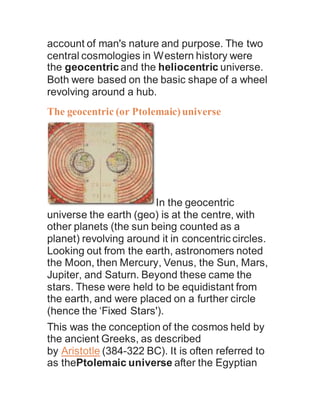
In the geocentric
universe the earth (geo) is at the centre, with
other planets (the sun being counted as a
planet) revolving around it in concentric circles.
Looking out from the earth, astronomers noted
the Moon, then Mercury, Venus, the Sun, Mars,
Jupiter, and Saturn. Beyond these came the
stars. These were held to be equidistant from
the earth, and were placed on a further circle
(hence the ‘Fixed Stars').
This was the conception of the cosmos held by
the ancient Greeks, as described
by Aristotle (384-322 BC). It is often referred to
as thePtolemaic universe after the Egyptian
scientist Ptolemy (c.90-168). This cosmology
persisted throughout the Middle Ages and much
of the Renaissance, until the new science
started to supplant it from about 1600.
The influence of the geocentricview
Christianity
Though the geocentric universe was originally
pre-Christian, it was comfortably Christianised.
Aristotle had described a ‘Prime Mover', a force
outside the heavens setting them in motion. To
Christians, this Prime Mover corresponded
to God. They believed that the universe involved
human-like intentions: for example, the
(presumed) circular orbit of the planets
expressed the planets' desire to be close to
God.
The music of the spheres
The planets were believed to revolve on invisible
but solid crystallinespheres. Their combined
movement made the music of the spheres,
which expressed divine harmony. The entire
design of the universe was seen to reflect the
will of a perfect God.
Geocentricity
The central position of the earth reflected the
idea that the human race were privileged
creatures, and the cosmos literally revolved
around them. But the geocentric universe also
put Earth at the furthest possible distance
from Heaven (the ‘empyrean'), which lay beyond
the Fixed Stars. Thus it also suited ideas of
humility, with humans as fallen sinners.
Dual nature
The heavens were held to be perfect and
unchanging. Earth, however, was mutable and
corrupt. Earthly and heavenly natures were
believed to be different, and therefore obeyed
two sets of physical laws. Earth corresponded to
the body, the heavens to the spirit.
Sublunar/ superlunar
Beyond the moon (superlunar), the heavens
existed in the perfect atmosphere of ‘ether', the
natural element of angels. Man occupied the
sublunar sphere. Here the atmosphere was
polluted, and matter was composed of the four
elements (Earth, Air, Fire and Water). Beneath
the moon, all things are liable to corruption and
decay.
Finite
The cosmos was seen as vast but finite.
Medieval man looking up at the stars imagined
he was looking at the outermost edge of the
universe.
Heliocentric
In the heliocentric cosmos, the sun
(Greek helios) was believed to be at the centre,
and the earth and other planets revolved around
it.Copernicus's On the Revolution of the
Heavenly Spheres (1543) showed that apparent
aberrations in planetary orbits on the old model
could be better explained if the sun were put at
the centre. Thus Earth spins around its axis and
revolves around the sun, giving
the appearance that the sun rises in the east
and sets in the west.
Later astronomers continued this work:
 Kepler (1571-1630) worked out that
orbits are elliptical, not circular
 Using the telescope, Galileo (1564-
1642) observed sunspots and
irregularities on the moon, showing that
the heavens were not perfect.
The responseto the Heliocentricview
Heretical
The heliocentric cosmos was a matter of great
controvesy. The Roman Catholic
Church authorities condemned the theory,
forcingd Galileo torecant in 1616, and banning
Copernicus' book. The Ptolemaic model had
informed Church teachings about God and man,
thus the new model presented a challenge to the
authority of the Church. Protestantreactions
were very mixed; heliocentrism was
enthusiastically adopted by some theologians
and taught in some Protestant universities.
New Science
The heliocentric cosmos helped to pave the way
for a fresh approach to science, based on
mathematics and experiment: Newton (1642-
1727) later demonstrated the physical rules
underlying the behaviour of all matter. Although
most scientists before the twentieth century
could be described as theists, who believed
that God was the reason behind the order
observed within scientific laws, the sense that all
aspects of cosmology were a reflection
of theology was weakened. Increasingly,
science studied only material things, while
religion dealt with meaning and morality.
Culture
The heliocentric picture took centuries to be
generally absorbed. Writers continued to use
ideas and images drawn from the older picture,
as is still common today in the
words sunrise and sunset.
Developments
The heliocentric model has itself been altered by
modern science, which places the solar system
on the edge of the known universe. Newtonian
physics has been revised by Einstein. Modern
theories of parallel universes inspire science
fiction in particular, while the relation of science
and religion is frequently discussed.
Astrology
The influence of the heavenlybodies
Astrology describes the influence of the stars on
human life. It was generally accepted until about
1600. Because the sun is the source of life, and
the moon causes tides, it was felt that other
heavenly bodies must also influence the earth.
In the absence of modern science, this would
help explain human behaviour and terrestrial
phenomena, and allow for predictions.
The planets
Each planet has an individual influence:
 Jupiter (Jove) disposes someone to be
merry or ‘jovial'
 Mars and Venus influence man to be
warlike ('martial') or loving respectively
 The influence of Mercury is seen in the
term ‘mercurial' (lively and
unpredictable)
 A ‘lunatic' is affected by the lunar cycle
of the moon
 The influence of Saturn is seen in the
adjective ‘saturnine' (having a gloomy
temprament or appearance)
 Planets also dominate particular days of
the week (Sun-day etc.).
Planetary influence is affected by the planets'
relation to each other
(theirconstellation or aspect). Though planets
could influence human behaviour, they could
not determine it since, in Christian thinking, man
has free will (see Romanticism: Determinism
and free will).
The stars
By picturing the geocentric universe as a circle,
it can be divided like a cake into twelve equal
slices. For about a month (starting on March
21st) each ‘slice' will appear in the east where
the sun rises. This segment is said to be ‘in the
ascendant'.
Each segment has a distinct grouping of stars,
referred to by the signs of the Zodiac: Aries (the
Ram), Taurus (Bull) , Gemini (Twins), Cancer
(Crab), Leo (Lion), Virgo (Virgin), Libra (Scales),
Scorpio (Scorpion), Sagittarius (Archer),
Capricorn (Goat), Aquarius (Water-carrier),
Pisces (Fishes). The stars in the ascendant
were believed to further affect the influence of
the planets passing through them.
Credibility
There were some scholarly attacks on astrology
in the sixteenth century, but in general people
from all social ranks turned to astrologers to help
them make important life decisions. The
mathematics behind it seemed dazzling, and
there was no alternative explanation of most
events. Astrology also provided a satisfying link
between the earth and the rest of the universe.
Astrology thus formed part of the general way of
thinking until it was displaced by modern science
from the seventeenth century. InKing Lear,
Edmund laughs at his father Gloucester for
ascribing events to the stars, a sign of a shift in
belief at this time.
Language
The impact of astrology can be traced in
language: influence itself comes from the idea of
power flowing in from the planets and stars; dis-
aster refers to a ‘bad star' having a malign
influence.

Astronomy a universal study .

  • 1.
    Astronomy A universalstudy All settledcivilizations have studied astronomy:  Knowledge of the movement of the moon and the sun was vital for a pre- industrial society, as a way of telling the time  The codification of such knowledge produced a calendar, by which the best periods for sowing, reaping, herding and other activities could be determined  Observation of the stars was also necessary for sea navigation and long land journeys  The calculations involved in this study made astronomy a main stimulus for mathematics. Cosmology The accumulated knowledge of the stars gave a cosmology, a picture of the whole universe. Before modern science, cosmology was closely related to theology: as well as describing the physical shape of the universe, a cosmology also explained its meaning, and gave an
  • 2.
    account of man'snature and purpose. The two central cosmologies in Western history were the geocentric and the heliocentric universe. Both were based on the basic shape of a wheel revolving around a hub. The geocentric (or Ptolemaic)universe In the geocentric universe the earth (geo) is at the centre, with other planets (the sun being counted as a planet) revolving around it in concentric circles. Looking out from the earth, astronomers noted the Moon, then Mercury, Venus, the Sun, Mars, Jupiter, and Saturn. Beyond these came the stars. These were held to be equidistant from the earth, and were placed on a further circle (hence the ‘Fixed Stars'). This was the conception of the cosmos held by the ancient Greeks, as described by Aristotle (384-322 BC). It is often referred to as thePtolemaic universe after the Egyptian
  • 3.
    scientist Ptolemy (c.90-168).This cosmology persisted throughout the Middle Ages and much of the Renaissance, until the new science started to supplant it from about 1600. The influence of the geocentricview Christianity Though the geocentric universe was originally pre-Christian, it was comfortably Christianised. Aristotle had described a ‘Prime Mover', a force outside the heavens setting them in motion. To Christians, this Prime Mover corresponded to God. They believed that the universe involved human-like intentions: for example, the (presumed) circular orbit of the planets expressed the planets' desire to be close to God. The music of the spheres The planets were believed to revolve on invisible but solid crystallinespheres. Their combined movement made the music of the spheres, which expressed divine harmony. The entire design of the universe was seen to reflect the will of a perfect God. Geocentricity
  • 4.
    The central positionof the earth reflected the idea that the human race were privileged creatures, and the cosmos literally revolved around them. But the geocentric universe also put Earth at the furthest possible distance from Heaven (the ‘empyrean'), which lay beyond the Fixed Stars. Thus it also suited ideas of humility, with humans as fallen sinners. Dual nature The heavens were held to be perfect and unchanging. Earth, however, was mutable and corrupt. Earthly and heavenly natures were believed to be different, and therefore obeyed two sets of physical laws. Earth corresponded to the body, the heavens to the spirit. Sublunar/ superlunar Beyond the moon (superlunar), the heavens existed in the perfect atmosphere of ‘ether', the natural element of angels. Man occupied the sublunar sphere. Here the atmosphere was polluted, and matter was composed of the four elements (Earth, Air, Fire and Water). Beneath the moon, all things are liable to corruption and decay.
  • 5.
    Finite The cosmos wasseen as vast but finite. Medieval man looking up at the stars imagined he was looking at the outermost edge of the universe. Heliocentric In the heliocentric cosmos, the sun (Greek helios) was believed to be at the centre, and the earth and other planets revolved around it.Copernicus's On the Revolution of the Heavenly Spheres (1543) showed that apparent aberrations in planetary orbits on the old model could be better explained if the sun were put at the centre. Thus Earth spins around its axis and revolves around the sun, giving the appearance that the sun rises in the east and sets in the west. Later astronomers continued this work:  Kepler (1571-1630) worked out that orbits are elliptical, not circular  Using the telescope, Galileo (1564- 1642) observed sunspots and irregularities on the moon, showing that the heavens were not perfect.
  • 6.
    The responseto theHeliocentricview Heretical The heliocentric cosmos was a matter of great controvesy. The Roman Catholic Church authorities condemned the theory, forcingd Galileo torecant in 1616, and banning Copernicus' book. The Ptolemaic model had informed Church teachings about God and man, thus the new model presented a challenge to the authority of the Church. Protestantreactions were very mixed; heliocentrism was enthusiastically adopted by some theologians and taught in some Protestant universities. New Science The heliocentric cosmos helped to pave the way for a fresh approach to science, based on mathematics and experiment: Newton (1642- 1727) later demonstrated the physical rules underlying the behaviour of all matter. Although most scientists before the twentieth century could be described as theists, who believed that God was the reason behind the order observed within scientific laws, the sense that all aspects of cosmology were a reflection of theology was weakened. Increasingly,
  • 7.
    science studied onlymaterial things, while religion dealt with meaning and morality. Culture The heliocentric picture took centuries to be generally absorbed. Writers continued to use ideas and images drawn from the older picture, as is still common today in the words sunrise and sunset. Developments The heliocentric model has itself been altered by modern science, which places the solar system on the edge of the known universe. Newtonian physics has been revised by Einstein. Modern theories of parallel universes inspire science fiction in particular, while the relation of science and religion is frequently discussed. Astrology The influence of the heavenlybodies Astrology describes the influence of the stars on human life. It was generally accepted until about 1600. Because the sun is the source of life, and the moon causes tides, it was felt that other heavenly bodies must also influence the earth. In the absence of modern science, this would
  • 8.
    help explain humanbehaviour and terrestrial phenomena, and allow for predictions. The planets Each planet has an individual influence:  Jupiter (Jove) disposes someone to be merry or ‘jovial'  Mars and Venus influence man to be warlike ('martial') or loving respectively  The influence of Mercury is seen in the term ‘mercurial' (lively and unpredictable)  A ‘lunatic' is affected by the lunar cycle of the moon  The influence of Saturn is seen in the adjective ‘saturnine' (having a gloomy temprament or appearance)  Planets also dominate particular days of the week (Sun-day etc.). Planetary influence is affected by the planets' relation to each other (theirconstellation or aspect). Though planets could influence human behaviour, they could not determine it since, in Christian thinking, man has free will (see Romanticism: Determinism and free will).
  • 9.
    The stars By picturingthe geocentric universe as a circle, it can be divided like a cake into twelve equal slices. For about a month (starting on March 21st) each ‘slice' will appear in the east where the sun rises. This segment is said to be ‘in the ascendant'. Each segment has a distinct grouping of stars, referred to by the signs of the Zodiac: Aries (the Ram), Taurus (Bull) , Gemini (Twins), Cancer (Crab), Leo (Lion), Virgo (Virgin), Libra (Scales), Scorpio (Scorpion), Sagittarius (Archer), Capricorn (Goat), Aquarius (Water-carrier), Pisces (Fishes). The stars in the ascendant were believed to further affect the influence of the planets passing through them. Credibility There were some scholarly attacks on astrology in the sixteenth century, but in general people from all social ranks turned to astrologers to help them make important life decisions. The mathematics behind it seemed dazzling, and there was no alternative explanation of most events. Astrology also provided a satisfying link between the earth and the rest of the universe. Astrology thus formed part of the general way of
  • 10.
    thinking until itwas displaced by modern science from the seventeenth century. InKing Lear, Edmund laughs at his father Gloucester for ascribing events to the stars, a sign of a shift in belief at this time. Language The impact of astrology can be traced in language: influence itself comes from the idea of power flowing in from the planets and stars; dis- aster refers to a ‘bad star' having a malign influence.