© Global Initiative for Asthma
Global Strategy for Asthma
Management and Prevention
This slide set is restricted for academic and educational purposes only.
No additions or changes may be made to slides. Use of the slide set or of individual
slides for commercial or promotional purposes requires approval from GINA.
What’s new in GINA 2023?
© 2023 Global Initiative for Asthma, used with permission.
© Global Initiative for Asthma, www.ginasthma.org
n GINA was established by the WHO and NHLBI in 1993
§ To increase awareness about asthma
§ To improve asthma prevention and management through a coordinated worldwide effort
§ Independent since 2014, funded only by the sale and licensing of its reports and figures
n The GINA Strategy Report is a global evidence-based strategy that can be adapted for local health
systems and medicine availability; it is widely used (downloaded from >200 countries)
n The GINA Strategy Report is updated every year
§ Twice-yearly cumulative review of new evidence (including GRADE reviews)
§ Evidence integrated across whole asthma strategy, not isolated PICOT questions
§ Careful attention to study design, populations, and clinical relevance
§ Extensive external review
§ Practical focus: not just ‘what’, but ‘how’
n All members of GINA Science Committee are active in clinical asthma research
§ See www.ginasthma.com/about-us/methodology for handling of conflict of interest
The Global Initiative for Asthma (GINA)
© Global Initiative for Asthma, www.ginasthma.org
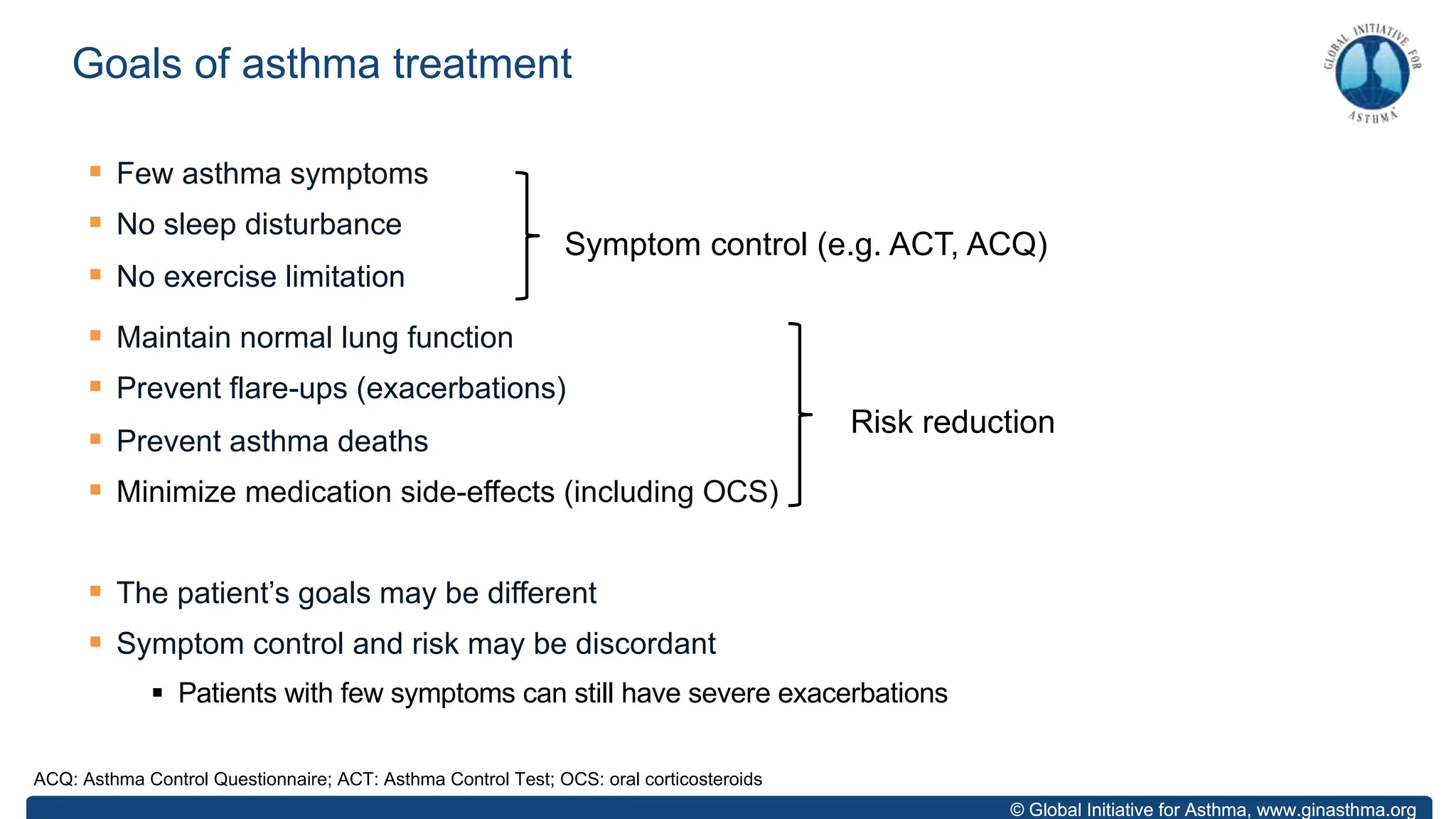
§ Few asthma symptoms
§ No sleep disturbance
§ No exercise limitation
§ Maintain normal lung function
§ Prevent flare-ups (exacerbations)
§ Prevent asthma deaths
§ Minimize medication side-effects (including OCS)
§ The patient’s goals may be different
§ Symptom control and risk may be discordant
§ Patients with few symptoms can still have severe exacerbations
Goals of asthma treatment
Symptom control (e.g. ACT, ACQ)
Risk reduction
ACQ: Asthma Control Questionnaire; ACT: Asthma Control Test; OCS: oral corticosteroids
© Global Initiative for Asthma, www.ginasthma.org
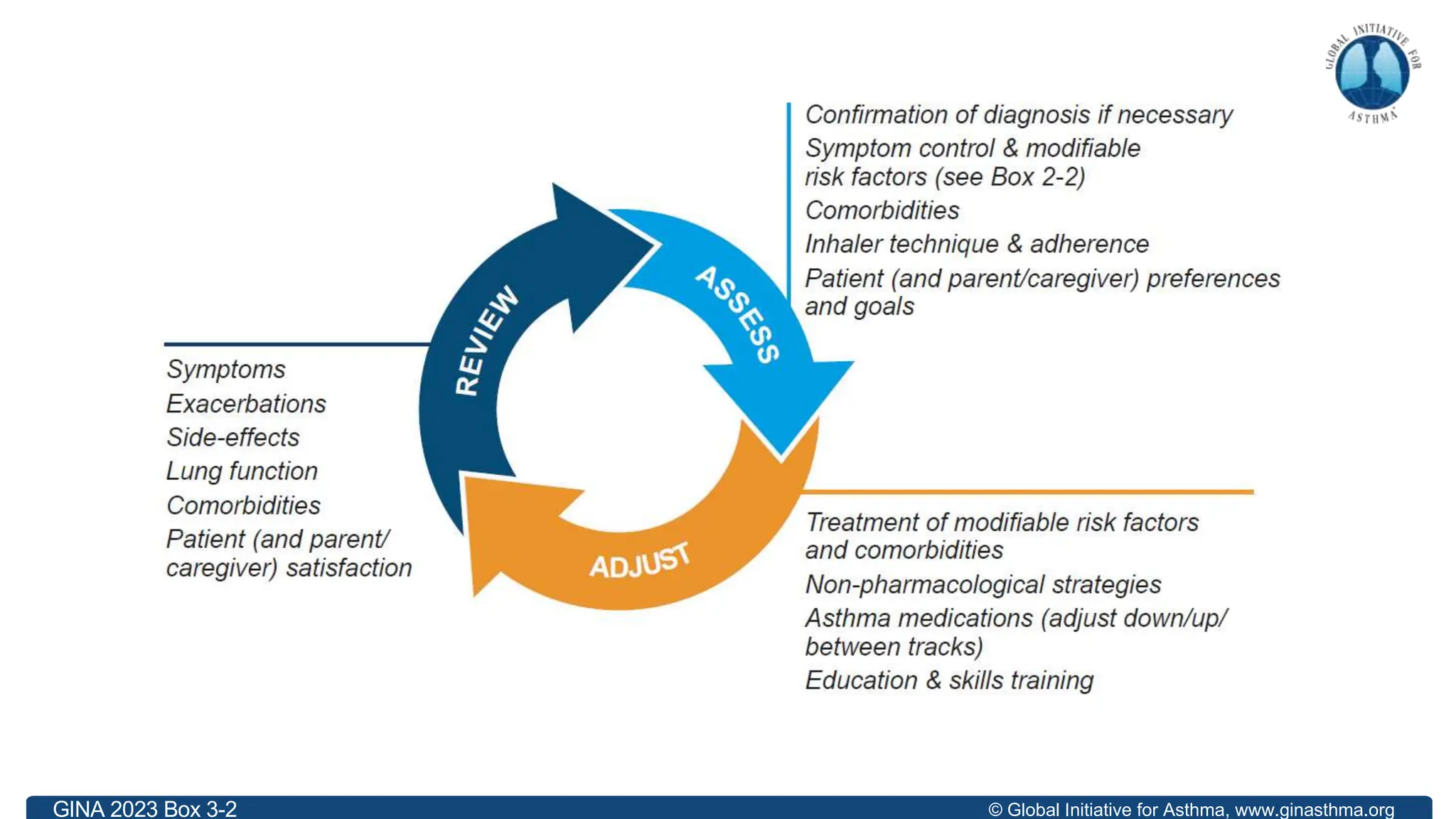
GINA 2023 Box 3-2
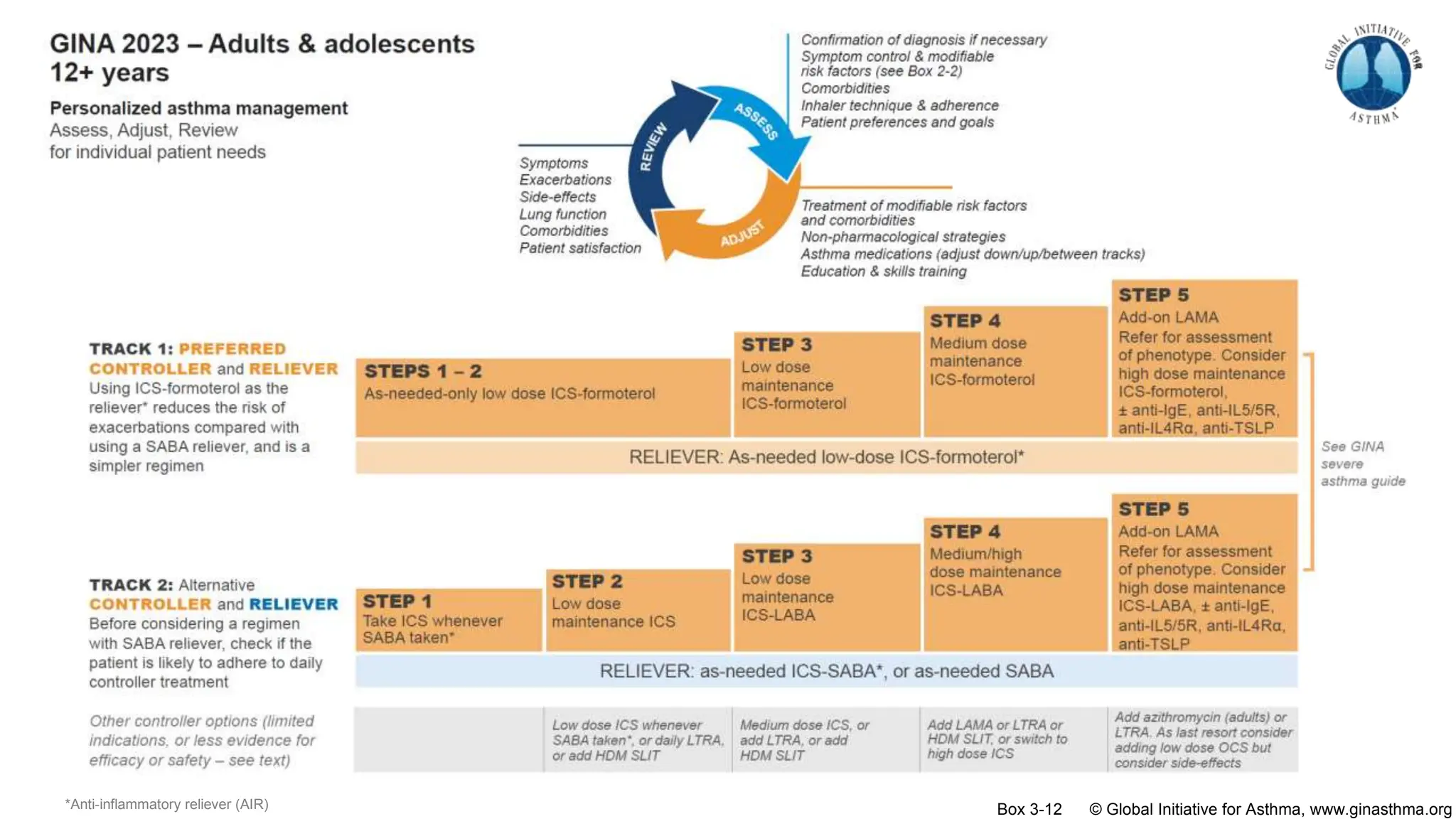
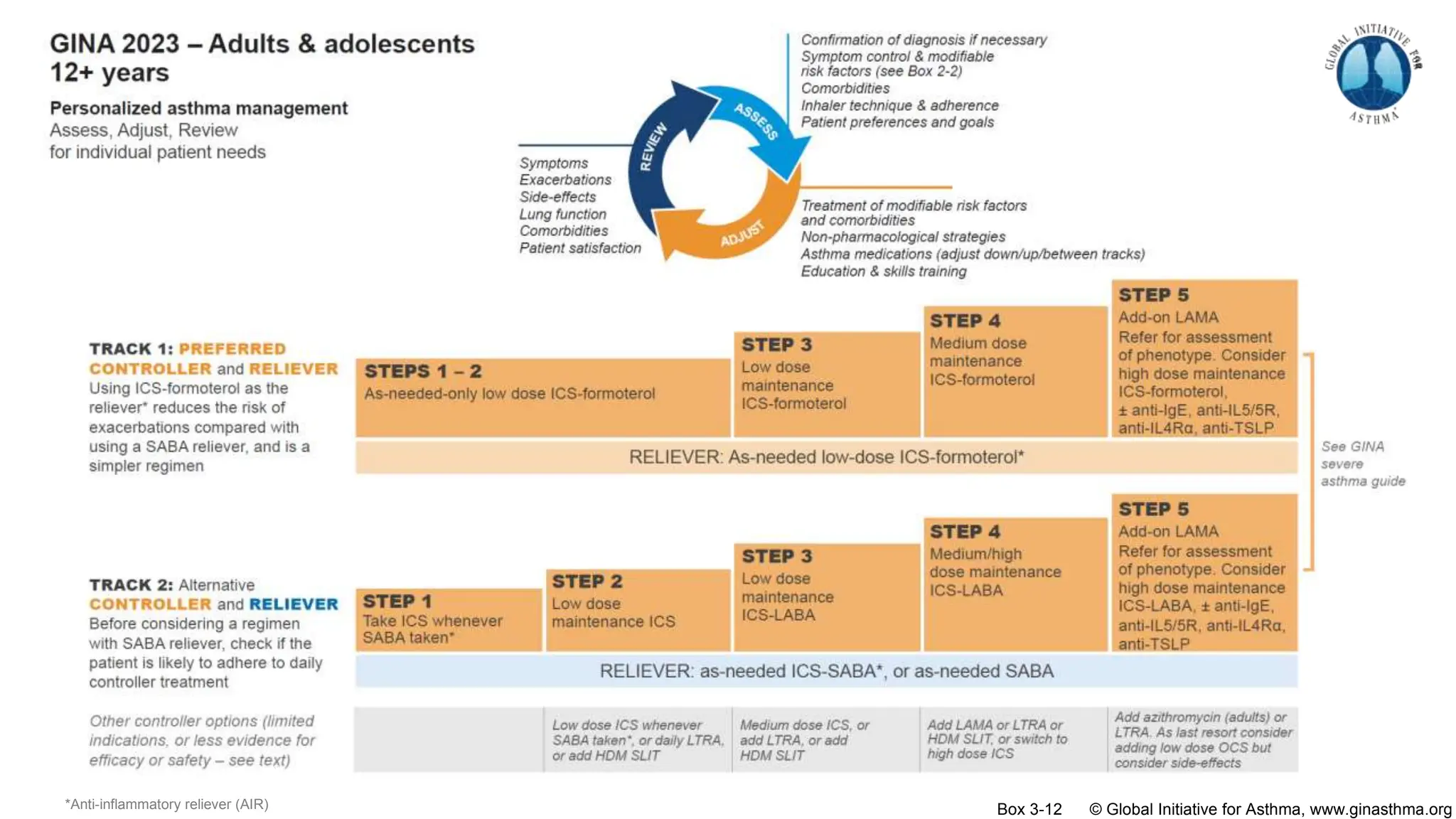
Box 3-12 © Global Initiative for Asthma, www.ginasthma.org
*Anti-inflammatory reliever (AIR)
© Global Initiative for Asthma, www.ginasthma.org
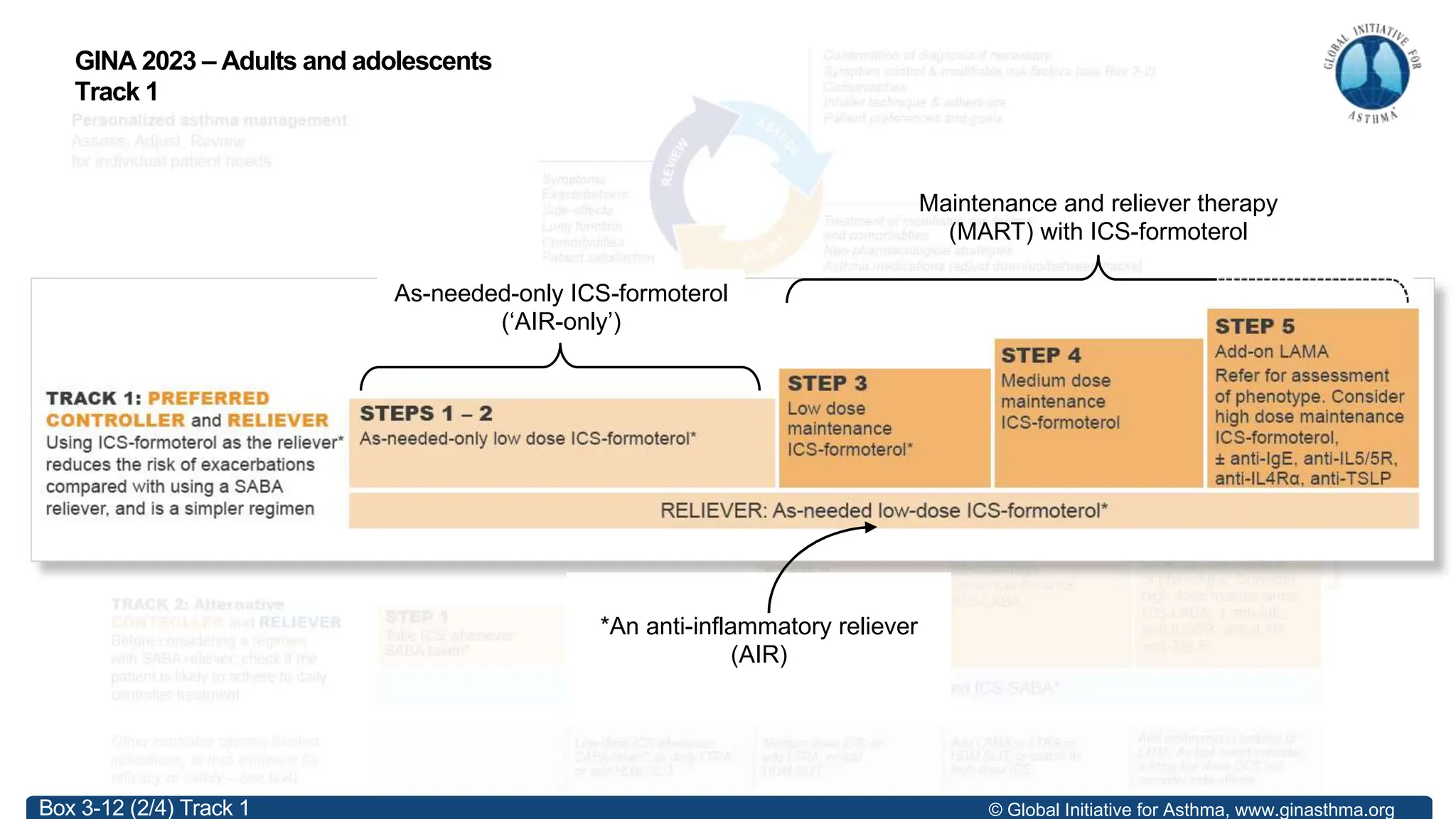
Box 3-12 (2/4) Track 1
GINA 2023 – Adults and adolescents
Track 1
*An anti-inflammatory reliever
(AIR)
As-needed-only ICS-formoterol
(‘AIR-only’)
Maintenance and reliever therapy
(MART) with ICS-formoterol
© Global Initiative for Asthma, www.ginasthma.org
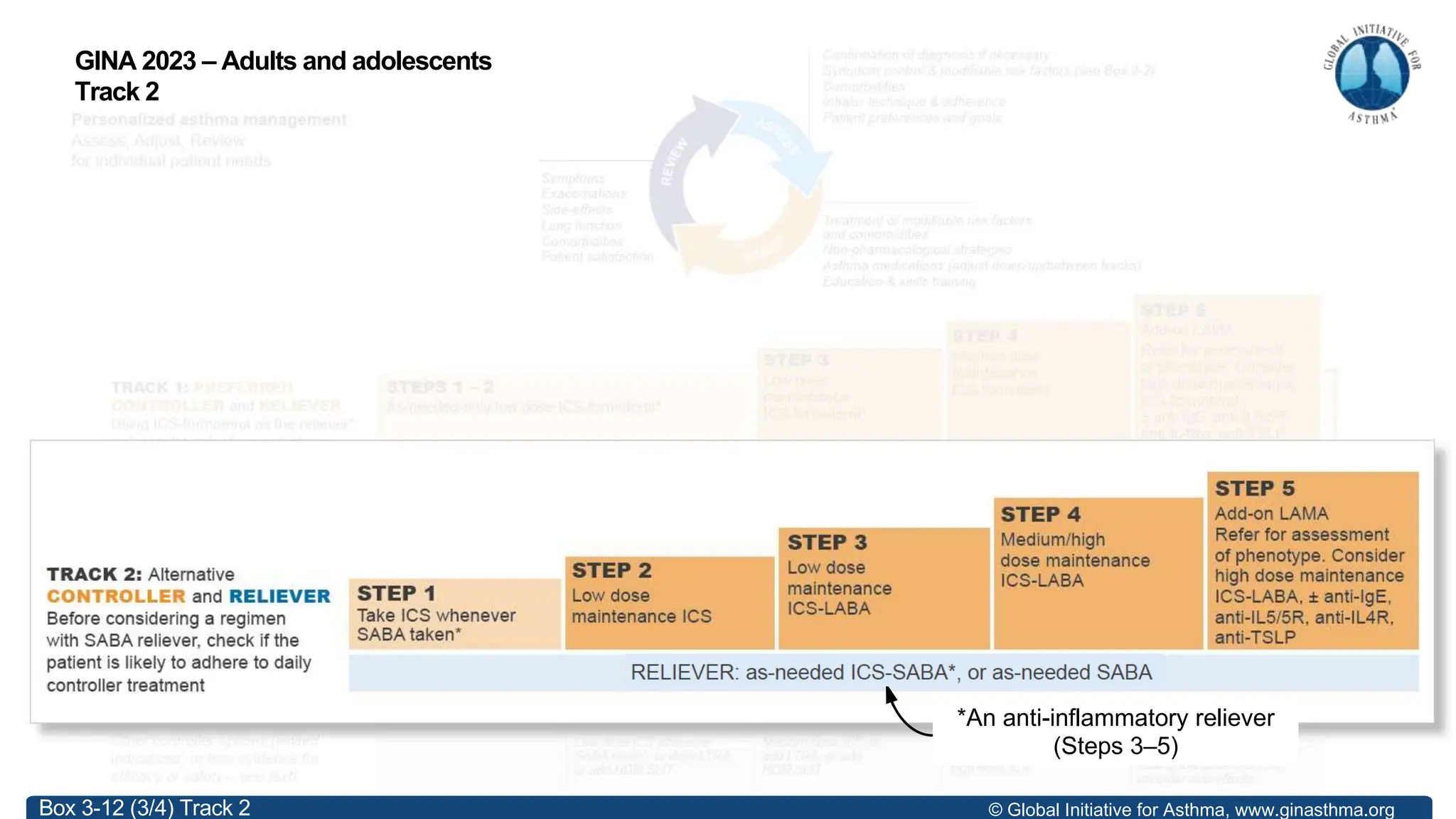
*An anti-inflammatory reliever
(Steps 3–5)
GINA 2023 – Adults and adolescents
Track 2
Box 3-12 (3/4) Track 2
© Global Initiative for Asthma, www.ginasthma.org
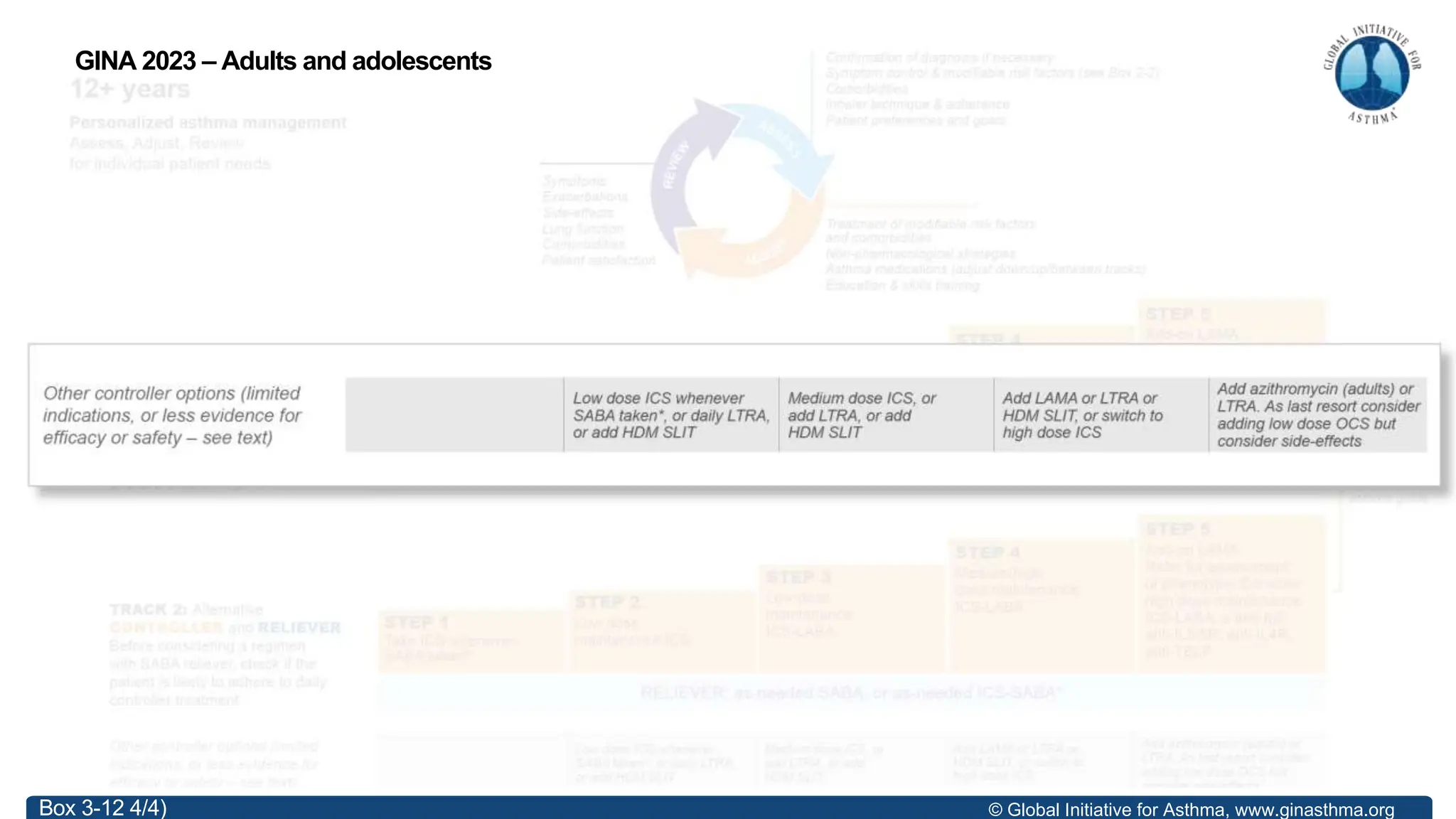
Box 3-12 4/4)
GINA 2023 – Adults and adolescents
© Global Initiative for Asthma, www.ginasthma.org
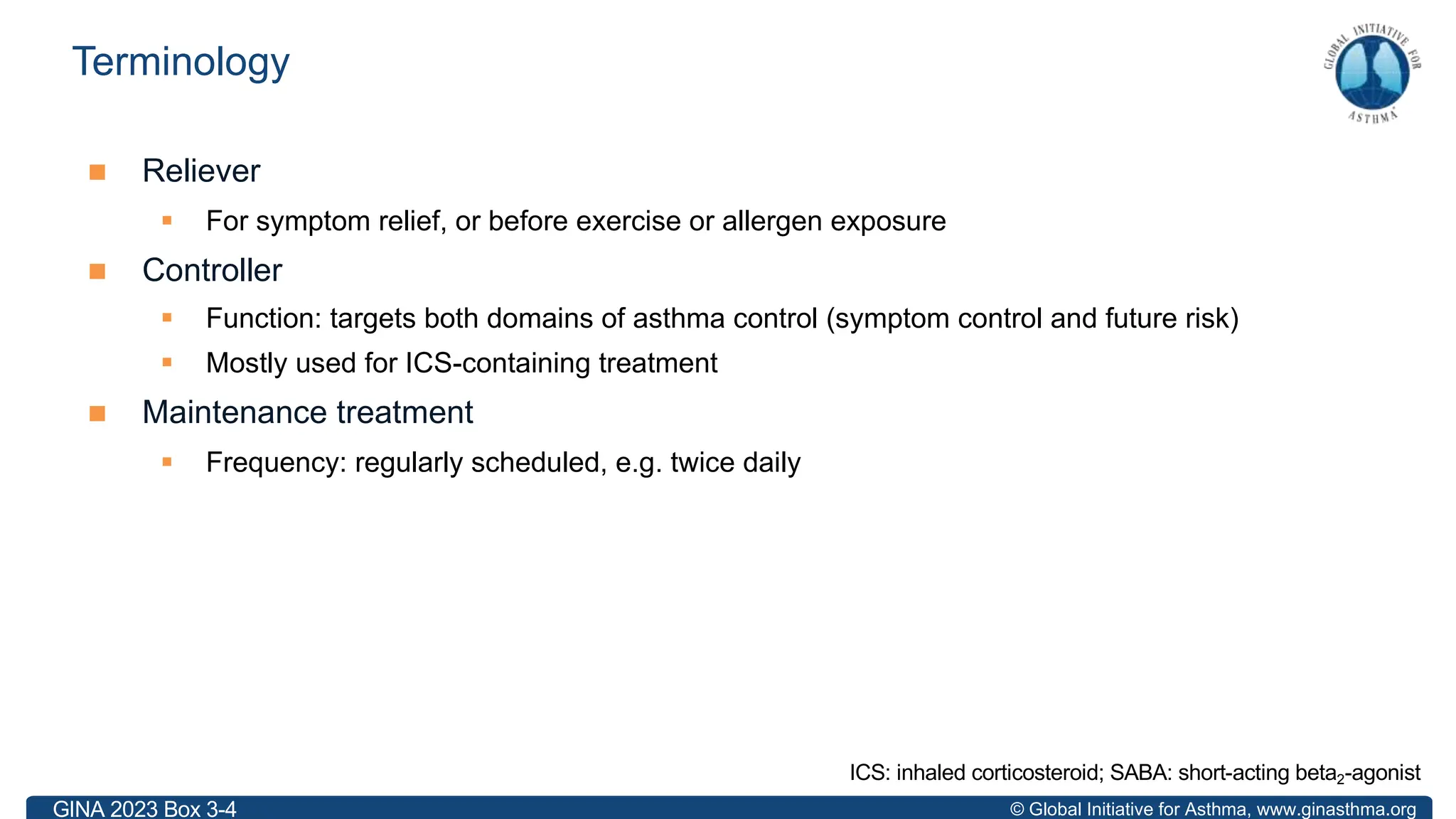
n Reliever
§ For symptom relief, or before exercise or allergen exposure
n Controller
§ Function: targets both domains of asthma control (symptom control and future risk)
§ Mostly used for ICS-containing treatment
n Maintenance treatment
§ Frequency: regularly scheduled, e.g. twice daily
Terminology
ICS: inhaled corticosteroid; SABA: short-acting beta2-agonist
GINA 2023 Box 3-4
© Global Initiative for Asthma, www.ginasthma.org
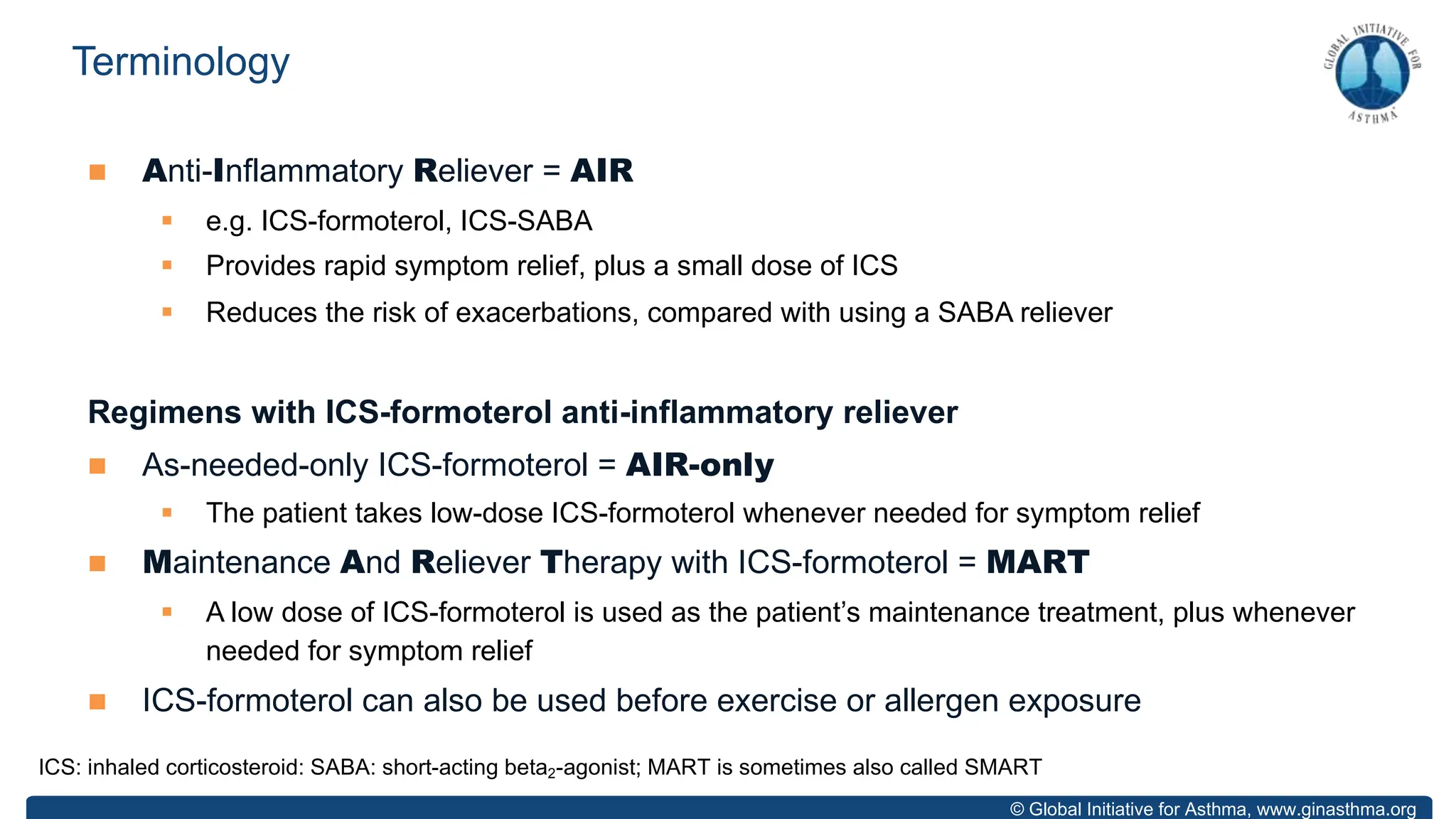
n Anti-Inflammatory Reliever = AIR
§ e.g. ICS-formoterol, ICS-SABA
§ Provides rapid symptom relief, plus a small dose of ICS
§ Reduces the risk of exacerbations, compared with using a SABA reliever
Regimens with ICS-formoterol anti-inflammatory reliever
n As-needed-only ICS-formoterol = AIR-only
§ The patient takes low-dose ICS-formoterol whenever needed for symptom relief
n Maintenance And Reliever Therapy with ICS-formoterol = MART
§ A low dose of ICS-formoterol is used as the patient’s maintenance treatment, plus whenever
needed for symptom relief
n ICS-formoterol can also be used before exercise or allergen exposure
Terminology
ICS: inhaled corticosteroid: SABA: short-acting beta2-agonist; MART is sometimes also called SMART
Evidence: Steps 1–2
© Global Initiative for Asthma, www.ginasthma.org
COMPARED WITH AS-NEEDED SABA
§ Two studies (SYGMA 1, O’Byrne et al, NEJM 2018, n=3836; Novel START, Beasley et al, NEJM 2019, n=668)
§ Risk of severe exacerbations was reduced by 60–64% (SYGMA 1, Novel START)
COMPARED WITH MAINTENANCE LOW DOSE ICS plus as-needed SABA
§ Four studies (SYGMA 1; SYGMA 2, Bateman et al, NEJM 2018, n=4176; Novel START; PRACTICAL, Hardy et al,
Lancet 2019, n=885)
§ Risk of severe exacerbations similar (SYGMA 1 & 2), or lower (Novel START, PRACTICAL)
§ Symptoms very slightly more, e.g. ACQ-5 0.15 (vs 0.5 MCID), not worsening over 12 months
§ Pre-BD FEV1 slightly lower (~54 mL), not worsening over 12 months
§ FeNO slightly higher (10ppb), not increasing over 12 months (Novel START, PRACTICAL)
§ As-needed ICS-formoterol used on ~ 30% of days à average ICS dose ~50–100mcg budesonide/day
§ Benefit independent of T2 status, lung function, exacerbation history (Novel START, PRACTICAL)
§ Qualitative research: most patients preferred as-needed ICS-formoterol (Baggott Thorax 2020, ERJ 2020;
Foster Respir Med 2020, BMJ Open 2022)
*Budesonide-formoterol 200/6 [160/4.5] mcg by Turbuhaler, 1 inhalation as needed for symptom relief
Track 1, Steps 1–2: As-needed-only low-dose ICS-formoterol
© Global Initiative for Asthma, www.ginasthma.org
n Risk of severe exacerbations (Crossingham et al, Cochrane 2021)
§ Compared with as-needed SABA alone: 55% reduction (OR 0.45 [0.34–0.60])
§ Compared with daily ICS plus as-needed SABA: (OR 0.79 [0.59–1.07])
n Risk of emergency department visits or hospitalizations (Crossingham et al, Cochrane 2021)
§ Compared with as-needed SABA alone: 65% reduction (OR 0.35 [0.20–0.60])
§ Compared with daily ICS plus as-needed SABA: 37% reduction (OR 0.63 [0.44–0.91])
§ Large population-level reduction in healthcare utilization
Track 1, Steps 1–2: As-needed-only low-dose ICS-formoterol
© Global Initiative for Asthma, www.ginasthma.org
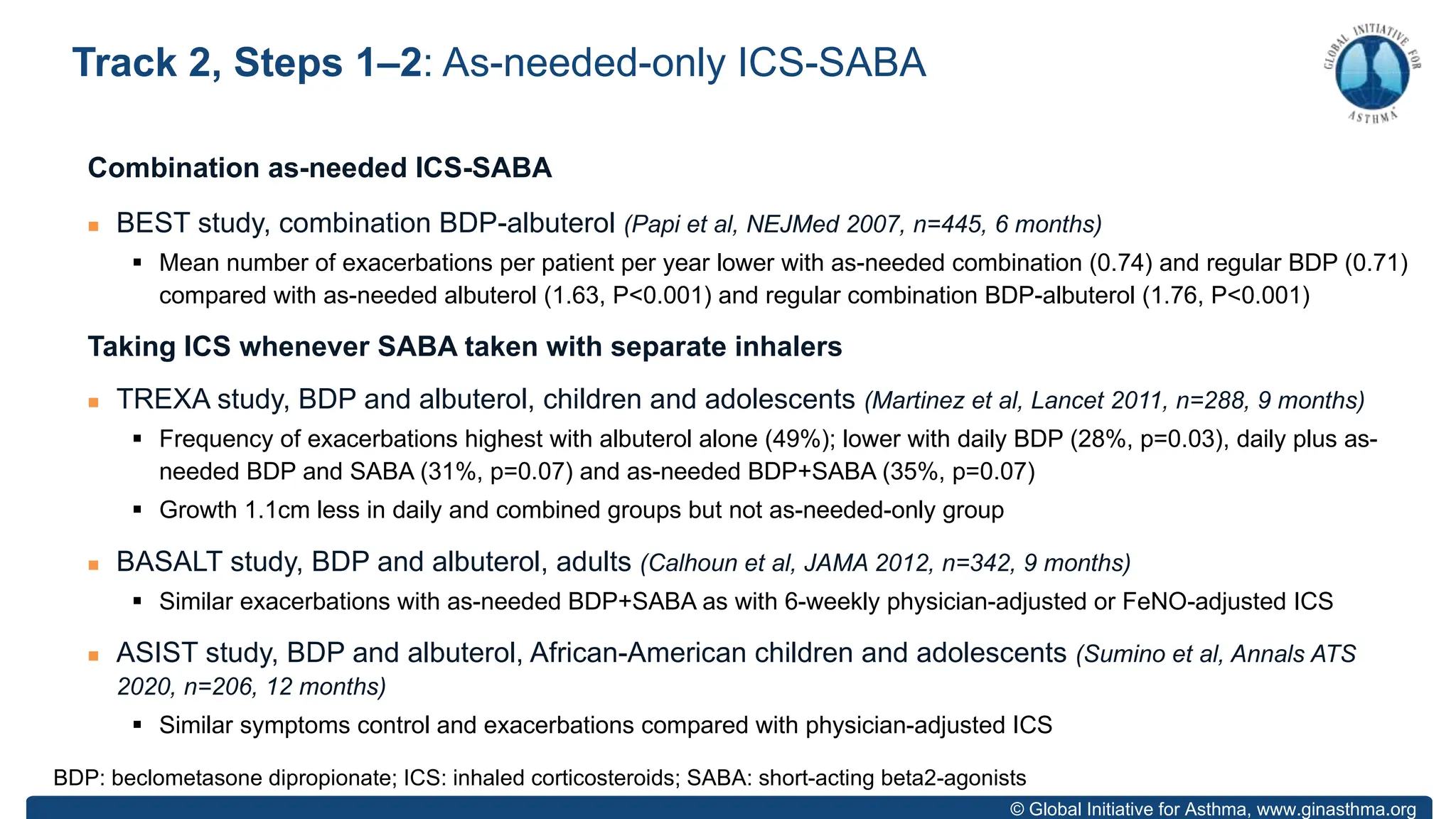
Combination as-needed ICS-SABA
n BEST study, combination BDP-albuterol (Papi et al, NEJMed 2007, n=445, 6 months)
§ Mean number of exacerbations per patient per year lower with as-needed combination (0.74) and regular BDP (0.71)
compared with as-needed albuterol (1.63, P<0.001) and regular combination BDP-albuterol (1.76, P<0.001)
Taking ICS whenever SABA taken with separate inhalers
n TREXA study, BDP and albuterol, children and adolescents (Martinez et al, Lancet 2011, n=288, 9 months)
§ Frequency of exacerbations highest with albuterol alone (49%); lower with daily BDP (28%, p=0.03), daily plus as-
needed BDP and SABA (31%, p=0.07) and as-needed BDP+SABA (35%, p=0.07)
§ Growth 1.1cm less in daily and combined groups but not as-needed-only group
n BASALT study, BDP and albuterol, adults (Calhoun et al, JAMA 2012, n=342, 9 months)
§ Similar exacerbations with as-needed BDP+SABA as with 6-weekly physician-adjusted or FeNO-adjusted ICS
n ASIST study, BDP and albuterol, African-American children and adolescents (Sumino et al, Annals ATS
2020, n=206, 12 months)
§ Similar symptoms control and exacerbations compared with physician-adjusted ICS
Track 2, Steps 1–2: As-needed-only ICS-SABA
BDP: beclometasone dipropionate; ICS: inhaled corticosteroids; SABA: short-acting beta2-agonists
Evidence: Steps 3–5
© Global Initiative for Asthma, www.ginasthma.org
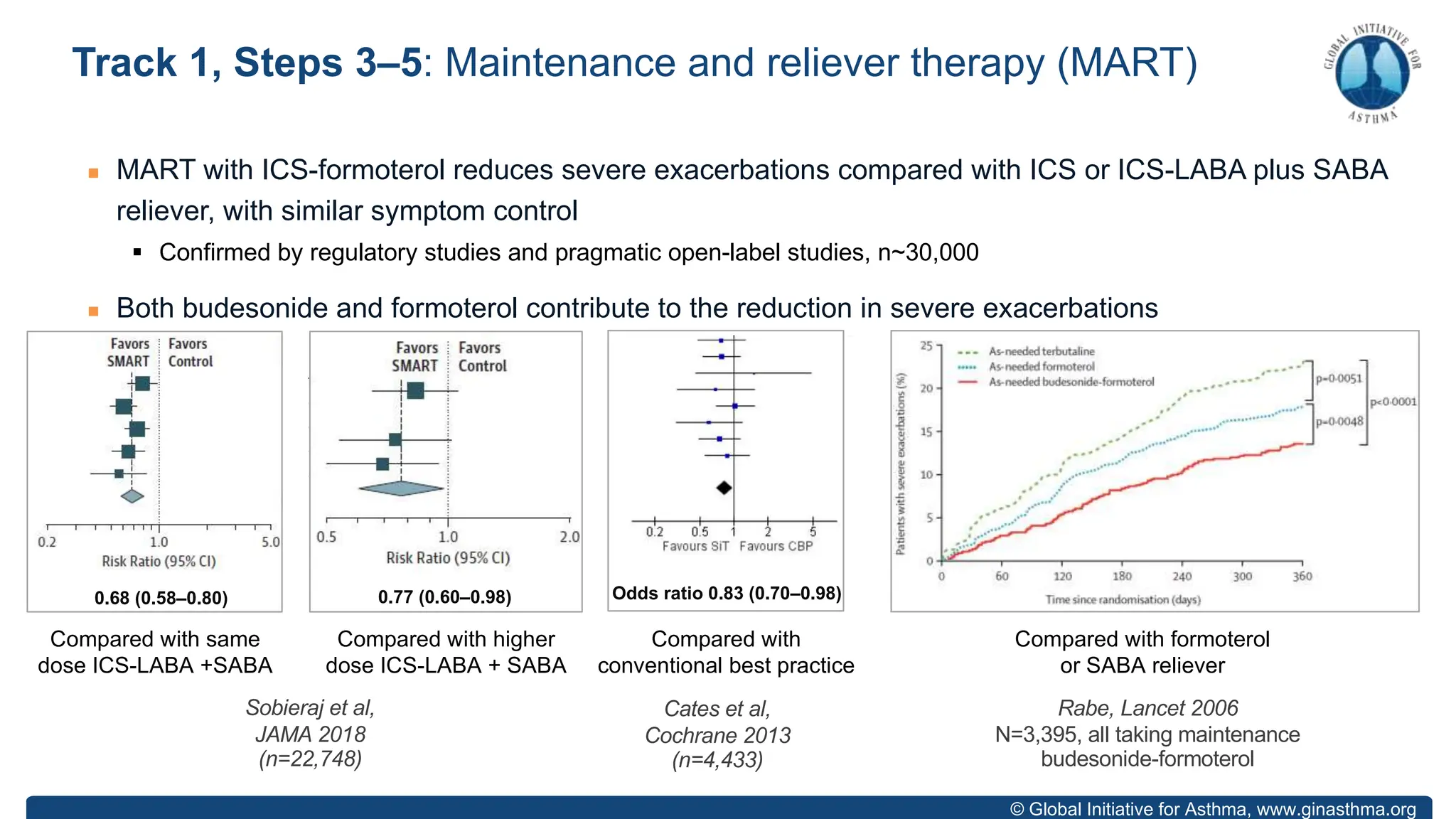
n MART with ICS-formoterol reduces severe exacerbations compared with ICS or ICS-LABA plus SABA
reliever, with similar symptom control
§ Confirmed by regulatory studies and pragmatic open-label studies, n~30,000
n Both budesonide and formoterol contribute to the reduction in severe exacerbations
Track 1, Steps 3–5: Maintenance and reliever therapy (MART)
Rabe, Lancet 2006
N=3,395, all taking maintenance
budesonide-formoterol
Sobieraj et al,
JAMA 2018
(n=22,748)
0.68 (0.58–0.80) 0.77 (0.60–0.98) Odds ratio 0.83 (0.70–0.98)
Cates et al,
Cochrane 2013
(n=4,433)
Compared with same
dose ICS-LABA +SABA
Compared with higher
dose ICS-LABA + SABA
Compared with
conventional best practice
Compared with formoterol
or SABA reliever
© Global Initiative for Asthma, www.ginasthma.org
Track 2, Steps 3–5: as-needed ICS-SABA added to maintenance
treatment
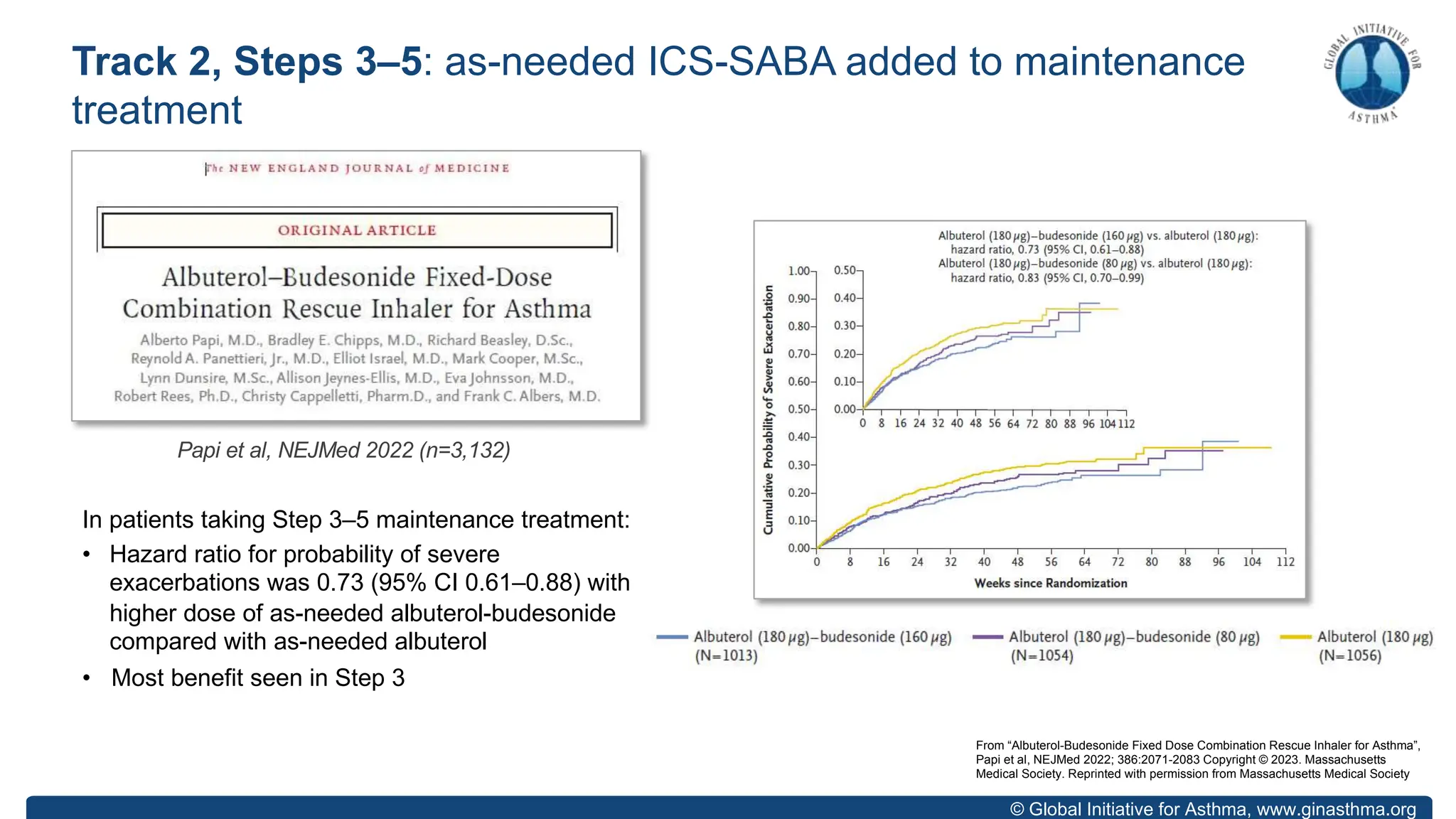
From “Albuterol-Budesonide Fixed Dose Combination Rescue Inhaler for Asthma”,
Papi et al, NEJMed 2022; 386:2071-2083 Copyright © 2023. Massachusetts
Medical Society. Reprinted with permission from Massachusetts Medical Society
In patients taking Step 3–5 maintenance treatment:
• Hazard ratio for probability of severe
exacerbations was 0.73 (95% CI 0.61–0.88) with
higher dose of as-needed albuterol-budesonide
compared with as-needed albuterol
• Most benefit seen in Step 3
Papi et al, NEJMed 2022 (n=3,132)
© Global Initiative for Asthma, www.ginasthma.org
n Steps 1–2: weight of evidence for effectiveness and safety compared with SABA alone, or low-dose
ICS plus as-needed SABA (4x12 month studies, n~10,000) (Crossingham et al, Cochrane 2021)
§ As-needed ICS-SABA: only one 6-month RCT (n=455) (Papi et al, NEJMed 2007)
n Steps 3–5: weight of evidence for effectiveness and safety of MART versus regimens with
as-needed SABA (n~30,000) (Sobieraj et al, JAMA 2018; Cates et al, Cochrane 2013)
§ As-needed ICS-SABA: only one RCT (n=3,132) vs as-needed SABA (Papi et al, NEJMed 2022); cannot be used
for maintenance and reliever therapy
n Both the ICS and the formoterol contribute to reduction in severe exacerbations (Tattersfield et al, Lancet
2001; Pauwels et al, ERJ 2003; Rabe et al, Lancet 2006)
§ Safety established up to total 12 inhalations in any day, in large studies
n Simplicity of approach for patients and clinicians
§ A single medication for both symptom relief and maintenance treatment (if needed) from diagnosis
§ Avoids confusion about inhaler technique with different devices
§ Short-term increase in symptoms à patient increases the number of as-needed doses
§ Step treatment down or up by changing the number of maintenance doses
Why is GINA Track 1 with ICS-formoterol preferred?
Box 3-12 © Global Initiative for Asthma, www.ginasthma.org
*Anti-inflammatory reliever (AIR)
© Global Initiative for Asthma, www.ginasthma.org
Example: budesonide-formoterol 200/6 mcg [160/4.5 delivered dose]
n Steps 1–2: take 1 inhalation whenever needed for symptoms
n Step 3: take 1 inhalation twice a day (or once a day) PLUS 1 inhalation
whenever needed for symptoms
n Steps 4–5: take 2 inhalations twice a day PLUS 1 inhalation whenever needed
for symptoms
n As-needed doses of ICS-formoterol can also be taken before exercise (Lazarinis
et al, Thorax 2014) or before allergen exposure (Duong et al, JACI 2007)
See following slides for medications, doses, and maximum number of inhalations in any day for GINA Track 1
How to prescribe low-dose ICS-formoterol in GINA Track 1
© Global Initiative for Asthma, www.ginasthma.org
Step
Age
(years)
Medication and device (check
patient can use inhaler)
Metered dose
(mcg/inhalation)
Delivered dose
(mcg/inhalation)
Dosage
Steps
1–2
(AIR-only)
6–11 (No evidence) - - -
12–17
≥18
Budesonide-formoterol DPI 200/6 160/4.5 1 inhalation whenever needed
Step 3
MART
6–11 Budesonide-formoterol DPI 100/6 80/4.5
1 inhalation once daily,
PLUS 1 inhalation whenever needed
12–17
≥18
Budesonide-formoterol DPI 200/6 160/4.5 1 inhalation once or twice daily,
PLUS 1 inhalation whenever needed
≥18 BDP-formoterol pMDI 100/6 84.6/5.0
Step 4
MART
6–11 Budesonide-formoterol DPI 100/6 80/4.5
1 inhalation twice daily,
PLUS 1 inhalation whenever needed
12–17
≥18
Budesonide-formoterol DPI 200/6 160/4.5 2 inhalations twice daily,
PLUS 1 inhalation whenever needed
≥18 BDP-formoterol pMDI 100/6 84.6/5.0
Step 5
MART
6–11 (No evidence) - - -
12–17
≥18
Budesonide-formoterol DPI 200/6 160/4.5 2 inhalations twice daily,
PLUS 1 inhalation whenever needed
≥18 BDP-formoterol pMDI 100/6 84.6/5.0
GINA 2023 from Box 3-15
DPI: dry powder inhaler; pMDI: pressurized metered dose inhaler. For budesonide-formoterol pMDI with 3 mcg [2.25 mcg] formoterol, use double number of puffs
© Global Initiative for Asthma, www.ginasthma.org
Step
Age
(years)
Medication and device (check
patient can use inhaler)
Metered dose
(mcg/inhalation)
Delivered dose
(mcg/inhalation)
Dosage
Steps
1–2
(AIR-only)
6–11 (No evidence) - - -
12–17
≥18
Budesonide-formoterol DPI 200/6 160/4.5 1 inhalation whenever needed
Step 3
MART
6–11 Budesonide-formoterol DPI 100/6 80/4.5
1 inhalation once daily,
PLUS 1 inhalation whenever needed
12–17
≥18
Budesonide-formoterol DPI 200/6 160/4.5 1 inhalation once or twice daily,
PLUS 1 inhalation whenever needed
≥18 BDP-formoterol pMDI 100/6 84.6/5.0
Step 4
MART
6–11 Budesonide-formoterol DPI 100/6 80/4.5
1 inhalation twice daily,
PLUS 1 inhalation whenever needed
12–17
≥18
Budesonide-formoterol DPI 200/6 160/4.5 2 inhalations twice daily,
PLUS 1 inhalation whenever needed
≥18 BDP-formoterol pMDI 100/6 84.6/5.0
Step 5
MART
6–11 (No evidence) - - -
12–17
≥18
Budesonide-formoterol DPI 200/6 160/4.5 2 inhalations twice daily,
PLUS 1 inhalation whenever needed
≥18 BDP-formoterol pMDI 100/6 84.6/5.0
GINA 2023 from Box 3-15
DPI: dry powder inhaler; pMDI: pressurized metered dose inhaler. For budesonide-formoterol pMDI with 3 mcg [2.25 mcg] formoterol, use double number of puffs
© Global Initiative for Asthma, www.ginasthma.org
Step
Age
(years)
Medication and device (check
patient can use inhaler)
Metered dose
(mcg/inhalation)
Delivered dose
(mcg/inhalation)
Dosage
Steps
1–2
(AIR-only)
6–11 (No evidence) - - -
12–17
≥18
Budesonide-formoterol DPI 200/6 160/4.5 1 inhalation whenever needed
Step 3
MART
6–11 Budesonide-formoterol DPI 100/6 80/4.5
1 inhalation once daily,
PLUS 1 inhalation whenever needed
12–17
≥18
Budesonide-formoterol DPI 200/6 160/4.5 1 inhalation once or twice daily,
PLUS 1 inhalation whenever needed
≥18 BDP-formoterol pMDI 100/6 84.6/5.0
Step 4
MART
6–11 Budesonide-formoterol DPI 100/6 80/4.5
1 inhalation twice daily,
PLUS 1 inhalation whenever needed
12–17
≥18
Budesonide-formoterol DPI 200/6 160/4.5 2 inhalations twice daily,
PLUS 1 inhalation whenever needed
≥18 BDP-formoterol pMDI 100/6 84.6/5.0
Step 5
MART
6–11 (No evidence) - - -
12–17
≥18
Budesonide-formoterol DPI 200/6 160/4.5 2 inhalations twice daily,
PLUS 1 inhalation whenever needed
≥18 BDP-formoterol pMDI 100/6 84.6/5.0
GINA 2023 from Box 3-15
DPI: dry powder inhaler; pMDI: pressurized metered dose inhaler. For budesonide-formoterol pMDI with 3 mcg [2.25 mcg] formoterol, use double number of puffs
© Global Initiative for Asthma, www.ginasthma.org
Step
Age
(years)
Medication and device (check
patient can use inhaler)
Metered dose
(mcg/inhalation)
Delivered dose
(mcg/inhalation)
Dosage
Steps
1–2
(AIR-only)
6–11 (No evidence) - - -
12–17
≥18
Budesonide-formoterol DPI 200/6 160/4.5 1 inhalation whenever needed
Step 3
MART
6–11 Budesonide-formoterol DPI 100/6 80/4.5
1 inhalation once daily,
PLUS 1 inhalation whenever needed
12–17
≥18
Budesonide-formoterol DPI 200/6 160/4.5 1 inhalation once or twice daily,
PLUS 1 inhalation whenever needed
≥18 BDP-formoterol pMDI 100/6 84.6/5.0
Step 4
MART
6–11 Budesonide-formoterol DPI 100/6 80/4.5
1 inhalation twice daily,
PLUS 1 inhalation whenever needed
12–17
≥18
Budesonide-formoterol DPI 200/6 160/4.5 2 inhalations twice daily,
PLUS 1 inhalation whenever needed
≥18 BDP-formoterol pMDI 100/6 84.6/5.0
Step 5
MART
6–11 (No evidence) - - -
12–17
≥18
Budesonide-formoterol DPI 200/6 160/4.5 2 inhalations twice daily,
PLUS 1 inhalation whenever needed
≥18 BDP-formoterol pMDI 100/6 84.6/5.0
GINA 2023 from Box 3-15
DPI: dry powder inhaler; pMDI: pressurized metered dose inhaler. For budesonide-formoterol pMDI with 3 mcg [2.25 mcg] formoterol, use double number of puffs
© Global Initiative for Asthma, www.ginasthma.org
Step
Age
(years)
Medication and device (check
patient can use inhaler)
Metered dose
(mcg/inhalation)
Delivered dose
(mcg/inhalation)
Dosage
Steps
1–2
(AIR-only)
6–11 (No evidence) - - -
12–17
≥18
Budesonide-formoterol DPI 200/6 160/4.5 1 inhalation whenever needed
Step 3
MART
6–11 Budesonide-formoterol DPI 100/6 80/4.5
1 inhalation once daily,
PLUS 1 inhalation whenever needed
12–17
≥18
Budesonide-formoterol DPI 200/6 160/4.5 1 inhalation once or twice daily,
PLUS 1 inhalation whenever needed
≥18 BDP-formoterol pMDI 100/6 84.6/5.0
Step 4
MART
6–11 Budesonide-formoterol DPI 100/6 80/4.5
1 inhalation twice daily,
PLUS 1 inhalation whenever needed
12–17
≥18
Budesonide-formoterol DPI 200/6 160/4.5 2 inhalations twice daily,
PLUS 1 inhalation whenever needed
≥18 BDP-formoterol pMDI 100/6 84.6/5.0
Step 5
MART
6–11 (No evidence) - - -
12–17
≥18
Budesonide-formoterol DPI 200/6 160/4.5 2 inhalations twice daily,
PLUS 1 inhalation whenever needed
≥18 BDP-formoterol pMDI 100/6 84.6/5.0
GINA 2023 from Box 3-15
DPI: dry powder inhaler; pMDI: pressurized metered dose inhaler. For budesonide-formoterol pMDI with 3 mcg [2.25 mcg] formoterol, use double number of puffs
© Global Initiative for Asthma, www.ginasthma.org
n For ICS-formoterol with 6 mcg (4.5 mcg delivered dose) of formoterol, take 1 inhalation whenever
needed for symptom relief
n Another inhalation can be taken after a few minutes if needed
n Maximum total number of inhalations in any single day (as-needed + maintenance)
§ Budesonide-formoterol: maximum 12 inhalations* for adults, 8 inhalations for children, based on extensive safety
data (Tattersfield et al, Lancet 2001; Pauwels et al, ERJ 2003)
§ Beclometasone-formoterol: maximum total 8 inhalations in any day (Papi et al, Lancet Respir Med 2013)
n Emphasize that most patients need far fewer doses than this!
n For pMDIs containing 3 mcg formoterol (2.25 mcg delivered dose), take 2 inhalations each time
Reliever doses of ICS-formoterol - how much can be taken?
*For budesonide-formoterol 200/6 [delivered dose 160/4.5 mcg], 12 inhalations gives 72 mcg formoterol (54 mcg delivered dose)
© Global Initiative for Asthma, www.ginasthma.org
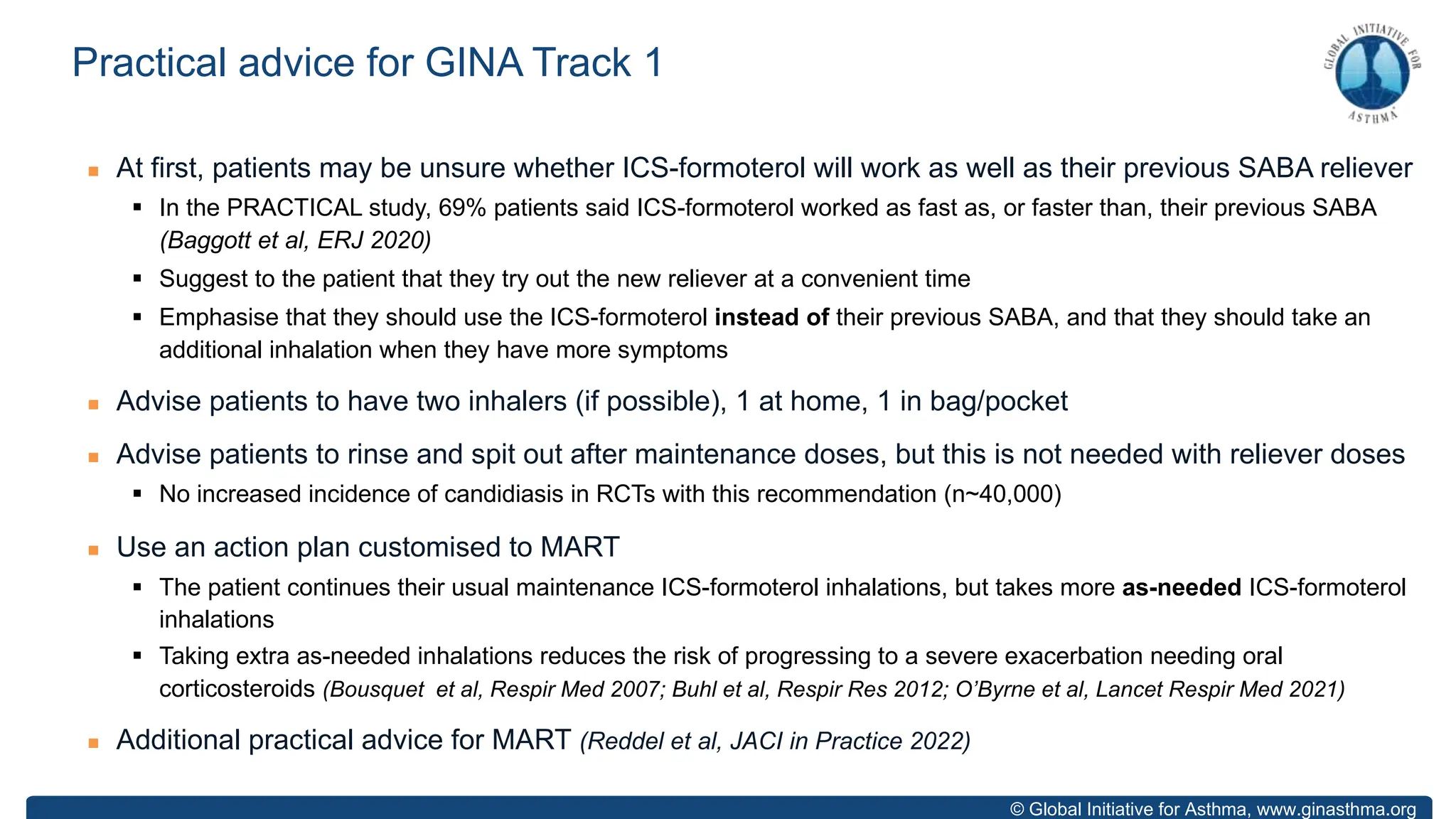
n At first, patients may be unsure whether ICS-formoterol will work as well as their previous SABA reliever
§ In the PRACTICAL study, 69% patients said ICS-formoterol worked as fast as, or faster than, their previous SABA
(Baggott et al, ERJ 2020)
§ Suggest to the patient that they try out the new reliever at a convenient time
§ Emphasise that they should use the ICS-formoterol instead of their previous SABA, and that they should take an
additional inhalation when they have more symptoms
n Advise patients to have two inhalers (if possible), 1 at home, 1 in bag/pocket
n Advise patients to rinse and spit out after maintenance doses, but this is not needed with reliever doses
§ No increased incidence of candidiasis in RCTs with this recommendation (n~40,000)
n Use an action plan customised to MART
§ The patient continues their usual maintenance ICS-formoterol inhalations, but takes more as-needed ICS-formoterol
inhalations
§ Taking extra as-needed inhalations reduces the risk of progressing to a severe exacerbation needing oral
corticosteroids (Bousquet et al, Respir Med 2007; Buhl et al, Respir Res 2012; O’Byrne et al, Lancet Respir Med 2021)
n Additional practical advice for MART (Reddel et al, JACI in Practice 2022)
Practical advice for GINA Track 1
© Global Initiative for Asthma, www.ginasthma.org
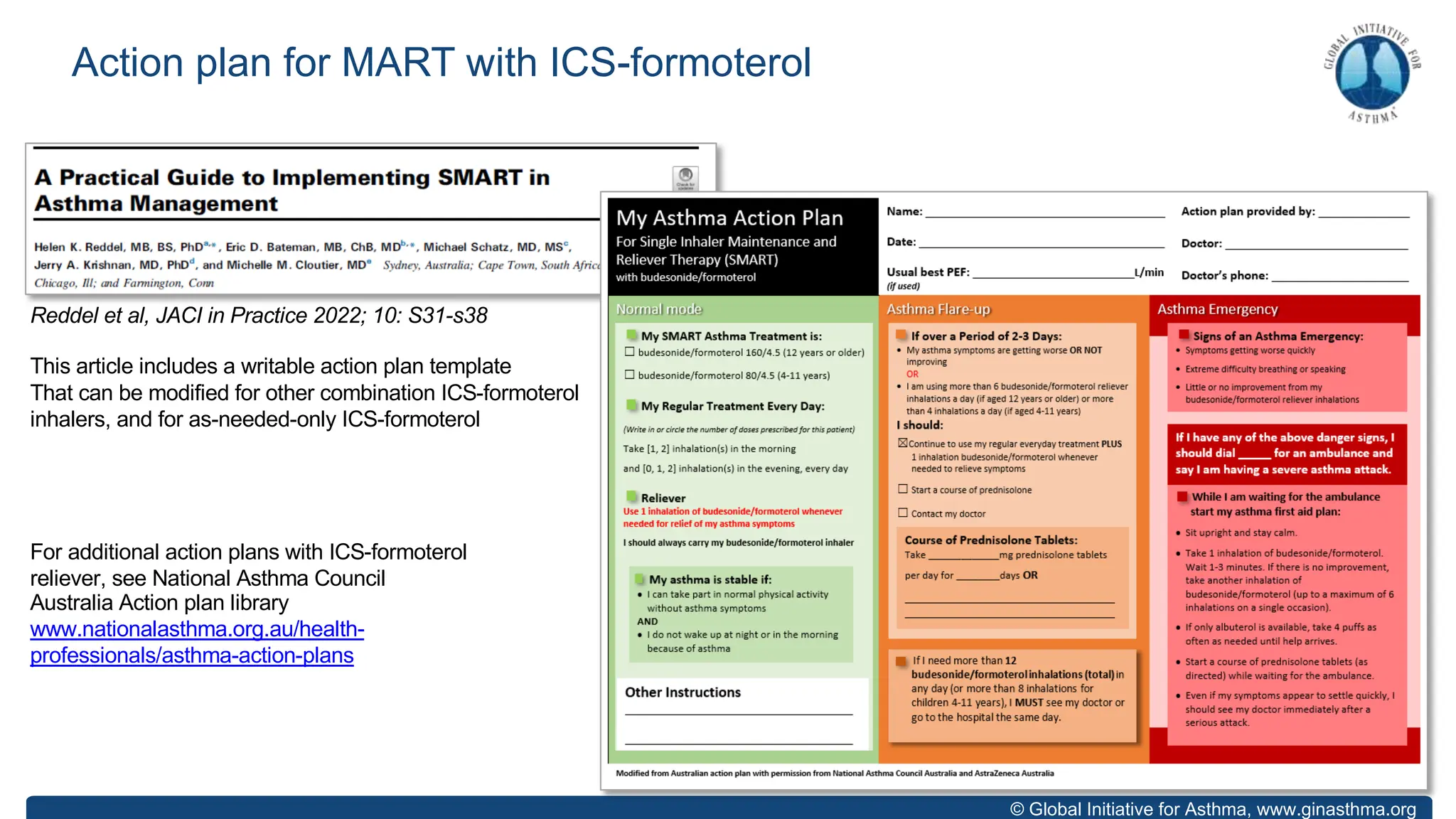
Action plan for MART with ICS-formoterol
Reddel et al, JACI in Practice 2022; 10: S31-s38
This article includes a writable action plan template
That can be modified for other combination ICS-formoterol
inhalers, and for as-needed-only ICS-formoterol
For additional action plans with ICS-formoterol
reliever, see National Asthma Council
Australia Action plan library
www.nationalasthma.org.au/health-
professionals/asthma-action-plans
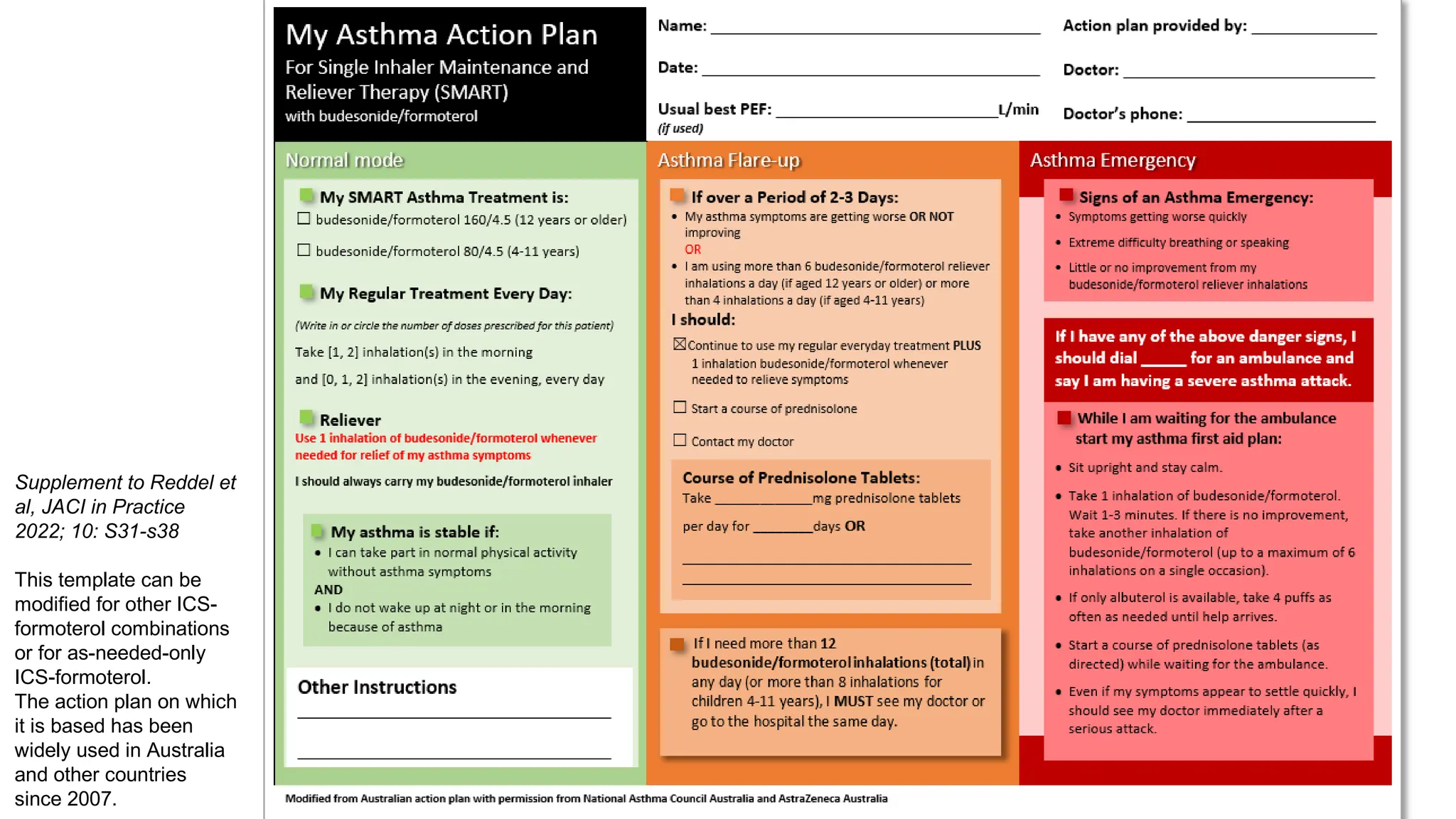
Supplement to Reddel et
al, JACI in Practice
2022; 10: S31-s38
This template can be
modified for other ICS-
formoterol combinations
or for as-needed-only
ICS-formoterol.
The action plan on which
it is based has been
widely used in Australia
and other countries
since 2007.
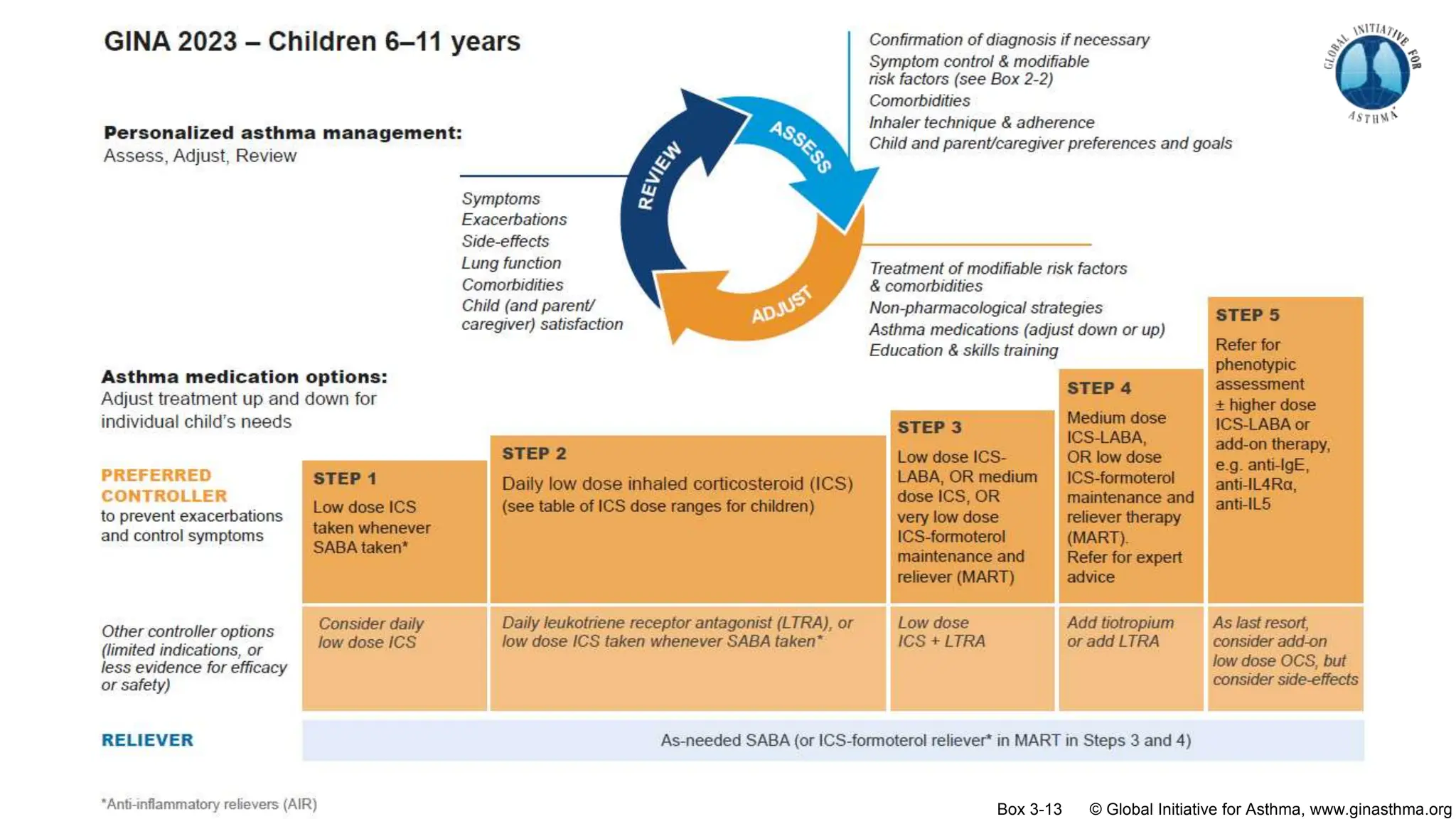
Box 3-13 © Global Initiative for Asthma, www.ginasthma.org
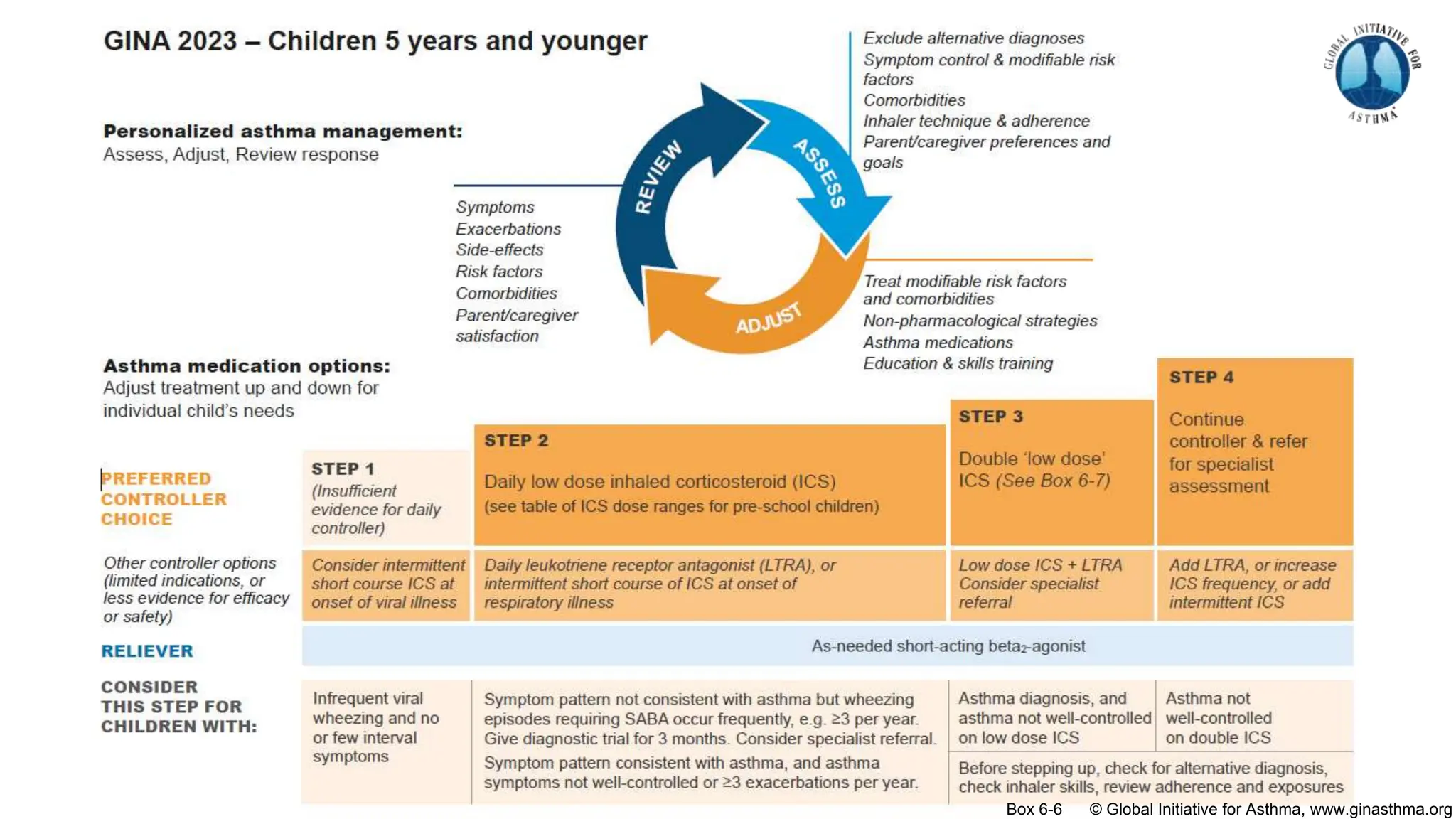
Box 6-6 © Global Initiative for Asthma, www.ginasthma.org
© Global Initiative for Asthma, www.ginasthma.org
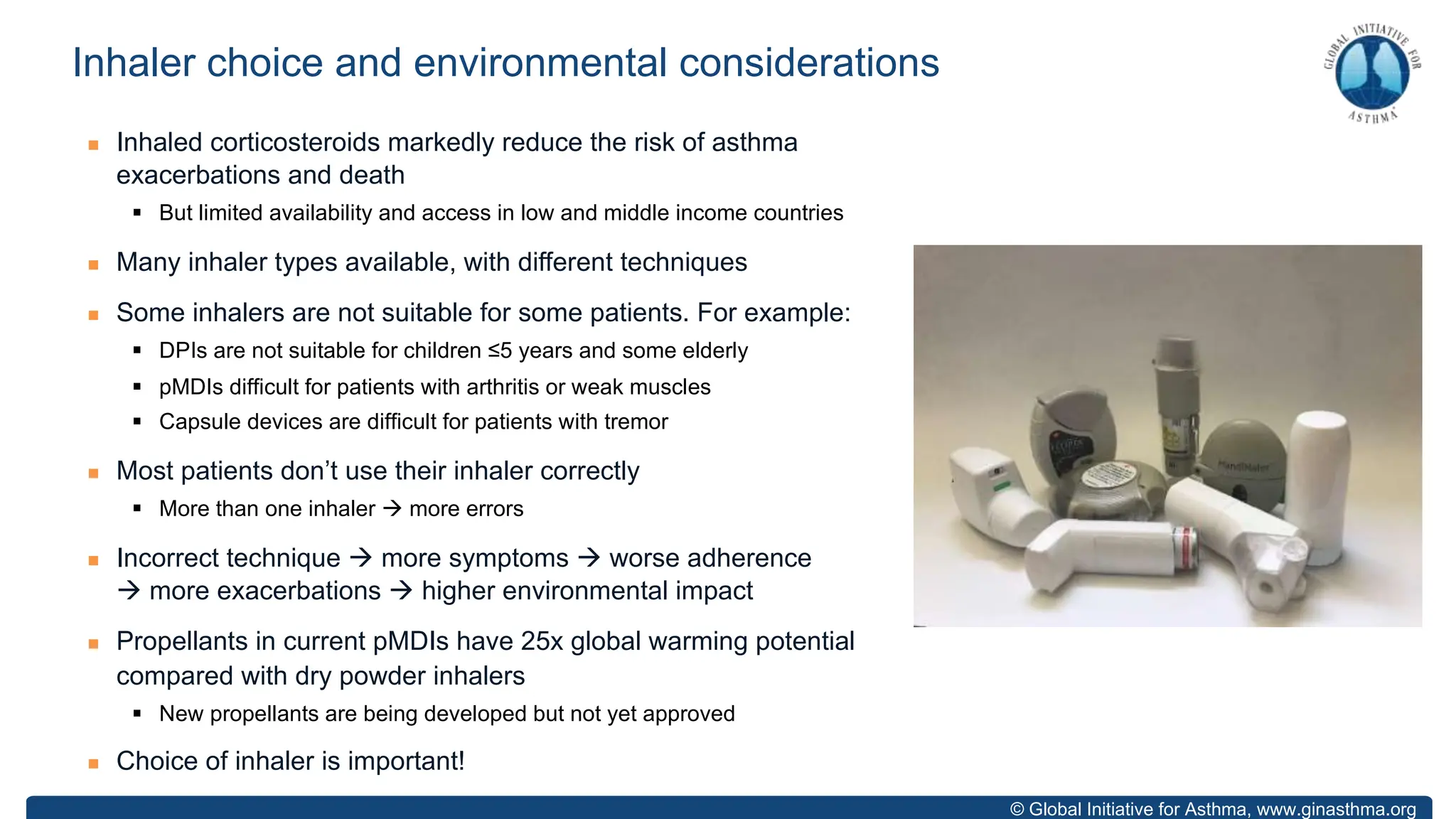
n Inhaled corticosteroids markedly reduce the risk of asthma
exacerbations and death
§ But limited availability and access in low and middle income countries
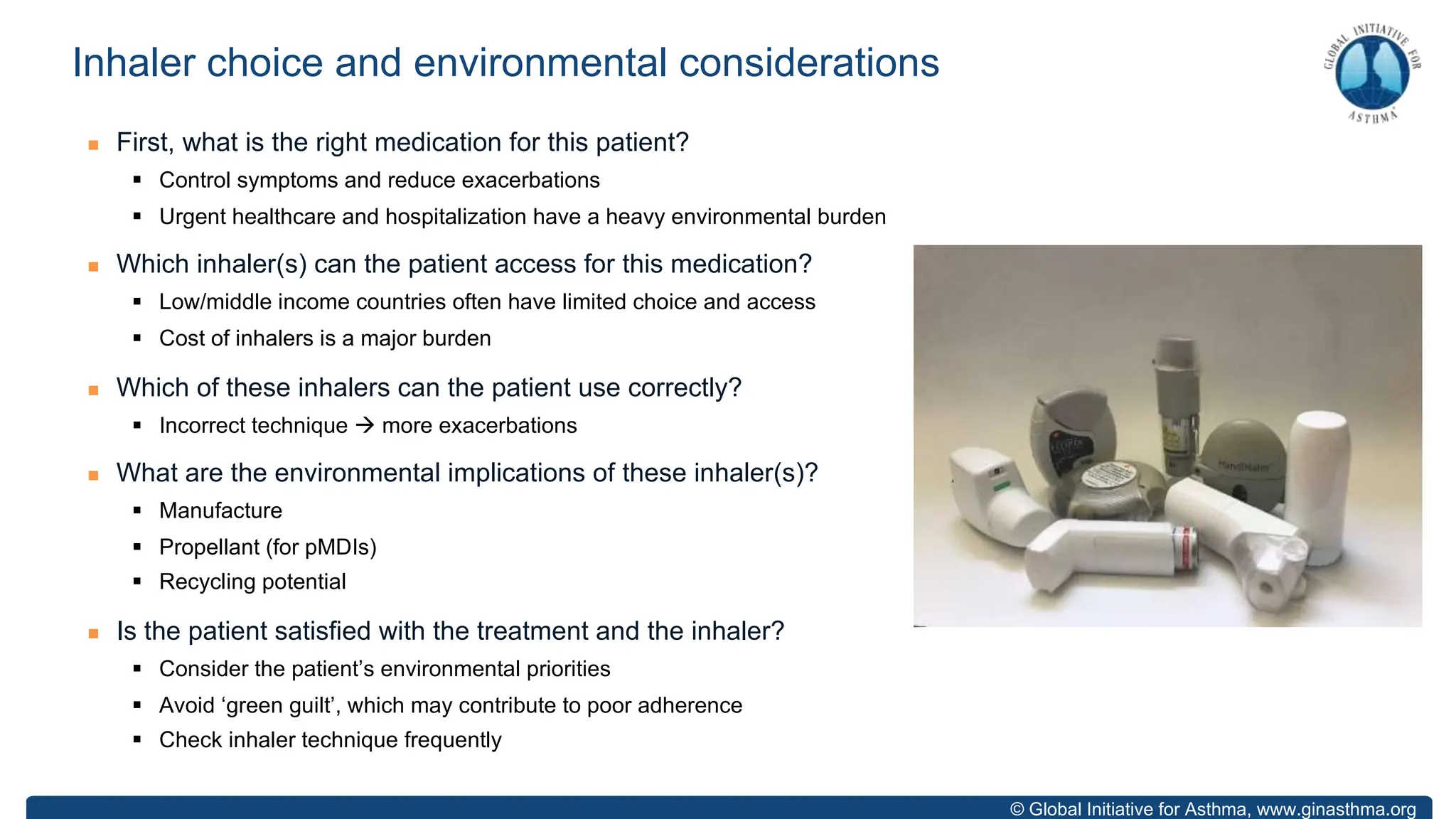
n Many inhaler types available, with different techniques
n Some inhalers are not suitable for some patients. For example:
§ DPIs are not suitable for children ≤5 years and some elderly
§ pMDIs difficult for patients with arthritis or weak muscles
§ Capsule devices are difficult for patients with tremor
n Most patients don’t use their inhaler correctly
§ More than one inhaler à more errors
n Incorrect technique à more symptoms à worse adherence
à more exacerbations à higher environmental impact
n Propellants in current pMDIs have 25x global warming potential
compared with dry powder inhalers
§ New propellants are being developed but not yet approved
n Choice of inhaler is important!
Inhaler choice and environmental considerations
© Global Initiative for Asthma, www.ginasthma.org
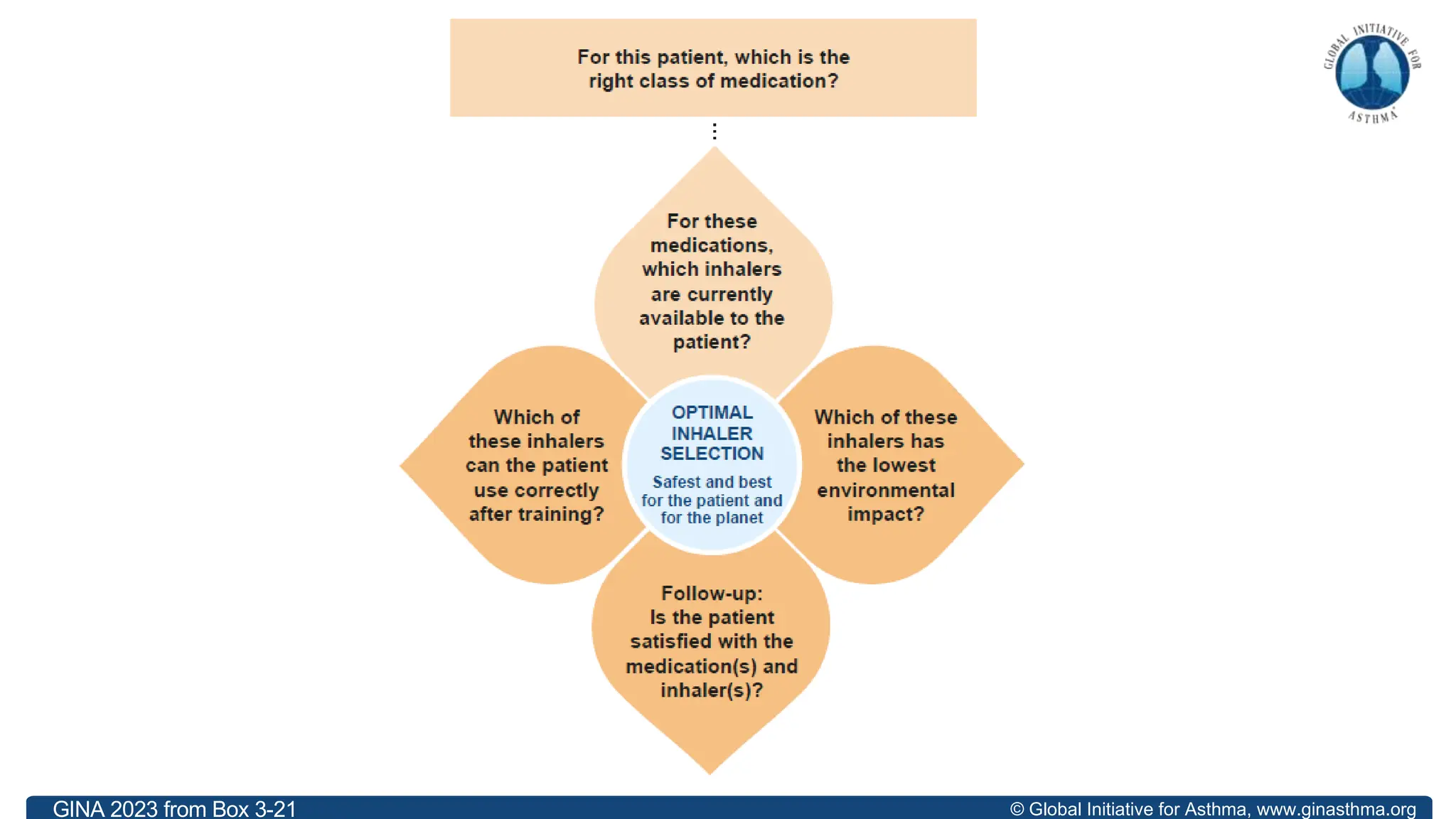
GINA 2023 from Box 3-21
© Global Initiative for Asthma, www.ginasthma.org
n First, what is the right medication for this patient?
§ Control symptoms and reduce exacerbations
§ Urgent healthcare and hospitalization have a heavy environmental burden
n Which inhaler(s) can the patient access for this medication?
§ Low/middle income countries often have limited choice and access
§ Cost of inhalers is a major burden
n Which of these inhalers can the patient use correctly?
§ Incorrect technique à more exacerbations
n What are the environmental implications of these inhaler(s)?
§ Manufacture
§ Propellant (for pMDIs)
§ Recycling potential
n Is the patient satisfied with the treatment and the inhaler?
§ Consider the patient’s environmental priorities
§ Avoid ‘green guilt’, which may contribute to poor adherence
§ Check inhaler technique frequently
Inhaler choice and environmental considerations
© Global Initiative for Asthma, www.ginasthma.org
n Changes in GINA 2023
§ Double-blind study of withdrawal of mepolizumab in adults with severe eosinophilic asthma found
more exacerbations in those who ceased mepolizumab than those who continued treatment (Moore
et al, ERJ 2022)
§ Mepolizumab (anti-IL5) added as a Step 5 option for children 6–11 years with severe eosinophilic
asthma (Jackson et al, Lancet 2022)
n Regardless of regulatory approvals, GINA recommends biologic therapy for asthma only
if asthma is severe, and only if treatment has been optimized
n Head-to-head studies are needed
n Non-asthma indications for biologic therapy are mentioned only if the condition is
relevant to asthma management, or if it is commonly associated with asthma
n Severe asthma guide published mid-2023 in large format
Difficult-to-treat and severe asthma
© Global Initiative for Asthma, www.ginasthma.org
n Pulse oximetry: FDA safety communication
§ Potential overestimation of oxygen saturation in people with dark skin color
n Risk of drug interactions between salmeterol or vilanterol and ritonavir-boosted nirmatrelvir (NMV/r)
§ Risk of cardiovascular adverse effects (Carr et al, JACI 2023; 151: 809-817)
§ Drug interaction websites recommend cessation of the LABA for duration of treatment, without warning about risks
§ Options (if available): prescribe alternative antiviral therapy, or switch to ICS or ICS-formoterol for duration of therapy
plus 5 days. Remember to teach correct technique if prescribing a new inhaler
§ (ICS effects unlikely given short duration of treatment)
n FeNO-guided treatment: well-conducted multinational study in children found no reduction in
exacerbations (Turner et al, Lancet Respir Med 2022). Update of Cochrane reviews awaited
n Updated advice about describing asthma severity
§ Consider using the term ‘apparently mild asthma’ in health professional education: patients with apparently mild
asthma can still have severe or fatal asthma exacerbations
n See GINA report for full list of changes
Other changes
© Global Initiative for Asthma, www.ginasthma.org
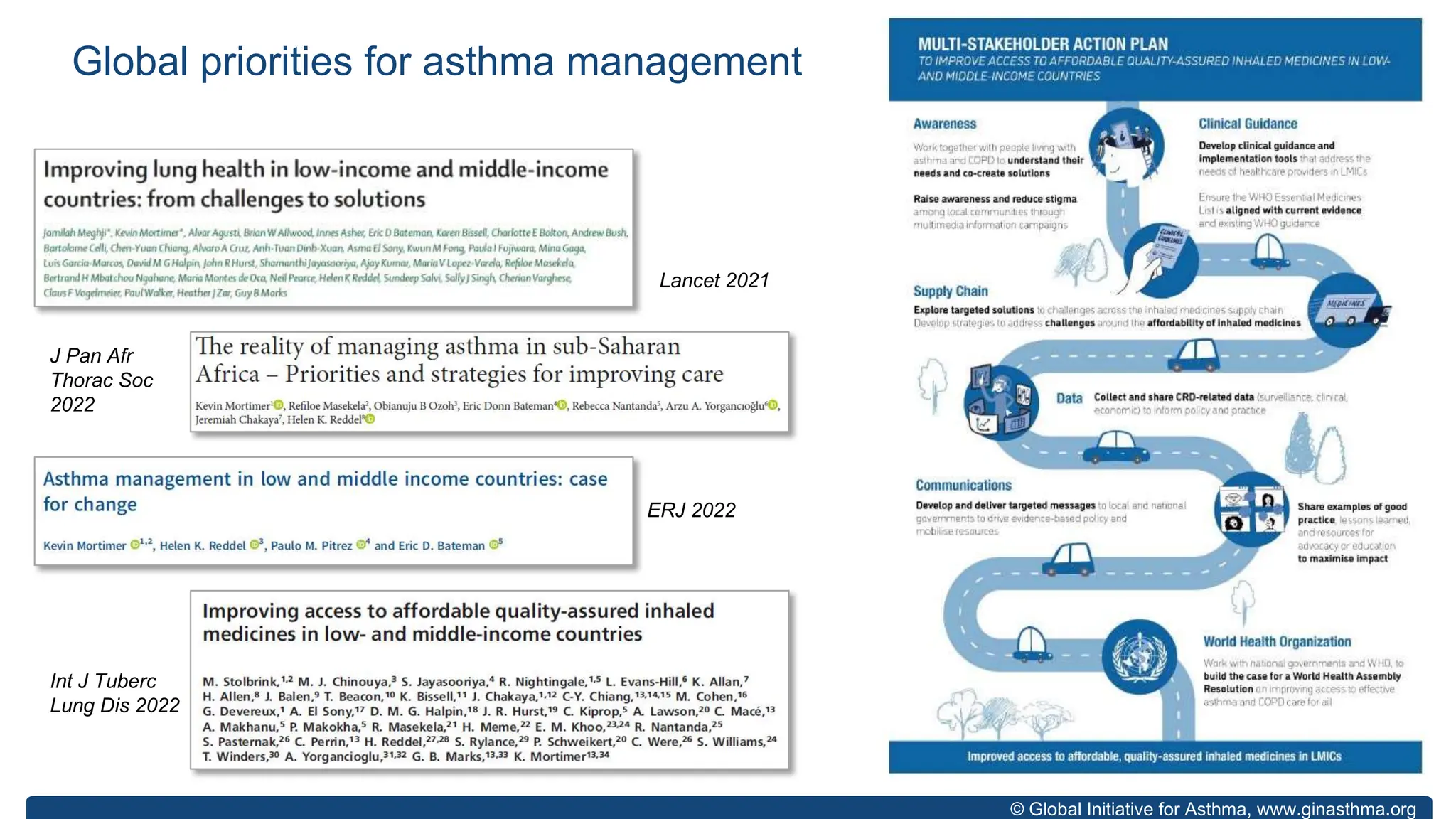
Global priorities for asthma management
Lancet 2021
J Pan Afr
Thorac Soc
2022
ERJ 2022
Int J Tuberc
Lung Dis 2022
© Global Initiative for Asthma, www.ginasthma.org

GINA-2023

  • 1.
    © Global Initiativefor Asthma Global Strategy for Asthma Management and Prevention This slide set is restricted for academic and educational purposes only. No additions or changes may be made to slides. Use of the slide set or of individual slides for commercial or promotional purposes requires approval from GINA. What’s new in GINA 2023? © 2023 Global Initiative for Asthma, used with permission.
  • 2.
    © Global Initiativefor Asthma, www.ginasthma.org n GINA was established by the WHO and NHLBI in 1993 § To increase awareness about asthma § To improve asthma prevention and management through a coordinated worldwide effort § Independent since 2014, funded only by the sale and licensing of its reports and figures n The GINA Strategy Report is a global evidence-based strategy that can be adapted for local health systems and medicine availability; it is widely used (downloaded from >200 countries) n The GINA Strategy Report is updated every year § Twice-yearly cumulative review of new evidence (including GRADE reviews) § Evidence integrated across whole asthma strategy, not isolated PICOT questions § Careful attention to study design, populations, and clinical relevance § Extensive external review § Practical focus: not just ‘what’, but ‘how’ n All members of GINA Science Committee are active in clinical asthma research § See www.ginasthma.com/about-us/methodology for handling of conflict of interest The Global Initiative for Asthma (GINA)
  • 3.
    © Global Initiativefor Asthma, www.ginasthma.org § Few asthma symptoms § No sleep disturbance § No exercise limitation § Maintain normal lung function § Prevent flare-ups (exacerbations) § Prevent asthma deaths § Minimize medication side-effects (including OCS) § The patient’s goals may be different § Symptom control and risk may be discordant § Patients with few symptoms can still have severe exacerbations Goals of asthma treatment Symptom control (e.g. ACT, ACQ) Risk reduction ACQ: Asthma Control Questionnaire; ACT: Asthma Control Test; OCS: oral corticosteroids © Global Initiative for Asthma, www.ginasthma.org
  • 4.
    © Global Initiativefor Asthma, www.ginasthma.org GINA 2023 Box 3-2
  • 5.
    Box 3-12 ©Global Initiative for Asthma, www.ginasthma.org *Anti-inflammatory reliever (AIR)
  • 6.
    © Global Initiativefor Asthma, www.ginasthma.org Box 3-12 (2/4) Track 1 GINA 2023 – Adults and adolescents Track 1 *An anti-inflammatory reliever (AIR) As-needed-only ICS-formoterol (‘AIR-only’) Maintenance and reliever therapy (MART) with ICS-formoterol
  • 7.
    © Global Initiativefor Asthma, www.ginasthma.org *An anti-inflammatory reliever (Steps 3–5) GINA 2023 – Adults and adolescents Track 2 Box 3-12 (3/4) Track 2
  • 8.
    © Global Initiativefor Asthma, www.ginasthma.org Box 3-12 4/4) GINA 2023 – Adults and adolescents
  • 9.
    © Global Initiativefor Asthma, www.ginasthma.org n Reliever § For symptom relief, or before exercise or allergen exposure n Controller § Function: targets both domains of asthma control (symptom control and future risk) § Mostly used for ICS-containing treatment n Maintenance treatment § Frequency: regularly scheduled, e.g. twice daily Terminology ICS: inhaled corticosteroid; SABA: short-acting beta2-agonist GINA 2023 Box 3-4
  • 10.
    © Global Initiativefor Asthma, www.ginasthma.org n Anti-Inflammatory Reliever = AIR § e.g. ICS-formoterol, ICS-SABA § Provides rapid symptom relief, plus a small dose of ICS § Reduces the risk of exacerbations, compared with using a SABA reliever Regimens with ICS-formoterol anti-inflammatory reliever n As-needed-only ICS-formoterol = AIR-only § The patient takes low-dose ICS-formoterol whenever needed for symptom relief n Maintenance And Reliever Therapy with ICS-formoterol = MART § A low dose of ICS-formoterol is used as the patient’s maintenance treatment, plus whenever needed for symptom relief n ICS-formoterol can also be used before exercise or allergen exposure Terminology ICS: inhaled corticosteroid: SABA: short-acting beta2-agonist; MART is sometimes also called SMART
  • 11.
  • 12.
    © Global Initiativefor Asthma, www.ginasthma.org COMPARED WITH AS-NEEDED SABA § Two studies (SYGMA 1, O’Byrne et al, NEJM 2018, n=3836; Novel START, Beasley et al, NEJM 2019, n=668) § Risk of severe exacerbations was reduced by 60–64% (SYGMA 1, Novel START) COMPARED WITH MAINTENANCE LOW DOSE ICS plus as-needed SABA § Four studies (SYGMA 1; SYGMA 2, Bateman et al, NEJM 2018, n=4176; Novel START; PRACTICAL, Hardy et al, Lancet 2019, n=885) § Risk of severe exacerbations similar (SYGMA 1 & 2), or lower (Novel START, PRACTICAL) § Symptoms very slightly more, e.g. ACQ-5 0.15 (vs 0.5 MCID), not worsening over 12 months § Pre-BD FEV1 slightly lower (~54 mL), not worsening over 12 months § FeNO slightly higher (10ppb), not increasing over 12 months (Novel START, PRACTICAL) § As-needed ICS-formoterol used on ~ 30% of days à average ICS dose ~50–100mcg budesonide/day § Benefit independent of T2 status, lung function, exacerbation history (Novel START, PRACTICAL) § Qualitative research: most patients preferred as-needed ICS-formoterol (Baggott Thorax 2020, ERJ 2020; Foster Respir Med 2020, BMJ Open 2022) *Budesonide-formoterol 200/6 [160/4.5] mcg by Turbuhaler, 1 inhalation as needed for symptom relief Track 1, Steps 1–2: As-needed-only low-dose ICS-formoterol
  • 13.
    © Global Initiativefor Asthma, www.ginasthma.org n Risk of severe exacerbations (Crossingham et al, Cochrane 2021) § Compared with as-needed SABA alone: 55% reduction (OR 0.45 [0.34–0.60]) § Compared with daily ICS plus as-needed SABA: (OR 0.79 [0.59–1.07]) n Risk of emergency department visits or hospitalizations (Crossingham et al, Cochrane 2021) § Compared with as-needed SABA alone: 65% reduction (OR 0.35 [0.20–0.60]) § Compared with daily ICS plus as-needed SABA: 37% reduction (OR 0.63 [0.44–0.91]) § Large population-level reduction in healthcare utilization Track 1, Steps 1–2: As-needed-only low-dose ICS-formoterol
  • 14.
    © Global Initiativefor Asthma, www.ginasthma.org Combination as-needed ICS-SABA n BEST study, combination BDP-albuterol (Papi et al, NEJMed 2007, n=445, 6 months) § Mean number of exacerbations per patient per year lower with as-needed combination (0.74) and regular BDP (0.71) compared with as-needed albuterol (1.63, P<0.001) and regular combination BDP-albuterol (1.76, P<0.001) Taking ICS whenever SABA taken with separate inhalers n TREXA study, BDP and albuterol, children and adolescents (Martinez et al, Lancet 2011, n=288, 9 months) § Frequency of exacerbations highest with albuterol alone (49%); lower with daily BDP (28%, p=0.03), daily plus as- needed BDP and SABA (31%, p=0.07) and as-needed BDP+SABA (35%, p=0.07) § Growth 1.1cm less in daily and combined groups but not as-needed-only group n BASALT study, BDP and albuterol, adults (Calhoun et al, JAMA 2012, n=342, 9 months) § Similar exacerbations with as-needed BDP+SABA as with 6-weekly physician-adjusted or FeNO-adjusted ICS n ASIST study, BDP and albuterol, African-American children and adolescents (Sumino et al, Annals ATS 2020, n=206, 12 months) § Similar symptoms control and exacerbations compared with physician-adjusted ICS Track 2, Steps 1–2: As-needed-only ICS-SABA BDP: beclometasone dipropionate; ICS: inhaled corticosteroids; SABA: short-acting beta2-agonists
  • 15.
  • 16.
    © Global Initiativefor Asthma, www.ginasthma.org n MART with ICS-formoterol reduces severe exacerbations compared with ICS or ICS-LABA plus SABA reliever, with similar symptom control § Confirmed by regulatory studies and pragmatic open-label studies, n~30,000 n Both budesonide and formoterol contribute to the reduction in severe exacerbations Track 1, Steps 3–5: Maintenance and reliever therapy (MART) Rabe, Lancet 2006 N=3,395, all taking maintenance budesonide-formoterol Sobieraj et al, JAMA 2018 (n=22,748) 0.68 (0.58–0.80) 0.77 (0.60–0.98) Odds ratio 0.83 (0.70–0.98) Cates et al, Cochrane 2013 (n=4,433) Compared with same dose ICS-LABA +SABA Compared with higher dose ICS-LABA + SABA Compared with conventional best practice Compared with formoterol or SABA reliever
  • 17.
    © Global Initiativefor Asthma, www.ginasthma.org Track 2, Steps 3–5: as-needed ICS-SABA added to maintenance treatment From “Albuterol-Budesonide Fixed Dose Combination Rescue Inhaler for Asthma”, Papi et al, NEJMed 2022; 386:2071-2083 Copyright © 2023. Massachusetts Medical Society. Reprinted with permission from Massachusetts Medical Society In patients taking Step 3–5 maintenance treatment: • Hazard ratio for probability of severe exacerbations was 0.73 (95% CI 0.61–0.88) with higher dose of as-needed albuterol-budesonide compared with as-needed albuterol • Most benefit seen in Step 3 Papi et al, NEJMed 2022 (n=3,132)
  • 18.
    © Global Initiativefor Asthma, www.ginasthma.org n Steps 1–2: weight of evidence for effectiveness and safety compared with SABA alone, or low-dose ICS plus as-needed SABA (4x12 month studies, n~10,000) (Crossingham et al, Cochrane 2021) § As-needed ICS-SABA: only one 6-month RCT (n=455) (Papi et al, NEJMed 2007) n Steps 3–5: weight of evidence for effectiveness and safety of MART versus regimens with as-needed SABA (n~30,000) (Sobieraj et al, JAMA 2018; Cates et al, Cochrane 2013) § As-needed ICS-SABA: only one RCT (n=3,132) vs as-needed SABA (Papi et al, NEJMed 2022); cannot be used for maintenance and reliever therapy n Both the ICS and the formoterol contribute to reduction in severe exacerbations (Tattersfield et al, Lancet 2001; Pauwels et al, ERJ 2003; Rabe et al, Lancet 2006) § Safety established up to total 12 inhalations in any day, in large studies n Simplicity of approach for patients and clinicians § A single medication for both symptom relief and maintenance treatment (if needed) from diagnosis § Avoids confusion about inhaler technique with different devices § Short-term increase in symptoms à patient increases the number of as-needed doses § Step treatment down or up by changing the number of maintenance doses Why is GINA Track 1 with ICS-formoterol preferred?
  • 19.
    Box 3-12 ©Global Initiative for Asthma, www.ginasthma.org *Anti-inflammatory reliever (AIR)
  • 20.
    © Global Initiativefor Asthma, www.ginasthma.org Example: budesonide-formoterol 200/6 mcg [160/4.5 delivered dose] n Steps 1–2: take 1 inhalation whenever needed for symptoms n Step 3: take 1 inhalation twice a day (or once a day) PLUS 1 inhalation whenever needed for symptoms n Steps 4–5: take 2 inhalations twice a day PLUS 1 inhalation whenever needed for symptoms n As-needed doses of ICS-formoterol can also be taken before exercise (Lazarinis et al, Thorax 2014) or before allergen exposure (Duong et al, JACI 2007) See following slides for medications, doses, and maximum number of inhalations in any day for GINA Track 1 How to prescribe low-dose ICS-formoterol in GINA Track 1
  • 21.
    © Global Initiativefor Asthma, www.ginasthma.org Step Age (years) Medication and device (check patient can use inhaler) Metered dose (mcg/inhalation) Delivered dose (mcg/inhalation) Dosage Steps 1–2 (AIR-only) 6–11 (No evidence) - - - 12–17 ≥18 Budesonide-formoterol DPI 200/6 160/4.5 1 inhalation whenever needed Step 3 MART 6–11 Budesonide-formoterol DPI 100/6 80/4.5 1 inhalation once daily, PLUS 1 inhalation whenever needed 12–17 ≥18 Budesonide-formoterol DPI 200/6 160/4.5 1 inhalation once or twice daily, PLUS 1 inhalation whenever needed ≥18 BDP-formoterol pMDI 100/6 84.6/5.0 Step 4 MART 6–11 Budesonide-formoterol DPI 100/6 80/4.5 1 inhalation twice daily, PLUS 1 inhalation whenever needed 12–17 ≥18 Budesonide-formoterol DPI 200/6 160/4.5 2 inhalations twice daily, PLUS 1 inhalation whenever needed ≥18 BDP-formoterol pMDI 100/6 84.6/5.0 Step 5 MART 6–11 (No evidence) - - - 12–17 ≥18 Budesonide-formoterol DPI 200/6 160/4.5 2 inhalations twice daily, PLUS 1 inhalation whenever needed ≥18 BDP-formoterol pMDI 100/6 84.6/5.0 GINA 2023 from Box 3-15 DPI: dry powder inhaler; pMDI: pressurized metered dose inhaler. For budesonide-formoterol pMDI with 3 mcg [2.25 mcg] formoterol, use double number of puffs
  • 22.
    © Global Initiativefor Asthma, www.ginasthma.org Step Age (years) Medication and device (check patient can use inhaler) Metered dose (mcg/inhalation) Delivered dose (mcg/inhalation) Dosage Steps 1–2 (AIR-only) 6–11 (No evidence) - - - 12–17 ≥18 Budesonide-formoterol DPI 200/6 160/4.5 1 inhalation whenever needed Step 3 MART 6–11 Budesonide-formoterol DPI 100/6 80/4.5 1 inhalation once daily, PLUS 1 inhalation whenever needed 12–17 ≥18 Budesonide-formoterol DPI 200/6 160/4.5 1 inhalation once or twice daily, PLUS 1 inhalation whenever needed ≥18 BDP-formoterol pMDI 100/6 84.6/5.0 Step 4 MART 6–11 Budesonide-formoterol DPI 100/6 80/4.5 1 inhalation twice daily, PLUS 1 inhalation whenever needed 12–17 ≥18 Budesonide-formoterol DPI 200/6 160/4.5 2 inhalations twice daily, PLUS 1 inhalation whenever needed ≥18 BDP-formoterol pMDI 100/6 84.6/5.0 Step 5 MART 6–11 (No evidence) - - - 12–17 ≥18 Budesonide-formoterol DPI 200/6 160/4.5 2 inhalations twice daily, PLUS 1 inhalation whenever needed ≥18 BDP-formoterol pMDI 100/6 84.6/5.0 GINA 2023 from Box 3-15 DPI: dry powder inhaler; pMDI: pressurized metered dose inhaler. For budesonide-formoterol pMDI with 3 mcg [2.25 mcg] formoterol, use double number of puffs
  • 23.
    © Global Initiativefor Asthma, www.ginasthma.org Step Age (years) Medication and device (check patient can use inhaler) Metered dose (mcg/inhalation) Delivered dose (mcg/inhalation) Dosage Steps 1–2 (AIR-only) 6–11 (No evidence) - - - 12–17 ≥18 Budesonide-formoterol DPI 200/6 160/4.5 1 inhalation whenever needed Step 3 MART 6–11 Budesonide-formoterol DPI 100/6 80/4.5 1 inhalation once daily, PLUS 1 inhalation whenever needed 12–17 ≥18 Budesonide-formoterol DPI 200/6 160/4.5 1 inhalation once or twice daily, PLUS 1 inhalation whenever needed ≥18 BDP-formoterol pMDI 100/6 84.6/5.0 Step 4 MART 6–11 Budesonide-formoterol DPI 100/6 80/4.5 1 inhalation twice daily, PLUS 1 inhalation whenever needed 12–17 ≥18 Budesonide-formoterol DPI 200/6 160/4.5 2 inhalations twice daily, PLUS 1 inhalation whenever needed ≥18 BDP-formoterol pMDI 100/6 84.6/5.0 Step 5 MART 6–11 (No evidence) - - - 12–17 ≥18 Budesonide-formoterol DPI 200/6 160/4.5 2 inhalations twice daily, PLUS 1 inhalation whenever needed ≥18 BDP-formoterol pMDI 100/6 84.6/5.0 GINA 2023 from Box 3-15 DPI: dry powder inhaler; pMDI: pressurized metered dose inhaler. For budesonide-formoterol pMDI with 3 mcg [2.25 mcg] formoterol, use double number of puffs
  • 24.
    © Global Initiativefor Asthma, www.ginasthma.org Step Age (years) Medication and device (check patient can use inhaler) Metered dose (mcg/inhalation) Delivered dose (mcg/inhalation) Dosage Steps 1–2 (AIR-only) 6–11 (No evidence) - - - 12–17 ≥18 Budesonide-formoterol DPI 200/6 160/4.5 1 inhalation whenever needed Step 3 MART 6–11 Budesonide-formoterol DPI 100/6 80/4.5 1 inhalation once daily, PLUS 1 inhalation whenever needed 12–17 ≥18 Budesonide-formoterol DPI 200/6 160/4.5 1 inhalation once or twice daily, PLUS 1 inhalation whenever needed ≥18 BDP-formoterol pMDI 100/6 84.6/5.0 Step 4 MART 6–11 Budesonide-formoterol DPI 100/6 80/4.5 1 inhalation twice daily, PLUS 1 inhalation whenever needed 12–17 ≥18 Budesonide-formoterol DPI 200/6 160/4.5 2 inhalations twice daily, PLUS 1 inhalation whenever needed ≥18 BDP-formoterol pMDI 100/6 84.6/5.0 Step 5 MART 6–11 (No evidence) - - - 12–17 ≥18 Budesonide-formoterol DPI 200/6 160/4.5 2 inhalations twice daily, PLUS 1 inhalation whenever needed ≥18 BDP-formoterol pMDI 100/6 84.6/5.0 GINA 2023 from Box 3-15 DPI: dry powder inhaler; pMDI: pressurized metered dose inhaler. For budesonide-formoterol pMDI with 3 mcg [2.25 mcg] formoterol, use double number of puffs
  • 25.
    © Global Initiativefor Asthma, www.ginasthma.org Step Age (years) Medication and device (check patient can use inhaler) Metered dose (mcg/inhalation) Delivered dose (mcg/inhalation) Dosage Steps 1–2 (AIR-only) 6–11 (No evidence) - - - 12–17 ≥18 Budesonide-formoterol DPI 200/6 160/4.5 1 inhalation whenever needed Step 3 MART 6–11 Budesonide-formoterol DPI 100/6 80/4.5 1 inhalation once daily, PLUS 1 inhalation whenever needed 12–17 ≥18 Budesonide-formoterol DPI 200/6 160/4.5 1 inhalation once or twice daily, PLUS 1 inhalation whenever needed ≥18 BDP-formoterol pMDI 100/6 84.6/5.0 Step 4 MART 6–11 Budesonide-formoterol DPI 100/6 80/4.5 1 inhalation twice daily, PLUS 1 inhalation whenever needed 12–17 ≥18 Budesonide-formoterol DPI 200/6 160/4.5 2 inhalations twice daily, PLUS 1 inhalation whenever needed ≥18 BDP-formoterol pMDI 100/6 84.6/5.0 Step 5 MART 6–11 (No evidence) - - - 12–17 ≥18 Budesonide-formoterol DPI 200/6 160/4.5 2 inhalations twice daily, PLUS 1 inhalation whenever needed ≥18 BDP-formoterol pMDI 100/6 84.6/5.0 GINA 2023 from Box 3-15 DPI: dry powder inhaler; pMDI: pressurized metered dose inhaler. For budesonide-formoterol pMDI with 3 mcg [2.25 mcg] formoterol, use double number of puffs
  • 26.
    © Global Initiativefor Asthma, www.ginasthma.org n For ICS-formoterol with 6 mcg (4.5 mcg delivered dose) of formoterol, take 1 inhalation whenever needed for symptom relief n Another inhalation can be taken after a few minutes if needed n Maximum total number of inhalations in any single day (as-needed + maintenance) § Budesonide-formoterol: maximum 12 inhalations* for adults, 8 inhalations for children, based on extensive safety data (Tattersfield et al, Lancet 2001; Pauwels et al, ERJ 2003) § Beclometasone-formoterol: maximum total 8 inhalations in any day (Papi et al, Lancet Respir Med 2013) n Emphasize that most patients need far fewer doses than this! n For pMDIs containing 3 mcg formoterol (2.25 mcg delivered dose), take 2 inhalations each time Reliever doses of ICS-formoterol - how much can be taken? *For budesonide-formoterol 200/6 [delivered dose 160/4.5 mcg], 12 inhalations gives 72 mcg formoterol (54 mcg delivered dose)
  • 27.
    © Global Initiativefor Asthma, www.ginasthma.org n At first, patients may be unsure whether ICS-formoterol will work as well as their previous SABA reliever § In the PRACTICAL study, 69% patients said ICS-formoterol worked as fast as, or faster than, their previous SABA (Baggott et al, ERJ 2020) § Suggest to the patient that they try out the new reliever at a convenient time § Emphasise that they should use the ICS-formoterol instead of their previous SABA, and that they should take an additional inhalation when they have more symptoms n Advise patients to have two inhalers (if possible), 1 at home, 1 in bag/pocket n Advise patients to rinse and spit out after maintenance doses, but this is not needed with reliever doses § No increased incidence of candidiasis in RCTs with this recommendation (n~40,000) n Use an action plan customised to MART § The patient continues their usual maintenance ICS-formoterol inhalations, but takes more as-needed ICS-formoterol inhalations § Taking extra as-needed inhalations reduces the risk of progressing to a severe exacerbation needing oral corticosteroids (Bousquet et al, Respir Med 2007; Buhl et al, Respir Res 2012; O’Byrne et al, Lancet Respir Med 2021) n Additional practical advice for MART (Reddel et al, JACI in Practice 2022) Practical advice for GINA Track 1
  • 28.
    © Global Initiativefor Asthma, www.ginasthma.org Action plan for MART with ICS-formoterol Reddel et al, JACI in Practice 2022; 10: S31-s38 This article includes a writable action plan template That can be modified for other combination ICS-formoterol inhalers, and for as-needed-only ICS-formoterol For additional action plans with ICS-formoterol reliever, see National Asthma Council Australia Action plan library www.nationalasthma.org.au/health- professionals/asthma-action-plans
  • 29.
    Supplement to Reddelet al, JACI in Practice 2022; 10: S31-s38 This template can be modified for other ICS- formoterol combinations or for as-needed-only ICS-formoterol. The action plan on which it is based has been widely used in Australia and other countries since 2007.
  • 30.
    Box 3-13 ©Global Initiative for Asthma, www.ginasthma.org
  • 31.
    Box 6-6 ©Global Initiative for Asthma, www.ginasthma.org
  • 32.
    © Global Initiativefor Asthma, www.ginasthma.org n Inhaled corticosteroids markedly reduce the risk of asthma exacerbations and death § But limited availability and access in low and middle income countries n Many inhaler types available, with different techniques n Some inhalers are not suitable for some patients. For example: § DPIs are not suitable for children ≤5 years and some elderly § pMDIs difficult for patients with arthritis or weak muscles § Capsule devices are difficult for patients with tremor n Most patients don’t use their inhaler correctly § More than one inhaler à more errors n Incorrect technique à more symptoms à worse adherence à more exacerbations à higher environmental impact n Propellants in current pMDIs have 25x global warming potential compared with dry powder inhalers § New propellants are being developed but not yet approved n Choice of inhaler is important! Inhaler choice and environmental considerations
  • 33.
    © Global Initiativefor Asthma, www.ginasthma.org GINA 2023 from Box 3-21
  • 34.
    © Global Initiativefor Asthma, www.ginasthma.org n First, what is the right medication for this patient? § Control symptoms and reduce exacerbations § Urgent healthcare and hospitalization have a heavy environmental burden n Which inhaler(s) can the patient access for this medication? § Low/middle income countries often have limited choice and access § Cost of inhalers is a major burden n Which of these inhalers can the patient use correctly? § Incorrect technique à more exacerbations n What are the environmental implications of these inhaler(s)? § Manufacture § Propellant (for pMDIs) § Recycling potential n Is the patient satisfied with the treatment and the inhaler? § Consider the patient’s environmental priorities § Avoid ‘green guilt’, which may contribute to poor adherence § Check inhaler technique frequently Inhaler choice and environmental considerations
  • 35.
    © Global Initiativefor Asthma, www.ginasthma.org n Changes in GINA 2023 § Double-blind study of withdrawal of mepolizumab in adults with severe eosinophilic asthma found more exacerbations in those who ceased mepolizumab than those who continued treatment (Moore et al, ERJ 2022) § Mepolizumab (anti-IL5) added as a Step 5 option for children 6–11 years with severe eosinophilic asthma (Jackson et al, Lancet 2022) n Regardless of regulatory approvals, GINA recommends biologic therapy for asthma only if asthma is severe, and only if treatment has been optimized n Head-to-head studies are needed n Non-asthma indications for biologic therapy are mentioned only if the condition is relevant to asthma management, or if it is commonly associated with asthma n Severe asthma guide published mid-2023 in large format Difficult-to-treat and severe asthma
  • 36.
    © Global Initiativefor Asthma, www.ginasthma.org n Pulse oximetry: FDA safety communication § Potential overestimation of oxygen saturation in people with dark skin color n Risk of drug interactions between salmeterol or vilanterol and ritonavir-boosted nirmatrelvir (NMV/r) § Risk of cardiovascular adverse effects (Carr et al, JACI 2023; 151: 809-817) § Drug interaction websites recommend cessation of the LABA for duration of treatment, without warning about risks § Options (if available): prescribe alternative antiviral therapy, or switch to ICS or ICS-formoterol for duration of therapy plus 5 days. Remember to teach correct technique if prescribing a new inhaler § (ICS effects unlikely given short duration of treatment) n FeNO-guided treatment: well-conducted multinational study in children found no reduction in exacerbations (Turner et al, Lancet Respir Med 2022). Update of Cochrane reviews awaited n Updated advice about describing asthma severity § Consider using the term ‘apparently mild asthma’ in health professional education: patients with apparently mild asthma can still have severe or fatal asthma exacerbations n See GINA report for full list of changes Other changes
  • 37.
    © Global Initiativefor Asthma, www.ginasthma.org Global priorities for asthma management Lancet 2021 J Pan Afr Thorac Soc 2022 ERJ 2022 Int J Tuberc Lung Dis 2022
  • 38.
    © Global Initiativefor Asthma, www.ginasthma.org

Editor's Notes

  • #6 SPEAKERS: Changes in GINA 2023 for adults and adolescents : Year added at top left, to avoid use of out-of-date versions of GINA figures Rationale for Track 1 being the preferred regimen has been updated (see details on later slides) As-needed ICS-SABA (if available) has been added as a reliever option in Track 2 for Steps 3–5, with most of the benefit seen in Step 3 Anti-inflammatory relievers have been identified with an asterisk (see next 2 slides for details) NOTE: in Step 5, ‘add-on LAMA’ can be combination (triple) or separate inhalers. If a patient is prescribed triple therapy with a non-formoterol LABA, the reliever should be SABA or ICS-SABA (not ICS-formoterol).
  • #7 SPEAKERS: MART was originally called SMART, with the ‘S’ coming from the brandname of the medication used in most of the studies. The ‘S’ can now stand for ‘single inhaler’, but this may cause confusion because patients may have two ICS-formoterol inhalers, one at home for their maintenance treatment, and one in their bag/pocket for as-needed doses when they are away from home. Step 5: The dotted line for MART is to indicate that there is no evidence, in a patient taking Step 5 treatment, for switching from a SABA reliever to an ICS-formoterol reliever. However, if a patient already prescribed MART is stepped up from Step 4 to Step 5, e.g. with addition of biologic therapy, there is no need to swjtch their reliever from ICS-formoterol to SABA. In Step 5, ‘add-on LAMA’ can be combination (triple) or separate inhalers. If a patient is prescribed triple therapy with a non-formoterol LABA, the reliever should be SABA or ICS-SABA (not ICS-formoterol).
  • #8 SPEAKERS The main benefit of using budesonide-salbutamol (ICS-SABA) as a reliever has been seen in Step 3. There is no evidence yet for safety and efficacy of budesonide-salbutamol in Steps 1–2. Track 2 requires two inhalers. Check inhaler technique carefully if the patient’s maintenance treatment and reliever treatment are in different inhaler devices. In Step 5, ‘add-on LAMA’ can be combination (triple) or separate inhalers.
  • #9 SPEAKERS The main benefit of using budesonide-salbutamol (ICS-SABA) as a reliever has been seen in Step 3. There is no evidence yet for safety and efficacy of budesonide-salbutamol in Steps 1–2. Track 2 requires two inhalers. Check inhaler technique carefully if the patient’s maintenance treatment and reliever treatment are in different inhaler devices. In Step 5, ‘add-on LAMA’ can be combination (triple) or separate inhalers.
  • #11 SPEAKERS: MART was originally called SMART, with the ‘S’ coming from the brandname of the medication used in most of the studies. The ‘S’ can also stand for ‘single inhaler’, but this may cause confusion because patients may have two ICS-formoterol inhalers, one at home for their maintenance treatment, and one in their bag/pocket for as-needed doses when they are away from home.
  • #13 O'Byrne PM, FitzGerald JM, Bateman ED, et al., Inhaled combined budesonide-formoterol as needed in mild asthma. N. Engl. J. Med., 2018. 378: 1865-1876. Bateman ED, Reddel HK, O'Byrne PM, et al., As-needed budesonide-formoterol versus maintenance budesonide in mild asthma. N. Engl. J. Med., 2018. 378: 1877-1887. Beasley R, Holliday M, Reddel HK, et al., Controlled trial of budesonide-formoterol as needed for mild asthma. N. Engl. J. Med., 2019. 380: 2020-2030. Hardy J, Baggott C, Fingleton J, et al., Budesonide-formoterol reliever therapy versus maintenance budesonide plus terbutaline reliever therapy in adults with mild to moderate asthma (PRACTICAL): a 52-week, open-label, multicentre, superiority, randomised controlled trial. Lancet, 2019. 394: 919-928. Baggott C, Chan A, Hurford S, et al., Patient preferences for asthma management: a qualitative study. BMJ open, 2020. 10: e037491. Baggott C, Hansen P, Hancox RJ, et al., What matters most to patients when choosing treatment for mild-moderate asthma? Results from a discrete choice experiment. Thorax, 2020. 75: 842-848. Foster J, Beasley R, Braithwaite I, et al., Perspectives of mild asthma patients on maintenance versus as-needed preventer treatment regimens: a qualitative study. BMJ open, 2022. 12: e048537. Foster JM, Beasley R, Braithwaite I, et al., Patient experiences of as-needed budesonide-formoterol by Turbuhaler® for treatment of mild asthma; a qualitative study. Respir. Med., 2020. 175: 106154.
  • #14 Crossingham I, Turner S, Ramakrishnan S, et al., Combination fixed-dose beta agonist and steroid inhaler as required for adults or children with mild asthma. Cochrane Database Syst Rev, 2021. 5: Cd013518.
  • #15 1. Papi A, Canonica GW, Maestrelli P, et al., Rescue use of beclomethasone and albuterol in a single inhaler for mild asthma. N. Engl. J. Med., 2007. 356: 2040-52. 2. Martinez FD, Chinchilli VM, Morgan WJ, et al., Use of beclomethasone dipropionate as rescue treatment for children with mild persistent asthma (TREXA): a randomised, double-blind, placebo-controlled trial. Lancet, 2011. 377: 650-7. 3. Calhoun WJ, Ameredes BT, King TS, et al., Comparison of physician-, biomarker-, and symptom-based strategies for adjustment of inhaled corticosteroid therapy in adults with asthma: the BASALT randomized controlled trial. JAMA, 2012. 308: 987-97. 4. Sumino K, Bacharier LB, Taylor J, et al., A pragmatic trial of symptom-based inhaled corticosteroid use in African-American children with mild asthma. J Allergy Clin Immunol Pract, 2020. 8: 176-185.e2.
  • #17 Sobieraj DM, Weeda ER, Nguyen E, et al., Association of inhaled corticosteroids and long-acting beta-agonists as controller and quick relief therapy with exacerbations and symptom control in persistent asthma: A systematic review and meta-analysis. JAMA, 2018. 319: 1485-1496. Cates CJ and Karner C, Combination formoterol and budesonide as maintenance and reliever therapy versus current best practice (including inhaled steroid maintenance), for chronic asthma in adults and children. Cochrane Database Syst Rev, 2013. 4: CD007313. Rabe KF, Atienza T, Magyar P, et al., Effect of budesonide in combination with formoterol for reliever therapy in asthma exacerbations: a randomised controlled, double-blind study. Lancet, 2006. 368: 744-53.
  • #18 SPEAKERS: the addition of as-needed ICS-SABA in Track 2 was because of evidence from this RCT (MANDALA) published in 2022
  • #19 1. Crossingham I, Turner S, Ramakrishnan S, et al., Combination fixed-dose beta agonist and steroid inhaler as required for adults or children with mild asthma. Cochrane Database Syst Rev, 2021. 5: Cd013518. 2. Papi A, Canonica GW, Maestrelli P, et al., Rescue use of beclomethasone and albuterol in a single inhaler for mild asthma. N. Engl. J. Med., 2007. 356: 2040-52. 3. Cates CJ and Karner C, Combination formoterol and budesonide as maintenance and reliever therapy versus current best practice (including inhaled steroid maintenance), for chronic asthma in adults and children. Cochrane Database Syst Rev, 2013. 4: CD007313. 4. Sobieraj DM, Weeda ER, Nguyen E, et al., Association of inhaled corticosteroids and long-acting beta-agonists as controller and quick relief therapy with exacerbations and symptom control in persistent asthma: A systematic review and meta-analysis. JAMA, 2018. 319: 1485-1496. 5. Papi A, Chipps BE, Beasley R, et al., Albuterol-Budesonide Fixed-Dose Combination Rescue Inhaler for Asthma. N. Engl. J. Med., 2022. 386: 2071-2083. 6. Pauwels RA, Sears MR, Campbell M, et al., Formoterol as relief medication in asthma: a worldwide safety and effectiveness trial. Eur. Respir. J., 2003. 22: 787-94. 7. Tattersfield AE, Lofdahl CG, Postma DS, et al., Comparison of formoterol and terbutaline for as-needed treatment of asthma: a randomised trial. Lancet, 2001. 357: 257-61. 8. Rabe KF, Atienza T, Magyar P, et al., Effect of budesonide in combination with formoterol for reliever therapy in asthma exacerbations: a randomised controlled, double-blind study. Lancet, 2006. 368: 744-53.
  • #20 SPEAKERS: Changes in GINA 2023 for adults and adolescents : Year added at top left, to avoid use of out-of-date versions of GINA figures Rationale for Track 1 being the preferred regimen has been updated (see details on later slides) As-needed ICS-SABA (if available) has been added as a reliever option in Track 2 for Steps 3–5, with most of the benefit seen in Step 3 Anti-inflammatory relievers have been identified with an asterisk (see next 2 slides for details) NOTE: in Step 5, ‘add-on LAMA’ can be combination (triple) or separate inhalers. If a patient is prescribed triple therapy with a non-formoterol LABA, the reliever should be SABA or ICS-SABA (not ICS-formoterol).
  • #21 Lazarinis N, Jørgensen L, Ekström T, et al., Combination of budesonide/formoterol on demand improves asthma control by reducing exercise-induced bronchoconstriction. Thorax, 2014. 69: 130-136. Duong M, Gauvreau G, Watson R, et al., The effects of inhaled budesonide and formoterol in combination and alone when given directly after allergen challenge. J Allergy Clin Immunol, 2007. 119: 322-7.
  • #27 1. Papi A, Corradi M, Pigeon-Francisco C, et al., Beclometasone–formoterol as maintenance and reliever treatment in patients with asthma: a double-blind, randomised controlled trial. Lancet Respir Med, 2013. 1: 23-31. 2. Pauwels RA, Sears MR, Campbell M, et al., Formoterol as relief medication in asthma: a worldwide safety and effectiveness trial. Eur. Respir. J., 2003. 22: 787-94. 3. Tattersfield AE, Lofdahl CG, Postma DS, et al., Comparison of formoterol and terbutaline for as-needed treatment of asthma: a randomised trial. Lancet, 2001. 357: 257-61.
  • #28 SPEAKERS: For patients who have a history of frequent oral candidiasis, suggest rinsing mouth and spitting out after as-needed doses as well, if possible. References: 1. Baggott C, Reddel HK, Hardy J, et al., Patient preferences for symptom-driven or regular preventer treatment in mild to moderate asthma: findings from the PRACTICAL study, a randomised clinical trial. Eur. Respir. J., 2020. 55. 2. Bousquet J, Boulet LP, Peters MJ, et al., Budesonide/formoterol for maintenance and relief in uncontrolled asthma vs. high-dose salmeterol/fluticasone. Respir. Med., 2007. 101: 2437-46. 3. Buhl R, Kuna P, Peters MJ, et al., The effect of budesonide/formoterol maintenance and reliever therapy on the risk of severe asthma exacerbations following episodes of high reliever use: an exploratory analysis of two randomised, controlled studies with comparisons to standard therapy. Respir. Res., 2012. 13: 59. 4. O'Byrne PM, FitzGerald JM, Bateman ED, et al., Effect of a single day of increased as-needed budesonide-formoterol use on short-term risk of severe exacerbations in patients with mild asthma: a post-hoc analysis of the SYGMA 1 study. Lancet Respir Med, 2021. 9: 149-158. 5. Reddel HK, Bateman ED, Schatz M, et al., A practical guide to implementing SMART in asthma management. J Allergy Clin Immunol Pract, 2022. 10: S31-s38.
  • #29 Reddel HK, Bateman ED, Schatz M, et al., A practical guide to implementing SMART in asthma management. J Allergy Clin Immunol Pract, 2022. 10: S31-s38.
  • #30 Reddel HK, Bateman ED, Schatz M, et al., A practical guide to implementing SMART in asthma management. J Allergy Clin Immunol Pract, 2022. 10: S31-s38.
  • #31 SPEAKERS: Changes for children 6–11 years in GINA 2023 Anti-IL5 (mepolizumab) included in Step 5 as an add-on option for children with severe exacerbation-prone eosinophilic asthma, following publication of the MUPPITS2 study (Jackson et al, Lancet 2022) Anti-inflammatory relievers are flagged with asterisk NOTE: ICS doses for children 6–11 years are found in Box 3-14. Doses for MART for children are in Box 3-15
  • #32 SPEAKERS: Changes for children 5 years and younger in GINA 2023 Step 1: for children with infrequent viral wheezing and no or few interval symptoms, the recommendation has been clarified as “Insufficient evidence for daily controller”. Intermittent should course ICS at onset of viral illness may be considered if the physician is confident that it will be used appropriately
  • #36 Moore WC, Kornmann O, Humbert M, et al., Stopping versus continuing long-term mepolizumab treatment in severe eosinophilic asthma (COMET study). Eur. Respir. J., 2022. 59. Jackson DJ, Bacharier LB, Gergen PJ, et al., Mepolizumab for urban children with exacerbation-prone eosinophilic asthma in the USA (MUPPITS-2): a randomised, double-blind, placebo-controlled, parallel-group trial. Lancet, 2022. 400: 502-511.
  • #37 SPEAKERS: Be aware that in some languages, the word for ‘apparently’ means ‘truly’, so ‘apparently mild asthma’ would convey the opposite of the intended meaning. References: 1. Carr TF, Fajt ML, Kraft M, et al., Treating asthma in the time of COVID. J Allergy Clin Immunol, 2023. 151: 809-817. 2. Turner S, Cotton S, Wood J, et al., Reducing asthma attacks in children using exhaled nitric oxide (RAACENO) as a biomarker to inform treatment strategy: a multicentre, parallel, randomised, controlled, phase 3 trial. Lancet Respir Med, 2022. 10: 584-592.
  • #38 1. Meghji J, Mortimer K, Agusti A, et al., Improving lung health in low-income and middle-income countries: from challenges to solutions. Lancet, 2021. 397: 928-940. 2. Mortimer K, Masekela R, Ozoh OB, et al., The reality of managing asthma in sub-Saharan Africa–Priorities and strategies for improving care. Journal of the Pan African Thoracic Society, 2022. 3: 105-120. 3. Mortimer K, Reddel HK, Pitrez PM, et al., Asthma management in low and middle income countries: case for change. Eur. Respir. J., 2022. 60: 2103179. 4. Stolbrink M, Chinouya MJ, Jayasooriya S, et al., Improving access to affordable quality-assured inhaled medicines in low- and middle-income countries. Int J Tuberc Lung Dis, 2022. 26: 1023-1032.