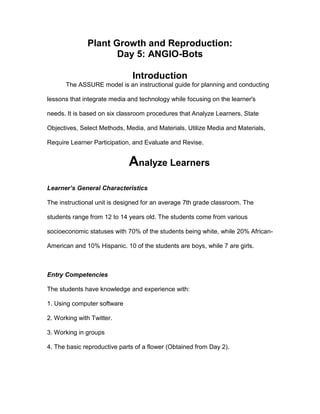
Plant Growth and Reproduction:
Day 5: ANGIO-Bots
Introduction
The ASSURE model is an instructional guide for planning and conducting
lessons that integrate media and technology while focusing on the learner's
needs. It is based on six classroom procedures that Analyze Learners, State
Objectives, Select Methods, Media, and Materials, Utilize Media and Materials,
Require Learner Participation, and Evaluate and Revise.
Analyze Learners
Learner’s General Characteristics
The instructional unit is designed for an average 7th grade classroom. The
students range from 12 to 14 years old. The students come from various
socioeconomic statuses with 70% of the students being white, while 20% African-
American and 10% Hispanic. 10 of the students are boys, while 7 are girls.
Entry Competencies
The students have knowledge and experience with:
1. Using computer software
2. Working with Twitter.
3. Working in groups
4. The basic reproductive parts of a flower (Obtained from Day 2).
Learning Styles
The students for the most part slightly under their reading level. They do not
respond to oral lecturing and instead prefer audio and visual means as a way to
present and learn material. Most do not test well making rubrics the most
popular means for grading objective achievement.
State Objectives
At the end of this lesson which is estimated to last one class day, the students
will have learned the meaning of phototropism and gravitropism by use of the
robitic kits. They will also use critical thinking, collaboration, and problem solving
skills to create their bots. By the end of the day my students will be able to define
phototropism and gravitropism by showing how their bots operate with 100%
proficiency.
Select Methods, Media, and Materials
The Method chosen for this lesson was small group instruction with constant
teacher reinforcement. The lesson will begin with the instructor introducing the
basic parts and components of the Hummingbird robotic kit and software. The
students will then break into groups and create an ANGIO-Bot that either
demonstrates phototropism or gravatropism. Students will log their progress in
their design notebooks. Students will present their bots to the class upon
completion.
Utilize Media and Materials
Preview the Materials
The teacher the Hummingbird kits to ensure no missing parts
Prepare the Materials
The places kits on tables in group formations. Recyclable materials and crafts
supplies are placed in one part of the room for easy access.
Prepare the Environment
Kits and craft materials are laid on tables as well as design notebooks
Prepare the Learners
The students are told that they will making a flower robot that either moves
toward light or reacts to gravity
Provide the Learning Experience
The teacher will begin by demonstrating his or her own bot and then explain the
basics of assembling a bot and how the various parts work. The teacher will split
students into groups and allow them freedom to design, create, and program
their own bots. Bots will then be presented to the class either by showing
phototropism or gravitropism. Design notebooks will be collected for evaluation
as well as an insight to the reflection process.
Require Learner Participation
Large Group Activities
Students will interact with the class through bot presentations
Small Group Activities
Students will create their group bot as well as complete a design notebook
Technology
Hummingbird Robotic Kits
The class Twitter page will be used at the beginning of the class as a “bellringer”
to see what was leaned from the previous day’s assignment on Bean Planting.
Evaluate and Revise
Assessment of Learner Achievement
Students’ knowledge of the lesson can be gaged watching their interaction with
their partner as well as the presentation and notebook reflections
Evaluation of Media and Methods
The students will be asked at the end of the day what part of the lesson they
liked the most and what part they liked the least.
Evaluation of Overall Instruction
At the end of the lesson students will be able to explain phototropism and
gravitropism by use of their robots.

Assure model day 5

  • 1.
    Plant Growth andReproduction: Day 5: ANGIO-Bots Introduction The ASSURE model is an instructional guide for planning and conducting lessons that integrate media and technology while focusing on the learner's needs. It is based on six classroom procedures that Analyze Learners, State Objectives, Select Methods, Media, and Materials, Utilize Media and Materials, Require Learner Participation, and Evaluate and Revise. Analyze Learners Learner’s General Characteristics The instructional unit is designed for an average 7th grade classroom. The students range from 12 to 14 years old. The students come from various socioeconomic statuses with 70% of the students being white, while 20% African- American and 10% Hispanic. 10 of the students are boys, while 7 are girls. Entry Competencies The students have knowledge and experience with: 1. Using computer software 2. Working with Twitter. 3. Working in groups 4. The basic reproductive parts of a flower (Obtained from Day 2).
  • 2.
    Learning Styles The studentsfor the most part slightly under their reading level. They do not respond to oral lecturing and instead prefer audio and visual means as a way to present and learn material. Most do not test well making rubrics the most popular means for grading objective achievement. State Objectives At the end of this lesson which is estimated to last one class day, the students will have learned the meaning of phototropism and gravitropism by use of the robitic kits. They will also use critical thinking, collaboration, and problem solving skills to create their bots. By the end of the day my students will be able to define phototropism and gravitropism by showing how their bots operate with 100% proficiency. Select Methods, Media, and Materials The Method chosen for this lesson was small group instruction with constant teacher reinforcement. The lesson will begin with the instructor introducing the basic parts and components of the Hummingbird robotic kit and software. The students will then break into groups and create an ANGIO-Bot that either demonstrates phototropism or gravatropism. Students will log their progress in their design notebooks. Students will present their bots to the class upon completion.
  • 3.
    Utilize Media andMaterials Preview the Materials The teacher the Hummingbird kits to ensure no missing parts Prepare the Materials The places kits on tables in group formations. Recyclable materials and crafts supplies are placed in one part of the room for easy access. Prepare the Environment Kits and craft materials are laid on tables as well as design notebooks Prepare the Learners The students are told that they will making a flower robot that either moves toward light or reacts to gravity Provide the Learning Experience The teacher will begin by demonstrating his or her own bot and then explain the basics of assembling a bot and how the various parts work. The teacher will split students into groups and allow them freedom to design, create, and program their own bots. Bots will then be presented to the class either by showing phototropism or gravitropism. Design notebooks will be collected for evaluation as well as an insight to the reflection process. Require Learner Participation
  • 4.
    Large Group Activities Studentswill interact with the class through bot presentations Small Group Activities Students will create their group bot as well as complete a design notebook Technology Hummingbird Robotic Kits The class Twitter page will be used at the beginning of the class as a “bellringer” to see what was leaned from the previous day’s assignment on Bean Planting. Evaluate and Revise Assessment of Learner Achievement Students’ knowledge of the lesson can be gaged watching their interaction with their partner as well as the presentation and notebook reflections Evaluation of Media and Methods The students will be asked at the end of the day what part of the lesson they liked the most and what part they liked the least. Evaluation of Overall Instruction At the end of the lesson students will be able to explain phototropism and gravitropism by use of their robots.