Department of CSE
City University
Class note-5
Course Title: Data Communication
Course Code:CSE-313
Submition To:
Pranab Bondhu Nath
Senior Lecturer
Department of CSE
City University
Submitted by
Name: Nazmun Nahar
Id:1834902176
Department:CSE(Day)
Batch:49th
Section:B
Differences between baseband and broadband transmissions:
Both baseband and broadband describe how data is transmitted between two nodes.
Baseband technology transmits a single data signal/stream/channel at a time while
broadband technology transmits multiple data signals/streams/channels
simultaneously at the same time.
The following image shows an example of both technologies.
To understand the basic differences between both technologies, considering the
baseband as a railway track and the broadband as a highway. Like, at a time, only one
train can go on a railway track, in the baseband transmission only one data signal can
be transmitted at a time.
Baseband transmission Broadband transmission
Transmit digital signals Transmit analog signals
To boost signal strength, use repeaters To boost signal strength, use amplifiers
Can transmit only a single data stream at a time Can transmit multiple signal waves at a time
Support bidirectional communication
simultaneously
Support unidirectional communication only
Use coaxial, twisted-pair, and fiber-optic cables Use radio waves, coaxial cables, and fiber optic
cables
Mainly used in Ethernet LAN networks Mainly used in cable and telephone networks
Unlike a railway track on a highway, multiple vehicles can go simultaneously. For
example, on a 3 lanes highway, 3 vehicles can go at the same time. Same as a
highway, in the broadband transmission, multiple data signals can be transmitted at
the same time.
Transmission Impairment:
In communication system, analog signals travel through transmission media, which
tends to deteriorate the quality of analog signal, which means that the signal at the
beginning of the medium is not the same as the signal at the end of the medium.
The imperfection causes signal impairment. Below are the causes of the impairment.
Consequences
1. For a digital signal, there may occur bit errors.
2. For analog signals, these impairments degrade the quality of the signals.
Causes of impairment
There are three main causes of impairment are,
1. Attenuation
2. Distortion
3. Noise
Causes of impairment –
• Attenuation – It means loss of energy. The strength of signal decreases with
increasing distance which causes loss of energy in overcoming resistance of
medium. This is also known as attenuated signal. Amplifiers are used to amplify
the attenuated signal which gives the original signal back and compensate for
this loss.
•
• Image Source – aviationchief
Attenuation is measured in decibels(dB). It measures the relative strengths of two
signals or one signal at two different point.
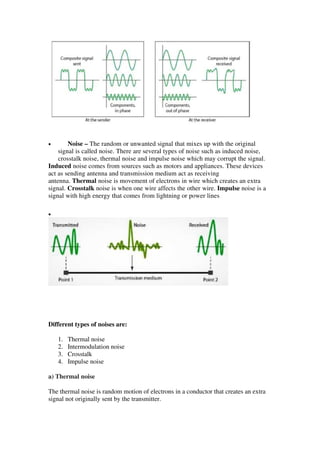
• Distortion – It means changes in the form or shape of the signal. This is
generally seen in composite signals made up with different frequencies. Each
frequency component has its own propagation speed travelling through a
medium. And thats why it delay in arriving at the final destination Every
component arrive at different time which leads to distortion. Therefore, they
have different phases at receiver end from what they had at senders end.
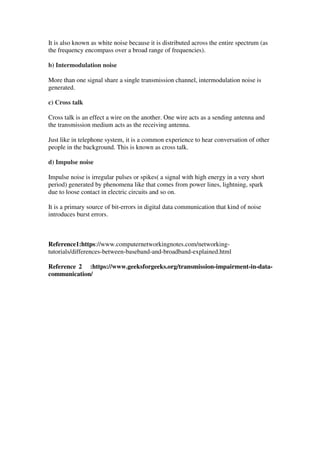
• Noise – The random or unwanted signal that mixes up with the original
signal is called noise. There are several types of noise such as induced noise,
crosstalk noise, thermal noise and impulse noise which may corrupt the signal.
Induced noise comes from sources such as motors and appliances. These devices
act as sending antenna and transmission medium act as receiving
antenna. Thermal noise is movement of electrons in wire which creates an extra
signal. Crosstalk noise is when one wire affects the other wire. Impulse noise is a
signal with high energy that comes from lightning or power lines
•
Different types of noises are:
1. Thermal noise
2. Intermodulation noise
3. Crosstalk
4. Impulse noise
a) Thermal noise
The thermal noise is random motion of electrons in a conductor that creates an extra
signal not originally sent by the transmitter.
It is also known as white noise because it is distributed across the entire spectrum (as
the frequency encompass over a broad range of frequencies).
b) Intermodulation noise
More than one signal share a single transmission channel, intermodulation noise is
generated.
c) Cross talk
Cross talk is an effect a wire on the another. One wire acts as a sending antenna and
the transmission medium acts as the receiving antenna.
Just like in telephone system, it is a common experience to hear conversation of other
people in the background. This is known as cross talk.
d) Impulse noise
Impulse noise is irregular pulses or spikes( a signal with high energy in a very short
period) generated by phenomena like that comes from power lines, lightning, spark
due to loose contact in electric circuits and so on.
It is a primary source of bit-errors in digital data communication that kind of noise
introduces burst errors.
Reference1:https://www.computernetworkingnotes.com/networking-
tutorials/differences-between-baseband-and-broadband-explained.html
Reference 2 :https://www.geeksforgeeks.org/transmission-impairment-in-data-
communication/

Class note 5..nazmun nahar 1834902176

  • 1.
    Department of CSE CityUniversity Class note-5 Course Title: Data Communication Course Code:CSE-313 Submition To: Pranab Bondhu Nath Senior Lecturer Department of CSE City University Submitted by Name: Nazmun Nahar Id:1834902176 Department:CSE(Day) Batch:49th Section:B
  • 2.
    Differences between basebandand broadband transmissions: Both baseband and broadband describe how data is transmitted between two nodes. Baseband technology transmits a single data signal/stream/channel at a time while broadband technology transmits multiple data signals/streams/channels simultaneously at the same time. The following image shows an example of both technologies. To understand the basic differences between both technologies, considering the baseband as a railway track and the broadband as a highway. Like, at a time, only one train can go on a railway track, in the baseband transmission only one data signal can be transmitted at a time. Baseband transmission Broadband transmission Transmit digital signals Transmit analog signals To boost signal strength, use repeaters To boost signal strength, use amplifiers Can transmit only a single data stream at a time Can transmit multiple signal waves at a time Support bidirectional communication simultaneously Support unidirectional communication only Use coaxial, twisted-pair, and fiber-optic cables Use radio waves, coaxial cables, and fiber optic cables Mainly used in Ethernet LAN networks Mainly used in cable and telephone networks
  • 3.
    Unlike a railwaytrack on a highway, multiple vehicles can go simultaneously. For example, on a 3 lanes highway, 3 vehicles can go at the same time. Same as a highway, in the broadband transmission, multiple data signals can be transmitted at the same time. Transmission Impairment: In communication system, analog signals travel through transmission media, which tends to deteriorate the quality of analog signal, which means that the signal at the beginning of the medium is not the same as the signal at the end of the medium. The imperfection causes signal impairment. Below are the causes of the impairment. Consequences 1. For a digital signal, there may occur bit errors. 2. For analog signals, these impairments degrade the quality of the signals. Causes of impairment There are three main causes of impairment are, 1. Attenuation 2. Distortion 3. Noise Causes of impairment –
  • 4.
    • Attenuation –It means loss of energy. The strength of signal decreases with increasing distance which causes loss of energy in overcoming resistance of medium. This is also known as attenuated signal. Amplifiers are used to amplify the attenuated signal which gives the original signal back and compensate for this loss. • • Image Source – aviationchief Attenuation is measured in decibels(dB). It measures the relative strengths of two signals or one signal at two different point. • Distortion – It means changes in the form or shape of the signal. This is generally seen in composite signals made up with different frequencies. Each frequency component has its own propagation speed travelling through a medium. And thats why it delay in arriving at the final destination Every component arrive at different time which leads to distortion. Therefore, they have different phases at receiver end from what they had at senders end.
  • 5.
    • Noise –The random or unwanted signal that mixes up with the original signal is called noise. There are several types of noise such as induced noise, crosstalk noise, thermal noise and impulse noise which may corrupt the signal. Induced noise comes from sources such as motors and appliances. These devices act as sending antenna and transmission medium act as receiving antenna. Thermal noise is movement of electrons in wire which creates an extra signal. Crosstalk noise is when one wire affects the other wire. Impulse noise is a signal with high energy that comes from lightning or power lines • Different types of noises are: 1. Thermal noise 2. Intermodulation noise 3. Crosstalk 4. Impulse noise a) Thermal noise The thermal noise is random motion of electrons in a conductor that creates an extra signal not originally sent by the transmitter.
  • 6.
    It is alsoknown as white noise because it is distributed across the entire spectrum (as the frequency encompass over a broad range of frequencies). b) Intermodulation noise More than one signal share a single transmission channel, intermodulation noise is generated. c) Cross talk Cross talk is an effect a wire on the another. One wire acts as a sending antenna and the transmission medium acts as the receiving antenna. Just like in telephone system, it is a common experience to hear conversation of other people in the background. This is known as cross talk. d) Impulse noise Impulse noise is irregular pulses or spikes( a signal with high energy in a very short period) generated by phenomena like that comes from power lines, lightning, spark due to loose contact in electric circuits and so on. It is a primary source of bit-errors in digital data communication that kind of noise introduces burst errors. Reference1:https://www.computernetworkingnotes.com/networking- tutorials/differences-between-baseband-and-broadband-explained.html Reference 2 :https://www.geeksforgeeks.org/transmission-impairment-in-data- communication/