Assignment 8: Narrative Theory

       Chelsea Fashole-Luke
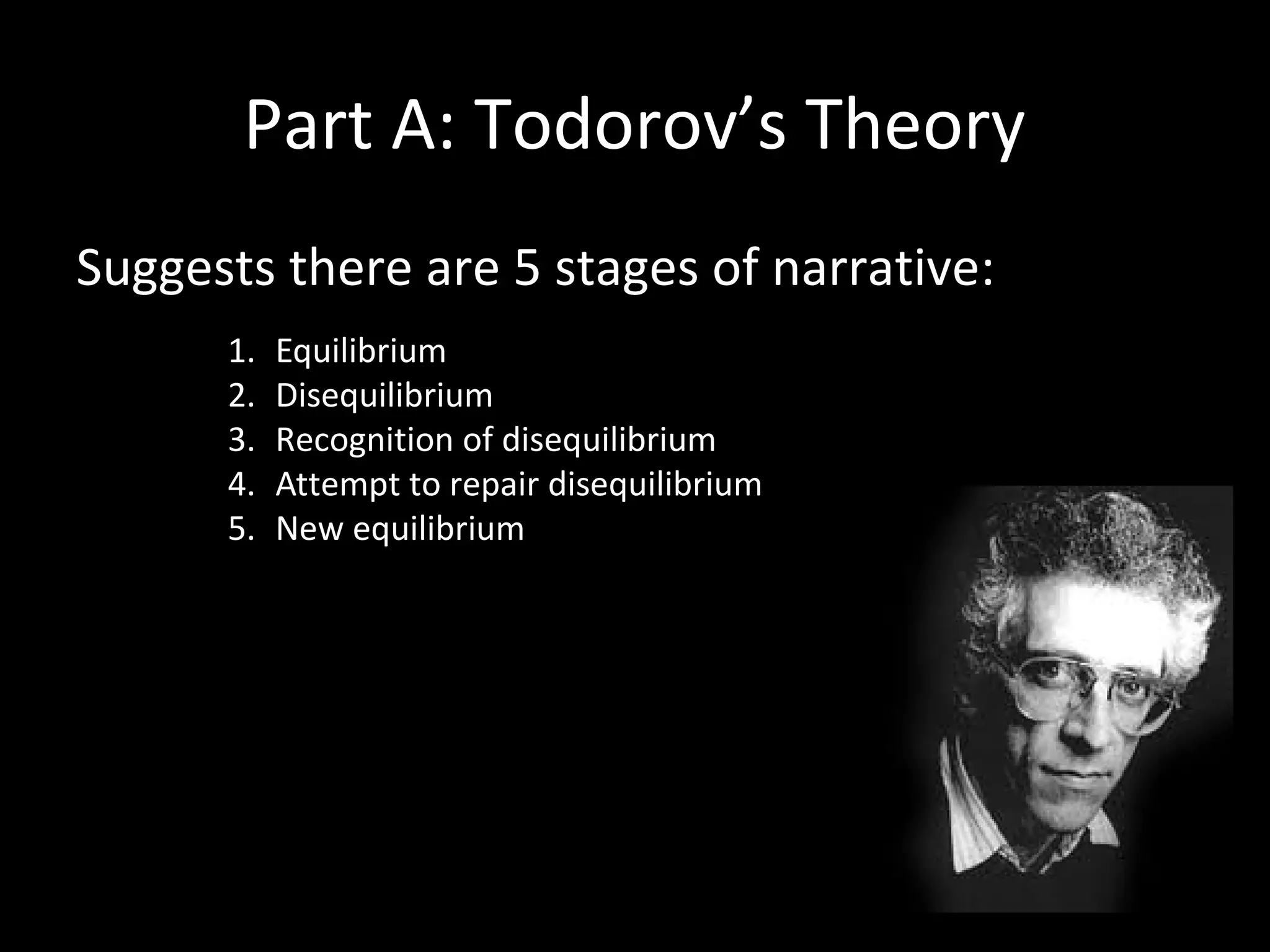
Part A: Todorov’s Theory
Suggests there are 5 stages of narrative:
      1.   Equilibrium
      2.   Disequilibrium
      3.   Recognition of disequilibrium
      4.   Attempt to repair disequilibrium
      5.   New equilibrium
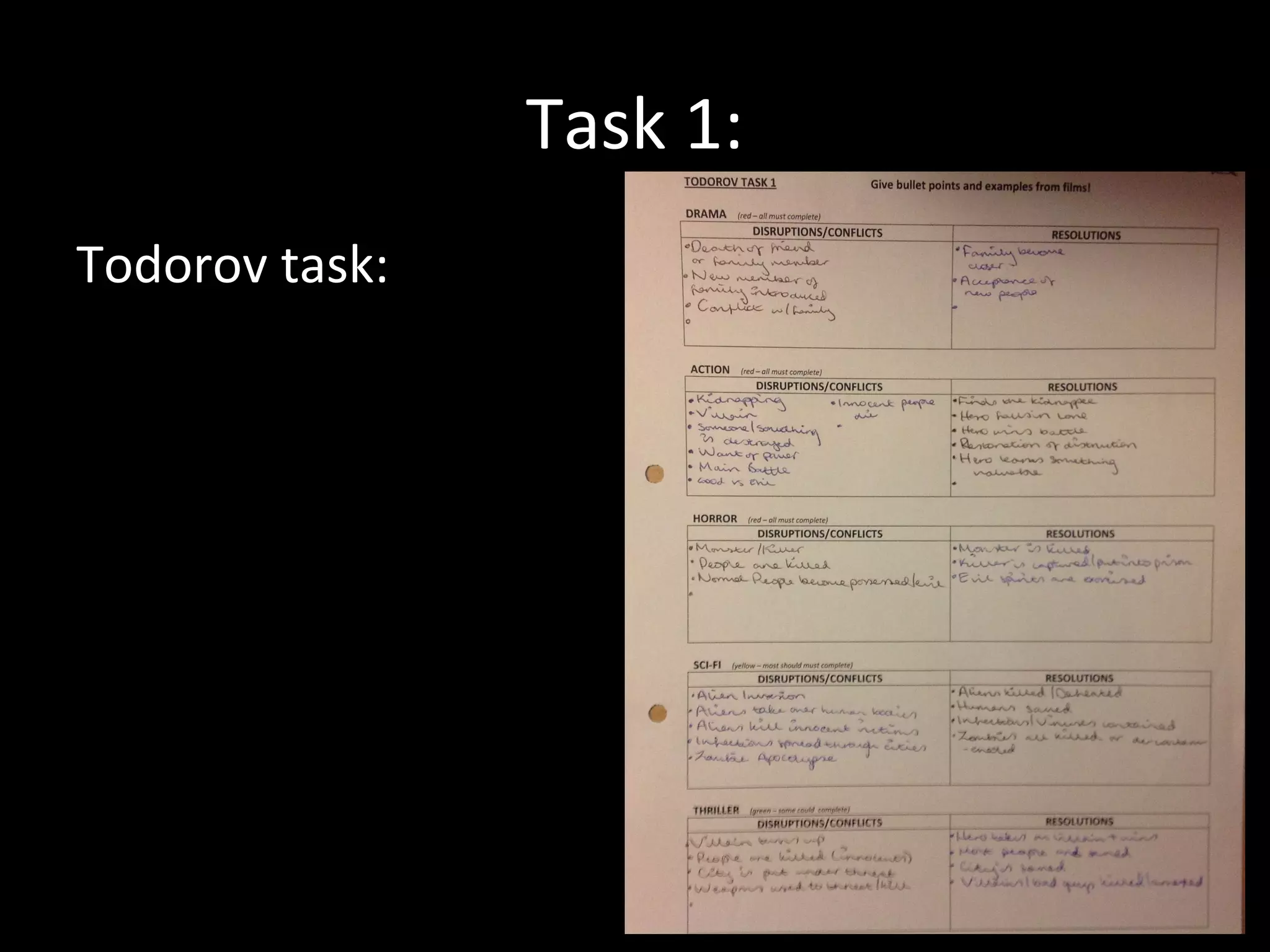
Task 1:
Todorov task:
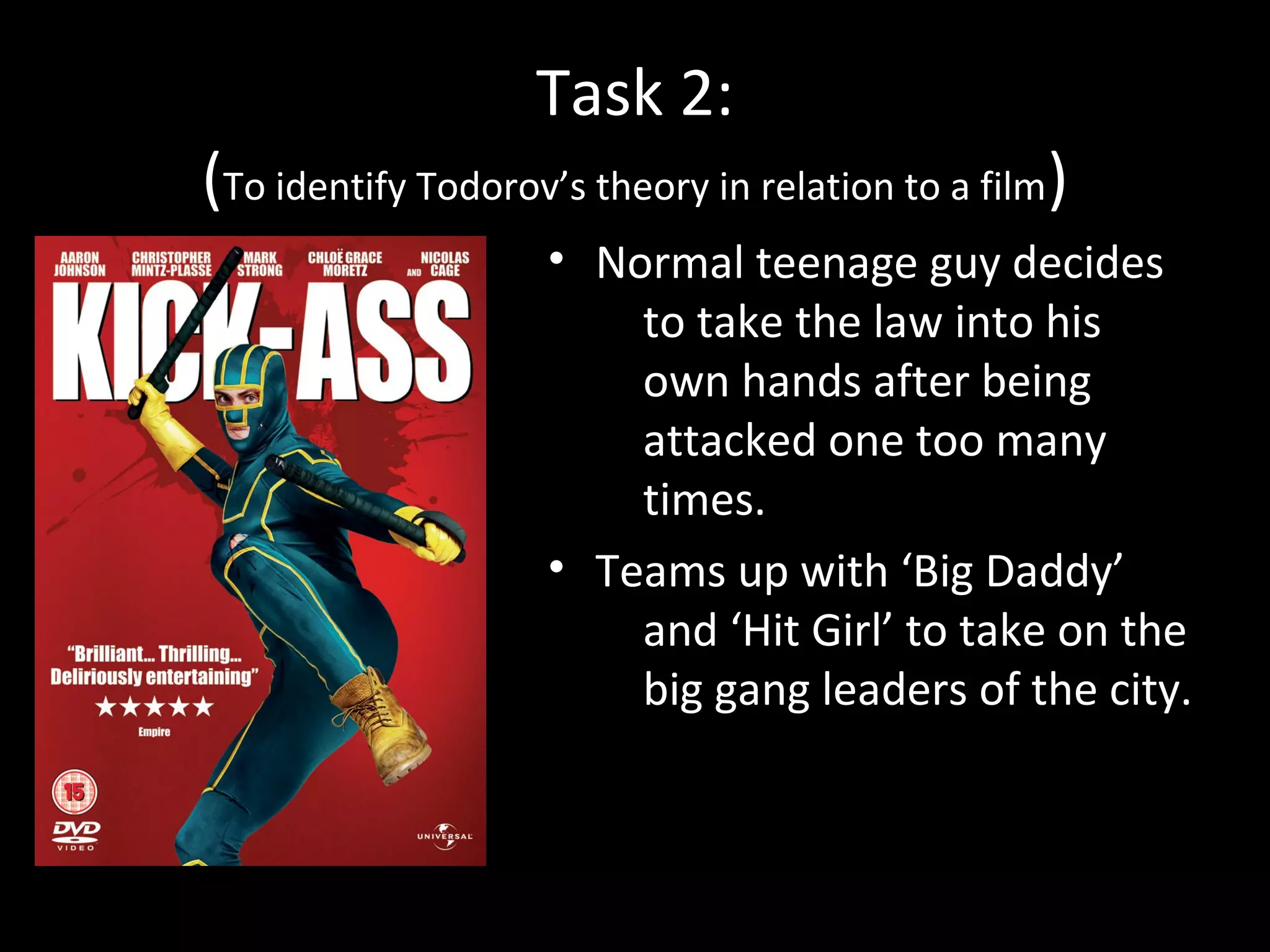
Task 2:
(To identify Todorov’s theory in relation to a film)
                    • Normal teenage guy decides
                        to take the law into his
                        own hands after being
                        attacked one too many
                        times.
                    • Teams up with ‘Big Daddy’
                        and ‘Hit Girl’ to take on the
                        big gang leaders of the city.
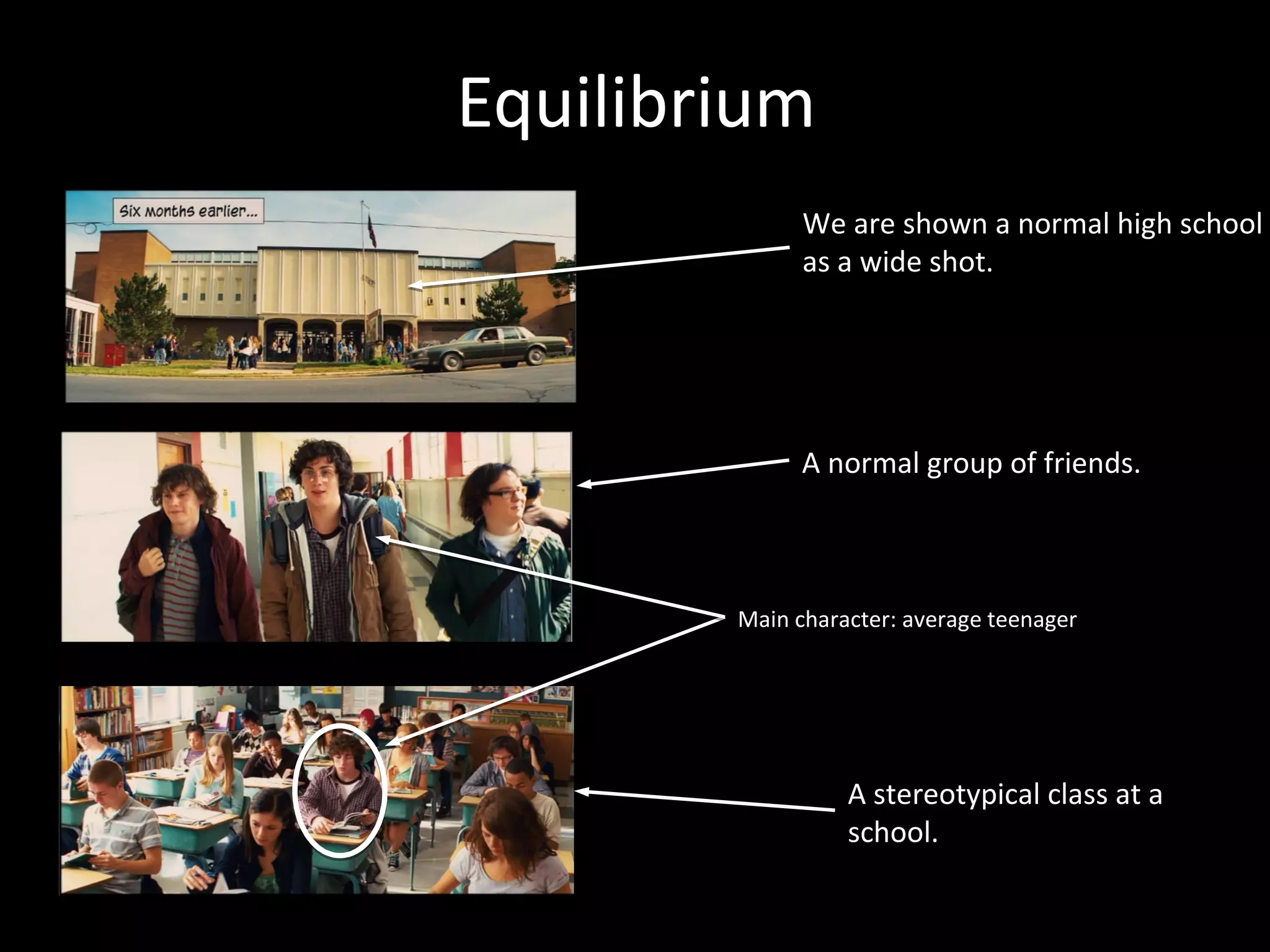
Equilibrium
              We are shown a normal high school
              as a wide shot.


              A normal group of friends.


        Main character: average teenager


                  A stereotypical class at a
                  school.
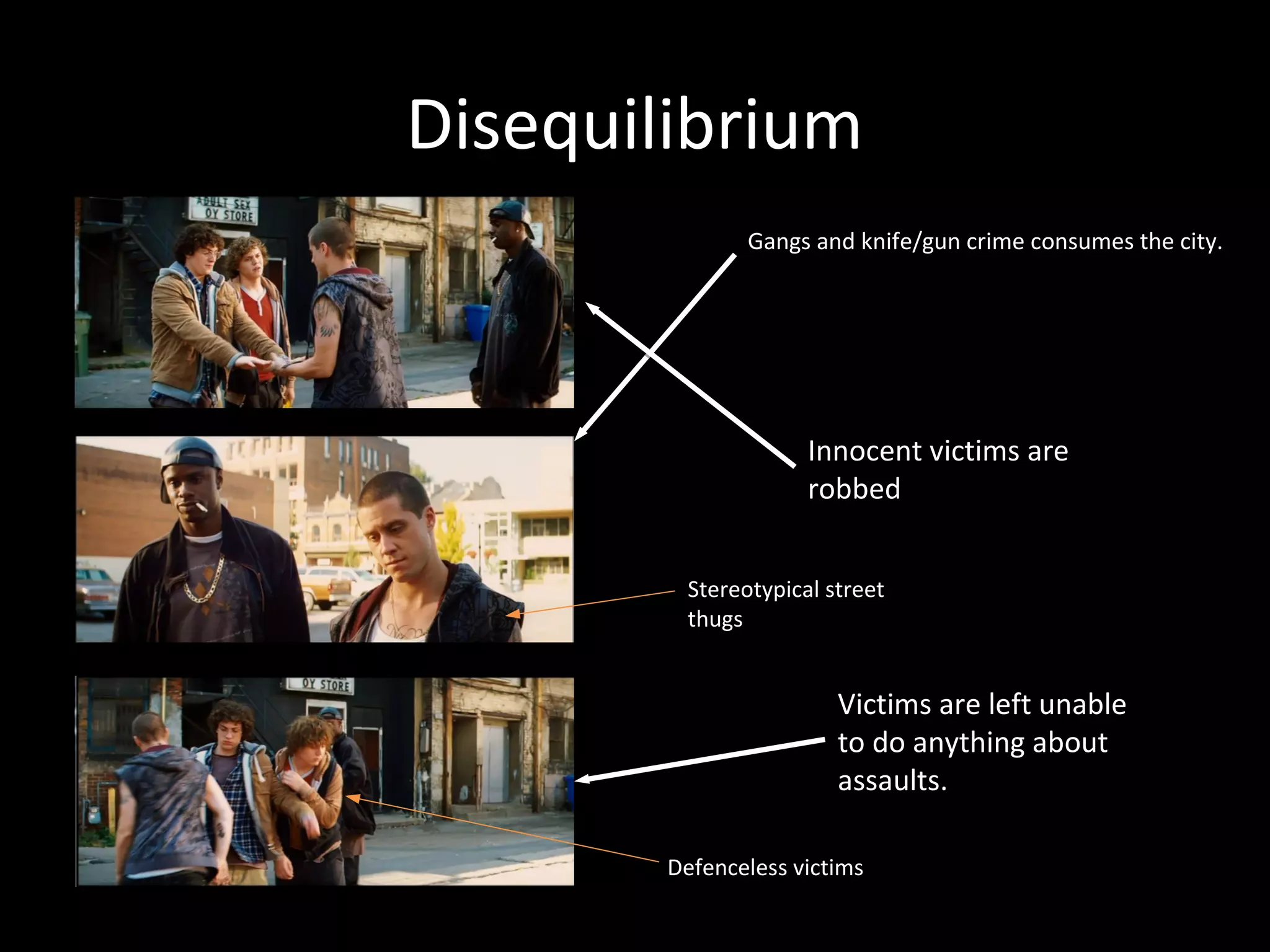
Disequilibrium
               Gangs and knife/gun crime consumes the city.


                     Innocent victims are
                     robbed


         Stereotypical street
         thugs


                        Victims are left unable
                        to do anything about
                        assaults.

        Defenceless victims
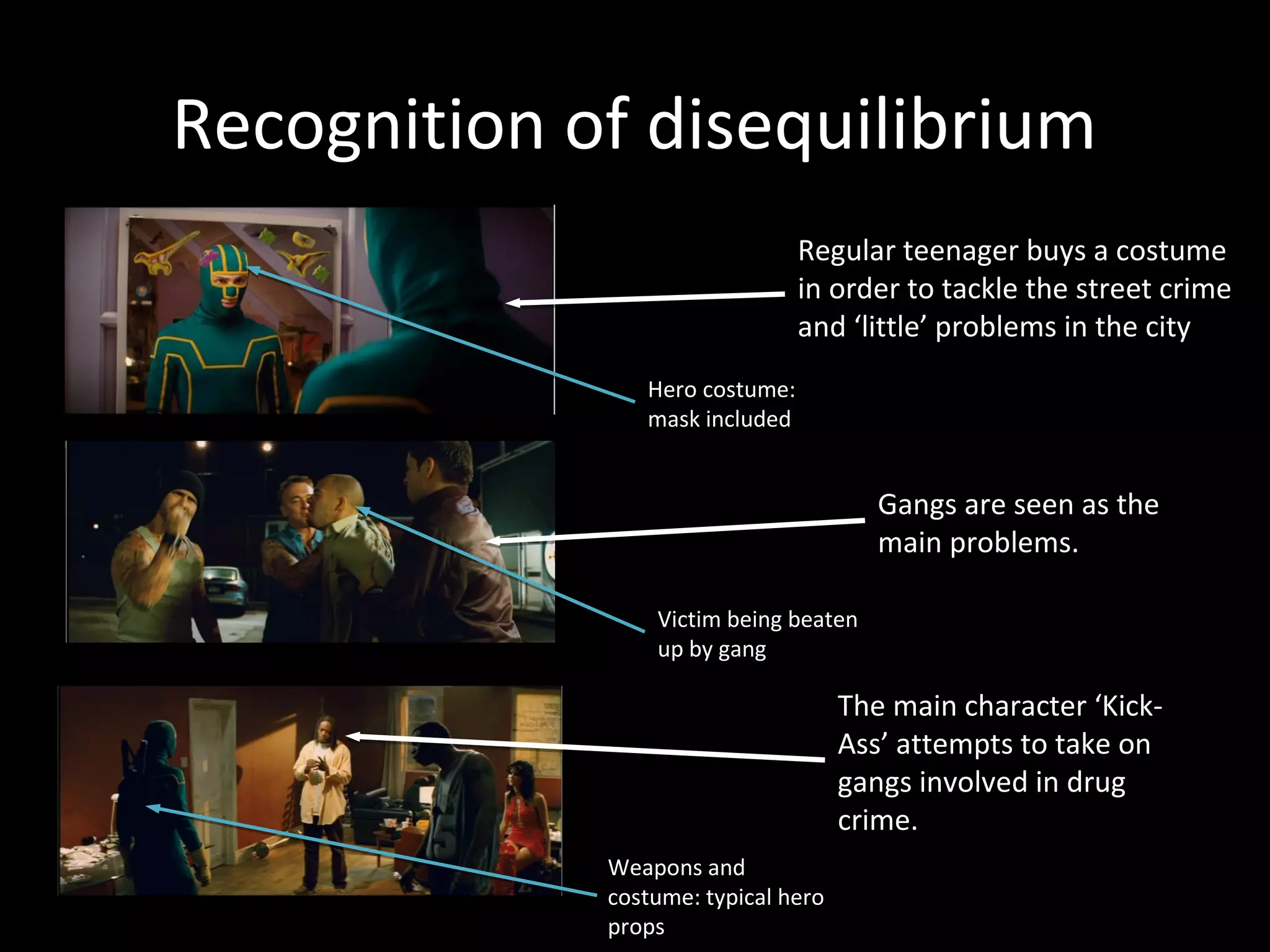
Recognition of disequilibrium
                                Regular teenager buys a costume
                                in order to tackle the street crime
                                and ‘little’ problems in the city
                Hero costume:
                mask included


                                        Gangs are seen as the
                                        main problems.

                 Victim being beaten
                 up by gang

                                     The main character ‘Kick-
                                     Ass’ attempts to take on
                                     gangs involved in drug
                                     crime.
             Weapons and
             costume: typical hero
             props
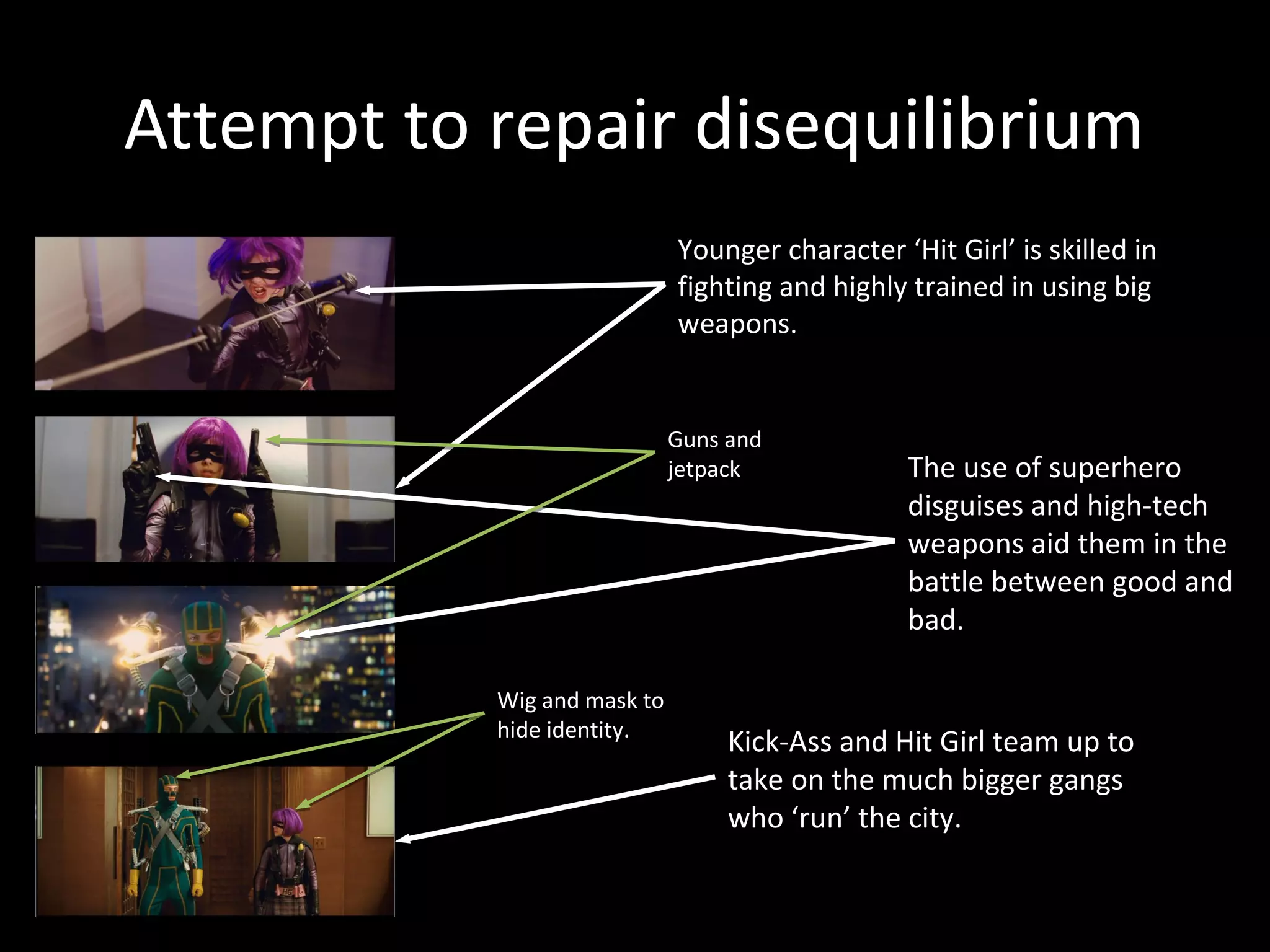
Attempt to repair disequilibrium
                             Younger character ‘Hit Girl’ is skilled in
                             fighting and highly trained in using big
                             weapons.


                             Guns and
                             jetpack             The use of superhero
                                                 disguises and high-tech
                                                 weapons aid them in the
                                                 battle between good and
                                                 bad.

           Wig and mask to
           hide identity.
                                  Kick-Ass and Hit Girl team up to
                                  take on the much bigger gangs
                                  who ‘run’ the city.
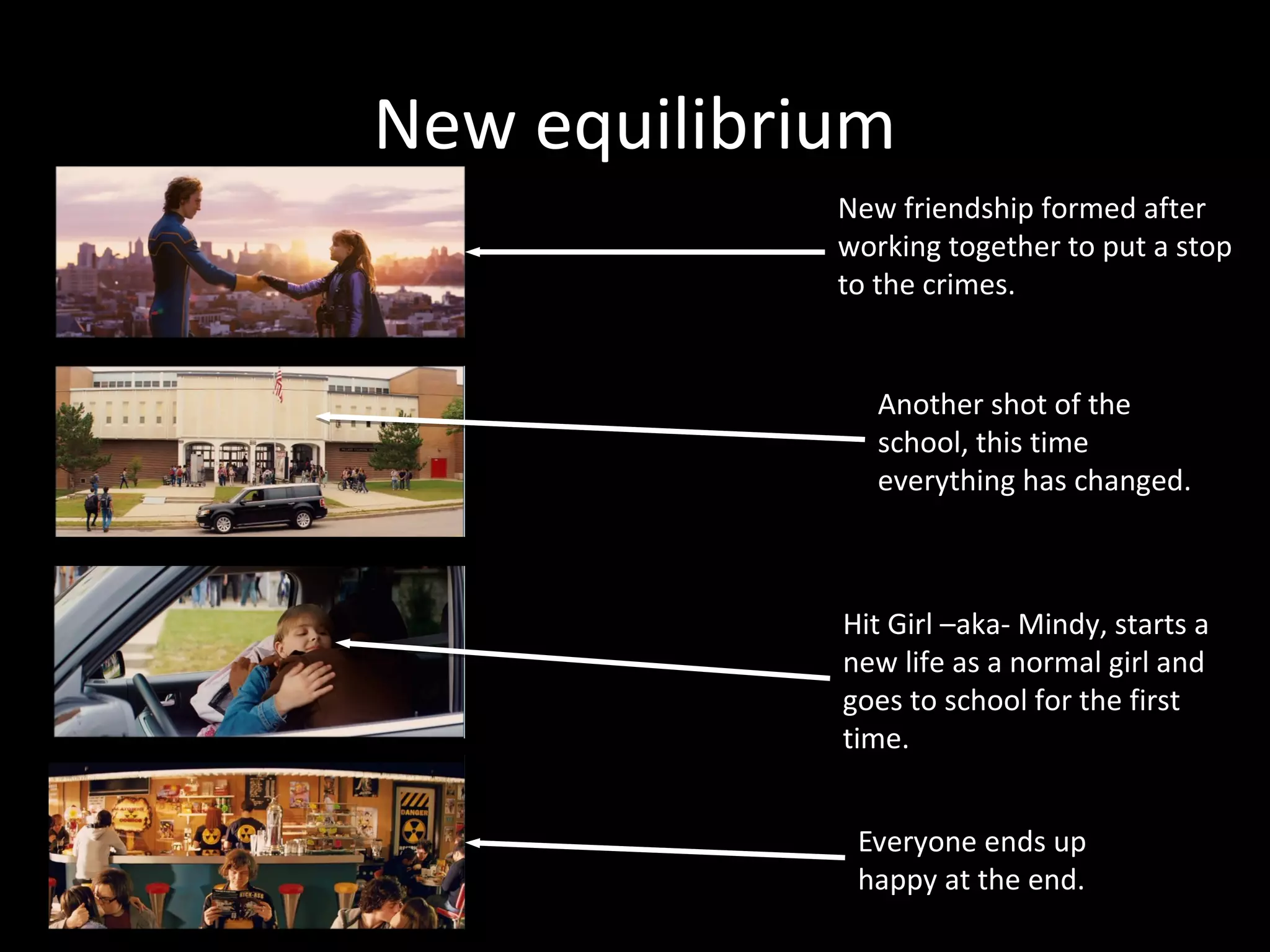
New equilibrium
             New friendship formed after
             working together to put a stop
             to the crimes.


                Another shot of the
                school, this time
                everything has changed.


             Hit Girl –aka- Mindy, starts a
             new life as a normal girl and
             goes to school for the first
             time.


              Everyone ends up
              happy at the end.
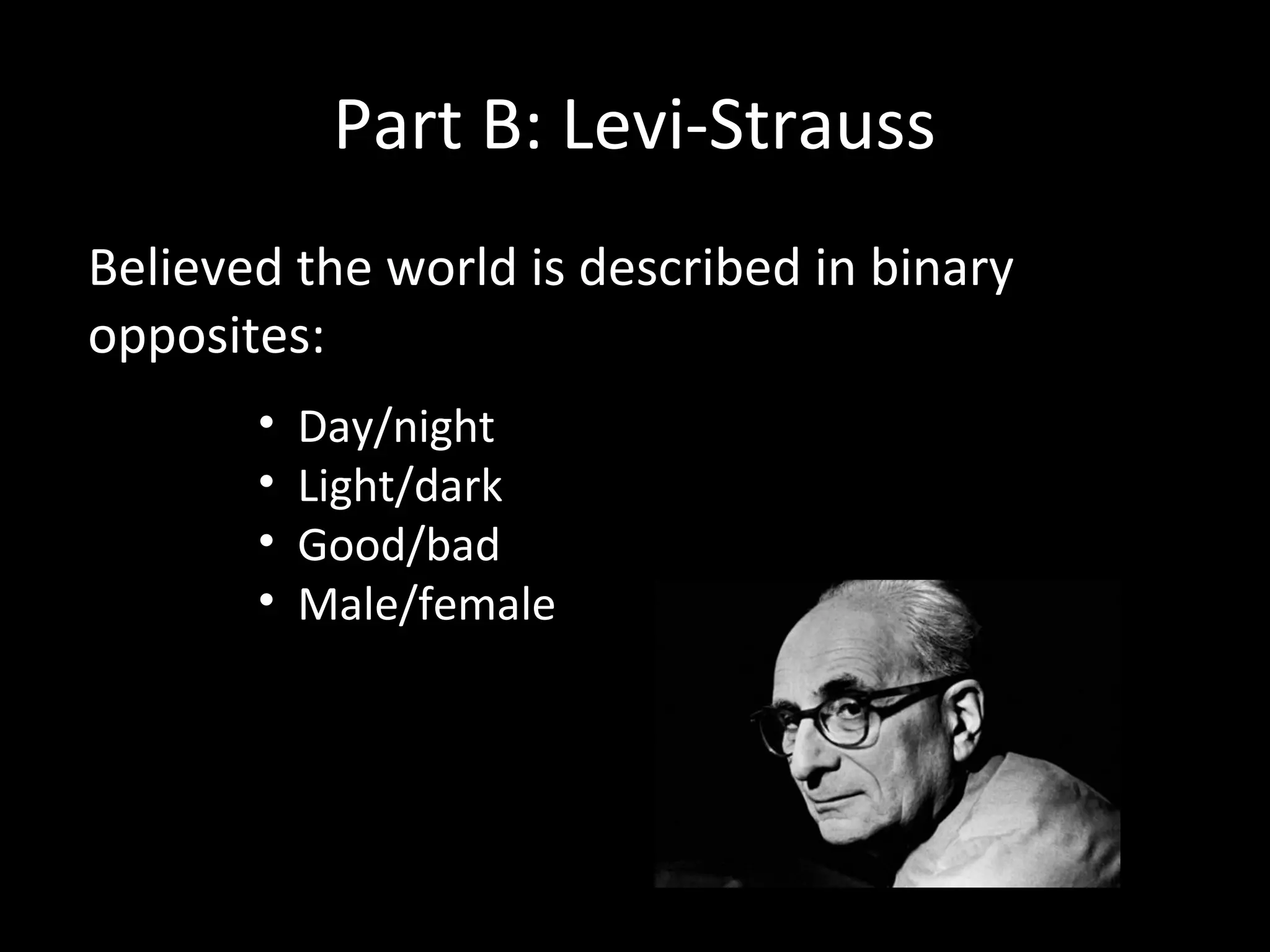
Part B: Levi-Strauss
Believed the world is described in binary
opposites:
       •   Day/night
       •   Light/dark
       •   Good/bad
       •   Male/female
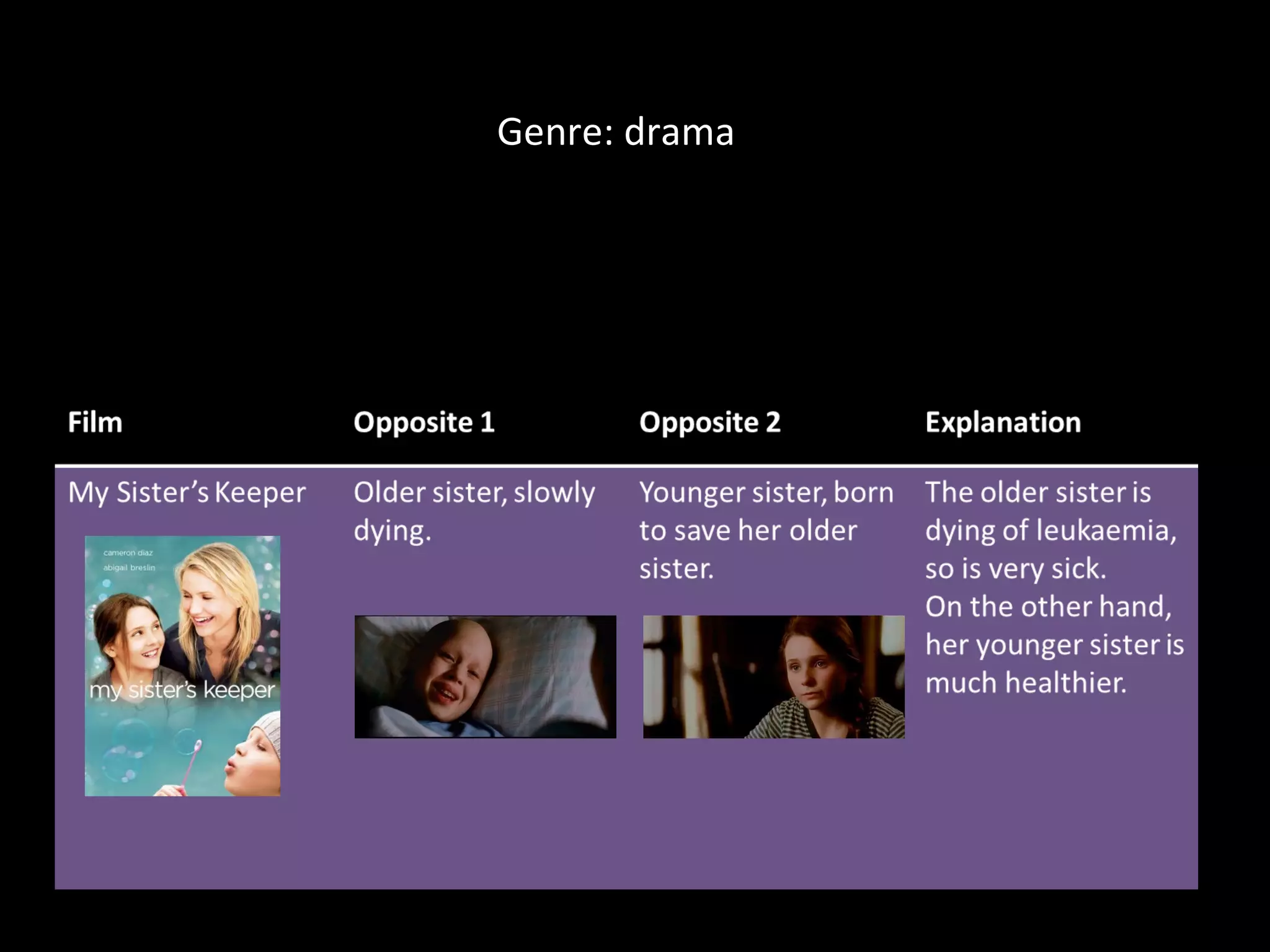
Genre: drama
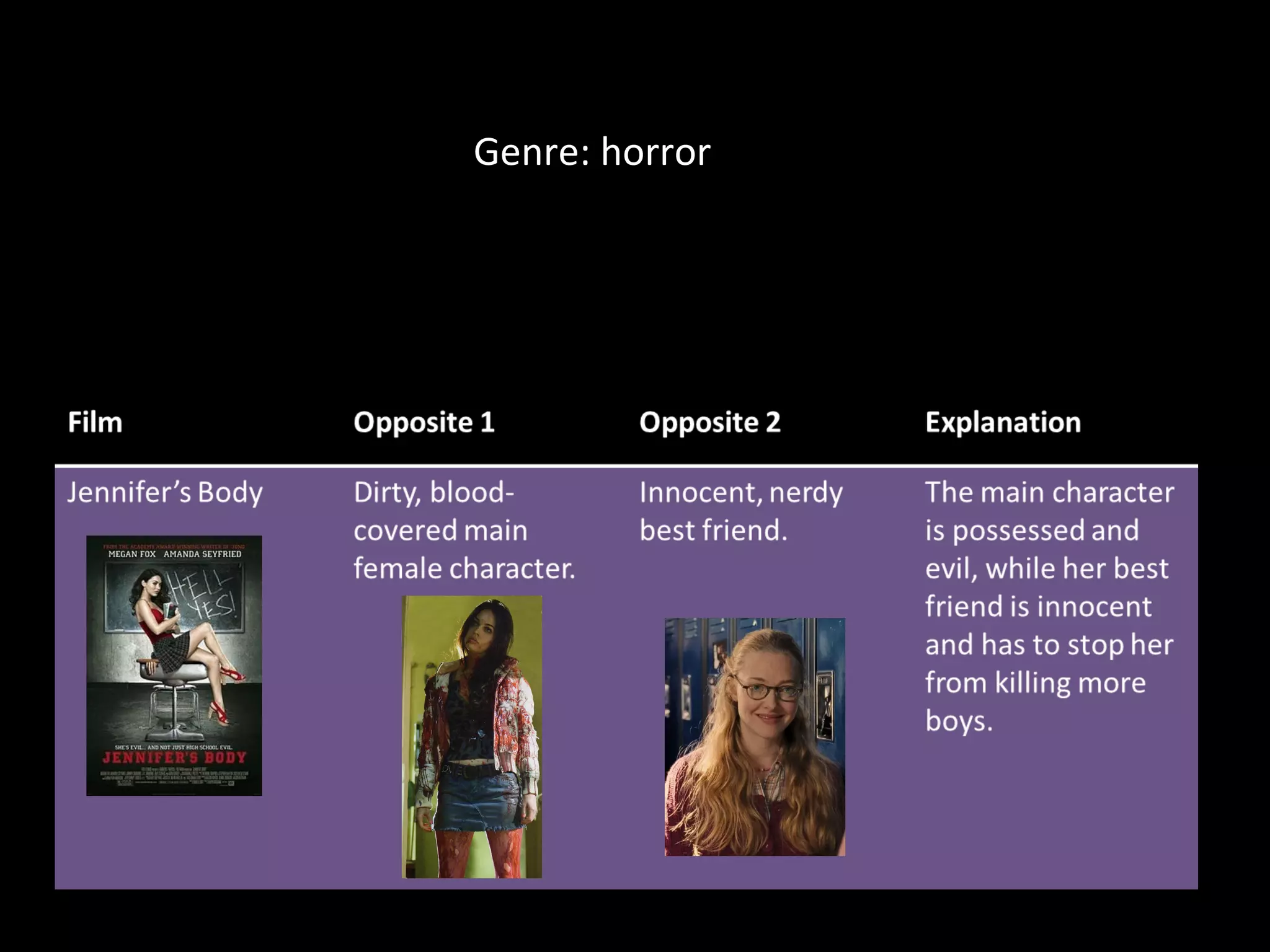
Genre: horror
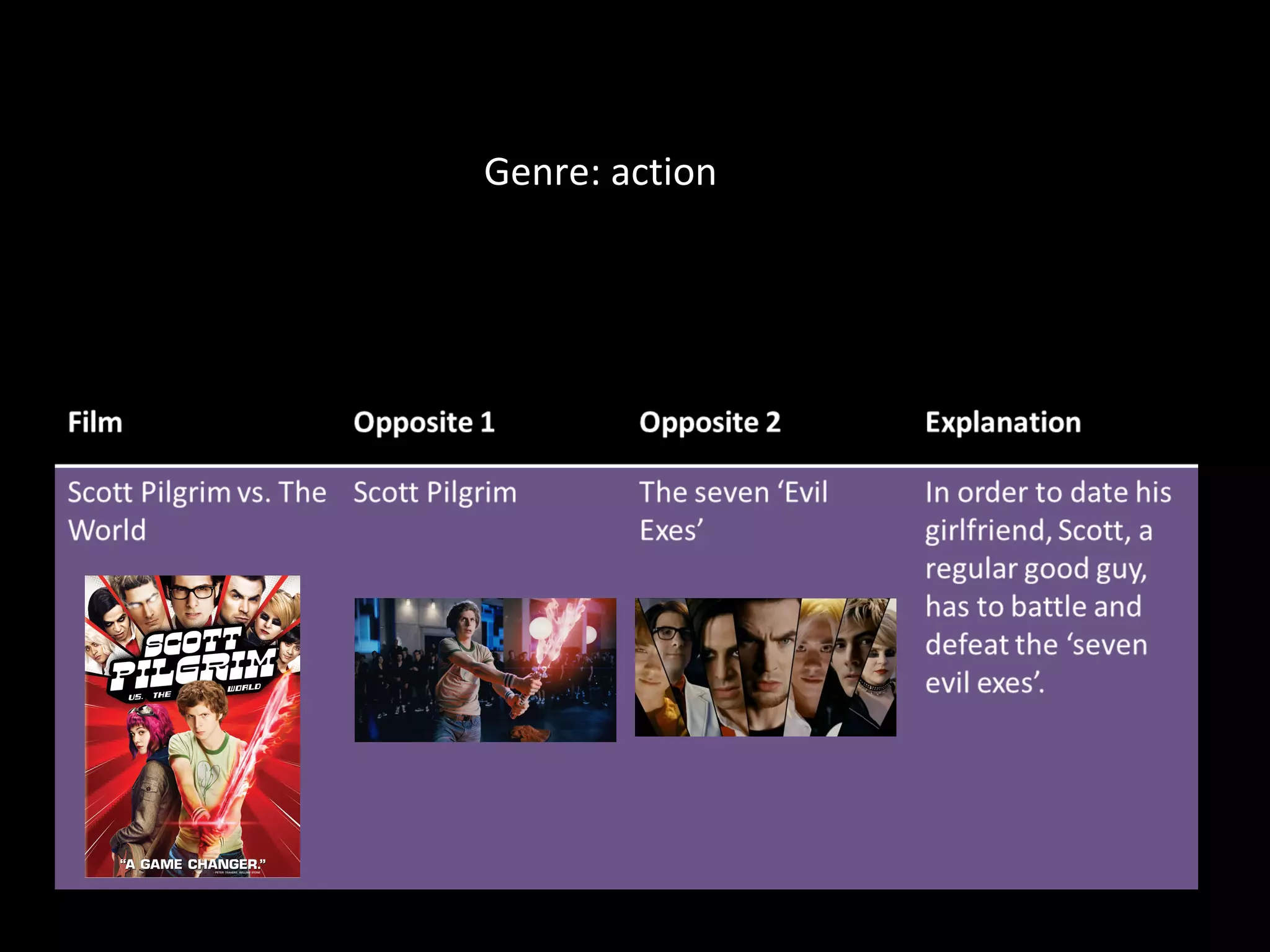
Genre: action
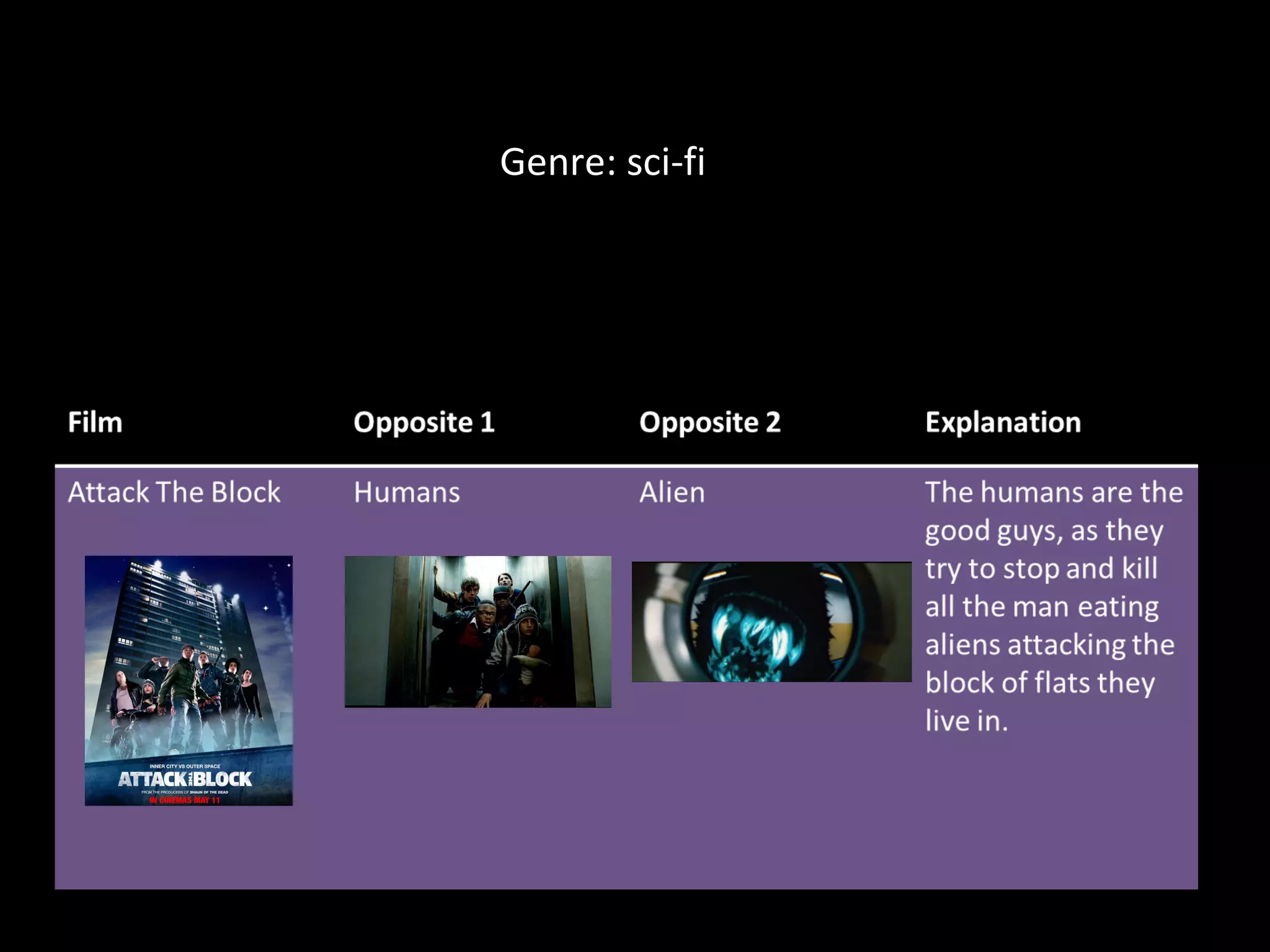
Genre: sci-fi
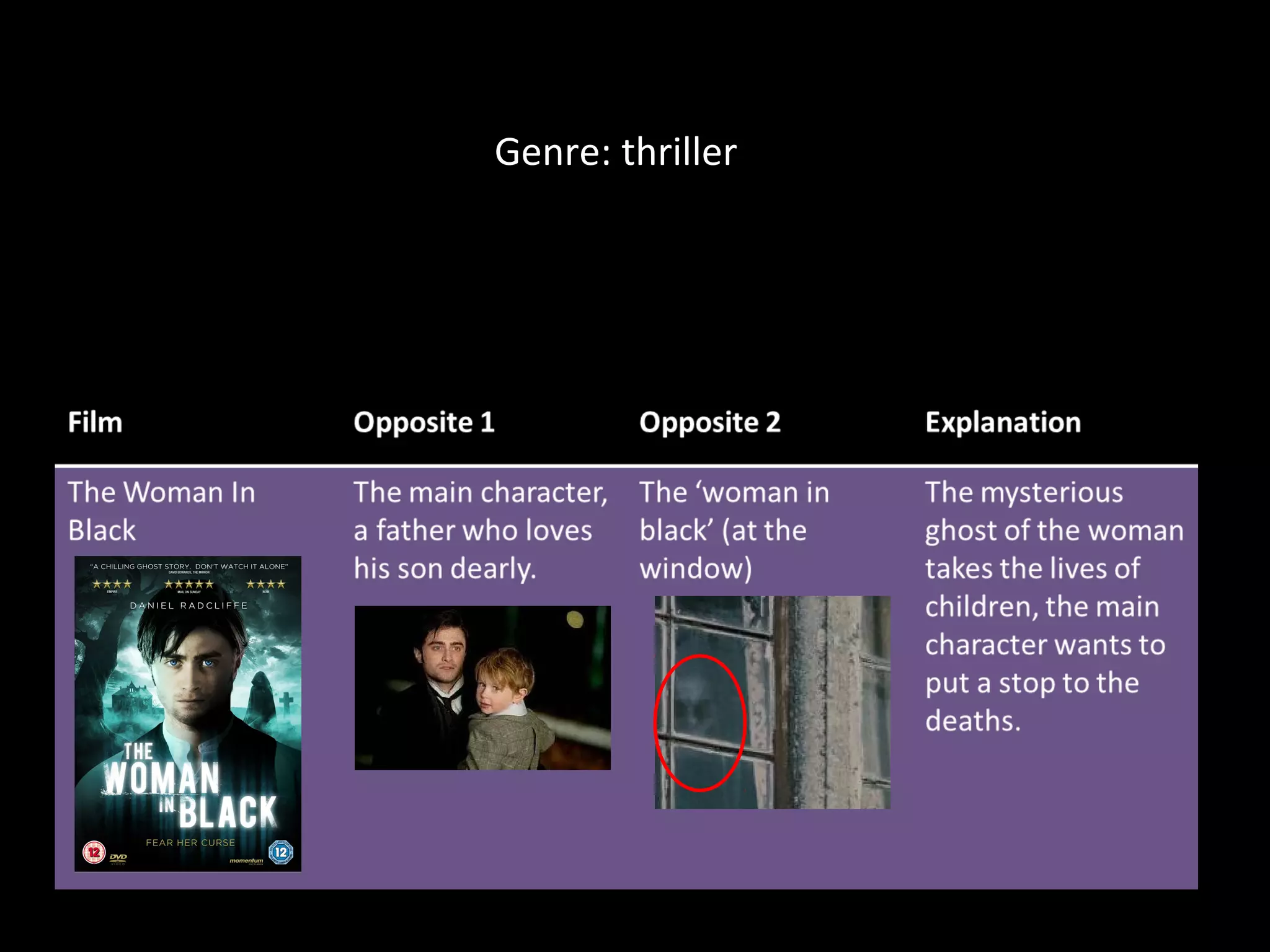
Genre: thriller
Part C: Barthes
Barthes theory of codes encourages the audience to
seek answers and clues to make them anticipate
outcomes.
        Identified by these codes:
        • Enigma Code
        • Action Code
        • Semantic Code
        • Symbolic Code
        • Cultural Code
Enigma Code
• Narratives are set up as puzzles to be solved by
    the audience.

           • Portrays a mystery and raises questions
               to draw in the audience.
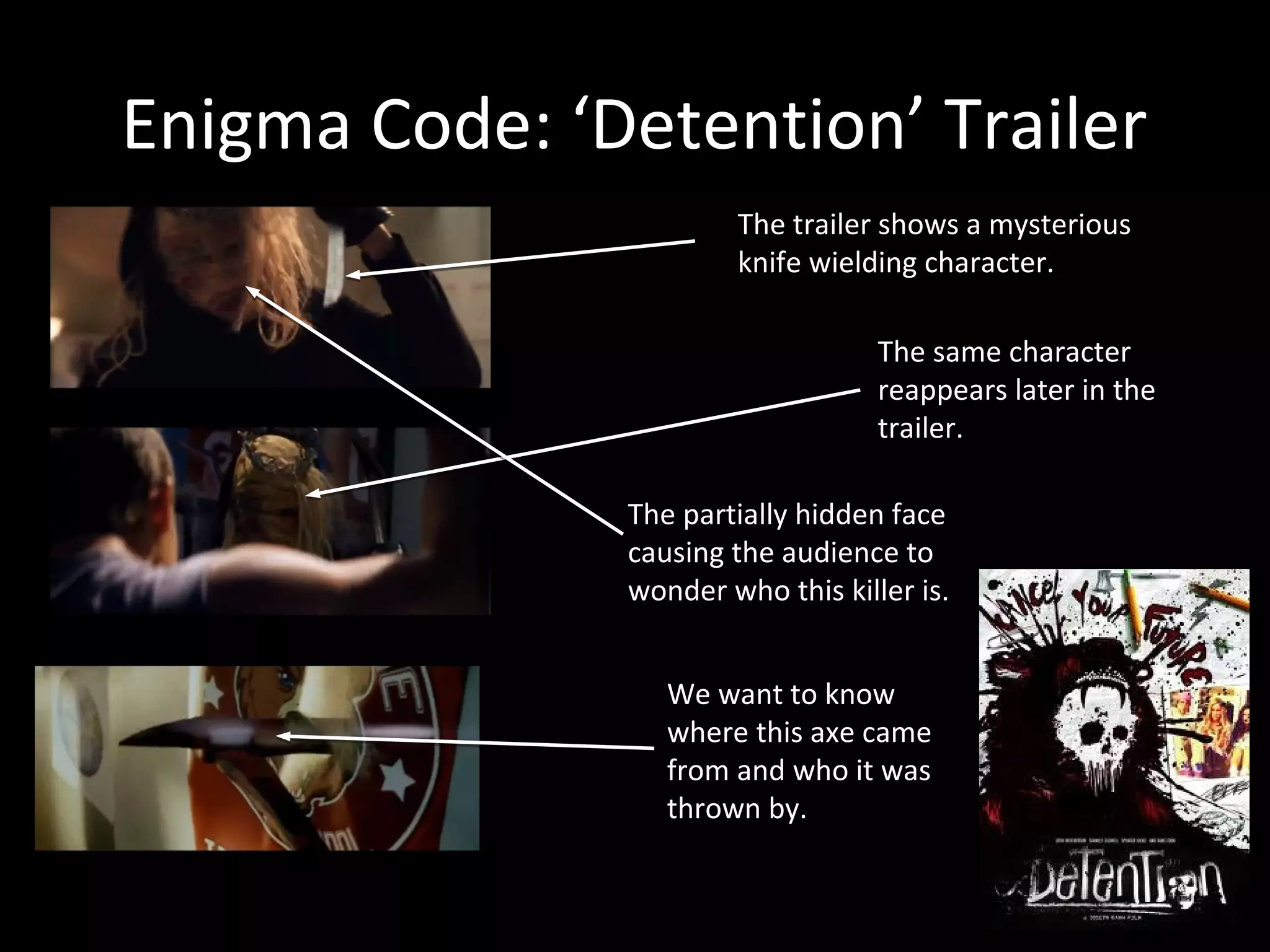
Enigma Code: ‘Detention’ Trailer
                       The trailer shows a mysterious
                       knife wielding character.

                                   The same character
                                   reappears later in the
                                   trailer.

               The partially hidden face
               causing the audience to
               wonder who this killer is.


                  We want to know
                  where this axe came
                  from and who it was
                  thrown by.
Action Code
These are codes of behaviours and actions that
lead the audience to expect certain
consequences based on the conventions of
other similar films or stories.
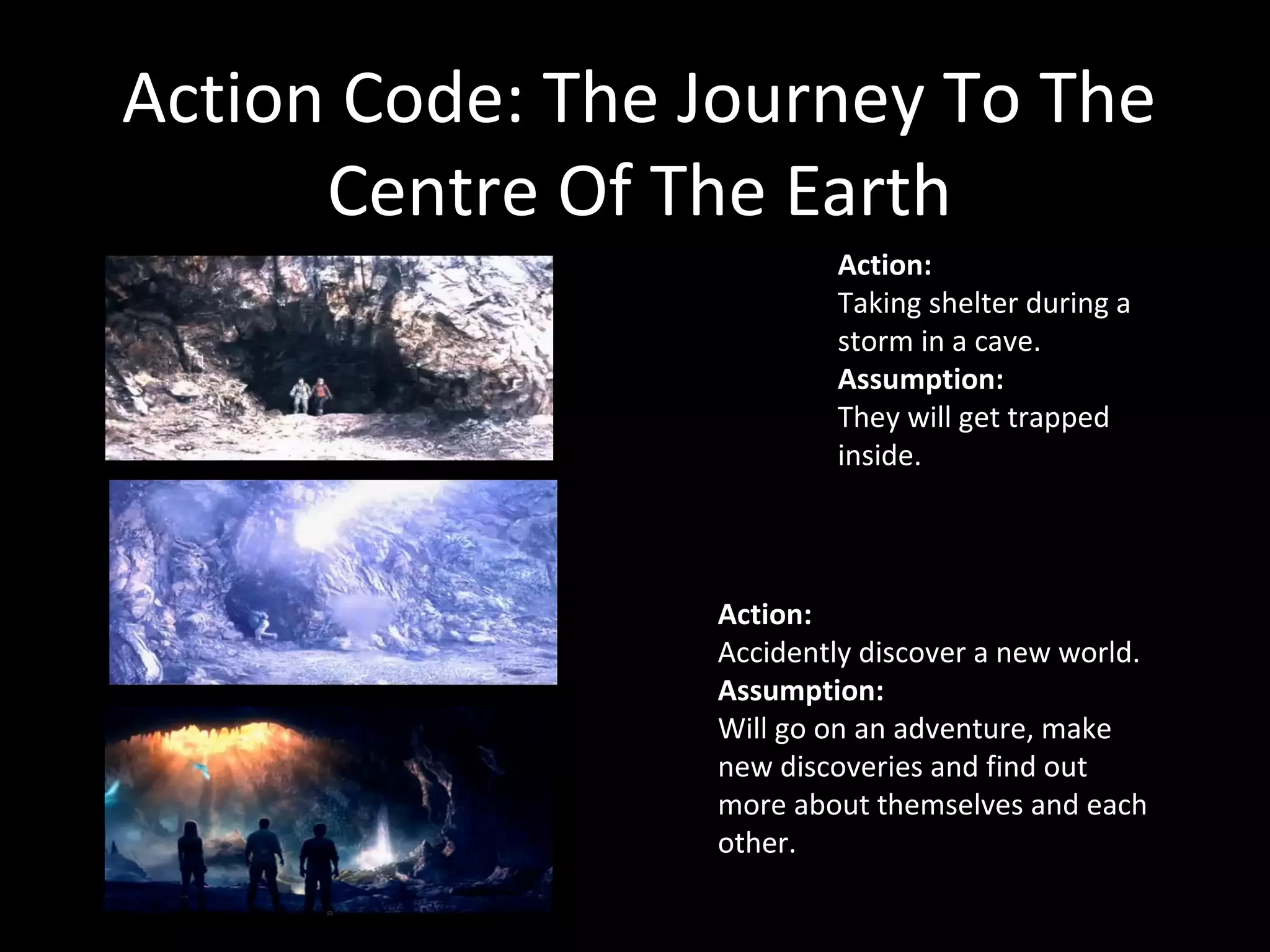
Action Code: The Journey To The
      Centre Of The Earth
                         Action:
                         Taking shelter during a
                         storm in a cave.
                         Assumption:
                         They will get trapped
                         inside.


                 Action:
                 Accidently discover a new world.
                 Assumption:
                 Will go on an adventure, make
                 new discoveries and find out
                 more about themselves and each
                 other.
Semantic Code
• Barthes semantic code contains
    connotative meanings of objects,
    characters and locations.


                       • We learn about the connotations
                          and denotations through
                          experience.


    • Iconographic features
         work in the same way.
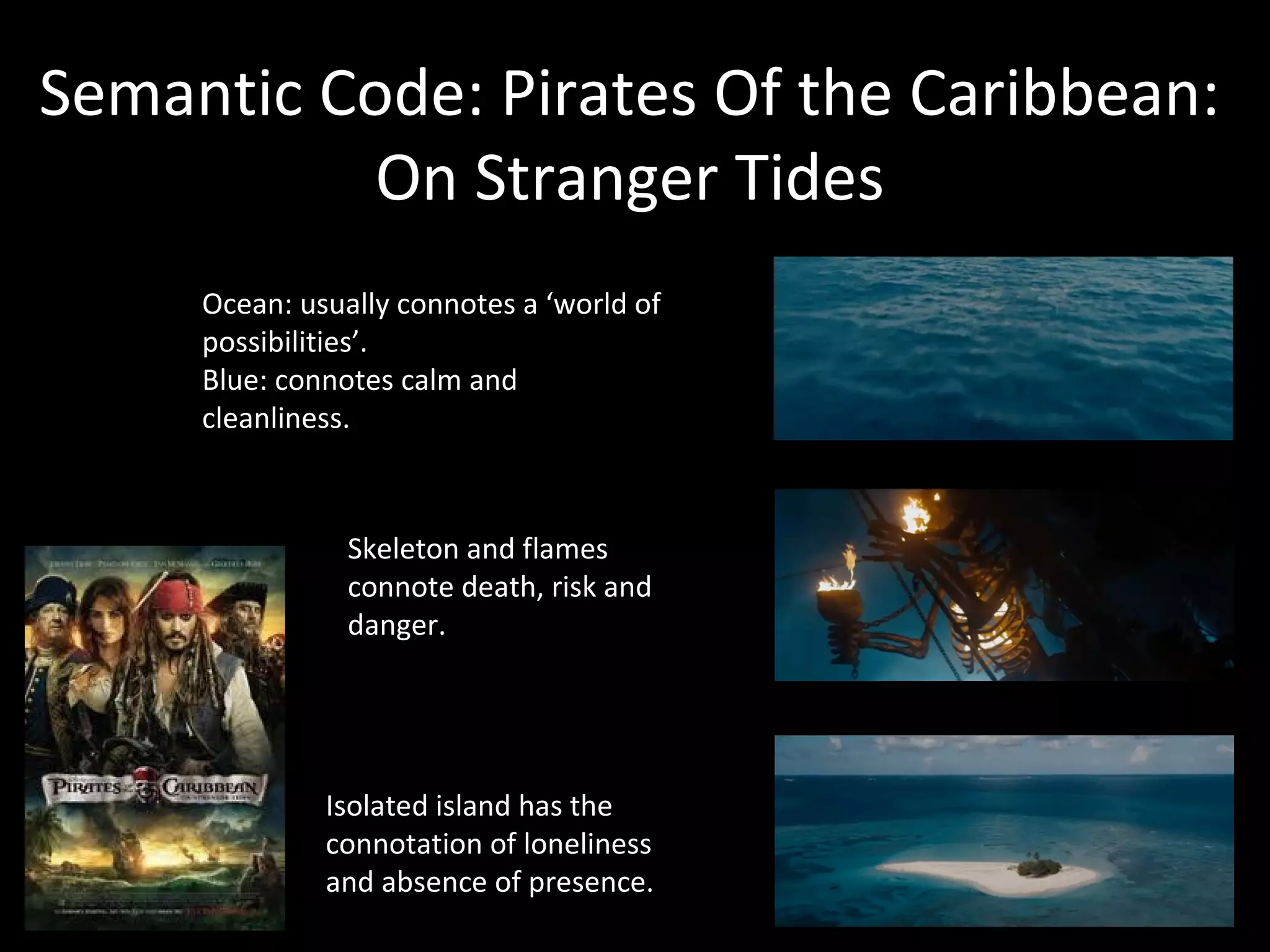
Semantic Code: Pirates Of the Caribbean:
           On Stranger Tides
     Ocean: usually connotes a ‘world of
     possibilities’.
     Blue: connotes calm and
     cleanliness.


                Skeleton and flames
                connote death, risk and
                danger.


              Isolated island has the
              connotation of loneliness
              and absence of presence.
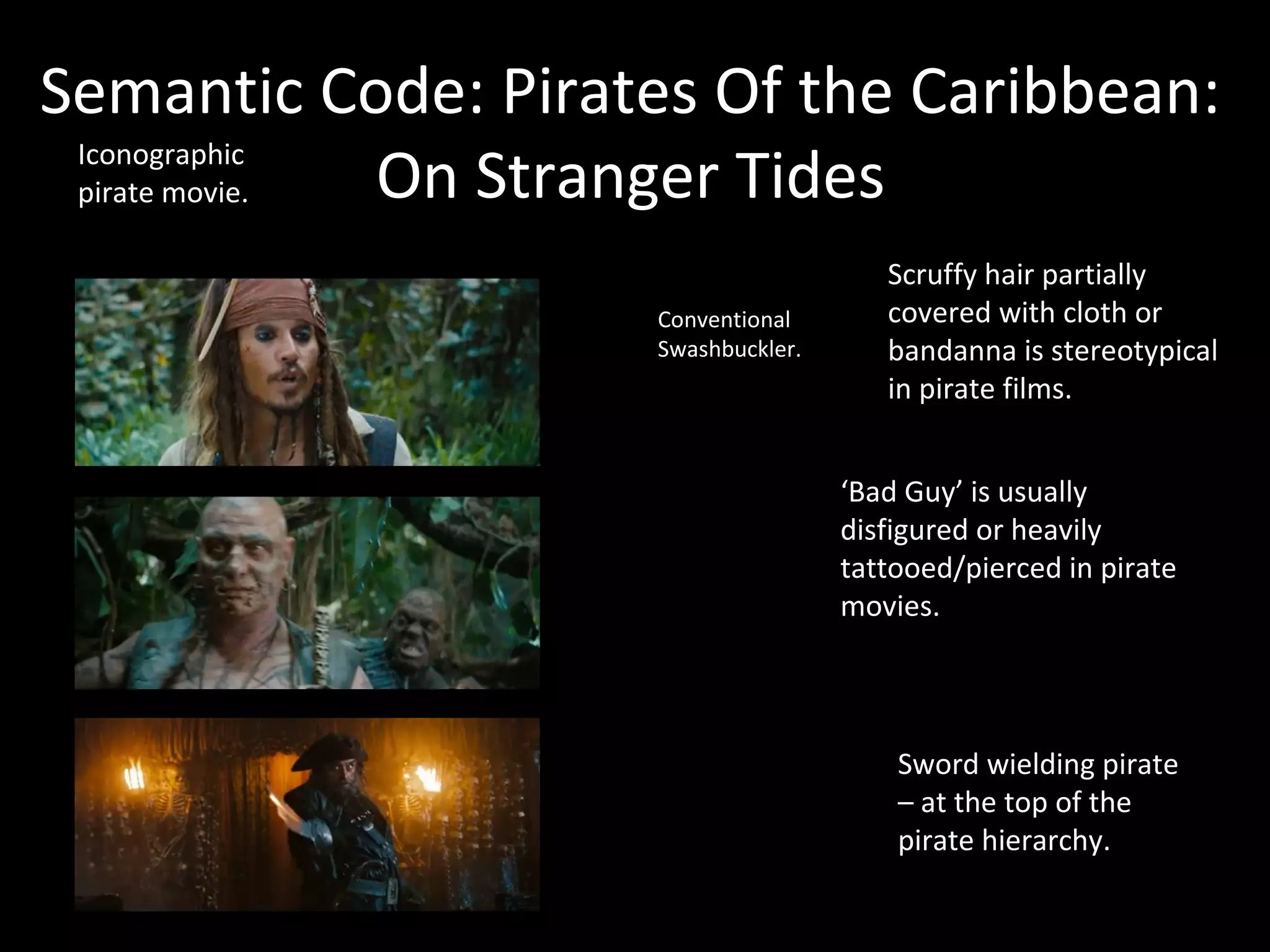
Semantic Code: Pirates Of the Caribbean:
 Iconographic
 pirate movie. On Stranger Tides
                                       Scruffy hair partially
                    Conventional       covered with cloth or
                    Swashbuckler.      bandanna is stereotypical
                                       in pirate films.


                                    ‘Bad Guy’ is usually
                                    disfigured or heavily
                                    tattooed/pierced in pirate
                                    movies.


                                        Sword wielding pirate
                                        – at the top of the
                                        pirate hierarchy.
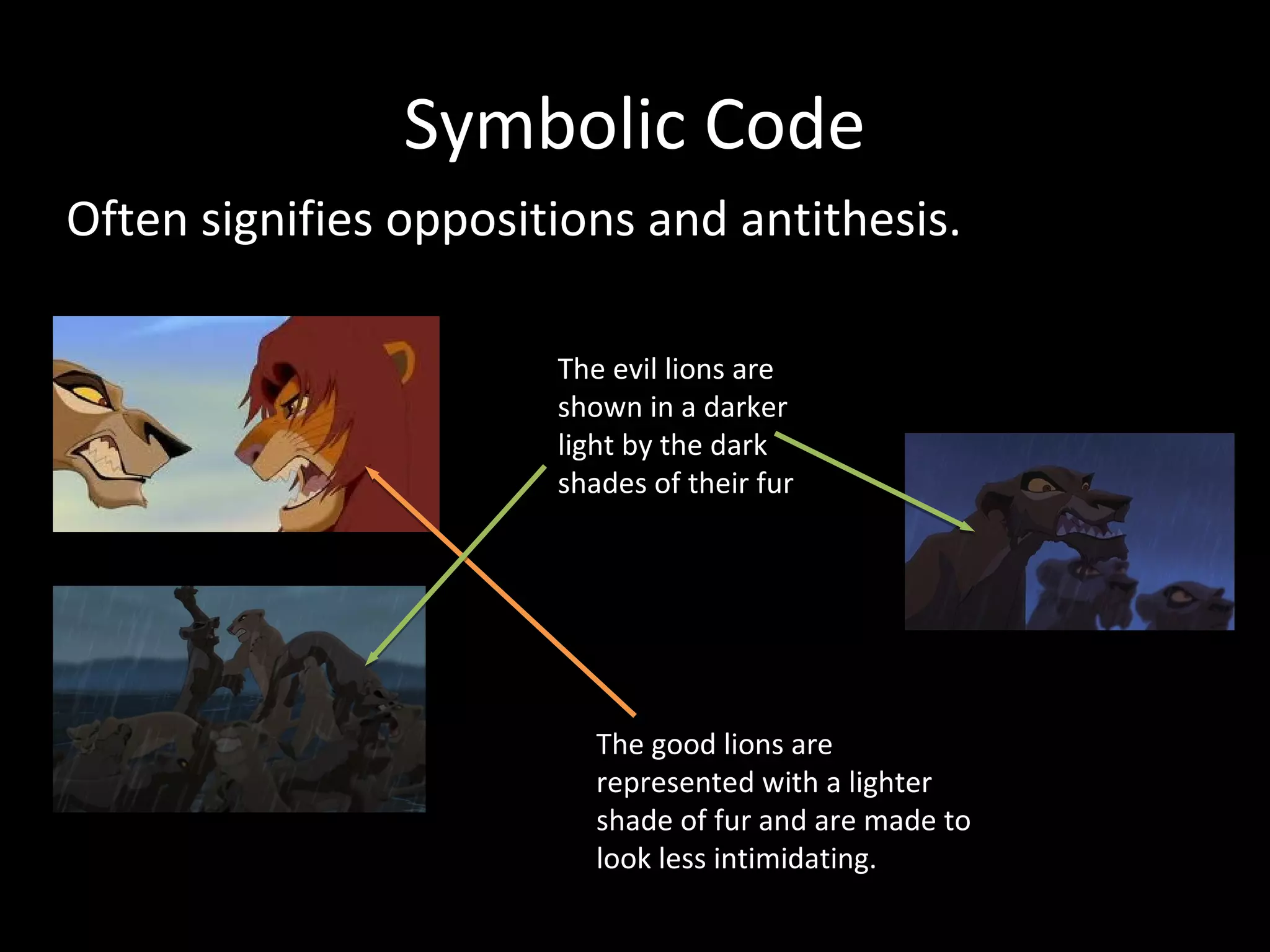
Symbolic Code
Often signifies oppositions and antithesis.

                       The evil lions are
                       shown in a darker
                       light by the dark
                       shades of their fur


                          The good lions are
                          represented with a lighter
                          shade of fur and are made to
                          look less intimidating.
Cultural Code
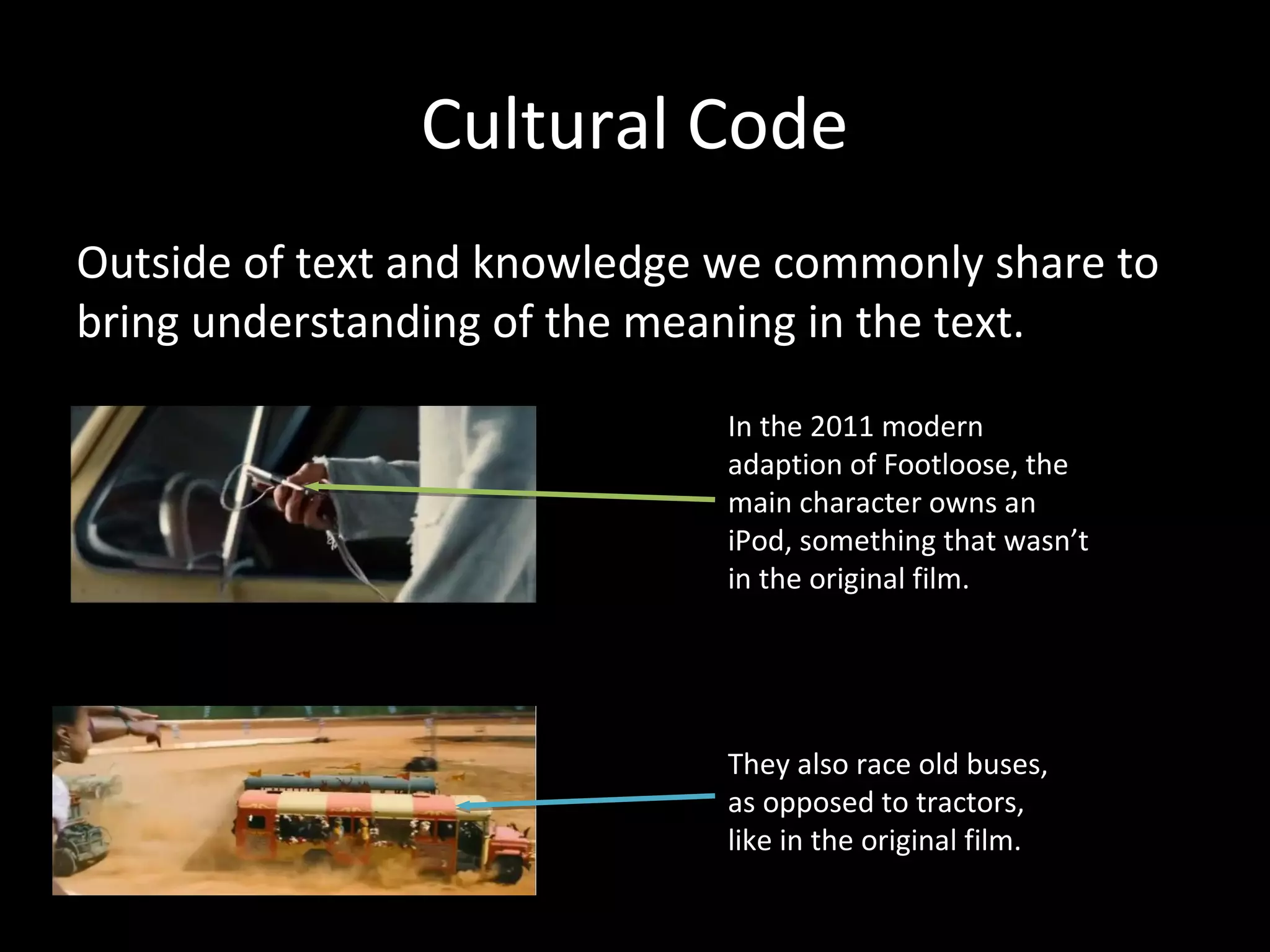
Outside of text and knowledge we commonly share to
bring understanding of the meaning in the text.

                              In the 2011 modern
                              adaption of Footloose, the
                              main character owns an
                              iPod, something that wasn’t
                              in the original film.


                              They also race old buses,
                              as opposed to tractors,
                              like in the original film.
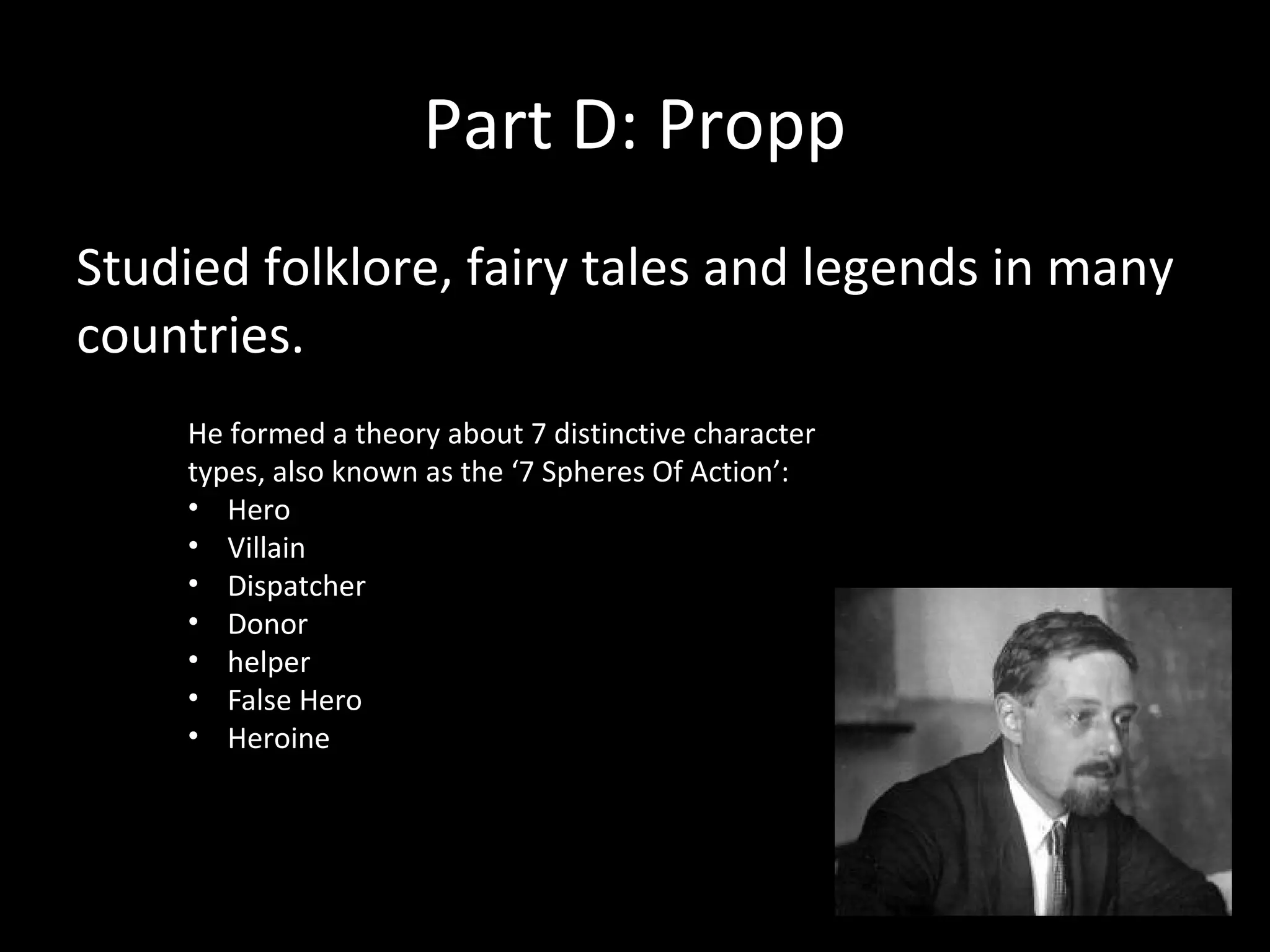
Part D: Propp
Studied folklore, fairy tales and legends in many
countries.
    He formed a theory about 7 distinctive character
    types, also known as the ‘7 Spheres Of Action’:
    • Hero
    • Villain
    • Dispatcher
    • Donor
    • helper
    • False Hero
    • Heroine
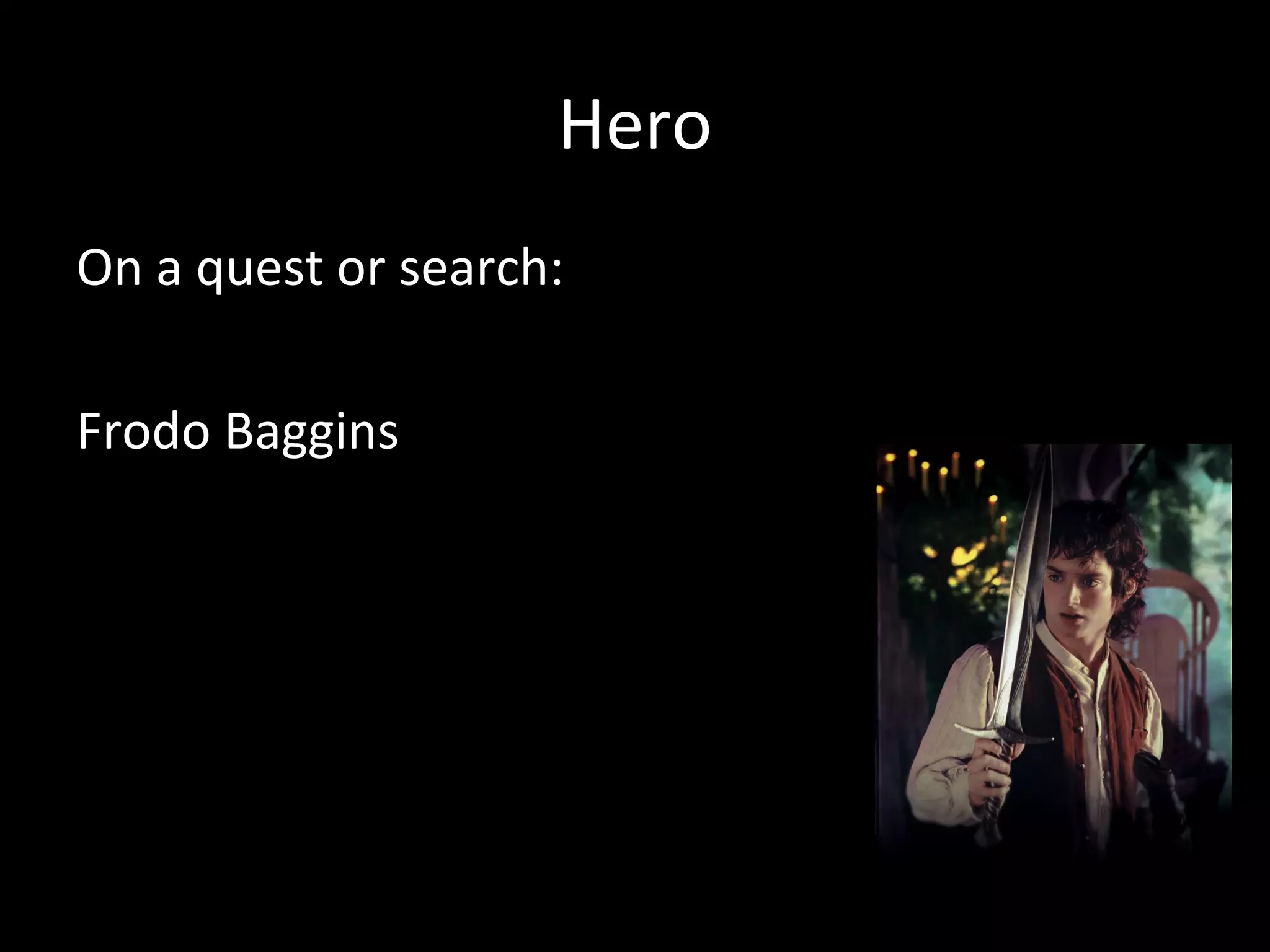
Hero
On a quest or search:

Frodo Baggins
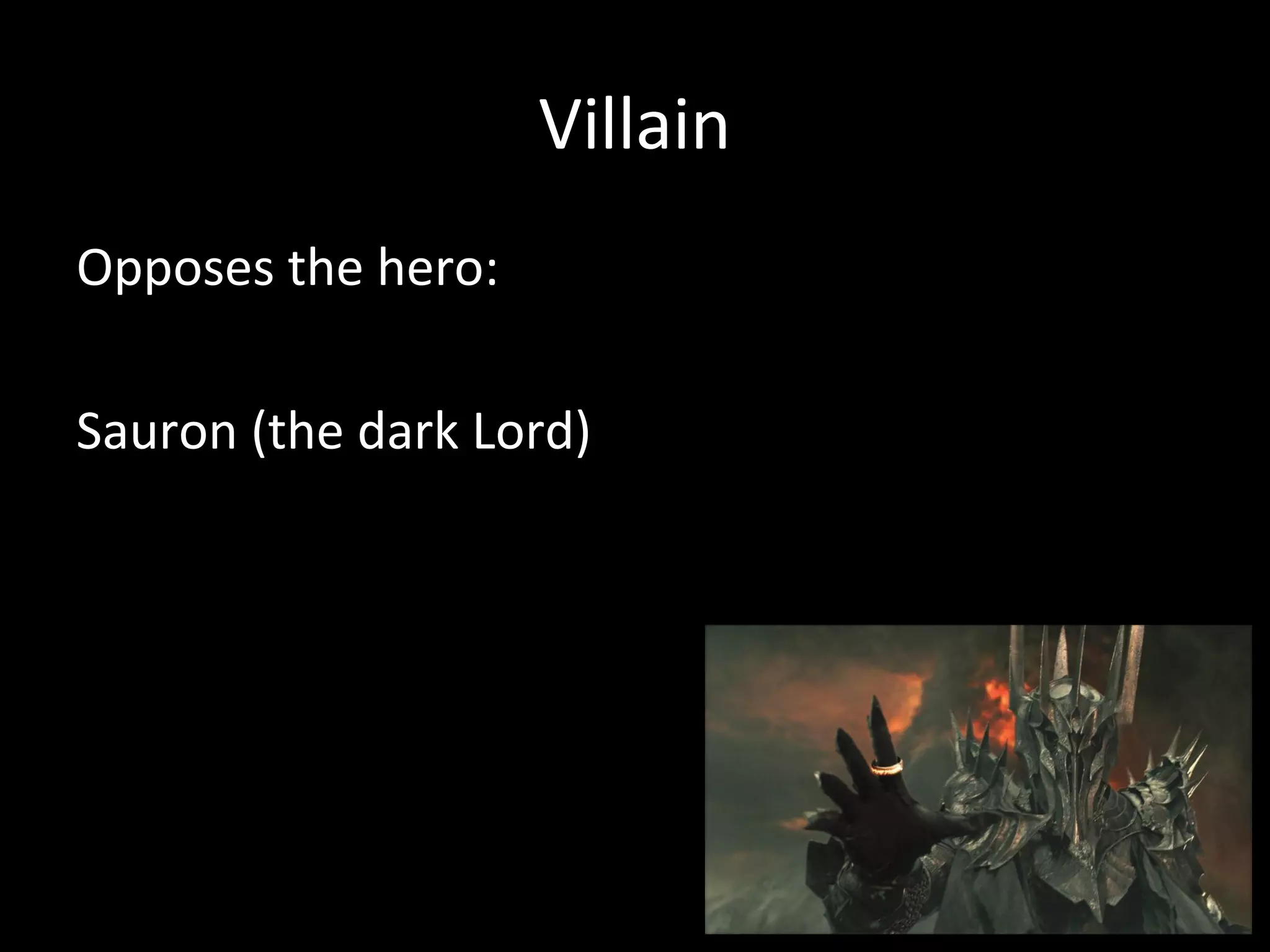
Villain
Opposes the hero:

Sauron (the dark Lord)
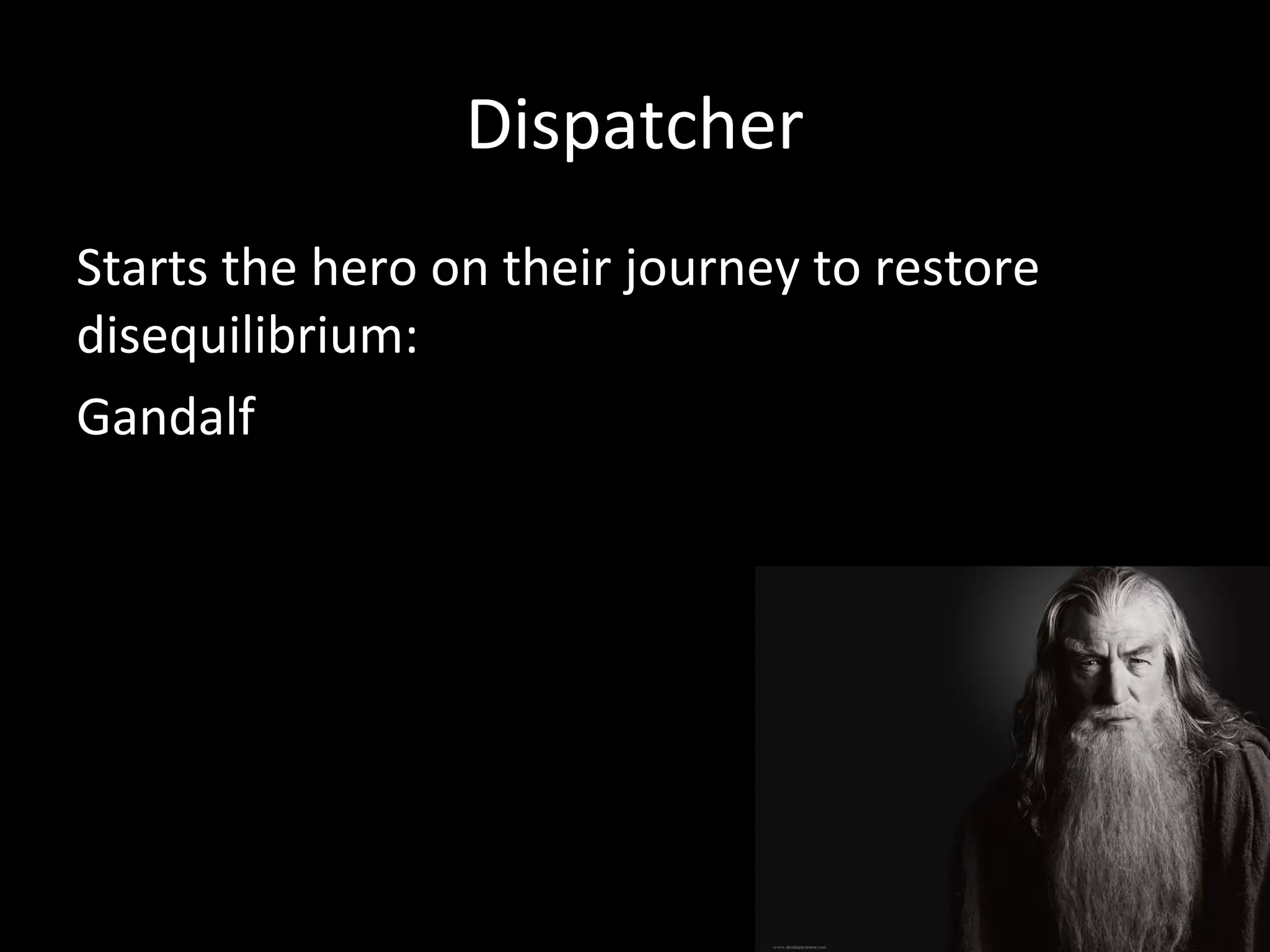
Dispatcher
Starts the hero on their journey to restore
disequilibrium:
Gandalf
Donor
Helps the hero by giving him a ‘magic’ tool or
gift to help on the journey:
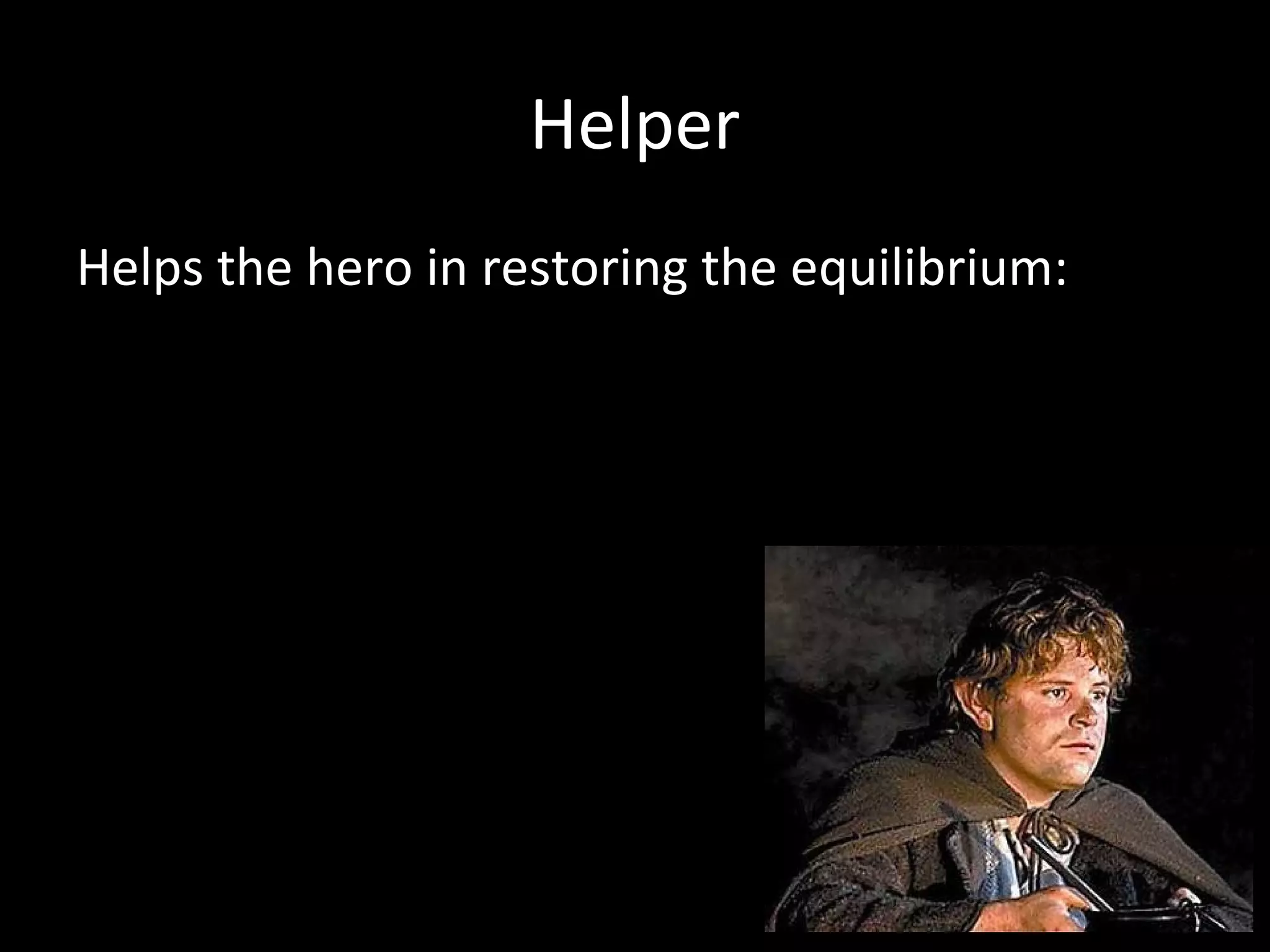
Helper
Helps the hero in restoring the equilibrium:
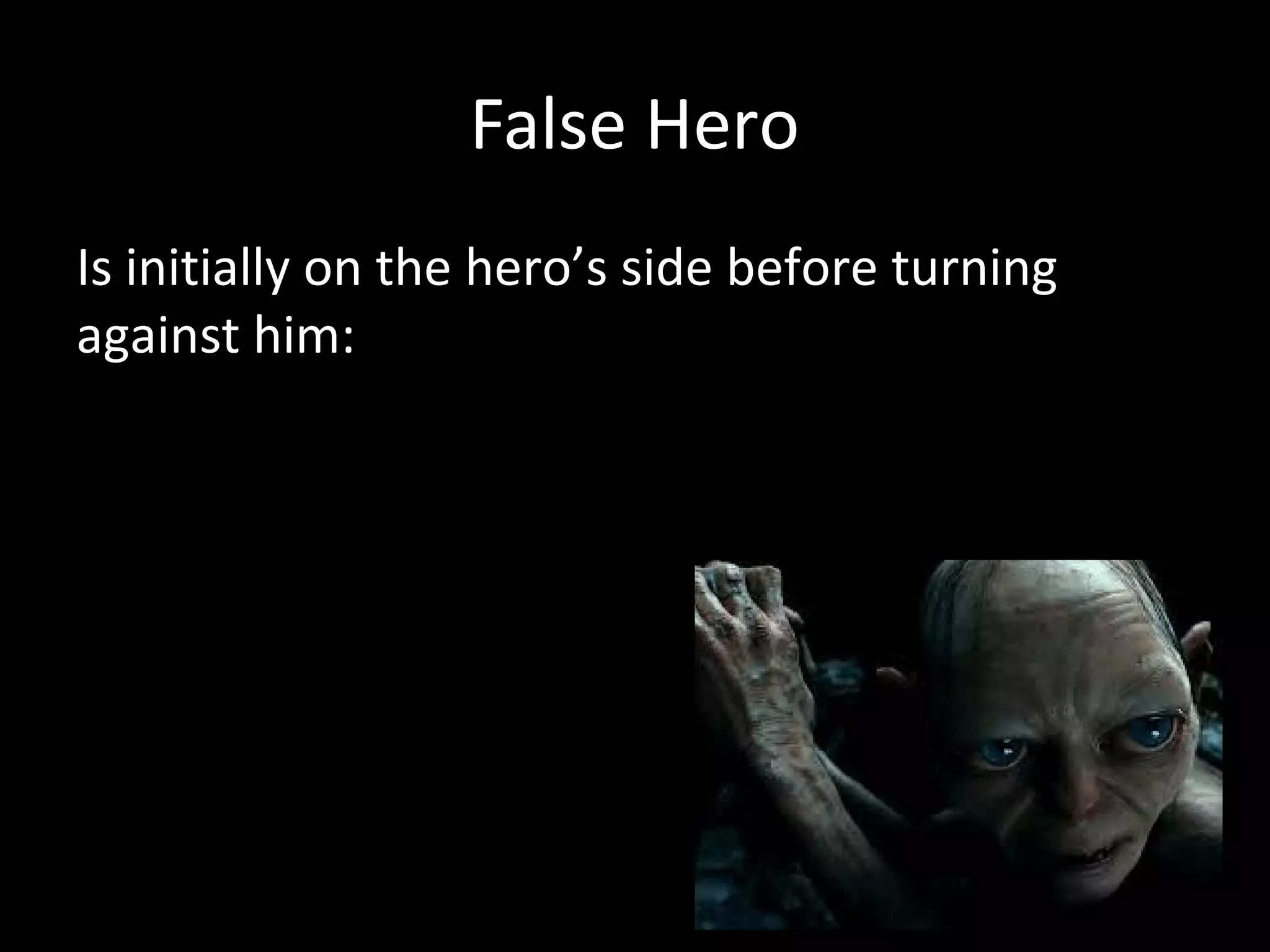
False Hero
Is initially on the hero’s side before turning
against him:
Heroine
Threatened by the villain, needs to be saved by
the hero:
Part E: Other Terms
• Diegesis

• Narrative Range
-   Unrestricted narration
-   Restricted narration
-
• Narrative Depth
-   Objective character identification
-   Subjective character identification
Diegesis
The internal world created by
a story in which the characters
live in, that they themselves
experience and encounter.
                                  We only see a section of this
                                  world within the film.


    The diegetic elements
    make up the diegetic
    world.
Narrative Range
• Unrestricted Narration
-   Narrative that has no limit to the amount of information it gives out.
-   The information given to the audience is unrestricted
-   Eg. News bulletins

 -
• Restricted Narration
-   The narrative only offers minimal information.
-   Hides some information from the audience, sometimes to create an
        enigma.
-   Eg. thrillers
Narrative Depth
• Objective Character Identification
-       The viewer is uniquely given access to a characters point of view.
-       Eg. Seeing things such as a character’s dreams, memories or thoughts.


    • Subjective Character Identification
    -      The viewer is uniquely given access to what a range of characters can see
               or do.
    -      Eg. Can see multiple things and characters.
Chelsea Fashole-Luke
         12J

Assignment 8 narrative theory

  • 1.
    Assignment 8: NarrativeTheory Chelsea Fashole-Luke
  • 2.
    Part A: Todorov’sTheory Suggests there are 5 stages of narrative: 1. Equilibrium 2. Disequilibrium 3. Recognition of disequilibrium 4. Attempt to repair disequilibrium 5. New equilibrium
  • 3.
  • 4.
    Task 2: (To identifyTodorov’s theory in relation to a film) • Normal teenage guy decides to take the law into his own hands after being attacked one too many times. • Teams up with ‘Big Daddy’ and ‘Hit Girl’ to take on the big gang leaders of the city.
  • 5.
    Equilibrium We are shown a normal high school as a wide shot. A normal group of friends. Main character: average teenager A stereotypical class at a school.
  • 6.
    Disequilibrium Gangs and knife/gun crime consumes the city. Innocent victims are robbed Stereotypical street thugs Victims are left unable to do anything about assaults. Defenceless victims
  • 7.
    Recognition of disequilibrium Regular teenager buys a costume in order to tackle the street crime and ‘little’ problems in the city Hero costume: mask included Gangs are seen as the main problems. Victim being beaten up by gang The main character ‘Kick- Ass’ attempts to take on gangs involved in drug crime. Weapons and costume: typical hero props
  • 8.
    Attempt to repairdisequilibrium Younger character ‘Hit Girl’ is skilled in fighting and highly trained in using big weapons. Guns and jetpack The use of superhero disguises and high-tech weapons aid them in the battle between good and bad. Wig and mask to hide identity. Kick-Ass and Hit Girl team up to take on the much bigger gangs who ‘run’ the city.
  • 9.
    New equilibrium New friendship formed after working together to put a stop to the crimes. Another shot of the school, this time everything has changed. Hit Girl –aka- Mindy, starts a new life as a normal girl and goes to school for the first time. Everyone ends up happy at the end.
  • 10.
    Part B: Levi-Strauss Believedthe world is described in binary opposites: • Day/night • Light/dark • Good/bad • Male/female
  • 11.
  • 12.
  • 13.
  • 14.
  • 15.
  • 16.
    Part C: Barthes Barthestheory of codes encourages the audience to seek answers and clues to make them anticipate outcomes. Identified by these codes: • Enigma Code • Action Code • Semantic Code • Symbolic Code • Cultural Code
  • 17.
    Enigma Code • Narrativesare set up as puzzles to be solved by the audience. • Portrays a mystery and raises questions to draw in the audience.
  • 18.
    Enigma Code: ‘Detention’Trailer The trailer shows a mysterious knife wielding character. The same character reappears later in the trailer. The partially hidden face causing the audience to wonder who this killer is. We want to know where this axe came from and who it was thrown by.
  • 19.
    Action Code These arecodes of behaviours and actions that lead the audience to expect certain consequences based on the conventions of other similar films or stories.
  • 20.
    Action Code: TheJourney To The Centre Of The Earth Action: Taking shelter during a storm in a cave. Assumption: They will get trapped inside. Action: Accidently discover a new world. Assumption: Will go on an adventure, make new discoveries and find out more about themselves and each other.
  • 21.
    Semantic Code • Barthessemantic code contains connotative meanings of objects, characters and locations. • We learn about the connotations and denotations through experience. • Iconographic features work in the same way.
  • 22.
    Semantic Code: PiratesOf the Caribbean: On Stranger Tides Ocean: usually connotes a ‘world of possibilities’. Blue: connotes calm and cleanliness. Skeleton and flames connote death, risk and danger. Isolated island has the connotation of loneliness and absence of presence.
  • 23.
    Semantic Code: PiratesOf the Caribbean: Iconographic pirate movie. On Stranger Tides Scruffy hair partially Conventional covered with cloth or Swashbuckler. bandanna is stereotypical in pirate films. ‘Bad Guy’ is usually disfigured or heavily tattooed/pierced in pirate movies. Sword wielding pirate – at the top of the pirate hierarchy.
  • 24.
    Symbolic Code Often signifiesoppositions and antithesis. The evil lions are shown in a darker light by the dark shades of their fur The good lions are represented with a lighter shade of fur and are made to look less intimidating.
  • 25.
    Cultural Code Outside oftext and knowledge we commonly share to bring understanding of the meaning in the text. In the 2011 modern adaption of Footloose, the main character owns an iPod, something that wasn’t in the original film. They also race old buses, as opposed to tractors, like in the original film.
  • 26.
    Part D: Propp Studiedfolklore, fairy tales and legends in many countries. He formed a theory about 7 distinctive character types, also known as the ‘7 Spheres Of Action’: • Hero • Villain • Dispatcher • Donor • helper • False Hero • Heroine
  • 27.
    Hero On a questor search: Frodo Baggins
  • 28.
  • 29.
    Dispatcher Starts the heroon their journey to restore disequilibrium: Gandalf
  • 30.
    Donor Helps the heroby giving him a ‘magic’ tool or gift to help on the journey:
  • 31.
    Helper Helps the heroin restoring the equilibrium:
  • 32.
    False Hero Is initiallyon the hero’s side before turning against him:
  • 33.
    Heroine Threatened by thevillain, needs to be saved by the hero:
  • 34.
    Part E: OtherTerms • Diegesis • Narrative Range - Unrestricted narration - Restricted narration - • Narrative Depth - Objective character identification - Subjective character identification
  • 35.
    Diegesis The internal worldcreated by a story in which the characters live in, that they themselves experience and encounter. We only see a section of this world within the film. The diegetic elements make up the diegetic world.
  • 36.
    Narrative Range • UnrestrictedNarration - Narrative that has no limit to the amount of information it gives out. - The information given to the audience is unrestricted - Eg. News bulletins - • Restricted Narration - The narrative only offers minimal information. - Hides some information from the audience, sometimes to create an enigma. - Eg. thrillers
  • 37.
    Narrative Depth • ObjectiveCharacter Identification - The viewer is uniquely given access to a characters point of view. - Eg. Seeing things such as a character’s dreams, memories or thoughts. • Subjective Character Identification - The viewer is uniquely given access to what a range of characters can see or do. - Eg. Can see multiple things and characters.
  • 38.