Mass Communication & Media
        Literacy 05
Narrative


                  Boy meets girl
       Girl meets boy ... Girl loses boy
Boy meets girl ... Loses girl ... Re-finds girl and
                  finds love etc.
Narrative

Narrative refers to the organisation of   "Story is the irreducible
textual elements into a pattern in        substance of a story (A meets
terms of space, time and perspective.     B, something happens, order
It is the narrative that encourages us    returns), while narrative is the
to read specific parts of the text as     way the story is related (Once
‘events’ which are ordered through        upon a time there was a
time (temporal succession) and which      princess...)" (Key Concepts in
we conceive as the cause of the other     Communication - Fiske et al
events (causation).                       (1983))
Origins and Interest

            Literary theory
            Psychology
            Anthropology
            Film studies


            Roman Jacobson
            Vladimir Propp
            Gerard Genette
            Tzvetan Todorov
            http://www.tictocs.ac.uk
Narrative as Structure: Propp
 Functions of characters                   Narrative units descriptive of
                                             particular action
     Villain, the donor, the               (31 units)
      dispatcher, the hero, the
                                                 The villain appears and (either villain tries to find the
      false hero, the princess, the
                                             
                                                 children/jewels etc; or intended victim encounters the
                                                 villain);
      King                                   
                                             
                                                 The villain gains information about the victim;
                                                 The villain attempts to deceive the victim to take
                                                 possession of victim or victim's belongings (trickery;
     A single character can fulfil more        villain disguised, tries to win confidence of victim);
      than one function (characters are         The victim is fooled by the villain, unwittingly helps the
                                                 enemy;
      more like character masks)                Villain causes harm/injury to family/tribe member (by
                                                 abduction, theft of magical agent, spoiling crops, plunders
                                                 in other forms, causes a disappearance, expels
                                                 someone, casts spell on someone, substitutes child
                                                 etc, commits murder, imprisons/detains
                                                 someone, threatens forced marriage, provides nightly
                                                 torments);
                                                Alternatively, a member of family lacks something or
                                                 desires something (magical potion etc);
                                                Misfortune or lack is made known, (hero is
                                                 dispatched, hears call for help etc/ alternative is that
                                                 victimised hero is sent away, freed from imprisonment);

                                                Proppian Fairytale Generator
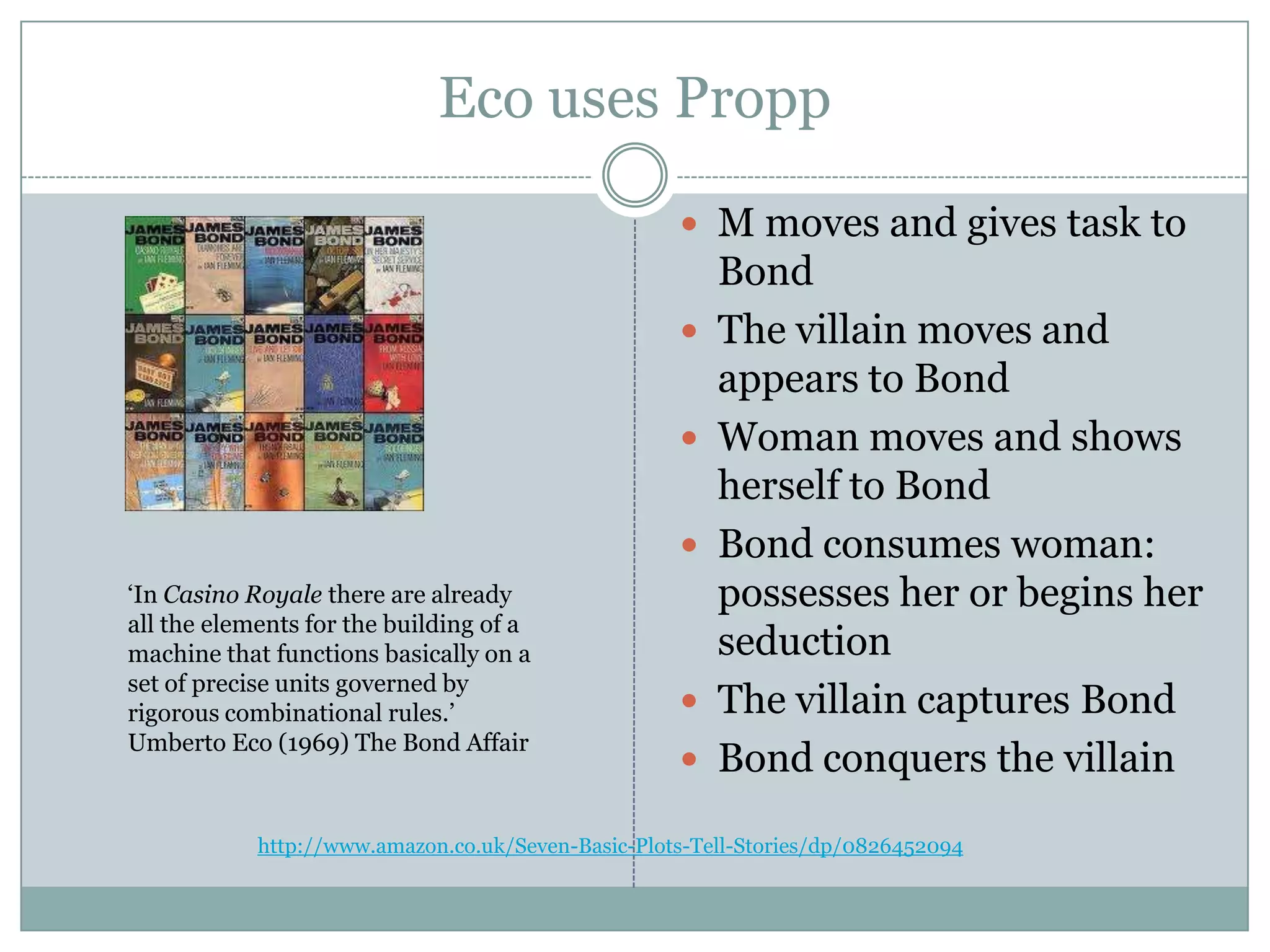
Eco uses Propp

                                                     M moves and gives task to
                                                        Bond
                                                       The villain moves and
                                                        appears to Bond
                                                       Woman moves and shows
                                                        herself to Bond
                                                       Bond consumes woman:
‘In Casino Royale there are already                     possesses her or begins her
all the elements for the building of a
machine that functions basically on a                   seduction
set of precise units governed by
rigorous combinational rules.’                         The villain captures Bond
Umberto Eco (1969) The Bond Affair
                                                       Bond conquers the villain

            http://www.amazon.co.uk/Seven-Basic-Plots-Tell-Stories/dp/0826452094
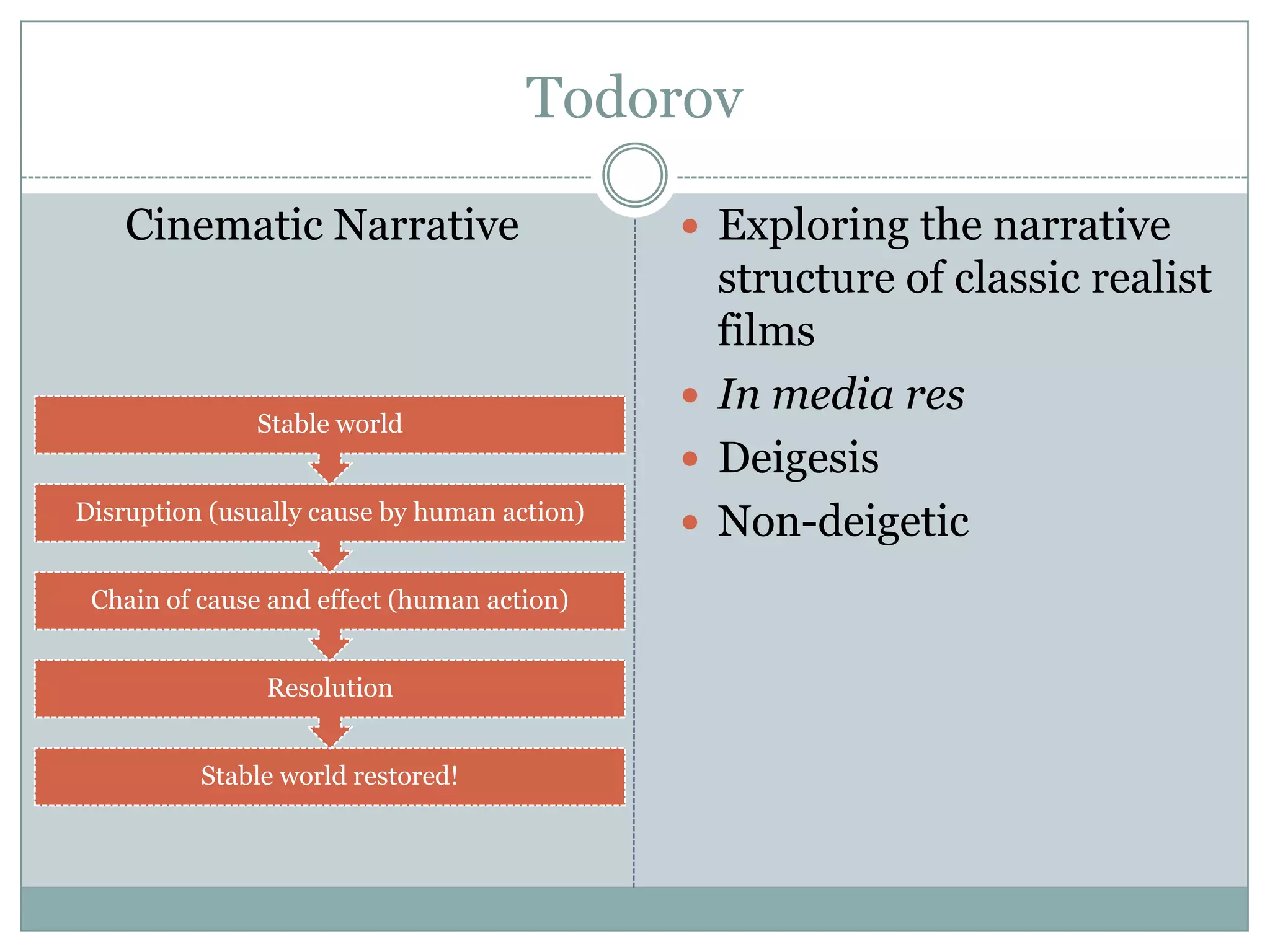
Todorov

    Cinematic Narrative                       Exploring the narrative
                                               structure of classic realist
                                               films
                                              In media res
              Stable world
                                              Deigesis
Disruption (usually cause by human action)
                                              Non-deigetic
 Chain of cause and effect (human action)


               Resolution


          Stable world restored!
Plot and Story

    We construct the story in our heads from information narrated
     to us through the plot

 Fabula (story)                     Syuzhet (plot)
    The fabula is a pattern             The syuzhet is the actual
     that film spectators create          arrangement and
     through assumptions and              presentation of the fabula
     inferences: we do not see            in the film. The syuzhet is
     or hear the fabula on the            a system because it
     screen or hear it in the             arranges elements – the
     soundtrack.                          story events – according
                                          to specific principles.
Narrative

 Narrative logic
    The syuzhet of a film is often far more complex than the fabula that
     we construct as spectators.
 Time
    The organisation of time by the syuzhet can be used to assist or block
     our fabula construction.
      Shouldn’t films have a beginning, middle and end?
      Yes, but not in that order.
      Pulp Fiction, Memento, Lost,
      The Matrix
      Groundhog Day

 Space
    In order to construct our fabula we need a sense of the space in
     which events ocurr.
Memento
Babel
Using the tools

 Rhetorical + Semiotic + syuzhet/fabula help us
 understand how films are constructed and how we
 make meaning from them.


 How does the syuzhet present story information?
 And why does it do so in the way it does?
Using the tools

 What point-of-view (POV) are we presented with?


 Who is telling the story or looking explicitly or
 implicitly?

 What kind of position are we, as consumers of the
 text, being asked to take or being placed in?
Saving Private Ryan
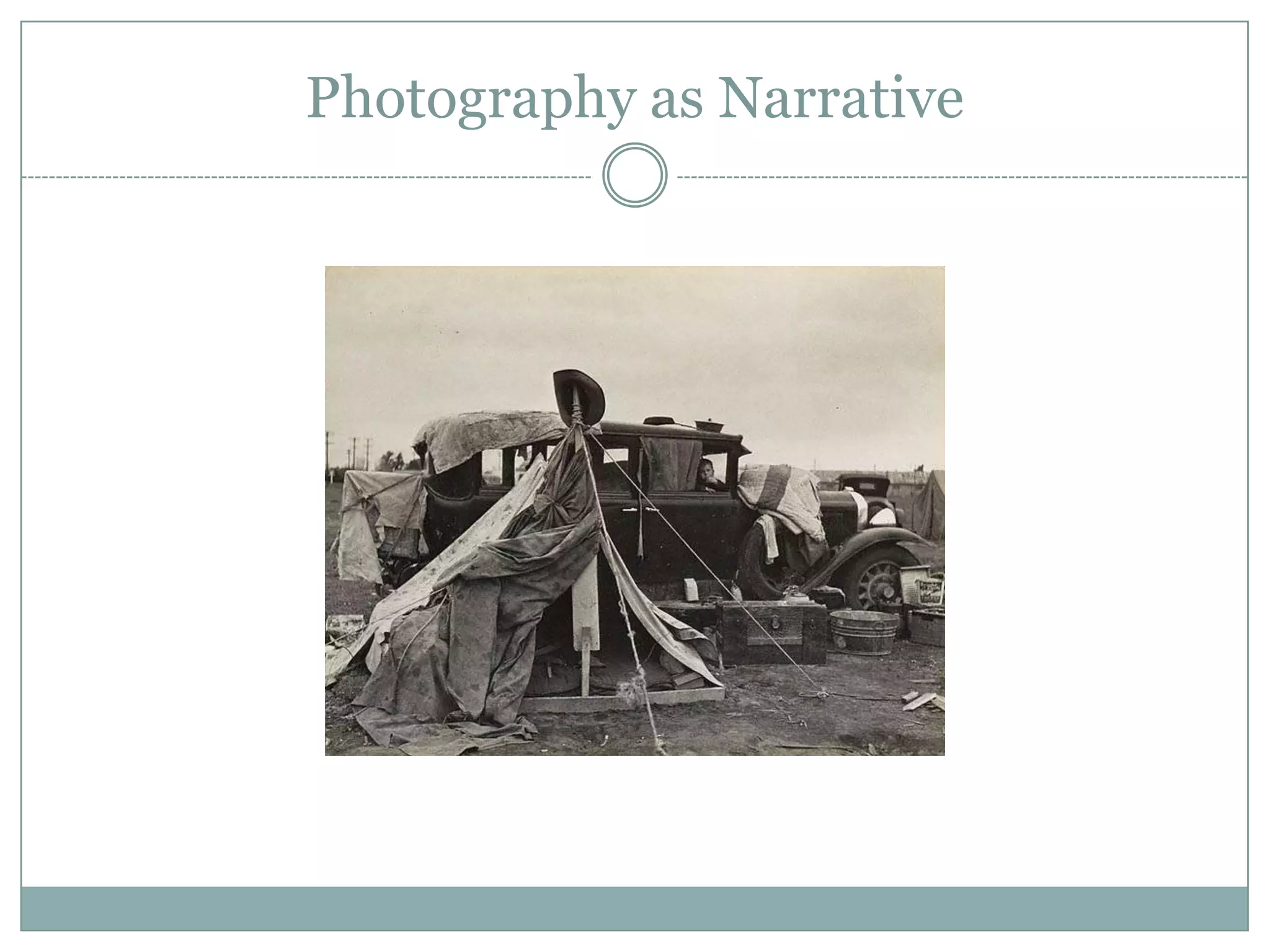
Photography as Narrative

Mass communication & media literacy 05

  • 1.
    Mass Communication &Media Literacy 05
  • 2.
    Narrative Boy meets girl Girl meets boy ... Girl loses boy Boy meets girl ... Loses girl ... Re-finds girl and finds love etc.
  • 3.
    Narrative Narrative refers tothe organisation of "Story is the irreducible textual elements into a pattern in substance of a story (A meets terms of space, time and perspective. B, something happens, order It is the narrative that encourages us returns), while narrative is the to read specific parts of the text as way the story is related (Once ‘events’ which are ordered through upon a time there was a time (temporal succession) and which princess...)" (Key Concepts in we conceive as the cause of the other Communication - Fiske et al events (causation). (1983))
  • 4.
    Origins and Interest  Literary theory  Psychology  Anthropology  Film studies  Roman Jacobson  Vladimir Propp  Gerard Genette  Tzvetan Todorov  http://www.tictocs.ac.uk
  • 5.
    Narrative as Structure:Propp  Functions of characters  Narrative units descriptive of particular action  Villain, the donor, the  (31 units) dispatcher, the hero, the The villain appears and (either villain tries to find the false hero, the princess, the  children/jewels etc; or intended victim encounters the villain); King   The villain gains information about the victim; The villain attempts to deceive the victim to take possession of victim or victim's belongings (trickery;  A single character can fulfil more  villain disguised, tries to win confidence of victim); than one function (characters are  The victim is fooled by the villain, unwittingly helps the enemy; more like character masks)  Villain causes harm/injury to family/tribe member (by abduction, theft of magical agent, spoiling crops, plunders in other forms, causes a disappearance, expels someone, casts spell on someone, substitutes child etc, commits murder, imprisons/detains someone, threatens forced marriage, provides nightly torments);  Alternatively, a member of family lacks something or desires something (magical potion etc);  Misfortune or lack is made known, (hero is dispatched, hears call for help etc/ alternative is that victimised hero is sent away, freed from imprisonment);  Proppian Fairytale Generator
  • 6.
    Eco uses Propp  M moves and gives task to Bond  The villain moves and appears to Bond  Woman moves and shows herself to Bond  Bond consumes woman: ‘In Casino Royale there are already possesses her or begins her all the elements for the building of a machine that functions basically on a seduction set of precise units governed by rigorous combinational rules.’  The villain captures Bond Umberto Eco (1969) The Bond Affair  Bond conquers the villain http://www.amazon.co.uk/Seven-Basic-Plots-Tell-Stories/dp/0826452094
  • 7.
    Todorov Cinematic Narrative  Exploring the narrative structure of classic realist films  In media res Stable world  Deigesis Disruption (usually cause by human action)  Non-deigetic Chain of cause and effect (human action) Resolution Stable world restored!
  • 8.
    Plot and Story  We construct the story in our heads from information narrated to us through the plot  Fabula (story)  Syuzhet (plot)  The fabula is a pattern  The syuzhet is the actual that film spectators create arrangement and through assumptions and presentation of the fabula inferences: we do not see in the film. The syuzhet is or hear the fabula on the a system because it screen or hear it in the arranges elements – the soundtrack. story events – according to specific principles.
  • 9.
    Narrative  Narrative logic  The syuzhet of a film is often far more complex than the fabula that we construct as spectators.  Time  The organisation of time by the syuzhet can be used to assist or block our fabula construction.  Shouldn’t films have a beginning, middle and end?  Yes, but not in that order.  Pulp Fiction, Memento, Lost,  The Matrix  Groundhog Day  Space  In order to construct our fabula we need a sense of the space in which events ocurr.
  • 10.
  • 11.
  • 12.
    Using the tools Rhetorical + Semiotic + syuzhet/fabula help us understand how films are constructed and how we make meaning from them.  How does the syuzhet present story information? And why does it do so in the way it does?
  • 13.
    Using the tools What point-of-view (POV) are we presented with?  Who is telling the story or looking explicitly or implicitly?  What kind of position are we, as consumers of the text, being asked to take or being placed in?
  • 14.
  • 15.
  • 16.