ASSIGNMENT
INTERNATIONAL BANKING
& FOREX MANAGEMENT
BY-ANIKET
MRIGANK
SAHIL
Question:
What is correspondent banking & off shore banking.
What are the advantages and difference between two.
Answer:
CORRESPONDENT BANKING:
 Correspondent banks are those banks in a country that
are set up to provide services for another bank or
financial institution in a foreign country.
 The services provided by a correspondent bank
include money transfers, currency exchange, trade
documentation and business transactions.
Advantages:
 Rapid Movement of Funds:
In this cheques of country banks are cleared and collected without much delay.
Thus there is a rapid movement of funds from one area to the other. This
system facilitates trade and industry.
 Help in Dealing in Securities:
Correspondent city banks help the country banks in the buying and selling of
securities.
 Help in Providing Finance:
Such banks also help the country banks in financing loans and advances by
providing them funds.
 Help in Foreign Exchange Transactions:
They facilitate foreign exchange transactions of their correspondent banks.
 Increase in Mobility of Credit:
They increase the geographical mobility of credit when business is transacted
from one area to the other through these banks.
OFFSHORE BANKING:
 An offshore banking unit (OBU) is a bank shell branch,
located in another international financial center.
 Offshore banking units (OBUs) refer to bank branches
located outside of its home country, and handling
transactions made in foreign currency.
 It can accept deposit from NRIs, foreign banks & OBUs.
 It can sanctioned loan.
 For Example:
A London-based bank with a branch located in Delhi.
Advantages:
 Enjoying the highest service levels
 Having convenient and accessible access to
funds
 So you can access international investment
opportunities
 To benefit from foreign exchange services
 For superior lending and credit facilities
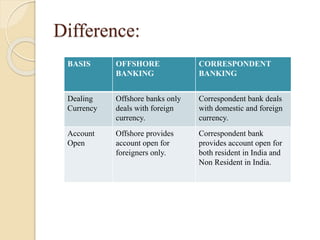
Difference:
BASIS OFFSHORE
BANKING
CORRESPONDENT
BANKING
Dealing
Currency
Offshore banks only
deals with foreign
currency.
Correspondent bank deals
with domestic and foreign
currency.
Account
Open
Offshore provides
account open for
foreigners only.
Correspondent bank
provides account open for
both resident in India and
Non Resident in India.
Assignment

Assignment

  • 1.
    ASSIGNMENT INTERNATIONAL BANKING & FOREXMANAGEMENT BY-ANIKET MRIGANK SAHIL
  • 2.
    Question: What is correspondentbanking & off shore banking. What are the advantages and difference between two. Answer: CORRESPONDENT BANKING:  Correspondent banks are those banks in a country that are set up to provide services for another bank or financial institution in a foreign country.  The services provided by a correspondent bank include money transfers, currency exchange, trade documentation and business transactions.
  • 3.
    Advantages:  Rapid Movementof Funds: In this cheques of country banks are cleared and collected without much delay. Thus there is a rapid movement of funds from one area to the other. This system facilitates trade and industry.  Help in Dealing in Securities: Correspondent city banks help the country banks in the buying and selling of securities.  Help in Providing Finance: Such banks also help the country banks in financing loans and advances by providing them funds.  Help in Foreign Exchange Transactions: They facilitate foreign exchange transactions of their correspondent banks.  Increase in Mobility of Credit: They increase the geographical mobility of credit when business is transacted from one area to the other through these banks.
  • 4.
    OFFSHORE BANKING:  Anoffshore banking unit (OBU) is a bank shell branch, located in another international financial center.  Offshore banking units (OBUs) refer to bank branches located outside of its home country, and handling transactions made in foreign currency.  It can accept deposit from NRIs, foreign banks & OBUs.  It can sanctioned loan.  For Example: A London-based bank with a branch located in Delhi.
  • 5.
    Advantages:  Enjoying thehighest service levels  Having convenient and accessible access to funds  So you can access international investment opportunities  To benefit from foreign exchange services  For superior lending and credit facilities
  • 6.
    Difference: BASIS OFFSHORE BANKING CORRESPONDENT BANKING Dealing Currency Offshore banksonly deals with foreign currency. Correspondent bank deals with domestic and foreign currency. Account Open Offshore provides account open for foreigners only. Correspondent bank provides account open for both resident in India and Non Resident in India.