B Y - A N I K E T
HUMAN RESOURCE
FORECASTING
What is human resource forecasting?
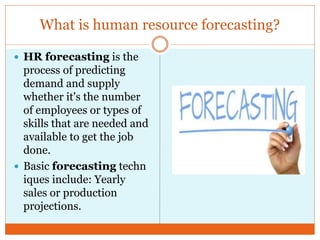
 HR forecasting is the
process of predicting
demand and supply
whether it's the number
of employees or types of
skills that are needed and
available to get the job
done.
 Basic forecasting techn
iques include: Yearly
sales or production
projections.
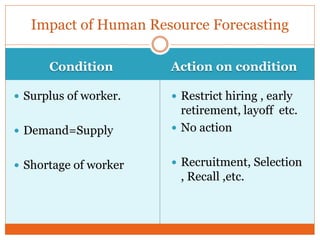
Condition Action on condition
 Surplus of worker.
 Demand=Supply
 Shortage of worker
 Restrict hiring , early
retirement, layoff etc.
 No action
 Recruitment, Selection
, Recall ,etc.
Impact of Human Resource Forecasting
Techniques of Human Resource Forecasting
Demand forecasting
Supply forecasting
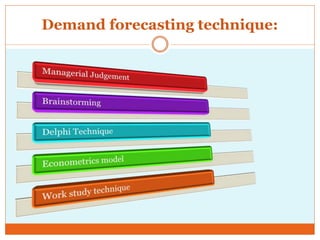
Demand forecasting technique:
Managerial Judgement:
 The managerial judgement technique includes the bottom up
approach and top down approach. In the bottom up approach, line
managers communicate human resource requirements to top
management.
 Applying the information received directly from their line
managers, top management forecasts human resource
requirements. The end result of the bottom up approach is a
demand forecasting process that incorporates input from various
departments.
 In the top down approach of the managerial judgement technique,
top management begins the demand forecasting process. After
their human resource forecasting is completed, top management
sends the forecast to departments for them to analyze and accept.
contd
 A combination of the top down
and bottom up approach is
referred to as the participative
approach. The participative
approach allows department
heads and top management
professionals to forecast
human resource requirements
collectively.
 The participative approach is
generally preferable to the top
down and bottom up
approach.
BRAINSTORMING
 Brainstorming is a popular method for encouraging
creative thinking in groups of about five to eight people
(Ivanceivich, 1998).
 Brainstorming is a group or individual’s creativity
technique by which efforts are made to find a conclusion
for a specific problem by gathering a list of ideas
spontaneously contributed by its member.
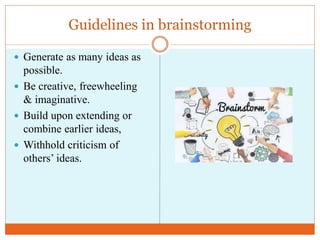
Guidelines in brainstorming
 Generate as many ideas as
possible.
 Be creative, freewheeling
& imaginative.
 Build upon extending or
combine earlier ideas,
 Withhold criticism of
others’ ideas.
DELPHI TECHNIQUE
 Delphi is a structured approach for reaching a consensus
judgment among experts about future developments in
any area that might affect a business, for example, a firm’s
future demand for labor.
 Experts are chosen based on their knowledge of internal
factors that might affect a business (e.g., projected
retirement), their knowledge of the general business plans
of the organization, knowledge of the external factors that
might affect demand for the firm’s product and service
and hence its internal demand for labor.
contd
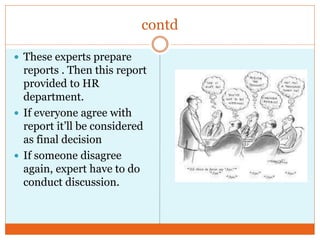
 These experts prepare
reports . Then this report
provided to HR
department.
 If everyone agree with
report it’ll be considered
as final decision
 If someone disagree
again, expert have to do
conduct discussion.
Econometrics Models
 The econometrics model analyzes the
relationship of an dependent variable
with an independent variable. An
example of an dependent variable are
human resources and an example of an
independent variable are sales.
 Statistical and mathematical techniques
used throughout the econometrics
model allows human resource
management professionals to estimate
future demand with significant
accuracy.
Work study technique
 Commonly referred to as
workload analysis, the work
study technique predicts
comprehensive activities and
production for a specified
future time period. The end
result of the work study
technique is an estimation of
the work hours required per
unit produced.
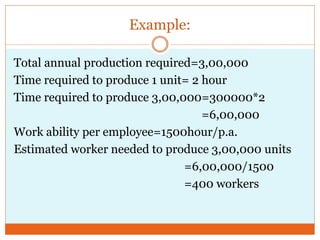
Example:
Total annual production required=3,00,000
Time required to produce 1 unit= 2 hour
Time required to produce 3,00,000=300000*2
=6,00,000
Work ability per employee=1500hour/p.a.
Estimated worker needed to produce 3,00,000 units
=6,00,000/1500
=400 workers
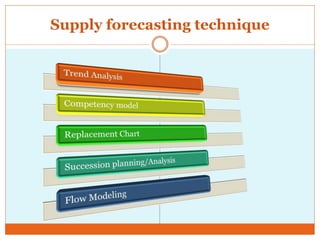
Supply forecasting technique
contd
 TREND ANALYSIS:
Examining the trends of the past, identify pattern & predict the
future .
For ex: Work from home etc.
 COMPETENCY MODEL:
Competencies are the knowledge , skills & attitude(KSA) required for
successful performance. Competency model is a future oriented model
that focus on matching the right skills or competencies needed for each
job with the skills available with the organization.
 REPLACEMENT CHART:
A chart used to estimate vacancies in higher level job and identify
how potential HR supply can fill . These vacancies via internal
movements from lower level jobs.
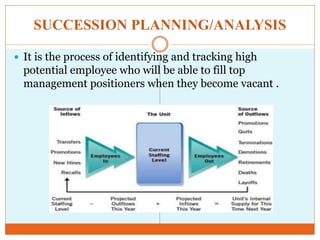
SUCCESSION PLANNING/ANALYSIS
 It is the process of identifying and tracking high
potential employee who will be able to fill top
management positioners when they become vacant .
MARKOV ANALYSIS/FLOW ANALYSIS
 A transition matrix, or Markov matrix, can be used to
model the internal flow of human resources. These
matrices simply show as probabilities the average rate of
historical movement from one job to another.
 The technique is named after Russian
mathematician Andrei Andreyevich Markov,
Hrm

Hrm

  • 1.
    B Y -A N I K E T HUMAN RESOURCE FORECASTING
  • 2.
    What is humanresource forecasting?  HR forecasting is the process of predicting demand and supply whether it's the number of employees or types of skills that are needed and available to get the job done.  Basic forecasting techn iques include: Yearly sales or production projections.
  • 3.
    Condition Action oncondition  Surplus of worker.  Demand=Supply  Shortage of worker  Restrict hiring , early retirement, layoff etc.  No action  Recruitment, Selection , Recall ,etc. Impact of Human Resource Forecasting
  • 4.
    Techniques of HumanResource Forecasting Demand forecasting Supply forecasting
  • 5.
  • 6.
    Managerial Judgement:  Themanagerial judgement technique includes the bottom up approach and top down approach. In the bottom up approach, line managers communicate human resource requirements to top management.  Applying the information received directly from their line managers, top management forecasts human resource requirements. The end result of the bottom up approach is a demand forecasting process that incorporates input from various departments.  In the top down approach of the managerial judgement technique, top management begins the demand forecasting process. After their human resource forecasting is completed, top management sends the forecast to departments for them to analyze and accept.
  • 7.
    contd  A combinationof the top down and bottom up approach is referred to as the participative approach. The participative approach allows department heads and top management professionals to forecast human resource requirements collectively.  The participative approach is generally preferable to the top down and bottom up approach.
  • 8.
    BRAINSTORMING  Brainstorming isa popular method for encouraging creative thinking in groups of about five to eight people (Ivanceivich, 1998).  Brainstorming is a group or individual’s creativity technique by which efforts are made to find a conclusion for a specific problem by gathering a list of ideas spontaneously contributed by its member.
  • 9.
    Guidelines in brainstorming Generate as many ideas as possible.  Be creative, freewheeling & imaginative.  Build upon extending or combine earlier ideas,  Withhold criticism of others’ ideas.
  • 10.
    DELPHI TECHNIQUE  Delphiis a structured approach for reaching a consensus judgment among experts about future developments in any area that might affect a business, for example, a firm’s future demand for labor.  Experts are chosen based on their knowledge of internal factors that might affect a business (e.g., projected retirement), their knowledge of the general business plans of the organization, knowledge of the external factors that might affect demand for the firm’s product and service and hence its internal demand for labor.
  • 11.
    contd  These expertsprepare reports . Then this report provided to HR department.  If everyone agree with report it’ll be considered as final decision  If someone disagree again, expert have to do conduct discussion.
  • 12.
    Econometrics Models  Theeconometrics model analyzes the relationship of an dependent variable with an independent variable. An example of an dependent variable are human resources and an example of an independent variable are sales.  Statistical and mathematical techniques used throughout the econometrics model allows human resource management professionals to estimate future demand with significant accuracy.
  • 13.
    Work study technique Commonly referred to as workload analysis, the work study technique predicts comprehensive activities and production for a specified future time period. The end result of the work study technique is an estimation of the work hours required per unit produced.
  • 14.
    Example: Total annual productionrequired=3,00,000 Time required to produce 1 unit= 2 hour Time required to produce 3,00,000=300000*2 =6,00,000 Work ability per employee=1500hour/p.a. Estimated worker needed to produce 3,00,000 units =6,00,000/1500 =400 workers
  • 15.
  • 16.
    contd  TREND ANALYSIS: Examiningthe trends of the past, identify pattern & predict the future . For ex: Work from home etc.  COMPETENCY MODEL: Competencies are the knowledge , skills & attitude(KSA) required for successful performance. Competency model is a future oriented model that focus on matching the right skills or competencies needed for each job with the skills available with the organization.  REPLACEMENT CHART: A chart used to estimate vacancies in higher level job and identify how potential HR supply can fill . These vacancies via internal movements from lower level jobs.
  • 17.
    SUCCESSION PLANNING/ANALYSIS  Itis the process of identifying and tracking high potential employee who will be able to fill top management positioners when they become vacant .
  • 18.
    MARKOV ANALYSIS/FLOW ANALYSIS A transition matrix, or Markov matrix, can be used to model the internal flow of human resources. These matrices simply show as probabilities the average rate of historical movement from one job to another.  The technique is named after Russian mathematician Andrei Andreyevich Markov,