By
Marisha Inoke
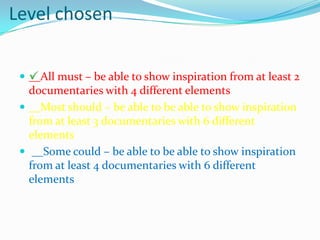
Level chosen
 __All must – be able to show inspiration from at least 2
documentaries with 4 different elements
 __Most should – be able to be able to show inspiration
from at least 3 documentaries with 6 different
elements
 __Some could – be able to be able to show inspiration
from at least 4 documentaries with 6 different
elements
PART 1: Purpose
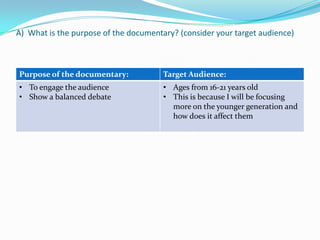
A) What is the purpose of the documentary? (consider your target audience)
Purpose of the documentary: Target Audience:
• To engage the audience
• Show a balanced debate
• Ages from 16-21 years old
• This is because I will be focusing
more on the younger generation and
how does it affect them
B) What would people learn about this topic from your documentary?
(consider your target audience)
 My target Audience (16-21 year olds) will learn that the only
cure to HIV & Aids is by raising awareness which will
reduce stigma towards the disease.
 They will learn that HIV & Aids can happen to anyone and
it doesn’t matter who you are.
 Tolerant towards people infected with HIV/Aids.
PART 2: Inspiration
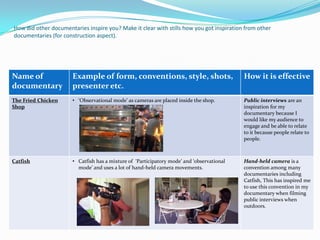
How did other documentaries inspire you? Make it clear with stills how you got inspiration from other
documentaries (for construction aspect).
Name of
documentary
Example of form, conventions, style, shots,
presenter etc.
How it is effective
The Fried Chicken
Shop
• ‘Observational mode’ as cameras are placed inside the shop. Public interviews are an
inspiration for my
documentary because I
would like my audience to
engage and be able to relate
to it because people relate to
people.
Catfish • Catfish has a mixture of ‘Participatory mode’ and ‘observational
mode’ and uses a lot of hand-held camera movements.
Hand-held camera is a
convention among many
documentaries including
Catfish, This has inspired me
to use this convention in my
documentary when filming
public interviews when
outdoors.
Part 3: Mode
Mode
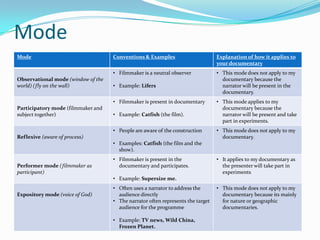
Mode Conventions & Examples Explanation of how it applies to
your documentary
Observational mode (window of the
world) (fly on the wall)
• Filmmaker is a neutral observer
• Example: Lifers
• This mode does not apply to my
documentary because the
narrator will be present in the
documentary.
Participatory mode (filmmaker and
subject together)
• Filmmaker is present in documentary
• Example: Catfish (the film).
• This mode applies to my
documentary because the
narrator will be present and take
part in experiments.
Reflexive (aware of process)
• People are aware of the construction
• Examples: Catfish (the film and the
show).
• This mode does not apply to my
documentary.
Performer mode (filmmaker as
participant)
• Filmmaker is present in the
documentary and participates.
• Example: Supersize me.
• It applies to my documentary as
the presenter will take part in
experiments
Expository mode (voice of God)
• Often uses a narrator to address the
audience directly
• The narrator often represents the target
audience for the programme
• Example: TV news, Wild China,
Frozen Planet.
• This mode does not apply to my
documentary because its mainly
for nature or geographic
documentaries.

Assignment 10

  • 1.
  • 2.
    Level chosen  __Allmust – be able to show inspiration from at least 2 documentaries with 4 different elements  __Most should – be able to be able to show inspiration from at least 3 documentaries with 6 different elements  __Some could – be able to be able to show inspiration from at least 4 documentaries with 6 different elements
  • 3.
  • 4.
    A) What isthe purpose of the documentary? (consider your target audience) Purpose of the documentary: Target Audience: • To engage the audience • Show a balanced debate • Ages from 16-21 years old • This is because I will be focusing more on the younger generation and how does it affect them
  • 5.
    B) What wouldpeople learn about this topic from your documentary? (consider your target audience)  My target Audience (16-21 year olds) will learn that the only cure to HIV & Aids is by raising awareness which will reduce stigma towards the disease.  They will learn that HIV & Aids can happen to anyone and it doesn’t matter who you are.  Tolerant towards people infected with HIV/Aids.
  • 6.
  • 7.
    How did otherdocumentaries inspire you? Make it clear with stills how you got inspiration from other documentaries (for construction aspect). Name of documentary Example of form, conventions, style, shots, presenter etc. How it is effective The Fried Chicken Shop • ‘Observational mode’ as cameras are placed inside the shop. Public interviews are an inspiration for my documentary because I would like my audience to engage and be able to relate to it because people relate to people. Catfish • Catfish has a mixture of ‘Participatory mode’ and ‘observational mode’ and uses a lot of hand-held camera movements. Hand-held camera is a convention among many documentaries including Catfish, This has inspired me to use this convention in my documentary when filming public interviews when outdoors.
  • 8.
  • 9.
    Mode Mode Conventions &Examples Explanation of how it applies to your documentary Observational mode (window of the world) (fly on the wall) • Filmmaker is a neutral observer • Example: Lifers • This mode does not apply to my documentary because the narrator will be present in the documentary. Participatory mode (filmmaker and subject together) • Filmmaker is present in documentary • Example: Catfish (the film). • This mode applies to my documentary because the narrator will be present and take part in experiments. Reflexive (aware of process) • People are aware of the construction • Examples: Catfish (the film and the show). • This mode does not apply to my documentary. Performer mode (filmmaker as participant) • Filmmaker is present in the documentary and participates. • Example: Supersize me. • It applies to my documentary as the presenter will take part in experiments Expository mode (voice of God) • Often uses a narrator to address the audience directly • The narrator often represents the target audience for the programme • Example: TV news, Wild China, Frozen Planet. • This mode does not apply to my documentary because its mainly for nature or geographic documentaries.