The History of Educational
       Technology

        Samanta Prieto
         Noelia Dolenc
What is it?
 Educational technology is the application of
technology in education.
 Nowadays, educators tend to think of
educational or instructional technology as
equipment (i.e. electronic equipment).

          …but before getting into detail, let’s
          have a look at a brief version of the
             educational technology’s history.
Back to roots…

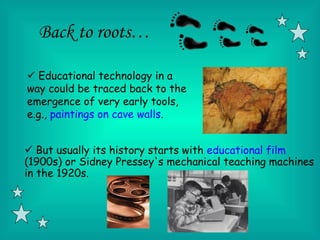
 Educational technology in a
way could be traced back to the
emergence of very early tools,
e.g., paintings on cave walls.


 But usually its history starts with educational film
(1900s) or Sidney Pressey's mechanical teaching machines
in the 1920s.
 The first administrative organizations in
 schools to manage instructional media were
school museums. The first school museum was
  established in St. Louis, Missouri, in 1905.

          Its purpose was to collect and loan:
         • portable museum exhibits,
         • films,
         • photographs,
         • charts,
         • stereographic slides, etc.
First decade of 20th:
                             Silent films were being produced for
instructional use.

                            Despite efforts, films never
reached the level of influence in schools due to:

                              teachers' lack of skill in using
equipment.
                               the cost of films, equipment
                              inaccessibility of equipment
when it was needed.
                               time involved in finding the
right film for each class.
Ring, Ring.   Knock, Knock.   Buaaa, Sniff…


In 1910,
more than 1,000
titles of films could be
rented by schools.
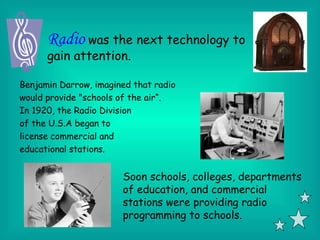
Radio was the next technology to
      gain attention.

Benjamin Darrow, imagined that radio
would provide "schools of the air“.
In 1920, the Radio Division
of the U.S.A began to
license commercial and
educational stations.


                       Soon schools, colleges, departments
                       of education, and commercial
                       stations were providing radio
                       programming to schools.
During the World War II (1945):
                                      - overhead projectors
                                    - slide projectors
                                    - audio equipment
 Were used by the military and then by schools in the decades
 to follow.


Instructional television was the focus during the 1950s and
      the 1960s.  Rapid development of educational television
                   stations
                     The aim was to provide instructional
                    programs to school system in their viewing
                    area.
                      A lot of money was invested by The Ford
                     Foundation .
Around 1950s and the 1960s:

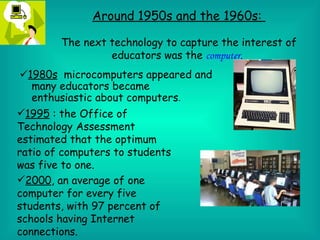
       The next technology to capture the interest of
                educators was the computer.
 1980s microcomputers appeared and
   many educators became
   enthusiastic about computers.
1995 : the Office of
Technology Assessment
estimated that the optimum
ratio of computers to students
was five to one.
2000, an average of one
computer for every five
students, with 97 percent of
schools having Internet
connections.
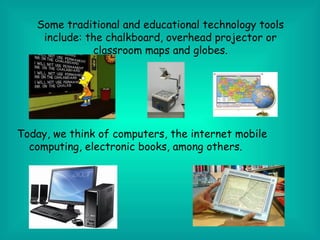
Some traditional and educational technology tools
    include: the chalkboard, overhead projector or
              classroom maps and globes.


Today, we think of computers, the internet mobile
  computing, electronic books, among others.
What can I do with it?

    Educational technology is more than just tools.
   Teachers can design, deliver, facilitate and manage
       instruction for global learners of all ages.


 With these tools and techniques you can improve and
              enhance student’s learning.
Bibliography…
 “School Technology in Education” [online].
   http://www.answers.com/topic/school-technology-in-education

 What is Educational Technology? — Presentation Transcript
   http://www.slideshare.net/joh5700/what-is-educational-technology

 What is educational technology by By M.D. Roblyer|A. H. Doering
   http://www.education.com/reference/article/what-educational-technology/

 Youtube: http://www.youtube.com/watch?v=gGY2cwWC8Ag
 Wikipedia, Educational Technology
   http://en.wikipedia.org/wiki/Educational_technology

Assignment 1 ict

  • 1.
    The History ofEducational Technology Samanta Prieto Noelia Dolenc
  • 2.
    What is it? Educational technology is the application of technology in education.  Nowadays, educators tend to think of educational or instructional technology as equipment (i.e. electronic equipment). …but before getting into detail, let’s have a look at a brief version of the educational technology’s history.
  • 3.
    Back to roots… Educational technology in a way could be traced back to the emergence of very early tools, e.g., paintings on cave walls.  But usually its history starts with educational film (1900s) or Sidney Pressey's mechanical teaching machines in the 1920s.
  • 4.
     The firstadministrative organizations in schools to manage instructional media were school museums. The first school museum was established in St. Louis, Missouri, in 1905.  Its purpose was to collect and loan: • portable museum exhibits, • films, • photographs, • charts, • stereographic slides, etc.
  • 5.
    First decade of20th: Silent films were being produced for instructional use. Despite efforts, films never reached the level of influence in schools due to: teachers' lack of skill in using equipment.  the cost of films, equipment inaccessibility of equipment when it was needed.  time involved in finding the right film for each class.
  • 6.
    Ring, Ring. Knock, Knock. Buaaa, Sniff… In 1910, more than 1,000 titles of films could be rented by schools.
  • 7.
    Radio was thenext technology to gain attention. Benjamin Darrow, imagined that radio would provide "schools of the air“. In 1920, the Radio Division of the U.S.A began to license commercial and educational stations. Soon schools, colleges, departments of education, and commercial stations were providing radio programming to schools.
  • 8.
    During the WorldWar II (1945): - overhead projectors - slide projectors - audio equipment Were used by the military and then by schools in the decades to follow. Instructional television was the focus during the 1950s and the 1960s.  Rapid development of educational television stations  The aim was to provide instructional programs to school system in their viewing area.  A lot of money was invested by The Ford Foundation .
  • 9.
    Around 1950s andthe 1960s: The next technology to capture the interest of educators was the computer. 1980s microcomputers appeared and many educators became enthusiastic about computers. 1995 : the Office of Technology Assessment estimated that the optimum ratio of computers to students was five to one. 2000, an average of one computer for every five students, with 97 percent of schools having Internet connections.
  • 10.
    Some traditional andeducational technology tools include: the chalkboard, overhead projector or classroom maps and globes. Today, we think of computers, the internet mobile computing, electronic books, among others.
  • 11.
    What can Ido with it? Educational technology is more than just tools. Teachers can design, deliver, facilitate and manage instruction for global learners of all ages.  With these tools and techniques you can improve and enhance student’s learning.
  • 12.
    Bibliography…  “School Technologyin Education” [online]. http://www.answers.com/topic/school-technology-in-education  What is Educational Technology? — Presentation Transcript http://www.slideshare.net/joh5700/what-is-educational-technology  What is educational technology by By M.D. Roblyer|A. H. Doering http://www.education.com/reference/article/what-educational-technology/  Youtube: http://www.youtube.com/watch?v=gGY2cwWC8Ag  Wikipedia, Educational Technology http://en.wikipedia.org/wiki/Educational_technology